


Mastering the Geometry of Light:
No-Move TV Glare Reduction
TV glare reduction usually has less to do with buying new gear and more to do with fixing one stubborn beam of light ricocheting into the screen. When a dark scene turns your TV into a polished black pond, the irritation isn’t the room, it’s the setup.
“This is a geometry problem, not a renovation project. By teaching the light to behave, you can make the picture calmer, clearer, and easier on your eyes without shifting the TV an inch.”
We solve this through dark-scene testing and one-variable changes. Let’s start with the reflection you can actually see.
Table of Contents
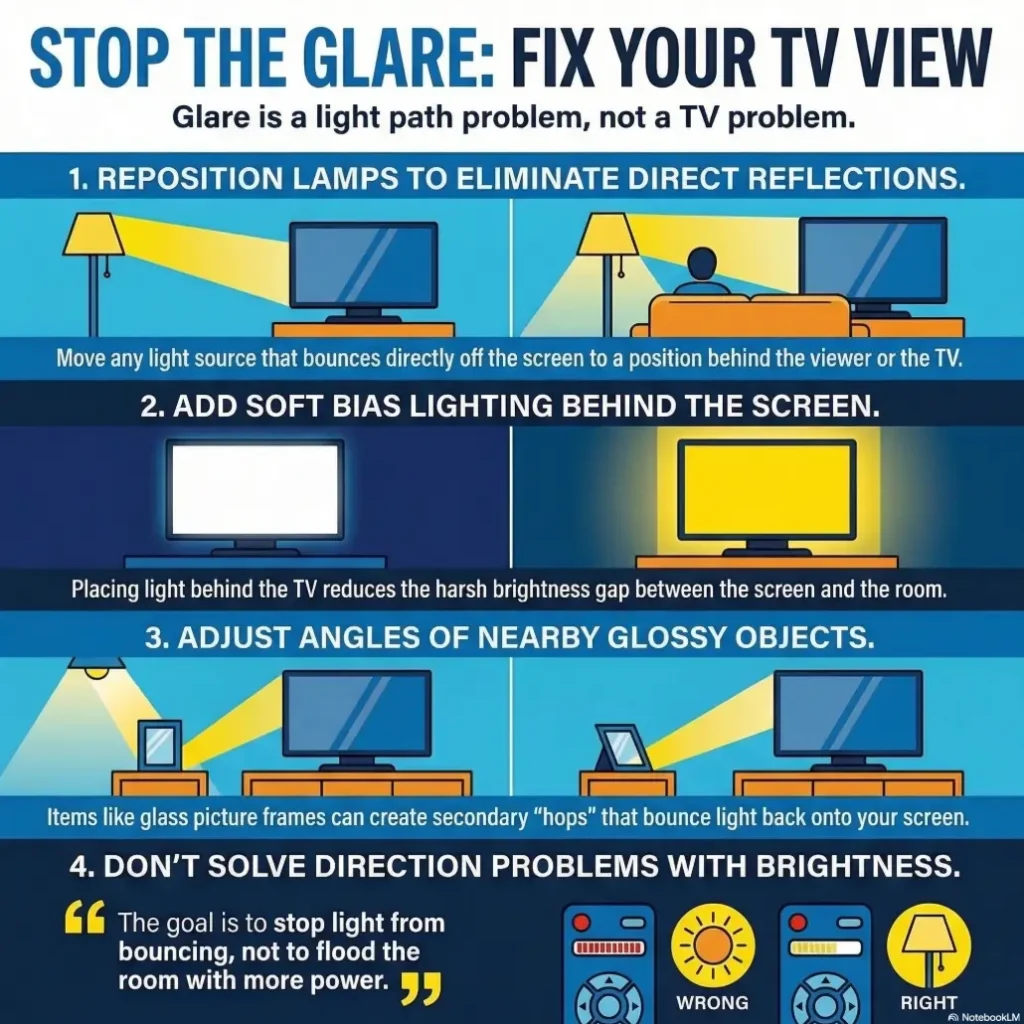
Start With the Reflection: What You Need to Reduce Is Not “Brightness” but Direct Reflection
The first mental shift is almost embarrassingly useful: your enemy is usually not “too much light.” It is the wrong light hitting the screen at the wrong angle. People often treat glare like weather, as if the room has become vaguely too bright and everyone must now live like cave monks. But most TV glare is geometry wearing a houseplant-colored cardigan.
The real cause of TV glare is not just light in the room, but light bouncing back at the screen from the wrong angle
A glossy or semi-gloss TV panel reflects what it sees. That means a lamp with an exposed bulb, a shiny overhead can, or even a bright hallway behind you can create a precise reflection path. The American Academy of Ophthalmology notes that when a screen is much brighter than its surroundings, your eyes work harder, and it also recommends dimming nearby lighting to reduce strain. Mayo Clinic guidance on eyestrain similarly emphasizes reducing glare and managing surrounding light rather than simply enduring it. If screen comfort is already a recurring battle in your home, the same principle shows up in everyday device use too, especially when learning how to make a screen dimmer than the usual minimum brightness.
The same lamp can create a completely different glare pattern depending on its height and position
I learned this in a rental where a floor lamp moved only 18 inches, yet the screen changed from “lighthouse on the sea” to “pleasantly watchable.” Height matters because the TV is not just a rectangle. It is a reflective plane. A bulb near the height of your eyes or the center of the screen often causes the most obvious hot spot. Raise it, lower it, move it back, or let it bounce off a wall instead, and the reflection path changes like a sentence after one missing comma is restored.
Why many glare problems can be improved without moving the TV at all
People assume the TV must move because the reflection appears fixed. In reality, the screen is only half the equation. If your furniture layout is locked, you still control lamp direction, shade style, bulb exposure, wall bounce, and the light level behind the TV. That is a lot of leverage for a problem that feels, at first glance, like a piece of fate.
- Reflections come from angle, height, and bulb exposure
- One lamp can cause most of the annoyance
- You can often fix glare without relocating the TV
Apply in 60 seconds: Turn the TV off, stand where you normally sit, and identify the brightest reflected object on the screen.
- Yes if your glare appears mostly at night
- Yes if you can see a lamp, ceiling light, or doorway reflected on the panel
- Yes if the room feels harsher when the TV is bright and the walls are dark
- Maybe not if midday sunlight is hitting the screen directly for hours
- Maybe not if the panel itself appears damaged or uneven even in darkness
Neutral next step: Test nighttime lighting first before spending money on accessories.
Before You Buy Anything: Why the Lamp Is Often the First Suspect
There is a quiet little tragedy in home tech: people buy a solution before isolating the culprit. That is how you end up with a premium LED strip, a stronger TV backlight, and the exact same reflection from the exact same lamp. The lamp is often the first suspect because it is both powerful and domestically invisible. We stop noticing it. The screen does not.
How floor lamps beside the TV often create the most predictable reflection path
A floor lamp near the screen is a classic offender because it sits in the same visual zone as the display. Even if it feels “off to the side,” the panel may still catch it. A drum shade helps only so much if the bulb is bright and the lamp is within that reflection corridor. I once had a tidy arc lamp that looked like a magazine spread and behaved like an interrogation room.
Why table lamps that feel cozy can still be bad news for the screen
Table lamps are sneaky. They are lower, warmer, and aesthetically innocent. But a lamp on a console below or beside the TV can still reflect on darker scenes, especially if the shade is translucent or the bulb is visible from your seated position. Cozy is not the same thing as screen-friendly. A croissant is cozy too. You would not hang one over the panel.
When overhead lighting is the real culprit, direction matters more than the bulb itself
Overhead lights get blamed for being “too bright,” but direction often matters more than raw brightness. A recessed light aimed toward the viewing zone can create a harsh reflection, while a diffused ceiling fixture or bounced light from elsewhere may be far less annoying. If your room has dimmable cans, test angle and selective use before assuming all overhead light is forbidden.
In practical eyestrain guidance, both the American Academy of Ophthalmology and Mayo Clinic focus on matching screen brightness to surroundings and reducing glare from nearby lighting. That is one reason the first move should be lamp triage, not blind escalation. The logic echoes other reflection-heavy spaces too, including the way bathroom mirror glare becomes a placement and angle problem long before it becomes a shopping problem.
Move it first if you can clearly see the lamp reflected on dark scenes.
Dim it second if the reflection is broad and soft but still distracting.
Replace the shade or bulb style if the glow is harsh, exposed, or visible from your seat.
Neutral next step: Change one variable at a time so you can tell what actually worked.
Lamp Placement That Helps, Not Hurts: Better Positions for Better Viewing
This is where the room begins to behave. You do not need perfect symmetry or a custom media wall. You need better light paths. The best lamp placement usually feels almost anticlimactic because the fix is simple, and simplicity is not photogenic enough for the internet.
Placing lamps behind or slightly behind the viewer usually works better than placing them near the screen
A lamp behind the seating area often works better because it lights the room without projecting a direct reflection into the panel. Not always, but often. The goal is ambient illumination that supports comfort without creating a bright object on the TV. If you can move a lamp behind your sofa or slightly behind your chair line, the screen often looks instantly calmer.
Lamp height should be judged against both eye level and the center of the TV
Most people think only in floor-plan terms. Left. Right. Near. Far. But vertical placement matters just as much. A bulb around seated eye level or lined up with the center of the TV is especially likely to show up in reflections. Raising a lamp can help if the shade truly diffuses light upward and away. Lowering it can help if it tucks the bright area below the screen’s reflective zone. There is no virtue in guessing. Test it while a dark movie scene is paused.
Why diffused shades usually work better than open bulbs or exposed shades
Diffused shades soften the light source. Open bulbs are little knives. Even if both emit similar total light, the exposed bulb creates a much sharper reflected point. In one bedroom setup, simply changing from a clear-bulb accent lamp to a closed-fabric shade reduced the visible reflection more than lowering the bulb wattage ever had.
Let’s be honest… not every stylish lamp is TV-friendly
Some lamps are decorators. Some are accomplices. Sputnik-style bulbs, shiny metal reflectors, clear glass shades, and bare filament bulbs may look wonderful in a static room photo and act terribly once the TV turns black between scenes. A living room is not a catalog spread. It is a place where people want to watch a show without making peace with a floating orb in the villain’s forehead.
Show me the nerdy details
Reflections become more noticeable when the reflected source is small and bright relative to the screen image. That is why a diffused shade often feels better than an exposed bulb even if the overall room brightness is similar. Softer sources spread luminance and reduce the “mirror point” effect on glossy surfaces.
- Move lamps behind the viewer when possible
- Check lamp height against eye level and screen center
- Choose diffused shades over exposed bulbs
Apply in 60 seconds: Pause a dark scene and move your nearest lamp one body-width away from the screen zone.
Ask three quick questions:
- Is the lamp within about one TV-width of the screen?
- Can you see the bulb or bright shade core from your seat?
- Does the lamp sit near your seated eye level or the center of the screen?
If you answered yes to two or more, that lamp is a prime glare suspect.
Neutral next step: Reposition that one lamp before changing bulbs across the whole room.
Bias Lighting Done Right: Behind-the-TV Light Should Feel Balanced, Not Bright
Bias lighting is one of those rare home-tech ideas that sounds fussier than it is. Done properly, it is not a neon halo. It is a soft glow behind the TV that reduces the brutal contrast between a bright screen and a dark room. Your eyes stop performing tiny acts of panic every time the scene flips from moonlit hallway to white snowfield.
Bias lighting works by reducing harsh contrast between the bright screen and the darker room
The American Academy of Ophthalmology explains that when your screen is much brighter than the surrounding environment, your eyes have to work harder. A soft rear glow helps narrow that gap. This does not magically remove reflections the way better lamp placement does, but it can reduce visual fatigue and make the whole setup feel more balanced. For readers already managing broader screen discomfort, some of the same visual-fatigue patterns show up in discussions of digital eye strain in older adults.
The wall behind the TV should glow softly, not compete with the picture
If the bias light becomes the second main attraction in the room, it has failed the assignment. You want a calm aura on the wall, not a spaceship trying to leave orbit. The most common beginner error is choosing a strip that is too bright or running it at full power because “more must be better.” No. More is just more. The useful version is subtle.
LED strips usually look more natural when mounted along the rear outer edge of the TV
Rear outer edge placement tends to work well because it distributes the light around the back perimeter and lets the wall do the softening. If the strip is too close to the inner center or visible from the front, the effect becomes patchy or distracting. In one setup, I mounted the strip too close to a side edge, then spent an evening wondering why one corner of the room looked like it was hosting a tiny nightclub.
Why 6500K gets recommended so often, and what to do if it feels too cold in a real living room
The 6500K recommendation did not appear from nowhere. It is tied to the D65 white point used in professional video and reference-display practice. SMPTE’s standards work on reference viewing environments is part of why 6500K remains the default recommendation in serious display conversations. In plain English, it is a neutral reference. That said, your everyday living room is not a grading suite. If 6500K feels too clinical, prioritize a dim, stable, neutral-looking light over a dramatically brighter strip in the “perfect” color temperature. The point is support, not holiness. Readers comparing warmer ambient options may also find it useful to think through 2700K vs 3000K for glare-sensitive eyes before chasing the coldest-looking setup.
- Your TV size and whether it is wall-mounted or on a stand
- Wall color behind the TV: white, gray, beige, or dark accent
- Whether the strip will be visible from side angles
- Whether you prefer remote dimming or plug-and-forget simplicity
- Whether your main goal is comfort, color accuracy, or both
Neutral next step: Match the kit to your wall and setup, not just the marketing photo.
The Hidden Trap: When Added Lighting Makes Glare Worse Instead of Better
Here is the twist that catches people off guard: adding light can absolutely make glare worse. The problem is not that bias lighting is fake or that lamps are evil. It is that direction beats intention. A well-meant light placed badly is still a badly placed light.
If you raise room brightness without changing light direction, reflections can become sharper
If the new light source still points toward the screen or increases the brightness of a reflective surface in front of the TV, the result may be a cleaner, harsher reflection. This is why “just brighten the room a bit” is incomplete advice. The screen does not care about your good intentions. It cares about incoming light.
If bias lighting leaks around the screen edges, it can distract more than it helps
Light leakage from visible strip segments or poorly placed edges creates a glowing border that keeps reminding you the hardware exists. That is the opposite of what you want. Good bias lighting disappears into comfort. Bad bias lighting behaves like stage makeup in daylight.
Too many small light sources can make the room feel visually noisy instead of comfortable
One lamp near the sofa. One accent light on a shelf. One candle-warmer thing. One strip under the console. One tiny uplight behind the plant. Each one alone feels harmless. Together they can turn the room into a committee. When the eye is asked to negotiate too many brightness points, comfort drops even if the room looks “designed.”
I once added two extra accent lights thinking I was making the room more balanced. Instead, dark scenes looked as if they were being watched through the memory of a jewelry store. That was the evening I learned the difference between ambiance and visual clutter.
Show me the nerdy details
Glare gets more noticeable when the contrast between a reflected source and the screen image is high. Multiple localized light sources increase the chance that at least one source lands inside the screen’s reflection angle. That is why fewer, softer, better-positioned lights often outperform a larger number of decorative ones.
Who This Is For / Not For
This is for
- US households where the TV position is fixed or hard to change
- People dealing with reflections from lamps, overhead lights, or open-plan room layouts
- Apartment renters and homeowners who want a practical fix without rearranging furniture
- Evening viewers who want to reduce both glare and eye fatigue
This is not for
- Rooms with strong direct sunlight hitting the screen during the day
- Situations where the issue may be panel damage or a TV hardware problem
- Readers who can easily solve the issue with curtains, blinds, or a new TV position
- Viewers trying to build a near-dark home theater setup rather than a comfortable everyday room
This matters because not every room has the same villain. Daytime sun glare is a different species from nighttime lamp glare. If bright daylight is hitting the screen, window treatment or repositioning may still be the real answer. But if your trouble begins after sunset, lamp placement and bias lighting are usually the sharpest tools in the drawer. For daytime trouble, the more relevant fix may look less like lamp choreography and more like window-film strategies for glare control.
Don’t Do This First: Common First Moves That Backfire
When people get irritated, they reach for the fastest lever. Unfortunately, the fastest lever is often the wrong one.
Turning off every lamp may reduce glare but still leave you with uncomfortable contrast and eye strain
A black room with a bright TV can reduce one type of reflection while creating another kind of discomfort. The American Academy of Ophthalmology specifically notes that screens much brighter than their surroundings can strain the eyes more. So yes, going full cave may solve the mirror problem and create a comfort problem.
Cranking up TV brightness can make the picture harsher without actually fixing reflections
This is the home-viewing version of shouting louder in an echoey room. You are not improving the environment. You are escalating against it. Brighter screens may overpower some mild reflections, but they also intensify contrast stress and can make the room feel less relaxing, not more.
Changing bulbs before noticing glossy furniture, glass tables, or nearby reflective surfaces can waste time
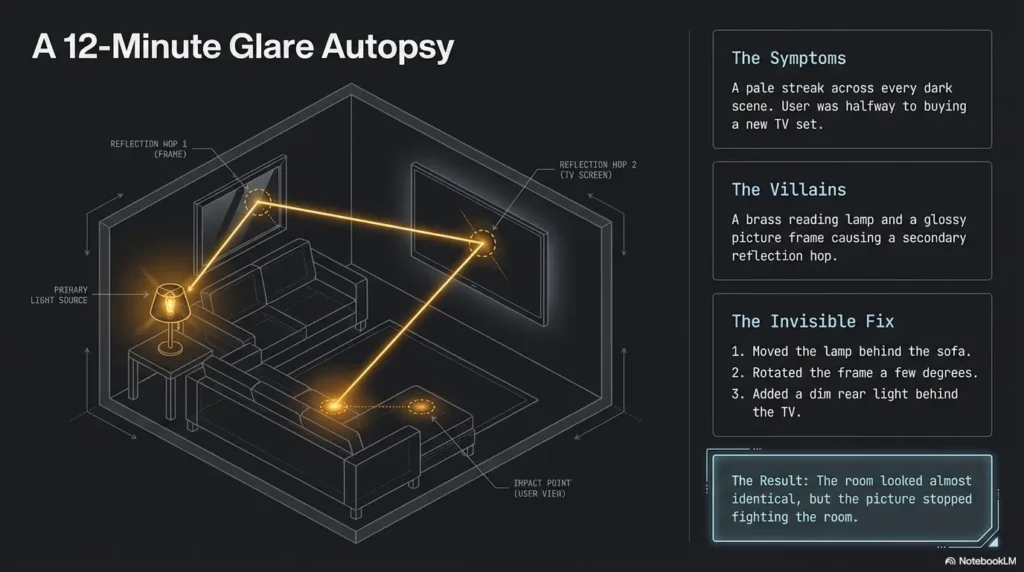
Sometimes the screen is not the only mirror in the room. Glass coffee tables, polished consoles, framed art, and shiny floors can bounce light around until it returns to the panel by a more scenic route. Once, a side table with a glossy lacquer top was helping the lamp sabotage the TV. The lamp got blamed. The table knew what it had done.
- Total darkness can increase contrast discomfort
- Higher TV brightness is not the same as lower glare
- Nearby reflective furniture can multiply the problem
Apply in 60 seconds: Cover one shiny nearby surface with a towel for a quick test and see if the screen changes.
Common Mistakes: Where Most TV Glare Fixes Go Wrong
Most failed glare fixes are not dramatic. They are tiny, reasonable-looking mistakes that accumulate until the room feels “almost better” forever.
Leaving an uplight or exposed bulb pointed toward the screen area
Uplights can seem harmless because the source points upward, not at the TV. But if the light splashes a bright wall, glossy ceiling feature, or framed art near the viewing zone, that brightness can still feed reflections. In open-plan rooms, the TV can end up reflecting a distant bright patch rather than the bulb itself.
Installing bias lighting so bright that it becomes another source of distraction
This is probably the single most common bias-lighting error. People buy a strip, love the effect during setup, and then leave it too bright because the initial glow feels impressive. Impressive is not the same thing as watchable. Good bias lighting is quiet. It should not feel like a second screen auditioning for the lead role.
Mixing warm lamps, cool strips, and directional spotlights until the room feels visually chaotic
Mixed color temperatures are not a moral failure, but they can make the room feel unsettled. A very warm table lamp, a cool white LED strip, and a crisp spotlight overhead can produce a visual argument. If your room feels restless, part of the problem may be tonal inconsistency, not just glare.
Adding more lights instead of improving the path of the existing light
This is the decorating equivalent of adding more cooks to a kitchen where the stove is on the wrong wall. Before you add anything, get your current light sources under control. Fewer better lights will usually beat more mediocre lights.
Tier 1: One lamp moved, no new purchases. Good for mild nighttime glare.
Tier 2: Lamp moved plus better shade or lower exposed-bulb visibility.
Tier 3: Add dim rear bias lighting for comfort and contrast balance.
Tier 4: Tackle surrounding reflective surfaces and overhead fixture direction.
Tier 5: Separate day and night modes for the room with different lighting scenes.
Neutral next step: Start at the lowest tier that matches your problem instead of overbuilding the solution.
Here’s What No One Tells You: The Real Answer Is the Path of Light
Once you understand the path of light, the whole room becomes readable. You stop treating glare as a mood and start treating it as a route. What is the source? What surface is carrying it? What angle returns it to the panel? Suddenly the room is less haunted and more solvable.
One badly placed light source can be easier to fix than three mediocre ones
This is strangely encouraging. If one lamp is causing 70 percent of the visible reflection, then you have a very generous problem. Fixing one thing well beats optimizing six things weakly. I have had rooms where an eight-minute lamp move solved more than an hour of menu fiddling ever did.
A glare-friendly room is not necessarily darker, but more controlled
This is the piece most guides skip. The goal is not dimness as a virtue. It is control. A comfortable room may still be gently lit. It simply avoids direct hits into the screen and extreme contrast around the image.
Good bias lighting should support the image, not announce itself
The best bias lighting becomes hard to describe after ten minutes because your eyes stop talking about it. That is success. It supports black levels perceptually, eases the jump between screen and wall, and then steps politely out of the conversation.
SMPTE’s standards work around reference viewing environments is one reason “neutral rear light” became more than audiophile folklore. The professional display world has spent years formalizing what comfortable, accurate viewing conditions look like. Everyday living rooms do not need lab-level purity, but they benefit from the same principle: controlled surroundings help the image do its job. The same low-drama truth appears in finish choices too, which is why matte vs. glossy paint decisions can quietly affect how reflective a room feels at night.
We moved the lamp behind the sofa, rotated the frame a few degrees, and added a dim rear light behind the TV. The fix took maybe twelve minutes. The room looked almost identical. But the picture stopped fighting the room. That is the odd beauty of these fixes. They are often invisible once they work, which is precisely why people underestimate them.
Room-by-Room Fixes: Different Layouts Need Different Solutions
Rooms have personalities. Some are stubborn. Some are forgiving. A good glare fix respects the layout you actually live with rather than the one a showroom pretends you have.
Apartment living rooms: using rear-side lamp placement and wall bounce to soften the space
Apartments often have fixed outlets, short wall spans, and multipurpose furniture. The best move is usually to place a lamp rear-side relative to the couch and let the light bounce off a nearby wall. That gives you ambient light without parking a bright object next to the TV. I have done this in compact rentals where moving the sofa was laughable and moving the lamp was heroic enough.
Family rooms: shifting emphasis away from ceiling lighting toward controlled ambient lighting
Family rooms love overhead lighting because they serve many functions. Fair. But for TV time, selective use helps. Leave the whole ceiling on and you may create reflections from multiple angles. Shift the emphasis to one or two softer side sources and a modest rear TV glow, and the room usually calms down fast.
Bedroom TVs: how bedside lamps and headboard lighting can interfere with viewing
Bedrooms often produce glare from lamps that sit almost perfectly aligned with the screen when you are propped up in bed. Bedside lamps are intimate little saboteurs. If they stay on during viewing, use shaded bulbs, lower visibility, and side placement that does not bounce directly into the panel.
Open-plan homes: stopping dining-area lighting from competing with the TV zone
Open plans are where glare becomes sociology. The TV is in one zone, but the dining pendants and kitchen lights insist on joining the conversation. In these spaces, think in visual territories. Dim or redirect the competing zone during viewing and give the TV area its own controlled ambient light. One house I visited had gorgeous dining pendants that reflected on the screen from twenty feet away. Beautiful fixtures. Terrible audience manners.
Show me the nerdy details
Open-plan glare often comes from secondary reflective paths. Even when a light is not physically close to the TV, the panel can still catch it if the source sits within the reflected field from the viewer’s position. That is why distant pendants, hallway lights, and bright kitchen task lighting can matter more than expected.
What to Adjust in Order: The Best Sequence for Testing Changes
Order matters because random tweaking is how evenings disappear. Use a sequence, and the room starts telling you the truth.
Step 1: Identify the lamp or fixture creating the most obvious on-screen reflection
Do this with the TV on a dark paused scene or fully off if the room reflection is severe. Sit where you normally sit. The first visible reflection path is your first suspect. Not the whole room. Just the brightest offender.
Step 2: Reposition that light before changing any TV settings
Move the lamp. Rotate the shade. Lower the brightness. Change the angle. Only after the light path improves should you touch the TV settings. This single bit of discipline saves so much wheel-spinning it deserves a small brass plaque.
Step 3: Add low-level bias lighting behind the TV
Once the main reflection is under control, add a gentle rear glow if the room still feels harsh or tiring. Keep it dim. Let it soften the wall, not compete with the content.
Step 4: Recheck the setup separately for daytime and nighttime use
The room you watch at 9:30 p.m. is not the room you have at 2:00 p.m. Evening glare and daytime glare are cousins, not twins. A setup that feels lovely at night may still need window management by day, and that is normal.
- Find the reflection first
- Change light path before TV settings
- Add dim rear glow only after the main offender is controlled
Apply in 60 seconds: Pause a dark scene and test one lamp move right now before touching brightness menus.

FAQ
Does bias lighting completely eliminate TV glare?
No. Bias lighting mainly helps reduce harsh contrast between the bright screen and the darker room. It improves comfort and can make the setup feel less fatiguing, but it does not replace fixing direct reflection paths from lamps or overhead fixtures.
What color temperature is best for bias lighting in a US living room?
6500K is commonly recommended because it aligns with the D65 white point used in professional display practice. In a normal living room, though, subtle and stable matters more than chasing perfection. A slightly warmer neutral light that is dim and well controlled may feel better than a brighter “ideal” strip. SMPTE’s reference-viewing standards are part of why 6500K became the default reference recommendation.
Are floor lamps always bad if they are near the TV?
No. A floor lamp can be perfectly fine if the bulb is diffused, the height is favorable, and the reflection path misses the panel from your viewing position. The problem is not the category of lamp. It is whether the screen can see it.
Can I reduce glare while keeping the overhead lights on?
Often, yes. Use fewer overhead fixtures, dim them if possible, and avoid lights that create direct reflected points on the panel. Diffuse fixtures or bounced ambient light usually behave better than directional overhead beams during TV viewing.
Does increasing screen brightness help reduce reflections?
It can overpower mild reflections in some cases, but it does not truly solve glare and can make viewing harsher. The American Academy of Ophthalmology recommends matching screen brightness more closely to the surrounding room rather than making the screen dramatically brighter than everything else.
Should movie-night lighting be different from everyday TV lighting?
Usually, yes. Everyday viewing may tolerate more ambient light, while movie-night viewing often benefits from lower, more controlled lighting and a softer rear glow. Separate “day mode,” “evening mode,” and “movie mode” can be surprisingly useful.
Do glossy coffee tables and furniture really make TV glare worse?
They can. Reflective surfaces can bounce lamp or window light into the room and sometimes back toward the TV. They are not always the main cause, but they can amplify an existing problem.
Can window glare and lamp glare be fixed the same way?
Not entirely. The principle is similar because both involve reflected light, but windows are stronger and more variable. Lamp glare is usually best solved with placement and diffusion. Window glare often needs blinds, curtains, shades, or time-of-day adjustments.
A Better Picture Tonight, Not Someday
The curiosity loop from the beginning closes here: the room probably does not need to become darker, stricter, or more expensive. It needs its light to behave. That is the real trick. Once you stop treating glare as a mysterious brightness curse and start reading the path of light, the fixes become almost ordinary. Lamps move. Shades soften. Rear glow supports. The TV stays put. The picture wins anyway.
If you do only one thing in the next 15 minutes, do this: turn on the TV, switch on your usual room lighting, pause a dark scene, and identify the one reflected source you can see most clearly. Move that light first. Then, and only then, decide whether soft bias lighting would make the room feel easier on your eyes.
Last reviewed: 2026-03.