

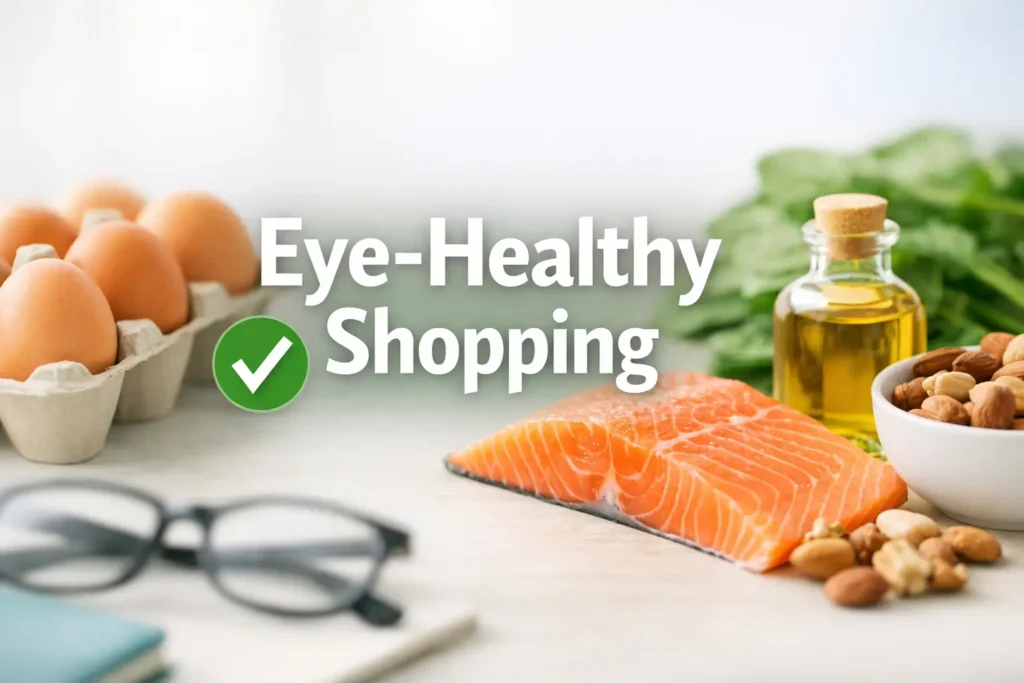
The Simplified Eye-Health Shopping Strategy
The fastest way to break an “eye-health plan” is to make it complicated enough that it only works on your best week. In the grocery aisle, that usually looks like a cart full of exotic good intentions—and a quiet fear that you’re still buying the wrong things.
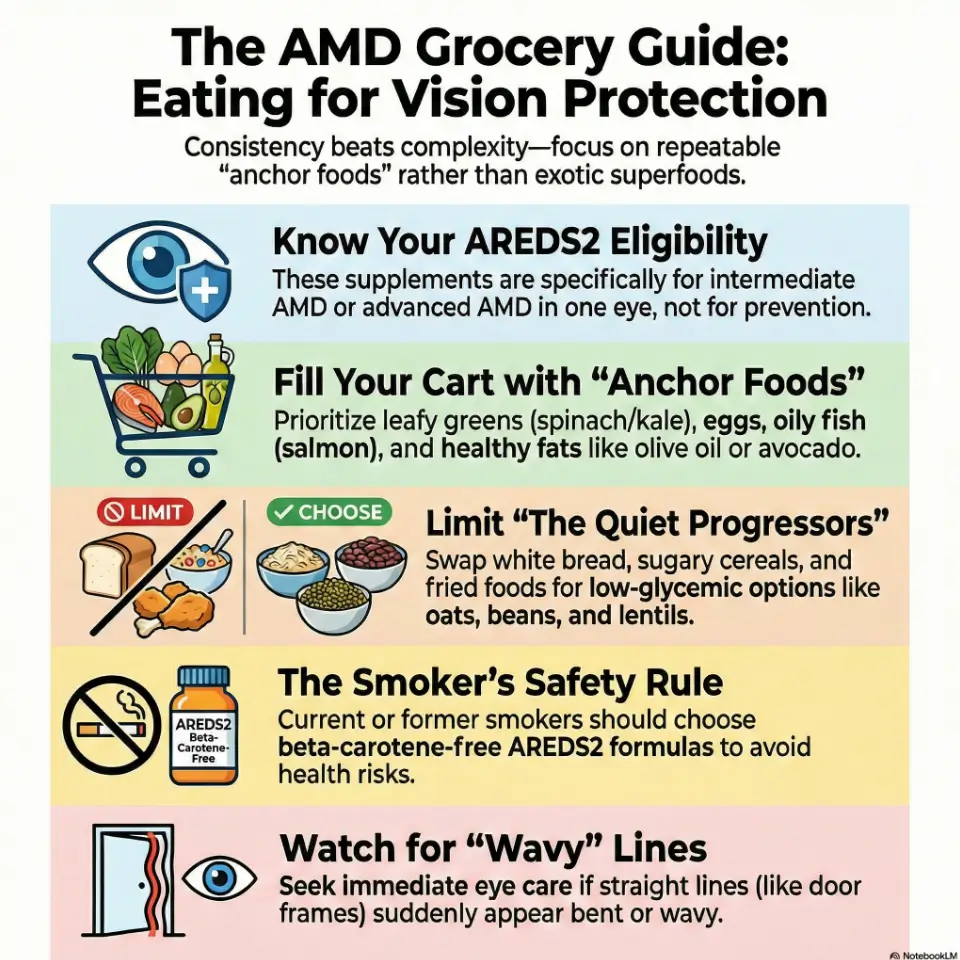
AREDS2 is a specific, studied supplement formula used for certain AMD stages (often intermediate AMD or advanced AMD in one eye). It doesn’t “prevent” AMD from starting—and food can’t replicate the exact doses—but your weekly shopping can support the same priorities: leafy greens, eggs (lutein/zeaxanthin), omega-3 fish, healthy fats, and low-glycemic carbs.
Keep guessing, and the loss is subtle: inconsistent habits, blood-sugar spikes, and a supplement stack that doesn’t match your needs. Here, you’ll get a best-foods cart, a worst-foods “crowd-out” list, and the quick label check that saves money.
Short beats. Clear aisles. No heroics.
Start with two anchors: frozen spinach and eggs. Then build from there.
Table of Contents
- Food supports patterns; it doesn’t replace studied AREDS2 doses
- Carotenoids like lutein/zeaxanthin show up better with healthy fats
- Refined sugars/white flour are the sneaky problem, not the occasional dessert
Apply in 60 seconds: Add frozen spinach and eggs to your next order—two items that quietly upgrade multiple meals.
Safety / Disclaimer (read first)
This guide is educational, not medical advice. The NIH’s National Eye Institute explains that AREDS2 supplements help specific AMD stages—typically intermediate AMD (like large drusen) or advanced AMD in one eye—and they are not meant to prevent AMD from starting. Talk with your eye doctor (and primary care clinician) before starting supplements, especially if you take medications that affect bleeding or you have other medical conditions.
Key caution points to discuss: vitamin E dose, zinc tolerance, and potential interactions with blood thinners or other meds. And if you’re a current or former smoker, most eye specialists recommend beta-carotene-free AREDS2 formulas rather than older beta-carotene versions—here’s a practical primer on AREDS2 guidance for current/former smokers.
Fast Answer (snippet-ready): If you have intermediate AMD (or advanced AMD in one eye), AREDS2 supplements can lower the risk of progression to advanced AMD in higher-risk people. Your grocery cart still matters: build meals around leafy greens, eggs, fish, nuts/olive oil, and low-glycemic carbs (oats/beans), and limit refined sugars and white flour staples. Confirm the right formula and dose with your clinician—especially if you’ve smoked or take meds that affect bleeding.
1) Who this is for / not for
For you if…
- You’ve been told you have intermediate AMD (often described as “large drusen”) or advanced AMD in one eye
- You’re taking (or considering) AREDS2 and want food choices that support the same “eye-protective” priorities
- You want a cart that’s repeatable—not a 3-day superfood sprint
Not for you if…
- You have no AMD or very early AMD and expect AREDS2 to “prevent” it
- You want a supplement to replace eye exams, monitoring, or treatment plans (if you’re building a “don’t forget” system, start with an annual eye exam checklist for seniors)
- You’re looking for a miracle food list (this is a habit list, not a magic list)
Personal note: I’ve watched smart, motivated people burn out on “perfect” plans by Day 9. The goal here is boring consistency—the kind that keeps going when life gets loud.
- Yes: intermediate AMD in one/both eyes
- Yes: advanced AMD in one eye (to protect the other)
- Not shown: no AMD or early AMD
Apply in 60 seconds: Pull up your last eye visit summary and look for the words “intermediate,” “large drusen,” or “advanced in one eye.” If you’re unsure, call and ask what stage you’re in.
2) AREDS2 in plain English: what it is (and what it isn’t)
The “only helps this stage” rule
The NIH’s National Eye Institute ran the big AREDS/AREDS2 research that shaped today’s formulas. Their bottom line is refreshingly specific: AREDS2 supplements are meant for intermediate AMD or advanced AMD in one eye. They’re not designed as a general “eye multivitamin,” and they haven’t been shown to prevent AMD from starting.
The formula you’re aiming to match (without pretending food = pills)
AREDS2 is a studied mix of vitamins/minerals plus lutein and zeaxanthin (and it removed beta-carotene). Food can’t reliably “hit the same numbers” as that formula—and it shouldn’t have to. Food’s job is different: it supports a pattern that makes the rest of your plan easier to live with (energy, glucose steadiness, and repeatable meals).
Curiosity gap: Why “more antioxidants” can be the wrong strategy
Because “more” isn’t automatically safer. High-dose supplements can interact with medications, cause side effects, or create accidental mega-dosing when combined with other products. This is why eye doctors often sound like cautious pilots: one plan, one route, fewer surprises.
Show me the nerdy details
In the original AREDS research, a specific high-dose mix reduced the risk of progression to advanced AMD in higher-risk participants by about 25%—but that effect was tied to certain AMD categories, not the general population. AREDS2 adjusted the carotenoid component (removing beta-carotene and adding lutein/zeaxanthin) to address safety concerns for smokers and to refine the formula. The practical takeaway: stage first, then formula, then consistency.
Personal note: The day I stopped treating supplements like “extra credit” and started treating them like “a fixed appointment,” everything got easier. Less negotiating with myself. More follow-through.
3) Best foods list: the AREDS2-friendly cart (aisle by aisle)
Think of this as the “base layer” cart: items that make it easier to build meals around lutein/zeaxanthin-rich foods, healthy fats, and steadier carbs. The American Academy of Ophthalmology often emphasizes the same general pattern: vegetables (especially leafy greens), fish, beans, and whole foods that support overall eye health.
Greens aisle: lutein/zeaxanthin “base layer”
- Kale, spinach, collards, Swiss chard, broccoli
- Rotate your greens so you don’t hate your life by Thursday
- Choose frozen when convenience wins (it usually does)
Let’s be honest… salads won’t happen daily
So don’t build your plan on a daily salad. Build it on one handful of greens that can disappear into eggs, soup, pasta, or a smoothie. My “no-hero” move: frozen spinach into scrambled eggs. Nobody claps. It works anyway.
Egg section: the “easy absorption” shortcut
Egg yolks contain lutein and zeaxanthin in a form that many people find practical to eat regularly. If you’re time-poor, eggs are the closest thing to a cheat code: 5–8 minutes, minimal dishes, high “I can keep doing this” energy.
Seafood counter: omega-3-rich patterns (food > capsule hype)
- Salmon, sardines, trout, tuna
- Aim for a rhythm like twice a week rather than a perfection target
- If cooking is hard, use canned salmon/sardines and call it a win
Nuts, oils, and avocados: fat that helps carotenoids “show up”
Lutein and zeaxanthin are fat-soluble, which means pairing greens with a little healthy fat can help them travel with your meal instead of getting left behind. Think: olive oil on broccoli, avocado with eggs, nuts on oatmeal.
Beans + whole grains: low-glycemic “vision steadiness”
- Oats, beans, lentils, quinoa, brown rice
- Swap these in when you can—especially for breakfast and snacks
Bonus color list (for variety + adherence)
- Red/yellow peppers, peas, zucchini, corn, tomatoes
- These make meals feel less “medical” and more like… food
Personal note: The first time I tried to “eat perfectly,” I bought exotic seeds and a fridge full of regret. The second time, I bought eggs, frozen spinach, oats, and canned fish—and suddenly I was consistent.
- Greens: ___ days/week
- Eggs: ___ days/week
- Fish: ___ servings/week
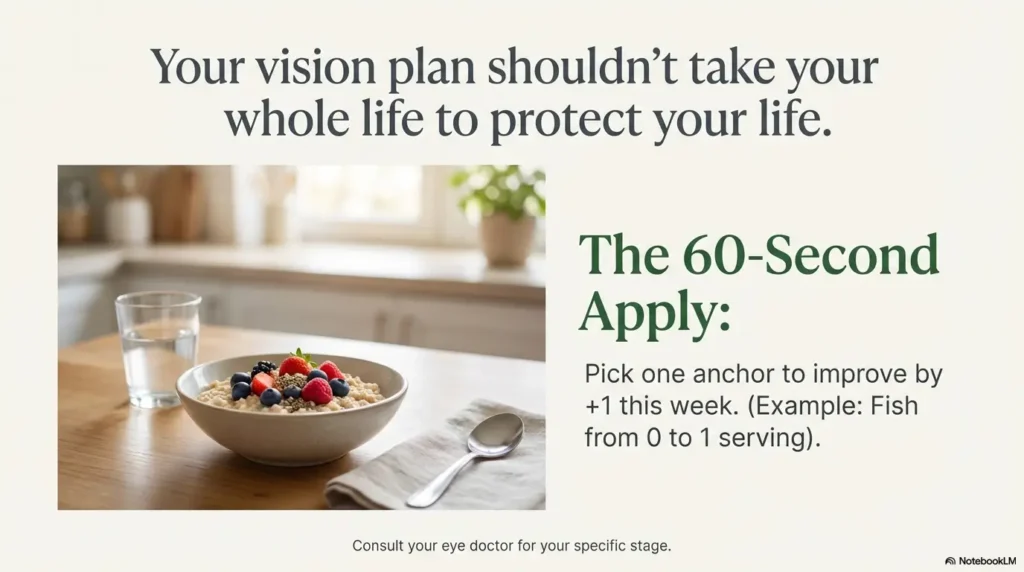
Apply in 60 seconds: Pick one anchor to improve by +1 this week (example: fish from 0 to 1 serving). That’s how plans become habits.
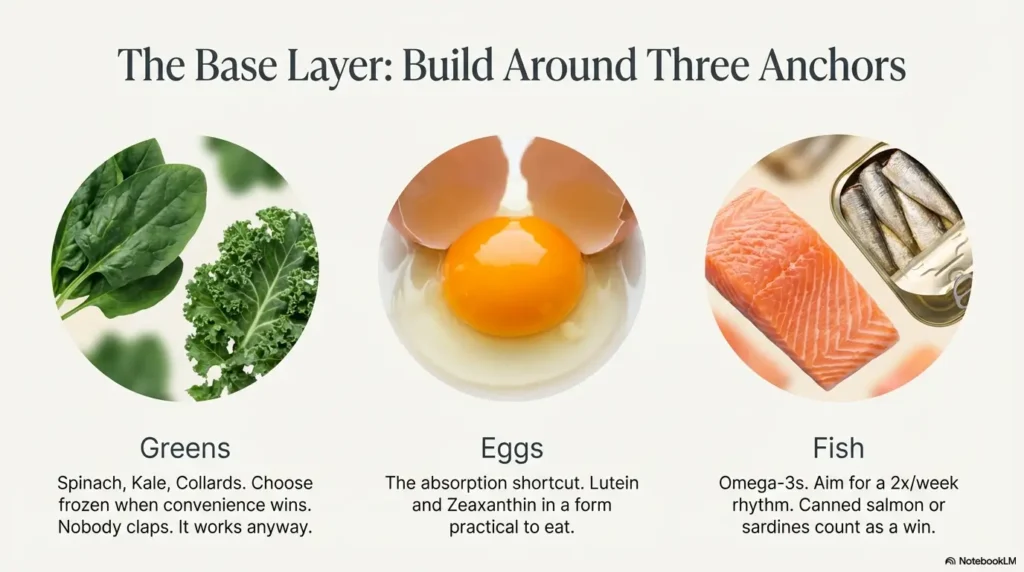
4) Worst foods list: what to limit (the “quiet progressors”)
This isn’t a ban list. It’s a “watch your patterns” list—because the foods that quietly take over your week are usually the ones that crowd out the good stuff.
High-glycemic carb traps (the blood-sugar spike problem)
- Frequent white bread, sugary cereals, pastries, candy, sweet drinks
- “Easy carbs” can become “default carbs” faster than you think
Research has explored links between higher dietary glycemic index patterns and AMD risk/progression. The exact mechanisms are complex, but the practical move is simple: stop letting refined carbs run your mornings and snack breaks.
Ultra-processed fats and fried “crunch calories”
- Regular fried fast food
- Packaged baked goods and heavily processed snacks
- Anything that leaves you thirsty and weirdly hungry an hour later
“Omega-6 overload” pattern (not a ban—just a balance)
If most fats come from processed, seed-oil-heavy packaged foods, you may crowd out fish/olive oil patterns that eye-health guidance tends to favor. You don’t need fear. You need balance.
The one breakfast swap that changes the whole day
Switching from “sweet + white flour” breakfast to oats + eggs + berries is often the fastest way to lower glycemic load without feeling punished. It also stops the late-morning snack spiral—the one where you swear you’re not hungry, yet somehow you’re holding a muffin.
Personal note: I used to think my “weak point” was willpower. It was breakfast. I fixed breakfast, and willpower suddenly looked a lot better.
5) The label check that saves you money (and regret)
Pick the right AREDS2 (and avoid the wrong “near match”)
Many products say “eye support” but don’t match the studied AREDS2 ingredient pattern or doses. The American Academy of Ophthalmology has warned for years that not every “eye vitamin” is equivalent. Your rule: look for “AREDS2” explicitly on the label, then confirm it fits your medical situation. If you want a quick, non-alarmist decision rule, see how to choose beta-carotene-free AREDS2 when you’ve ever smoked.
Smoker/former smoker warning: avoid beta-carotene formulas
AREDS2 removed beta-carotene largely because of safety concerns for current/former smokers. If you’ve ever smoked—even if it was “a long time ago”—this is a conversation worth having with your clinician.
Here’s what no one tells you…
The “best” bottle is the one you’ll take consistently without side effects or medication conflicts. That means your doctor/pharmacist’s input often matters more than the brand name.
- If you’ve smoked → prioritize AREDS2 (beta-carotene-free)
- If zinc upsets your stomach → ask about timing, splitting, or alternatives
- If you already take a multivitamin → check for overlap to avoid mega-dosing
Apply in 60 seconds: Take a photo of your supplement label and your med list. Bring both to your next visit (or message your clinic portal).
6) A “grab-and-go” AREDS2 grocery list (copy/paste)
Here’s the list you can paste into a shopping app. It’s built to be weekly-repeatable, not “new personality” ambitious.
The 15-item core list (repeat weekly)
- Greens: spinach or kale (fresh or frozen)
- Eggs
- Oily fish: salmon, sardines, trout, or canned options
- Olive oil
- Mixed nuts
- Beans/lentils
- Oats
- Berries (fresh or frozen)
- Greek yogurt (or a fortified alternative)
- Whole-grain bread/tortillas
- Sweet potatoes or squash
- Bell peppers
- Tomatoes
- Avocados
- Citrus (simple snack + habit anchor)
The 3 “rotation packs” to prevent diet fatigue
- Soup pack: beans + greens + olive oil (and whatever vegetables you’ll actually eat)
- Breakfast pack: eggs + oats + berries
- Sheet-pan pack: fish + peppers + greens
Personal note: My “rotation pack” trick saved me when I got tired of cooking. I wasn’t failing. I was bored. Different problem, different fix.
7) Common mistakes (that make people quit)
Mistake #1: Treating AREDS2 like a substitute for food
AREDS2 supplements are a targeted tool for specific AMD stages. Food supports your overall pattern—energy, glucose steadiness, and nutrient density—but it doesn’t replace the studied supplement formula if you’re in a group that benefits from it.
Mistake #2: Buying “eye gummies” that aren’t AREDS2
Gummies are convenient—and sometimes that convenience is the trap. Many don’t match AREDS2 doses or ingredients. If you need gummies for adherence, talk to your clinician about what’s realistic and safe.
Mistake #3: Ignoring the smoker rule (beta-carotene)
This is the landmine people step on because they’re trying to do the right thing quickly. If you’re a current/former smoker, bring it up. It’s not awkward. It’s responsible.
Mistake #4: Going “perfect” for 10 days, then stopping
AMD-friendly eating is a boring victory: repeatable, not heroic. Your best week isn’t the one where you cooked everything from scratch. It’s the one where you kept going when you didn’t feel like it.
Short Story: The grocery cart that stopped the guilt spiral (120–180 words) …
I once watched a friend—brilliant, practical, not dramatic—turn a diagnosis into a full-time job overnight. She downloaded five meal plans, bought twelve new “superfoods,” and spent an hour reading labels like they were legal contracts. By Day 6, she was exhausted. By Day 12, she’d stopped. Not because she didn’t care—because the plan demanded a version of her life that didn’t exist.
So we rebuilt it around what she actually did: breakfast on autopilot, two simple dinners, and snacks that didn’t spike into regret. Eggs stayed. Frozen greens stayed. Oats stayed. Fish happened twice a week. And suddenly she wasn’t “trying” all day—she was just living. That’s the point. Your vision plan shouldn’t take your whole life to protect your life.
8) Special situations: ask before you stack supplements
If you take blood thinners or have bleeding risk
Discuss vitamin E and overall supplement interactions with your clinician. This isn’t a scare tactic—just basic safety. The older we get, the more “simple supplements” meet “complex medication lists.”
If you have GI upset from zinc
Zinc can cause nausea for some people, especially on an empty stomach. Ask about taking it with food, splitting doses (if appropriate), or other adjustments. Don’t quit silently—side effects are solvable more often than people think.
If you already take a multivitamin
Overlapping ingredients can push totals higher than intended. This is where a quick review with your clinician or pharmacist can prevent months of “I didn’t realize I doubled that.”
Personal note: I used to think “supplement review” was fussy. Then I saw how often the same ingredient appears in three different bottles. It’s not fussy. It’s math.
9) When to seek help (don’t “wait and see”)
Urgent: possible wet AMD / sudden change
Get prompt eye care if you notice sudden distortion or rapid change, especially:
- Straight lines look wavy/bent (door frames, window blinds, tile grout)
- New central blur or a growing dark/missing spot
- Sudden drop in clarity that feels “not like normal tired eyes”
The National Eye Institute specifically flags “straight lines looking wavy” as a warning sign that should prompt timely evaluation. If you’re navigating active treatment questions, it can also help to understand the usual wet AMD injection schedule patterns so you’re not guessing what “normal follow-up” means.
Practical monitoring habit
Ask your clinician about an Amsler grid or another monitoring plan that fits your situation. Put it somewhere you’ll actually use it—like the fridge or the bathroom mirror. The best tool is the one you remember. (If you want a simple way to track changes without relying on memory, use a printable symptom diary designed for seniors.)
- Leafy greens (fresh or frozen)
- Eggs
- Fish (2×/week rhythm)
- Olive oil, nuts, avocado
- Beans, oats, whole grains
- White bread, pastries, sugary cereal
- Sweet drinks and frequent candy
- Fried fast foods as a weekly default
- Ultra-processed snack “crunch meals”
- AREDS2 stage eligibility
- Vitamin E / bleeding risk interactions
- Zinc intolerance solutions
- Multivitamin overlap (double-dosing)
FAQ
1) Should everyone with AMD take AREDS2?
No. AREDS2 is generally recommended for intermediate AMD or advanced AMD in one eye. If you have early AMD or no AMD, the NIH’s National Eye Institute notes it isn’t meant as prevention.
2) Does AREDS2 help early AMD?
Evidence hasn’t shown that AREDS2 prevents early AMD from progressing into intermediate AMD. The best move is regular monitoring (as advised by your clinician) plus a repeatable dietary pattern.
3) Can food replace AREDS2 supplements?
Food and supplements do different jobs. Food supports a steady, nutrient-dense pattern, but it doesn’t replicate the studied AREDS2 formula or guarantee the same dosing. If you’re in a group that benefits, think “both/and,” not “either/or.”
4) What’s the best breakfast for macular degeneration?
A simple, repeatable one: oats + berries (fiber + lower glycemic load) and/or eggs + greens (lutein/zeaxanthin-friendly). The best breakfast is the one you’ll eat 5 days a week.
5) Which foods are highest in lutein and zeaxanthin?
Leafy greens (like spinach and kale) are classic. Egg yolks are also practical for many people, and pairing these foods with healthy fats (olive oil, avocado) can help fat-soluble pigments travel with the meal.
6) What foods should I avoid with AMD?
Focus on limiting patterns that crowd out your core foods: frequent refined carbs (white bread, pastries, sugary cereals) and heavily processed/fried foods as a default. You don’t need fear—just fewer “accidental” daily habits.
7) Are eggs “safe” if I have high cholesterol?
This is individualized. Many people can include eggs as part of a balanced diet, but if you have high LDL, heart disease risk, diabetes, or specific dietary guidance, ask your clinician what’s appropriate for you.
8) If I’m a former smoker, which formula should I choose?
Bring this up explicitly. Many clinicians prefer AREDS2 (beta-carotene-free) for current/former smokers because beta-carotene has raised safety concerns in smokers in other research contexts—this AREDS2 for smokers guide can help you ask the right question at the visit.
Conclusion
Remember the worry hiding inside the grocery aisle question—“What if I buy the wrong things and it gets worse?” Here’s the honest relief: your plan doesn’t need perfection to be protective. It needs repeatable anchors. If you’re eligible for AREDS2, treat it like a steady appointment, not a heroic project. Then build meals around leafy greens, eggs, fish, olive oil/nuts, and low-glycemic carbs—because that pattern is realistic, durable, and supported by what major eye-health institutions emphasize about nutrition.
In the next 15 minutes, do the smallest high-leverage step: write a 6-item “always buy” list (eggs, frozen spinach, oats, beans, olive oil, canned fish). If you do nothing else, that list will quietly improve dozens of meals this month.
Last reviewed: 2026-01-19