

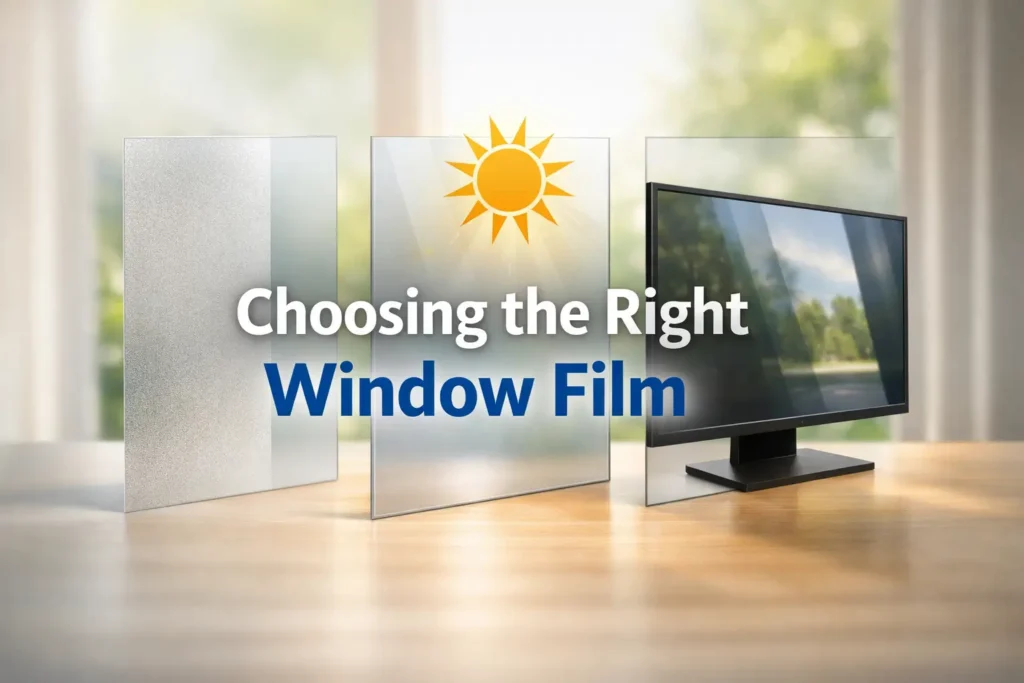
Beyond the “Glare”:
Choosing Window Film That Actually Works
Most people shop for window film as if glare were one tidy problem. It isn’t. It’s eye strain at 4:30 p.m., a TV reflecting the whole room, or the quiet panic of watching your floors fade under the sun.
This confusion leads to “buying hope in a roll”—frosted film when you needed solar control, or technical-sounding “polarized” films that don’t stop the squinting.
Our approach is practical, room-based, and gloriously unimpressed by marketing fog. We help you sort through frosted, UV, and solar films by the problems they actually solve.
Let’s clear the glass, then the language, then the room.
If you are comparing window film for glare: frosted vs UV vs polarized effect, the biggest truth is this: these films solve different problems. Frosted film is mainly for privacy and light diffusion. UV-focused film helps reduce ultraviolet exposure and fading, but may not reduce harsh visible glare enough on its own. Most residential products marketed with a “polarized effect” are not true polarization in the sunglasses sense, so shoppers should look at real glare-control specs and room conditions before buying.
Table of Contents
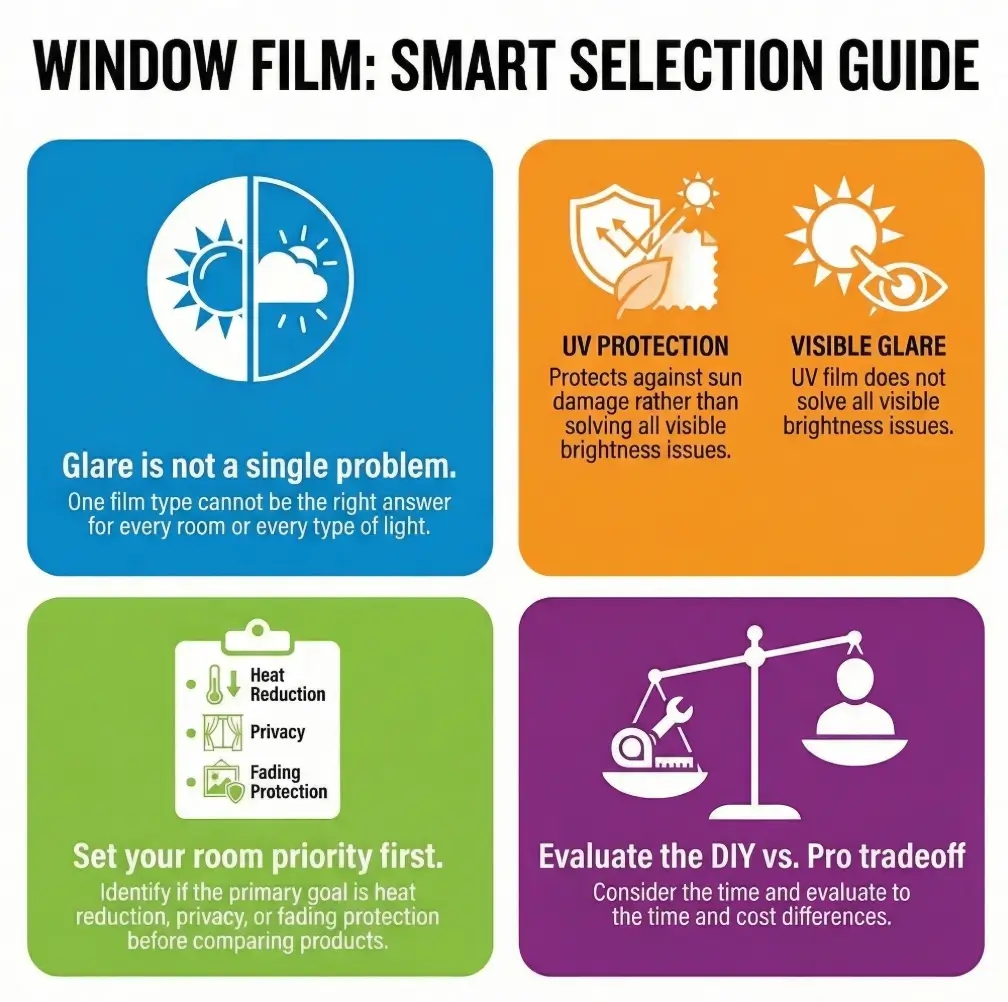
Start here: what kind of glare are you actually fighting?
Most bad window-film purchases happen because people shop for the word glare as if it were a single creature. It is not. It is more like a small family of inconveniences sharing one coat. If you do not name the problem correctly, you can easily buy privacy film for a brightness problem, or UV film for a reflection problem, and then stare at your receipt like it betrayed you personally.
Direct sun glare on eyes
This is the sharp, low-angle brightness that makes you squint, lean away, or mentally draft complaints against the sun. It tends to hit hardest in east-facing rooms during the morning and west-facing rooms in the late afternoon. In this case, the issue is not privacy. It is raw visual discomfort.
Screen glare on TVs and monitors
Here the window is not always making the room too bright overall. Instead, it is creating reflections on glossy screens. A bright rectangle on a laptop, a ghostly lamp shape on a TV, a video call where you can see yourself and the window at the same time: that is not quite the same problem as sunlight in your eyes. Geometry matters here. So do screen angle and surface gloss.
White-room brightness overload
Some rooms feel bleached out. Nothing is technically blinding, but everything feels overexposed. This is common in pale rooms with light floors, shiny counters, and broad daytime sun. People often call this “glare” when what they really mean is visual fatigue from too much visible light bouncing around. In kitchens and work zones, that can overlap with the same reflective-surface problem people run into with under-cabinet lighting glare on glossy surfaces.
Fabric and floor fading anxiety
Sometimes shoppers say glare because it feels simpler than saying, “I just noticed my rug looks tired near the window and now I’m spiraling.” That is not silly. Ultraviolet light does contribute to fading, but so can visible light and heat over time. The buying path shifts if protection of furnishings matters as much as comfort.
I learned this the expensive way in a bright workroom years ago. I thought I needed “anti-glare” film because my afternoon writing sessions felt like typing inside a spoon. The actual culprit was a west window behind me and a glossy monitor angled like a mirror. Film helped, but moving the desk by less than two feet helped more. Humbling, really. Very rude of the room.
- Eye glare and screen glare are different buying scenarios
- Fading concerns can change product priority completely
- Room brightness overload is often a visible-light issue, not just UV
Apply in 60 seconds: Write one sentence describing your pain point: eye strain, screen reflection, privacy, or fading.
Frosted film first: when diffusion helps, and when it backfires
Frosted film is the easiest product to misunderstand because it often feels like a glare solution when you first imagine it. Bright window, harsh light, frosted surface, softer look. The logic seems tidy. And in some rooms, it works beautifully. In others, it solves the wrong problem with great confidence.
Where frosted film actually shines
Frosted film is excellent for bathrooms, entry sidelights, street-facing lower windows, shared interior office glass, and any place where privacy is the lead actor. It diffuses the view, softens the hard visual edge of the window, and makes a room feel less exposed. On a bathroom casement window, it can be a tiny domestic miracle. If the brightness problem is actually bouncing off reflective surfaces nearby, the issue may sit closer to bathroom mirror glare than to the window alone.
What frosted film does to light
Instead of preserving a clear view through the glass, frosted film scatters incoming light. That means it can soften harshness and reduce some visual intensity. But diffusion is not the same as strong glare control for every use case. If you are dealing with a bright patch on a screen across the room, frosted film may change the look of the light without solving the reflection pattern that is driving you nuts.
What it usually does not do well
It does not preserve your view outside. It does not usually rank as the best choice for meaningful heat rejection. And it does not reliably solve TV glare in the crisp, satisfying way shoppers hope. In fact, in some rooms it can create a broad, glowing panel effect, which feels softer than direct sun but still very present.
Let’s be honest…
Frosted film gets bought for “glare” and kept for privacy all the time. That is not failure exactly, but it is a mismatch. If your deepest wish is, “I want less glare and I still want to see the trees,” frosted film is usually the wrong horse in the race. Elegant horse, hardworking horse, but wrong horse.
There is also a subtle style issue. Frosted film changes the emotional feel of a window. A living room picture window covered in heavy frosting can feel oddly administrative, like your cozy Sunday space has been promoted to conference room status. In a bathroom, that same look feels clean and intentional. Context does a lot of the heavy lifting.
Show me the nerdy details
Diffusing films reduce clarity by scattering transmitted light. That can help reduce harsh line-of-sight brightness, but diffusion alone does not guarantee strong control of reflected screen glare. If the room still has high visible light levels and the geometry remains unchanged, reflections can persist even after the light looks softer to the eye.
UV film sounds right, but here’s where people get tripped up
UV film sounds wonderfully sensible because it uses a familiar villain. Ultraviolet light damages skin. Ultraviolet light contributes to fading. Therefore, UV film must be the grown-up, sensible choice for bright windows. Sometimes yes. Sometimes it is the most responsible pick in the room. But for pure glare control, it often gets more credit than it deserves.
What UV-blocking film is actually designed to do
Its main role is to reduce ultraviolet transmission. That matters for protecting flooring, textiles, furniture, artwork, and certain finishes. If you have walnut floors, vintage textiles, framed prints, or a sofa placed in direct sun day after day, UV protection deserves real respect. This is one reason solar screens and other coverings are often described by the U.S. Department of Energy as helping reduce UV damage in addition to glare and heat issues.
Why UV protection alone may disappoint glare shoppers
Because visible light is what most people are reacting to when they say a room feels blinding, washed out, or painful for screens. A product can block a large share of UV and still leave a room visually intense. That is the quiet trap. You buy protection and still keep squinting.
When UV-focused film makes sense anyway
It makes excellent sense in rooms where fading risk matters as much as comfort, or more. Think sunlit reading rooms, bedrooms with expensive wood furniture, condos with wall-to-wall windows and rugs you would prefer not to replace out of spite, or rental units where you want a relatively subtle intervention without a dramatic change in appearance.
Here’s what no one tells you…
Many shoppers use “UV film” as shorthand for “sun control film,” but the categories are not always the same. That naming confusion causes a parade of disappointing purchases. Window performance language is not especially poetic, but it matters. The DOE’s window guidance also points shoppers toward measurable properties like visible transmittance and solar heat gain rather than relying on mood-board adjectives alone.
- Great for fading risk and material protection
- Not always enough for TV or monitor reflections
- Visible light still matters for comfort
Apply in 60 seconds: Look around the room and name the item you are most trying to protect: your eyes, your screen, or your furnishings.
One small practical note: if you are comparing products and only one page gives you real details on visible light transmission or solar performance, and the others mostly whisper “UV” with romantic product photos, choose the boring page. Boring pages often save money.
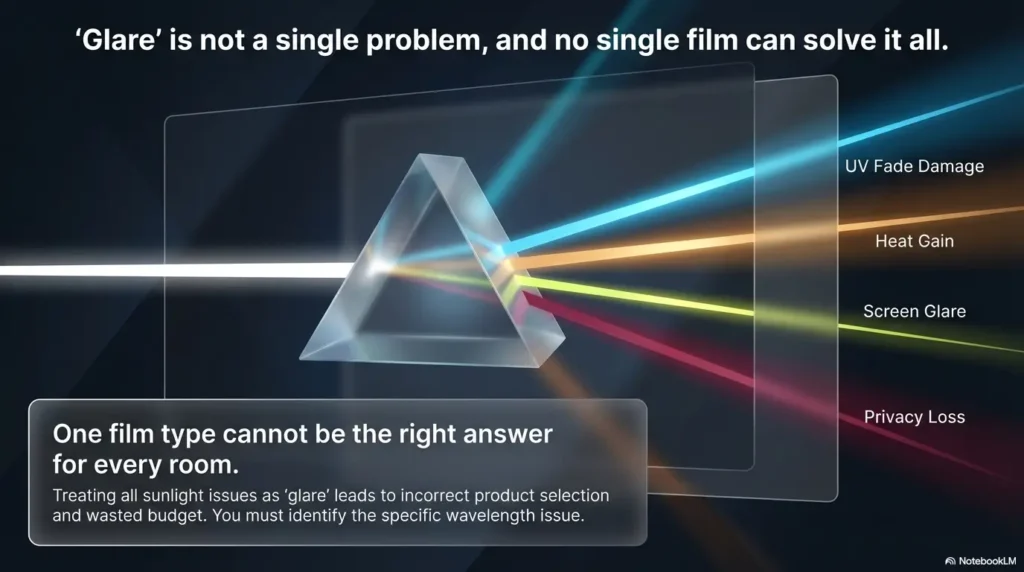
Polarized effect: the phrase that causes the most confusion
This is the phrase that sends otherwise sensible buyers into the weeds. Polarized sunglasses are famous for cutting reflected glare. So when a listing hints at a “polarized effect,” the brain lights up like a slot machine. Ah yes, the miracle answer. The science-y one. The grown-up one. The one that finally defeats the cruel television reflection at 5:12 p.m.
Why “polarized” sounds like the ultimate glare answer
Because people have experienced polarized lenses personally. You put them on, water glare softens, road reflections calm down, and the world stops yelling. So the phrase carries emotional weight. It feels trustworthy even when the product page is vague.
What most home window films actually are
In residential and small-office settings, films are more commonly sold as decorative, privacy, dyed, metallized, ceramic, or solar-control products. The market language often focuses on heat rejection, UV reduction, privacy level, mirror effect, removability, or visible light transmission. True polarization is not how most home window film products are typically described or standardized for everyday retail comparison.
What shoppers may really mean by “polarized effect”
Usually one of four things: less harsh brightness, fewer reflections at certain angles, improved comfort while using screens, or a slightly softened visual field that feels calmer. Those are real goals. But they are not automatically proof of literal polarization. A seller may simply be using familiar language because shoppers recognize it.
Don’t assume the label means the physics
Marketplace wording can be gloriously imprecise. “Anti-glare,” “sun control,” “mirror,” “one-way,” and “polarized effect” are often used as mood words more than strict technical categories. That does not mean the product is useless. It means you should buy based on measurable behavior, room orientation, and use case, not on the glamour of a term borrowed from eyewear.
I once watched a friend buy a “polarized privacy film” for a bright home office because the listing made it sound like the window equivalent of tactical sunglasses. It turned out to be mostly a daytime privacy film with decent tint. Not terrible. Not magic. The desk lamp reflection still strutted across the screen like it owned the place.
| If the listing shows… | Treat it as… | Your next move |
|---|---|---|
| Only lifestyle claims | Marketing fog | Look for actual specs or skip |
| Mentions privacy + tint + UV | General sun-control language | Confirm whether view and brightness stay acceptable |
| Visible light numbers and use-case examples | Higher-quality comparison page | Compare it against your actual room problem |
Neutral action: If a product leans hard on “polarized” but avoids real performance details, keep scrolling.
The real decision tree: privacy problem, fading problem, or screen problem?
Here is the cleaner way to shop: stop asking which film is “best” and start asking what the room is asking you for. Homes are not laboratories. They are stacks of compromises with snacks in them. A great choice is usually the one that accepts the right tradeoff on purpose.
Choose privacy first if…
The window faces a sidewalk, neighbors, a parking lot, or a street-level view that makes you feel like you are living inside a fishbowl. If sacrificing a clear outward view is acceptable, frosted or privacy-oriented film may be exactly right. Bathrooms, entry glass, and lower condo windows often fall into this lane.
Choose UV protection first if…
Your biggest concern is damage to floors, upholstery, wood, or artwork. That does not mean comfort is irrelevant, only that long-term material protection is the main reason you are buying. In these rooms, a more subtle-looking film may be sensible even if it is not the strongest possible answer for screen reflections.
Choose glare-control or solar-control performance first if…
You are fighting monitor glare, TV reflections, or the kind of room brightness that makes you feel slightly hunted by daylight. This is often where clearer solar-control films outperform frosted film because they can preserve more view while reducing the visible-light and heat behavior that is bothering you. DOE materials repeatedly describe shading strategies and advanced glazing approaches as ways to reduce glare while maintaining views, which is closer to what many living-room and home-office buyers actually want.
And if you want all three?
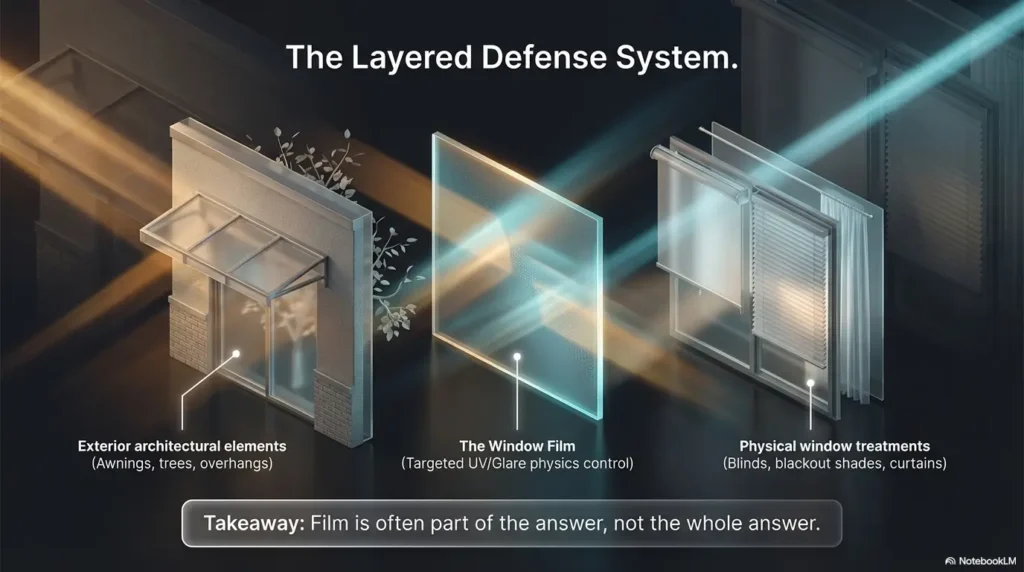
You may need a layered strategy. That sounds less romantic than a single-product miracle, but it is often more effective. A moderate solar-control film plus a roller shade for the worst hour of the day can beat a stronger but more visually compromising film. A small desk move plus a modest film can outperform a premium film applied to a badly arranged room.
There is a kind of peace that arrives when you stop demanding one product solve privacy, fading, heat, reflections, and aesthetics all at once. That peace looks suspiciously like better shopping.
Don’t buy by keyword alone: “anti-glare” listings can hide weak performance
The internet is full of listings that promise privacy, UV protection, heat rejection, glare control, and tasteful living-room enlightenment in one cheerful rectangle. It is seductive. It is also how people end up buying the wrong thing twice.
What vague listings often do
They promise everything at once. They use sun-drenched product images that tell you almost nothing. They describe the emotional outcome instead of the operating behavior. “Anti-glare” becomes a decorative adjective instead of a useful performance clue.
What to look for instead
Look for whether the film is clearly decorative or solar-control. Look for mention of visible light transmission, privacy behavior in daytime versus nighttime, adhesive type, and whether the film is meant for interior or exterior application. The DOE and NFRC materials on window performance repeatedly point buyers toward measurable ratings like visible transmittance and solar heat gain because those metrics give you a more honest idea of how a product may behave.
The sneaky mismatch
A film can look gorgeous in a product photo and still fail in a bright west-facing room with a glossy TV. A staged image at noon in a professionally lit apartment is not the same thing as your real room at 4:47 p.m. in August when the couch arm is hot and the screen looks like a portal to nowhere. The same kind of mismatch shows up in decor choices too, especially when matte vs glossy paint changes how much light bounces back into the room.
- Window direction: east, west, south, or north
- Main complaint: privacy, fading, eye glare, or screen reflection
- Need to preserve outside view: yes or no
- Lease-friendly removal requirement: yes or no
- Room type: bathroom, office, living room, bedroom, kitchen
Neutral action: Keep this list open while you compare listings so marketing language does not steer the whole decision.
Room-by-room picks: the best film type depends on where the window lives
A bathroom window and a home-office window are not cousins. They are strangers with different priorities. This is why generic advice feels so slippery here. The room itself is telling you what kind of compromise it can tolerate.
Home office windows
Prioritize screen comfort, controllable brightness, and enough view to avoid that trapped-inside-a-printer feeling. In many home offices, a solar-control or glare-control film makes more sense than frosted film. If you work on a glossy monitor or a laptop with a big reflective panel, start there. Also check desk position before you spend money. A 10-minute rearrangement can save a 10-day return process. If the whole room still feels visually sharp after that, lighting choices like 2700K vs 3000K for glare-sensitive eyes can quietly change the experience after sunset.
Living room and TV area
This is where people get their expectations bruised. Film may help, but TV glare is strongly tied to screen finish, window angle, and seating position. If you have a reflective TV directly opposite a bright window, film alone may not produce the cinematic redemption arc you were promised. A layered approach often works better.
Bathroom windows
Frosted film is often the cleanest, least dramatic answer. Privacy leads. View matters less. Diffused light is usually welcome. This is one of the few rooms where frosted film often does exactly what people hope, with very little emotional fallout.
Kitchen and breakfast nook
East-facing kitchens can be dazzling in the morning, especially with white cabinets, quartz counters, and every reflective surface known to modern renovation culture. Here, softer brightness and comfort may matter more than maximum clarity. But if it is a street-facing breakfast window, privacy may tie for first place. It is also worth thinking about glare-free under-cabinet lighting so the room is not fighting you from two directions at once.
Nursery or bedroom
These rooms are about comfort over spectacle. Fading, heat, nap conditions, and overall calm often matter more than the pure aesthetics of daylight. Film can help, but blackout shades or curtains may still be necessary if sleep or late-afternoon heat is the true enemy.
Short Story: A neighbor once asked me whether frosted film would fix the “violent sparkle” in her breakfast nook. That was her phrase, and frankly it deserved an award. The room faced east, with glossy tile, pale counters, and a glass table that seemed determined to reenact the surface of the moon each morning. She bought a light privacy film first because the listing said anti-glare.
It softened the window but did not calm the whole room. The real breakthrough came from a modest solar-control film, a fabric runner on the table, and moving the coffee station away from the brightest corner. None of those fixes was dramatic alone. Together, they made the room feel breathable. That is the thing about glare: it rarely leaves through one door. You usually have to open two or three.
- Bathrooms usually favor frosted privacy solutions
- Home offices usually favor glare-control and view preservation
- Living rooms often need film plus layout changes
Apply in 60 seconds: Label your room in one of three buckets: privacy room, screen room, or protection room.
Common mistakes that turn a simple fix into a second purchase
This is the section that saves money. Not with grand financial theatrics, just by preventing the unnecessary sequel purchase. That is often enough.
Mistake #1: buying frosted film when you still want a view
This is the classic heartbreak. The product works. The buyer is annoyed. Those two things can coexist beautifully. If you want to see sky, trees, weather, or even the deeply thrilling sight of your delivery driver approaching, heavy frosted film may feel claustrophobic fast.
Mistake #2: assuming UV blocking equals glare control
UV reduction helps with fading, but visible light is what your eyes and screens often complain about. The room can still feel aggressive even after UV is reduced.
Mistake #3: chasing “polarized effect” without verifying what it means
A familiar phrase is not a specification. Treat it as a clue, not a conclusion.
Mistake #4: ignoring time-of-day sunlight
A room that seems perfectly fine at noon may become unlivable at 4:30 p.m. This is why quick shopping in the wrong hour misleads people. Sun angles are petty and specific.
Mistake #5: expecting film to solve every reflection
Screen angle, glossy decor, bright floors, and shiny tables all matter. If your home is full of reflective surfaces, the window is only part of the orchestra.
- Yes / No: You can identify the worst glare hour
- Yes / No: You know whether privacy or view matters more
- Yes / No: You have checked lease, condo, or HOA limitations
- Yes / No: You are willing to pair film with shades if needed
Next step: If you answered “no” to two or more, pause the purchase and diagnose the room first.
Before you order: test the room like a rational person, not a desperate one
The best pre-purchase move is embarrassingly low-tech. Watch the room. Not once. Three times. The urge to buy quickly usually arrives after one especially irritating glare moment, but rooms are not static. They perform their little solar dramas on a schedule.
Watch the window in three time blocks
Morning, midday, and late afternoon. You do not need laboratory precision. You need pattern recognition. When does the room become annoying? When does the screen reflection peak? When does privacy feel most exposed? A few phone photos are often enough to clarify what written product pages cannot.
Identify the true pain point
Pick one primary complaint: eye strain, screen reflection, heat buildup, fading risk, or privacy. Just one. If everything feels equally bad, choose the one that most affects how the room is used. That becomes your buying compass.
Check what must stay unchanged
Do you need to preserve the outside view? Do you want the room to remain bright? Does your lease require removability? Does your condo or HOA care about exterior appearance? Practical constraints are not boring footnotes. They are the fence around your decision.
Let’s be practical…
The best film on paper can still be wrong for your room if your complaint was misdiagnosed. That sentence alone can save you from turning a small home-improvement task into a hobby of returns, regrets, and bubble-filled second attempts.
Show me the nerdy details
Visible transmittance measures how much light comes through a window system. Higher numbers generally mean brighter interiors, while lower numbers reduce transmitted light. That metric matters because comfort is often tied to visible light levels, not just UV reduction. Separately, solar heat gain metrics help explain how much solar heat enters through the glazing. Looking at both is usually more useful than chasing a single marketing phrase.
Installation reality: bad application can make a good film feel bad
A surprisingly large share of “this film didn’t work” complaints are really “this film was installed badly” complaints wearing a fake mustache. Window film is unforgiving about dust, alignment, and patience. If you apply a decent product in a rushed, lint-filled frenzy, the result can look hazy, distorted, or visibly worse than the original problem.
Common install problems
Bubbles, edge lift, dust specks, haze, creases, and sloppy cuts. Some settle down. Some do not. Some stare at you forever from eye level like a tiny monument to impatience.
Why this affects glare perception
Poor application can create distortions that catch the eye in the same way glare does. Even when light levels improve, the window may feel visually noisy. That can make the room seem lower quality or oddly tiring.
DIY or pro?
Small privacy windows are often DIY-friendly. Large living-room panes, high-visibility office windows, and big glass doors are far less forgiving. If the window is the visual center of the room, a professional install may be worth the cost simply to avoid daily annoyance.
I am all for a brave DIY mood. I am less enthusiastic about a brave DIY mood on a giant patio door at noon with two cats, airborne lint, and a very confident online tutorial. Sometimes adulthood looks like outsourcing.
| Approach | Typical cost range | Time range | Notes |
|---|---|---|---|
| DIY small window | Low product-only cost | 30 to 90 minutes | Best for bathrooms and sidelights |
| DIY large pane | Low to moderate | 1 to 3 hours | Mistake risk rises fast |
| Professional install | Moderate to high | Scheduling plus install day | Worth considering for focal-point windows |
Neutral action: If the glass dominates the room, price the cost of annoyance along with the cost of installation.
What to do if film alone does not fix the problem
This is where honest advice parts ways with miracle marketing. Film is useful. Sometimes very useful. But it is not a universal solvent for bad light. Exterior shading, interior shades, furniture placement, and reflective surfaces all participate in the final outcome.
Pair film with shades
This is especially helpful for west-facing rooms, TV areas, and offices with predictable worst-hour glare. The U.S. Department of Energy also notes that shading devices such as awnings and solar screens can reduce heat gain and glare, sometimes while still allowing view and light transmission. In practical terms, that means film is not always competing with shades and screens. Sometimes it is better when it has allies.
Reduce reflective surfaces
Glass tables, glossy cabinets, polished stone, framed art behind you, shiny paint, and bright decor can amplify discomfort. A film upgrade in a room full of reflective surfaces may still leave the space visually restless. That is one reason finish choices such as matte versus glossy paint can matter more than people expect.
Reposition screens before blaming the film
Sometimes the glare source is geometry, not film weakness. Tilt the screen. Rotate the desk. Change seating angle. Test before and after. A 15-minute experiment can tell you whether the problem is solar or spatial.
Consider exterior solutions
Awnings, exterior solar shades, landscaping, or simple overhang solutions can outperform interior film in stubborn rooms. DOE guidance notes that exterior shading can significantly cut solar heat gain depending on orientation, especially on west- and south-facing windows.
- West-facing glare often needs layered solutions
- Screen angle can matter as much as film type
- Exterior shading can outperform interior fixes in hard cases
Apply in 60 seconds: Before buying stronger film, test one screen move and one temporary shade during the worst glare hour.
FAQ
Does frosted window film reduce glare?
It can soften harsh light by diffusing it, but it is mainly a privacy solution. It may help a room feel less visually harsh, yet it is not always the best answer for screen glare or for rooms where you want to preserve a clear outside view.
Does UV window film stop glare?
Not necessarily. UV-focused films are more directly aimed at reducing ultraviolet exposure and helping with fading risk. If your room still has strong visible brightness or reflective screen problems, the discomfort may remain.
Is polarized window film real for homes?
Most residential films are not sold as true polarized products in the same sense as polarized sunglasses. The phrase is often used loosely in retail language, so it is smarter to compare performance claims and room fit than to shop by that term alone.
Which window film is best for computer screen glare?
A glare-control or solar-control film is usually more relevant than standard frosted film or UV-only film, especially if you want to keep your outside view. But screen angle and desk placement still matter.
Is frosted film good for a living room window?
Usually only if privacy matters more than the view. In many living rooms it feels too opaque or visually limiting, especially on larger panes meant to bring in openness and landscape.
Will window film make my room too dark?
Some films noticeably reduce brightness, while others remain relatively clear. The outcome depends on the product’s light transmission and how intense your room’s daylight already is.
Can renters use glare-reducing window film?
Yes, but removable or lease-friendly products matter. Check adhesive details and your lease terms first, especially if the building has appearance restrictions or if residue removal is a concern.
Does window film help TV glare?
Sometimes, yes, but not always enough on its own. TV finish, placement, seating angle, and the direction of the window all influence how much improvement you will actually feel.
Next step
Let’s close the loop from the beginning. The problem was never just “Which film is best?” The problem was that glare was wearing disguises. Once you separate privacy from fading, and fading from screen reflections, the decision becomes much less theatrical.
If you want the most practical next move within 15 minutes, do this: stand in the room during the worst glare hour, take two photos, and write one sentence naming the true issue. Not three issues. One. Then compare products only against that sentence. If it says privacy, frosted deserves a real look. If it says fading, UV protection rises. If it says monitor or TV reflections, start with glare-control or solar-control options and be ready to pair them with shades or layout tweaks. If the room still feels sharp after sunset, even with the windows no longer to blame, revisit your lighting setup and compare options like 2700K versus 3000K for glare-sensitive eyes.
That simple step keeps you from buying the wrong film for the right reason, which is the most common trap in this entire category. And in a small way, it returns the room to you. Not as a showroom fantasy. As a place where you can work, rest, watch something foolish, read near the window, and not feel ambushed by light.
Last reviewed: 2026-03.