

Complete Guide to Age-Related Eye Diseases After 60: Cataracts, Glaucoma, Macular Degeneration, and Diabetic Retinopathy
You know you’ve crossed a line when “reading the fine print” means holding the menu at arm’s length, then squinting, then asking your dinner companion to read it out loud like it’s a group project. If you’re over 60 and starting to feel like your eyes are staging a quiet rebellion, trust me—you’re in good company.
I still remember the moment I realized something had changed: I was trying to read the directions on a bottle of pain reliever and ended up using the flashlight on my phone and my reading glasses—and still had to guess a couple of words. (Spoiler: I guessed wrong. It wasn’t a fun afternoon.)
But here’s the good news: just because your vision is changing doesn’t mean you’re powerless. In fact, with the treatments available today, most people can keep what I like to call “drive-and-read” vision—sharp enough to stay independent, safe, and yes, still able to enjoy a good mystery novel without needing a magnifying glass the size of a dinner plate.
This guide is your no-jargon, no-eye-rolls cheat sheet to the four big age-related eye diseases. We’re talking real talk: what warning signs to watch for, what’s normal aging versus “hey, you should call someone,” and how much this stuff actually costs (spoiler: Medicare may have your back more than you think).
You’ll also find some surprisingly simple daily habits that can actually protect your sight—not in a “someday you’ll thank me” way, but in a “start this week and it makes a difference” kind of way.
Stick with me for the next 15 minutes and by the end, you’ll know whether you can relax, book a routine check-up, or use the 60-second “eye urgency” checker below to figure out if it’s time to act today.
Your eyes have served you well—let’s return the favor.
Important: This article is for education, not diagnosis. If you notice sudden vision changes, eye pain, or a “curtain” over your sight, treat that as an emergency and contact an eye doctor or emergency services right away.
Why Your Vision Changes After 60
After 60, your eyes are doing exactly what the rest of your body is doing: aging, adapting, and occasionally complaining. The lens inside your eye slowly stiffens and yellows, fluid drainage pathways can clog, the macula (your fine-detail center) can thin, and tiny blood vessels may leak if you live with diabetes. None of this means automatic blindness—but it does mean you can’t rely on “I see fine” as proof that everything is okay.
In 2021, global data showed cataracts and age-related macular degeneration (AMD) among the top causes of vision loss in older adults, and their burden is projected to rise sharply as populations age. What matters for you isn’t the statistics; it’s timing. Most serious eye problems are far easier—and cheaper—to treat if you catch them early.
One of my patients once joked, “My eyes have more seniority than my boss.” He’d ignored gradually worsening night glare for two years because he “didn’t want a lecture about cholesterol.” When he finally came in, his cataracts were bad but still fixable with routine surgery. Another year or two and driving might have been off the table for good.
Think of your 60s and 70s as the decade of regular eye audits. A quick dilated exam once a year can uncover cataracts, glaucoma, macular degeneration, and diabetic retinopathy long before you notice trouble.
- Yes, within 24 hours if you have sudden vision loss, a dark curtain, new flashes of light, or severe eye pain.
- Yes, within 1–2 weeks if you notice new distortion (straight lines look wavy), a gray smudge in central vision, or many new floaters.
- Yes, within 3 months if you’re over 60 and haven’t had a dilated eye exam in the last year—even if you “see fine.”
Neutral action: Screenshot this list or write it down, and ask your eye clinic where your symptoms fit before you schedule.
Check the boxes that match you today, then hit “Check my urgency.”
This tool doesn’t diagnose anything. It just helps you decide how fast to seek a professional eye exam.
Infographic: Your Four Main Eye Diseases After 60
Cataracts
Main issue: Cloudy lens.
Typical age: 60+.
Red-flag: Glare and halos make night driving unsafe.
Glaucoma
Main issue: Nerve damage from pressure.
Typical age: 60+ risk jumps.
Red-flag: Usually none—needs regular pressure checks.
Macular Degeneration
Main issue: Central retina thinning.
Typical age: 65+.
Red-flag: Straight lines look wavy on the page.
Diabetic Retinopathy
Main issue: Leaking retinal blood vessels.
Typical age: Any age with diabetes; risk climbs after 60.
Red-flag: Blurry or patchy spots in both eyes.
Use this as a mental “map.” The rest of the article simply walks you through each box in more detail.
Cataracts: Cloudy Vision, But Very Treatable
Cataracts are why car headlights feel like searchlights and why your once-crisp newspaper now looks like it’s been printed through a fog. A cataract is just a cloudy natural lens. It usually grows slowly, which is why people often blame “dirty glasses” or “old light bulbs” instead.
Globally, cataract is one of the most common causes of vision loss in older adults, and its prevalence rises sharply after 60. In 2021, researchers projected that cataract cases among adults 60+ could reach over 160 million worldwide by 2050 as populations age. That sounds frightening, but it’s also the most fixable problem we’ll talk about today.
One woman in her late 70s told me she hadn’t driven at night for three years. Not because she couldn’t—but because she was terrified of making a mistake. After routine cataract surgery on both eyes, her first comment was, “I didn’t realize my kitchen tiles were white, not beige.” That’s the kind of quality-of-life shift we’re aiming for.
Common cataract symptoms after 60
- Hazy, filmy, or “dirty” vision even with new glasses.
- Glare and halos from headlights or bright lights.
- Colors look dull or yellowed.
- Frequent prescription changes without real improvement.
Cataracts do not usually cause pain or redness. If you have pain, that’s a separate, urgent problem and needs immediate care.
Cataract surgery, cost, and coverage tiers (US, 2024–2025)
Cataract surgery usually takes 10–20 minutes per eye and is done as an outpatient procedure. The cloudy lens is removed and replaced with a clear artificial lens (IOL). In the United States, the average cost without insurance often falls between about $3,500 and $7,000 per eye, depending on region, technology, and lens type.
For many Medicare beneficiaries, Part B typically covers 80% of Medicare-approved cataract surgery costs after you meet your annual deductible, leaving you with around 20% plus any non-covered “premium lens” upgrades. Premium multifocal or astigmatism-correcting lenses can add $2,000–$4,000 per eye out-of-pocket.
- Watch for glare, halos, and faded colors.
- Ask your surgeon to show you standard vs premium lens options and costs.
- Confirm how much Medicare or your insurer pays before booking a surgery date.
Apply in 60 seconds: Write down one activity cataracts are interfering with (e.g., night driving), and bring that sentence to your next eye appointment.
Show me the nerdy details
Inside your eye, the natural lens is made mostly of water and proteins arranged in a very precise pattern. With age, oxidative stress and UV exposure change these proteins so they clump and scatter light. Different patterns of clouding (nuclear, cortical, posterior subcapsular) cause different symptoms: nuclear cataracts often change your glasses prescription first, while posterior subcapsular cataracts create intense glare. The artificial intraocular lenses used in surgery are usually acrylic or silicone and can be monofocal (single distance), multifocal, toric (for astigmatism), or light-adjustable. These choices drive both your visual outcome and your out-of-pocket costs.
Glaucoma: The “Silent Thief of Sight”
Glaucoma is a group of diseases where damage to the optic nerve slowly steals your side vision. You don’t feel it happening. You don’t usually see it happening. That’s why many people discover it late—during a routine pressure check they almost skipped.
You’re about six times more likely to develop glaucoma after age 60 compared with younger adults, especially if you have a family history or are of African, Hispanic/Latino, or Asian descent. Some studies show risk more than triples after 70 compared with under 50.
I once saw a retired teacher who came in “just for new reading glasses.” Her eye pressure was quietly high, and a nerve scan showed damage in both eyes. She had no idea. With drops and later a laser treatment, she kept her license and her independence. Her words: “I almost waited until I noticed a problem—and by then it might have been too late.”
Key risk factors you can’t ignore
- Age over 60.
- Family history of glaucoma, especially parents or siblings.
- African, Hispanic/Latino, or Asian ethnicity.
- Thin corneas, high eye pressure, or very high/low eye prescriptions.
- Long-term steroid use (including some inhalers and creams).
Glaucoma care often means lifelong monitoring, pressure-lowering drops, and sometimes laser or surgery. Think of it as managing blood pressure for your optic nerve.
- If you’re over 60, ask explicitly, “Did you check me for glaucoma today?”
- Write down your target eye pressure if your doctor sets one.
- Set a phone reminder to use glaucoma drops at the same time every day.
Apply in 60 seconds: Add “Ask about my optic nerve and pressure” as a note in your calendar for your next eye visit.
Macular Degeneration: Slow Loss of Central Vision
Age-related macular degeneration (AMD) damages the macula, the tiny central area of your retina responsible for sharp vision. You can think of it as a worn patch on the sensor of a camera—edges might look okay, but faces, print, and road signs become blurry or distorted.
AMD is the leading cause of vision loss in people over 65 in many high-income countries and accounts for roughly 9% of legal blindness worldwide. It often starts quietly; early AMD may show up on your eye doctor’s scan years before you see any difference.
One man in his early 80s told me the first sign was his crossword puzzle: “The center of the clue just…went missing.” He thought it was his glasses. It turned out to be early wet AMD in one eye, caught in time for injections that stabilized his vision.
Dry vs wet AMD
- Dry AMD: More common; gradual thinning and “waste” deposits (drusen) under the macula. Vision changes are often slow.
- Wet AMD: Less common but more aggressive; abnormal blood vessels leak under the macula, causing rapid distortion and central blind spots.
Treatment ranges from monitoring and lifestyle changes for early dry AMD to anti-VEGF injections for wet AMD, often every 4–8 weeks initially. In 2024, a review of studies suggested that following a Mediterranean-style diet might reduce AMD risk or slow progression by around 20–30%, especially when combined with not smoking.
- Use an Amsler grid (a simple square grid) weekly to check for wavy lines.
- Talk to your doctor before starting any “eye vitamins” or supplements.
- If you already get injections, don’t skip visits—even when vision seems stable.
Apply in 60 seconds: Draw a simple grid on a piece of paper, tape it to your fridge, and check each eye separately once a week.
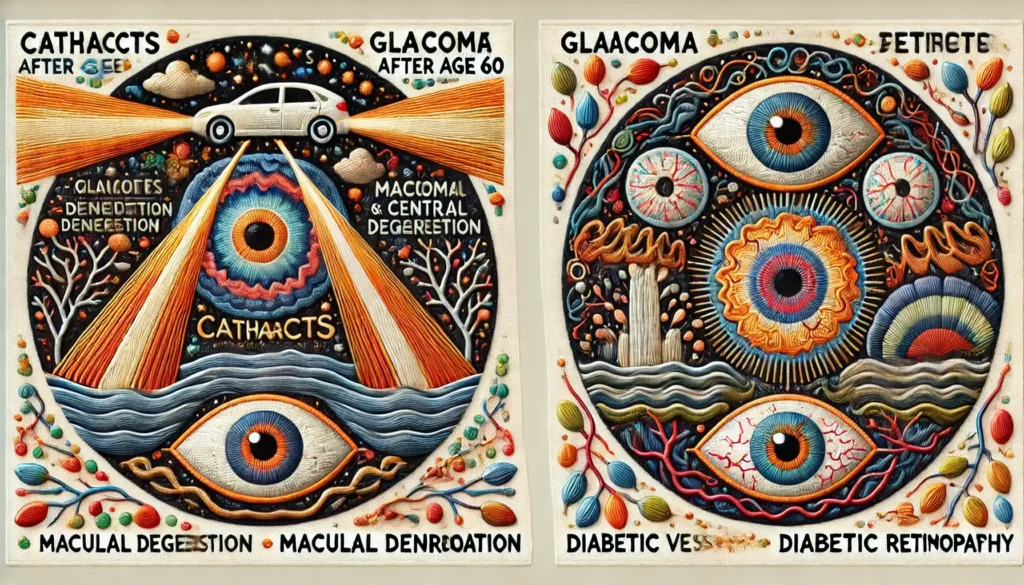
Diabetic Retinopathy: When Blood Sugar Hurts the Eyes
If you live with diabetes, your eyes are quietly keeping score. High blood sugar over time can weaken and leak the tiny blood vessels in your retina, leading to diabetic retinopathy (DR). This can cause blurring, dark patches, or even sudden vision loss if bleeding or swelling is severe.
In the United States, about one in four adults aged 40 and older with diabetes has some form of diabetic retinopathy, and recent estimates suggest roughly 9.6 million people are affected nationwide. The risk rises with longer duration of diabetes, higher A1C, high blood pressure, and kidney disease.
I still remember a grandfather who came in only when his granddaughter noticed he was holding picture books at arm’s length. He hadn’t had a dilated eye exam in eight years. His retinopathy was advanced, but with injections and laser treatment, we preserved enough vision for him to keep reading to her—just with bigger print and better lighting.
What you can do if you have diabetes
- Keep your A1C, blood pressure, and cholesterol as close to target as safely possible.
- Schedule yearly dilated retinal exams; sooner if your doctor recommends.
- Report any new floaters, patchy shadows, or sudden blur immediately.
- Ask whether you need retinal photographs or OCT scans at baseline.
- Pair your annual diabetes review with an annual eye check in your calendar.
- Ask for copies of your eye images to track progress over time.
- Talk with your eye specialist before any major diabetes medication change.
Apply in 60 seconds: If you have diabetes, open your calendar app and create a recurring “eye and A1C week” reminder once a year.
Cost, Coverage, and Medicare Questions for Eye Disease Treatment (US, 2025)
Even if you’re emotionally ready for treatment, the financial side can feel like another diagnosis. Cataract surgery, glaucoma lasers, macular injections, and diabetic eye treatments all involve different billing codes, prior authorization rules, and coverage tiers.
In many parts of the US, cataract surgery without insurance typically runs around $3,500–$7,000 per eye. Medicare Part B commonly covers 80% of approved costs after you meet the yearly deductible (around $257 in 2025), leaving you responsible for the remaining 20% and any non-covered extras. Premium intraocular lenses or laser-assisted techniques often sit outside standard coverage and can add several thousand dollars per eye.
Injections for wet AMD or diabetic macular edema may involve very expensive drugs. Coverage often depends on your plan’s formulary, prior authorization, and whether your retina clinic is in-network. Your out-of-pocket cost can range from a modest copay to hundreds of dollars per injection without coverage.
| Service | Typical self-pay range | Common coverage notes |
|---|---|---|
| Standard cataract surgery + basic lens (per eye) | $3,500–$7,000 | Often covered by Medicare/insurance after deductible, at ~80% of approved amount. |
| Premium or multifocal lens upgrade | +$2,000–$4,000 per eye | Frequently not covered; paid out-of-pocket. |
| Anti-VEGF injection (wet AMD/DR) | $300–$2,000+ per dose | Plan-dependent; subject to prior authorization and copays. |
| Glaucoma laser or surgery | $1,000–$6,000+ | Often covered as medically necessary; out-of-pocket depends on deductible and coinsurance. |
Numbers shown are broad estimates as of 2024–2025; your actual costs depend on your region, provider, and insurance.
Neutral action: Save this table and confirm each line item with your insurer and clinic’s billing team before scheduling any procedure.
- Ask, “Is this covered under my medical plan or my vision plan?”
- Confirm your Part B deductible and coinsurance before cataract surgery.
- For injections, ask which drug and billing code will be used.
Apply in 60 seconds: Grab your insurance card and write down your deductible and typical coinsurance percentage on a sticky note near your phone.
Daily Habits That Protect Your Vision After 60
Here’s the hopeful part: small daily choices genuinely influence how quickly age-related eye diseases progress. You can’t change your birthdate or your genes, but you can change what you eat, how you move, and how you manage chronic conditions.
A 2024 analysis suggested that following a Mediterranean-style eating pattern—rich in leafy greens, colorful vegetables, whole grains, olive oil, and fish—was associated with lower AMD risk and slower progression in older adults. That same type of diet also supports blood pressure, cholesterol, and blood sugar, which matter for glaucoma and diabetic eye disease.
- Quit smoking (or reduce drastically). Smoking doubles your risk for several eye diseases.
- Wear UV-protective sunglasses whenever you’re outdoors, even on cloudy days.
- Control blood pressure, cholesterol, and blood sugar with your primary-care team.
- Move your body most days of the week; even 20–30 minutes of walking helps circulation.
- Use task lighting and high-contrast materials at home to reduce eye strain.
One couple in their seventies decided to make “eye-friendly dinners” four nights a week: salmon or beans, dark greens, and bright orange or yellow vegetables. They weren’t perfect, but after a year their bloodwork improved—and more importantly, they felt they were actively fighting for their vision together.
- Pair eye-friendly foods with something you already enjoy.
- Keep one pair of good sunglasses near your door, another in the car.
- Measure your home lighting once and upgrade the darkest spots.
Apply in 60 seconds: Add “greens + something orange” to your next grocery list as a visual-health reminder.
How to Prepare for Your Next Eye Appointment
Going to an eye doctor can feel like speed dating: a lot of questions, a short window, and you walk out thinking of three things you forgot to say. A little prep work turns that rushed visit into a real strategy session for your vision.
If you’re in the United States, it’s worth knowing that many routine eye exams fall into a gray zone: some are billed as “medical” (e.g., monitoring glaucoma, AMD, DR) and go through Medicare Part B or private insurance; others are “vision” exams (mostly refractive) and use a separate vision plan. That’s why you might see different copays and deductibles for what feels like the same visit.
Before you compare cataract surgery centers or retina clinics, gather:
- Your insurance card(s) and a photo of the back with customer-service numbers.
- A list of all eye medications and drops, plus any blood thinners or diabetes meds.
- Past eye surgery dates, if any (LASIK, cataract, retinal procedures).
- Your priorities: night driving, reading, computer work, or hobbies like sewing.
- Recent lab results (A1C, blood pressure summary) if you have chronic conditions.
Neutral action: Keep this list in a folder or note on your phone and bring it whenever you ask for a quote or second opinion.
In the UK or other countries with national health systems, your pathway may run through your general practitioner, who refers you to hospital eye services. Knowing your system’s referral rules—and waiting times—helps you decide if you need private care for faster access or if the standard path is enough.
- Write down your top three vision frustrations.
- Bring all current glasses and contact lens boxes.
- Ask, “If this were your eyes, what would you do in the next year?”
Apply in 60 seconds: Start a small “eye file” (physical or digital) and drop in your last exam summary, so you’re not scrambling before the next one.
Emergency Eye Symptoms You Should Never Ignore
Most age-related eye changes are slow and polite. Some are not. These are the situations where you should treat your eyes the way you’d treat chest pain: not tomorrow, now.
- Sudden vision loss in one or both eyes.
- A dark curtain or shadow moving across your vision (possible retinal detachment).
- New, intense flashes of light or a sudden “shower” of floaters.
- Severe eye pain, redness, halos around lights, and nausea (possible acute glaucoma attack).
- Sudden double vision or trouble moving one eye.
If any of these appear, bypass routine booking systems. Use your eye doctor’s emergency number, an urgent-care clinic with eye equipment, or the emergency department—whatever gets you seen fastest and safely. Your future vision may depend on hours, not days.
I once spoke with a man who waited three days with a “gray shadow” because he “didn’t want to bother anyone on the weekend.” By Monday, his retinal detachment was more complex and harder to repair. He regained some vision, but not all. His words to others: “Don’t be polite. Be annoying if you have to. It’s your eyesight.”
Living Well With Low Vision and New Technologies
Even with the best medicine, some people over 60 end up with permanent vision loss. That doesn’t mean life is over. It does mean you may need new tools, new habits, and sometimes new technology.
Low-vision specialists can help you use magnifiers, telescopic glasses, large-print devices, high-contrast settings on phones and tablets, and clever lighting setups at home. A few clever changes—like bump-on stickers on appliances and bold markers for medication labels—can cut daily frustration dramatically.
Newer technologies are also emerging. Recent clinical trials of tiny retinal implants combined with special glasses have allowed some people with late-stage dry AMD to read letters and words again after losing central vision. These devices are still specialized, require training, and aren’t for everyone—but they’re a sign that innovation hasn’t stopped just because you turned 70.
One woman described her first successful session with low-vision rehab like this: “It felt like I’d been trying to read the world through a keyhole, and someone finally showed me how to move the keyhole instead of blaming my eyes.” That shift—from defeat to problem-solving—is the heart of living well with low vision.
- Ask your eye doctor for a “low-vision rehab” referral if print feels too hard.
- Experiment with phone accessibility settings: larger text, bold fonts, voice control.
- Consider support groups—vision loss is emotional as well as physical.
Apply in 60 seconds: On your phone, open accessibility settings and bump your text size one notch higher as a test.
Short Story: Finding Hope in a Waiting Room
Short Story: The first time Ellen walked into the retina clinic, she was angry. At 74, she’d just been told she had wet macular degeneration in her better eye. She sat in the waiting room, arms folded, silently judging every poster on the wall. A younger man across from her was fidgeting with his car keys. “First visit?” she asked. He nodded.
“I’m scared I won’t be able to drive my kids,” he admitted. Without thinking, she said, “I’ve been getting injections for a year. I still read, boss my granddaughter, and terrorize my book club. You’ll learn the drill.” They both laughed, a little too loudly. Later, as she left, she realized something had shifted. Her eyes weren’t “failing” in isolation; she was part of a room full of people quietly fighting for their vision, one appointment at a time. The fear didn’t vanish, but it became something she could walk into instead of run from.
FAQ
Q1. How often should I get my eyes checked after 60?
Most experts recommend a comprehensive dilated eye exam at least once a year after 60, even if you have no symptoms. If you already have cataracts, glaucoma, AMD, or diabetic retinopathy, your doctor may need to see you every 3–6 months.
60-second action: If you can’t remember your last dilated exam date, treat that as your sign to book one within the next three months.
Q2. Does Medicare cover routine eye exams for seniors?
Original Medicare (Part A and B) generally doesn’t cover routine “check-your-glasses” eye exams, but it does cover medically necessary visits—for example, monitoring cataracts significant enough to affect safety, glaucoma, AMD, or diabetic eye disease. Many Medicare Advantage plans and separate vision plans offer additional routine coverage.
60-second action: Call the number on your insurance card and ask, “What eye exams are covered for me this year, and what is my copay?”
Q3. How do I know if my cataracts are “bad enough” for surgery?
There’s no single number on a chart that flips the switch. Instead, doctors look at how cataracts affect your daily life: night driving, reading, recognizing faces, work, or hobbies. If glasses no longer solve your problems and your cataracts are the main cause, surgery becomes a reasonable option.
60-second action: Write down three tasks that your vision makes difficult now; bring that list to your next eye visit and ask your doctor to comment on each one.
Q4. I have diabetes but good vision. Do I really need annual retinal exams?
Yes. Diabetic retinopathy can be quite advanced before you notice any blur. Regular retinal exams allow your doctor to catch small leaks, swelling, or new vessels early, when treatment is easier and more effective.
60-second action: Pair your retinal exam with another yearly event—an anniversary, tax season, or birthday—so you remember to schedule it consistently.
Q5. Can lifestyle changes really make a difference if I already have AMD or glaucoma?
They won’t replace medical treatment, but they can support it. Not smoking, eating an eye-friendly diet, controlling blood pressure and blood sugar, and using UV protection can reduce additional damage and help treatments work as well as possible.
60-second action: Choose one habit—such as wearing sunglasses whenever you step outside—and commit to improving that for the next two weeks.
Q6. What can I do if I can’t afford the copays for injections or surgery?
Many clinics have payment plans, social workers, or access to drug assistance programs from manufacturers. Some charitable organizations help with costs for eligible patients. Talk to the billing office before you cancel or delay treatment; they would rather help you find a safe solution than see your vision deteriorate.
60-second action: Before your next visit, call the clinic and say, “I’m worried about affording my treatment. Is there someone I can speak with about payment options or assistance programs?”
Summary and Next Steps
Let’s close the loop on that first question: “Are my aging eyes just annoying—or truly at risk?” The honest answer is usually “both.” Cataracts, glaucoma, macular degeneration, and diabetic retinopathy become more common after 60, but you’re not a passenger. With regular exams, smart questions, realistic cost planning, and a few surprisingly simple habits, you can tilt the odds strongly in favor of keeping the vision that lets you read, drive, cook, and recognize the faces you love.
In the next 15 minutes, you can:
- Book (or at least calendar) your next dilated eye exam.
- Run through the 60-second urgency estimator if you’re worried right now.
- Start an “eye file” with your last exam note, insurance info, and a list of questions.
Your eyes have carried you through millions of pages, roads, and faces. They’re worth a plan, not just a wish. Start with one small action today, and let your future self—still reading, still recognizing, still moving through the world with confidence—say thank you.
Last reviewed: 2025-11; sources include major ophthalmology journals, public-health agencies, and national eye institutes. age-related eye diseases after 60, cataracts in seniors, glaucoma after 60, macular degeneration treatment options, diabetic retinopathy in older adults
🔗 Early Warning Signs of Cataracts in Your 60s and 70s (When to See an Eye Doctor): 7 Scary Red Flags I Nearly Ignored