


How Often Should Seniors Get Dilated Eye Exams? Evidence-Based Guide – 7 Life-Saving Lessons from My Dad’s Scary Glaucoma Wake-Up Call
The night my dad finally said the words, “Something’s wrong with my eyes,” we weren’t at the doctor’s office or anywhere dramatic like that. We were in the kitchen — him squinting at the microwave, trying to figure out why the numbers looked “kind of smudged on one side.” For a second, I thought maybe the microwave was dirty. Nope. His vision was.
He could still read the paper, still drive himself to the store and back. But glaucoma doesn’t tap you on the shoulder — it quietly erases your side vision, like someone slowly drawing the curtains without asking. That moment in the kitchen? It was our wake-up call.
So, this guide? It’s my way of helping you or someone you love not wait for a blurry microwave moment. Over the next few minutes, I’ll walk you through how often seniors really need dilated eye exams (spoiler: more than you think), why glaucoma is so sneaky (no pain, no warning), how Medicare and insurance actually work for eye care (because the fine print is blurry), and how to create a super simple exam schedule you can stick to — even if you’re tired, overwhelmed, or kind of in denial. (It’s okay. We were too.)
Let’s make sure you catch the problem before it’s stealing your sight — not after.
Table of Contents
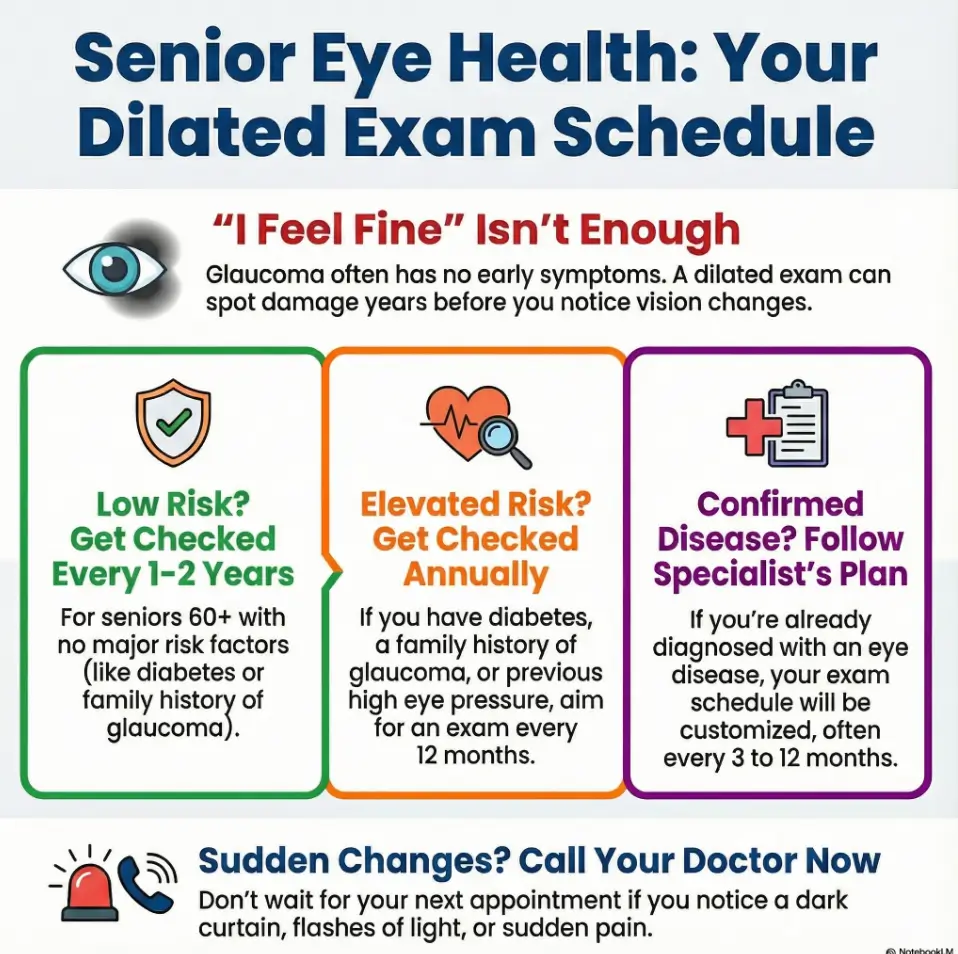
- Age 60+ with no major risk factors: comprehensive dilated eye exam every 1–2 years is widely recommended.
- Age 60+ with glaucoma risks (diabetes, family history, certain ethnic backgrounds): aim for every 12 months or as your eye specialist advises.
- Already diagnosed with glaucoma or other eye disease: follow your specialist’s plan — often every 3–12 months.
Apply in 60 seconds: Circle the row that fits you best, then compare it with what’s on your calendar right now.
Why My Dad’s Glaucoma Wake-Up Call Changed Everything
My dad is the classic “I’m fine, don’t fuss” kind of person. He skipped eye exams for years because he could still read the sports section and find the remote. When he finally sat in the ophthalmologist’s chair, the doctor showed us the visual field test: a ghostly grey island where his side vision used to be.
Lesson 1: “I feel fine” is not a screening tool. Glaucoma doesn’t usually cause pain, redness, or obvious blur in the early stages. It quietly trims your side vision first, so you can still read the center of the page while losing the edges. By the time most people notice on their own, permanent damage is already done.
That kitchen confession — “the numbers look smudged” — was his wake-up call, but it came late. A regular dilated eye exam could have spotted pressure changes and optic nerve damage years earlier. The good news: once we had a clear schedule, his progression slowed, and he kept his driver’s license and his independence.
Short Story: the day the curb disappeared. One afternoon, before his diagnosis, Dad was walking our neighborhood loop. He went to step off the curb, misjudged where it ended, and stumbled hard. He laughed it off as “clumsy ankles,” but later he admitted he never really saw the curb on his left. On the visual field map, that exact area was blank. That moment — a simple walk, a hidden blind spot — is why I’m writing this for you. Most seniors don’t lose vision in a dramatic flash. They lose it one missed step, one bumped shoulder, one “Why is that person suddenly so close to me?” at a time.
“If someone you love keeps saying ‘I’m fine, I can still read the paper,’ translate it as ‘I need a real eye exam, not a guess.’”
- Glaucoma usually starts without pain or obvious blur.
- Side vision can shrink while center vision looks “normal.”
- A dilated eye exam is how doctors see damage you can’t feel.
Apply in 60 seconds: Write one name: the person in your life most likely to say “I’m fine.” They’re your first exam buddy.

How Often Should Seniors Get Dilated Eye Exams, Really?
Let’s answer the big question directly and then add nuance.
Major eye health organizations in the United States recommend that adults age 60–65 and older have a comprehensive dilated eye exam every 1–2 years, even if they have no symptoms and think their vision is fine.
For people at higher risk of glaucoma — including those over 60, anyone with a family history of glaucoma, and certain ethnic groups — the National Eye Institute advises a comprehensive dilated exam every one to two years, with some specialists recommending annual or more frequent visits depending on the optic nerve and eye pressure findings.
Lesson 2: after 60, “sometime soon” means maximum every 1–2 years. The older you get, the less safe it is to stretch that gap. My own rule for Dad became simple: if we couldn’t clearly remember the last dilated exam month and year, it was already time to book the next one.
Here’s a practical way to think about it:
- Age 60–64, no major risk factors: at least every 1–2 years, sooner if you notice any change.
- Age 65+ with stable eyes and no extra risks: most doctors lean toward annual exams as a safer default.
- Any age with risk factors (diabetes, strong family history, prior abnormal pressure): you’re in the “at least annual, often more” bucket.
One more wrinkle: there is a difference between a quick glasses check and a comprehensive dilated exam. The first might just tweak your prescription; the second is a medical evaluation of your retina, optic nerve, and eye pressure that can catch disease years earlier.
So when you call to schedule, use clear language: “I’m over 60; I need a comprehensive dilated eye exam, not just a glasses update.” That one sentence can change what actually happens in the chair.
- Ask specifically for a “comprehensive dilated eye exam.”
- Know that age 60+ automatically raises your risk profile.
- Risk factors usually pull you toward annual or more frequent exams.
Apply in 60 seconds: Grab your calendar and write down the month and year of your last truly dilated exam — not just when you picked new frames.
What Actually Happens During a Dilated Eye Exam
Part of what scared my dad was the mystery. “Why do they need to pour drops in my eyes? Are they doing experiments back there?” Once he understood the steps, the fear shrank.
In a comprehensive dilated eye exam, your eye doctor will typically:
- Check your visual acuity (the classic “read line three” chart).
- Measure your eye pressure (tonometry) using a small puff of air or a gentle device.
- Use dilating drops to widen your pupils, letting more light into the back of the eye.
- Examine your optic nerve, retina, and blood vessels with special lenses and lights.
- Often run a visual field test to map your side vision.
The dilation part matters: a comprehensive dilated eye exam is the only way to fully check for early signs of glaucoma, diabetic retinopathy, and macular degeneration before symptoms are obvious.
You’ll likely be light-sensitive and a bit blurry up close for a few hours afterward. My dad described it as “someone put a soft-focus filter on the world.” It’s annoying, but temporary.
Lesson 3: the drops are the boring part; the information they unlock is priceless. Those few minutes of dilation are what let your doctor see the small, silent changes that keep you driving, reading, and recognizing faces five, ten, or fifteen years from now.
Show me the nerdy details
During dilation, the muscles in your iris relax, letting the pupil open wider than usual. That gives your doctor a wider “window” to the retina and optic nerve. In glaucoma, subtle changes in the optic nerve head — like thinning of the nerve fiber layer or cupping — can appear before you notice any functional change. Combining dilation with imaging tools and visual field testing lets your doctor track whether those structures are stable from year to year or slowly worsening. For diabetes or age-related macular degeneration, dilation reveals tiny leaks, bleeding, or deposits in the retina long before you see distortions or central blind spots.
- Expect 2–4 hours of light sensitivity afterward.
- Plan a ride home if night driving is tricky for you.
- Ask your doctor to explain what they see in plain language.
Apply in 60 seconds: Add “bring sunglasses and a companion” next to your next exam date in your calendar.
Who Needs More Frequent Dilated Exams After 60?
Not all eyes age at the same speed. Some seniors can safely stay in the 1–2 year interval; others really shouldn’t.
Common reasons your doctor may recommend at least annual, and sometimes 6–12 month, dilated exams include:
- Diabetes: even with good control, diabetes raises your risk of diabetic retinopathy and glaucoma.
- Family history of glaucoma: especially in a parent or sibling.
- Higher-risk ethnic background: for example, Black adults over 40 and Hispanic/Latino adults over 60 have a higher glaucoma risk in U.S. data.
- Previous high eye pressure or “suspicious” optic nerves.
- Existing eye diseases: glaucoma, macular degeneration, or significant cataracts.
Lesson 4: your risk factors, not your birthday alone, set the tempo. My dad had two big risk factors: family history and borderline high eye pressure that everyone hoped would behave. Once glaucoma actually showed up, his schedule moved from “come back next year” to “see you in six months” — and during a rough patch, “see you in three.”
Here’s the part I wish someone had told us earlier: insurance rules and medical needs are not identical. Medicare may cover one screening glaucoma test every 12 months for people at high risk, but your doctor may still want to see you more often for follow-up or treatment monitoring. That extra visit is not a “bonus”; it’s what keeps the disease from silently marching on.
If this feels overwhelming, start simple: make a two-column list. Left: your risk factors (diabetes, family history, previous findings). Right: what your doctor says about frequency. Anywhere those two disagree is a place to ask follow-up questions.
- Tell your eye doctor about all medical conditions, not just vision symptoms.
- Insurance coverage frequency is a floor, not always the ideal schedule.
- You can ask directly, “What puts me in a higher-risk group?”
Apply in 60 seconds: Jot down your top three health conditions and one family eye history detail to bring up at your next visit.
Costs, Coverage, and Medicare: Avoiding Surprise Bills
Eye health is personal, but the billing codes are not. They can either quietly support you or quietly ambush you.
In the United States, Medicare Part B generally does not cover routine vision exams just to check your glasses — but it does help pay for comprehensive dilated eye exams when they’re medically necessary, including for people with diabetes or at higher risk for glaucoma. Typically, Medicare pays about 80% of the approved amount after you meet the Part B deductible; you or your supplemental plan pick up the rest.
For glaucoma screening, Medicare usually covers one screening test every 12 months if you meet high-risk criteria (such as diabetes, certain ethnic backgrounds, or family history). More frequent exams may be covered when they’re considered diagnostic or follow-up, not just screening.
That’s where many seniors get confused: “But Medicare already paid for a test this year.” Yes — but that screening limit is not the same as a hard stop on medical care. If your doctor finds glaucoma or suspects it, follow-up visits and tests can fall under different coverage rules.
Money Block: Sample Fee & Coverage Table (2025, US – approximate)
Numbers vary by region and provider. These ballpark ranges are for orientation only, not quotes.
| Scenario | Typical Frequency | You May Pay | Notes |
|---|---|---|---|
| Comprehensive dilated exam, Original Medicare, medically necessary | Every 12–24 months (or as advised) | Deductible + ~20% of approved amount | Often partly covered by Medigap or secondary insurance. |
| Glaucoma screening, high-risk patient, Part B | Once every 12 months | Deductible + ~20% of approved amount | Must meet Medicare’s definition of high risk. |
| Routine vision exam (glasses only), Original Medicare | As scheduled | Usually full cost | Sometimes covered by Medicare Advantage or other plans. |
Apply in 60 seconds: Call your plan and ask, “How often do you cover comprehensive dilated exams and glaucoma screening, and what’s my share after deductible?” Then note their answer next to your exam date. Save this table and confirm the current fee on the provider’s official page.
Lesson 5: coverage rules are tools, not excuses. We used to treat Medicare rules as a ceiling — “Well, they only cover once a year.” Now we treat them as a safety net: the minimum coverage you can count on while still following what the doctor thinks is medically necessary.
If you’re outside the US: your country may fund regular eye exams through national health services or private insurance. Many systems offer fully or partly covered exams after a certain age, especially when there’s diabetes or glaucoma risk. The pattern is similar: routine glasses checks may be limited, but medically necessary dilated exams are usually covered more generously. The 60-second action is the same: call or log in to your insurer’s site and lock in the frequency and copay for dilated exams specifically.
- Medicare Part B often covers 80% of approved exam costs after deductible.
- High-risk glaucoma screening is usually annual, not optional.
- Your medical needs can justify more frequent follow-ups than the basic screening rule.
Apply in 60 seconds: Write one line on a sticky note: “Eligibility first, quotes second — I’ll save 20–30 minutes.” Stick it near your insurance card as a reminder before you call.
60-Second Dilated Eye Exam Urgency Estimator
This is not a diagnostic tool, and it doesn’t replace a doctor. It’s a way to turn fuzzy guilt — “I should probably go” — into a concrete nudge.
Money Block: 60-Second Dilated Exam Urgency Estimator
This quick estimator is for education only. It can’t diagnose disease or override your doctor’s advice. Save any result that worries you and discuss it with your eye care professional.
Apply in 60 seconds: After you see your result, either open your calendar app or write a question for your doctor. Save this block and confirm any date changes with your provider’s office.
- Age, risk factors, and time since last exam all matter.
- Most seniors should feel uneasy if it’s been 2+ years.
- The right next step is usually “call the clinic,” not “panic.”
Apply in 60 seconds: Screenshot your estimator result and save it in the same place as your insurance card.
Warning Signs You Should Not Wait for Your Next Annual Visit
There are times when “I’ll mention it at my next checkup” is too slow.
Call your eye doctor promptly — or seek urgent care if symptoms are severe — if you notice:
- Sudden vision changes: a dark curtain, big missing patch, or lightning-like flashes.
- Persistent eye pain or redness that’s new and not explained by allergy or strain.
- Halos around lights with headache and nausea.
- Rapid worsening of side vision or bumping into objects on one side.
- Double vision that doesn’t go away when you blink or rest.
Not all of these mean glaucoma — other eye conditions can be at play — but they all deserve more than a “wait and see.” Sudden, severe symptoms can represent emergencies; in those situations, calling emergency services or going to an emergency department is often safer than waiting for a routine clinic slot.
Lesson 6: your exam schedule is a safety net, not a cage. The calendar doesn’t get to veto your instincts. If something feels off, you’re allowed to move up your appointment.
With my dad, the biggest signal wasn’t pain. It was behavior. He stopped driving after dark “because headlights bug me” and quietly rearranged furniture to keep paths clear. Those were early self-adjustments to shrinking side vision. Once we saw that pattern, we moved quickly.
If your habits are changing to protect your vision — fewer night drives, extra lights, avoiding steps — that’s your cue to get checked, not just cope.
- Vision changes, pain, or halos deserve timely assessment.
- Behavior changes (“I avoid stairs now”) are red flags, too.
- Emergencies call for emergency care, not a routine visit.
Apply in 60 seconds: Write one sentence in big letters: “If my vision suddenly changes, I call — I don’t wait.” Put it near your phone.
How to Talk to Your Eye Doctor Like a Pro
One of the quiet tragedies of healthcare is people walking out of appointments more confused than when they walked in. Let’s not do that here.
Here are questions that shifted Dad’s care from vague to laser-focused:
- “What is my exact diagnosis? Am I a glaucoma suspect, or do I clearly have glaucoma?”
- “What did my optic nerve and retina look like today compared with last time? Better, worse, or stable?”
- “Given my age and risk factors, how often do you want me dilated? Please give me a range in months.”
- “What happens if I only come every two years instead of yearly? What’s the realistic risk?”
- “Can you write down my next due date for a dilated exam on this card? I forget once I get home.”
Doctors are busy, but most appreciate clear, focused questions. When Dad started arriving with a short written list, his appointments became less rushed and more productive.
For caregivers or adult children, it helps to frame things in terms of independence: “We want to keep him driving as long as it’s safe. What schedule gives us the best odds?” That’s a concrete outcome that maps directly to exam frequency and treatment decisions.
Lesson 7: you get better care when you treat the doctor as a partner, not a vending machine. Share your fears. Ask about trade-offs. It’s okay to say, “I’m overwhelmed; can you explain that again more simply?” That one sentence has saved my family thousands of dollars and who-knows-how-many neurons of stress.
- Ask what your optic nerve and visual field look like over time.
- Get a written month/year for your next dilated exam.
- Discuss how exam frequency ties to goals like driving or reading.
Apply in 60 seconds: Write down two questions from this list you’d actually feel comfortable asking at your next visit.

Build Your Personal Exam Schedule in 15 Minutes
Now we tie everything together into something you can put on the fridge.
- Mark your last dilated exam. Month, year, clinic name.
- Write your risk factors. Age, diabetes, family history, previous findings.
- Copy your doctor’s recommendation. “Every 12 months” or “every 6 months,” etc.
- Set your next due window. For example: “Between March and May 2026.”
- Book inside that window now, not later. Clinics fill up; future-you will be busy.
Think of this as your exam coverage tier map:
- Tier 1 – Healthy senior, no extra risk: every 1–2 years, often yearly after 65.
- Tier 2 – Senior with one risk factor: at least yearly; many doctors prefer every 9–12 months.
- Tier 3 – Diagnosed glaucoma or major disease: every 3–12 months, customized to your eye.
Downloading your schedule onto paper makes it easier to coordinate with Medicare, supplemental plans, or private insurance. It also helps you compare coverage tiers and this year’s deductible before you pay.
Infographic: Dilated Eye Exam Timeline After 60
Tier 1: Lower Risk
Age 60–70, no major risk factors.
Timing: Every 1–2 years.
Color in one box for each exam on your calendar.
Tier 2: Elevated Risk
Diabetes, family history, or suspicious findings.
Timing: Every 9–12 months.
Think “same month every year.”
Tier 3: Confirmed Disease
Glaucoma, advanced cataract, or macular disease.
Timing: Every 3–12 months.
Follow your specialist’s written plan exactly.
Use it: Circle your tier, then write your “ideal exam month” on a sticky note and put it on your fridge or inside your planner.
For US readers: once you know your tier, you can ask your plan a very targeted question: “At my tier, how often will you cover comprehensive dilated exams, and what’s my out-of-pocket cost after deductible?” Lock the year and ZIP code before comparing rates; that alone can save 20–30 minutes of phone tag.
- Match your tier (1–3) with a specific exam interval.
- Book the next exam while you still remember this page.
- Keep the schedule where family or caregivers can see it.
Apply in 60 seconds: Choose your “exam month” for next year and write it in your phone, on paper, or both.
Nerdy Details: Glaucoma, Dilation, and the Science in Plain English
Glaucoma is not one disease but a group of conditions that damage the optic nerve — the cable that carries visual information from your eye to your brain. Often, but not always, eye pressure is involved. The scary part is that you can lose 30–40% of your optic nerve fibers before you notice a symptom.
That’s why comprehensive dilated exams matter. Dilation lets your doctor see the shape and color of the optic nerve head, look for thinning of the nerve fiber layer, and compare photos or scans over time. A shrinking rim or deepening “cup” can reveal damage years before your reading vision complains.
Visual field testing adds another layer: it checks how well you detect tiny lights in different parts of your vision. Glaucoma often shows a signature pattern — side vision loss or arc-shaped blind spots — that doesn’t match simple “I need stronger readers.”
From a science standpoint, the logic of frequent exams is simple:
- The older you are, the higher your baseline risk.
- The more risk factors you have, the steeper the curve.
- More exams mean more chances to catch small changes before they become big, permanent ones.
For my dad, seeing the “before and after” optic nerve images was the real wake-up call. It wasn’t a lecture that convinced him; it was a picture where part of the nerve looked like it had been quietly erased. Once the drops, tests, and follow-ups made sense at that level, he stopped arguing with the calendar.
- Structure (nerve photos) shows long-term damage or stability.
- Function (visual fields) shows how you actually see.
- Pressure readings help guide treatment intensity and timing.
Apply in 60 seconds: At your next visit, ask, “Can you show me how my optic nerve and visual fields have changed over time?”
FAQ
Q1. What is the safest exam frequency if I’m over 70 and have no big eye problems yet?
For many people over 70, an annual comprehensive dilated exam is a comfortable balance between safety and convenience, especially as risks for cataracts, macular degeneration, and glaucoma climb with age. Some may be able to stretch to 18–24 months, but that decision should be made with your eye doctor, based on your optic nerve, retina, and overall health. 60-second action: Ask, “If I were your parent, would you rather see me yearly or every two years?” and write the answer down.
Q2. How often should I get dilated exams if I already have glaucoma?
Once glaucoma is diagnosed, exam frequency becomes more individualized. Early, well-controlled disease might mean visits every 6–12 months. More advanced or unstable disease can require visits every 3–4 months, and sometimes more often when medications or pressures change. Your doctor will base this on how your optic nerve, visual fields, and pressure behave over time. 60-second action: Before leaving your next visit, say, “Please write the exact month you want to see me again on this card.”
Q3. How do costs and insurance coverage affect how often I can realistically go?
Costs are real, but they shouldn’t be mysterious. In the US, Medicare and many private plans help pay for medically necessary dilated exams, particularly for diabetes and glaucoma risk. Coverage for routine glasses checks may be more limited. Rather than guessing, call your plan and ask how often they cover comprehensive dilated exams, what the deductible is, and what you pay after that. 60-second action: Write three questions for your insurer, call once, and keep the answers with your exam schedule.
Q4. What if my doctor says “every two years,” but I feel safer going yearly?
It’s okay to ask for yearly exams, especially after 65, if that helps your peace of mind and budget. The key is to make sure your doctor understands your history and your fears. Say, “I’d feel safer with yearly checks — is there any medical reason that would be a bad idea?” Usually there isn’t, and the main constraint becomes time and cost. 60-second action: Decide what schedule feels safe to you, then bring it to your doctor as a proposal, not a demand.
Q5. I’m caring for a parent who resists appointments. How can I help without starting a war?
Start with stories, not threats. Share how someone they know or someone in the news nearly lost vision because they waited too long. Keep the focus on independence: driving, reading, hobbies, seeing grandchildren. Offer to make the calls, do the driving, and handle the paperwork. Sometimes framing it as a “checkup for the family,” not a lecture, lowers resistance. 60-second action: Choose one concrete offer — “I’ll book it and pick you up” — and present it gently but clearly.
Q6. Do I always need dilation, or can modern machines replace the drops?
Some clinics use wide-field imaging that can sometimes reduce the need for dilation in low-risk patients, especially younger adults. But for many seniors and almost everyone with glaucoma risk, dilation remains an important part of a comprehensive exam. Machines add information; they rarely replace the need to fully view the optic nerve and retina in higher-risk eyes. 60-second action: Ask, “In my case, would skipping dilation make you miss anything important?” and follow the answer, even if it means a few hours of blurriness.
Bringing the Lights Back Up: Final Thoughts and Next Steps
My dad didn’t lose his license. He still reads the paper, badly tells jokes, and complains about the price of coffee. We can’t undo the nerve damage that was already there when he finally walked into that exam room — but steady, scheduled, dilated exams have kept things from getting dramatically worse.
If you remember nothing else from this guide, remember this:
- After 60, every 1–2 years is the bare minimum for comprehensive dilated exams, with annual visits being safest for most seniors.
- Risk factors like diabetes, family history, or prior findings usually mean at least yearly, sometimes more.
- Insurance rules should support your eye health plan, not trap it.
Glaucoma and other age-related eye diseases are sneaky, but they’re not unbeatable. They move slowly enough that a good schedule can outpace them — as long as that schedule lives somewhere other than your memory.
- Set your exam frequency based on age and risk, not convenience alone.
- Write it down where you and your family can see it.
- Use coverage information to plan, not to delay care.
Apply in 60 seconds: Within the next 15 minutes, choose one: call your eye clinic, log in to your patient portal, or set a calendar reminder titled “Book my next dilated exam.”
Last reviewed: 2025-12. This guide is for education and planning only and does not replace personalized advice from your eye care professional or other qualified health providers.
how often should seniors get dilated eye exams, glaucoma in seniors, comprehensive dilated eye exam, medicare glaucoma screening, senior eye health schedule