

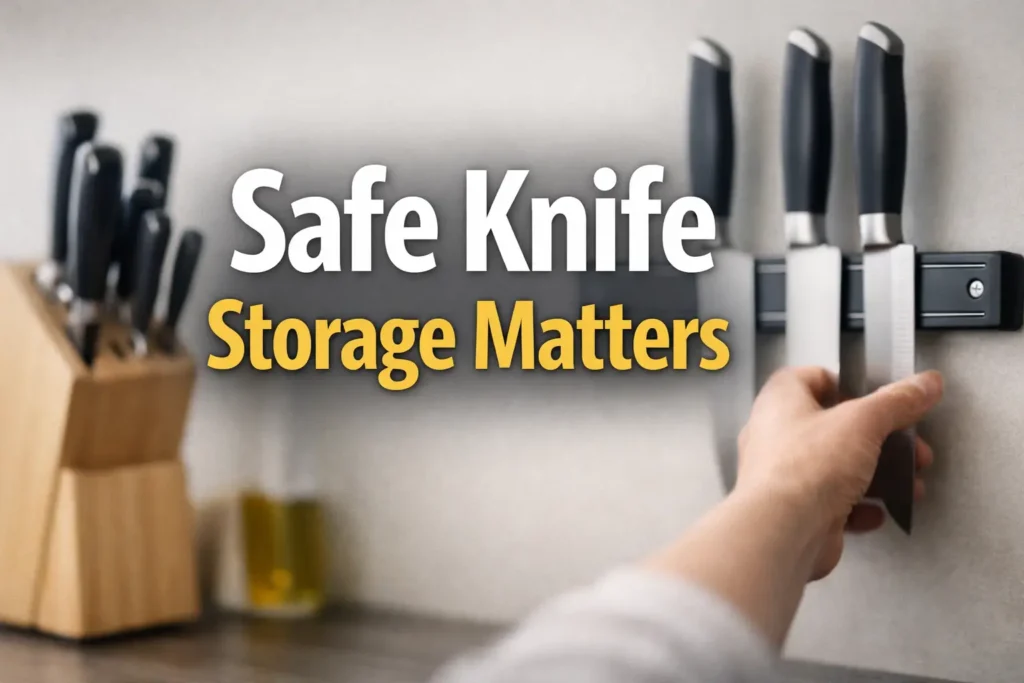
Precision Beyond Sight: Redefining Safe Knife Storage
Safe knife storage for low vision is rarely about style. It is about what happens in the half-second when your hand reaches for steel and the kitchen asks you to trust a system that may or may not deserve it.
Most sighted buying guides get this wrong. They talk about counter space, aesthetics, and “easy access,” while low-vision cooks are dealing with something much more concrete: exposed edges, awkward reach angles, inconsistent knife placement, and the quiet stress of having to search by touch when tired or distracted.
Keep guessing, and the cost is not just annoyance. It is hesitation, near-misses, and a kitchen that never quite feels safe.
This guide helps you choose between a magnetic knife strip, a knife block, and safer enclosed alternatives based on how a real kitchen actually works, not how a showroom looks. You will be able to judge the retrieval pattern, reduce surprise blade contact, and build a setup that is easier to repeat on ordinary, imperfect days.
The approach here is practical on purpose: real-world hand paths, tactile predictability, household routines, and the small setup mistakes that quietly raise injury risk.
Because that is where safety lives. Not in the product photo. In the motion.
Fast Answer: For many low-vision households, a stable knife block or other enclosed slot system is often safer than a magnetic strip because blade exposure is lower and hand placement is more repeatable. A magnetic strip can still work, but only when height, spacing, pull-off motion, and household consistency are carefully controlled. The safest setup is the one that makes your hand motion obvious before you touch steel.
Table of Contents
Who this is for / not for
Who this is for
- Low-vision home cooks deciding between a magnetic strip and a knife block
- Mixed-vision households trying to create one safer kitchen system
- Caregivers helping organize a kitchen for repeatable, lower-stress use
- Anyone who wants safer knife access without relying on sight alone
Who this is not for
- Professional kitchens with fast multi-user tool turnover
- Households looking for child-proofing as the primary goal
- People seeking medical or occupational therapy advice tailored to a specific diagnosis
- Anyone whose current setup already causes near-misses and needs immediate in-person safety guidance
This matters because advice gets weirdly generic when the internet smells a shopping opportunity. One guide says, “Magnetic strips save space.” Another says, “Blocks protect blades.” Both statements can be true and still be useless. Neither tells you what happens when someone reaches from the wrong angle with wet hands, or when one family member returns the chef’s knife handle-left and another returns it handle-right as if they are composing jazz.
I once watched a perfectly smart home cook freeze for two seconds over a magnetic strip because the knife they wanted was easy to identify visually but awkward to remove without brushing the neighboring blade. Two seconds is not a long time. In kitchen-risk math, it is plenty. When sharp tools are involved, hesitation often means the system is asking the hand to solve a puzzle. That is the problem we are here to eliminate.
- Low blade exposure usually reduces surprise
- One consistent return location lowers stress
- Household consistency matters as much as hardware
Apply in 60 seconds: Notice whether your current setup forces hovering, searching, or re-gripping before a knife is secure in your hand.
The real question is not “which is better?”
It is “which creates fewer surprise blade moments?”
- Why low-vision knife storage is a predictability problem before it is a product problem
- How reach angle, hand placement, and blade exposure change the risk picture
The safest system is usually the one you can repeat half-asleep
- Why consistency beats sleek design
- How routine lowers cognitive load in a busy kitchen
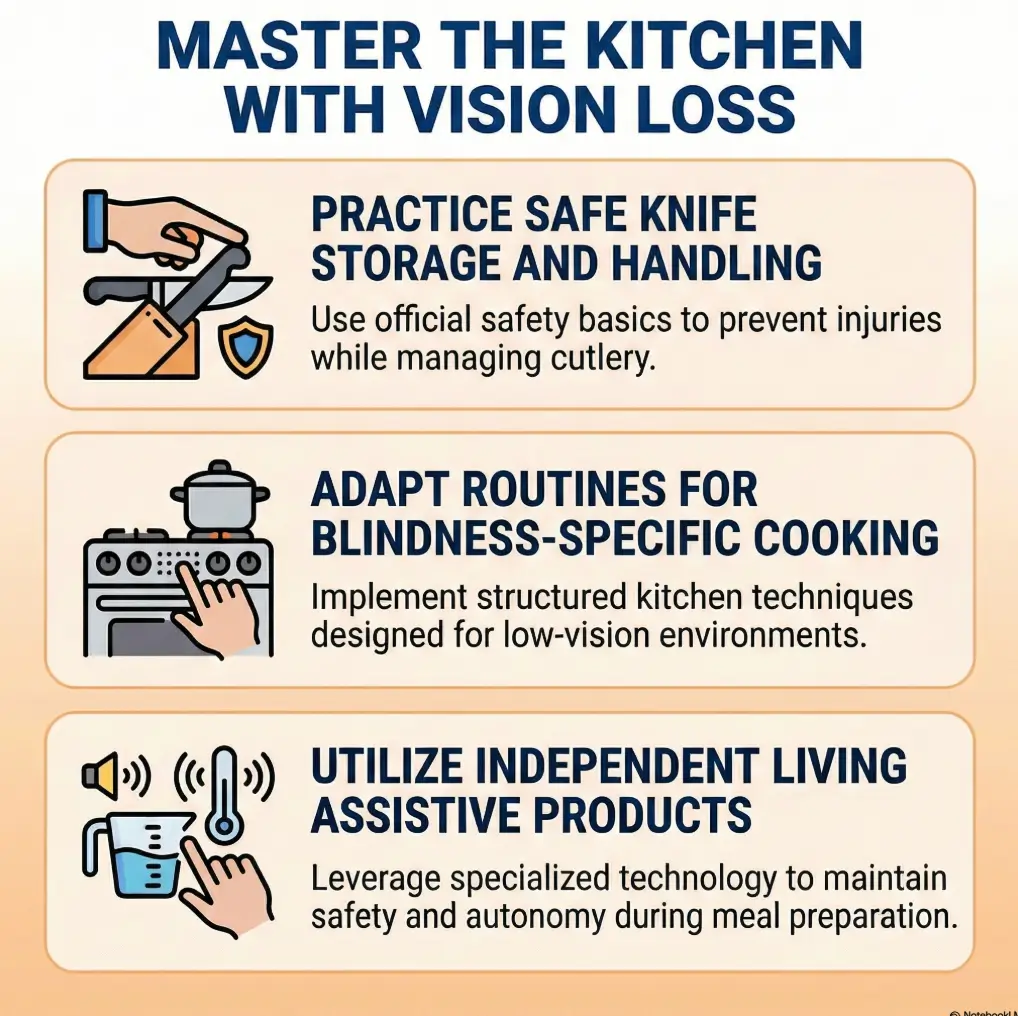
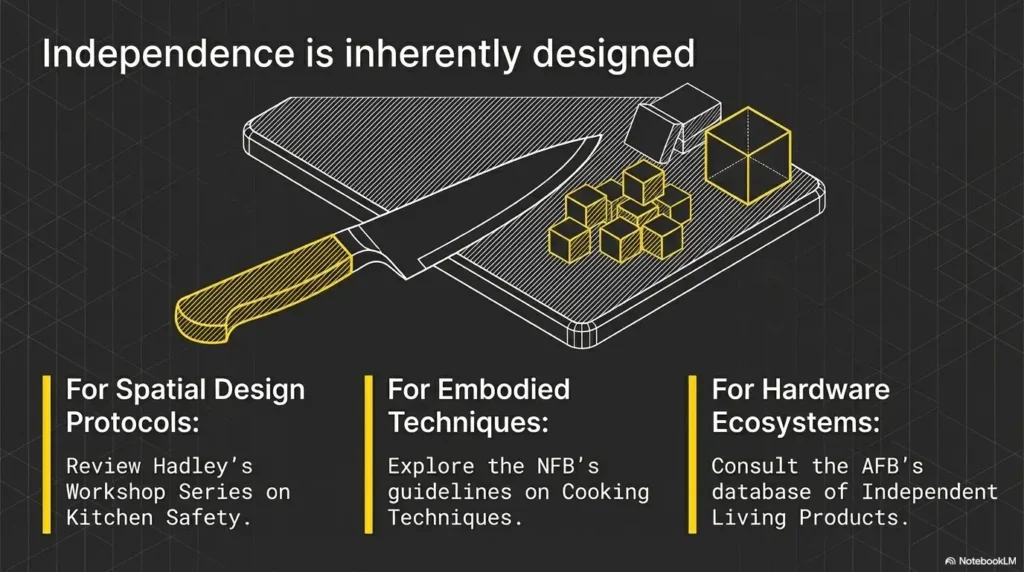
Low-vision kitchen safety is often taught as a combination of skill, organization, and repeatable technique rather than heroic reflexes. Hadley’s cooking resources and National Federation of the Blind kitchen materials both lean heavily toward method over glamour: safe cooking is built from consistent habits, not from hoping your body “just knows” what to do.
That framing is quietly liberating. It means you do not need the most aesthetic solution. You need the least surprising one. In practice, that usually means asking four plain questions: Where is the knife? How does the hand approach it? What part of the blade is exposed during the approach? What must the wrist do to return it safely? If the answer to any one of those is fuzzy, the setup deserves suspicion.
A lot of sighted kitchens run on visual shorthand. The chef’s knife is obvious. The paring knife is right there. The strip looks neat, so everyone assumes it is organized. But low vision changes the center of gravity. Tactile predictability becomes the real luxury item. A system that is merely “fine” when you can glance quickly at it can become annoying, then tiring, then risky when you cannot. The same principle shows up in other low-vision cooking tasks too, from choosing the best cutting board color for low vision to deciding whether a low-vision-friendly meat thermometer is truly easy to use by touch and sound.
There is also the honest truth nobody prints on the box: most kitchen injuries are not cinematic. They happen during ordinary reach patterns. Reaching too high. Reaching across clutter. Returning a knife while distracted by boiling pasta and a phone vibrating somewhere like a needy beetle. The right storage system shrinks those everyday error windows.
Decision card: When storage is safer vs when it only looks organized
- Safer: one obvious reach path, one obvious grip point, low exposed edge, easy return
- Looks organized: crowded tools, multiple removal motions, frequent re-gripping, visual neatness doing all the work
Neutral next step: test the motion, not the marketing photos.
Magnet strip appeal comes with hidden tradeoffs
Why people love magnetic strips in the first place
- Counter space stays clear
- Knife choice is visible and quick for sighted users
- Cleaning around the area can feel simpler
Where the risk begins for low-vision use
- Exposed blades create “search with caution” moments
- Pulling one knife can bump or shift another
- Misjudging handle position can put fingers too close to an edge
Here’s what no one tells you…
- A magnetic strip may be secure and still be awkward
- “Held firmly” does not always mean “easy to remove safely”
Magnetic strips are popular for a reason. They keep the counter clearer, make knives easy to see, and can feel satisfyingly orderly. For a sighted minimalist kitchen, that can be beautiful. For a low-vision kitchen, beauty is not enough. The blade stays exposed, and the removal motion is not always intuitive by touch alone. Depending on the strip, you may need a slight peel, a sideways tug, or a careful lift-and-roll that is never explained in the product listing, because apparently product listings believe we are all born knowing the secret handshake of magnets.
Spacing is the first hidden variable. A strip with three knives placed generously apart is one thing. A strip with six knives packed together like commuters at rush hour is another. The more tightly grouped the handles, the more likely it becomes that the hand brushes a neighboring knife while trying to remove one. That does not mean strips are automatically unsafe. It means their margin for sloppy setup is much smaller.
Mounting height is the second hidden variable, and it is a loud one. If the strip sits too high, the user may need shoulder lift, wrist extension, or a slightly upward removal angle. That sounds trivial until you try doing it with one hand, in a real kitchen, while carrying mental load. The Consumer Product Safety Commission’s injury surveillance system includes kitchen-knife laceration scenarios among emergency-department narratives, a reminder that sharp-tool injuries are not theoretical household folklore. In the same way, poor visibility and reflective surfaces can quietly distort everyday kitchen judgment, which is why some households also benefit from reducing glare from under-cabinet lighting.
There is also the “false reassurance” issue. A good magnetic hold can feel safe because the knife does not slide off. But retention is only half the story. A knife can be stable on the strip and still require an awkward hand path to remove. In other words, the strip can pass the engineering test and fail the human one.
I have seen homes solve this by keeping only 2 or 3 frequently used knives on a generously spaced strip at chest or below-chest height, with no other metal tools nearby. That is a disciplined system. Most kitchens, if we are honest, are not disciplined every day. They are Tuesday-at-6:40-p.m. kitchens.
Show me the nerdy details
Magnetic storage changes the task sequence. With a block, the hand typically approaches a known handle position, then lifts or pulls through one familiar path. With a strip, the user must identify the correct handle, maintain clearance from neighboring tools, overcome magnetic retention, and control the blade while it disengages. That adds more variables to the retrieval cycle, which can matter when vision is limited or the kitchen is busy.
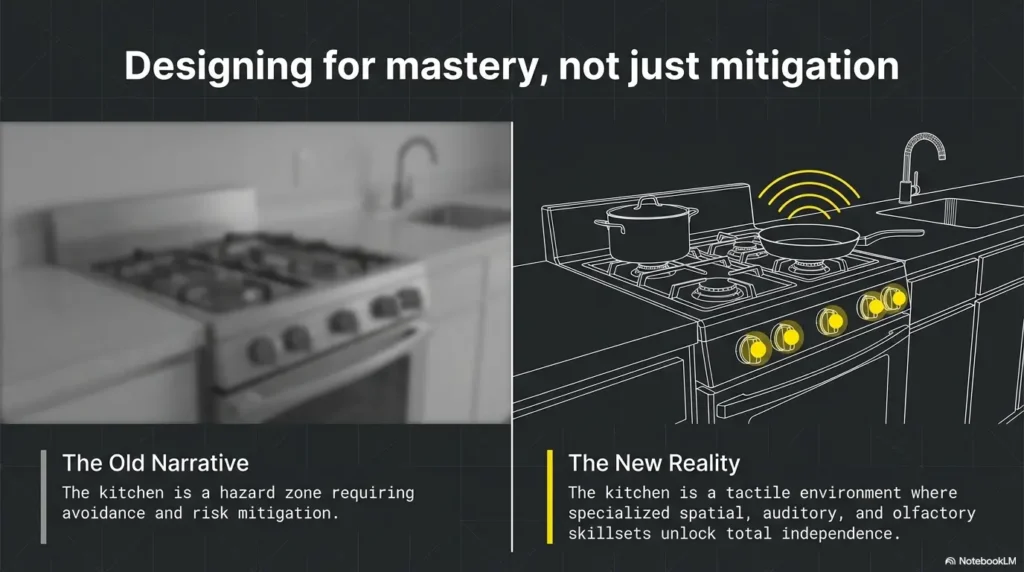
Knife blocks look old-school, but old-school has a point
Why blocks often win on tactile predictability
- Each knife has one repeatable home
- Blade edges stay enclosed during storage
- Hand approach is more constrained and easier to learn
The catch most buying guides skip
- Slot direction matters more than aesthetics
- Tight or poorly finished slots can create drag and hesitation
- Overstuffed blocks can turn order into guesswork
Let’s be honest…
- A bad knife block can still be a hazard
- “Safer than a strip” does not mean “automatically safe”
A knife block often wins in low-vision kitchens for one unfashionable reason: it tells the hand where to go. That matters. Each knife gets a fixed tactile destination. The blade edge is not hanging in open space. The hand usually approaches a handle from above or at a predictable angle, which reduces the chance of accidental contact with exposed steel. In daily life, that kind of boring repeatability is gold-plated wisdom.
But blocks are not saints. Slot direction matters more than many buyers realize. If the slot forces an odd wrist rotation during return, the movement can become clumsy even if the knife was easy to retrieve. Likewise, a block that is too light may slide during insertion, which is the sort of tiny indignity that can turn into a real safety problem faster than you would expect. A block should stay put like an old stone wall, not scoot around like it paid no rent.
Universal blocks deserve special caution. They look flexible, but flexibility is not always your friend. When the exact insertion angle or resting position changes from day to day, tactile certainty drops. For some households, a fixed-slot block is actually easier because the location and motion remain stable. The knife has one home. The hand learns it. The kitchen stops negotiating.
I remember using a block in a rental kitchen where two slots felt nearly identical. After three days, I noticed I was slowing down every time I returned the utility knife. That was the clue. The issue was not dramatic danger. The issue was friction. Repeated friction in a sharp-tool workflow is often a warning sign that the setup is asking too much from attention, much the way cluttered measurement tools can create unnecessary hesitation before cooking even starts, especially when you are choosing between low-vision measuring cups and measuring spoons that are easier to identify by touch.
- Fixed slots are usually more predictable than flexible interiors
- A heavy, stable base matters more than “designer” styling
- Slot direction can improve or sabotage safety
Apply in 60 seconds: Pick up your current knife and rehearse the return motion three times; if your wrist twists oddly, the storage system deserves rethinking.
The biggest risk is exposed edge plus awkward reach
When a magnet strip becomes riskier
- Mounted too high, forcing shoulder lift and unstable removal
- Mounted near face level or above a prep zone
- Knives placed too close together so handles crowd each other
When a block becomes riskier
- Slots are unlabeled and similar-sized
- The block slides during insertion or removal
- The user has to rotate the wrist strangely to return the knife
If you wanted the whole article in one sentence, it would be this: the most dangerous combination is exposed edge plus awkward reach. Everything else is a variation on that theme. A magnetic strip can be perfectly safe in one kitchen and foolish in another, depending on height, spacing, and the body mechanics required to use it. A block can be reassuringly simple in one home and annoyingly slippery in another if it shifts or if the slots feel too similar.
Reach matters because the body is not a crane. Overhead storage, face-level placement, or cross-body motion all increase the chance that the user compensates mid-movement. Compensation is where grips get adjusted, wrists turn, and fingers drift closer to edges than anyone intended. This is why the “safest” storage is rarely the one that photographs best. Instagram cannot feel your shoulder angle.
In low-vision kitchens, it helps to think in zones. Safe zones are neutral-reach zones: easy to access, not too high, not below the point where you must crouch or reach blindly near other hazards. Unsafe zones are clutter corridors, dish areas, splash zones, and places where other hands pass casually. The knife should not live where ordinary traffic happens. Sharp steel deserves a dedicated address, not a corner of kitchen gossip. That same zoning logic also matters elsewhere in the room, including where a kettle sits and how boiling water is poured safely with low vision.
| Setup issue | Why risk rises | Better move |
|---|---|---|
| Strip mounted high | Requires unstable lift and controlled disengage | Lower to neutral reach zone |
| Knives crowded on strip | Hand may touch adjacent blade or handle | Reduce knife count or widen spacing |
| Lightweight block | Block may move during insertion | Choose heavier base or non-slip footing |
| Universal block with vague slots | Return path varies day to day | Prefer fixed-slot storage |
Don’t choose by trend, choose by retrieval pattern
Test the “find, grip, remove, return” cycle
- Can you identify the knife by touch without contacting the blade?
- Can you remove it in one clean motion?
- Can you return it without hunting for the slot?
Why retrieval matters more than storage photos
- Social-media kitchens reward appearance
- Safe kitchens reward boring repeatability
The best buying question is not “Which storage category is safer?” It is “Which retrieval cycle is safer for this user in this kitchen?” That cycle has four steps: find, grip, remove, return. When you test storage, test all four. Some products feel great on step 1 and quietly betray you on step 4. That is how people end up buying something that looks streamlined and then using it with a tiny daily grimace they never quite admit to themselves.
Try the cycle slowly. Use the actual counter height. Stand where you really stand while cooking. Mimic the motion when you are carrying a dish towel, when your mind is elsewhere, when the room is not perfectly lit. A good system still feels understandable under ordinary imperfection. A bad system only feels safe in showroom conditions, where every surface sparkles and nobody has tomato sauce on their sleeve.
One of my own most useful household tests has become this: if I instinctively pause before the return motion, the setup is not finished yet. That pause is information. It means the environment is demanding extra calculation. In a low-vision kitchen, extra calculation is not always impossible, but it is costly. It drains attention that could be used for heat, timing, spills, or simply enjoying dinner before it turns into a philosophical study of reheated vegetables. The same friction shows up in smaller kitchen routines too, such as trying to identify spice jar labels for low vision or reading expiration dates with low vision without turning every meal into a tiny detective novel.
Mini calculator: score your retrieval cycle from 0 to 2 for each step.
- Find: 0 = hunting, 1 = slight hesitation, 2 = immediate
- Grip: 0 = risky or unclear, 1 = usable, 2 = obvious
- Remove: 0 = re-grip needed, 1 = somewhat awkward, 2 = clean motion
- Return: 0 = guessing, 1 = slow alignment, 2 = automatic
Output: 7 to 8 means the setup is likely workable. 5 to 6 needs refinement. 0 to 4 means do not trust it yet.
Neutral next step: test both storage options before buying on looks alone.
Common mistakes
Common mistakes with magnetic strips
- Mounting the strip where the user reaches across the body
- Storing knives too close together
- Using strips with weak hold or inconsistent pull force
- Assuming a louder “click” means safer placement
Common mistakes with knife blocks
- Keeping too many similar knives
- Using a lightweight block that shifts on the counter
- Mixing blade sizes in slots that do not fit cleanly
- Ignoring how hard it is to confirm full insertion by touch
The most common storage mistake is not choosing the “wrong product.” It is keeping the wrong habits. Crowding a magnetic strip with too many tools is a classic example. So is keeping five similar medium knives in a block because the set came that way and nobody wanted to admit three of them are essentially cousins in different jackets.
Another frequent mistake is designing the kitchen around visual memory alone. People say, “I’ll remember which side the handle faces,” or “I always put it back in the second slot.” Then a guest cooks, or a spouse unloads dishes differently, or a sleepy evening arrives and the entire system develops jazz improvisation tendencies. Low-risk storage usually depends on rules that survive imperfect days.
I also see people overestimate confirmation cues. On a strip, a satisfying magnetic contact does not guarantee ideal placement. In a block, the feeling of insertion does not always mean full insertion. You want tactile logic that is easy to confirm without finger exploration near the blade path. If the system requires “just checking” too often, it is not really doing its job.
Organizations that serve blind and low-vision users repeatedly emphasize home organization, tactile markers, and stable routines as practical accessibility tools. That broader principle matters here even when no official body is issuing a knife-block decree from a marble building. Stability reduces searching. Searching near sharp tools is expensive. It is the same reason many homes do better when they build a low-vision freezer organization system or create a key identification system for low vision instead of trusting memory to behave politely forever.
Show me the nerdy details
Human-factors problems often hide inside “tiny” setup choices. Similar handles, slot friction, storage drift, and crowded retrieval areas all increase decision load. In safety-sensitive household routines, lower decision load usually improves consistency. That is why a modest, obvious system often outperforms a clever one.
Do not do this: the small setup errors that create big injury risk
Do not store knives where hands travel casually
- Why storage near dish zones and cluttered counters backfires
- How incidental contact happens during ordinary tasks, not dramatic ones
Do not build a system around visual memory alone
- Why “I’ll remember where it is” fails on tired evenings
- How low light, kitchen noise, and rushing amplify small errors
Do not put knife storage next to the place where hands already wander. That includes chaotic prep zones, dish stacks, mail piles, produce bowls, and the section of counter that has somehow become a staging ground for keys, chargers, and one onion with big opinions. Incidental hand travel is the enemy. Good storage separates sharp tools from casual reach.
Do not put a magnetic strip near face height just because a backsplash photo looked elegant. Do not position a block where a user must reach around a drying rack. Do not accept “pretty good” if pretty good still means the hand occasionally floats to locate the right position. Sharp storage should reward certainty, not winging it with confidence.
And do not confuse familiarity with safety. A familiar but slightly awkward system can stay in a kitchen for years simply because everyone adapted to its quirks. Adaptation is not the same as good design. Sometimes households become so loyal to inconvenience that they treat it like family tradition. You are allowed to break that tradition.
- Keep sharp tools out of casual traffic lanes
- Eliminate any setup that depends on visual guesswork
- Prefer systems that stay understandable on tired days
Apply in 60 seconds: Stand at your sink and trace your normal hand travel across the counter; any knife storage in that path deserves relocation.
A safer middle ground exists between strip and block
Better options for some households
- Enclosed in-drawer knife organizers with fixed slots
- Countertop knife docks with separated, shielded placement
- Blade guards paired with a dedicated drawer zone
When alternatives beat both strip and block
- Very small kitchens with crowded vertical space
- Shared kitchens where knife locations change too often
- Users who need stronger tactile boundaries than either option provides
This is where many households breathe easier: you do not have to marry either camp. In-drawer organizers with fixed, enclosed slots can be excellent for low-vision cooks when the drawer layout is simple and stable. They reduce exposed edges and often make the hand path more deliberate. They are not magical, but they can sidestep the strip-vs-block argument entirely in kitchens where wall space is crowded or counters are already busy.
Blade guards are another middle-ground option, especially when paired with a dedicated drawer section that never hosts random utensils. The key phrase is dedicated drawer section. Without that, guards can become loose accessories wandering through the kitchen like socks in a dryer, and we are back in the land of avoidable chaos.
Some households also do well with a reduced-knife strategy. Instead of storing seven knives with overlapping purposes, they keep 2 or 3 that cover almost every home-cooking need: chef’s knife, serrated knife, paring knife. Fewer tools often means clearer storage logic. There is a particular peace in admitting your kitchen does not need to impersonate a television set.
Short Story: A friend once reorganized her kitchen after realizing the knife block was not actually the problem. The problem was that the block lived beside a bowl of fruit, a stack of unopened mail, and a jar of wooden spoons. Every evening, that corner became crowded. She moved the block to a quieter part of the counter, reduced the knife set from six to three, and added a simple rule:
each knife goes back immediately after washing, never “for a minute.” Nothing about the hardware changed. The accidents did not vanish because there had not been a dramatic accident. What vanished was the low-grade tension. Cooking felt smoother. Less hovering. Less second-guessing. The room itself seemed to exhale, as if someone had finally removed a small but persistent pebble from the shoe of the kitchen.
Eligibility checklist: an in-drawer organizer may suit you if the answer is “yes” to most of these.
- Yes / No: You have one drawer you can keep dedicated and uncluttered
- Yes / No: The drawer opens smoothly without sticking
- Yes / No: The user can identify each knife position by touch
- Yes / No: Other household members will not toss utensils into the same space
Neutral next step: if two or more answers are “no,” keep comparing blocks and other fixed storage instead.
Setup rules that matter more than the product
Height, spacing, and orientation change everything
- Keep storage in a neutral, easy reach zone
- Reduce twisting, overhead reaching, and cross-body motion
- Assign one stable location and do not drift from it
Tactile logic should be obvious on first touch
- One knife, one spot
- Handle direction should be consistent
- The user should never need to “check the edge” to confirm placement
Here’s what no one tells you…
- The best knife storage often feels almost boring
- Boring is excellent when sharp steel is involved
If you remember only one section, let it be this one. Product category matters. Setup matters more. Height, spacing, orientation, and return rules determine whether a good product behaves well in real life. A decent block in an excellent location often beats a premium strip in an awkward one. A modest drawer organizer with strong household discipline can outperform both.
The first rule is neutral reach. The second is stable spacing. The third is consistent orientation. These sound almost insultingly simple, which is exactly why they work. Home safety often improves through humble clarity rather than through baroque innovation. When a user approaches a storage area, the hand should already know roughly what shape the motion will take.
Tactile markers can help in some kitchens. Small, distinct bump markers on a drawer edge or a subtle non-slip mat under a block can make the environment easier to confirm by touch. NFB’s educational materials also note simple tactile adaptations as a practical way to make household tools and spaces more accessible. That same “small marker, large payoff” principle is familiar from other routines, such as using tactile dots for microwave buttons.
One of the funniest lies kitchens tell is that they are static. They are not. They drift. Someone deep-cleans. Someone rearranges. A new appliance arrives. A holiday guest cooks. Your “system” is suddenly interpretive dance. This is why a household rule matters: one knife, one spot, every time. Storage safety is not only what you buy. It is what the household agrees not to undo.
How to decide: magnet strip vs block for your kitchen
Choose a magnetic strip if…
- You can mount it at a safe height with generous spacing
- The user can remove each knife without touching neighboring blades
- Everyone in the household will follow the same placement rules
Choose a knife block if…
- You want more enclosed blade storage
- The user benefits from fixed tactile destinations
- You need a lower-surprise system for everyday home cooking
Choose neither if…
- Your kitchen is cramped and chaotic
- Multiple people constantly move tools around
- You cannot create a reliable return-to-home routine
Here is the practical answer most readers came for. Choose a magnetic strip only if the kitchen can support disciplined mounting and disciplined spacing. That means safe height, generous clearance, limited knife count, and a removal motion that feels clean rather than theatrical. If any of those conditions are missing, the strip becomes an attractive gamble.
Choose a block when you want lower surprise, lower exposure, and one predictable tactile map. That does not mean any block will do. It means a block is often the safer default starting point for low-vision home kitchens because it simplifies the hand’s job. It narrows the options. It keeps the blade path more contained. It usually asks less from attention.
Choose neither when the kitchen itself is the problem. If tools migrate constantly, counters are overcrowded, and nobody can commit to a return routine, a strip-versus-block debate is almost beside the point. You need a system reset first. Sometimes the bravest kitchen improvement is not buying a shiny thing. It is removing three confusing things and making one rule that everyone actually follows.
Quote-prep list: what to gather before comparing products
- Your actual available wall or counter space measurements
- How many knives you truly use weekly, not aspirationally
- The user’s comfortable reach zone
- Whether everyone in the home can follow the same return rule
Neutral next step: compare products only after your kitchen constraints are written down.
Next step
Run a five-minute blind-touch safety test before buying anything
- Stand in the actual kitchen zone where the knives will live
- Mimic finding, gripping, removing, and returning a knife with your eyes closed
- Reject any setup that requires hovering, guessing, or wrist twisting
- Keep the option that feels most predictable, not the one that looks most elegant
The five-minute blind-touch test is the simplest high-value move in this entire topic. Stand where the storage will actually go. Use your real posture, your real reach, your real kitchen rhythm. Pretend you are tired, because one day you will be. Then rehearse the four-part cycle: find, grip, remove, return.
If a magnetic strip requires too much precision, let that be data, not disappointment. If a block feels stable but the slot pattern confuses you, let that be data too. The goal is not to prove a preference. The goal is to discover which setup creates the fewest sharp little mysteries.
A lot of readers want permission to choose the less glamorous option. Here it is. In low-vision kitchens, the “best” system is often the one that feels almost dull in use. You approach, you grip, you move, you return. No flourish. No suspense. No tiny duel between memory and steel. Boring is not failure. In this context, boring is a triumph. And once that core motion is calmer, it becomes easier to improve the rest of the room too, whether that means choosing a talking kitchen scale that is actually accurate or fixing a microwave beep that is too quiet to hear reliably.
FAQ
Is a magnetic knife strip safe for low vision?
It can be, but only when the strip is mounted in a neutral reach zone, knives are generously spaced, and the removal motion is predictable without exposing fingers to neighboring blades. A strip becomes riskier when it is crowded, mounted too high, or used by multiple people who do not follow the same placement rules.
Is a knife block safer than a magnetic strip?
For many low-vision households, yes. A block often reduces exposed-edge contact and gives each knife a fixed tactile location, which lowers surprise. The best block is heavy enough to stay put, uses slots that fit the knives clearly, and does not require awkward wrist rotation during return.
Are in-drawer knife organizers safer than both?
Sometimes. Enclosed, fixed-slot in-drawer organizers can reduce exposed-blade risk, especially when the drawer layout is simple and dedicated. They tend to work best when no other utensils drift into the same space and the drawer opens smoothly every time.
What makes knife storage unsafe for visually impaired cooks?
The biggest issues are exposed edges, inconsistent placement, awkward reach angles, clutter, and any setup that forces the hand to search near the blade. In practice, unsafe storage usually creates hesitation or guessing during the find, remove, or return steps.
Should knives be stored on the counter or in a drawer?
Either can work if the storage method keeps blade exposure low and placement consistent. Counter storage may be easier for some users because it avoids bending and keeps the destination obvious. Drawer storage may be safer for others when it uses fixed, enclosed slots and remains uncluttered.
Are universal knife blocks a good idea for low vision?
They can be less predictable than fixed-slot blocks because tactile placement may vary from day to day. If consistency is the main goal, many households do better with fixed slots that give each knife one repeatable home.
Can blade guards make a magnetic strip safer?
Usually not in a simple, elegant way. Guards can help in some drawer systems, but on a magnetic strip they may add extra steps and reduce tactile simplicity. Safer storage usually comes from clearer hand paths, not from extra fiddly pieces.
What should caregivers look for when setting up knife storage?
Look for low-surprise placement, comfortable reach height, strong tactile consistency, minimal clutter, and a system every household member can use the same way every time. The best caregiver setup is often the one that reduces decision-making, not the one with the most features.
How many knives should a low-vision home cook keep in the main storage area?
Usually fewer than many retail sets suggest. For a lot of home kitchens, 2 to 4 core knives are enough for everyday cooking. Fewer tools often mean clearer identification, better spacing, and simpler return routines.
What is the fastest way to tell whether a setup is wrong?
Notice whether you pause, hover, re-grip, or search during retrieval or return. Those are small but meaningful signs that the system is demanding too much attention. With sharp tools, repeated hesitation is useful feedback.
Conclusion
We began with a simple-looking comparison and found the real answer underneath it. The question was never merely magnet strip versus block. The question was which system asks less from the hand, the wrist, the memory, and the nervous system in an ordinary kitchen on an ordinary day. That is the curiosity loop closed. The safer choice is the one that removes uncertainty before you touch the blade.
For many low-vision households, that points toward a stable knife block or another enclosed fixed-slot system. Not because it is trendy. Quite the opposite. Because it often creates the most legible hand path and the least exposed-edge drama. Magnetic strips can work, but they demand more from setup discipline and household consistency. That is not a moral failing. It is just the shape of the tradeoff.
Your best next move is small and immediate. In the next 15 minutes, run the five-minute blind-touch test in the exact kitchen zone where the knives would live. Then reduce the decision to one honest standard: keep the setup that feels the most predictable, not the one that looks the most elegant. In sharp-tool safety, a calmer hand beats a prettier photo almost every time.
Last reviewed: 2026-03.