


Mastering the Glare: From High-Fatigue Floors to High-Confidence Spaces
A glossy white tile floor can turn an ordinary kitchen or hallway into a high-fatigue zone in under five minutes.
For people dealing with low vision, glare from white tile floor surfaces is not a cosmetic annoyance. It is a daily visibility problem that can wash out edges, flatten depth cues, and make a familiar room feel strangely harder to trust.
“The room looks bright, clean, and technically ‘fine,’ yet your eyes keep working overtime just to read the floor.”
More light often makes it worse, not better, especially when reflective flooring, overhead fixtures, and daylight all pile into the same visual lane. Keep guessing, and you do not just lose comfort, you lose energy, confidence, and sometimes safe movement in the rooms you use most.
Our Practical Approach:
- Identify the Trigger: Understand exactly what is causing the glare.
- Fix the Path of Light: Use window control and lighting direction to your advantage.
- Make the Room Readable: Implement rugs, runners, and edge cues for instant contrast.
Table of Contents
Fast Answer: Glare from white tile floors can be especially punishing for people with low vision because bright reflection flattens contrast, hides edges, and creates eye strain that feels bigger than the room itself. The most effective fixes usually involve changing light direction, breaking up reflective surfaces with matte layers or rugs, improving edge contrast, and avoiding “more brightness” as a default solution.
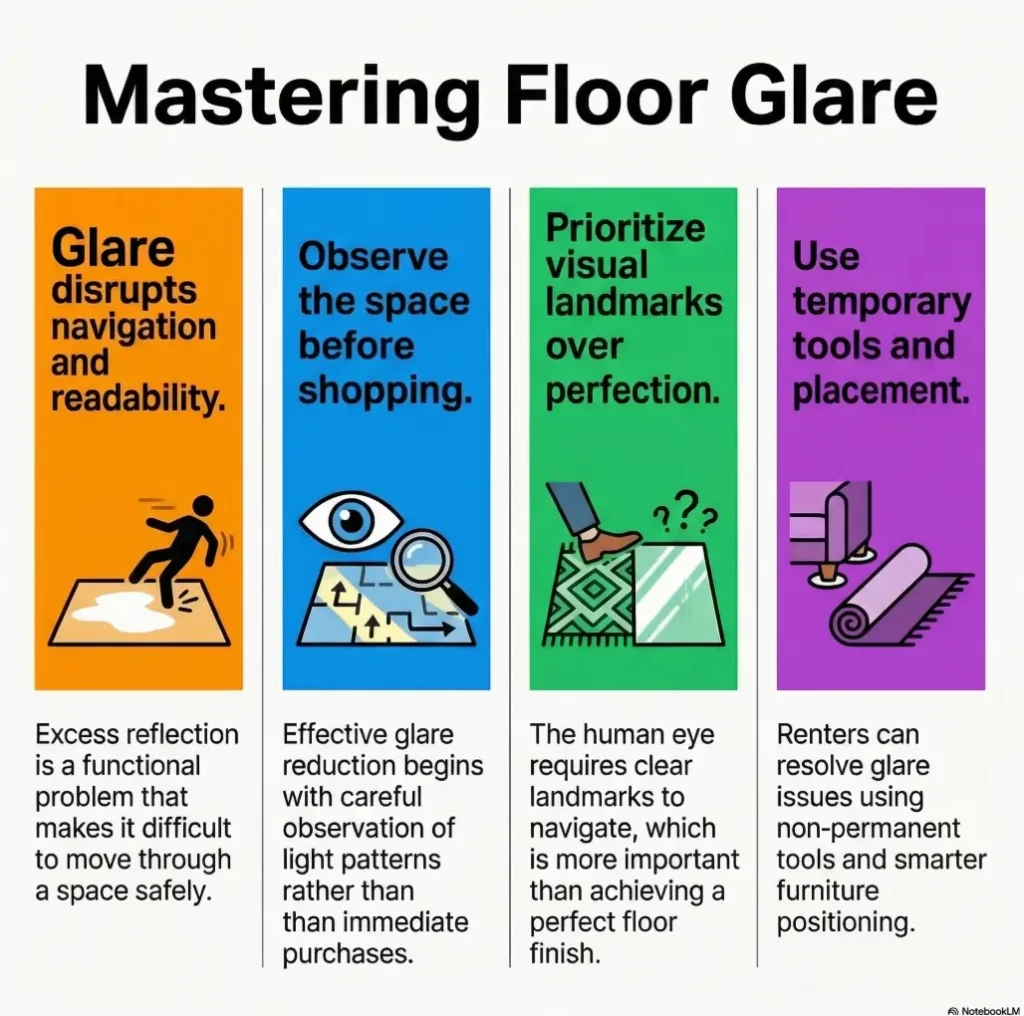
Start Here First: Who This Is For / Not For
Who this is for
This guide is for people with low vision who walk into a room and feel the floor “flare up” before anything else comes into focus. It is also for caregivers, spouses, adult children, renters, and homeowners trying to make a kitchen, bathroom, hallway, or entry easier to use without jumping straight to renovation. If you have ever thought, “The room is clean, bright, and somehow impossible,” you are in the right place.
- People noticing washed-out contrast on white or off-white glossy tile
- Readers dealing with eye fatigue, hesitation while walking, or trouble spotting edges
- Anyone wanting a practical home fix before spending four figures on flooring
Who this is not for
This is not a diagnosis. It will not tell you why your vision has changed, and it should not replace an eye exam if symptoms are new, worsening, or severe. It is also not a permission slip to ignore near-falls or major disorientation. Those deserve faster attention than a decor article ever can. If recent changes feel bigger than “just aging,” compare them against the warning patterns covered in senior vision changes that should not be brushed off as normal.
I learned this difference the irritating way. Years ago, I kept assuming a bright room meant a better room. It looked crisp in photos, glorious for five minutes, and then my eyes felt like they had run a small marathon on a polished skating rink. The room was “beautiful.” My nervous system vetoed the design.
- Low vision changes how reflection is experienced
- Glossy white tile amplifies the issue
- Safer movement matters more than visual perfection
Apply in 60 seconds: Pick the one room where you slow down or squint most often. That is your first intervention zone.
Why White Tile Feels So Brutal Indoors
Reflection is the real culprit, not just brightness
Most people blame brightness. Brightness gets all the gossip. But in many homes, the real villain is reflection. White tile, especially with a polished or semi-gloss finish, can behave like a low-budget mirror. It does not need to reflect a perfect image to cause trouble. It only needs to bounce enough light back toward your eyes to flatten the scene.
That flattening matters. When contrast drops, the floor can begin to swallow the edges of cabinets, walls, thresholds, chair legs, and even your own shadow. A room stops feeling three-dimensional and starts behaving like a glowing sheet.
Why glossy pale flooring erases depth cues
Depth cues are the quiet assistants of daily life. They tell you where one surface ends and another begins. They help you judge distance, step safely, and track pathways without consciously narrating every move like you are in a detective novel. Glare weakens those cues. Pale glossy tile weakens them even more because the floor itself becomes the brightest thing in view.
The National Eye Institute explains that low vision can interfere with everyday activities and that people often benefit from strategies that improve contrast and reduce visual strain. That principle matters at floor level more than many people realize. When the floor is blasting reflected light upward, the problem is not merely “too much light.” It is the wrong light, in the wrong place, at the wrong angle.
How glare turns a safe room into a low-contrast maze
This is where daily life gets sneaky. You can have a room with no clutter, a decent layout, and clean surfaces, yet still feel unsteady in it. A bathroom can look spotless and remain strangely hostile. A hallway can be empty and still feel difficult to read. The eye is working harder, the body slows down, and fatigue stacks up by late afternoon like plates after dinner.
That is why “bright and clean” is not always accessibility-friendly. Sometimes it is just visually loud. The same trap shows up on vertical surfaces too, which is why understanding the tradeoff in matte vs glossy paint for glare-sensitive rooms can help you think beyond the floor alone.
Show me the nerdy details
Glossy surfaces create specular reflection, meaning light bounces in a more directional way rather than scattering softly. When that reflection reaches the eye from common walking angles, it can reduce perceived contrast and mask boundaries. This is especially annoying when ceiling fixtures, windows, and shiny floors line up in the same visual path.
Infographic: The three-part glare chain
1. Light Source
Window, ceiling LED, under-cabinet strip, lamp
2. Reflective Floor
White tile bounces light upward and outward
3. Tired Eyes + Lost Edges
Contrast drops, depth cues weaken, movement feels harder
Spot the Trigger: Which Light Source Is Actually Causing It
Morning sun, ceiling LEDs, and under-cabinet lights create different problems
Not all glare arrives wearing the same outfit. Morning sun often sweeps across the floor in a low, sharp band. Ceiling LEDs can create persistent hotspots. Under-cabinet lights can be excellent for task work and terrible for floor reflection if they spill forward too aggressively. One room, three culprits, and each one calls for a different fix.
I once spent an embarrassing week blaming a pendant light over a kitchen island. The true offender was a narrow stripe of late-morning sun bouncing from a patio door across the floor and straight into the walking path. The pendant was innocent. The window was the drama queen.
Why overhead light can make the floor look brighter than the walls
Overhead light seems logical because it “fills the room.” But when the floor is pale and reflective, ceiling fixtures can make the floor visually louder than vertical surfaces. Walls recede. The ground glows. That is a terrible trade when the floor is the surface your body depends on for movement.
One-room test: identify the worst glare window in under ten minutes
Try this simple test. Turn on the room as you normally use it. Then stand at the main entry point, the usual sitting position, and the walking path you take most often. Note where the floor blooms with reflection. Next, turn off or block one light source at a time. Start with window light if it is daytime, then ceiling lights, then accent lights. In under 10 minutes, you will often discover that one source causes 70 percent of the pain.
- Check the room at two different times of day
- Test while moving, not only while standing still
- Watch whether the glare crosses your route to the sink, bathroom, or front door
Decision card: Which light should you fix first?
If glare moves across the floor with the time of day: start with window control.
If glare stays in the same bright patches all day: start with ceiling or fixture direction.
If the room is worst during tasks: check under-cabinet and task lighting spill.
Neutral next step: Fix the largest reflection source before buying accessories.

Before You Buy Anything: Do This Two-Step Glare Check
Step 1: Watch where the reflection travels during the day
Glare has a route. It drifts, pools, and returns. A hallway that feels manageable at 8 a.m. may become a tiny solar opera at 1 p.m. A bathroom that seems harmless under cloudy light may turn mutinous after sunset when overhead LEDs take over. You need a pattern, not a single impression.
Make a quick note in your phone for one day only. Morning, midday, evening. Which room? Which patch of floor? How annoying on a scale of 1 to 5? That little record is worth more than wandering through home stores in a fog of hope.
Step 2: Stand, sit, and walk the room from real-life viewing angles
A room should not only be tested from the doorway like a real-estate listing. Sit in the chair where you pay bills. Walk from stove to sink. Step out of the shower area. Carry a basket down the hall. Glare may appear modest while standing and much worse while moving or lowering your gaze.
Let’s be honest… most people test glare while standing still, not while moving
That is why so many “fixes” disappoint. A product seems right because it looked good in one pose under one lighting condition. Then daily life shows up wearing socks, fatigue, and a laundry basket. The floor wins again.
Why “it looks fine from the doorway” is often a false reading
Doorway testing ignores motion, fatigue, angle, and routine. It is the visual equivalent of testing an umbrella only while indoors. Better than nothing, perhaps. Not exactly persuasive.
- Track the worst glare by time of day
- Test while walking and sitting
- Prioritize the route you actually use
Apply in 60 seconds: Record one 15-second video of your worst floor reflection while walking through the room. It will reveal more than memory alone.
Contrast First, Brightness Second
Why adding more light can make low vision navigation worse
This is the counterintuitive part people fight at first. More light is not always more usable light. The American Foundation for the Blind recommends adjustable lighting and window coverings to help control glare, and that small wording matters. Adjustable. Controlled. Directed. Not simply brighter by brute force.
If a room already has enough illumination but the floor is acting like a reflector, adding brightness can intensify the washout. The eye strains harder, edges retreat, and fatigue arrives earlier. A room can become technically brighter and practically less usable. That is not failure on your part. It is a mismatch between lighting design and visual function.
Use layered lighting to reveal edges without bleaching the floor
Layered lighting means different lights doing different jobs. Ambient lighting keeps a room generally visible. Task lighting helps with a specific activity like chopping vegetables or reading labels. Accent lighting can reveal boundaries or objects without blasting the entire floor. This approach is usually more helpful than one heroic overhead fixture trying to do everything like a tired office manager.
Think sideways, not just downward. Light that hits cabinet fronts, counters, or walls can create depth without igniting the floor. Warm or neutral light often feels gentler than an icy cool-white bulb on reflective tile, though the best choice depends on the user’s actual comfort and task needs. If you are debating bulb warmth, the comparison in 2700K vs 3000K for glare-sensitive eyes is a useful next layer.
Best places to add contrast instead of lumens
If the floor is overwhelming, improve what the eye can anchor to:
- Thresholds between rooms
- Baseboards where wall meets floor
- Furniture legs or bench edges
- The route to the bathroom, sink, bed, or entry door
In many homes, increasing contrast around these features does more for usable vision than adding another bright bulb ever will.
Show me the nerdy details
Contrast sensitivity can matter as much as standard visual acuity in everyday environments. A room may be technically bright enough by measurement, yet still feel hostile if reflective surfaces reduce edge visibility and create luminance imbalance between the floor and surrounding objects.
Soft Barriers That Work: Rugs, Runners, and Mats Without the Trip Hazard
Where textile coverage helps most on white tile
Rugs and runners are often recommended so casually that the advice becomes mush. But textile coverage can genuinely help when it is strategic. The goal is not to wallpaper the floor with fabric. It is to interrupt long reflective pathways and create calmer visual zones where you walk, turn, stand, or transfer weight.
High-value placement areas include:
- The main route between entry and living area
- The sink zone in the kitchen
- The bedside landing area
- Long hallways that act like reflection corridors
How to choose low-profile, matte, non-slip options
The CDC’s fall-prevention guidance for older adults warns about slippery surfaces and unsecured rugs, which is exactly why rug advice needs grown-up guardrails. Choose low-profile materials, matte finishes, and real non-slip backing or secure rug tape. Avoid thick curled corners and fluffy edges that look cozy in catalogs and behave like banana peels in real homes.
Texture matters too. A matte woven surface breaks up reflection better than a shiny pale mat that politely continues the original problem. Color matters because contrast helps the eye locate the walking path. You do not need dramatic black strips everywhere. Even medium-tone runners can create a calmer visual lane on a bright floor. If fall anxiety is already part of the household picture, it also helps to review broader aging vision fall-prevention strategies at home so the rug fix fits into a safer whole.
Which rooms benefit from partial coverage instead of wall-to-wall changes
Kitchens, hallways, and entry zones often respond well to partial coverage. Bathrooms need more caution because moisture changes everything. A targeted mat by the sink or exit point can help, but it must stay flat, grippy, and dry enough to remain trustworthy. The floor should not become safer to look at and riskier to step on. That is a bad bargain dressed as a solution.
Eligibility checklist: Is a rug fix a good first move?
Yes, if the glare follows a clear walking path.
Yes, if you can secure the rug fully and keep edges flat.
No, if the area gets wet often and the mat shifts.
No, if mobility aids or shuffling gait make edges unsafe.
Neutral next step: Test one low-profile matte runner in the worst path for 48 hours before buying more.
The Edge Clue Method: Make Boundaries Easier to Read
Use contrast at thresholds, baseboards, and furniture legs
When the floor becomes visually noisy, the eye looks for reliable anchors. That is where edge cues earn their keep. A contrasting threshold strip, a darker baseboard, or even clearer visibility on chair and table legs can help the room stop dissolving into one bright field. The point is not to make the house look clinical. It is to make it readable.
Thresholds matter because they signal transition. Baseboards matter because they define where the floor ends. Furniture legs matter because they tell your brain where objects occupy space. Without those clues, white tile glare can make the lower half of a room feel oddly unfinished, as if everything is floating a few millimeters above reality.
Why visual anchors matter more than perfect decor matching
People sometimes resist contrast because they want everything to “blend.” Blending is lovely until it becomes camouflage. In a low-vision environment, a little visual separation is often more humane than perfect tonal harmony. Design magazines may not write sonnets about this. Your body, however, tends to appreciate not bumping into a bench.
Small additions that help the floor stop “glowing into everything else”
Practical options include contrast tape in discreet locations, peel-and-stick markers on problem edges, darker mats at doorway landings, or furniture choices that do not vanish against pale flooring. These are not glamorous interventions. Neither are eyeglasses. Both remain excellent inventions.
When a room is visually exhausting, tiny anchors can do huge emotional work. They lower the amount of guessing your eyes must do every minute. The same principle matters in other daily zones too, including nighttime bathroom safety for low vision where edges and transitions do a great deal of quiet work.
- Mark transitions clearly
- Separate objects from floor color
- Favor readability over invisible decor choices
Apply in 60 seconds: Stand in your worst room and identify one place where wall, floor, and furniture visually melt together. That is your first anchor point.
Window Control Without Making the Room Feel Like a Cave
Sheer curtains, solar shades, and angle control
Window control is where many people overcorrect. They either leave the room blazing or darken it until it feels like a submarine. There is a middle path. Sheer curtains can soften incoming light. Solar shades can reduce harsh direct beam without erasing daylight altogether. Sometimes simply changing the angle of blinds is enough to keep the floor from lighting up like a polished ice rink at noon. If you are weighing materials, privacy, and light diffusion, a deeper look at window film options for glare control can help you choose more deliberately.
When diffused daylight helps and when it backfires
Diffused daylight can be beautiful and useful. It can also backfire if the room has multiple reflective surfaces, such as glossy floor tile, shiny cabinets, and a bright countertop. In that case, the room does not become calm. It becomes uniformly glary, which is somehow softer and more annoying at the same time. Quite an achievement.
Here’s what no one tells you… midday glare often needs redirection, not darkness
You do not always need to dim the room. Often you need to redirect the path of light. Adjust a blind slat. Shift a reflective accessory. Close only one panel during peak glare hours. The difference between a hostile room and a manageable room is sometimes one angle, not one expensive purchase.
The American Foundation for the Blind notes that people adjusting to vision loss often benefit from appropriate window coverings and adjustable lighting. That advice sounds simple because it is. The magic, such as it is, lies in matching the intervention to the actual reflection path rather than treating every room the same.
Short Story: A friend once described her hallway as “mysteriously bad between lunch and tea.” We stood there at 1:30 p.m. and watched a stripe of light hit the white tile, bounce off a glossy console table, and turn the floor into a bright ribbon. She had nearly bought new bulbs, a new mirror, and a new rug.
Instead, she tilted one set of blinds, moved the table lamp six inches, and added a medium-tone runner. The hallway did not become magazine-ready. It became walkable. That is the kind of victory I respect. Not dramatic. Not photogenic. Just one less room asking the eyes to perform acrobatics before a cup of water.
Don’t Accidentally Make It Worse
Avoid high-gloss cleaners that turn tile into a mirror
Many floors get brighter not because the tile changed, but because the maintenance routine did. Cleaners that leave a shine can make reflective tile even more reflective. That glossy finish may look satisfying for approximately seven minutes. After that, it may just magnify the problem you were trying to solve.
Don’t choose pale shiny rugs that preserve the same glare problem
This happens more often than you would think. Someone buys a cream-toned synthetic runner with a faint sheen because it “matches everything.” It does indeed match the original problem beautifully. What you want is interruption, not continuity. Matte and medium contrast usually beat glossy and almost-white.
Why cool-white bulbs can feel harsher on reflective flooring
Some people tolerate cool-white bulbs well. Others find them sharp and tiring on pale glossy floors. When glare is already the issue, a very crisp high-color-temperature bulb can make the room feel more clinical than helpful. Test before committing. The right bulb is the one that improves usability, not the one that wins an argument online.
Show me the nerdy details
Light quality is not just about output. Beam spread, fixture shielding, reflection angle, and surface finish all change what the eye experiences. A harsher bulb in a poorly aimed fixture can create more visual stress than a slightly lower-output option with better direction and less spill onto the floor.
Common Mistakes
Using brighter bulbs before fixing reflection paths
This is the classic first move because it feels decisive. Unfortunately, it often acts like pouring extra sunlight onto a problem that was already overachieving. Always test direction and reflection before increasing brightness.
Treating every room the same, even though bathroom glare behaves differently
Bathrooms bring mirrors, moisture, hard finishes, and often limited floor space. The glare pattern there is not the same as a hallway or kitchen. Kitchens involve task lighting and frequent movement. Hallways involve long sight lines. Entryways combine daylight, shoes, shadows, and transition. One fix rarely fits all three. In bathrooms especially, floor glare often works together with sink-area reflection, so it helps to think alongside bathroom mirror glare solutions rather than treating the tile as a solo offender.
Buying tiny accent rugs that break visual flow instead of guiding it
Small decorative mats can create islands of contrast without creating a readable path. They may help style the room and do almost nothing for navigation. In some cases they introduce more visual clutter than help. The eye does not need confetti. It needs guidance.
Assuming sunglasses indoors are a full solution
Some people do benefit from tinted lenses or glare-reducing eyewear, and the National Eye Institute mentions anti-glare options in certain contexts. But indoor sunglasses alone do not fix a hostile room design. They reduce the burden on the eye. They do not move the window, matte the tile, secure the rug, or define the threshold.
Mini calculator: Which fix should you test first?
Count your worst glare sources: windows, overhead lights, reflective accessories.
If 2 or more are windows or daylight-related, test shade control first.
If 2 or more are fixture-related, test light direction and bulb changes first.
If the main issue is one walking path, test a runner or contrast cue first.
Neutral next step: Start with the category that appears most often, then reassess.
Renters, This Part Matters: Low-Commitment Fixes That Don’t Require Renovation
Peel-and-place contrast cues that remove cleanly
If you rent, your options may feel small, but they are not useless. Removable contrast markers at thresholds or problem edges can help. So can renter-safe window film, temporary shades, or portable mats that are actually secured properly. The trick is to choose changes that improve function without creating residue, damage, or a call from a landlord who suddenly discovers a passion for security deposits.
Temporary shade strategies for problem windows
Temporary paper shades, tension-rod curtains, or removable light-filtering panels can be enough to tame a specific glare window. You do not need a custom treatment for every pane of glass to get meaningful relief. Often one problem window creates the majority of daily frustration.
Portable layout tweaks that reduce reflected light across walking paths
Sometimes the cheapest fix is moving what reflects. A glossy side table, a metal trash can, a mirrored cabinet face, or a glass-front accessory can multiply floor glare. Shift it. Rotate it. Remove it for a day and test the difference. A room is a light system, not a still photograph.
I have watched people spend weeks comparing products and 30 seconds ignoring the chrome stool leg blasting light into a hallway. We are all artists of selective blindness when home irritation becomes familiar enough.
- Use removable contrast cues
- Target one window before treating all of them
- Move reflective objects before buying new ones
Apply in 60 seconds: Remove one shiny accessory from the worst room for a single afternoon and see whether the floor calms down.
Room-by-Room Fixes: What Works in Kitchens, Bathrooms, and Hallways
Kitchens: under-cabinet glow versus task visibility
Kitchens are trickier than they look because you need light for chopping, labels, measuring, and safety. Under-cabinet lighting can help countertops while also spilling onto the floor. Try aiming it back toward the task area rather than out into the room. A sink mat, a medium-tone runner, and less aggressive overhead spill can do a lot here. If the backsplash, counters, or cabinet finish are joining the rebellion, compare your setup with under-cabinet lighting glare on glossy surfaces or the broader guide to glare-free under-cabinet lighting.
Bathrooms: wet floor reflections and mirror bounce
Bathrooms combine glossy surfaces like they are trying to win a prize. Floor tile, mirror, fixtures, and moisture all join forces. Prioritize secure non-slip mats, better edge definition near the exit path, and light control that does not blast the floor directly. Because wet surfaces raise slip risk, the “pretty but flimsy mat” category should be escorted out immediately.
Hallways and entries: long reflection corridors that hide edges
Hallways are where a little glare can feel huge because the reflection stretches. Entries often add daylight, shadows, bags, shoes, and transitions between indoor and outdoor brightness. A continuous runner, calmer window light, and clear doorway contrast usually help more than small decorative gestures.
Coverage tier map: Which room needs the strongest intervention?
Tier 1: Mild discomfort only at certain times. Use light-angle changes.
Tier 2: Frequent squinting or visual fatigue. Add a matte path or runner.
Tier 3: Edges vanish during normal walking. Add contrast cues and redirect light.
Tier 4: Repeated hesitation or near-missteps. Combine floor, light, and edge changes.
Tier 5: Severe disorientation or near-falls. Seek professional input soon.
Neutral next step: Rate each room honestly and start with the highest tier, not the prettiest room.
When the Problem Is Bigger Than the Floor
How wall color, cabinet finish, and countertop shine can multiply floor glare
Sometimes the floor is the headline but not the whole story. A glossy cabinet finish can bounce light downward. A bright white wall can amplify the room’s overall luminance. A polished countertop can reflect into the same visual field as the floor. By the time all three join hands, the room becomes one large glowing committee meeting.
Why a “bright clean look” sometimes creates visual overload
Minimal bright interiors photograph beautifully because cameras love uniform light. Human eyes are fussier. Especially with low vision, visual overload can come from too many reflective pale surfaces competing for attention. The result is not just discomfort. It is fatigue, slower navigation, and the urge to avoid the room entirely.
The chain reaction between floor reflection and overall room fatigue
What begins as floor glare can become whole-room fatigue. You squint. You slow down. You avoid the room. The avoidance changes routines. Tasks feel more annoying. You start blaming yourself for being tired in a room that everyone else calls “fresh.” This is where practical design can feel oddly emotional. A calmer room can restore a little dignity along with comfort.
When to Seek Help
Signs the issue may need an eye care or low vision specialist’s input
If glare suddenly feels much worse, if you are getting headaches or unusual eye strain, if you notice new halos or big changes in visual comfort, or if normal home tasks become much harder, it is reasonable to seek professional input. The National Eye Institute notes that if vision loss is interfering with everyday activities, vision rehabilitation may help. That can matter enormously when a home environment becomes harder to use, even after sensible changes. If you are wondering what kind of clinician is most useful next, this guide on when to see a low vision specialist can make the referral path less foggy.
When repeated near-falls or severe disorientation should not be treated as a decor problem
This is the serious part. If you or someone in the home is having repeated near-falls, sudden disorientation, or major trouble navigating familiar spaces, stop treating this as a styling problem. The CDC includes glare and slippery surfaces among factors that can contribute to falls. Floor glare becomes more than annoying when it affects movement and stability.
How to document the room problem clearly before asking for help
Take photos or short videos at the time of day the glare is worst. Note the room, the light source, the route affected, and what happens. “The kitchen is bright” is vague. “At 1 p.m., sunlight from the patio door makes the floor between sink and stove too reflective to see the mat edge clearly” is useful. Professionals can do better work when the problem arrives with specifics instead of sighs.
Quote-prep list: What to gather before asking for professional help
- Photo or video of the worst glare period
- Notes on time of day and room orientation
- Any near-fall or navigation incidents
- What changes you already tested
- Whether symptoms are new or worsening
Neutral next step: Bring evidence, not just frustration. It shortens the path to a better solution.

FAQ
Why is white tile floor glare worse for low vision?
Because glare reduces usable contrast. For many people with low vision, the issue is not only sharpness. It is also the ability to distinguish edges, depth, and boundaries. White reflective tile can flatten those cues and make a room feel washed out or harder to navigate.
Can rugs really reduce glare on glossy tile?
Yes, if they are placed strategically and secured properly. A matte runner or low-profile rug can interrupt a reflective path and create a calmer visual lane. The key is safety. Rugs must stay flat and non-slip.
What type of lighting is best for reflective white floors?
Usually lighting that is directed and layered rather than simply brighter. Task lighting aimed at work surfaces, softer ambient light, and reduced spill onto the floor often work better than one intense overhead source.
Are matte floor treatments safe for renters?
Some temporary options may help, but renters should avoid anything that could damage the surface or violate a lease. In many cases, removable window control, secure runners, and contrast cues offer a safer first step than coating the tile.
How can I reduce glare without making the room dark?
Start by redirecting light rather than removing all of it. Adjust blinds, use sheers or solar shades, angle fixtures differently, and add contrast anchors. The goal is not darkness. It is readable light.
What colors help create better contrast on white tile floors?
Medium tones often work well because they create separation without becoming visually harsh. The right choice depends on the room, the person’s vision, and how the space is used. Matte finish matters as much as color.
Is floor glare worse at certain times of day?
Very often, yes. Daylight angle changes can create strong glare windows in the morning or midday, while artificial lighting may dominate after sunset. That is why testing the room at different times matters.
Can glare from tile floors increase eye fatigue or headaches?
It can contribute to visual strain for some people, especially if the room repeatedly causes squinting, loss of contrast, or overstimulation. Persistent or worsening symptoms deserve discussion with an eye care professional.
Next Step
Pick one room, turn off half the light sources, and map the worst reflection path before buying anything
That is the honest first move. Not ten tabs open. Not a cart full of miracle products. One room. One route. One time of day. Watch what the light does. See where the floor flares. Notice what disappears when you walk.
Then add one matte, non-slip, contrast-creating change where your eyes or feet struggle first
A single runner. A better blind angle. A threshold cue. A less reflective cleaner. A calmer bulb. One change tested in the real room is worth more than a dozen theoretical fixes. The curiosity loop from the beginning closes here: the floor is not brighter because you are failing to cope. It is brighter because light is behaving badly, and bad light can be redesigned.
Start with the room that steals the most energy. Give yourself 15 minutes. Take one video, test one adjustment, and choose one fix that improves readability without adding hazard. That is how homes get kinder. Not all at once. One glare path at a time. And if the same sensitivity follows you from the floor to your evening screen time, it may be worth pairing this room-by-room work with TV glare reduction strategies for low vision households so the day does not simply trade one bright problem for another.
Last reviewed: 2026-03.