

Eating for Your Eyes: The Repeatable AREDS2 Script
The hardest part of “eating for your eyes” isn’t kale—it’s Tuesday at 6:12 p.m., when you’re tired, hungry, and the plan collapses into whatever’s easiest. If you’re over 60 with intermediate AMD, that moment can turn every grocery trip into a low-grade stress test: you’re taking AREDS2 supplements, but the food piece still feels vague, expensive, and oddly fragile.
Keep guessing and you don’t just waste money—you lose consistency, the one lever that actually makes a week repeatable.
This AREDS2 diet for intermediate AMD gives you a simple 7-day meal plan built around:
- ✔ Leafy greens & omega-3-rich seafood
- ✔ Legumes, nuts, and “color quota” produce
- ✔ A printable grocery list organized by aisle (Costco/Walmart friendly)
It’s not a perfection plan. It’s a script.
Just anchors you can hit on ordinary weeks. Start here—then let the structure do the heavy lifting. (If you want the shopping piece in one clean place, see this AREDS2-aligned grocery list organized for real stores.)
Table of Contents
1) Who this is for / not for
For you if…
- You’ve been told you have intermediate AMD (often “many drusen”), or late AMD in one eye and you’re protecting the other.
- You want an AREDS2-aligned 7-day meal plan that’s realistic when energy is low and time is tight.
- You want a printable grocery list that works at Costco, Walmart, or a regular neighborhood store.
Not for you if…
- You have early AMD and your eye clinician told you AREDS2 isn’t needed yet. (The eating pattern can still help overall health, but supplement decisions are stage-specific.)
- You have sudden vision changes right now. Please jump to When to seek help first.
A small personal note: when a family member first started “eating for their eyes,” they did what most of us do—bought kale, felt proud, then didn’t know what to do with it by Thursday. The problem wasn’t motivation. It was structure. This post is structure.
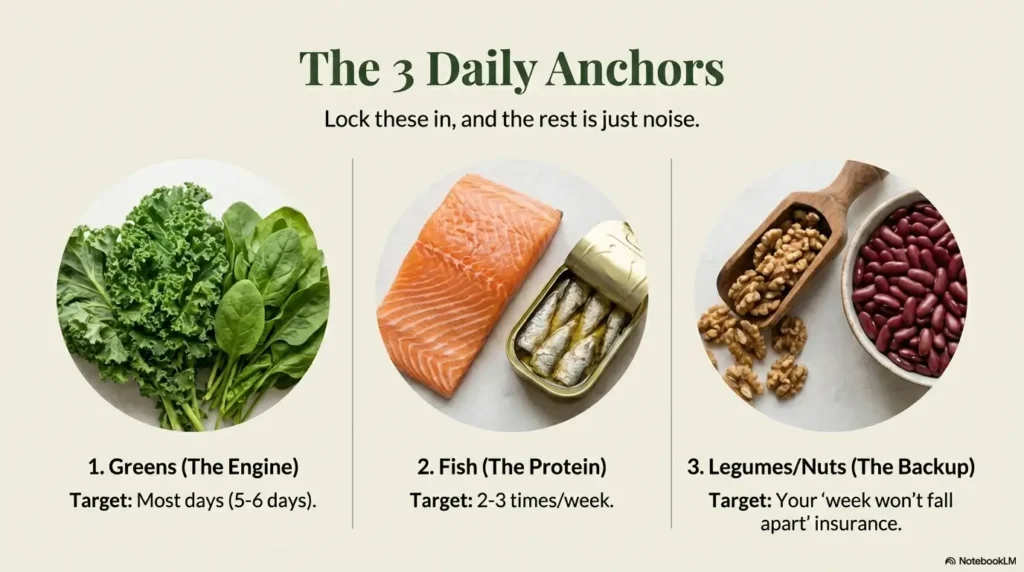
- Pick anchors: greens + fish + legumes/nuts.
- Use freezer and pantry “backups” to prevent plan collapse.
- Make the grocery list your weekly script, not a suggestion.
Apply in 60 seconds: Circle two fish meals and five “greens days” on your calendar.
Eligibility checklist (quick yes/no)
- Yes: You’ve been told you have intermediate AMD (or late AMD in one eye).
- Yes: You want a weekly food routine that supports eye health alongside clinician guidance.
- Yes: You can eat leafy greens and at least one protein source (fish, eggs, beans, tofu, chicken).
- No / pause: You have new or sudden vision changes (wavy lines, curtain/shadow, rapid loss).
- No / check first: You’re planning to start a high-dose supplement without clinician input—especially if you have kidney disease, kidney stone history, or take blood thinners.
Neutral next step: If any “pause” applies, call your eye clinic and ask what to do today.
2) The AREDS2 “diet vs supplement” line (and why it matters)
What AREDS2 supplements are designed to do
AREDS2 is a specific supplement formula studied for specific AMD stages. For people with intermediate AMD (or advanced AMD in one eye), the formulation is associated with a meaningful reduction in risk of progression from intermediate to advanced AMD—often summarized as about 25%. That’s not a vibe. That’s a research outcome people hang real hope on.
What food does better than pills
Food does something supplements can’t: it creates a daily pattern—fiber, protein, healthy fats, and plant variety that support heart and metabolic health too (which matters because your eyes don’t live in a separate universe). Food also trains consistency. And consistency is the quiet superpower here.
Curiosity gap: the “why am I doing everything right?” moment
Here’s the uncomfortable truth I’ve watched in real kitchens: most people aren’t “doing everything right.” They’re doing a few things right—randomly. A good breakfast on Monday. A salad on Wednesday. Then a long weekend of beige carbs because life happened. The hidden issue is usually inconsistency, not ignorance.
Decision card: Food pattern vs AREDS2 supplements
- You’re overwhelmed and need a plan you can execute this week.
- You’re not hitting greens/fish/legumes consistently.
- You want benefits that extend beyond the eyes (energy, blood sugar steadiness).
- Your clinician says your AMD stage fits the AREDS2 evidence.
- You can tolerate the product and you’ve reviewed interactions.
- You want a “belt + suspenders” approach—diet supports, supplements target.
Neutral next step: Write down your AMD stage (early/intermediate/late) from your last visit and bring it to your next appointment.
3) The 6 nutrient targets your week should quietly hit
Think of this section like a packing list. Not because nutrients are magic spells, but because a week without a packing list turns into “whatever was nearby.” (I say this as someone who has eaten peanut butter out of the jar at 11:19 PM and called it a “protein strategy.”)
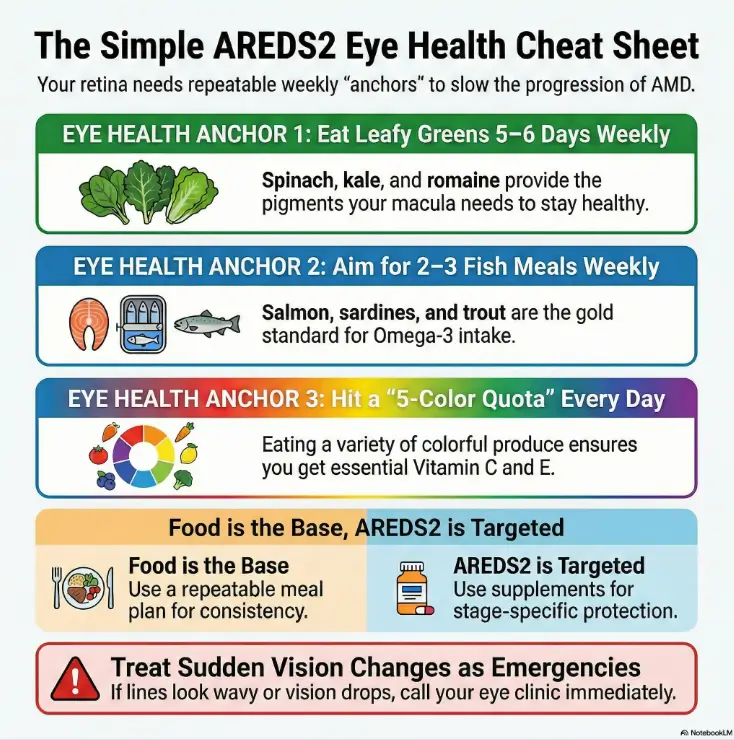
1) Lutein + zeaxanthin (food-first “macula pigments”)
These carotenoids are strongly associated with leafy greens and a few sneaky foods like egg yolks and corn. Your practical goal: greens most days, not “greens once when you feel guilty.”
- Top choices: spinach, kale, collards, romaine
- Also helpful: egg yolks, corn
2) Omega-3s (especially from fish)
Rather than chasing capsule perfection, aim for 2–3 seafood meals per week. You don’t need a chef’s hat. You need a repeatable default: salmon, sardines, trout, mackerel.
3) Vitamin C + E (plant variety + nuts/seeds)
Let fruit and colorful vegetables do most of the work: citrus, berries, peppers. Add nuts/seeds for vitamin E support: almonds, sunflower seeds.
4) Zinc + copper (food supports; supplements are high-dose)
Beans, nuts, whole grains, and seafood contribute. If you’re using AREDS2, remember: the formula includes high-dose zinc with copper to balance it—so “stacking” with other products can get messy fast.
5) Low-glycemic swaps (quietly protecting the long game)
Refined carbs spike and crash, and older bodies often feel that more sharply. Your easy swaps: oats instead of sugary cereal, beans instead of white bread snacks, berries instead of pastry “just because.”
6) “Color quota” (your easy weekly compliance metric)
Goal: 5 colors/day across produce. Greens count as one color. Don’t let them crowd out everything else—your plate should look like a small, edible paint set.
- Greens = most days.
- Fish = 2–3 meals/week.
- Legumes/nuts = your “week won’t fall apart” insurance.
Apply in 60 seconds: Add frozen spinach, canned fish, and beans to your cart right now.
4) The 7-day AREDS2 meal plan (built for repetition, not perfection)
How to use this plan
- Each day includes: Greens anchor + protein + color + healthy fat
- Swap rule: keep the function, change the food (salmon ↔ trout; spinach ↔ collards; chickpeas ↔ lentils)
- If you miss a day, you didn’t fail—you just restart at the next meal. That’s the whole trick.
Day 1 — “Greens + fish” starter day
- Breakfast: veggie omelet (spinach) + berries
- Lunch: lentil salad + olive oil vinaigrette
- Dinner: salmon + roasted vegetables + quinoa
Day 2 — Budget-friendly carotenoids
- Breakfast: oatmeal + walnuts + blueberries
- Lunch: turkey/bean chili + side salad
- Dinner: chicken + sautéed kale + sweet potato
Day 3 — Mediterranean rhythm (the easy default)
- Breakfast: Greek yogurt + fruit + chia
- Lunch: tuna or sardine salad wrap + crunchy veggies
- Dinner: veggie stir-fry + tofu/edamame + brown rice
Day 4 — “Eggs count” day (zeaxanthin-friendly)
- Breakfast: eggs + sautéed greens
- Lunch: chickpea bowl + avocado + peppers
- Dinner: trout + broccoli + farro
Day 5 — Plant-forward, still protein-adequate
- Breakfast: smoothie (spinach + berries) + nut butter
- Lunch: bean soup + whole-grain toast
- Dinner: shrimp + mixed vegetables + quinoa
Day 6 — Weekend flexibility (eat out without blowing the week)
- Restaurant strategy: pick fish + side salad; ask for olive oil/lemon; skip heavy sugary drinks
- At home fallback: sheet-pan salmon or chicken + any vegetables you have
Day 7 — Reset day (prep for the grocery list)
- Big salad base + leftover protein
- Make-ahead: cook grains + roast vegetables + wash greens
Another real-life detail: the “reset day” is the part people skip—and then they wonder why the week goes off the rails on Tuesday. Ten minutes of prep doesn’t make you a new person. It just makes Wednesday less fragile.
5) Printable grocery list (AREDS2-aligned, by aisle)
This is the part that turns good intentions into groceries. If you only do one thing from this entire post, do this list. Put it in Notes, print it, or tape it to the inside of your pantry like a tiny, benevolent boss. (If you prefer a dedicated, shareable version, use this printable AREDS2 grocery list by aisle.)
Produce (your “macula pigment” engine)
- Spinach / kale / collards / romaine
- Bell peppers, broccoli, carrots, sweet potatoes
- Berries (fresh or frozen), oranges/citrus
- Tomatoes, onions, garlic, mushrooms
Seafood + proteins
- Salmon (fresh/frozen), sardines or canned salmon, trout
- Eggs
- Chicken/turkey (or your preferred lean protein)
- Tofu/edamame
Pantry staples (the “week doesn’t fall apart” section)
- Lentils, chickpeas, black beans
- Oats, quinoa, brown rice, whole-grain bread/wraps
- Olive oil, vinegar, herbs/spices
- Low-sugar marinara, canned tomatoes
Nuts/seeds + dairy
- Walnuts, almonds
- Chia/flax
- Greek yogurt (plain)
Freezer shortcuts (compliance hacks)
- Frozen spinach, frozen mixed vegetables, frozen berries
Curiosity gap: The aisle most plans forget is the one that saves you when you’re tired: canned fish + beans. That combo is the “I can still follow the plan” backbone.
Quote-prep list: what to bring to your next eye appointment
- Your AMD stage as written in your visit summary (early/intermediate/late; one or both eyes).
- A photo of your supplement label (front + “Supplement Facts”).
- Your current medication list (especially blood thinners) and other supplements. (If you need a safer system, consider a low-vision-friendly medication management setup.)
- One week of “what I actually eat” notes (even if it’s messy). (A structured printable symptom diary can help you track patterns without overthinking.)
- Questions: “Do I fit AREDS2 criteria?” “Any reasons I should avoid high-dose zinc or vitamin E?”
Neutral next step: Put the label photo in a dedicated album called “Eye Health” so you can find it fast.
6) How to pair meals with AREDS2 supplements (without stacking mistakes)
Important: this section is educational, not medical advice. Supplement decisions depend on your AMD stage, medical history, and medications. But we can still reduce common “label math” mistakes that trip up smart people.
Know the standard AREDS2 formula (label check)
The classic AREDS2 formulation is commonly described as: Vitamin C 500 mg, Vitamin E 400 IU, Zinc 80 mg, Copper 2 mg, Lutein 10 mg, Zeaxanthin 2 mg. Many products aim to match that research-backed pattern—but labels vary. Front-of-bottle promises are not contracts.
Timing + tolerance (simple, practical)
- Take supplements with a meal that includes some fat (helps with fat-soluble components).
- If a product upsets your stomach, ask your clinician/pharmacist about timing, splitting doses (if label allows), or switching brands.
Here’s what no one tells you about labels…
Many “eye health” vitamins are not AREDS2. Some are general vision multivitamins. Some are partial formulas. Some add extra ingredients you may not need. If you’re paying for the AREDS2 evidence, make sure you’re actually buying the AREDS2 structure.
Smoking history note (non-negotiable)
If you are a current or former smoker, avoid formulas that include beta-carotene. AREDS2 replaced beta-carotene with lutein/zeaxanthin in part because beta-carotene raised lung cancer risk in certain groups. If you want a clear label-check walkthrough, use this AREDS2 for smokers guide.
Show me the nerdy details
In the AREDS/AREDS2 research, the “benefit” is tied to specific formulations in specific populations (not every person, not every eye condition). That’s why “close enough” labels can be misleading. Also: omega-3 supplements have not shown the same kind of AMD outcome effect as the AREDS2 formulation—so if you’re choosing where to focus, food-based fish meals often make more sense than betting everything on capsules.
- “Eye health” ≠ “AREDS2.” Read the Supplement Facts.
- Take with a meal that includes some fat for comfort and absorption.
- Don’t stack multiple multis + eye formulas without doing the math.
Apply in 60 seconds: Take a photo of your supplement facts label and zoom in—check for lutein + zeaxanthin.
7) Common mistakes (what quietly derails progress)
Mistake #1: Treating “healthy eating” as a single category
“Healthy” is too vague to execute at 6:40 PM. The fix is embarrassingly simple: lock three anchors—greens, fish, legumes/nuts—then add color around them.
Mistake #2: “I’ll just eat kale instead of supplements”
Food is powerful. But it doesn’t replicate the stage-specific supplement evidence. If your clinician recommends AREDS2 for your stage, treat diet as the daily base and supplements as the targeted add-on—not rivals.
Let’s be honest: if you’re not eating greens 4–6 days/week, you’re not on a plan. You’re on a hope. (Hope is lovely. It’s also unreliable.)
Mistake #3: Chasing omega-3 pills expecting AREDS2-level results
Omega-3s matter for health, and fish is a strong food choice. But omega-3 supplements haven’t shown the same “this slows progression risk” story that people associate with AREDS2. Don’t outsource your week to capsules if you can build fish meals instead.
Mistake #4: Stacking multivitamins + eye formulas without doing the math
This is where well-meaning people accidentally create “mega-dose soup.” If you take a multivitamin, an eye vitamin, plus other single nutrients, talk with your clinician or pharmacist to review totals—especially for vitamin E and minerals like zinc.
Don’t do this: 5 “eye-health” myths that backfire
- “More supplements = better.”
- “Carrots fix AMD.”
- “Detox cleans the retina.”
- “Skipping meals is fine if dinner is perfect.”
- “Any AREDS bottle is the same.”
Commercial reality check (neutral, just so you’re not confused at the shelf): brands like PreserVision AREDS 2 are designed to match the research-style formulation, while general eye vitamins such as Ocuvite are often positioned for broader eye health. The point is not which brand you choose—it’s that the label matches your goal.
8) When to seek help (don’t meal-plan through red flags)
Seek urgent eye care now if you notice
- Sudden distortion (straight lines bending), a new blind spot, or rapid worsening in one eye
- Sudden vision loss
- A curtain/shadow sensation
If you’re unsure whether it’s urgent
Treat “sudden change” as urgent. AMD isn’t the only cause of fast vision shifts, and waiting to “see if it passes” is a gamble you don’t need.
One of the most sobering moments I’ve witnessed: someone describing wavy lines as “probably just fatigue.” It wasn’t. They were lucky they acted quickly. This is your permission slip to be the kind of person who overreacts in the right direction. (If you’re building a “no-panic” plan for worst-case days, keep a wet AMD home safety checklist handy—because stress makes details slippery.)
10) Next step (one concrete action)
Do this in 10 minutes today
Print (or copy into Notes) the grocery list, then choose two anchors for this week:
- Two fish dinners
- Greens at least five days
That’s the smallest change that reliably moves you from “trying” to “following.”
Mini calculator: Are your weekly anchors covered?
Enter two numbers. Get a simple “on track / adjust” signal. (No data is stored.)
Neutral next step: If you’re short on anchors, add one freezer item and one pantry item to close the gap.
Also: give yourself a “bad day protocol.” Mine is simple—canned sardines or salmon, bagged salad, olive oil, and a piece of fruit. Not glamorous. Very effective.

FAQ
1) Do I need AREDS2 supplements if I have intermediate AMD?
Many people with intermediate AMD are the exact group discussed in AREDS2 guidance. But the right answer depends on your stage, the eye(s) affected, and your medical history. Bring your diagnosis wording and your supplement label to your clinician so the decision is precise, not guessy. (If you’re also navigating appointments and practical next steps, a senior-friendly annual eye exam checklist can make visits less stressful.)
2) Can an AREDS2 diet replace AREDS2 vitamins?
Diet supports overall health and can help you consistently hit food sources of lutein/zeaxanthin, omega-3s (from fish), and colorful plants. But the AREDS2 evidence is tied to a specific formulation used in specific AMD stages. Many people do best with “food as the base, supplements as the stage-specific add-on,” if recommended.
3) What’s the difference between AREDS and AREDS2—and why should smokers care?
AREDS2 replaced beta-carotene with lutein/zeaxanthin in part because beta-carotene raised lung cancer risk in current/former smokers. If you have any smoking history, this is a label detail worth double-checking. (This AREDS2 label guide for current/former smokers can help you verify quickly.)
4) What foods are highest in lutein and zeaxanthin?
Leafy greens are the biggest hitters: spinach, kale, collards, romaine. Egg yolks also contribute in a convenient, breakfast-friendly way. The “best” food is the one you’ll eat repeatedly, so pick two greens you actually like.
5) How many times a week should I eat fish for AMD-friendly eating?
A practical target is 2–3 fish meals per week. If that feels like a lot, start with two. Use canned fish if cooking feels like a barrier—your retina won’t grade your plating.
6) Are eggs okay for AMD (and do they help with zeaxanthin)?
Eggs can be a helpful, protein-rich option, and yolks contain carotenoids like zeaxanthin. If you’re managing cholesterol or other conditions, follow your clinician’s guidance, but eggs are often an easy way to make breakfast more “eye-aligned.”
7) What AREDS2 ingredient amounts should I look for on labels?
The commonly referenced formulation includes vitamin C, vitamin E, zinc, copper, lutein, and zeaxanthin in specific amounts. Labels vary by product, so compare the Supplement Facts panel carefully—and ask your pharmacist if you’re stacking multiple supplements.
8) Can I take AREDS2 with a multivitamin?
Sometimes, but you must check for overlap—especially vitamin E and minerals like zinc. This is one of the most common “accidental mega-dose” situations. When in doubt, ask a pharmacist to review totals.
9) What should I do if straight lines start looking wavy?
Treat new distortion as urgent and contact your eye clinic promptly. Don’t wait for your next scheduled visit, and don’t try to solve it with a better salad. Nutrition is long-game support; sudden symptoms are a “today” problem. (If your doctor discusses injections or wet AMD treatment, having a plain-English wet AMD injection schedule overview can reduce uncertainty.)
Conclusion
Remember the anxious grocery-store question from the beginning—the one that sounds like, “I’m doing the vitamins… why do I still feel unsure?” Here’s the answer: because vitamins are a decision, but meals are a system. A system needs defaults. And you now have them.
Short Story: The Tuesday Turnaround (120–180 words) …
A friend of mine—smart, organized, deeply tired—kept telling me they were “eating better for their eyes.” On paper, it was true. In reality, their week was a string of good intentions separated by convenience. The turning point wasn’t a lecture. It was Tuesday at 6:12 PM. They were hungry, slightly grumpy, and one small decision away from ordering something that would leave them feeling worse.
Instead, they opened a cabinet, found canned salmon and chickpeas, dumped both into a bowl, added olive oil and lemon, and threw a handful of greens on top. It wasn’t pretty. It was done. The next day they repeated it—because repetition is easier than reinvention. Two weeks later, they weren’t “trying” anymore. They were following a script. Anxiety went down. Confidence went up. And the kitchen felt less like a test.
If you want the cleanest “next 15 minutes” action: choose two fish meals and five greens days, then shop only for those anchors plus color. Start small, make it sturdy, and let it repeat.
Last reviewed: 2026-01-20