
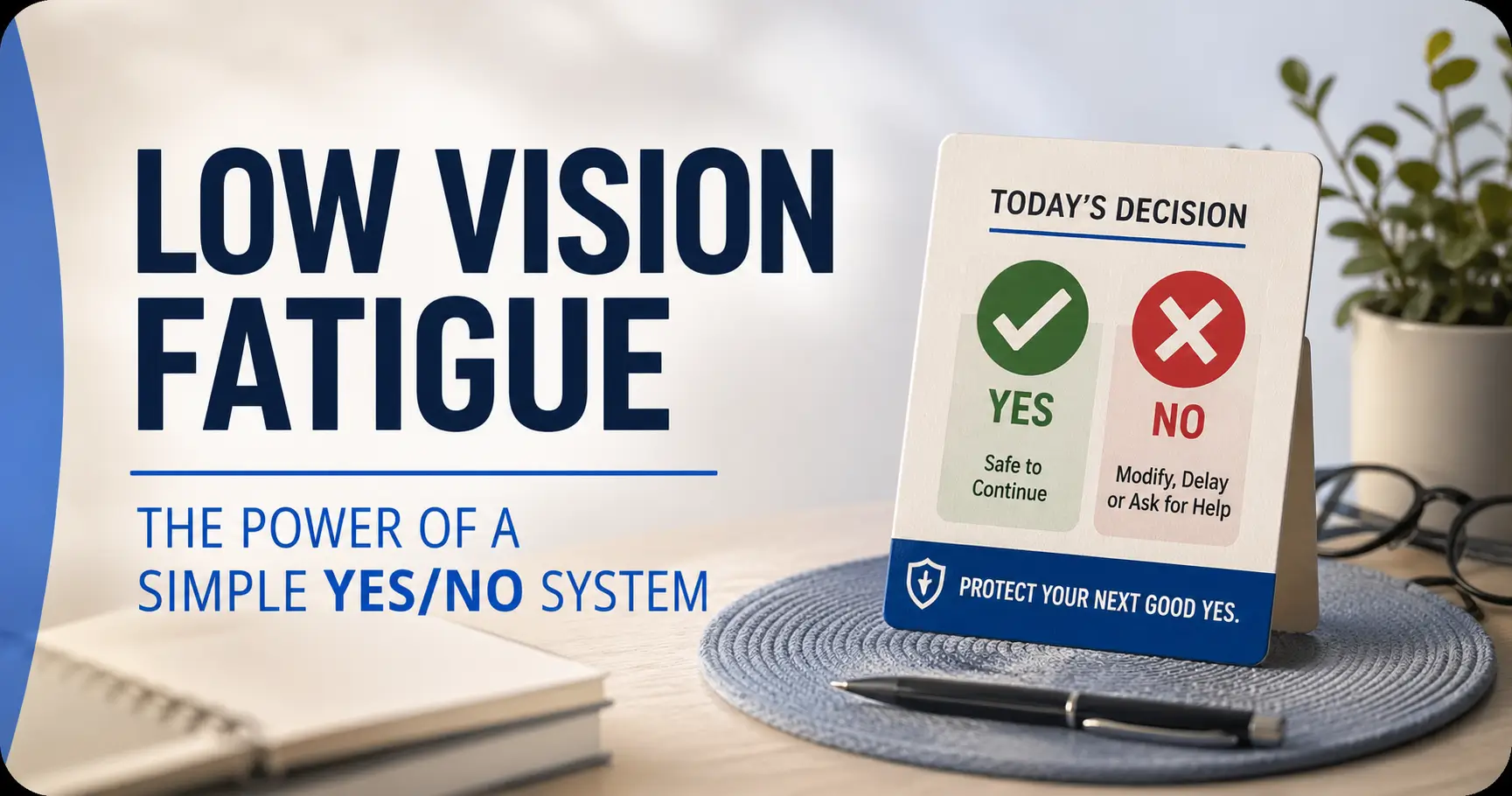
Navigating Low Vision Fatigue:
The Power of a Simple Yes/No System
Low vision fatigue rarely arrives with drama. It surfaces when a familiar kitchen requires extra effort, stairs feel less trustworthy, or a medication label demands more concentration than you have left.
“A Yes/No decision system turns ‘Maybe I can push through’ into a safer, simpler choice before the risky moment gathers speed.”
When glare, screen strain, and household tasks collide, guessing can lead to skipped meals or unsafe movements. By implementing visible rules for tasks like bathing, cooking, and errands, you replace uncertainty with clarity.
The Goal: To protect your next good “yes.”
Fewer decisions • Clearer task cards • Safer substitutes • Supportive check-ins
Table of Contents
Safety note: This guide helps organize daily decisions and caregiver check-ins. It does not diagnose low vision, fatigue, dizziness, medication side effects, depression, sleep problems, or neurological symptoms. Sudden vision changes, new confusion, fainting, chest pain, severe weakness, or unsafe walking need medical guidance right away.
Start Here: Fatigue Days Need Fewer Decisions, Not More Willpower
Why low vision fatigue makes ordinary choices feel heavier
Low vision fatigue is not ordinary tiredness wearing a nicer jacket. It is the strain of reading the world through extra effort: brighter lights, sharper contrast, slower scanning, careful steps, repeated checking, and that little internal accountant calculating whether the hallway is safe enough.
On a good day, making lunch may be one task. On a fatigue day, it becomes six: find the knife, check the stove, read the label, avoid glare, remember the timer, and carry the plate without rushing. That is a crowded committee meeting inside one kitchen.
I once watched a caregiver ask, very kindly, “Can you make soup today?” The person answered, “Yes,” then paused. The real answer was: yes to soup from a container, no to chopping vegetables, no to leaning over steam, yes to sitting while it heats. The yes/no system exists for that pause.
The real goal: protect safety, energy, and independence
The goal is not to become cautious about everything. That would be a tiny kingdom with too many locked doors. The goal is to reserve energy for what matters and reduce the odds of a preventable fall, burn, missed dose, or exhausted evening.
The National Eye Institute explains that low vision can make everyday activities harder, including reading, driving, recognizing faces, telling colors apart, and using screens. Vision rehabilitation can help people learn tools and strategies that support independence. That matters here because a yes/no system works best when it is paired with practical skills, not shame.
For many homes, the first practical layer is not a dramatic remodel. It is a safer daily map: better lighting, fixed locations, readable labels, and a few routines that make aging vision fall prevention at home feel less like a warning poster and more like ordinary good design.
The “yes/no” system in one sentence
A yes/no decision system is a set of plain rules that turns “Should I push through?” into “Is this task safe today, or should I modify, delay, simplify, or ask for help?”
- Use yes/no rules before the risky moment.
- Treat “no” as a design cue, not a personal defeat.
- Protect energy for bathing, meals, medication checks, and safe movement.
Apply in 60 seconds: Pick one task that often feels harder after lunch and write, “If I feel unsteady, I modify this task.”
Who This Is For, and Who Should Use a Different Plan
Good fit: people with predictable low vision fatigue patterns
This system is a strong fit when fatigue follows a pattern. Maybe reading labels is harder after 4 p.m. Maybe glare makes the kitchen feel hostile by noon. Maybe showering is fine in the morning but feels risky at night. Patterns are not failures. They are maps.
For many adults with low vision, the hardest part is not one dramatic obstacle. It is the daily drizzle of effort: checking, squinting, reaching, correcting, searching. A yes/no system gives that drizzle a gutter. Less flooding, fewer frantic towels.
Good fit: caregivers who need clearer check-in language
Caregivers often ask broad questions because they are trying not to sound controlling. “Are you okay?” feels gentle. Unfortunately, it is also foggy. A person can be emotionally okay, physically tired, visually strained, and not safe to carry laundry down the stairs. That answer does not fit inside one polite “fine.”
Yes/no prompts are kinder because they reduce translation. “Did you skip the stairs after dark, yes or no?” is easier to answer than “How are you managing?” The first question has a door handle. The second is a hallway in the dark.
If a spouse or adult child is trying to help without taking over, it can also be useful to think beyond task lists and consider helping a spouse with vision loss as a relationship skill: clear offers, shared routines, and fewer vague interrogations across the kitchen table.
Not enough: sudden vision change, new confusion, fainting, or severe weakness
A home decision system is not the right tool for sudden or severe symptoms. If fatigue arrives with sudden vision loss, new confusion, fainting, chest pain, severe weakness, trouble speaking, a new severe headache, or a fall with injury, treat that as medical territory.
Here is the plain version: a yes/no system helps with routine fatigue days. It should not be used to explain away a new symptom that makes the day feel strange, unsafe, or sharply different from normal.
Not ideal: tasks that require clinician-specific instructions
Some decisions need a clinician’s plan, especially medication timing, blood sugar concerns, oxygen use, post-surgery restrictions, eye drop schedules, dizziness, vertigo, or assistive device changes. Your yes/no system can remind you to follow the plan. It should not invent the plan.
Money Block: Eligibility Checklist
Use this system if most answers are yes:
- Yes / No: Fatigue usually follows a recognizable pattern.
Next step: Track the hardest time of day for 3 days. - Yes / No: You can name 3 risky tasks, such as showering, stairs, cooking, or errands.
Next step: Start with only one task card. - Yes / No: Caregivers need clearer check-ins.
Next step: Replace “Are you okay?” with one yes/no question. - Yes / No: Symptoms are familiar, not sudden or severe.
Next step: Use the system for routine days only.
Neutral action line: If you answered no to sudden-symptom safety, contact the appropriate care team before relying on a home routine.
The Hidden Question: “Is This a Safe Day or a Support Day?”
Why “I’m tired” is too vague to guide action
“I’m tired” can mean “I need a nap.” It can also mean “I am about to misread the stove dial, trip on the rug, skip lunch, or forget whether I took the afternoon medication.” Same sentence. Very different stakes.
That is why the hidden question is not “Am I tired?” It is: Is this a safe day or a support day? Safe days allow normal tasks with usual precautions. Support days call for shortcuts, seated tasks, brighter lighting, simpler meals, fewer errands, and clearer caregiver contact.
Turn fatigue into three zones: green, yellow, red
A yes/no system becomes easier when you divide the day into 3 zones:
- Green: I feel steady, alert, oriented, and able to use my usual tools.
- Yellow: I can do some tasks, but I need modifications, breaks, or support.
- Red: I should stop risky tasks and contact help or medical support if symptoms are concerning.
Green does not mean “charge forth like a caffeinated marching band.” It means normal caution. Yellow means the day needs guardrails. Red means the system stops being a productivity tool and becomes a safety tool.
Make the system visible, tactile, and repeatable
A low vision fatigue system should not live only in a phone menu unless the phone is genuinely the easiest tool. On tired days, hidden systems become decorative furniture. Pretty, theoretically useful, and absolutely ignored when needed.
Use large print, bold contrast, tactile dots, a talking reminder, a magnetic card, or a laminated one-page sheet near the decision point. The system should sit where the question happens: bathroom door, kitchen counter, stair rail, bedside table, medication area, or front door.
For the medication area, tactile cues can prevent the “I think this is the right bottle” moment from becoming a daily stress test. A simple system for pill bottle tactile label placement can support the yes/no rule without asking tired eyes to do all the work.
Infographic: The 3-Zone Fatigue Decision Map
GREEN
Question: Can I see, think, and move steadily?
Decision: Yes, use normal routine.
Example: Simple meal, planned walk, usual shower setup.
YELLOW
Question: Is this safe only if I simplify it?
Decision: Modify, sit, delay, or ask.
Example: No stairs with laundry, no cooking with knives.
RED
Question: Is something new, severe, or unsafe?
Decision: Stop risky tasks and seek help.
Example: New confusion, fainting, sudden vision loss.
Build the First Rule: If the Body Says No, the Task Changes
Yes if: balance, focus, lighting, and pain feel manageable
A good yes/no rule should begin with the body, not the calendar. The calendar may say grocery day. Your balance may say sandwich day. Listen to the body. It is the only committee member who has to cross the bathroom floor at 9 p.m.
A task can be a “yes” when 4 things are true: balance feels steady, focus is clear, lighting is good enough, and pain or discomfort is not pulling attention away from movement. You do not need perfection. You need enough safety margin.
No if: dizziness, rushing, glare, or uncertainty shows up
A task should become a “no” or “not this way” when dizziness, rushing, glare, uncertainty, new weakness, or mental fog appears. These are not tiny inconveniences. They are warning lights on the dashboard.
One older adult I knew had a brilliant rule: “If I say ‘I’ll just do it quickly,’ I sit down first.” That tiny pause prevented more chaos than any expensive gadget in the house. Speed is not always the villain, but on fatigue days it wears a little fake mustache.
Maybe means modify, not force
“Maybe” is the most dangerous answer because it sounds flexible. On fatigue days, maybe should trigger a modification. Sit while sorting laundry. Use a microwave meal instead of a stovetop meal. Call before taking stairs with a basket. Move the errand to daylight.
Think of maybe as a hinge, not a shove. It opens a safer version of the task.
- Yes requires balance, focus, lighting, and enough comfort.
- No appears when dizziness, rushing, glare, or uncertainty appears.
- Maybe means change the task before starting.
Apply in 60 seconds: Write this sentence: “If I feel rushed or unsure, I stop and choose the easier version.”

The Morning Gate: Decide Before the Day Gets Noisy
Ask three questions before breakfast
The morning gate is a 2-minute check before the day begins bargaining with you. Do it before breakfast, before news, before texts, before the house starts tossing tiny requests like confetti.
Ask these 3 questions:
- Can I move steadily from bed to bathroom today?
- Can I read or identify what I need for meals and medication checks?
- Do I need help, delay, or simpler tasks before afternoon fatigue arrives?
Keep the answers plain. Yes. No. Not sure. If the answer is “not sure,” treat the day as yellow until proven otherwise.
Choose one “must-do” task and one “can-wait” task
Fatigue days punish overstuffed plans. Instead, choose one must-do task and one can-wait task. Must-do might be meals, medication check, hydration, an appointment, or a necessary call. Can-wait might be laundry, deep cleaning, paperwork, or the drawer full of cables that somehow breeds at night.
This is not laziness. It is triage. Emergency rooms do not treat paper cuts before chest pain, and fatigue days need similar common sense.
When appointments are part of the must-do list, a visible calendar can stop the day from turning into a guessing game. A low vision calendar system for appointments can make the morning gate more concrete: what must happen today, what can wait, and what needs support before the afternoon fog rolls in.
Let’s be honest: mornings can lie
Some mornings feel better than they are. A person may wake with a little energy and spend it all by 10 a.m. Then the afternoon arrives with a bill and no payment plan.
That is why the morning gate should include an afternoon prediction. Ask: “If I do this now, what will be harder later?” If the answer is showering, eating, walking safely, or taking medication correctly, the task needs modification.
Money Block: 3-Input Fatigue Margin Calculator
Use this tiny calculator on paper. No app, no account, no digital circus.
- Energy now: 0 to 3 points. 0 = drained, 3 = steady.
- Vision strain now: 0 to 3 points. 0 = high strain, 3 = manageable.
- Balance confidence now: 0 to 3 points. 0 = unsafe, 3 = steady.
Total: 7–9 = green task day. 4–6 = yellow modification day. 0–3 = red support day for risky tasks.
Neutral action line: If your score is low because symptoms are new or severe, stop the task and contact appropriate help.
Task Cards: Give Daily Activities a Clear Yes or No
Cooking: yes for simple prep, no for heat-and-knife multitasking
Cooking is not one task. It is heat, sharp tools, labels, timing, steam, carrying, cleaning, and memory. On a low vision fatigue day, that is a crowded stage. Someone will forget a line.
A good cooking card might say: Yes to microwave meals, pre-cut food, cold plates, labeled leftovers, and sitting while prepping. No to new recipes, hot oil, large knives, multitasking at the stove, or cooking while rushed.
One practical trick: keep 2 fatigue-day meals visible and predictable. Soup with a pull-tab lid, yogurt with fruit, a sandwich kit, frozen meals with tactile labels, or whatever fits the person’s diet and clinician guidance. The best emergency meal is not glamorous. It is findable.
Kitchen yes/no cards become much more useful when the tools match the rule. For example, low vision knife storage can turn “no knives when fatigued” from a vague warning into a visible boundary, while tactile dots for microwave buttons can make the safer meal option easier to use without squinting at a keypad.
Showering: yes with safe setup, no when balance feels unreliable
Showering combines wet surfaces, temperature changes, reaching, bending, low contrast, and closed-door privacy. It deserves respect. A fatigue-day shower card should be more specific than “be careful,” which is what advice says when it has given up.
Yes might mean shower chair ready, non-slip surface in place, towel within reach, lighting steady, phone or alert method nearby, and no rushing. No might mean feeling dizzy, unusually weak, confused, shaky, or unable to organize the steps safely.
Bathroom routines also benefit from tactile anchors. A simple tactile faucet marking system can reduce temperature guessing, and tactile labels for shampoo and conditioner can keep the shower from becoming a slippery little memory test.
Stairs: yes with calm conditions, no when carrying items or rushing
Stairs are honest. They do not care that the laundry needs to move. They do not care that the doorbell rang. On fatigue days, stairs should have a stricter rule.
Yes to stairs when lighting is good, hands are free, shoes are secure, and there is no rushing. No to stairs while carrying laundry, food, trash, packages, or anything that blocks handrail use. If an object needs to go upstairs, it can wait in a basket near the stairs like a patient little bureaucrat.
Errands: yes with daylight and support, no when fatigue is already rising
Errands are sneakier than they look. They include transportation, parking lots, changing light, unfamiliar shelves, payment screens, traffic noise, and social pressure from the person behind you who sighs like a haunted accordion.
Yes to short, familiar errands in daylight with a plan. No to new routes, crowded stores, driving when vision or alertness is strained, or “just one more stop” after fatigue has started rising.
If grocery trips are a recurring fatigue trap, a low vision grocery list system can make errands shorter and less improvisational. For payment screens and crowded checkout lanes, it may also help to practice low vision self-checkout strategies on a green day, not during a tired, noisy rush.
Show me the nerdy details
A useful task card has 4 parts: the task name, the “yes” condition, the “no” condition, and the safer substitute. For low vision fatigue, the substitute matters most because a flat “no” often gets ignored. “No stovetop cooking when dizzy” works better when paired with “use labeled microwave meal or call caregiver before starting.”
The No List: Decisions You Should Not Debate on Bad Fatigue Days
Do not “just quickly” rearrange furniture or cords
Furniture and cords are not casual fatigue-day projects. Moving them changes the map of the home. For someone with low vision, a changed map can turn a memorized route into a surprise obstacle course.
The no list should include rearranging furniture, shifting rugs, moving floor lamps, changing cord paths, stacking boxes in walkways, or leaving items on stairs. If something must move, make it a planned task with good lighting and a second person if needed.
Do not test new routes, new apps, or new medication routines alone
New things demand extra visual and mental processing. That includes a new grocery route, a new delivery app, a new pill organizer, a new voice assistant command, or a new device charger. On a rested day, those may be fine. On a fatigue day, they become tiny mazes with customer service music.
Medication routines deserve extra caution. Do not change timing, combine doses, skip doses, or redesign a pill system without clinician or pharmacist guidance. The yes/no system should support the existing plan, not improvise a remix.
When medication questions are the problem, the safer move is often a prepared script, not a brave guess. A low vision pharmacy help script can make it easier to ask about label readability, bottle confusion, refill timing, and instructions without trying to remember everything under fluorescent lights.
Do not save every chore for one heroic afternoon
The heroic afternoon is a famous household villain. It starts with “I will just catch up” and ends with sore feet, dim light, a missed meal, and one person standing in the hallway wondering why the house is spinning slightly.
Instead, use 10-to-20-minute chore windows when energy is better. Stop before the crash. A fatigue-day system should protect tomorrow’s function, not merely finish today’s list.
- No furniture or cord changes on bad fatigue days.
- No new routes or apps when visual strain is high.
- No heroic chore marathons after energy has already dropped.
Apply in 60 seconds: Put one sentence near the stairs or kitchen: “No new setups on yellow or red days.”
Caregiver Check-Ins: Replace “Are You Okay?” With Yes/No Prompts
Ask: “Did you use the shower today, yes or no?”
“Are you okay?” often produces “I’m fine,” partly because nobody wants to become a project. A better question is specific, answerable, and respectful. “Did you use the shower today, yes or no?” gives the caregiver useful information without requiring a full courtroom testimony.
If the answer is no, the follow-up should not be a scolding little thundercloud. Try: “Was it because of balance, vision strain, pain, or energy?” That turns the answer into a useful pattern.
Ask: “Did you skip stairs after dark, yes or no?”
Stairs after dark are a common danger zone, especially when lighting, fatigue, and urgency overlap. A yes/no question helps both people discuss the behavior, not the person’s character.
Instead of “You shouldn’t be going upstairs at night,” try: “Did you skip stairs after dark yesterday, yes or no?” If the answer is no, ask what needed to be upstairs. The solution may be a duplicate phone charger, extra towel, medication checklist, or laundry basket system.
Night routines deserve their own tiny architecture. If bathroom trips after dark are part of the concern, low vision nighttime bathroom safety can help families think through lighting, path clearing, fixed item locations, and safer “no debating” rules before midnight turns the hallway into a puzzle.
Ask: “Do you want help today, yes or no?”
This question sounds simple, but it needs one small improvement: define help. Many people say no because “help” sounds like losing control. Offer choices.
- “Do you want help with errands, yes or no?”
- “Do you want help setting up dinner, yes or no?”
- “Do you want me to call while you check the medication list, yes or no?”
Here’s what no one tells you: vague concern creates vague answers
Caregiver worry can fill a room quickly. It has elbows. Yes/no prompts make the room easier to breathe in because they replace emotional fog with task clarity.
I have seen families transform a daily argument with one change: they stopped asking “Why didn’t you do that?” and started asking “Was today a safe day or a support day?” Same concern. Better doorway.
Money Block: Caregiver Decision Card
| Use this | When it helps | Trade-off |
|---|---|---|
| Vague check-in “Are you okay?” | Emotional connection, casual conversation. | Low detail. May hide safety problems. |
| Yes/no prompt “Did you avoid stairs after dark?” | Safety tasks, patterns, caregiver planning. | Needs warmth so it does not sound like an inspection. |
Neutral action line: Choose one yes/no prompt and use it for 7 days before adding more.
Common Mistakes: Where a Simple System Quietly Breaks
Mistake 1: making too many categories
A fatigue-day system should not require a training manual, a password, and a ceremonial candle. If it has 12 categories, it will collapse on the exact day it is needed.
Start with 3 zones and 4 task cards. That is enough: meals, bathing, stairs, errands. Add medication checks only in a way that supports the existing medical plan. Add more later if the system is actually being used.
Mistake 2: hiding the system in a phone menu
Phones can be excellent accessibility tools. They can also become tiny locked filing cabinets when fatigue rises. If unlocking, navigating, zooming, or listening takes too much effort, the checklist will not be used.
Consider a hybrid: phone reminder plus a large-print card. Or a tactile marker on the phone that opens the right note. Or a voice command that reads the checklist aloud. The best tool is the one that survives a yellow day.
For readers who already use a smartphone comfortably, phone-based support can still be a useful second layer. Features like iPhone Back Tap Magnifier or Android Select to Speak for menus can help when the task is reading a label, menu, or short instruction, as long as the system does not depend on a maze of taps during a fatigue crash.
Mistake 3: treating “no” as failure
This is the emotional knot. Many people hear “no” as loss. No shower today. No stairs tonight. No cooking from scratch. No extra errand. It can feel like the world getting smaller.
But in this system, no means “protect the next yes.” No to stairs with laundry may preserve yes to dinner, yes to a calm evening, yes to walking safely tomorrow. That is not surrender. That is resource management with better shoes.
Mistake 4: forgetting the evening version
Evening fatigue is different. The house is dimmer. The body is slower. Patience is thinner. The floor may contain one mysterious sock with villainous intentions.
Create evening rules for lighting, bathroom trips, phone charging, glasses placement, water, medications, and tomorrow’s breakfast setup. A good morning often begins with a less chaotic night.
Lighting is especially personal at night. Some people need a softer path light, while others need enough contrast to avoid guessing. If the house feels too harsh after sunset, compare red vs amber night light options, or troubleshoot a motion sensor light that feels too bright before the evening rule gets ignored.
- Keep the first version painfully simple.
- Put the rule where the decision happens.
- Use “no” to preserve tomorrow’s independence.
Apply in 60 seconds: Remove one category from your draft system. Fewer rules used daily beat many rules ignored beautifully.
When to Seek Help: The Red-Flag Side of Fatigue
Seek urgent help for sudden vision loss, chest pain, fainting, severe weakness, or new confusion
Fatigue can be ordinary. It can also be a signal that something has changed. Seek urgent help for sudden vision loss, new confusion, fainting, chest pain, severe weakness, trouble speaking, a fall with injury, or symptoms that feel dramatically different from the person’s usual pattern.
This is where the yes/no system should be blunt: No debating red flags. No waiting to see if a severe symptom becomes more convenient. Bodies rarely schedule emergencies politely.
For families unsure whether a change is ordinary aging or something more serious, a red-flag review like senior vision changes warning signs can help frame the conversation before the next eye appointment or urgent call.
Call the care team when fatigue changes suddenly or causes skipped meals, missed medication, or unsafe walking
Call the care team when fatigue suddenly worsens, starts affecting meals, leads to missed or double medication doses, causes unsafe walking, increases falls or near-falls, or makes basic hygiene difficult. These are not character flaws. They are data.
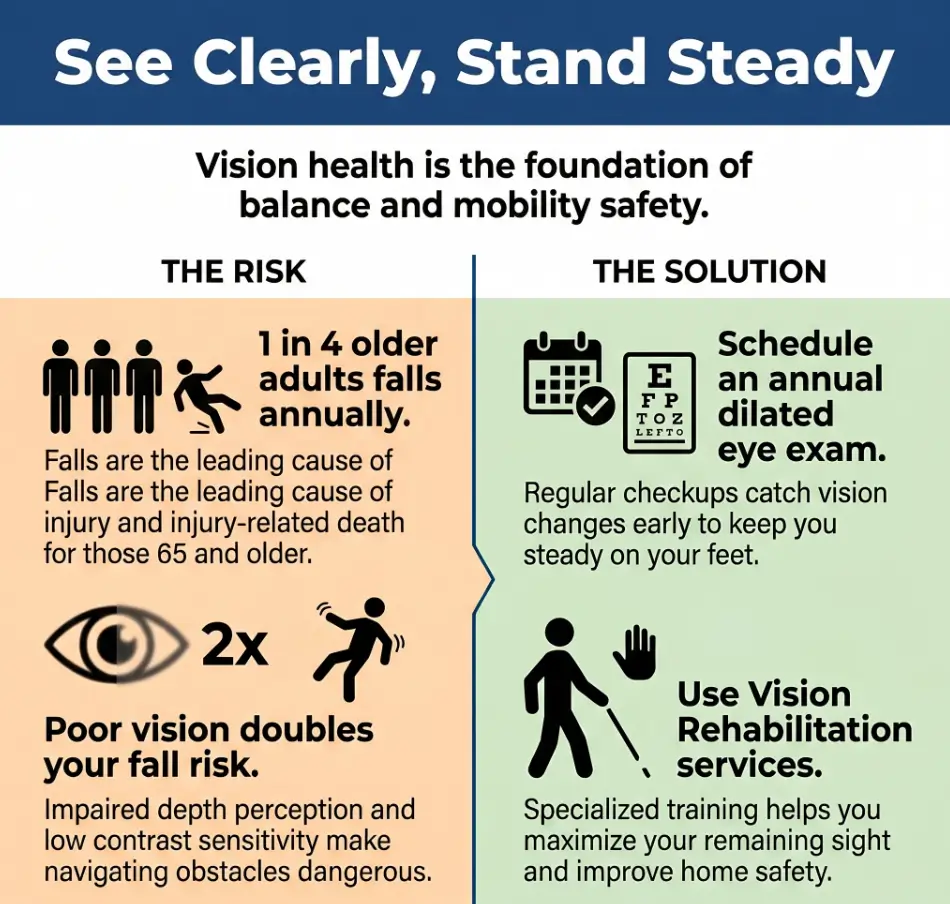
The CDC notes that vision impairment can increase fall risk among older adults, and home safety steps matter. The CDC also reports that falls are the leading cause of injury for adults 65 and older, with more than 14 million older adults reporting a fall each year. That is not meant to frighten anyone. It is meant to justify taking “small” home decisions seriously.
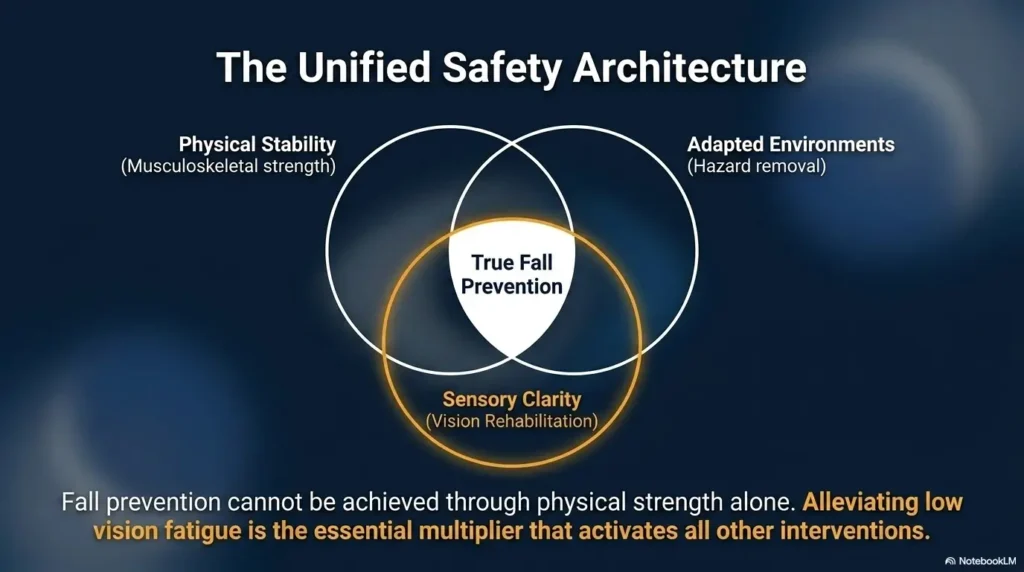
Ask about vision rehabilitation when daily tasks keep getting harder
If daily tasks keep getting harder, ask an eye doctor or care team about vision rehabilitation. The National Eye Institute describes vision rehabilitation as support that can include tools, training, and strategies to help people manage daily life and keep independence.
That can include learning safer ways to read labels, organize medication areas, cook, use devices, manage lighting, navigate the home, or adapt familiar routines. A yes/no system is stronger when paired with real-world training.
Readers who need a more specialized starting point may also want to learn what a low vision specialist for macular degeneration can help with, especially when home routines, reading, glare, and independence are all tangled together.
Your First Yes/No Template: A One-Page System Readers Can Copy
Morning decision: safe day or support day?
Use this template as a starting point. Print it large, write it by hand, record it as a voice memo, or place it in a shared caregiver note. The format matters less than the habit.
Copyable One-Page Yes/No System
Morning Gate
- Can I walk steadily from bed to bathroom? Yes / No / Not sure
- Can I identify meals, medication setup, and important items clearly enough? Yes / No / Not sure
- Is today green, yellow, or red? Green / Yellow / Red
Today’s Must-Do: __________________________
Today’s Can-Wait: __________________________
Person to contact if the day turns yellow or red: __________________________
Home task decision: do, modify, delay, or ask
Each task gets one of 4 choices. This keeps “no” from becoming a brick wall.
- Do: The task is safe today with normal precautions.
- Modify: Use a simpler version, seated setup, better lighting, or support.
- Delay: Move the task to a better time or another day.
- Ask: Call, text, or use planned support before starting.
For example, “cook dinner” may become “modify: microwave labeled meal and sit while preparing.” “Laundry” may become “delay: no stairs with basket today.” The task does not vanish. It changes clothes.
Evening decision: stop, simplify, or prepare tomorrow
The evening system should be shorter than the morning system. Tired people do not need a dissertation near the toothbrush.
Try 3 questions:
- Are tomorrow’s glasses, phone, water, and key items in their fixed places?
- Is the path to the bathroom clear and lit?
- Should I stop chores now to protect tomorrow morning?
Keep it by the place where decisions happen
Put the cooking rule in the kitchen. Put the shower rule near the bathroom, but not where it gets wet and becomes paper oatmeal. Put the stair rule near the rail. Put the caregiver prompt list where calls happen.
Fixed places are the quiet engine behind this whole system. A low vision key identification system, a consistent medication spot, and a simple low vision filing system can reduce the search-and-panic loop that drains energy before the day has even properly opened its curtains.
Money Block: Quote-Prep List Before Comparing Tools or Services
Before buying devices, hiring help, or asking about home safety upgrades, gather:
- Top 3 hardest tasks: showering, stairs, cooking, errands, medication checks, or screen use.
- Hardest time of day: morning, afternoon, evening, or overnight.
- Current tools: magnifier, cane, walker, shower chair, grab bars, lighting, phone accessibility settings.
- Recent near-misses: trips, burns, missed meals, missed medication checks, or unsafe walks.
- Care team contacts: eye doctor, primary care clinician, pharmacist, occupational therapist, or vision rehabilitation provider.
Neutral action line: Compare options based on the repeated task they solve, not the fanciest feature on the box.
FAQ
What is a yes/no decision system for low vision fatigue?
A yes/no decision system is a simple set of rules that helps someone decide whether a task is safe today, needs modification, should be delayed, or requires help. For low vision fatigue, it is especially useful for tasks involving movement, heat, water, stairs, labels, screens, medication checks, and errands.
How do I know when low vision fatigue is affecting safety?
Low vision fatigue may be affecting safety when familiar tasks take much longer, glare feels harder to manage, balance feels less reliable, reading labels becomes frustrating, walking paths feel uncertain, or the person starts skipping meals, bathing, medication checks, or errands because the steps feel too heavy.
Should I use paper, large print, tactile labels, or a phone checklist?
Use the format the person can access on a tired day. Large print works well for many people. Tactile labels can help when reading is difficult. Phone checklists are useful if voice access, magnification, or screen readers are already comfortable. Many homes do best with both: one physical card and one phone reminder.
What tasks should be automatic “no” tasks on severe fatigue days?
Common automatic no tasks include stairs while carrying items, cooking with hot oil or knives, rearranging furniture, testing new routes alone, changing medication routines without guidance, driving when alertness or vision is strained, and showering when balance feels unreliable. The safer substitute should be written next to each no.
How can caregivers ask about fatigue without sounding controlling?
Ask about tasks, not character. Try “Did you avoid stairs after dark, yes or no?” or “Do you want help setting up dinner, yes or no?” Keep your tone calm. A yes/no prompt should feel like a handrail, not a courtroom.
Can this system help someone who lives alone?
Yes, especially if the system includes visible task cards, fixed item locations, planned check-ins, emergency contacts, and clear red-flag rules. For someone living alone, the system should focus on the highest-risk moments first: bathroom use, stairs, cooking, medication checks, nighttime movement, and leaving the house.
What should I do if fatigue suddenly gets worse?
If fatigue suddenly worsens or arrives with sudden vision changes, fainting, chest pain, severe weakness, trouble speaking, new confusion, a fall, or unsafe walking, do not treat it as a normal fatigue day. Contact urgent medical help or the care team based on the severity and local guidance.
How often should the system be updated?
Review it every month at first, then whenever vision, medication, mobility, home layout, caregiving support, or fatigue patterns change. Also update it after near-misses. A near-miss is not embarrassment. It is free data with dramatic lighting.
Next Step: Write One “No Means Modify” Rule Today
Pick one risky task: showering, stairs, cooking, or errands
Do not start with the whole house. The whole house will put on a cape and become impossible. Start with one risky task that appears often enough to matter.
For many homes, the first task should be showering, stairs, cooking, or errands. Choose the one that causes the most hesitation, the most caregiver worry, or the most “I’ll just quickly” moments. That phrase is a tiny siren. Respect it.
Write the yes/no rule in plain language
Use this formula:
If I notice ________, then I will not ________. I will ________ instead.
Examples:
- If I feel dizzy, then I will not shower alone. I will wash at the sink or ask for help instead.
- If it is dark, then I will not use the stairs with items in my hands. I will leave them for morning instead.
- If glare is strong, then I will not cook with knives or hot oil. I will use a prepared meal instead.
- If I feel mentally foggy, then I will not change my medication setup. I will call the care team or caregiver instead.
Put the rule where the decision actually happens
The rule belongs at the point of use. Not in a notebook under three magazines. Not in a phone note titled “misc.” Put it near the shower, stairs, kitchen, front door, or bedside table.
This closes the loop from the opening moment: when the mug is on the counter, the stairs are waiting, and fatigue starts negotiating, you do not need to become braver. You need the rule to speak first.
- Start with one repeated risky task.
- Write the safer substitute into the rule.
- Place it where the decision happens.
Apply in 60 seconds: Write one “If I notice…, I will not…, I will… instead” rule and tape it near the task today.
Final thought: A yes/no system is not a cage. It is a handrail made of words. On low vision fatigue days, the kindest plan is not the one that asks for heroic willpower. It is the one that catches the risky moment before it gathers speed.
In the next 15 minutes, choose one task card, write one “no means modify” rule, and place it where the decision actually happens. Small, visible, boringly practical. The good kind of boring. The kind that helps tomorrow arrive with fewer bruises and less bargaining.
Last reviewed: 2026-04.