

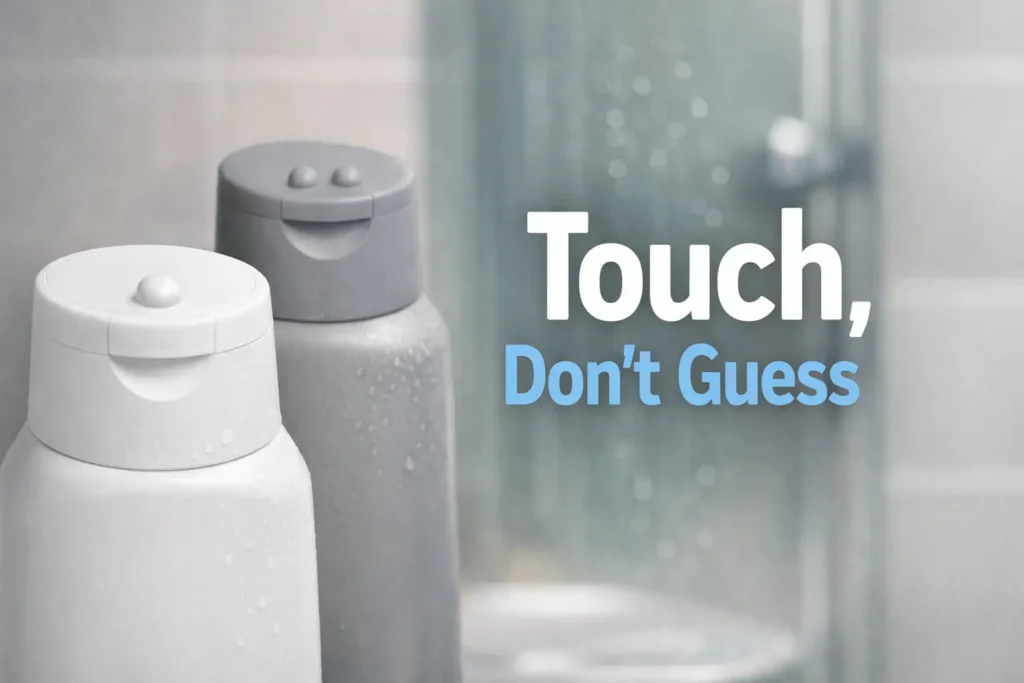
Stop Playing Shower Roulette: Tactile Systems for Modern Bathrooms
You don’t need perfect eyesight in the shower. You need a system that gives you the right bottle in under one second, with wet hands, steam in your face, and your brain still booting up.
The modern problem is cruelly specific: brands love identical minimalist bottles, and even at home, the “nice flat label area” turns into a slippery spin zone the moment soap hits it. Once you guess wrong, your whole routine starts to feel like a tiny daily betrayal.
No squinting. No sniffing “coconut-ish something.” No more wasted mornings.
The Fail-Proof Method
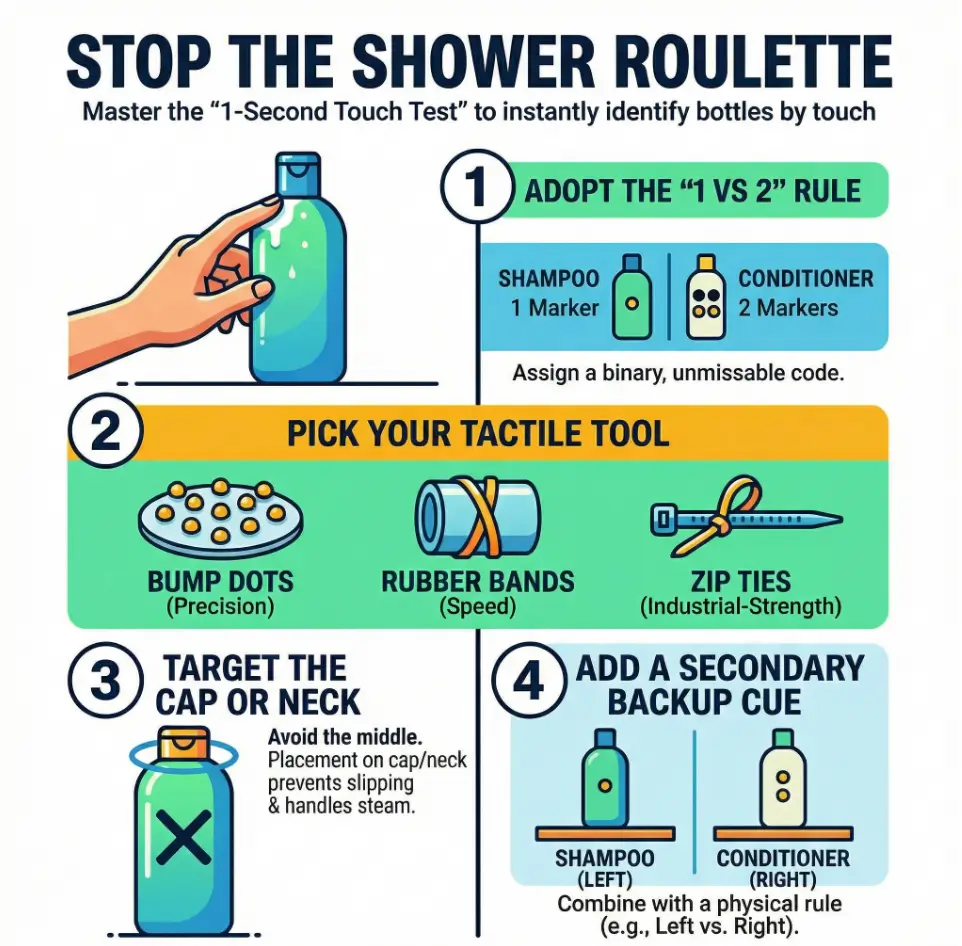
- Primary Cue: Bump dots, rubber bands, or zip ties.
- Simple Code: 1 for Shampoo vs 2 for Conditioner.
- Placement Rule: Always on the cap or the neck.
This is a repeatable, real-bathroom method that survives steam, residue, and refills. Make your bottles tell the truth.
A reliable tactile labeling system for shampoo vs conditioner starts with one “primary cue” per bottle: raised bump dots (most precise), rubber bands (fast + cheap), or zip ties (durable + unmistakable). Pick a rule you can feel in 1 second (ex: shampoo = 1 dot, conditioner = 2 dots), place it in the same spot on every bottle (neck or cap), and add a backup cue (different cap texture or bottle orientation) to prevent shower mix-ups.
Table of Contents
Who this is for / not for
For: “I need a 1-second answer in the shower”
- Low vision, glare sensitivity, or no-glasses showers
- Shared bathrooms (partners/kids/roommates)
- Similar bottles, travel sizes, refill pouches, subscription deliveries
I’ve lived the moment: the shower’s running, conditioner’s already on your palms, and you’re thinking, “This better not be shampoo.” That’s not a personal failure. That’s a system failure. The goal is to make the right choice feel inevitable.
Not for: “I want a pretty label that looks accessible”
- If you rely on printed labels only (steam + water + low contrast = betrayal)
- If bottles are frequently swapped/decanted with no consistent container
- Build for wet hands and low attention
- Use one cue, one meaning, one location
- Add one backup cue for “same-bottle” chaos
Apply in 60 seconds: Pick “1 = shampoo / 2 = conditioner” and choose your marker (dot, band, or tie).
The “1-second touch test” rule (your system’s backbone)
Make one decision: What does “shampoo” feel like?
- Choose one tactile cue per product category (shampoo vs conditioner)
- Keep it binary + obvious (1 vs 2; smooth vs ridged; left vs right)
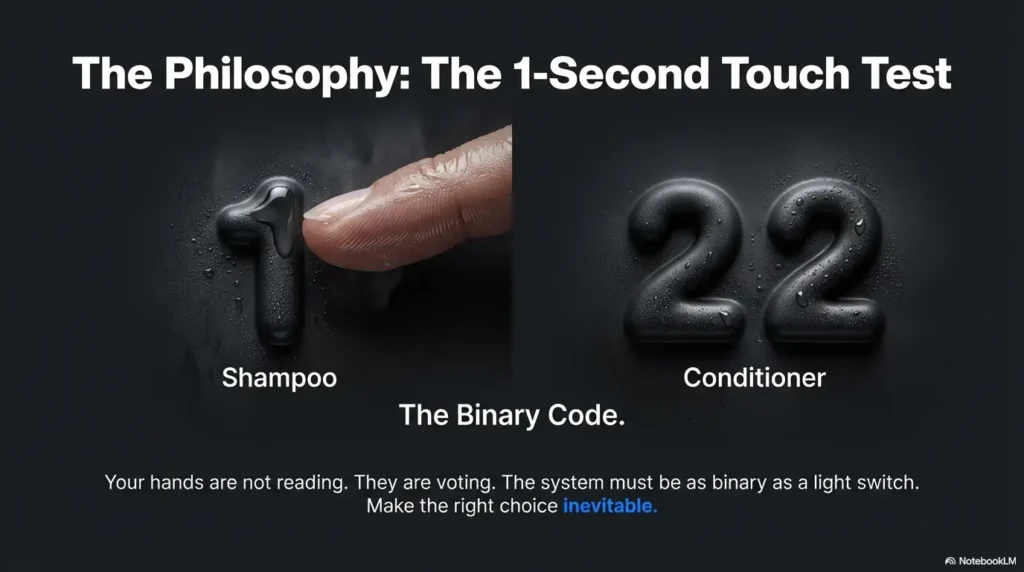
Here’s the mental model: your hands are not “reading.” They’re voting. They tap the cap, feel a signal, and decide. The best systems feel like a light switch: up means up. Not “up unless the moon is waning and you remembered to rotate the bottle.”
My favorite default code is the boring one that wins: shampoo = 1, conditioner = 2. It scales to travel bottles, refills, and that mystery bottle your well-meaning friend left behind.
Placement matters more than product
- Always place cues on the same zone: cap edge, bottle neck, or pump collar
- Avoid slippery middle-body placements that rotate in your hand
A quick lived-experience confession: I once put a tactile marker on the “nice flat area” of a bottle. It felt smart until the first shower. The bottle rotated like a bar of soap doing interpretive dance. After that, I became a placement snob.
Let’s be honest… you won’t remember a complicated code
If it takes more than one breath to explain, it won’t survive a sleepy shower. Your system must be explainable like a nursery rhyme, because your brain will be operating on “minimum viable cognition.”
- Yes if bottles stay in the same general area (shelf, caddy, tub ledge)
- Yes if you can keep to a “one cue per category” rule
- Yes if you can commit to cap/neck placement
- No if bottles are constantly swapped/decanted with no container rule
- No if household members remove cues “to tidy things up”
Next step: If you answered “No” to either of the last two, skip ahead to the shared bathroom treaty. If you’re also working on broader safety routines, pair this with a low-vision nighttime bathroom safety plan so the whole space stops fighting you.
Bump dots: the “precision tool” option (best for consistency)
What bump dots do best
- High accuracy: instantly countable (1 dot vs 2 dots)
- Strong habit formation: same feel every time
- Works on most plastics if you prep surface
Bump dots are the “operator” choice: quiet, consistent, and almost boring. That’s a compliment. If you want the shower to stop being a daily logic puzzle, bump dots are the closest thing to a set-it-and-forget-it solution.
When I first tried them, I expected them to feel fussy. Instead, they felt like installing a tiny tactile “home button” for your hand. You touch, you know, you move on.
Where bump dots fail (so you don’t blame yourself)
- Adhesive can loosen with steam + oils
- Some caps are too textured for clean adhesion
Steam is a sneaky saboteur. So are conditioner drips, which seem to find the exact spot you thought was “dry enough.” If your dot falls off, that’s not you being careless. That’s physics being petty.
Setup that lasts
- Clean with soap, dry fully, then apply
- Place on cap top or cap edge for quickest detection
- Make a “dot map” rule: shampoo = 1 dot, conditioner = 2 dots (or triangle arrangement)
Show me the nerdy details
Adhesives fail faster when they sit in a “wet pocket.” The cap top and cap edge dry sooner than the bottle body. If your cap is heavily textured, adhesion improves if you choose a smoother micro-zone (often the rim or hinge area). If dots keep lifting, consider switching the cue to a band/tie at the neck, where friction does the work instead of adhesive. If lighting glare is part of what’s making labels feel extra slippery to “see,” it can help to reduce reflective hotspots around the sink and shower with glare-free lighting choices.
One more lived-experience tip: apply the dot, then don’t touch it again for a while. The first hour is the “new tattoo” phase. Let it set. Let it become part of the bottle’s identity.
Rubber bands: the “cheap-and-fast” hack (surprisingly effective)
Why rubber bands work
- Instant tactile ring you can’t miss
- Easy to replace and adjust
Rubber bands are the “I need this solved by tonight” option. I respect that. Sometimes you don’t want to research products. You want to stop the shower from feeling like roulette.
I’ve used rubber bands in hotel bathrooms, at a friend’s house, and once in a desperate airport lounge situation involving a travel bottle and a questionable sink. The band didn’t care about my chaos. It just worked.
The hidden problem: band drift and snap
- Bands slide down tapered bottles
- Bands degrade from heat + product residue
Here’s the thing rubber bands won’t tell you: they get tired. Heat, steam, and product residue are basically the band’s retirement plan. So if you choose bands, choose a setup that makes drift less likely.
Make rubber bands shower-proof
- Use thicker bands or silicone bands
- Anchor at the bottle neck or pump collar
- Create a rule: shampoo = one band, conditioner = two bands (spaced)
Input 1: How many bathrooms? (1–3)
Input 2: How many bottles per bathroom? (2–6)
Input 3: How often do you replace the bottle? (monthly / quarterly)
Output: If you replace bottles often (monthly) and don’t want to re-adhere anything, bands or ties usually feel lower-friction. If you replace less often (quarterly) and want the fastest identification, bump dots can be the “one-time setup” win.
Neutral next step: Choose the lowest-effort option you’ll actually maintain.
Small confession: I once tried the “one thin band vs one thick band” approach. It felt clever. It also felt like asking my fingertips to become sommeliers. I switched back to 1 vs 2 and regained my peace.
Zip ties: the “industrial-strength” choice (when you want zero ambiguity)
Why zip ties shine
- Extremely durable, tactile, and stable
- Great for shared bathrooms (harder to “accidentally remove”)
Zip ties are the “this household will respect the system” option. Or, more realistically: the “this household will not respect the system, so the system needs armor” option.
I’ve seen zip ties save the day in family bathrooms where bottles are constantly moved, swapped, squeezed, and occasionally used as toys. It’s not glamorous. It’s reliable. Like a good door lock.
Comfort + safety tweaks
- Clip tail flush so it doesn’t scratch
- Place around neck/collar rather than mid-bottle (reduces spinning)
Two practical notes: (1) cut it flush, truly flush, because sharp edges in the shower are the opposite of fun, and (2) choose placement that won’t rotate when you grip the bottle. The neck/collar is your friend.
Best use cases
- Pump bottles, large family-size bottles, refillable containers
- People who want the most “fail-safe” tactile cue
- Zip ties are tactile and durable
- They resist “helpful” removal
- Neck/collar placement reduces rotation
Apply in 60 seconds: Put 1 tie on shampoo and 2 ties on conditioner, then run a blind touch test.
Hybrid systems: two cues beat one (when mix-ups are costly)
The backup cue ladder (simple, not fussy)
- Primary cue: dot/band/tie
- Secondary cue: cap orientation (flip-top facing front), bottle position (left/right), or pump lock state (locked = conditioner)
Think of the backup cue as your safety net. Not your second job. If you’ve ever had the “same brand, same shape, same color, same lies” situation, you already know why this matters.
The trick most people skip…and regret later
Add a secondary cue for “same-brand, same-shape” bottles before the first mix-up happens. After the mix-up, your brain starts anticipating betrayal. That’s an exhausting way to bathe.
- Use one cue if bottles are distinct shapes or you live alone
- Use two cues if bottles are same-shape, shared bathroom, or you decant/refill
- Time trade-off: +30 seconds to set up a backup cue can save repeated shower mistakes
Neutral next step: If you’ve had even one mix-up, add a backup cue today.
A tiny anecdote: I once relied on “shampoo goes left, conditioner goes right.” It worked until someone cleaned. The bottles returned in the opposite order like a prank performed by a polite ghost. That’s when I embraced two cues. If this is happening in a shared home, the communication part matters too, and a practical guide on helping a spouse with vision loss without turning it into a daily friction point can make the “system” feel kinder for everyone.
Placement zones that survive steam, soap, and chaos
Best zones (ranked)
- Cap edge / top (fastest recognition)
- Bottle neck / collar (stable, low rotation)
- Pump collar (excellent for pumps)
Worst zones (avoid)
- Mid-bottle smooth plastic (spins, gets slippery)
- Bottom edges (hard to find under running water)
Here’s what no one tells you…
Your hands don’t “read” in the shower. They hunt. Put cues where the hunt starts: cap/neck.
Why: fastest touch, least rotation, dries sooner.
Why: slippery, spins, adhesives fail faster.
Another lived moment: I used to “search” the bottle like I was patting down a coat for keys. It took 3–5 seconds each time. Moving the cue to the cap edge dropped it to under 1 second, which sounds small until you do it daily. Tiny friction compounds, especially when the rest of the home setup is also changing, so it can help to fold this into a bigger fall-prevention plan for aging vision at home.
Common mistakes that cause “shower roulette”
Mistake 1: Using the same cue “but in different spots”
Consistency is the system. Random placement kills it. Your brain can learn “cap edge means truth.” It cannot learn “truth moves around like a cat.”
Mistake 2: Overcoding (you’ll forget by Tuesday)
If shampoo has dots + band + a notch… it becomes a memory test. The shower is not the place for memory tests. The shower is the place for water and mercy.
Mistake 3: Labels that don’t survive wet life
Marker fades, stickers peel, raised paint blobs flatten. I love a DIY moment, but bathrooms are unforgiving ecosystems.
Mistake 4: Decanting without a container rule
Refilling into a new bottle without reapplying the cue is not “maybe confusing.” It’s guaranteed confusion on a schedule.
- Same cue, same spot, every time
- Keep the code simple (1 vs 2)
- Reapply immediately when bottles change
Apply in 60 seconds: Do a quick audit: are cues always on cap/neck? If not, move them today.
“Don’t do this” safety checks (small things that prevent big annoyances)
Don’t create scratch points
Cut zip tie tails flush; avoid sharp edges. If you can lightly drag your fingertip over it and feel a snag, you’ll feel it more when skin is wet and sensitive.
Don’t place cues where product pools
Adhesives fail faster where conditioner drips and sits. If you see residue collecting in that area, move the cue.
Don’t rely on scent as your primary identifier
Fragrances overlap; steam changes perception; allergies happen. A tactile cue won’t trigger sneezes, and it doesn’t get confused by “coconut-ish something.”
Quick lived-experience note: I once tried “shampoo is minty.” Then the conditioner was also minty. My nose staged a peaceful protest and my brain resigned. If scent overlap is also aggravating dry-eye discomfort on “bad-eye” days, the routines around the bathroom can matter more than you’d expect, and a practical read on waking up with blurry vision can help you spot patterns you can actually control.
Curiosity-gap: The “shared bathroom treaty” that stops re-labeling wars
Create one household standard
- Shampoo = 1 marker, conditioner = 2 markers
- Everyone agrees: cues stay on, bottles return to the same location
This is the part that feels awkward until you do it. Then it feels like installing a tiny constitution for your bathroom. Not because anyone is evil, but because people are busy and bathrooms are entropy factories.
Quick script (for roommates/family)
“If you replace a bottle, replace the cue. Same rule. Same spot.”
- How many people use the shower (1, 2, 4+)
- Do bottles get refilled/decanted often?
- Are bottles pump, flip-top, or screw-cap?
- Is the bathroom very steamy/humid most days?
- Any skin sensitivity to rough edges or adhesives?
Neutral next step: Match your marker choice to your bathroom reality, not to aesthetic preferences. If this “treaty” is getting emotional (it happens), a couples-oriented guide like coping with vision loss as a couple can help keep the conversation practical instead of personal.
A short personal moment: I used to feel guilty asking others to “follow a system.” Then I realized it’s not a favor I’m demanding; it’s preventing daily friction for everyone. Less confusion, fewer annoyed mornings, fewer “who moved my stuff?” mysteries.
Short Story: Last winter, a friend stayed over after a late concert. The bathroom was warm, the mirror was fogged, and the bottles were identical white cylinders like minimalist chess pieces. I had no markers on them yet, because I kept telling myself I’d “do it later.” In the morning, I heard the cap click, then a pause.
Then another click. I walked in to find my friend holding both bottles, squinting, laughing that tired laugh people do when they’re trying not to be rude. “I’m sorry,” they said, “I can’t tell which is which.” That wasn’t their failure. It was mine, in the gentle way life teaches. Ten minutes later, we looped one zip tie on shampoo and two on conditioner, right at the neck. The next day, nobody had to apologize to a bottle again.
Travel + hotels: pocket-sized labeling that still works
The mini-bottle problem
Tiny bottles reduce tactile surface area. The cap is often the only reliable “landmark,” which is why cap-based cues shine when you travel.
Fast fixes
- Zip tie around the cap hinge
- One thick band for shampoo, two thin bands for conditioner
- Pre-labeled silicone sleeves for travel containers (if you use them)
The hotel bottle trap
Many hotels use identical pump bottles. Bring one cue you trust, every time. I like zip ties for travel because they don’t care about humidity, and they don’t peel off in your toiletry bag.
Two tiny numbers that matter in travel reality: 10 seconds of setup before your first shower can prevent a week of daily guessing, and a single spare tie in your bag can rescue you in a hotel bathroom that thinks “matching bottles” is a personality. If you’re building a whole travel routine around low vision, this pairs naturally with low-vision travel tips that reduce friction on the road, and if your eyes run dry in transit, add dry eye travel tips so the bathroom stops being the first “pain point” after a flight.
FAQ
1) What’s the easiest way to tell shampoo from conditioner by touch?
The easiest is a 1 vs 2 system placed at the cap/neck: shampoo = one dot/band/tie, conditioner = two. Keep the placement identical across bottles so your hand finds the cue instantly.
2) Are bump dots waterproof enough for daily showers?
Often, yes, but longevity depends on surface prep and placement. Cap edges and cap tops tend to hold better than the bottle body. If steam and oils keep defeating adhesive, switch to bands or zip ties at the neck where friction does the work.
3) Do rubber bands degrade in hot showers?
They can. Heat, steam, and product residue wear bands out over time. Silicone bands usually last longer than thin office-style rubber bands. If you notice snapping or drifting, treat bands as a replaceable “consumable” cue.
4) Are zip ties safe to use on bottles (sharp edges, irritation)?
They’re safe when you cut the tail flush and place the tie where it won’t scrape skin during use (neck/collar is ideal). Run a fingertip check after trimming. If it catches, trim again or rotate the tie so the cut edge faces away from your grip. If you want a broader “night routine” safety layer, combine this with low-vision nighttime bathroom safety tweaks.
5) Where should I place tactile markers so they don’t fall off?
Best zones: cap edge/top, bottle neck/collar, and pump collar. Avoid the mid-bottle smooth body because it spins and stays wet longer, which can defeat adhesives and make cues harder to locate.
6) What’s the best system for shared bathrooms with kids or roommates?
Use a “treaty” plus a durable cue: shampoo = 1, conditioner = 2, and everyone agrees cues stay on. Zip ties are often the most removal-resistant. Add a backup cue like left/right placement for extra stability when bottles get moved.
7) How do I label travel-size bottles for low vision?
Use cues that work on tiny surfaces: zip ties around the cap hinge, or 1 thick band vs 2 thin bands. Keep one spare tie/band in your toiletry bag. Hotels love identical pump bottles, so travel with your own cues. For a complete travel checklist mindset, see low-vision travel tips.
8) What if my bottles are identical and always getting swapped?
That’s the perfect case for two cues: a primary tactile marker (dots/bands/ties) plus a secondary placement rule (left/right, cap facing forward, pump locked vs unlocked). If swapping is frequent, prioritize zip ties for durability.
Next step (one concrete action)
Do this today: build your “1 vs 2” rule in 3 minutes
- Pick your primary cue: dots, bands, or zip ties.
- Decide: shampoo = 1, conditioner = 2.
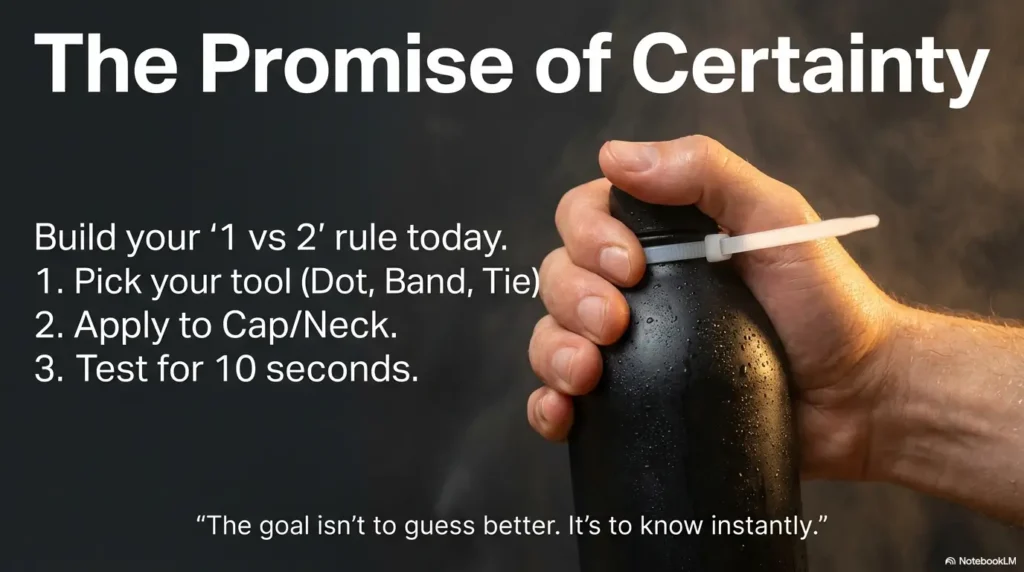
- Apply to both bottles on the cap/neck, then test with eyes closed for 10 seconds.
- Add one backup cue (left/right placement or cap orientation) and call it done.
Remember the curiosity loop from the start, the one about bottles becoming smooth, identical liars? The way you win is not by becoming better at guessing. You win by building a system that tells the truth in one touch, even when your day is loud and your eyes are tired. If you’re collecting small, repeatable systems like this, a gentle companion piece is journaling prompts for macular degeneration, because routines are easier to maintain when your mindset isn’t constantly bracing for the next tiny betrayal.
Last reviewed: 2026-02-24