


Navigating the Buffet: A Strategy for Low Vision
Navigating buffets with low vision is not really about food. It is about glare on sneeze guards, steam over hot trays, labels that vanish on contact, and the peculiar social pressure to keep moving while your brain is trying to build a map from fragments.
For many adults with low vision, the hardest part is not choosing dinner. It is balancing safety, etiquette, and independence in a setting designed for quick decisions and steady hands. Without a plan, a simple meal can turn into spills, burns, or awkward collisions.
This guide helps you move through lines with less panic and more control. You will learn how to:
- Pre-map the room before you pick up a plate.
- Use a two-trip strategy to separate scouting from serving.
- Handle hot stations safely.
- Ask for help in ways that feel brief, practical, and dignified.
The goal is to reduce decision load and protect your balance. You do not need to look effortless; you need a method that works. Once the route becomes clearer, the whole meal gets lighter.
Table of Contents
Fast Answer: How to navigate buffets with low vision etiquette and safety usually comes down to a few repeatable moves: map the room before you stand up, make one reconnaissance pass before you build a full plate, keep one hand free for stability or orientation, and choose brief, specific help when the setup is risky. You do not need to look smooth. You need to move predictably, avoid spills and burns, and get through the line without panic running the show.
Start Here First: Why Buffets Become Harder Than They Look
The problem is rarely just “seeing the food”
People who do not live with low vision often imagine the buffet challenge as one simple issue: can you see what dish is in front of you. In real life, that is only one thread in the knot. The harder problem is that buffet lines combine movement, heat, crowd rhythm, reflective surfaces, tiny labels, awkward serving angles, and silent pressure to make quick choices while carrying objects.
A hotel breakfast bar is a good example. The eggs may be easy to spot, but the label may be printed in pale gray, the spoon handle may jut into the aisle, the sneeze guard may bounce back ceiling lights like a rude mirror, and the person behind you may be breathing with the emotional energy of a commuter train. That is not a vision test. That is a systems problem wearing a polite brunch costume.
Glare, crowd flow, labels, steam, and tray placement create the real difficulty
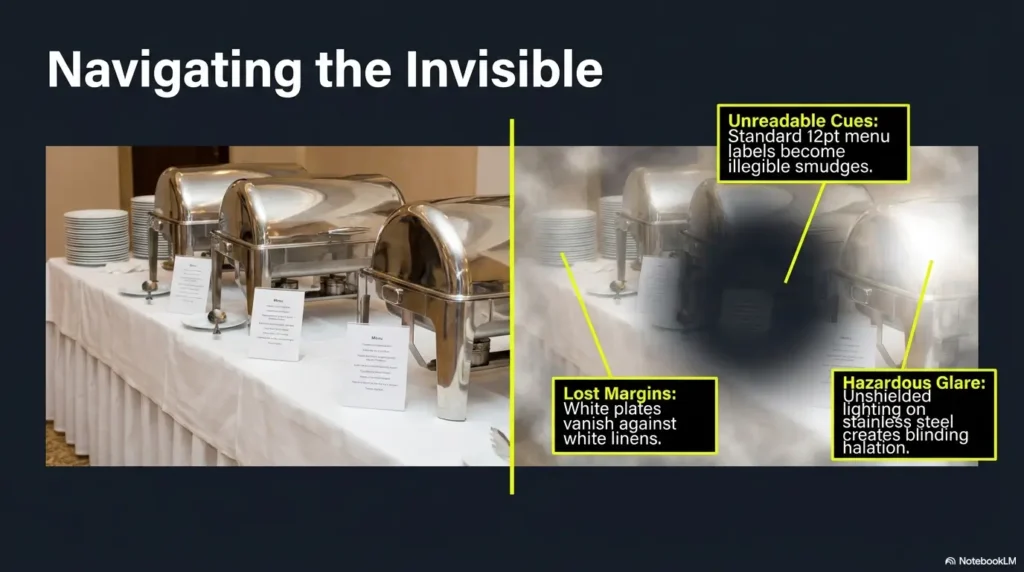
Low vision often means contrast loss matters as much as acuity. Steam softens edges. Stainless steel reflects overhead light. Clear lids disappear until they do not. Deep trays make it harder to judge depth. Tongs cross over one another like metal chopsticks after a family argument. A line that moves in short bursts also forces constant stop-start balance adjustments.
The National Eye Institute notes that low vision can affect everyday tasks even when ordinary correction is already in place. A buffet condenses several of those tasks into one narrow lane: reading, locating, deciding, reaching, balancing, and safely carrying items back to a seat. The same visual friction shows up in other ordinary tasks too, from reading restaurant menus with low vision to sorting labels under difficult lighting.
Why buffet stress often starts before the first serving spoon
Many people feel the stress spike before they even enter the line. That makes sense. The brain is trying to solve too many unknowns at once: Where does the line start? Are the drinks separate? Is the soup station off to the side? Will I need both hands? Is there a return path? Will I have to ask for help in front of strangers?
I have watched people with perfectly good vision fumble a buffet simply because they were rushed and carrying too much. Add low vision, and the margin for error narrows fast. The answer is not courage theater. The answer is structure.
- Visual clarity is only one part of the challenge
- Movement rhythm and tray setup matter just as much
- Stress drops when you treat the line like a route, not a performance
Apply in 60 seconds: Before standing up, identify the start of the line, the drink area, and your seat return path.
Who This Helps: Who This Is For and Not For
Best for adults with low vision navigating self-serve food in public settings
This guide fits adults dealing with reduced contrast sensitivity, blurry detail, glare sensitivity, narrowed visual comfort, depth-judgment trouble, or general buffet overwhelm in restaurants, hotels, conferences, church events, family gatherings, and assisted-living dining rooms. It is especially useful when the environment, not just the menu, is the problem.
Especially useful if glare, contrast loss, crowding, or depth judgment make buffet lines harder
If your main difficulty comes from reading tiny labels, judging portion size, spotting utensil handles, distinguishing foods that share similar color, or safely moving with a plate in one hand, the strategies here should help. They are less about “being brave” and more about reducing friction. That usually works better. Heroic improvisation is overrated. Quiet systems are not glamorous, but they save shirts from soup.
Not a full substitute when you also need hands-on mobility support or active medical help
This article is not a substitute for individualized mobility training, low vision rehabilitation, medical advice, or support for dizziness, significant balance impairment, severe hand weakness, or acute neurological symptoms. If buffet lines feel unsafe because of falls, disorientation, sudden vision change, severe fatigue, or burning risk you cannot manage, the smarter move may be to skip the line and choose a plated or assisted option.
Eligibility Checklist: Is this buffet strategy likely to help?
- Yes: You can walk the route safely, but the visual setup is stressful
- Yes: You mainly need a better method for mapping, choosing, and carrying food
- Yes: Brief verbal assistance would solve the hardest part
- No: You are dizzy, at high fall risk, or cannot safely carry a plate
- No: Hot stations or crowding make the route unsafe even with help
Next step: If you landed on the “No” items, switch to table service, plated assistance, or staff-guided help before entering the line.
Before You Join the Line: Build a One-Minute Visual Map
Scan the room before you stand up, not while people are moving around you
The cleanest buffet habit is the one most people skip: do your seeing while seated. That one-minute pause can spare you five minutes of awkward shuffling. Look for the start of the line, where plates are stacked, whether drinks are separate, where condiments are hiding, and whether the return route crosses traffic. This is the buffet version of checking the weather before leaving the house. The umbrella may still fail, but at least it is your umbrella.
If you use a magnifier app, zoom tool, or camera preview, this is the moment to use it. It is much easier to inspect signs or headings before you are juggling a plate. A quick pre-scan also helps you decide whether a buffet is laid out in a straight line, island format, or scattered clusters. Cluster layouts are where confidence often goes to evaporate. If your phone is part of your toolkit, a shortcut like using iPhone Back Tap to open Magnifier faster can make that pre-scan feel much less clumsy.
Look for the buffet’s start point, plate stack, drink station, and seating return path
These four landmarks matter most because they prevent the most common errors: entering the line in the wrong place, getting trapped near the drinks, losing your seat route, or discovering too late that your plate hand and cane hand are now conducting a domestic dispute.
Try mentally noting the layout in simple order: plates, hot foods, sides, condiments, drinks, cutlery, table. Keep it coarse. You do not need the poetry of every croissant. You need a usable path.
Identify decision points early so you do not have to improvise under pressure
Decision points are where you will need to pause, choose, ask, or switch tactics. For example: a soup station, a carving station, a waffle maker, a narrow turn, a self-serve beverage area, or a dessert island full of tiny identical-looking squares. If you identify those early, you can decide which ones to skip, which ones to revisit later, and where help may be worth asking for.
I have seen a surprising number of buffet problems start because a person committed too early to “I can do this all in one trip.” That sentence has the same energy as “I can carry all the grocery bags in one go.” It sounds efficient right before it turns into slapstick.
Show me the nerdy details
Visual mapping reduces the number of real-time decisions your brain must process while walking, balancing, and sorting visual input. For people with low vision, this matters because movement, glare, and crowd flow can increase perceptual load. Pre-mapping turns a reactive task into a partially scripted one, which can improve safety and reduce hesitation in traffic zones.
First Pass Strategy: Why One Calm Recon Lap Beats One Risky Full Plate
Use the first pass to learn layout, not to win the meal
The safest buffet move is often the one that looks least efficient. Make the first trip a reconnaissance pass. Put one or two simple items on the plate if needed, but treat the main job as learning the layout. Where are the hot foods? Which labels are readable? Where are the risky stations? Which dishes are worth a second look?
This matters because the first pass is when visual uncertainty is highest. It is also when people are most likely to overfill a plate, lose stability, and feel rushed. A calmer first pass gives you a map for the second pass, and the second pass is where independence usually feels much easier.
Notice where labels are readable, where steam obscures food, and where utensils jut outward
Not all hazards are equally important. Prioritize the ones that can burn you, trip you, or create collisions. Steam tables, soup ladles, sauce stations, and serving tools that extend into the lane deserve attention first. Labels matter, but labels can be clarified with a question. Burns are harder to negotiate with.
Curiosity gap: the safest buffet move is often the one that looks least efficient
Buffet etiquette often rewards predictability more than speed. A person who makes two short, calm trips usually causes less disruption than someone trying to perform mastery in one overloaded expedition. Counterintuitive, yes. But in practice, a measured rhythm is kinder to everyone in the line, including you.
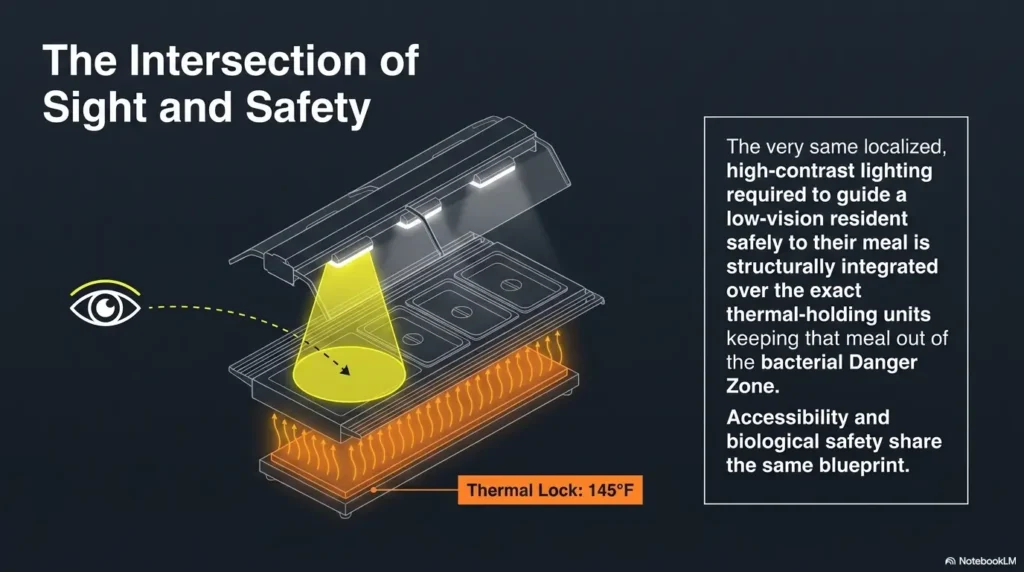
USDA food safety guidance also notes that buffet-style service has special risks around heat and holding temperatures. That is not a reason to panic over brunch. It is simply one more reason not to lean into hot trays, hover too long over steam wells, or treat hot stations casually.
Decision Card: One trip or two?
Choose one trip when the buffet is short, labels are clear, traffic is light, and you already know what you want.
Choose two trips when there is glare, crowding, steam, scattered stations, or any chance that loading the plate will reduce balance.
Time trade-off: Two trips may cost 2 to 4 extra minutes. They often save embarrassment, spills, and bad guesses.
Neutral action: Default to two trips unless the setup is unusually simple.
Plate in One Hand, Stability in the Other: How to Move Without Creating a Tiny Disaster
Keep one hand available for orientation, tray balance, cane management, or rail contact when appropriate
The fastest way to turn a manageable buffet into chaos is to occupy every hand. Do not carry a drink, plate, utensils, phone, and napkin at once. That is not dining. That is a physics exam.
Whenever possible, keep one hand free for orientation and stability. For some people that means holding the plate with the non-dominant hand and serving with the dominant one. For others it means using a tray only if it genuinely improves balance. If you use a cane, consider whether you need to secure the plate first, return to the table, then get the drink separately. Separate the tasks instead of forcing them into one awkward ballet.
Choose smaller portions first so the plate stays stable and readable
Small portions make the plate easier to balance and easier to interpret visually. A crowded plate turns food into a topographic puzzle. Sauces slide. Round items roll. Contrasts disappear. It becomes harder to tell where the edge of the plate is, harder to avoid touching food with your fingers, and harder to walk without tipping the center of gravity into nonsense.
Why overloaded plates turn visual uncertainty into spill risk fast
Overloading makes every uncertainty worse. If you already struggle to judge depth or detect tilt quickly, a heavy plate amplifies that problem. It also narrows your recovery margin when someone stops suddenly in front of you. A plate that is 60 percent full is usually far safer than one that looks ready for a magazine photo about buffet value extraction.
I once watched a man build what can only be described as a breakfast monument: eggs on hash browns, fruit leaning into yogurt, toast on the side like decorative scaffolding. He took three steps, froze, and quietly asked for a second plate to rescue the first. There was something noble about it, but the better lesson was simpler. Food does not become more yours by stacking it higher.
- Carry fewer things at once
- Take smaller portions on the first trip
- Separate drinks and hot liquids from the main plate when needed
Apply in 60 seconds: At your next buffet, commit in advance to plate first, drink second.
Let’s Be Honest: Etiquette Feels Harder When You Are Also Trying Not to Fall Apart
Good etiquette is not performing smoothness. It is moving predictably and respectfully.
A lot of buffet anxiety comes from trying to appear effortless. That is a bad bargain. True etiquette is not about gliding like a diplomatic swan through a sea of chafing dishes. It is about being predictable, calm, and considerate. If you pause in a sensible place, ask one clear question, and avoid blocking the line unnecessarily, you are already being courteous.
Pausing to inspect food is more courteous than blocking the line through confusion
The trick is where and how you pause. Step slightly aside when possible. Inspect from the edge rather than the center lane. Rejoin once you know your next move. That is much better manners than stopping dead in the middle while trying to decode six casseroles and an unlabeled pan of beige uncertainty.
Asking a brief, specific question can be more graceful than guessing wrong with the tongs
Specific questions reduce friction for everyone. “Could you tell me which tray is the chicken?” is easier than “What is all this?” “Is the soup station separate?” is easier than drifting toward a hot surface and discovering the answer by touch, which is a poor method for obvious reasons.
Brief, practical language also protects your own attention. The longer a companion or staff member talks, the more likely you are to lose track of the physical environment around you. Good buffet assistance should feel like a caption, not a podcast.
Useful short scripts to gather before the line
- “Please tell me which tray is first and which one is soup.”
- “Can you name the next three dishes in order?”
- “Is there a safer place to step aside and read the labels?”
- “I’m going to make two trips, so I’ll just take one item now.”
Neutral action: Pick one script and rehearse it once before you stand up.
Don’t Do This: The Most Common Low-Vision Buffet Mistakes
Do not try to read every label while standing in the main traffic lane
This is the classic trap. You want information, but you are collecting it in the worst possible place. The main lane is for movement. If you need to inspect labels, do it from the side, during a recon pass, or with brief help from staff or a companion. The more you try to perform full certainty in the center of the line, the more exposed and stressed you become.
Do not balance drink, plate, phone, and utensils all at once
A buffet is not the place to prove your dexterity. Every extra object increases the chance of a drop or collision. Drinks, especially hot drinks, deserve their own trip when visibility is poor. A phone can help with magnification, but once the food goes on the plate, the phone usually becomes one item too many. If glare is part of the problem, it may also help to adjust your screen setup beforehand with strategies like Reduce White Point versus Night Shift for glare-sensitive eyes.
Do not let social pressure rush you into spills, burns, or collisions
People behind you may be impatient. Let them be impatient. That is better than you being injured. A lot of buffet mistakes happen when someone tries to match the tempo of the fastest people in line. You are allowed to move at the speed required for safe decision-making.
A useful rule: if your body starts hurrying, simplify the task. Take one item. Step aside. Reset. Go back for the rest. There is no medal for finishing first, and even if there were, it would probably be greasy.
Hidden Hazards First: What Usually Causes Trouble at Buffets
Steam tables, soup stations, and poorly placed serving handles raise burn risk
Burn risk deserves special respect because it combines heat, tilt, and surprise. Steam can hide container edges. Soup ladles extend farther than expected. Handles may rest at odd angles. If you are not confident about a hot station, skip it on the first pass and return with help or after you have mapped the layout better. The same caution belongs in the kitchen at home too, especially around kettle safety for low vision and other hot-pour routines.
USDA food safety materials emphasize that hot foods at buffets should be held hot and cold foods cold. For you, the practical takeaway is this: hot zones are not only visually confusing, they also create physical risk. Move slower there. Reach less. Ask earlier.
Low-contrast labels and reflective sneeze guards distort what you think you see
Labels are often printed as if the designer had a private grudge against readable contrast. Add a shiny cover and overhead lights, and the words may dissolve into silver fog. If you cannot read a label quickly, do not spend 20 seconds staring harder while the line forms around you. Step aside and ask.
Narrow gaps, children at elbow height, and sudden stops change the safety equation
Some buffet hazards are human. A child can pivot suddenly. A person ahead may stop without warning. A purse or backpack may swing into the lane. These are good reasons to leave extra space rather than advancing bumper-to-bumper. A small gap gives you more time to react and more room to correct tilt in the plate.
Hazard Tier Map: What changes from Tier 1 to Tier 5?
Tier 1: Clear labels, wide aisle, cool items, light traffic
Tier 2: Some glare, moderate traffic, basic serving tools
Tier 3: Steam, shiny surfaces, mixed stations, frequent pauses
Tier 4: Hot liquids, narrow turns, poor labeling, crowded line
Tier 5: High heat, scattered layout, unstable traffic, low confidence
Neutral action: If the buffet feels like Tier 4 or Tier 5, use help, split the task into smaller trips, or switch plans.
Here’s What No One Tells You: Independence Sometimes Looks Like Strategic Assistance
A short assist at the serving line can preserve more independence than struggling through the whole route
Many adults resist help because they do not want their whole meal experience taken over. That is understandable. But there is a middle path. A short, precise assist at one risky point can preserve your independence for the rest of the meal. That is not giving up. That is intelligent scope control.
The National Eye Institute also points people toward low vision services and rehabilitation because independence is often built through targeted adaptations, not stubbornness alone. Buffet strategy works the same way. Use help where it buys the most safety and keep the rest for yourself.
Asking staff to identify dishes or guide you through the sequence is practical, not defeatist
Staff often help best when the request is simple and bounded. Ask them to identify the dish sequence, point out the safest place to stand aside, or tell you where the hot station begins. Keep the request concrete. Vague requests invite vague answers, and vague answers are how one ends up with gravy on fruit.
Curiosity gap: the most confident buffet habit may be knowing exactly where you want help
People sometimes think confidence means doing everything alone. In practice, confidence often looks like this: “I know I only need help with the soup, the labels, and the drink station. Everything else I can handle.” That is strong judgment. It also keeps helpers from hovering over the rest of your meal like anxious air traffic control.
Short Story: At a hotel breakfast buffet, one woman I know used to dread the entire line because the eggs, oatmeal, and waffle area were clustered under bright lights with steam rising. The first few times, she tried to power through and ended up taking food she did not want because it felt easier than asking.
Then she changed one thing. She asked a staff member, right at the start, to name the first five items in order and to tell her where the hot liquid station began. That took less than 20 seconds. After that, she did the rest herself, including getting toast and fruit on the second pass. What changed was not her vision. What changed was the shape of the task. The line stopped feeling like one giant test and became three small decisions she could manage.
Show me the nerdy details
Strategic assistance works because it narrows the number of unknowns at the highest-risk points. This is similar to task analysis in rehabilitation settings: identify the steps with the greatest visual or physical demand, support those steps, and let the person retain control over the remainder. The result is often more independence, not less.
Common Mistakes Other People Make Around You and How to Handle Them
When companions narrate too much and overload your attention
Some companions become live sports commentators. “There’s pasta, no wait that might be potatoes, and over there is salad, and that man is cutting ham, and now the line is moving…” This is usually well meant, but it floods attention at the exact moment you need clean, usable information.
A better request is: “Please tell me only the next two dishes and any hot liquid.” That keeps the signal strong and the noise low.
When staff point vaguely instead of using clear directional language
Pointing is often useless. “It’s over there” may be accurate in a cosmic sense, but not in a buffet sense. Ask for sequence or relative position instead: “Is it the second tray after the rice?” “Is the soup before or after the bread?” “Is the dessert island to the left of the drinks?” Direction tied to landmarks is easier to use than finger choreography.
When the line moves too fast for safe decision-making
If the line is moving too quickly, let one or two people go ahead. This can feel awkward for half a second and helpful for the next five minutes. A tiny pause often restores control better than trying to keep pace while guessing.
I recommend thinking of this as traffic merging, not surrender. You are creating space for safe movement. That is a driving skill, not a character flaw.
Food Choice Triage: How to Decide Quickly When Everything Blurs Together
Start with familiar categories first: protein, starch, vegetables, drink
When visual detail is unreliable, category thinking beats perfectionism. Instead of identifying every option, ask: where is the protein, where is the starch, where are the vegetables, where is the drink. That trims the number of decisions and prevents buffet paralysis.
Use contrast, smell, and position cues when labels are unreliable
Labels are not the only data source. Color contrast, tray location, smell, and the shape of the serving tool can all help. Fruit often sits in cooler zones. Hot entrées cluster together. Soup stations often have deeper vessels and longer ladles. Bread and pastries tend to occupy outer areas or separate counters. Use these cues as clues, not guarantees.
Choose “good enough” over perfect when the line is crowded and visibility is poor
One of the most underrated buffet skills is accepting a good-enough plate. You do not need to optimize the meal like a consultant with a slide deck. You need a plate you can safely assemble and enjoy. If the dessert labels are unreadable and the line is packed, skipping dessert or returning later may be the smartest move.
Infographic: The Two-Trip Buffet Rule
Trip 1: Map
Scan line → identify plates → spot hot stations → choose 1 or 2 simple items
Trip 2: Build
Return with better knowledge → take remaining items → keep one hand free
Optional Trip 3: Drink or dessert
Separate risky liquids or visually confusing items from the main plate
Why it works: Fewer decisions per trip, lighter plate weight, lower spill risk, and less pressure to solve everything at once.
Don’t Chase Courtesy So Hard That You Lose Safety
Why apologizing excessively can make movement less steady
Many people with low vision apologize too much in buffet lines. The impulse is understandable, but excessive apologizing can split your attention and make your movements less steady. One calm “Thanks, I just need a second” is usually enough. You do not need to narrate your existence as an inconvenience.
Why stepping aside briefly is often better manners than forcing speed
There is a strange social myth that moving faster is always more polite. At buffets, predictable movement is often more polite than fast movement. Stepping aside to inspect, reset, or wait for traffic to clear can be the better etiquette choice, because it reduces the chance of abrupt stops and collisions.
Curiosity gap: the etiquette move that feels slow can be the one everyone prefers
Most people in line do not need you to be quick. They need you to be readable. A person who pauses at the edge and then moves clearly is easier for everyone to navigate around than someone who surges, hesitates, and pivots unexpectedly.
- Use short, calm language
- Step aside instead of forcing fast decisions
- Let one person pass if it gives you safer space
Apply in 60 seconds: Replace “Sorry, sorry, sorry” with one steady sentence: “Please go ahead, I just need a moment.”
If You Are With Someone: The Best Help Is Specific, Quiet, and Short
Useful prompts: identify dish names, clock-face directions, and spill risks
If you have a companion, decide the support style before you stand up. Good help is specific and brief. Dish names in sequence, clock-face orientation, and warnings about soup, steam, or protruding handles are usually enough. “Chicken at 12 o’clock, vegetables at 2, soup station next” is helpful. “Let me just do everything for you” is a different experience entirely.
Unhelpful help: grabbing your plate, steering your body, or narrating every tray
Grabbing, steering, and over-narrating often make things harder. They interrupt your own body map and can startle you mid-motion. Even affectionate help can become chaos if it removes your control at the wrong moment. The best support preserves your pacing and your choices.
Build a repeatable support script before you enter the line
A support script can be as short as this: “Please name the next three dishes, warn me about hot liquids, and let me ask the rest.” Once you have a script, companions are less likely to improvise into helpfulness theater. This saves energy for both of you. The same principle shows up outside the dining room too, especially in practical guides on how to help a spouse with vision loss without taking over.
Mini Calculator: Should you split the task?
Input 1: Crowd level: low / medium / high
Input 2: Hot stations involved: yes / no
Input 3: Need one hand for cane or stability: yes / no
Rule of thumb: If 2 or more answers increase difficulty, split the task into plate first, drink second, dessert later.
Neutral action: Decide your split before you reach the plates.
When the Buffet Is the Wrong Tool: Signs You Should Switch Plans
When lighting, crowd density, or layout make safe self-service unrealistic
Sometimes the problem is not your method. The problem is the buffet. Lighting may be too harsh. The route may be too narrow. The labels may be useless. The hot stations may be clustered badly. If the setup forces unsafe choices, walking away from the line is not failure. It is judgment.
When pain, fatigue, dizziness, or balance concerns raise the risk beyond etiquette questions
If your body is having a hard day, it is reasonable to change the plan. Fatigue narrows patience. Pain shortens attention. Dizziness changes everything. The same buffet you could handle last month may be wrong for you tonight. That is not inconsistency. It is reality.
Choosing table service, staff help, or a plated option can be the smarter win
Sometimes the best buffet strategy is not using the buffet. Ask staff whether they can plate selected items for you. Send a companion with a specific list. Choose seated service if it is available. Strategic assistance, again, is not the opposite of independence. It is independence with better risk management.
VisionAware and similar rehabilitation-focused resources often emphasize environmental adaptation and practical living skills. That same spirit belongs here. The question is not “Can I force this?” The better question is “What setup gives me the safest, calmest meal?”
FAQ
Is it rude to ask buffet staff to identify dishes for me?
No. A brief, specific request is usually more courteous than guessing, blocking the line, or risking a spill. Ask for the dish order, the location of hot liquids, or the safest place to step aside.
What is the safest way to carry a plate if I use a cane?
It depends on your mobility pattern, but many people do best by simplifying the task: plate first, return to the table, then drink or second items later. Keep one hand as free as possible for stability and orientation.
Should I let someone go ahead of me if I need extra time?
Yes, if doing so creates safer space and lowers pressure. One calm pause often helps more than trying to match the speed of the line.
How do I avoid spills when I cannot judge portion size well?
Take smaller portions on the first trip, keep wet foods separated when possible, and avoid overloading the plate. A lighter plate is easier to balance and visually interpret.
What should I do if the labels are too small or placed badly?
Do not linger in the traffic lane trying to decode them. Step aside and ask staff or a companion to name the dishes in order. You can also use a phone magnifier before entering the line if the environment allows it.
Is it better to make two trips instead of one?
Very often, yes. Two trips lower the number of decisions per pass, reduce plate weight, and improve balance. In crowded or high-glare settings, two trips are often the safer choice.
How do I handle soup, sauces, or hot drinks safely at a buffet?
Treat them as high-risk items. Get them on a separate trip when possible, ask where the hot station begins, and avoid carrying hot liquids alongside a crowded plate.
What can a companion do that actually helps instead of making things harder?
Give short, useful cues: the next two or three dishes, clock-face directions, and warnings about hot liquids or protruding handles. Avoid grabbing, steering, or over-narrating.
Next Step: Use a Simple Two-Trip Buffet Rule at Your Next Meal
First trip: scan, map, choose only one or two items
On your next buffet, do not try to solve the whole line at once. Use the first trip to map the stations, check the risky zones, and choose one or two simple items. The mission is orientation, not optimization.
Second trip: return for the rest once the layout is familiar
On the second trip, build the plate with less guesswork. You already know where the hot stations are, where the labels fail, where the crowd bottlenecks form, and which items are worth asking about. The line will often feel markedly calmer on this pass because your brain is no longer negotiating pure uncertainty.
One concrete action: practice this two-trip rule at the next buffet, hotel breakfast bar, or salad station you encounter
That is the quiet answer to the stress spiral. Not bravado. Not pretending you do not need time. Not apologizing your way through the line. Just a better structure: map first, build second, split risky tasks, and ask for help only where it buys real safety.
The curiosity loop from the beginning closes here. The buffet did not become easier because you forced yourself to look confident. It became easier because you changed the shape of the problem. In the next 15 minutes, write a tiny buffet script for yourself: where you will scan, what you will ask, and whether you will separate plate, drink, and dessert into different trips. That small plan can make the whole meal feel more like dinner and less like an obstacle course in formalwear.
Last reviewed: 2026-04.