

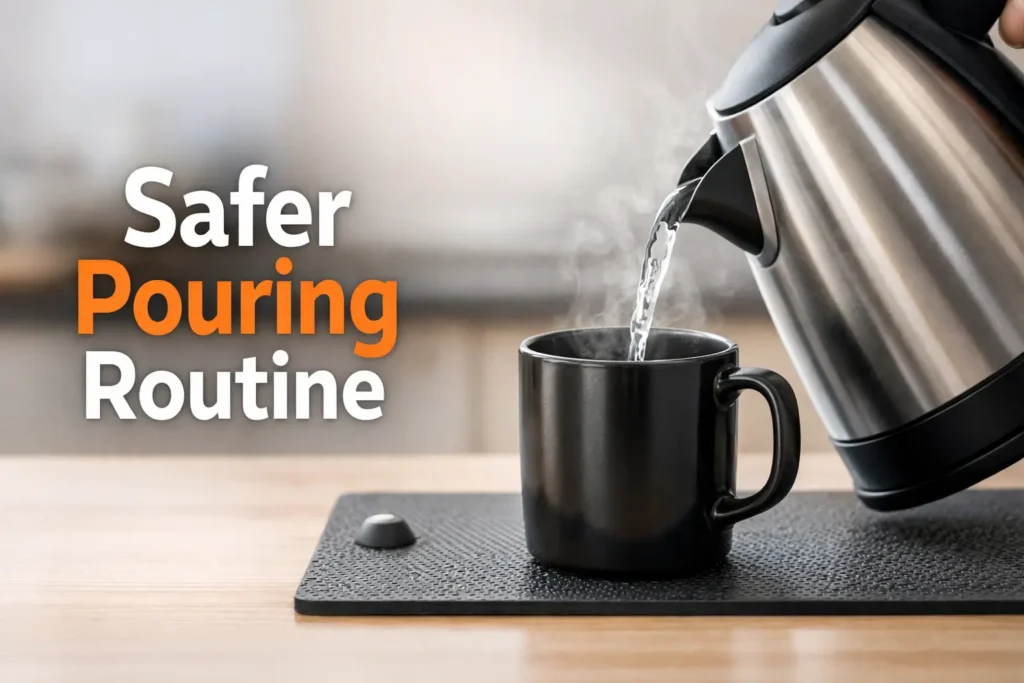
The Art of the Structured Pour: Safety Beyond Caution
Boiling water becomes dangerous long before the pour. In many low-vision kitchens, the real problem starts when a routine task suddenly demands pinpoint locating, wrist control, and luck all at once.
Pouring safely is not about being “extra careful” — it’s about reducing the number of decisions your body has to make once the kettle is hot. A vague setup or an awkward kettle can quietly turn a simple coffee into a daily burn risk.
This guide helps you build a repeatable hot-water routine using:
- • Smart kettle selection and mug placement
- • Minimized travel distances for hot vessels
- • High-contrast and tactile cues for steam-heavy environments
Because “careful” is not the same thing as structured, and a boring routine is often the most elegant form of independence.
Table of Contents
Safety / Disclaimer
This article is educational and home-safety focused, not medical advice. Boiling water can cause serious burns. If low vision, hand weakness, tremor, balance issues, slowed reaction time, dizziness, or reduced sensation make hot-water handling unreliable, it is wise to discuss kitchen safety strategies with an occupational therapist, low-vision specialist, or clinician.
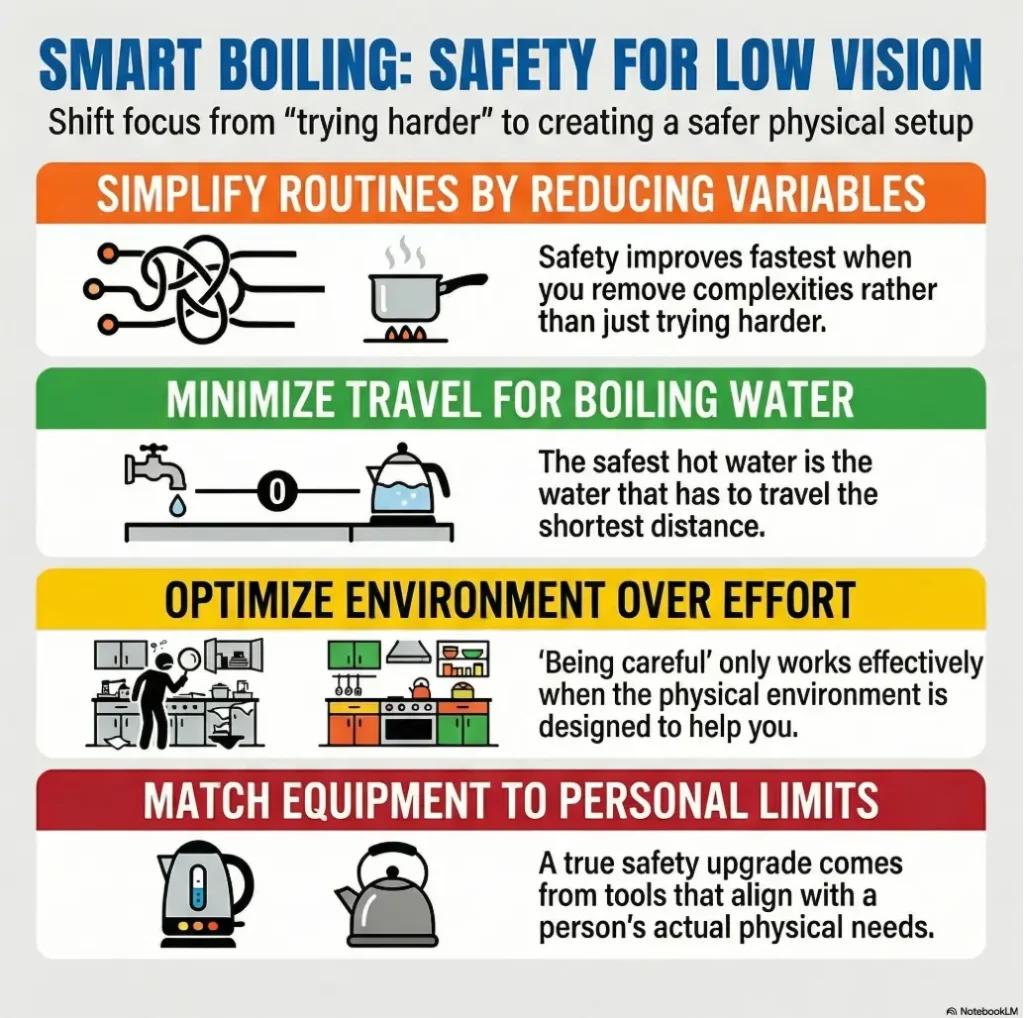
That is not a dramatic disclaimer. It is a practical one. When people get hurt around hot liquids, the problem is often not laziness or carelessness. It is a stack of small variables arriving at once: poor contrast, clutter, steam, an awkward handle angle, a mug parked too close to the edge, or the innocent little lie we tell ourselves that this setup is “fine for today.”
- Pick one kettle routine and repeat it
- Shorten the distance between kettle and mug
- Treat clutter as part of the burn risk
Apply in 60 seconds: Clear one counter zone now and decide that it will be your only hot-water station this week.
Why Boiling Water Feels Riskier Than It “Should”
The real problem is often not pouring, but locating
Many people describe the act itself as the scary part, but the hidden trouble usually starts a beat earlier. You are not only pouring. You are first locating the kettle, the mug, the handle, the landing space, the edge of the counter, the angle of your wrist, and sometimes the cord that has decided to impersonate a vine. The hot water is merely the villain with the loudest entrance.
I once watched a perfectly capable home cook pause for three full seconds before pouring, not because her hands were unsteady, but because the mug had been moved two inches to the left after dish drying. Two inches is not much in a recipe. Two inches can be a different planet when steam is rising and you are committing to motion.
Heat plus uncertainty is what turns a small task into a high-risk one
Hot-water tasks become risky when uncertainty is layered on top of heat. If you already need to spend visual effort finding the mug or reading the kettle’s position in space, you are spending attention before the real action begins. By the time you lift the kettle, your brain is already paying rent in three neighborhoods.
That is why low-vision kitchen guidance emphasizes organized work areas, predictable placement, and tactile or contrast cues. Those changes reduce search time and decision fatigue before the hot-water step begins.
A safer routine beats last-second improvisation
The human brain loves familiar choreography. If the mug always lives in the same zone, the kettle always returns to the same base, and your body always turns the same direction before pouring, the task becomes a practiced sequence instead of a negotiation. That matters because boiling water is a bad time to freelance.
Eligibility checklist: Is a fixed hot-water routine likely to help?
- Yes if your main problem is finding the mug, kettle, or target area in time
- Yes if your counter layout changes often and that increases hesitation
- Yes if you do well with repeated, body-based routines
- No if your main issue is sudden severe tremor, major dizziness, or reduced hand sensation
Neutral next step: Test a fixed station for 3 to 5 days before buying new equipment.
Kettle First: The Features That Actually Make Pouring Safer
Stable base over stylish silhouette
Kitchen marketing loves to seduce us with shape. Sculptural chrome. Narrow necks. Café energy. A kettle can look like a tiny opera house and still be a nuisance to use safely. For low-vision pouring, the prettier question is rarely the useful question. The useful question is this: Does the kettle feel obvious in the hand?
A stable, broad-based kettle usually creates fewer surprises than one with a tall, top-heavy profile. You want something that feels settled both on the counter and during the pour. If the empty kettle already feels like it wants to lean, the full kettle will only become more persuasive about its opinions.
Handle shape that tells your hand where it is
A good handle gives orientation without requiring a visual double-check. It should make it easy to know where your grip starts, where your thumb lands, and how your wrist is aligned. Texture matters. Spacing matters. If your hand slides around looking for the “right” place, the handle is asking too much from you.
I am suspicious of handles that feel elegant in a showroom and vague in a real kitchen. The kettle does not get points for looking Scandinavian if it becomes emotionally mysterious at 7:10 a.m. when you are half-awake and just want tea.
Lid design that stays predictable when steam enters the scene
Lid behavior matters more than many buyers realize. Some kettles open in ways that put your hand uncomfortably close to the path of steam. Others have mechanisms that feel flimsy, spring-loaded, or too eager. Consumer product safety recalls over the years have repeatedly described hazards involving hot water or steam escaping unexpectedly from kettle lids or spouts, which is a useful reminder that “kettle” is not automatically the same thing as “well-behaved.”
Water window placement that is useful before heating, not during pouring
If a water window is hard to see unless you twist the kettle or hold it under a light, it may not be helping very much. The water level should be checked before heating, in a calm moment, not while the kettle is hot and you are improvising angle corrections like a nervous crane operator.
Show me the nerdy details
A safer kettle workflow reduces “mid-task visual demands.” That means the design lets you gather needed information before heat is introduced. Good examples include obvious fill lines, a wide opening for filling, easy-to-identify controls, and a handle that supports a single clean lifting arc instead of corrective micro-movements.
Not All “Accessible” Kettles Help: What to Look For Before You Buy
Cordless base vs stovetop kettle: which creates fewer decision points?
There is no universal winner here. A cordless electric kettle often reduces stove-related variables and usually adds automatic shutoff, which can be excellent for many households. But “electric” is not a magic spell. Some electric kettles still have awkward lids, ambiguous buttons, slippery handles, or a base connection that encourages awkward repositioning.
A stovetop kettle can work well if the stove routine is already stable and the kettle is never carried far. But stovetop use adds another layer of heat-source management, plus the risk of reaching over burners or lifting from a hotter environment. In general, more decision points mean more chances for the routine to fray. That is also why some households pair safer kettle habits with other simple kitchen fixes such as stove knob covers that reduce accidental burner changes.
Automatic shutoff, wide opening, and controlled spout matter more than trendy extras
Automatic shutoff is one of those features that sounds boring until the day it is the best adult in the room. A wide opening makes filling easier and decreases the chance of awkward water transfer at the sink. A controlled spout matters because pouring safety is not just about whether water comes out. It is about whether it comes out in a predictable stream you can stop cleanly.
Fancy temperature presets are lovely if you use them. They do not matter much if the kettle is still awkward to lift, confusing to orient, or irritating to clean. In home safety, boring competence wins by a mile.
Texture, balance, and one-handed confidence deserve more attention than aesthetics
Some readers assume a bigger kettle is automatically more efficient. Sometimes it is just heavier. The safer question is whether you can lift and pour the kettle comfortably at the fill level you actually use. Daily use beats showroom fantasy. A kettle that feels manageable with one or two cups may be safer than a larger one that turns your wrist into a reluctant project manager.
Decision card: Electric vs stovetop for low-vision pouring
| Signal you see | Most likely better fit | Neutral next move |
|---|---|---|
| You want automatic shutoff and fewer stove variables | Cordless electric kettle | Test handle comfort at your usual fill level |
| Your stove routine is already fixed and reliable | Stovetop kettle | Keep pouring zone beside stove, not across the room |
| You are unsure whether weight is the bigger issue | Smaller-capacity kettle | Try a one-cup fill for three mornings |
Neutral next step: Choose the model that reduces total hand travel and total decision points, not the one with the longest feature list.
Placement Before Pouring: Build a “Hot Water Home Base”
Choose one fixed counter zone and stop wandering
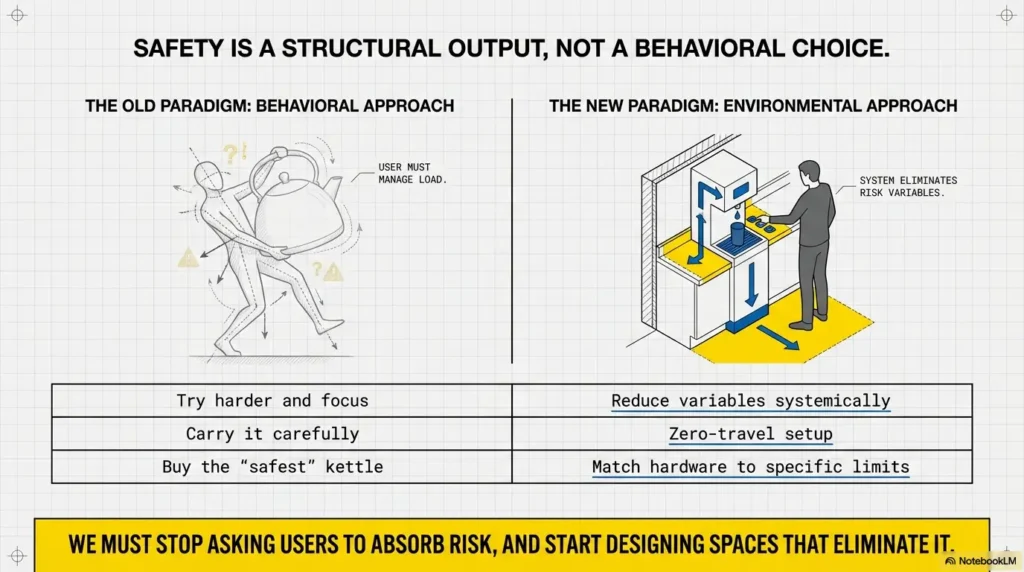
If your kettle sometimes lives by the sink, sometimes near the toaster, and sometimes beside the fruit bowl because the counter was “busy,” you do not have a system. You have a weather pattern. A fixed pouring zone removes the need to rediscover the kitchen every time.
The best home base is usually close to the fill point, close to the mug, away from counter edges, and clear of unrelated items. That means no mail pile, no knife block crowding the landing zone, no charging cable with theatrical ambitions. Hot water deserves a boring neighborhood.
Keep kettle, mug, and landing space in the same geometry every time
The phrase sounds technical, but it means something simple: the relationship among objects should stay constant. If the kettle base is always in the same place, the mug is always placed in the same target zone, and your free hand always knows where the counter edge is, you reduce uncertainty before the pour begins.
Hadley and other low-vision kitchen educators emphasize organization, good lighting, and repeatable placement because they help you find what you need without extra searching. APH’s VisionAware materials also stress the usefulness of contrast and environmental clarity in daily tasks. In some kitchens, that same logic extends to clear spice-jar labeling systems for low vision and other fixed-location cues that reduce visual hunting.
Why the shortest travel path is usually the safest path
Distance is a sneaky villain. Every extra step while holding boiling water is another chance to clip a chair, pivot around someone, catch a sleeve, or lose track of where the mug actually is. The shortest safe travel path is not laziness. It is risk management wearing house shoes.
Infographic: A safer hot-water station
Zone 1
Kettle base
Fixed spot, cord controlled, away from counter edge
Zone 2
Mug target
Placed before heating, same handle direction every time
Zone 3
Clear buffer
No clutter, no mail, no utensils, no decorative chaos
Rule: Move the empty mug into position first. Then heat. Then turn fully toward the pouring zone. No diagonal reaches. No mid-action rearranging.
Don’t Cross the Kitchen With Boiling Water
Carry less distance, create less risk
This is one of the highest-value changes in the entire article. The farther you carry boiling water, the more you are relying on balance, navigation, surface awareness, and luck. People often think the risk is all concentrated in the pour. In reality, transport is where the routine can unravel quietly.
Move the cup to the kettle, not the kettle to the cup, when possible
If the mug can be placed in the pouring zone before heating starts, that usually reduces risk. The kettle stays near its base. The travel distance shrinks. Your body can orient to a single fixed area. The pour becomes shorter, cleaner, and less theatrical. We are trying to make the scene so dull that even your future self gets bored and therefore safe.
Reaching around clutter is where many routines quietly fail
I have seen more near-misses caused by counter clutter than by dramatic hand instability. A spoon left across the mug zone. A bag of bread leaning into the path. A dish towel creeping toward the kettle base like it has a personal agenda. None of these items are dangerous alone. Together they create hesitation, rerouting, and awkward reaches.
- Bring the mug to the kettle zone before heating
- Avoid walking hot water across open floor space
- Clear the pour path before the kettle turns on
Apply in 60 seconds: Stand in your kitchen and identify the shortest path between fill point, kettle base, and mug target. That triangle is your routine.
Mug Positioning Rules: Small Shifts, Bigger Safety
Place the mug before the kettle starts heating
This removes one whole decision later. If the mug is already in place, you are not trying to locate, carry, and position it while also monitoring a hot appliance. The order matters. Setup first, heat second, pour third. It is a small discipline that pays back like compound interest.
Keep the handle orientation consistent every single time
Pick one handle direction and commit to it. Handle to the right. Handle to the left. Slightly angled outward. The specific choice matters less than the repetition. Repetition teaches the body faster than instructions do.
I know one caregiver who used a tiny raised dot on the counter mat to mark the mug’s front edge. It looked almost comically modest. But that one tactile cue removed the daily negotiation of “Is the mug straight enough?” which meant less hesitation and a cleaner pour. The same principle shows up in other low-vision routines, from key identification systems that rely on touch to simple tactile household markers.
Use a tray, mat, or tactile marker to make the target easier to find
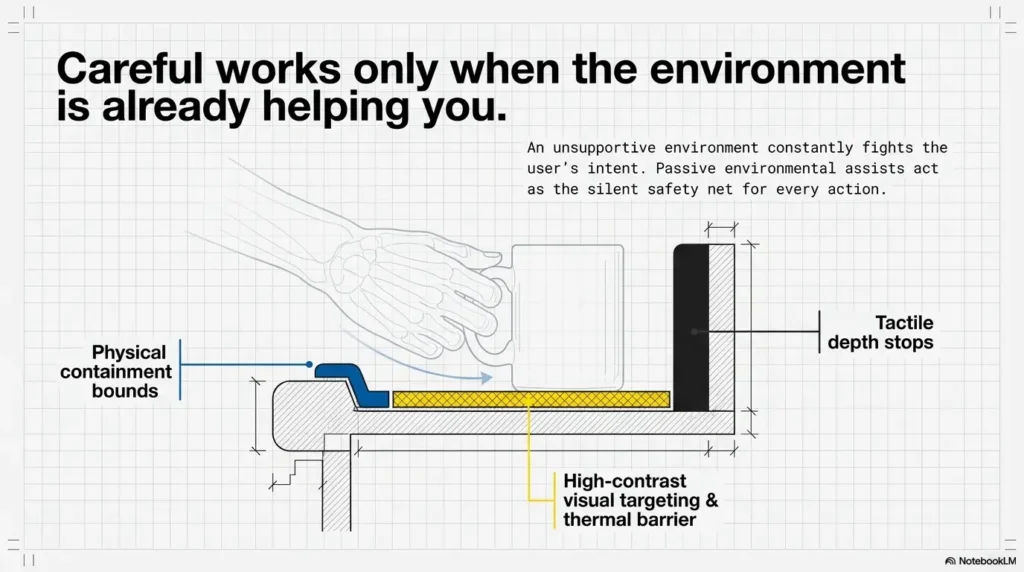
A shallow tray, silicone mat, or tactile marker can create a clear landing zone for the mug. For many low-vision adults, tactile placement cues work even when steam, glare, or morning fatigue make visual cues less reliable. Contrast also helps, especially if the mug and the counter tend to disappear into one another. APH’s guidance on contrast makes the same basic point across the home: when objects stand out from their background, everyday navigation gets easier and safer.
Mini calculator: Is your current setup making you carry hot water too far?
Input 1: How many steps do you take with the kettle while it is full and hot?
Input 2: How many times per day do you do this?
Output: If you can reduce that from 4 steps to 1 step, twice a day, you remove 6 hot-water travel steps daily. Over a week, that is 42 fewer chances for a spill, pivot, or bump.
Neutral next step: Rearrange the station once and test the new route for seven days.
Let’s Be Honest… Steam Changes Everything
Steam can blur what little visual contrast you have
Steam is not just heat. It is visual sabotage. Even people with relatively functional residual vision can find that steam softens edges, dulls contrast, and makes a once-clear target briefly uncertain. A routine that feels fine with cold water may become flimsy the moment the kettle actually boils.
Lifting the lid at the wrong moment adds confusion and heat exposure
Many people open the lid out of habit, curiosity, or simple impatience. In practice, opening a just-boiled kettle can bring your hand closer to steam and may add unnecessary sensory confusion right before the pour. If you can avoid interacting with the lid after boiling, that often keeps the routine simpler and safer.
A routine that works cold may fall apart once the kettle is actually boiling
This is worth testing honestly. Do a dry run with the kettle empty. Then do the same sequence with warm water. Then do it under real conditions. Sometimes the setup is fine in theory and annoyingly theatrical in practice. The steam reveals what the room has been hiding.
Short Story: The morning the setup told the truth
For weeks, a reader thought her kettle routine was basically fine. She could find the mug. She knew where the handle was. She had even rehearsed the motion once or twice with cold water and felt confident. Then one early morning, with oatmeal going on the stove and the window bright behind her, the kettle boiled for real. Steam drifted up. The black mug on the dark mat vanished into a soft blur. She did not spill, but she froze halfway through the movement, kettle hovering in the air, trying to confirm where the rim actually was. That pause changed everything.
She moved the station away from the window glare, switched to a lighter mug, and added a tactile mat marker. Nothing about her hands changed. The system changed. The next morning, the task stopped feeling like a tiny exam and returned to being what it should have been all along: ordinary. If glare is part of your own setup, it may help to think beyond the mug itself and look at broader fixes like window film for glare control or reducing white-tile floor glare in bright rooms.
Show me the nerdy details
Steam can reduce usable visual information by softening edges and lowering apparent contrast around the target area. That matters especially when the mug color is similar to the counter, when backlighting is present, or when reflective surfaces create glare. Tactile cues remain available when visual cues briefly degrade.
Common Mistakes: The Tiny Habits That Raise Burn Risk
Filling the kettle at the sink, then carrying it too far
This is common because it feels efficient. In reality, it can create an unnecessary transport phase before boiling even starts. If the kettle is filled generously and then carried across the kitchen to the heating zone, the risk begins long before the water is hot. Smaller fills and shorter routes usually behave better.
Pouring into a mug placed near a counter edge
This one is a classic because edge placement often happens for innocent reasons. The counter is crowded. The “good spot” is occupied. You are trying to keep the mug visible. But edge proximity gives you less margin if the mug shifts, the kettle bumps, or your wrist angle changes. Give yourself more counter behind the mug than you think you need.
Changing the setup every day depending on convenience
Convenience is not always the same thing as safety. A setup that changes with the weather, dishes, mood, or grocery bag placement is asking your brain to recalibrate around hot liquid every single day. That is a poor bargain.
Trusting memory when the counter layout has shifted
Memory is useful, but it is not a substitute for a stable environment. The kitchen is one of those places where “I thought it was there” can become an expensive sentence.
Setup-prep list: What to gather before comparing kettles or routines
- Your usual number of cups boiled at one time
- Whether you pour left-handed or right-handed
- How many steps you currently carry hot water
- Whether steam, glare, or clutter is the bigger problem
- Whether automatic shutoff would remove stress in your household
Neutral next step: Use this list before buying anything new, so you solve the real friction instead of the loudest-looking one.
Don’t Do This: “I’ll Just Be Extra Careful” Is Not a System
Caution without routine still leaves too many variables
“Be careful” is not useless. It is just incomplete. Caution is a state of mind. Safety is an environment plus a sequence. When you rely on carefulness alone, you are still leaving the target location, handle angle, clutter, and travel distance up to the mood of the day.
Multitasking and hot water do not belong together
Tea does not need you to answer a text. Oatmeal does not need you to pivot toward a ringing phone. Hot water routines work best when they are boringly single-purpose. The kettle gets one tiny window of your full attention. That is not a luxury. It is the actual task.
Rushing because the whistle stopped is how hands get ahead of judgment
There is no medal for immediate response time. If the kettle has boiled, you can take one breath, orient your body, confirm the zone, and pour. Speed is not the goal. Clean sequence is.
- Remove multitasking from the hot-water window
- Use the same body turn and same target every time
- Pause before lifting if anything feels off
Apply in 60 seconds: Say your sequence out loud once: mug first, heat second, turn, lift, pour, park.
Contrast Helps, But Routine Helps More
High-contrast mugs and mats can reduce search time
If your mug disappears into the counter, give it a stage. A light mug on a dark mat or a dark mug on a light mat can make the target easier to find. Contrast is often one of the cheapest, fastest environmental changes available.
Matte surfaces often beat shiny surfaces near steam
Glossy surfaces may look clean and bright, but they can create glare and visual noise. Many people with low vision find matte surfaces easier to read in real use, especially when moisture and steam are involved. This matches broader low-vision home guidance that warns against letting glare steal the little clarity you had. The same idea shows up in design choices like matte vs. glossy paint for glare-sensitive spaces and under-cabinet lighting on glossy surfaces.
Tactile placement cues can do the job when visual cues fade
Tactile markers, textured mats, silicone dots, or a tray lip can function when contrast alone is not enough. This matters on mornings when the light is wrong, your eyes are tired, or steam has turned your usual visual landmarks into watercolor.
I am fond of this category of solution because it is humble. A raised dot, a mat edge, a tray corner. None of them will ever win a design award. They just quietly help at the exact second you need help. That is a kind of kitchen grace.
Here’s What No One Tells You… The Best Kettle May Be the One You Lift Less
Weight after filling matters more than weight on the shelf
People often test kettles empty in a store or online imagination. But the real question is how it behaves when filled to your actual use level. Weight distribution changes. Confidence changes. Wrist control changes. A kettle that feels merely “a bit chunky” when empty may become irritatingly persuasive when full of hot water.
Smaller-capacity boils may be safer for daily single-cup use
If you usually make one cup of tea or one bowl of oatmeal, boiling a larger amount each time may add unnecessary weight and slosh. Smaller-capacity use can mean a steadier lift, a shorter pour, and less overfill pressure. Efficiency is not always more volume. Sometimes efficiency is simply less drama per morning.
“More convenient” can become “harder to control” once hot water is involved
A huge kettle may feel convenient because it means fewer refills. But if it is harder to manage, awkward to align, or tiring to hold, the convenience is partly fictional. A system that matches your real daily use is safer than one that wins on paper.
That is also why some users do well with adaptive pouring aids or kettle tippers that reduce the need to fully lift the unit. Not everyone needs them. But for readers with limited grip strength or wrist pain, “lift less” is often the quiet key that unlocks safer independence. Vision Australia’s product descriptions for low-vision users reflect this practical logic, even if the right solution varies by person.
Who This Is For / Not For
This is for low-vision adults who prepare tea, coffee, oatmeal, or simple hot drinks at home
If your main goal is safer daily hot-water handling for one or two servings, this routine is built for you. It is especially useful when the issue is not total inability but avoidable uncertainty: mug-finding, steam interference, clutter, awkward reaches, or inconsistent setup.
This is for caregivers trying to reduce guesswork in a shared kitchen
Caregivers often do something generous and accidentally unhelpful: they reorganize the kitchen for neatness without realizing they have erased the user’s body map of the space. If you support someone with low vision, consistency may matter more than tidiness theater. That same tension appears in broader caregiving adjustments, including helping a spouse with vision loss without overcomplicating the home.
This may not be enough for people with significant tremor, severe neuropathy, major balance problems, or frequent confusion around hot surfaces
There is a point where better setup alone may not be enough. Repeated near-burns, reduced hand sensation, frequent dizziness, or trouble understanding when surfaces are hot deserve a more personalized safety plan. Occupational therapists are especially useful here because they focus on real tasks in real spaces, not idealized kitchens in glossy brochures.
- Low vision alone may be manageable with routine changes
- Grip, sensation, balance, and cognition change the equation
- Caregivers should preserve consistency, not just visual neatness
Apply in 60 seconds: Ask one honest question today: is the current problem mostly locating, lifting, or judging heat?
A Safer Pouring Routine: One Sequence You Can Repeat Without Reinventing It
Set the mug in its fixed spot first
Before the kettle heats, place the mug in its marked zone. Confirm the handle direction. Confirm that the area around it is clear. This is the quiet part where the routine earns its keep.
Heat the water with the kettle in its home base
Keep the kettle in its fixed zone while heating. Avoid moving things around once the process begins. If you need tea bags, oatmeal packets, or a spoon, set them out before the boil starts. The future version of you holding hot water should not also be doing treasure hunts.
Turn your body fully toward the pouring zone before lifting
Body orientation matters. Turn toward the mug zone so the pour happens in front of you, not across your torso or at an angle. Crossing reaches are sloppy little saboteurs. They ask for more shoulder rotation, less clean alignment, and greater odds of clipping something on the way.
Pour with no crossing reach, no mid-action repositioning, and no clutter nearby
Lift, move in the shortest path, pour, and return the kettle. No mid-pour corrections. No “Actually, the mug should be a little more over there.” No spoon suddenly appearing in the target zone like a badly timed side character.
Show me the nerdy details
The safest repeated sequence is the one with the fewest moving parts after the water is hot. Once heat is introduced, avoid creating new decisions. Pre-positioning the mug, pre-clearing the area, and fully orienting the body all reduce the need for visual re-checking during the most hazardous phase of the task.
When to Seek Help
Repeated near-burns, spills, or hesitations are not “just being careful”
If you find yourself regularly pausing mid-pour, overshooting the mug, nearly brushing steam, or feeling afraid every time the kettle boils, that is useful information. Fear is not failure. It is often data.
New vision changes, hand weakness, dizziness, or reduced sensation deserve attention
A sudden change in how safe the task feels can signal more than a layout problem. New weakness, numbness, dizziness, or worsening vision should not be waved away as “probably just a weird day.”
An occupational therapist or low-vision specialist can help adapt the kitchen to your real routine
This is one of the best-kept practical secrets in home safety. These professionals can help analyze the actual task, the actual kitchen, and the actual points of friction. That is much better than buying three gadgets and hoping one of them turns out to be your soulmate.
Research on home safety in people with vision loss and on hazard reduction in visually impaired older adults supports the broader principle that targeted environmental modification can meaningfully reduce risk.
Next Step: Change One Thing Today
Pick one permanent hot-water station in your kitchen and use it for every boil this week
If there is one change to make today, make it this one. Not a dramatic remodel. Not an elaborate equipment search. Just one permanent hot-water station. Use the same zone, same mug spot, same handle direction, same body turn, same return path. Give the routine enough repetitions to become familiar.
This closes the loop from the opening of the article. Boiling water feels riskier than it should when the task keeps changing. The answer is not to become superhuman. The answer is to make the task ordinary again by making the environment predictable.
Within the next 15 minutes, you can do a pilot version: clear one zone, place one mug marker, test one shorter route, and decide on one fill level that feels steady. That is not glamorous. It is also exactly how safer kitchens are built.
Last reviewed: 2026-03.
FAQ
What kind of kettle is safest for someone with low vision?
The safest kettle is usually the one that feels predictable in the hand, has a stable base, a clear handle, a controlled spout, and a routine-friendly design. For many people, an electric kettle with automatic shutoff reduces variables. But the best option depends on lift comfort, fill level, and how far the hot water has to travel.
Is an electric kettle safer than a stovetop kettle for low vision?
Often, yes, because automatic shutoff and a fixed base can reduce stove-related variables. But not always. A poorly designed electric kettle can still be awkward, heavy, or confusing. The safer choice is the one that shortens the task, reduces decisions, and fits the user’s actual hand strength and layout.
Should the mug be next to the kettle or somewhere else?
Usually as close to the kettle’s home base as possible, while still leaving enough clear space to pour safely. In many kitchens, it is safer to move the empty mug to the kettle zone before heating rather than carrying boiling water across the room.
Is it safer to carry hot water or carry the empty mug?
In most home setups, carrying the empty mug is safer. It weighs less, it will not burn you if bumped, and it lets you keep the hot-water phase confined to one predictable counter zone.
Do kettle weight and handle shape matter that much?
Yes. They matter more than many people expect. An awkward handle or an overfilled kettle can make the pour harder to control, especially when steam, morning fatigue, or reduced contrast are also in play.
Can tactile markers help with pouring boiling water safely?
Yes. Tactile markers can be extremely useful because they still work when contrast is poor or steam briefly blurs the scene. A mat edge, raised dot, or tray lip can help you find the mug zone without needing a perfect visual read.
What should I avoid on the counter near a boiling-water setup?
Avoid clutter, loose cords, dish towels, utensils, papers, food packaging, and anything that forces a reach-around motion. Also avoid placing the mug close to the counter edge or changing the layout day to day.
When is low vision alone not the only concern anymore?
If you are also dealing with tremor, reduced sensation, dizziness, frequent near-burns, major balance problems, or confusion around hot surfaces, the issue is no longer just about contrast or placement. That is a good moment to seek help from an occupational therapist, low-vision specialist, or clinician.