
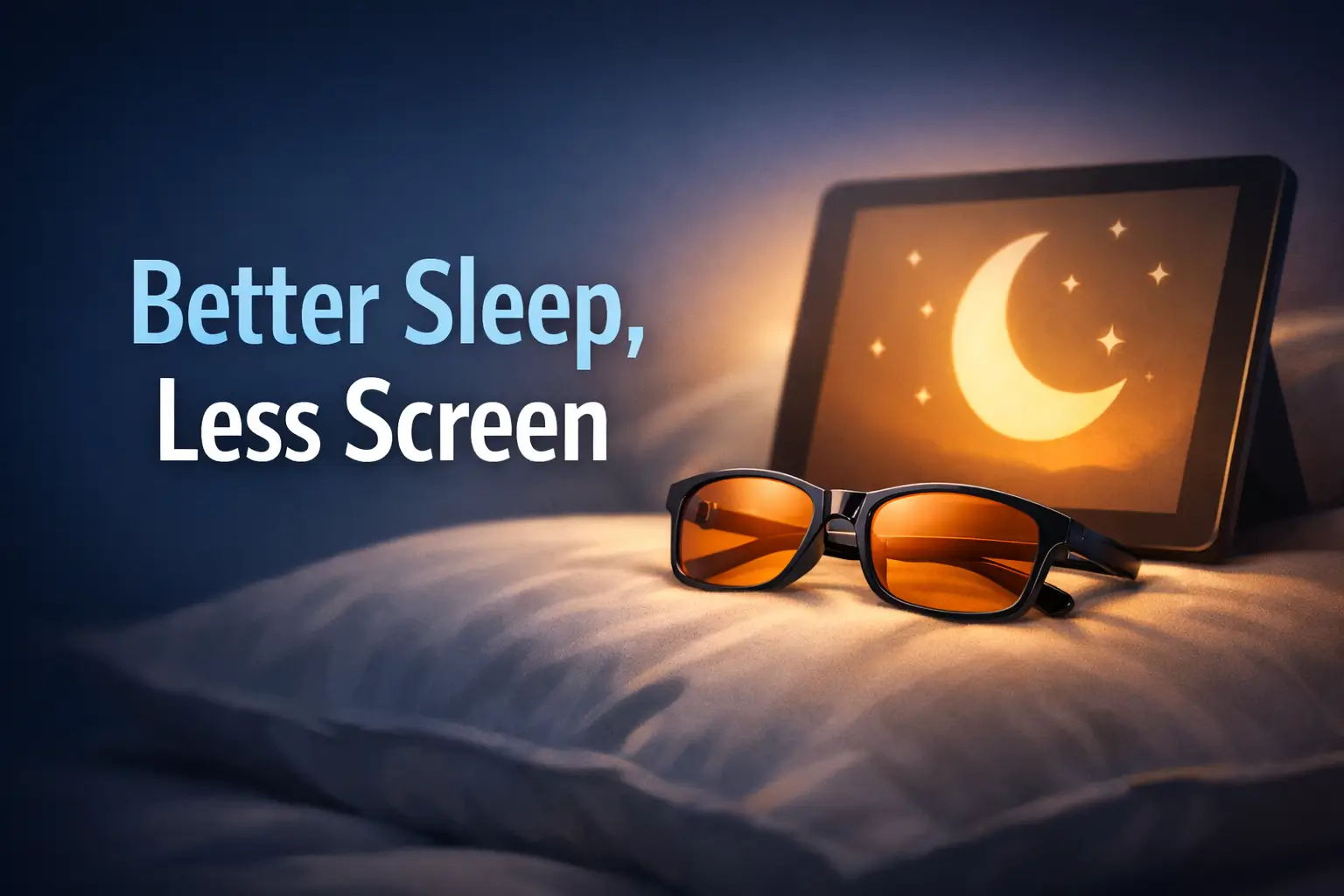

Reclaim Your Rest: The Low-Drama Sleep System
We focus on the 60–120 minute timing rule, optimizing “Night Shift” settings, and reducing white intensity to stop your screen from acting like a spotlight. (If your device still feels too bright even on the lowest setting, the trick is learning how to make an iPhone screen dimmer than the minimum using accessibility controls.)
- ✓ Fall asleep faster by reducing “daytime” signals earlier
- ✓ Read comfortably with less brightness and less eye strain
- ✓ Separate “calm reading” from content that spikes alertness
Trust the process: Test these changes with a clean 7-night mini experiment.
Blue-light glasses can help some seniors fall asleep easier when tablet use is the trigger—especially if the lenses block a meaningful amount of short-wavelength (“blue”) light and you wear them 60–120 minutes before bed. But they’re not a magic cure: screen brightness, stimulating content, timing, and issues like sleep apnea, pain, or meds often matter more. For many people, tablet settings + dim room light + a consistent routine beat glasses alone.
Table of Contents
1) Who this is for / not for
For: “I’m sleepy… until the tablet”
This is for you if your sleep trouble has a very specific personality: it shows up when the screen turns on. You might read on a tablet nightly and feel oddly wired afterward, or you might wake at 2–3 a.m. and accidentally “wake your brain all the way up” with a bright screen.
- You use an iPad/Kindle/tablet in the evening most nights
- You notice a difference when you stop screens (even if you hate stopping screens)
- You want a non-drug tool you can repeat without fuss
Composite snapshot: A 68-year-old reader told me her “innocent” bedtime crossword turned into 90 minutes of backlit news headlines. The insomnia wasn’t mysterious—it was rehearsed nightly, like a song her brain learned too well.
- Look for a consistent “screen → wired” pattern
- Assume brightness and content matter, not just “blue” light
- Test changes for 7 nights, not 1 night
Apply in 60 seconds: Tonight, set a timer: “screen off in 20 minutes,” and notice how your body feels when the light disappears.

Not for: “This isn’t a screen problem”
If insomnia started long before tablets entered your evenings—or if you sleep the same whether you use screens or not—glasses won’t be your main lever. Also, if you have strong red flags, treat the sleep problem like a health problem (because it is).
- Loud snoring, choking/gasping, or extreme daytime sleepiness (possible sleep apnea)
- Severe restless legs, severe pain, or major mood changes driving sleep loss
- New insomnia after a medication change
- Yes — You feel sleepier on nights you avoid screens for 60 minutes.
- Yes — You get “second wind” while reading/scrolling.
- Yes — Middle-of-the-night phone checks make it harder to fall back asleep.
- No — You wake gasping/snoring loudly or feel unusually sleepy in daytime.
- No — Insomnia began right after a new medication or dose change.
Neutral next step: If you have two or more “No” items, prioritize a clinician conversation while you still try gentle screen-light changes.
2) Blue light basics: what matters (and what’s marketing)
Blue light vs brightness: the overlooked tradeoff
Most people hear “blue light” and picture one villain. In real life, sleep disruption is more like a trio: wavelength (blue-leaning light), brightness (how much light), and duration (how long you’re exposed). If you warm the screen but keep it bright enough to light your face like a tiny stage spotlight, your brain may still get a strong “it’s daytime” signal.
Composite snapshot: One caregiver set Night Shift to “very warm” on her dad’s iPad… then turned the brightness up so he could read tiny text. Warm? Yes. Sleepy? Not even close.
The real target: your circadian “night signal”
Your body runs on a timing system that responds to light. Evening light—especially brighter, blue-leaning light—can delay the body’s sense of night. Older adults often experience a natural shift toward lighter, more fragmented sleep, and even small routine disruptions can feel bigger than they did at 40.
Show me the nerdy details
The eye contains light-sensitive pathways that communicate with the brain’s “clock.” Short-wavelength light (the kind many LEDs and screens emit) tends to be efficient at signaling “daytime.” The outcome isn’t just melatonin timing—it’s alertness, temperature rhythm, and how strongly your brain tags the evening as “still active.”
What’s marketing: “Blue light is frying your eyes” headlines. The American Academy of Ophthalmology has said there isn’t good evidence that blue light from screens causes eye disease, and that sleep can often be improved without special glasses. That doesn’t mean glasses never help—it means you should buy based on measurable specs and a real routine, not fear. (If the issue is eye discomfort more than sleep timing, it helps to understand digital eye strain in seniors and the simple fixes that reduce “tired eyes” without expensive gear.)
- Useful concept: Reduce bright, blue-leaning light before bed
- Misleading leap: “Any blue-blocking lens automatically fixes insomnia”

3) Tablet-at-night insomnia: the real culprits (not just photons)
Content arousal: your brain’s “one more chapter” trap
The most underrated sleep disruptor isn’t the screen. It’s what the screen does to you. Thrillers, arguments, breaking news, competitive games, email—these are basically little adrenaline snacks. Your body doesn’t care that you’re under a blanket; it cares that your attention is locked and your emotions are moving.
- Cliffhangers and scrolling feeds delay “wind-down”
- Politics and conflict raise alertness (even when you feel tired)
- “Just checking one thing” turns into 45 minutes
Posture + eye strain: the quiet sleep disruptors
When your neck is craned forward and your eyes are dry, your body stays on duty. That can show up as headaches, jaw tension, or a subtle restless feeling that makes sleep feel “slippery.” If “dry, gritty eyes at night” is part of the picture, a simple, repeatable routine like a 15-minute night routine for dry eyes can reduce the physical irritation that keeps your nervous system awake.
Composite snapshot: A 72-year-old Kindle reader finally solved his “mystery insomnia” by moving the device up on a pillow (less neck bend) and increasing font size—no glasses required. The fix was geometry, not gadgets.
Let’s be honest… it’s rarely the light alone. It’s light + brightness + arousal + routine. The good news: you have more levers than you think.
4) What “works” glasses look like: specs that actually matter
Lens type: clear vs amber vs red (what each is trying to do)
If you’re going to try blue-light glasses for sleep, the first question isn’t brand—it’s strength.
- Clear “blue-filter” lenses: Often mild. They may reduce some short-wavelength light, but many are too subtle to meaningfully change the evening signal—especially if the screen is bright.
- Amber lenses: Usually stronger for evening use. They visibly warm the world and are more likely to reduce the blue-leaning component enough to matter.
- Deep red lenses: Very strong, often overkill for normal life. Some people love them; many find them annoying or unsafe for walking around (color distortion).
Composite snapshot: One reader described cheap “blue light” glasses as “barely tinted optimism.” The amber pair, though? “My brain finally got the memo.” That difference is typically strength, not magic.
Show me the nerdy details
Look for manufacturer data on transmission or blocking in the short-wavelength range. Marketing terms vary, but your goal is a meaningful reduction of the wavelengths most associated with “daytime” signaling. Without data, you’re buying a vibe.
Fit + comfort: seniors won’t wear what pinches
The best glasses are the ones you’ll actually keep on your face for 60–120 minutes. Seniors often do best with lightweight frames, soft nose pads, and a wide field of view (so you’re not peering through a tiny tinted window).
- Lightweight frame + stable nose pads
- Wide lenses (less “edge peeking”)
- Options for prescription wearers: fit-overs or clip-ons
Claims to ignore: the persuasion checklist
Ignore vague promises like “supports sleep” with no explanation of how much light is filtered. Also be skeptical of “100% blue light” claims that don’t tell you which wavelengths and under what measurement method. Your decision should be boring: comfort + plausible strength + consistent use.
- Do you need fit-overs or clip-ons for prescription lenses?
- Will you wear them only for reading, or also for TV and household lights?
- Can the seller show lens transmission data (even a simple chart) rather than slogans?
- Do you need a frame that’s stable for nighttime bathroom trips?
Neutral next step: Write down your three “must-haves” (fit, strength, comfort) before shopping so you don’t buy a pretty placebo.
- Choose clear/mild if you mainly want comfort for screen use and your insomnia is mild.
- Choose amber if the problem is clearly “screen → alert,” and you can commit to wearing them 60–120 minutes pre-bed.
- Skip for now if you won’t change brightness/content—settings will give you more value first.
Neutral next step: Pick one lane for 7 nights. Mixed experiments (“sometimes amber, sometimes not”) make results hard to trust.
5) Timing rules: when to wear them for tablet reading
The 60–120 minute window (why it’s the sweet spot)
If glasses help, they usually help because they change your evening light exposure before your body commits to “night.” Wearing them only at the exact moment you turn out the light is like locking the front door after everyone has already come inside.
- Ideal: Put glasses on 60–120 minutes before bed, then do your tablet reading
- If you only read 20 minutes: Put glasses on earlier anyway, even during TV time
- If you binge-read 3 hours: Great—glasses matter more, but keep brightness low
The “bathroom break problem”
This one surprises people: you can do everything right, then erase the benefit with one trip to a brightly lit hallway or kitchen. If you’re wearing amber lenses but walk into bright overhead LEDs, your eyes still receive a strong “daytime” hit (and your brain notices). This is why a simple plan for nighttime bathroom safety lighting for seniors can matter as much as the glasses themselves.
- Use a low-lux nightlight pathway (bed → bathroom)
- Avoid bright ceiling lights after you’ve started your “night signal” window
- If you must turn on a light, keep it dim and warm
Here’s what no one tells you… your lamp can cancel your glasses. You’re not failing. The environment is simply louder than the lenses. (If overhead LEDs are your nemesis, swapping to glare-free under-cabinet lighting ideas or warm, indirect lamps can make “night mode” actually feel like night.)
Set your bedtime and pick a lead time. This gives you a simple start time to wear glasses and dim lights.
Neutral next step: Put that start time in a phone reminder for the next 3 nights and see if sleep onset shifts.
6) Tablet settings that often beat glasses alone (cheaper, faster)
The “make the screen sleepy” checklist
Before spending money, make the screen behave like a polite evening guest—quiet, warm, and not shouting white light into your eyes. Apple calls it Night Shift (and Reduce White Point), Android uses Night Light on many devices, and Kindle/e-readers vary by model (some are front-lit and gentler by nature). If you’re on iPhone/iPad and “night mode” still feels harsh, learning to make your iPhone or iPad screen dimmer than the minimum is often the missing piece.
- Warm color shift: Turn on Night Shift/Night Light and schedule it earlier
- Lower brightness: Don’t rely on “warm mode” while staying bright
- Reduce white point (iOS): A secret weapon for “still too bright” screens
- Dark mode + larger text: Less squinting, less eye strain, less arousal
Composite snapshot: A 66-year-old who hated glasses got the same benefit by combining larger font + dark mode + 30% brightness. The win wasn’t trendy—it was sustainable.
The 2-device trap
Here’s the classic pattern: you warm and dim your tablet, then you pick up a phone with a bright, blue-white screen. It’s like brushing your teeth and then eating a mint-chocolate cake. The body is confused, and it will express that confusion at 1:40 a.m.
- Match settings across devices: phone, tablet, TV (if possible)
- Set a “night profile” you can toggle in 5 seconds
- Keep the charger away from the bed to reduce impulse scrolling
- Tier 1: Warm mode + brightness down
- Tier 2: Tier 1 + Reduce White Point (or equivalent)
- Tier 3: Tier 2 + dim room lighting (lamps, not overhead LEDs)
- Tier 4: Tier 3 + amber glasses for 60–120 minutes
- Tier 5: Tier 4 + “boring content” rule + consistent wake time
Neutral next step: Move up only one tier at a time so you know what actually helps.
7) Common mistakes (the ones that make people swear glasses “don’t work”)
Mistake #1: Wearing them only at bedtime
This is the big one. If you put them on at the moment you want to fall asleep, you’re asking your body to change gears instantly. Many people need a ramp, not a switch.
Mistake #2: Blocking blue, keeping brightness high
Warm light can still be bright light. If your screen is lighting up your face and the room, your brain may stay “on,” even if the color is amber-ish.
Mistake #3: Reading “activating” content
Thrillers, social media, email, politics—these are professional-grade stimulants. If you want to test glasses honestly, pair them with content that doesn’t hijack your nervous system.
Mistake #4: Forgetting morning light
Morning light helps anchor your clock. Without it, nights can drift. You don’t need to become a sunrise athlete—just get daylight exposure early when you can.
Composite snapshot: One older couple fixed “middle-of-night waking” by taking breakfast near a bright window for 15 minutes. Their nighttime routine didn’t change much; their morning anchor did.
- Put glasses on before your brain gets its second wind
- Lower brightness until the screen stops lighting your face
- Test with calm content for 7 nights
Apply in 60 seconds: Tonight, choose one “boring but comforting” read—no cliffhangers, no comment sections.
8) Don’t do this: the “false fix” loop that prolongs insomnia
“I’ll buy glasses and keep everything else the same”
This is the sleep equivalent of buying a new frying pan and refusing to turn down the heat. A single tool can help, but insomnia often behaves like a system problem: light + habits + arousal + timing.
“I’ll stay in bed and scroll until I pass out”
If your bed becomes the place where you’re awake, worried, and entertained, your brain learns that bed means “awake time.” That learning is powerful—and inconvenient.
Short Story: … (120–180 words) …
A man in his early 70s told me he “never had sleep issues” until retirement. The new habit was small: he brought his tablet to bed, because it felt cozy. At first he read novels. Then he added email. Then the news. If he woke at 3 a.m., he checked “just one thing” so he wouldn’t worry. Over weeks, his brain began to associate bed with problem-solving and alertness. The fix wasn’t heroic.
He moved the tablet to a chair by a lamp, kept the bed for sleeping, and gave himself a 20-minute “read then lights out” ritual. Some nights were still rough—but the bed slowly became a sleep place again. The story wasn’t about willpower. It was about retraining a cue his body had quietly learned.
- If you can’t sleep, consider a short reset: sit somewhere else briefly, then return to bed
- Keep screens as a tool, not a midnight companion
9) When to seek help (especially for seniors)
Red flags that shouldn’t wait
Light management is a great first step. But if your insomnia is driven by a medical issue, no lens tint will outsmart it. This is especially true in older adults, where sleep and safety overlap (falls, balance, cognition, medication sensitivity).
- Loud snoring + daytime sleepiness (possible sleep apnea)
- New/worsening insomnia after a medication change
- Depression/anxiety symptoms, memory changes, or increased falls risk
- Leg discomfort/urge to move that disrupts sleep (possible restless legs)
- Nighttime urination that’s frequent and new (ask about underlying causes)
What to ask your clinician about
If you want a high-signal conversation, ask about CBT-I (cognitive behavioral therapy for insomnia), sleep apnea evaluation if symptoms fit, medication timing (not just medication choice), and pain management strategies that reduce nighttime wake-ups. MedlinePlus and NIH resources commonly highlight CBT-I as an effective approach for chronic insomnia, and it’s often safer than escalating sedating medications in older adults. (And if your “wired” feeling is partly driven by eye discomfort, having a simple plan for preservative-free eye drops options for seniors can reduce the urge to rub, squint, and keep “fixing” your eyes at bedtime.)
- Ask about CBT-I and sleep apnea screening
- Review medication timing and side effects
- Prioritize fall safety (night lighting matters)
Apply in 60 seconds: Write down: “When did this start?” and “What changed?” before your appointment—those two lines save time and improve accuracy.
FAQ
Do blue-light glasses actually help you fall asleep faster?
Sometimes—especially when screens are the clear trigger and the glasses are strong enough (often amber). But many people get equal or better results by lowering brightness, warming the screen, and avoiding stimulating content. Think of glasses as an amplifier for a good routine, not a replacement for it.
Are amber blue-light glasses better for sleep than clear ones?
Often, yes. Clear lenses are frequently mild and may not change your evening light exposure enough to matter. Amber lenses are more likely to reduce the blue-leaning component meaningfully. Comfort and safety still matter—especially if you walk around at night.
How long before bed should seniors wear blue-light glasses?
A practical window is 60–120 minutes before bed, especially if you’re using a bright tablet. If you only read for 20 minutes, you can still put them on earlier during TV time so your brain gets a longer “night signal” ramp.
Do Night Shift or Night Light settings replace blue-light glasses?
For many people, they can. Warming the screen helps, but the biggest win often comes from lowering brightness and reducing white intensity. If you do those well, glasses may be optional—or become a smaller “extra edge.”
Can blue-light glasses help with waking up at 3 a.m.?
They can help indirectly if your 3 a.m. wake-up turns into a bright-screen session. The bigger goal is to avoid bright light exposure during that window. If you must use a screen, keep it dim, warm, and short—then return to a dark environment.
Do blue-light glasses work for Kindle/e-readers the same as iPads?
It depends on the device. Many e-ink readers are gentler than tablets, but front-lights and brightness settings still matter. If the device lights your face or the room, treat it like a sleep-relevant light source and dim it aggressively.
Are blue-light glasses safe for cataracts or after cataract surgery?
In general, blue-light filtering lenses are widely used and discussed in eye care, but individual needs vary. If you’ve had cataract surgery or have eye conditions, ask your eye doctor what’s appropriate for your vision and nighttime safety—especially if color distortion could increase fall risk.

11) Next step: one concrete action (do this tonight)
Run a 7-night “screen-sleep reset” mini experiment
Here’s the point: you don’t need to believe in blue-light glasses. You need to test them in a way that actually answers the question. This mini experiment is designed to be simple, repeatable, and honest—because insomnia punishes wishful thinking.
- Nights 1–3: tablet warm settings + dim room light + boring/comforting content
- Nights 4–7: same rules + amber blue-blocking glasses 90 minutes pre-bed
- Track: time to fall asleep, nighttime awakenings, next-day grogginess
- Warm screen mode
- Lower brightness
- Dim room lighting
- Calm content
- Same rules
- + Amber glasses
- Wear them 60–120 min pre-bed
- Protect bathroom pathway lighting
- Minutes to fall asleep
- # of awakenings
- Morning grogginess (0–10)
- Any naps/caffeine changes
If you like a concrete tracker, use something like a printable symptom diary for seniors so patterns show up fast (without relying on fuzzy morning memory).
Composite snapshot: A 70-year-old who “failed every sleep tip” finally succeeded with this experiment—because it gave her a way to notice small changes without expecting perfection on night one.
Conclusion
So, do blue-light glasses help seniors with insomnia who use a tablet at night? They can—when the problem is truly screen-triggered, when the lenses are strong enough (often amber), and when you use them early enough to matter. But the curiosity loop you came in with has a calmer ending: the most reliable fix usually isn’t one product. It’s a small system—dim the environment, lower brightness, choose quieter content, protect your bathroom pathway lighting, and keep the routine consistent.
If you want a next step you can complete in 15 minutes: set your tablet to warm mode, reduce brightness, increase font size, place a low nightlight for the bathroom path, and run the 7-night experiment. Let the results—not the marketing—tell you what works for your brain.
Last reviewed: 2026-01-24