
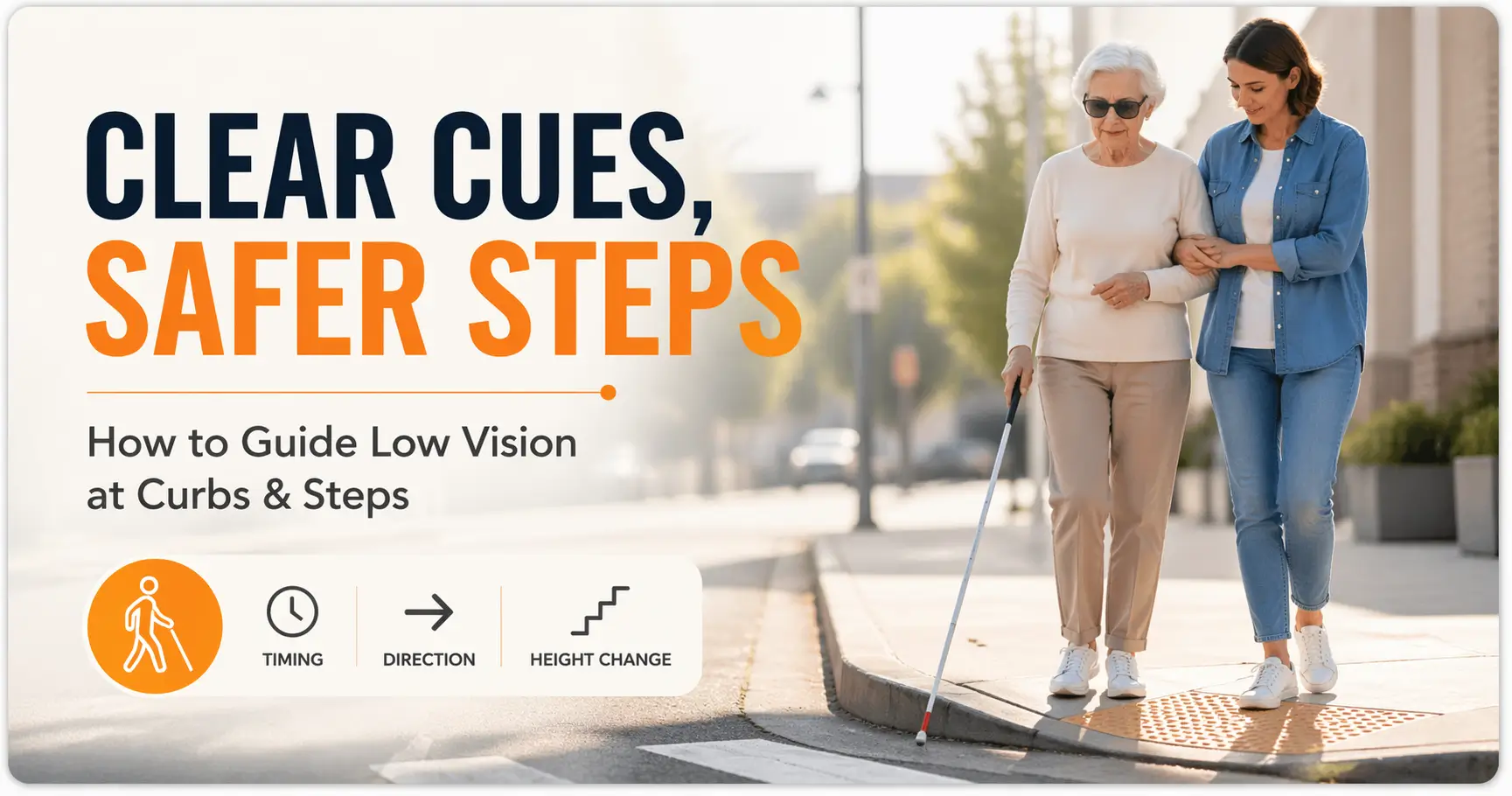
Beyond “Watch Out”: Precise Guidance for Low Vision Navigation
“Watch out” is often the least helpful thing to say at the exact moment someone with low vision needs clarity. By the time the warning lands, the foot may already be searching for a curb, a single step, or a threshold the eyes could not read in time.
That tiny delay is the problem.
The goal is simple: move with less surprise and more confidence using short verbal guidance that fits real walking. You will learn when to say “curb down in two steps,” when “step up now” is enough, and when fewer words are kinder than a nervous speech.
The method is practical, not fancy:
- Name the change, not your panic.
- Give the cue before the body commits.
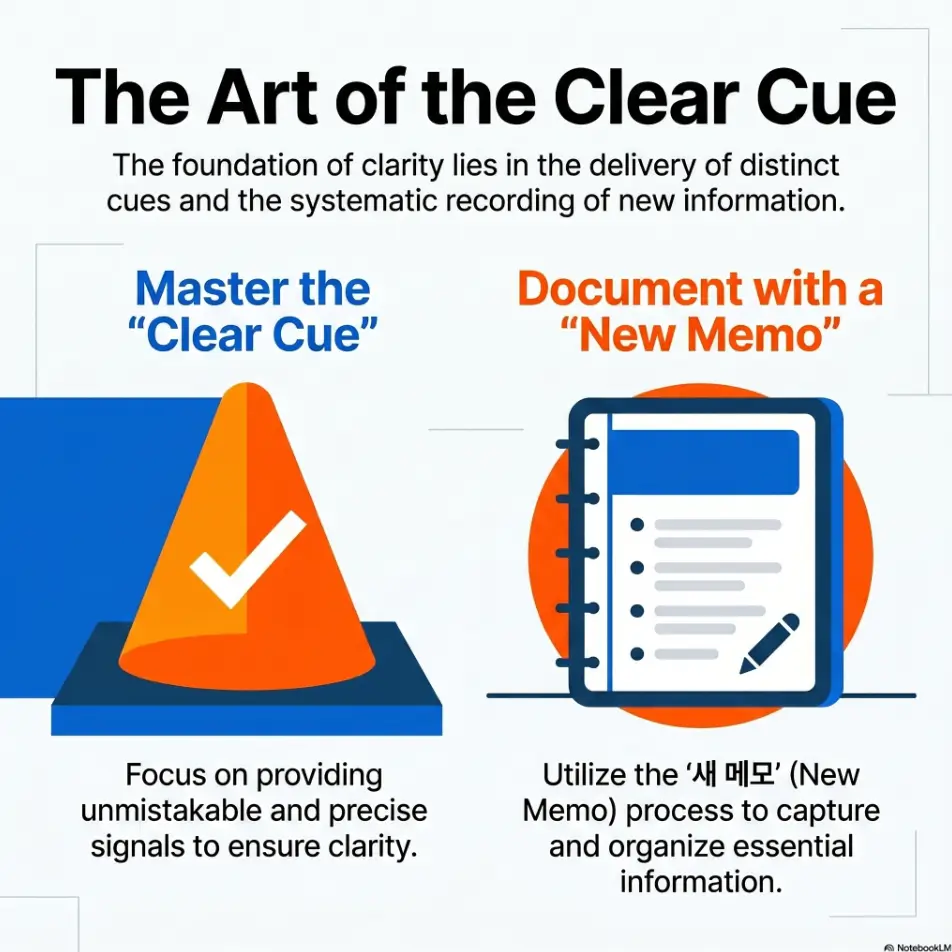
- Use the fewest words that still create a usable picture.
Apply in 60 seconds: Practice saying one line out loud: “Curb down in two steps.”
Table of Contents
Start Here: Why “Watch Out” Is Usually Too Late
Why vague warnings fail when the ground changes fast
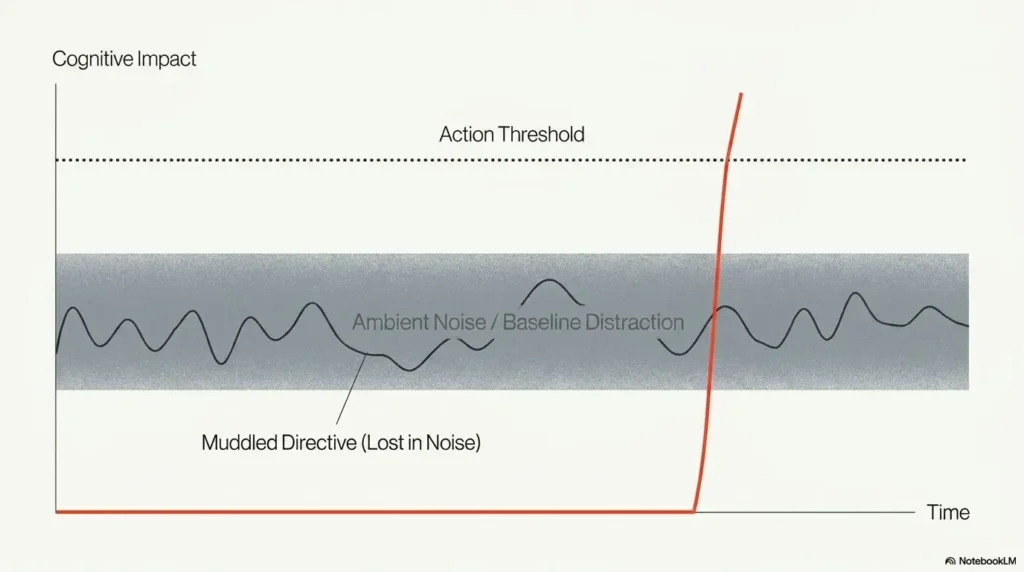
“Watch out” feels helpful because it sounds urgent. In practice, it often hands the other person a basket full of uncertainty. Watch out for what? Up, down, left edge, broken concrete, puddle, lip of the threshold, traffic island? By the time the brain has opened all six tabs, the body is already negotiating the ground. A cue that vague asks for interpretation when what the moment needs is preparation.
I once heard someone warn an older relative with low vision by saying, “Careful, careful, careful.” The words came with great sincerity and almost no information. Everyone’s shoulders went up. Nobody’s footing improved. That is the hidden cost of bad helping. It turns movement into guesswork wrapped in emotion.
How low vision turns ordinary height shifts into timing problems
Many step and curb problems are not about intelligence, caution, or effort. They are timing problems. A person may detect the ground change only a little later than someone with full visual contrast and depth cues. That tiny delay matters. Outdoors, shadows, glare, pavement color, and visual clutter can flatten edges. Indoors, a single surprise step can disappear into familiar flooring until the very last moment.
The American Academy of Ophthalmology notes that low vision can affect safe movement and that orientation and mobility support can help people travel more safely, while the National Eye Institute and related low-vision resources emphasize adapting tasks and environments rather than assuming willpower will solve the problem.
Why the best script is short, not chatty
There is a humane temptation to explain everything. The problem is that walking is already a live task. Extra words compete with balance, foot placement, ambient sound, and decision-making. Good cues are not miniature speeches. They are more like handrails made of language. Brief. Load-bearing. Exactly where needed.
That brevity is not cold. It is respectful. It says: I trust your body to do the work once I give it the right clue.
| When guidance sounds like this | It usually causes this | Better alternative |
|---|---|---|
| “Watch out” | Alarm without a picture | “Step down now” |
| “Careful over there” | Unclear location | “Curb down on your right” |
| “There’s something ahead” | Late mental scramble | “One step up in two steps” |
Script First: What a Helpful Cue Actually Sounds Like
The simplest formula: distance, direction, change, action
For most everyday routes, the most useful cue follows a simple pattern:
- Distance: now, in one step, in two steps, ahead
- Direction: center, slightly left, right edge
- Change: step up, step down, curb down, threshold, uneven ground
- Action: lift, slow, pause, shorter step
You rarely need all four. Often two or three pieces are enough. “Two steps, curb down.” “Step up now.” “Right edge uneven.” The formula matters because it keeps your language anchored to movement instead of your own anxiety.
How “step up,” “step down,” and “curb ahead” do different jobs
These are not interchangeable. Step up prepares the body to clear height. Step down prepares the foot to search lower than expected. Curb ahead is a category label, which can be helpful early but usually needs a second cue for timing. “Curb ahead” tells the story genre. “Curb down in two steps” tells you when the plot twist happens.
In daily life, one word can be the hinge between calm and clumsy. Up and down are tiny, but they are not decorative. They are architectural.
Why timing matters more than extra detail
A perfect description said too late is like an umbrella opened after the rain has already moved indoors. Timing beats eloquence. Most people need the cue early enough to adjust stride, weight shift, and attention. That often means 1 to 3 steps before the change, depending on pace and familiarity.
Here the guide’s biggest mistake is often kindness with a delay. We wait because we do not want to interrupt. Then we interrupt at the worst possible moment. Better to be lightly early than dramatically late.
- Use “ahead” for preparation.
- Use “now” for immediate action.
- Save extra detail for after the footing is secure.
Apply in 60 seconds: Pick one timing pair and practice it: “ahead” versus “now.”
Show me the nerdy details
From a mobility standpoint, verbal guidance works best when it reduces cognitive load rather than adding to it. Real-time walking already requires balance control, route attention, auditory filtering, and foot placement. Concise cueing preserves processing capacity for the movement itself.
Use These Words: The Short Script That Works in Real Life
How to describe one step clearly without overloading the moment
For a single step, clarity usually beats completeness. Good examples:
- “One step up now.”
- “One step down ahead.”
- “Single step down in two steps.”
- “Threshold up, small rise.”
The word single can help because isolated steps are sneaky. They do not have the obvious grammar of a staircase. A whole staircase announces itself like a brass band. One lonely step behaves more like a trapdoor with good manners.
How to call out a curb when walking outdoors
For curbs, the most useful wording often includes both category and timing. Examples:
- “Curb down in two steps.”
- “Curb up ahead, slight left.”
- “Broken curb edge on the right.”
- “Curb ramp ahead, slope down.”
If traffic noise or crowd noise is high, shorter is usually better. A phrase like “Curb down now” can land more reliably than a fuller explanation swallowed by buses, wind, and the soundtrack of urban impatience.
How to signal whether the edge is near, now, or next
A tiny vocabulary can do a lot of work:
- Ahead: useful when the change is visible or expected soon
- In two steps / in one step: good for timing
- Now: immediate action
- Then level: tells the person what happens after the transition
That last piece matters more than people think. “Two steps down, then level” reduces the fear that the body is about to enter an endless staircase when in fact it only needs to negotiate one transition. A little map is sometimes enough to quiet a lot of muscular tension.
Let’s be honest: too many words can become their own obstacle
Many well-meaning guides start sounding like live audio description for a film nobody asked to watch. “Okay so there’s a curb kind of coming up and it’s near the street and maybe a little broken but not too bad and just…” By then the moment has turned into soup. A cue should not require editing on arrival.
When in doubt, cut the sentence in half. Then cut it again. Keep the nouns and verbs that change footing. Lose the decorative parsley.
Curbs Are Different: Why Outdoor Edges Need Better Language
How sunlight, shadows, and pavement color make curbs harder to read
Outdoors, a curb is rarely just a curb. It is a curb plus glare, shadow, wet pavement, parked cars, paint wear, and the visual noise of everything else happening at once. Contrast can collapse. A curb edge that looks obvious to one person can flatten into the street for another. Low-vision resources from the AAO discuss how lighting and contrast affect everyday function, which is exactly why outdoor cueing often needs to be more intentional than people assume.
I have seen bright noon light do a strange magic trick on a pale curb. It erased the edge while making everyone else feel certain it should have been visible. That gap between “should” and “is” is where better guidance lives.
Why “there’s a curb” is weaker than “curb down in two steps”
The first phrase identifies an object. The second provides an action-ready moment. Walking is about timing. “There’s a curb” may be enough if the person stops and explores slowly. It is not enough if both of you are in motion. The body needs a countdown, even a tiny one.
Think of it as the difference between weather and a forecast. “There’s rain somewhere” is not as useful as “Rain starts in two minutes.” One reduces surprise. The other just announces that surprise exists.
How slope, broken pavement, and gutter edges complicate the cue
Curbs are not always clean drops. Sometimes they blend into curb ramps, crumbled edges, gutters, pooled water, leaves, or uneven asphalt. In those cases, add only the detail that changes movement:
- “Curb ramp ahead, long slope down.”
- “Broken edge right side.”
- “Gutter after curb, longer step.”
- “Uneven landing after curb.”
That is the real art here. Not describing everything. Describing the part that changes how the next step should be taken.
- Say whether it is up or down.
- Add the count when movement is ongoing.
- Name uneven landings only when they change the step.
Apply in 60 seconds: Practice one outdoor cue: “Curb ramp ahead, slope down.”
Steps Are Sneakier: Why Indoor Changes Catch People Off Guard
How entryways, porches, and single surprise steps create risk
Indoor and entry-area steps are often dangerous precisely because they do not look dramatic. A porch lip, a sunken living room, a dark threshold, a small rise at the bathroom entry, a single step into a garage. These are the places where familiarity becomes overconfidence. The house feels known, so the body pre-loads expectation. When the floor fails to keep its promise, the foot arrives in the wrong story.
That is why “single step down ahead” can be more useful than a long explanation about the architecture. You are not narrating a renovation show. You are protecting the next footfall.
Why one isolated step can be worse than a full staircase
A staircase is visually loud. It advertises itself. A single step often whispers. That is the problem. People prepare for repeated steps more naturally than for one isolated change in level, especially when floor color, rugs, or lighting blur the boundary.
The National Institute on Aging and CDC both emphasize that falls in older adults are common and preventable, and that environmental conditions and movement strategies matter. In ordinary life, an isolated indoor step is a perfect example of a preventable surprise rather than an unavoidable mystery.
Here’s what no one tells you: the dangerous part is often the last inch of uncertainty
The body can handle many things. What it dislikes is ambiguity at the moment of loading weight. That final inch of “is the ground there or not?” is where tension spikes. People often think the issue is courage. It is not. It is unresolved information colliding with movement.
So when guiding, your job is to reduce that last inch of uncertainty. Not to dramatize it. Not to apologize for it. Just to make the landing legible a beat earlier.
- Do step changes become more stressful when routes are dim, busy, or unfamiliar? Yes: use shorter countdown cues.
- Are single steps worse than staircases? Yes: add “single” to the cue.
- Does the person dislike long narration? Yes: cut to 3 to 6 words.
- Are near-falls happening indoors? Yes: review pace, lighting, and route habits too.
Neutral next step: test one cue on the most troublesome doorway or entry path.
Who This Is For, and Who It Is Not For
Best for family members, friends, volunteers, and guides walking with someone who has low vision
This article is for ordinary humans doing ordinary helping. Family members guiding a parent. A friend walking across a parking lot. A volunteer escorting someone into a church hall. A spouse doing the soft choreography of daily errands. If that is you, the goal is not to become a specialist overnight. The goal is to become more predictably helpful.
Helpful for older adults who want more predictable verbal guidance in public places
It is also for the person receiving the cue. Sometimes what someone wants is not more help, but better help. A shorter script. Fewer vague alarms. More predictable wording. That can reduce friction and preserve dignity at the same time. Nobody enjoys being treated like a crisis when they are simply trying to cross a curb cut outside the pharmacy.
Not enough for someone who needs formal orientation and mobility training
This is the important boundary line. A short cue script can improve everyday communication, but it does not replace formal orientation and mobility training when someone needs cane skills, route training, individualized travel strategies, or assessment for repeated stumbles and missed edges. The AAO’s low-vision orientation and mobility information points toward the value of structured training for safer travel beyond informal family guidance.
That boundary matters because good advice should know where it ends.
Don’t Do This: Common Mistakes That Make Guidance Worse
Why saying “careful” without details is rarely useful
“Careful” is emotion in a raincoat. It signals concern, but not direction. Without a usable noun or verb, it leaves the person to guess whether the problem is above, below, left, right, slippery, crowded, or moving. Use it only if you instantly attach information. “Careful, curb down now.” Even then, the second half is doing the actual work.
How grabbing, steering, or correcting too late breaks trust
A sudden arm yank is often more destabilizing than the step itself. It can throw off balance, create alarm, and make the person feel managed rather than supported. If physical guidance is being used, it should be coordinated and preferred, not improvised like emergency puppetry.
I once watched someone correct late by pressing on the walker’s handle from behind. The intention was good. The effect was chaos wearing a helpful face. Trust does not grow from surprise contact.
Why constant narration can drown out the one cue that matters
Some people narrate because silence feels negligent. But overtalking creates auditory wallpaper. Then, when the crucial cue appears, it arrives buried under all the other sentences. Your words should function more like road signs than like radio chatter.
Good guiding is often quieter than people expect. Quiet is not absence. Quiet is room for the important cue to land cleanly.
- Replace “careful” with a usable cue.
- Avoid sudden steering unless it is coordinated and wanted.
- Let silence protect the important words.
Apply in 60 seconds: Remove one filler phrase you always say and replace it with “step down ahead.”
Mistake Map: What People Get Wrong About “Helping”
Why describing after the person reaches the edge is already too late
Late describing is one of the classic failures of good intention. We notice the curb at the same moment the other person is about to meet it. Then we announce it as if naming a fire after the curtains have already committed. Help needs a lead, not a postgame summary.
How uncertain words like “kind of” or “right there” create confusion
Hedging language may feel polite, but it muddies action. “Kind of a step.” “Right there.” “A little thing.” These phrases do not create a reliable movement picture. They are verbal shrugging. In everyday conversation that can be charming. In motion, it is expensive.
Better words are concrete and plain. Step. Curb. Up. Down. Left. Right. Now. Ahead. A tiny vocabulary can be wonderfully trustworthy.
Why your pace may be the hidden problem, not your wording
Sometimes the cue is fine and the speed is the saboteur. If you walk half a step ahead, speak while turning away, or keep moving at your own comfortable clip, the other person may be processing on a different clock. The solution is not necessarily better script. It may be a slower approach, a pause, or better alignment.
This is where many helpers get humbled. We think we need smarter words. Sometimes what we need is one less kilometer of enthusiasm.
| If this keeps happening | Try this first |
|---|---|
| They say your cues are vague | Shorter, concrete words: up, down, curb, step, now |
| They miss the edge despite hearing you | Give the cue 1 to 2 steps earlier |
| They seem rushed or tense | Slow the walking pace and pause before the transition |
Neutral next step: test one change at a time so you can tell what actually helps.
Build a Rhythm: How to Make the Script Feel Natural, Not Robotic
How to match cues to walking speed and environment
Walking through a quiet hallway is not the same as crossing a noisy curb line at a busy intersection. In calm spaces, you may be able to say, “Single step down in two steps, then level.” In noisy places, the winning cue may be, “Curb down now.” Rhythm is not about elegance. It is about fit.
Try matching your cue length to the environment. More noise, fewer words. Faster pace, earlier cue. More complexity, slightly more structure. This is less like memorizing a script and more like learning to play a piece of music in different rooms.
Why the same person may want different wording in quiet halls versus busy sidewalks
Preference is context-sensitive. Someone may love full cues indoors and want only the bare minimum outdoors. Another person may prefer counts when descending but not when stepping up. The goal is not to discover one universal line and engrave it on a plaque. The goal is to develop a small flexible toolkit.
That flexibility is a form of respect. It treats the other person not as a category, but as a collaborator with habits, preferences, and good days and tired days.
Let’s be honest: good guidance sounds calm because it is practiced
Calm guidance can look effortless, but it is usually the fruit of rehearsal. The first few tries may feel wooden. That is fine. A useful sentence is allowed to sound slightly rehearsed until it becomes part of your shared rhythm. Plenty of good care starts awkwardly and becomes graceful later.
Short Story: A daughter and her mother walked the same small route from the car to the clinic every Tuesday. At first the daughter narrated everything. Door. Mat. Hallway. Person coming. Left turn. Another door. Her mother finally laughed and said, “I feel like I’m inside a documentary.” So they changed the system. Only footing changes got a cue. “Threshold up.” “Single step down.” “Curb ramp ahead.”
Within two weeks the walk felt lighter. The mother moved more smoothly, and the daughter looked less like a nervous weather reporter. Nothing magical happened. No grand breakthrough, no cinematic lesson. Just fewer unnecessary words and a better sense of timing. Sometimes dignity returns not in one heroic act, but in the quiet removal of friction.
Show me the nerdy details
Practice improves cue reliability because both people begin to share expectations. Predictable wording reduces ambiguity, and repeated timing helps the walker calibrate body movement before the step transition arrives.
Beyond the Script: What Else Makes Step and Curb Guidance Easier
How arm guidance, pace matching, and pause points support verbal cues
Words do better when the rest of the movement system is not working against them. Walking side by side at a matched pace helps. Using a preferred arm-guidance method can help. Brief pause points before a complicated curb or entry can help. A cue is part of a larger choreography, not a standalone gadget.
This is especially true when someone is tired, carrying bags, managing background noise, or dealing with unfamiliar terrain. Under those conditions, even a good cue may need the support of a slower approach and a cleaner route.
Why contrast, lighting, and familiar routes still matter even with a script
Language is not a substitute for environment. Better contrast, better lighting, reduced clutter, and familiar route patterns still matter. Low-vision resources commonly point to lighting and contrast as practical supports, while fall-prevention guidance for older adults stresses that environmental changes reduce preventable risk.
That matters because some people treat verbal cueing as a magic patch. It is not. If the porch light is dim, the threshold is dark, and the helper is rushing, a beautiful cue script will still be doing uphill labor in bad shoes. Home routes may also need practical changes around glare, especially in places where white tile floor glare can blur edges and make familiar rooms feel less readable.
How to check preference without turning every walk into a briefing
You do not need a seminar before crossing a parking lot. A simple preference check is enough:
- “Do you want counts or just up/down?”
- “Earlier cues okay?”
- “Do you want me to mention uneven spots?”
That tiny conversation can save a lot of awkwardness. It also avoids the common sin of helpers everywhere: designing the assistance around their own comfort instead of the other person’s needs.
- Words help movement, but environment still matters.
- Preference checks can be brief.
- Pause points are allowed.
Apply in 60 seconds: Ask one preference question before the next walk: “Counts or just up/down?”
in one step
in two steps
now
step down
curb up
curb down
uneven edge
then level
slow
Example: “Curb down in two steps.”
Common Mistakes
Talking too much when one precise cue would do more
The most common mistake is word inflation. People mistake quantity for care. But walking guidance is one of those areas where less can be more generous. One precise cue is often kinder than a paragraph with good intentions.
Waiting until the foot is already near the edge
The second mistake is delay. If the foot is already searching, the cue is late. Move the timing earlier by one beat. Often that alone changes the whole feel of the interaction.
Using blurry phrases like “over there” or “right here”
These phrases depend too much on shared visual reference. Replace them with the thing itself. Step. Curb. Threshold. Left. Right. Down. Now.
Forgetting that curbs, thresholds, and single steps each need different wording
Different terrain asks for different language. A threshold may need “small rise.” A curb may need a count. A single indoor step may need “single step down ahead.” Lumping them together creates sloppy cues.
Assuming one person’s preferred cue style works for everyone
Some people like counts. Some hate counts. Some want “now.” Some want “ahead.” The right system is the one that actually helps that person on that route, on that day.
- Which route causes the most hesitation?
- Is the problem indoor steps, outdoor curbs, or both?
- Does the person prefer counts, early cues, or bare-minimum wording?
- Does noise or lighting change what works?
Neutral next step: test one route, one wording style, one pace change.
Safety / Disclaimer
This article is for general accessibility communication guidance, not a substitute for clinical advice, mobility assessment, or formal orientation and mobility instruction. If someone is having frequent stumbles, near-falls, fear of walking outdoors, or increasing trouble judging edges even in familiar places, better wording alone may not be enough.
The CDC states that falls are common, costly, and preventable for older adults, and its current public guidance stresses prevention rather than resignation. That broader context matters here because missed steps and curbs are not merely communication quirks when repeated instability is entering the picture. For home-based prevention, a broader aging vision fall prevention at home checklist can help families connect communication, lighting, clutter, and routine safety into one calmer system.
When to Seek Help
Repeated missed curbs, stumbles, or near-falls during routine walking
If the same kinds of route problems keep happening, that is a signal. Repetition means the issue may be bigger than wording alone.
Growing anxiety about steps, parking lots, entrances, or unfamiliar sidewalks
Fear changes movement. People shorten stride, rush weirdly, avoid outings, or stiffen in ways that can make balance worse. The National Institute on Aging notes that fear of falling can reduce activity, which is part of why this deserves attention rather than dismissal.
Major difficulty seeing transitions despite brighter lighting or slower pace
If lighting and simple cueing are not improving things, it may be time for a low-vision assessment or rehabilitation-oriented support. A low vision specialist can help translate daily trouble spots into practical supports, especially when vision changes are affecting mobility, reading, errands, and confidence at the same time.
Need for cane skills, formal route training, or individualized mobility strategies
That is the lane for formal orientation and mobility instruction, not improvised family patchwork. Informal guidance can help. Specialist support can transform. When travel is still possible but feels increasingly stressful, broader low vision travel tips can also help families think beyond one curb and plan routes, pauses, lighting, and communication together.
FAQ
What is the best short phrase to warn about a curb?
Usually something like “Curb down in two steps” or “Curb up ahead”. The best phrase names the change and gives timing.
How early should you tell someone about a step down?
Usually 1 to 3 steps before the transition, depending on walking speed, noise, familiarity, and preference. The goal is to give enough time for adjustment without forcing the person to hold too much information too long.
Should you say the number of steps or just the first one?
For single changes, the first one often matters most. Counts can help when timing is important, especially outdoors. “In two steps” is usually more useful than a long description.
Is “watch your step” ever enough?
Sometimes, but not often. It is better than silence only when the person already knows the route and the exact problem is obvious. Most of the time, a more specific cue is safer and calmer.
How do you describe uneven pavement for someone with low vision?
Use the shortest phrase that changes movement: “Uneven ground ahead,” “broken edge right side,” or “rough landing after curb.” Do not pile on extra commentary unless it affects the next step.
What is the difference between guiding and steering?
Guiding supports the person’s own movement with agreed cues or preferred contact. Steering overrides their movement suddenly. One builds trust. The other often startles it.
How do you help without sounding patronizing?
Use plain words, calm tone, and brief preference checks. Talk like a practical teammate, not like someone narrating a disaster drill.
What should you say when there is both a curb and traffic noise?
Shorten the cue. “Curb down now” or “Curb up ahead.” In noisy environments, fewer words often survive better than better words packed into a longer sentence.
Next Step: Practice One Three-Part Cue Before the Next Walk
Pick one simple structure such as “curb down ahead,” “step up now,” or “two steps down, then level”
If this whole article could be folded into one pocket-sized truth, it would be this: the winning cue is the one that helps the next step happen with less surprise. Not the prettiest cue. Not the most caring-sounding cue. The most usable one.
Test it on one familiar route and notice whether earlier, shorter cues feel safer and calmer
Do not try to rebuild every walking habit at once. Pick one route. One trouble spot. One cue. Maybe the clinic curb. Maybe the front threshold. Maybe the single step at the side entrance that behaves like it pays rent in ambushes. Practice the same line a few times and notice what changes. Does the body tense less? Does the foot search less? Does the moment feel less dramatic?
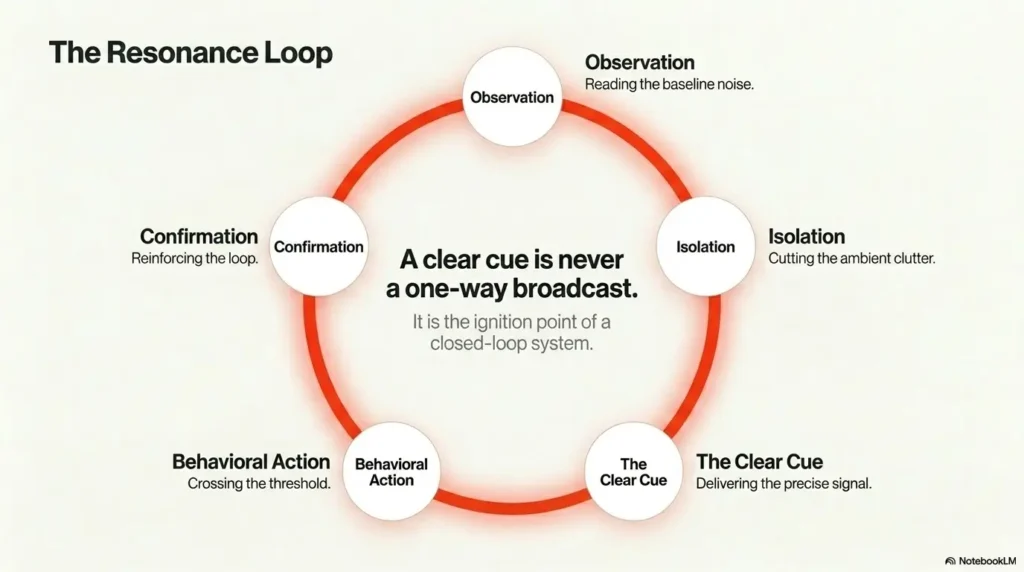
That is the quiet loop we opened at the beginning and can now close honestly. Better guidance is rarely about finding grander words. It is about removing the half-second of confusion that turns a small height change into a bigger event. In the next 15 minutes, choose one cue and try it on one familiar path. That is enough to begin.
Last reviewed: 2026-04.