

The Art of the Helpful Script
Someone pauses near a curb, a glass door, or a checkout line, and suddenly your good intentions feel clumsy in your hands. You want to help, but you do not want to grab, hover, embarrass, or turn an ordinary errand into a tiny public ceremony.
The real friction behind offering help to someone with low vision is simple: most people are not unkind, they are under-scripted. They reach for “Need help?” or “Watch out!” because no one ever handed them better language.
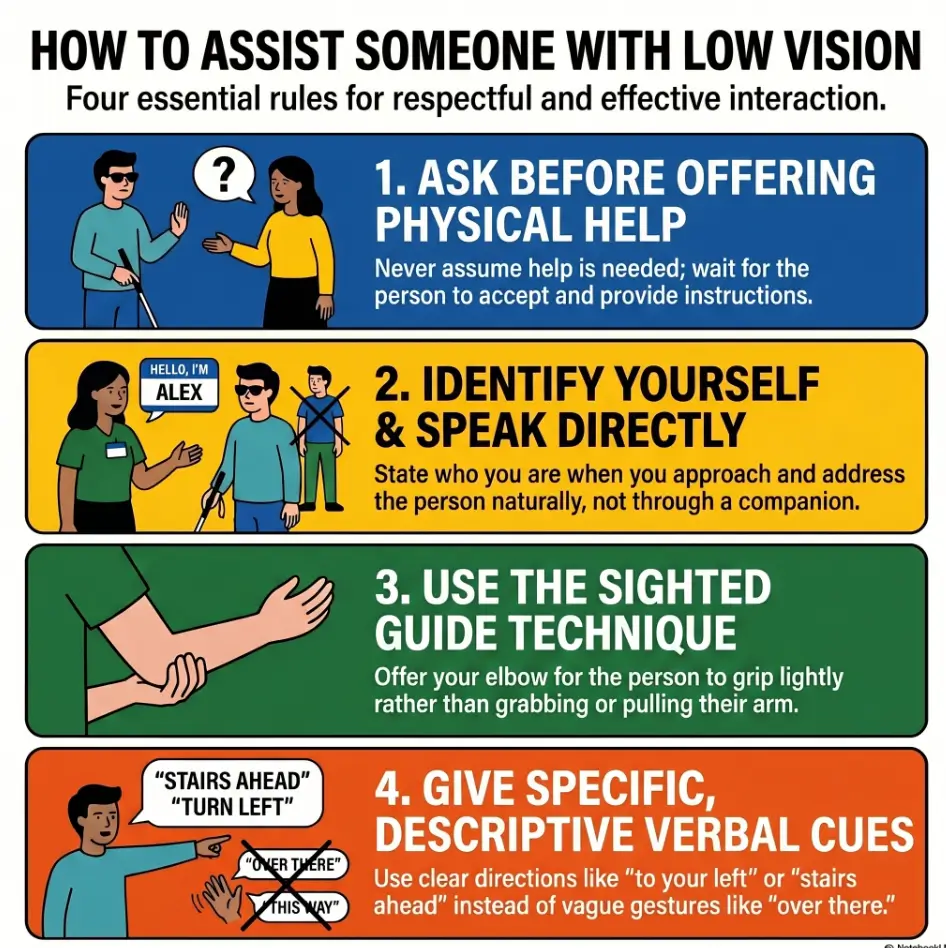
This guide provides calm, choice-based scripts for everyday spaces—from airports to offices—so your assistance feels like useful information, not control. Learn to offer sighted guide assistance without taking over, ensuring every interaction remains respectful and safe.
Table of Contents
Fast Answer: When offering help to someone with low vision, use a calm, specific, choice-based script: “Hi, I’m nearby. Would you like any help finding the entrance?” Avoid grabbing, steering, or saying vague warnings like “over there” or “watch out.” The best help respects independence first, then offers clear information only if the person accepts.
Start Here: The Best Help Sounds Like a Door, Not a Net
The best help does not swoop. It does not announce itself with cymbals. It stands nearby, opens a choice, and lets the other person decide whether to walk through it.
That is the heart of offering help to someone with low vision. Your words should create options, not pressure. A person may be moving slowly because they are reading the room, listening to traffic, checking contrast, waiting for a crowd to thin, or simply choosing their own pace. Slowness is not always distress. A pause is not always a plea.
Why “Do You Need Help?” Sometimes Lands Awkwardly
“Do you need help?” sounds harmless, and often it is. But it can also put the person in a tiny courtroom. Suddenly they must prove whether they “need” help, explain themselves, or manage your feelings if they decline. That is a lot to ask from someone who may simply be looking for the elevator button.
A better question names the possible task. Instead of asking a broad question, offer one clear option.
- “Would you like help finding the entrance?”
- “Would a description of the checkout area be useful?”
- “Would you like me to point out where the line starts?”
The Better Formula: Identify Yourself, Offer One Specific Help, Wait
The formula is beautifully plain:
Respectful Help Formula
1
Identify
“Hi, I’m nearby.”
2
Offer
“Would you like help finding the door?”
3
Wait
Give them room to answer.
A Simple Script You Can Use Almost Anywhere
Try this:
“Hi, I’m nearby. Would you like any help finding the entrance?”
That sentence does 3 quiet things. It tells the person you are speaking to them, names where you are, and gives them a choice. No grabbing. No guessing. No public performance of your own virtue wearing tap shoes.
- Identify yourself briefly.
- Offer one concrete kind of help.
- Wait for the person to accept, refuse, or redirect.
Apply in 60 seconds: Memorize: “Hi, I’m nearby. Would you like help with the door?”
The Core Script: Say This Before You Step In
Most people do not need a lecture on disability etiquette while balancing a coffee, a tote bag, and a self-checkout machine that has chosen violence. They need a sentence. Better yet, 3 sentences they can use under mild social panic.
“Hi, I’m Nearby. Would You Like Help With the Door?”
This is the everyday workhorse. It fits offices, apartment buildings, shops, clinics, community centers, and event venues. It is short enough to say without sounding rehearsed, but precise enough to be useful.
Notice what it does not do. It does not say, “Be careful.” It does not say, “Let me get that.” It does not assume the person is lost. It simply offers a clearly bounded assist.
“Would It Be Useful If I Described the Layout?”
This script works beautifully in places where the problem is not a single door, but a room. Think restaurants, conference check-in areas, hospital waiting rooms, pharmacies, banks, and crowded store entrances.
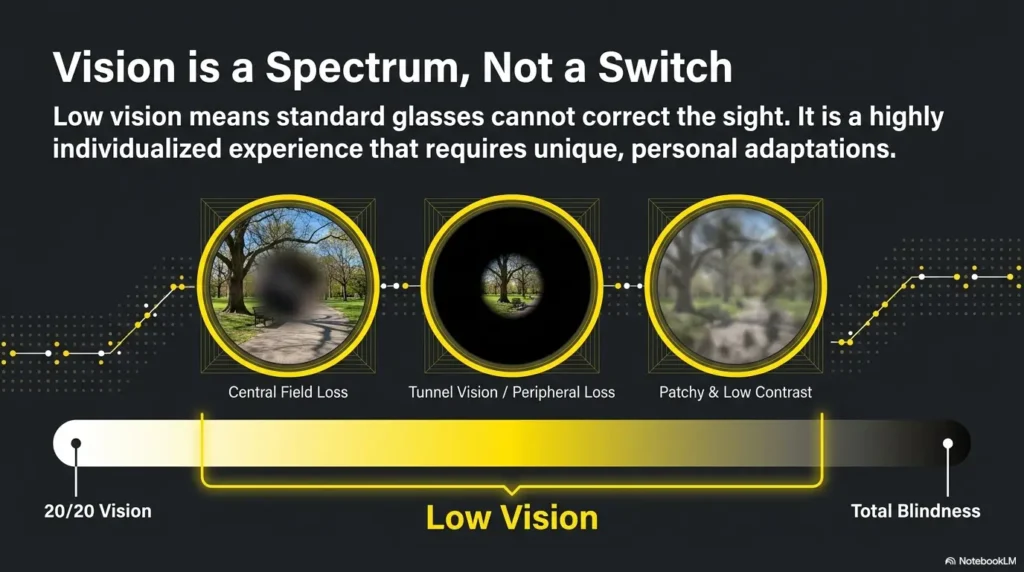
A layout description can be more useful than pointing. Many people with low vision may not catch your gesture, especially if glare, lighting, distance, contrast, or crowd movement is interfering. The National Eye Institute describes low vision as vision loss that cannot be fully corrected with regular glasses, contacts, medicine, or surgery, and daily tasks like reading, shopping, and moving through spaces can become harder. That does not mean helpless. It means the environment matters.
“I Can Walk Beside You, or Just Point Out the Counter”
This sentence gives 2 options. That matters. One person may want verbal directions. Another may want human guide assistance. Another may only need to know where the counter begins. You are not designing a parade float. You are offering a menu.
Decision Card: Verbal Help vs. Walking Guidance
| Use this | When it helps | Example script |
|---|---|---|
| Verbal directions | The destination is nearby and easy to describe. | “The counter is about 8 feet ahead, slightly left.” |
| Human guide | The route is crowded, noisy, narrow, or changing. | “Would you like to take my elbow, or would verbal directions be better?” |
Neutral next step: Ask which option the person prefers before you move.
Who This Is For, and Who This Is Not For
This guide is for the ordinary human moment. The one where you are not a clinician, not a mobility instructor, not a policy officer, and definitely not the protagonist of a rescue montage. You are simply nearby, and you want your help to be clean, useful, and respectful.
This Is For Sighted People Who Want to Help Without Taking Over
If you are a friend, neighbor, coworker, retail employee, receptionist, volunteer, usher, server, church greeter, airport passenger, or someone in a grocery aisle wondering what to say, this is for you.
I once watched a café worker do this perfectly. A customer paused near a pastry case, and the worker said, “Hi, I’m at the counter. Would you like me to read the labels from left to right?” No drama. No baby voice. Just the calm elegance of a well-placed lamp.
This Is For Stores, Offices, Churches, Airports, and Public Events
Public spaces often make small tasks oddly complicated. A checkout line shifts. A door propped open yesterday is closed today. A sign has low contrast. A waiting room has chairs that moved after cleaning. A convention hallway sounds like 200 tote bags having a debate.
Good scripts reduce friction in these spaces. Staff can use them during check-in, checkout, waiting, boarding, seating, or wayfinding.
This Is Not a Guide to Medical Advice, Diagnosis, or Vision Treatment
This article is not medical advice. It does not diagnose low vision, explain treatment, or replace orientation and mobility training. It is about communication. Specifically, it is about how to offer help without shrinking the person you are trying to support.
The Permission Rule: Ask Before You Assist
Consent is not a decorative ribbon tied around help. It is the hinge. Without it, even kind behavior can feel invasive.
Why Consent Matters More Than Speed
When you grab someone’s arm, cane, backpack, sleeve, or shoulder without permission, you may interrupt their balance, navigation plan, or sense of safety. You may also startle them. Nobody enjoys becoming a surprise shopping cart.
Asking first takes about 3 seconds. Those 3 seconds can prevent confusion, embarrassment, and actual physical risk.
The Tiny Pause That Protects Dignity
After you ask, wait. Really wait. Do not fill the silence with a second offer, a third offer, and a tiny weather report from your anxiety.
The person may need a moment to process the sound, identify where you are standing, finish listening to traffic, or decide what kind of help would be useful. Silence can be part of access. It is not always awkward. Sometimes it is the room making space.
Let’s Be Honest: “Helping” Can Feel Like Being Managed
Many people with disabilities spend part of their day managing other people’s reactions. That can be exhausting. A respectful offer keeps the emotional labor small.
Use adult-to-adult language. No sing-song voice. No public announcement. No “I’m just trying to help” speech if the person declines. Good help does not demand applause. It clocks in, does its job, and leaves quietly.
- Ask before touching or guiding.
- Give the person time to answer.
- Accept their preference without debate.
Apply in 60 seconds: Replace “Here, let me” with “Would you like help with that?”
Common Mistakes: Helpful Words That Accidentally Create Stress
Most mistakes come from urgency. You see a possible hazard, your nervous system lights a match, and words fly out before they have shoes on. The result may be loud, vague, or physically intrusive.
Don’t Grab an Arm, Cane, Bag, Shoulder, or Sleeve
Grabbing may feel efficient to the sighted helper. It rarely feels efficient to the person being grabbed. A cane is not a handle. A sleeve is not a steering wheel. A shoulder is not a remote control.
If guidance is needed, offer your arm or elbow and let the person choose whether to take it. Many sighted guide instructions from vision organizations describe the person with vision loss holding the guide’s arm above the elbow, rather than being pulled along.
Don’t Say “Over There” Without a Useful Reference Point
“Over there” is a fog machine pretending to be a map. It depends on the person seeing your gesture, your eye line, and the object you mean. That is a lot of invisible scaffolding.
Use fixed references instead:
- “The restroom door is on the right wall.”
- “The elevator is straight ahead, past the front desk.”
- “The line begins behind the person with the red suitcase.”
- “The card reader is at chest height, just right of the screen.”
Don’t Rush the Person Because You Feel Awkward
Awkwardness is not an emergency. Your discomfort does not need to become their schedule.
If they accept help, match their pace. If they decline, move on. If you are staff and need to keep a line moving, explain the process clearly instead of hurrying the person physically.
Eligibility Checklist: Should You Offer Help Right Now?
- Yes, if there is a clear obstacle, confusing layout, or obvious wayfinding moment.
- Yes, if you are staff and the person is trying to access your service.
- No, if you only feel curious about their vision or mobility aid.
- No, if offering would require interrupting a private conversation.
Neutral next step: If the answer is yes, offer one specific option and wait.
Vague Directions: The Hidden Problem With “Watch Out”
“Watch out” is often the sentence people shout when their brain is trying to sprint faster than language. It sounds protective. But in real time, it may not contain enough information to use.
Why “Watch Out” Usually Arrives Too Late
“Watch out” tells someone there is danger, but not what kind, where it is, or how soon it matters. Is it a curb? A dog leash? A wet floor? A rolling suitcase? A toddler moving like a caffeinated meteor?
For someone with low vision, a vague warning can create a freeze response. The person may stop suddenly, turn the wrong way, or lose track of the original route.
Say the Hazard, Location, and Distance Instead
Use the 3-part cue:
- What: “Curb,” “wet floor,” “chair,” “cone,” “step,” “open cabinet.”
- Where: “On your right,” “straight ahead,” “near your left foot.”
- When: “In about 3 steps,” “right now,” “after the doorway.”
Example: “Curb Coming Up in About Three Steps”
That sentence is useful because it gives action-ready information. The person knows the object, distance, and timing. It is not poetry, but neither is a curb. A curb wants practical language.
Show me the nerdy details
Useful verbal cues reduce uncertainty by converting visual information into structured spatial information. The strongest cues usually include object type, location relative to the person, and timing or distance. “Step down in 2 steps, curb on your right edge” is more usable than “be careful” because it helps the listener prepare a specific movement.
Better Scripts by Situation: What to Say in Real Life
Scripts are not meant to make you robotic. They are meant to give your kindness a clean handle. Once you know the pattern, you can adapt it without sounding like a customer service training video trapped in an elevator.
At a Door: “The Handle Is on Your Left”
Try:
- “The door opens toward you. The handle is on your left.”
- “Would you like me to hold the door, or would you prefer I describe it?”
- “There’s a small threshold after the doorway.”
Doorways can be tricky because they combine movement, handles, thresholds, reflections, mats, and impatient people behind you exhaling their entire personality. Keep your words simple.
In a Store: “The Checkout Line Starts About Ten Feet Ahead”
Try:
- “The checkout line starts about 10 feet ahead, slightly to your right.”
- “The card reader is on the right side of the screen.”
- “Would you like me to read the shelf labels from top to bottom?”
Retail staff should avoid assuming the customer wants personal shopping help. Start with the access point, then let the person choose the next layer. If the customer is using a kiosk or payment station, a calm low vision self-checkout script can make the machine feel less like a wall of blinking decisions.
At a Restaurant: “Would You Like Me to Read the Menu Headings?”
Try:
- “Would you like me to read the menu headings first?”
- “The host stand is straight ahead, about 12 feet.”
- “There are booths along the left wall and tables in the center.”
Reading every menu item immediately can overwhelm the person and the server. Headings first. Then categories. Then details if requested. Tiny orderliness, enormous relief. For sit-down meals, it also helps to know how to read restaurant menus with low vision in a way that keeps choice, privacy, and appetite intact.
On a Sidewalk: “There’s a Construction Cone on the Right Side”
Try:
- “There’s a construction cone on the right side in about 4 steps.”
- “The sidewalk narrows after the tree.”
- “A bike is leaning into the path on your left.”
- At doors, describe handle and swing direction.
- In stores, describe line, counter, and card reader location.
- On sidewalks, describe hazards by object, side, and distance.
Apply in 60 seconds: Pick one place you visit often and write 2 useful direction sentences for it.
If They Say No: Respect Is the Whole Answer
This is where many well-meaning people wobble. They offer help, the person says no, and suddenly the helper wants to explain, justify, hover, or negotiate. Please do not turn a declined offer into a tiny committee meeting.
“Of Course” Is Better Than Explaining Yourself
If someone says no, try:
- “Of course.”
- “No problem.”
- “Got it. Have a good day.”
That is enough. You do not need to add, “I was only trying to help.” The person probably knows. The issue is not your moral biography. The issue is their right to move through the world without accepting every offer that appears.
Don’t Hover After They Decline
Hovering can feel like surveillance dressed as kindness. If you are staff, stay generally available. If you are a bystander, continue with your own task unless there is an immediate safety issue.
A useful rule: after a declined offer, give at least one normal social beat of distance. Return to your lane, your cart, your coffee, your life.
Here’s What No One Tells You: Refusing Help Is Not Rudeness
A person may refuse because they know the route, prefer independence, are practicing a skill, already have a plan, do not trust strangers, or simply do not want help. All of those are valid.
Good help respects the no. Better help makes the no easy to say.
Quote-Prep List: Phrases to Keep Ready
- “Of course.”
- “No problem.”
- “I’ll be at the counter if you need anything.”
- “Thanks for letting me know.”
Neutral next step: Practice saying one refusal response without adding an explanation.
When Guidance Is Accepted: How to Walk Without Steering the Moment
If the person accepts guidance, slow down internally before you move externally. This is the moment when many helpers become overexcited and accidentally transform into airport tugboats.
Offer Your Elbow Instead of Pulling Their Arm
Say:
“Would you like to take my elbow?”
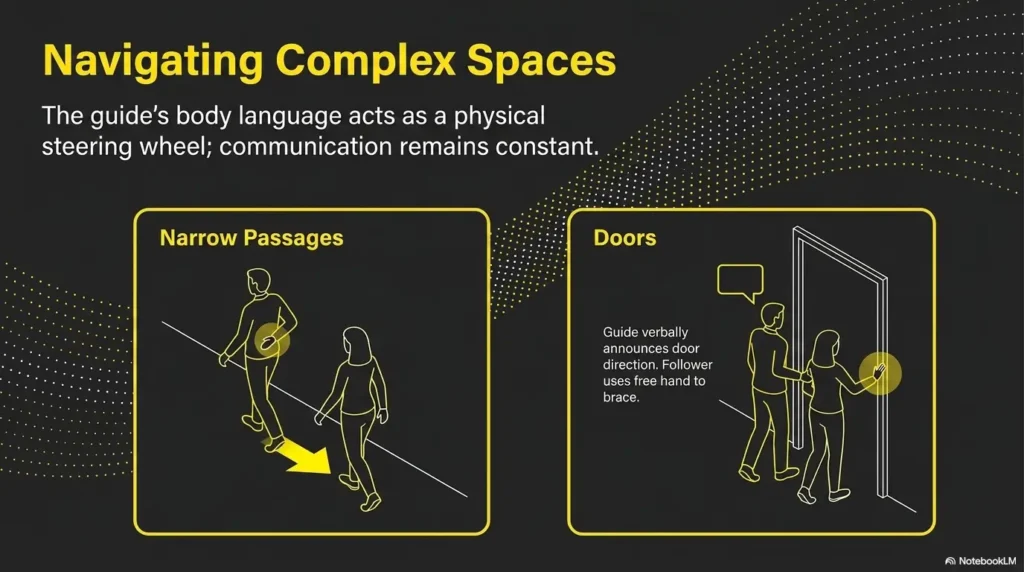
Then let them take your arm. Do not clamp onto them. Do not pull them forward. Do not steer from behind. In common sighted guide technique, the person being guided usually holds the guide’s arm just above the elbow and follows slightly behind, which allows them to sense changes in direction and pace.
Match Their Pace, Not Your Urgency
Your walking speed may feel normal to you, but “normal” is not a universal unit. Crowds, cane use, guide dog work, glare, noise, unfamiliar flooring, pain, age, anxiety, or balance concerns can all affect pace.
Say:
- “Let me know if this pace works.”
- “We’re turning left after the doorway.”
- “There are 3 steps down, then a flat landing.”
Narrate Changes Before They Happen
Do not narrate every tile like a documentary about linoleum. Narrate meaningful changes: stairs, curbs, narrow passages, doors, ramps, surface changes, sudden stops, and turns.
Think of your words as stage lighting. Just enough to reveal the next movement.
- Offer your elbow rather than taking their arm.
- Walk at a comfortable pace.
- Describe stairs, curbs, doors, and turns before they arrive.
Apply in 60 seconds: Say aloud: “Would you like to take my elbow, or would verbal directions be better?”
The Three-Part Cue: Make Directions Clear Enough to Use
The 3-part cue is the little engine of this whole article. It is the difference between “careful!” and “wet floor on your left in 2 steps.” One sentence creates panic. The other creates a plan.
Say What It Is
Name the object or change. “Obstacle” is sometimes useful, but “chair,” “curb,” “step,” “cone,” “dog leash,” “low branch,” or “open drawer” is better.
Say Where It Is
Use the person’s body as the reference point when possible:
- “On your left.”
- “Just to your right.”
- “Straight ahead.”
- “At your 2 o’clock.”
Clock directions can help some people and annoy others. If you do not know their preference, plain left, right, ahead, and behind are safer starting points.
Say When It Matters
Timing converts information into action. “In 3 steps” is more useful than “soon.” “After the doorway” is more useful than “up there.” “At the end of the counter” is more useful than “a little farther.”
Mini Calculator: Turn a Vague Warning Into a Clear Cue
Neutral next step: Use the sentence only when the cue is timely and relevant.
Don’t Do This: Scripts That Sound Kind but Shrink the Person
Some phrases arrive wearing a soft sweater, but underneath, they quietly reduce the person to a problem. The goal is not to become terrified of language. The goal is to notice when a sentence centers your comfort instead of their agency.
“Let Me Do That for You”
This can be useful if the person asks for it. But as a first move, it may sound like you are replacing their ability with your efficiency.
Try instead:
- “Would you like help finding the button?”
- “Would it help if I read the options?”
- “Would you prefer to do it, or would you like me to assist?”
“You’re So Brave”
Bravery language can turn an ordinary errand into a spectacle. Buying toothpaste, crossing a lobby, or ordering soup does not always need a medal ceremony.
Try adult-to-adult acknowledgment instead:
- “Thanks for your patience.”
- “I can describe the options if useful.”
- “Let me know what format works best.”
“Careful, Careful, Careful”
Repeating “careful” often increases stress without adding information. Replace it with the actual cue.
Instead of “Careful!” say, “Step down in 1 step.” Instead of “Careful, there!” say, “Bag on the floor near your left foot.” Less alarm bell, more map.
Safer Public Spaces: Scripts for Staff and Bystanders
Public-facing staff have a special opportunity. A store, clinic, church, airport desk, library, bank, or event venue can make access feel normal rather than improvised. The words matter, but the system behind the words matters too.
“Would You Like Verbal Directions or Someone to Walk With You?”
This is one of the strongest staff scripts because it gives options without assuming the answer.
Use it at entrances, check-in desks, hotel lobbies, airports, hospital registration counters, and large event venues. In places where printed papers still carry the rhythm of the room, such as churches or community meetings, a simple church bulletin reading script for low vision can make announcements, songs, and schedules easier to follow without fuss.
“The Waiting Area Has Open Chairs Along the Left Wall”
This sentence gives useful layout information without making a big production of assistance. It also helps avoid the classic waiting room confusion: empty chairs exist, but their location is visually messy.
“I’ll Let You Know When Your Name Is Called”
In clinics, salons, public offices, and restaurants, visual cues often do quiet work: a staff member waving, a screen changing, a host pointing. If someone may not see those cues, verbal confirmation helps. Pharmacies have their own pressure points, so a prepared low vision pharmacy help script can make pickup, counseling, labels, and waiting less confusing.
The ADA’s effective communication guidance explains that businesses and public entities may need to provide auxiliary aids or services so people with vision, hearing, or speech disabilities can communicate effectively. For people with vision loss, that can include qualified readers, large print, Braille, audio, or accessible electronic information depending on the situation.
Coverage Tier Map: Better Access in Public Spaces
| Tier | What changes | Example |
|---|---|---|
| 1 | Staff use respectful scripts. | “Would verbal directions help?” |
| 2 | Layout cues are consistent. | Clear counter, predictable line start. |
| 3 | Printed info has alternatives. | Large print, readable digital copy, staff reader. |
| 4 | Staff know when to offer guide options. | “Elbow or directions?” |
| 5 | Access is built into the service flow. | Check-in, waiting, payment, and exit are all explainable. |
Neutral next step: Choose one customer touchpoint and write a standard staff script for it.
Next Step: Memorize One Sentence Before You Need It
The moment to learn the sentence is not when a suitcase is rolling toward someone’s ankle or the checkout line has turned into a confused little snake. Learn it before you need it. That is how good manners become muscle memory.
Your One-Sentence Practice Script
Use this:
“Hi, I’m nearby. Would you like help with the door, or would verbal directions be better?”
This sentence is not perfect for every situation, but it carries the right architecture: identify, offer, choose, wait.
Try This Today in a Low-Pressure Setting
Practice in an empty hallway, near your own front door, or while walking through a grocery store. Quietly name objects by type, side, and distance: “Cart on the left in 4 steps.” “Display table on the right.” “Door opens outward.”
Yes, you may feel slightly ridiculous. That is fine. Most useful skills begin as small private theater.
Keep It Calm, Specific, and Optional
The answer to the hook is simple: you do not need a grand speech. You need a sentence that gives the person control.
Low vision does not make someone a public project. It changes what information may be useful. Your job, when you choose to offer help, is to make that information available without taking over the person’s body, route, time, or dignity.
- Use one calm opening sentence.
- Replace vague warnings with clear cues.
- Let refusal be normal.
Apply in 60 seconds: Practice the sentence once today so it is ready when the room gets busy.
Short Story: The Door That Did Not Become a Drama
A few winters ago, I watched a man pause outside a glass office door. The building was full of reflections, that particular lobby glare that makes everything look polished and slightly untrustworthy. A woman near the reception desk started forward, then stopped herself. Instead of grabbing the handle and announcing help, she said, “Hi, I’m by the door.
Would you like me to describe it?” He smiled and said, “Just the handle.” She answered, “Vertical handle, right side, door pulls toward you.” That was all. He opened it, entered, and thanked her. The moment lasted maybe 12 seconds. Nothing grand happened, which was exactly why it worked. Good assistance often feels almost invisible afterward, like a well-tuned hinge.
FAQ
What is the most respectful way to offer help to someone with low vision?
The most respectful way is to identify yourself, offer one specific kind of help, and wait for an answer. For example: “Hi, I’m nearby. Would you like help finding the entrance?” This avoids pressure and gives the person control.
Should I touch someone with low vision to guide them?
No, not without permission. Do not grab an arm, cane, bag, shoulder, or sleeve. If guidance is accepted, you can offer your elbow and let the person choose whether to take it.
What should I say instead of “watch out”?
Name the hazard, location, and timing. Say, “Curb in about 3 steps,” “Wet floor on your left,” or “Chair near your right knee.” Clear cues are more useful than vague warnings.
How do I give directions to someone who cannot see well?
Use concrete reference points. Say left, right, straight ahead, near the door, along the wall, or after the counter. Avoid pointing silently or saying “over there” unless you also describe where “there” is.
What if the person refuses my help?
Accept it simply. Say, “Of course” or “No problem,” then stop hovering. Refusing help is not rude. It may mean the person already has a plan, knows the space, or prefers independence.
Is it okay to describe obstacles out loud?
Yes, if the obstacle is relevant and your description is clear. Keep it short: “Open drawer on your left,” “Step down after the mat,” or “Bike leaning into the path on your right.” Do not over-narrate every object.
How can store employees help customers with low vision?
Employees can offer choices: “Would you like verbal directions or someone to walk with you?” They can describe line locations, card readers, product sections, menu headings, waiting areas, and when a name or order is called. For food service settings, staff can also learn simple ways to help someone navigate buffets with low vision without rushing or over-serving.
What should I avoid saying to someone with low vision?
Avoid “You’re so brave,” “Let me do that for you,” “Careful, careful,” and “over there” without context. These can sound patronizing or unclear. Use practical, adult-to-adult language instead.
Conclusion: The Kindest Help Leaves the Choice Intact
The first moment of this article was that familiar little panic: someone may need help, and you do not want to get it wrong. The answer is not to freeze. It is to simplify.
Use one calm sentence. Offer one specific option. Wait. If they say yes, follow their preference. If they say no, let the no stand with dignity. That is the whole quiet craft.
In the next 15 minutes, choose one place you visit often, a store, lobby, sidewalk, clinic, church, café, or office, and write one script for that space. Something plain. Something usable. Something that sounds less like rescue and more like respect.
Last reviewed: 2026-04.