
Senior vision comfort guide
How Seniors with Presbyopia Can Read Hymnals More Comfortably
without squinting through the whole service
A hymnal should feel like a companion, not a tiny-print obstacle course. Yet for many older worshippers, the page that once opened easily now seems to drift away: notes blur, verses hide in narrow columns, and the sanctuary lighting feels beautiful until it lands on glossy paper like a pale fog.
Presbyopia often starts quietly. The eyes need more distance, more light, better contrast, and a steadier setup. That does not mean seniors must give up singing, stop using the hymnal, or feel embarrassed asking for help. It means the reading environment needs a little tuning, just like an organ before the first chord.
This guide walks through practical fixes for seniors, caregivers, choir members, ushers, worship planners, and church volunteers. It covers readers, large-print hymnals, seating, glare, lighting, posture, screens, warning signs, and one simple comfort check that can make next Sunday feel less like a visual workout.
Find the real cause
Separate blur, glare, small print, poor light, and awkward book distance.
Choose smarter tools
Use readers, large-print copies, bookmarks, lamps, and seating with less guesswork.
Know when to ask
Spot symptoms that deserve a real eye exam instead of stronger squinting.
Small promise: by the end, you will have a calm, practical way to make hymnal reading easier without turning worship into an equipment seminar. 🎵
Snapshot: This article is for older adults with common near-vision trouble, caregivers helping a parent or spouse, choir members balancing music and director cues, and churches that want a more accessible worship experience. You will learn how to test reading distance, reduce glare, choose better reading support, and recognize when blurry hymnal reading needs professional attention.
Table of Contents
The Hymnal Problem Isn’t Just Small Print
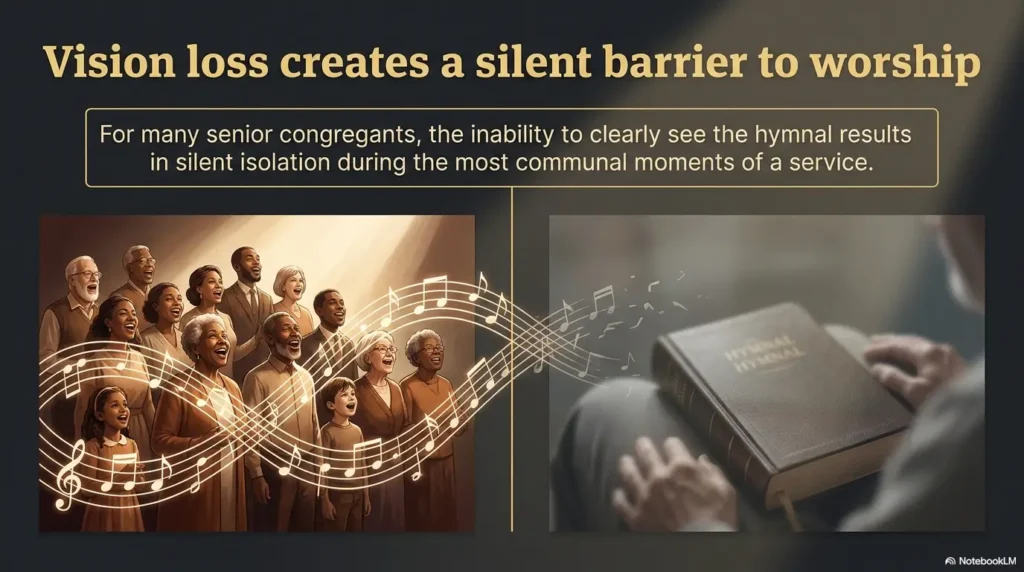
When a senior says, “I can’t read the hymnal anymore,” the first guess is usually print size. That may be part of the problem, but it is rarely the whole choir. Hymnal reading combines close vision, contrast, lighting, posture, hand steadiness, page tracking, and musical layout.
Presbyopia makes near focusing harder with age. The page may need to be held farther away than before, but the arms, pew, bulletin, walker, purse, coat, or neighbor’s elbow may all have opinions about that distance. The result is a small but irritating mismatch: the eyes want one setup, the service gives another.
A normal book gives the eyes a steady line of text. A hymnal asks the eyes to jump between lyrics, staff lines, verse numbers, refrains, repeat marks, page turns, and sometimes a bulletin insert with different typography. It is less like reading a paperback and more like following a quiet map while standing in a moving train car.
Presbyopia changes the reading distance first
One of the most common signs of presbyopia is needing to hold print farther away to see it clearly. With hymnals, that “sweet spot” may be awkward. A book held too close may blur. A book held too far may make the print too small. A book held low may force the neck to bend and the eyes to look through the wrong part of a lens.
This is why a senior may read a phone fairly well but struggle with a hymnal. The phone can be brightened, enlarged, moved, tilted, and zoomed. The hymnal has fixed print, fixed contrast, and sometimes a page color that looked charming in 1978 but now behaves like beige fog.
Music notation adds a second layer of strain
Even people who know the hymn may need visual anchors. They need to find the verse, confirm the refrain, catch the next line, and avoid singing verse three while everyone else is sailing through verse two. Music notation can be beautiful, but for aging eyes it can also be crowded.
Staff lines are thin. Verse numbers are small. Repeated lyrics may be tucked under notes. If the hymn has multiple endings, tiny instructions, or four-part harmony, the page becomes a miniature city with narrow streets. Presbyopia does not just blur the words; it can make navigation slower.
The hidden culprit: lighting that feels “fine”
Sanctuary lighting is often designed for atmosphere. Warm pendant lights, stained glass, candles, and softer evening illumination can create a peaceful room. Unfortunately, peaceful is not always readable.
A room can feel bright enough for conversation while still being too dim for small print. The page may be half-lit, shadowed by the pew in front, or washed out by a glossy reflection. Many seniors blame their eyes when the real culprit is a little gray curtain of shadow across the hymn.
Key takeaway: Hymnal reading is not one problem. It is a small system. The best fix may be better reading distance, brighter page light, less glare, a steadier hold, larger print, or a different lens setup.
Safety and When This Guide Applies
This guide is for common near-vision difficulty during worship: small print, mild blur, glare, visual fatigue, trouble finding the right verse, and discomfort that improves when lighting or reading distance improves.
It is not a substitute for medical advice, diagnosis, or treatment. Presbyopia is common, but not every reading problem is presbyopia. Cataracts, dry eye, medication side effects, macular changes, glaucoma, double vision, and other conditions can also make hymnals harder to read.
Safety note: Sudden vision changes deserve prompt professional care. Do not assume new blur, eye pain, flashes, new floaters, double vision, missing areas of vision, or distortion is “just age.” If symptoms are sudden, severe, or one-sided, seek medical guidance quickly.
For ongoing reading trouble, an optometrist or ophthalmologist can check whether the issue is presbyopia, lens strength, dry eye, cataracts, eye alignment, or another condition.
This is for common near-vision difficulty
If the hymnal becomes clearer when you hold it farther away, sit in better light, use readers, or switch to large print, this article will likely help. These are everyday presbyopia-friendly adjustments, not medical treatment.
Think of them as comfort tuning. The goal is not to diagnose your eyes from the pew. The goal is to remove obvious friction so worship feels less visually tiring.
This is not for sudden vision changes
If a person suddenly cannot read familiar print, sees double, notices flashes, develops new floaters, has eye pain, or loses part of the visual field, that belongs outside the “try better lighting” category. It should be treated as a health concern.
Families sometimes notice the change first. A parent who used to read the bulletin easily may suddenly ask others to read every line. A choir member may lose their place more often than usual. A worshipper may start covering one eye. Those clues deserve attention.
Choir members may need a different setup
Choir singers have a special challenge. They need to see the music, the director, the sanctuary steps, and sometimes a bulletin or order of service. Standard reading glasses may sharpen the hymnal but blur the director.
That does not mean choir members are stuck. It means they may benefit from a lens conversation that includes music distance, standing posture, conductor distance, and whether they use bifocals, progressives, intermediate lenses, or separate music glasses.
Start With the Reading Distance Test
Before buying stronger readers or asking the church to replace every hymnal, test distance. It is the cheapest, fastest, most revealing step. Presbyopia often announces itself through distance: too close is blurry, too far is tiny, and the useful zone can be narrower than expected.
Try this at home with a hymnal, prayer book, Bible, bulletin, or any small-print book. Sit in a chair, relax your shoulders, and hold the page where your hands naturally settle. Then slowly move it farther away until the print becomes clearer. Notice where clarity improves and where the print becomes too small.
Hold the hymnal where your eyes naturally relax
Many people pull print closer when they cannot see it. With presbyopia, that can backfire. The eyes may need the page a little farther away, even if the instinct says, “Bring it here, tiny rascal.”
The best test is not heroic squinting. It is relaxed clarity. Can you read a line without tightening your forehead? Can you find the next verse without lifting your chin? Can you hold the page there for a whole hymn, not just five seconds?
The “too close” mistake
Pulling the hymnal too close may sharpen large headings for a moment but blur normal text. It may also force the person to bend the neck or lift the book into an uncomfortable position. During a service, discomfort stacks up quickly: shoulders rise, hands tense, breathing shortens, and singing becomes work.
If the page clears when held farther away, do not treat that as failure. Treat it as useful data. It tells you that a different lens strength, book support, or large-print option may help more than raw effort.
Steadiness matters as much as distance
Older eyes often need both distance and steadiness. A shaky hand, bent wrist, slippery cover, low pew angle, or crowded seat can make print feel blurrier than it truly is. The eye is trying to focus, but the target keeps doing a tiny waltz.
Try resting the hymnal on a pew rack, lap board, folded bulletin, or both hands. If the print improves when the book is steadier, part of the solution is support, not stronger magnification.
One-minute reading distance check
- Choose a hymnal page with normal lyrics, not a large title.
- Sit in a chair with your shoulders relaxed.
- Hold the page where it feels natural.
- Move it slowly farther away, then slightly closer.
- Notice where words are clearest and where your neck stays comfortable.
- Repeat with your usual readers, if you use them.
Choose Reading Glasses That Match the Hymnal
Reading glasses can be helpful, but “more magnification” is not always the answer. The right strength depends on reading distance, existing prescription, eye health, lens type, and the task. Hymnal reading may happen farther away than phone reading, especially while standing.
Over-the-counter readers can be convenient for some seniors. They are easy to buy and useful for simple near tasks. But they are not personalized, and they may not correct astigmatism, unequal eyes, distance correction needs, or eye alignment issues.
Drugstore readers can help, but strength matters
Readers that are too weak may not clear the page. Readers that are too strong may force the hymnal closer than comfortable. That can create a narrow reading zone, more head movement, and a service-long sense that the words are hiding behind a curtain.
A practical approach is to test the hymnal distance before choosing. If you only test readers on a phone held very close, you may buy a strength that works for texting but feels wrong for singing from a book held lower and farther away.
Don’t borrow someone else’s readers
Borrowed readers can feel magical for one verse and miserable by the sermon. Another person’s glasses may be a different strength, lens quality, frame fit, or pupillary distance. They may also be scratched, tilted, or designed for a different working distance.
For a quick emergency, borrowed readers may help someone find the page. For regular worship, they are a shaky plan. Better to keep a dedicated pair in a case, purse, choir folder, Bible cover, or church bag.
Ask about computer or intermediate lenses
Some seniors do not need stronger readers. They need a lens made for a slightly farther working distance. Intermediate or computer-style lenses may help with tasks that sit between close reading and distance viewing.
This can matter for choir members, organists, pianists, worship leaders, and anyone who needs to look from page to director to room. The ideal lens is not “the strongest one.” It is the one that matches the real task.
Key takeaway: Test glasses at hymnal distance, not just phone distance. A pair that works for reading a text message may be too strong, too close, or too narrow for singing comfortably.
| Option | May Help When | Possible Downside | Best Next Step |
|---|---|---|---|
| Over-the-counter readers | Both eyes need similar simple near help | Wrong strength can cause strain | Test with an actual hymnal page |
| Prescription readers | You have astigmatism, unequal eyes, or complex needs | May be less useful for looking up | Tell the eye doctor your hymnal distance |
| Bifocals | You need distance and near correction | Head angle may feel awkward | Check whether the reading segment sits correctly |
| Progressives | You want multiple viewing zones | Small print may require precise head position | Practice finding the clearest lens zone |
| Intermediate lenses | The book sits farther than normal reading distance | May not replace distance glasses | Ask about music, computer, or task-specific lenses |
If you already have a post on near-vision changes, this is a natural moment to review it. Readers who want a broader explanation can also read more about senior near vision problems before choosing glasses for worship.
Large-Print Hymnals and Church Accessibility
Large-print hymnals are not a luxury. For many older worshippers, they are the difference between participating and politely pretending. Bigger print reduces visual hunting, helps with verse changes, and lowers the pressure to keep up while everyone else is already singing.
Churches do not always need to replace every hymnal at once. A small number of large-print copies, placed wisely, can change the experience for seniors, visitors, choir members, and anyone having a temporary vision issue after surgery or illness.
Bigger print reduces visual hunting
Visual hunting is the small search process that happens before reading. Where is the verse? Where does the refrain begin? Which line comes after the repeat? When print is small, the eyes spend more time searching than singing.
Large print gives the eyes more generous landmarks. Verse numbers stand out. Line breaks feel less crowded. A senior can recover their place after standing, sitting, greeting someone, or looking up at the worship leader.
One large-print copy can change a whole pew
A church does not need a dramatic program to begin. Put a few large-print hymnals near entrances, accessible seating, choir rooms, usher stations, and the back of the sanctuary. Make them easy to find without making people ask loudly.
Ushers can quietly offer one the same way they might offer a bulletin. The tone matters. “We have large-print hymnals right here if that’s easier” feels welcoming. “Do you need a special book?” can feel like a spotlight.
The dignity detail matters
Accessibility works best when it feels normal. Seniors should not have to confess difficulty to participate in worship. Large-print hymnals, readable bulletins, and clear projected lyrics are hospitality, not special treatment.
The best church accessibility is quiet. It waits at the door. It is labeled clearly. It does not require a committee meeting in the aisle. It simply says, “We expected you, and we saved you a better page.”
Church accessibility starter checklist
- Keep large-print hymnals near every main entrance.
- Train ushers to offer them casually and kindly.
- Place copies near accessible seating and choir areas.
- Use high-contrast bulletin text with generous spacing.
- Avoid glossy paper for small-print worship materials when possible.
- Check whether evening services need better page lighting.
Lighting, Glare, and the Sanctuary Seat
Lighting is the silent choir member. When it behaves, nobody notices. When it fails, everyone blames their glasses. For seniors with presbyopia, the quality of light can determine whether a hymn page feels crisp or strangely washed out.
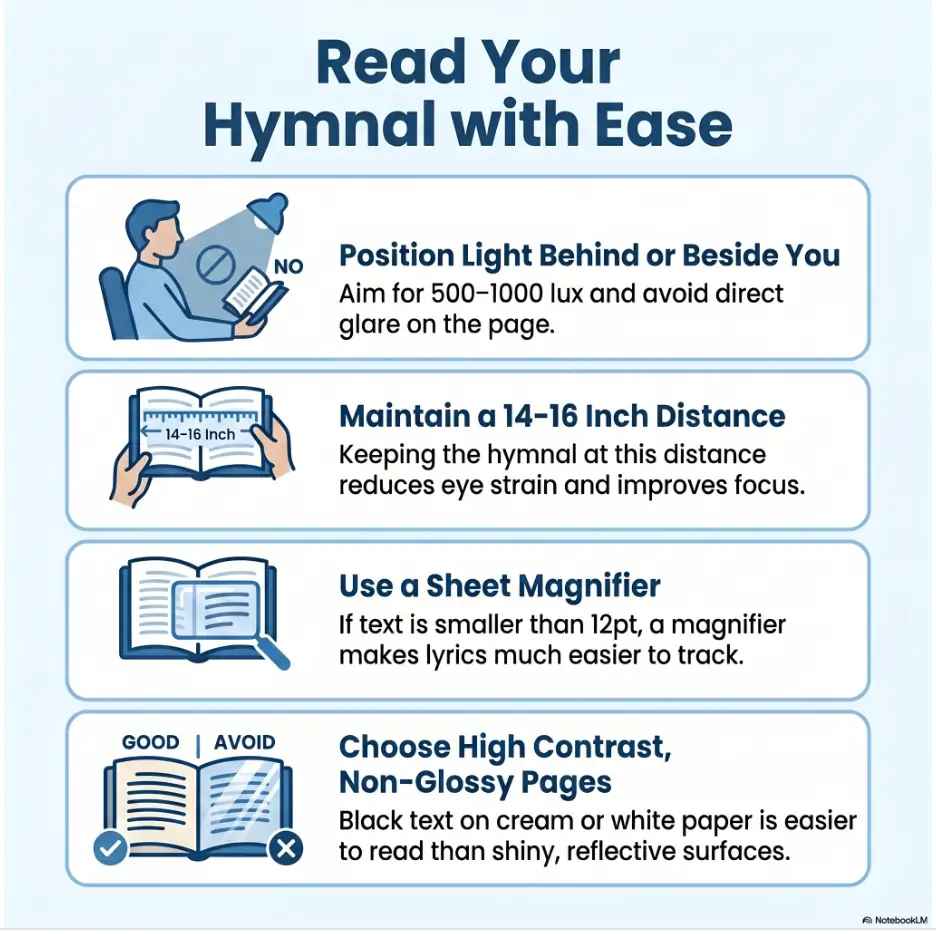
The goal is not harsh brightness. More light is not always better if it creates glare. The goal is steady, even illumination on the page with enough contrast to make print and notation distinct.
Add light without adding glare
A small directed light can help in some settings, especially for choir folders, music stands, or evening Bible study. But the light should fall on the page, not shine into the eyes or bounce off glossy paper.
For churches, this may mean testing real hymnal pages under real service lighting. A sanctuary can look lovely from the center aisle and still leave the side pews in print-reading twilight.
Sit where the page catches steady light
Some seats are better for reading than others. The front pew may help someone see the pulpit, but it may not give the best page light. A side aisle may allow better elbow room. A seat under a balcony may cast a shadow over the book.
Try one small experiment: sit in a different area for one service and notice whether the hymnal page looks brighter, flatter, or less reflective. If the page improves, the eyes were not the whole problem.
Reduce glare before you blame your eyes
Glossy pages can scatter light and make print look pale. Overhead fixtures, windows, candles, and screens can all create reflections. A small tilt of the hymnal may remove the glare without moving the head into an awkward position.
The trick is to tilt the book, not the neck. If you crane your head for an entire hymn, you may trade blurry print for a stiff collar. Instead, adjust the page angle until the shiny patch disappears.
Key takeaway: If the hymnal looks clearer when you move seats, tilt the book, or avoid a shadow, the problem may be lighting and glare rather than the need for stronger readers.
The Hymnal Comfort Flow
1
Distance
Find the page position where words clear without neck strain.
2
Light
Choose steady illumination that does not wash out the page.
3
Lens
Match glasses to hymnal distance, not just phone distance.
4
Support
Steady the book and mark the page before the hymn begins.
For more home-based ideas on glare and older eyes, readers may also find ways to read glossy mail without glare useful. The same principle often applies to hymnals: angle, contrast, and surface matter.
Make the Hymnal Easier to Hold and Follow
Sometimes the eyes are blamed for a hand problem. A hymnal may be heavy, slippery, narrow, or hard to keep open. During standing hymns, a senior may be managing balance, glasses, bulletin, cane, handbag, and page number all at once. No wonder the page starts acting like a squirrel.
Making the hymnal easier to hold can improve reading comfort even when vision stays the same. Less hand strain means a steadier page. A steadier page means less chasing. Less chasing means more singing.
Support the book with both hands or a pew rack
If standing is safe, hold the hymnal with both hands and keep the elbows relaxed. If sitting, rest the lower edge against a pew rack, lap, folded coat, or small firm folder. The goal is not elegance. The goal is steadiness.
Caregivers can watch for subtle signs: trembling pages, frequent hand switching, dropping the book lower, or giving up halfway through the hymn. These may point to fatigue, arthritis, tremor, or posture challenges rather than pure vision trouble.
Use a bookmark or finger guide discreetly
A finger guide is not childish. It is a tracking tool. Many adults use a pen, bookmark, folded bulletin edge, or fingertip to keep place while reading dense material. Hymnals are dense material wearing church clothes.
For people who lose their place between verses, a simple bookmark can reduce frustration. It can be placed beside the verse, under the refrain, or between two hymns in advance.
Small page tabs can help choir singers
Choir members often move through several hymns, responses, service music, and anthems. Removable tabs or slips can prevent frantic page searching. They should be easy to remove, not damaging to church books, and placed where they do not cover notes or lyrics.
A choir folder can also include a large-print order sheet. Even when the music itself is not large print, knowing the sequence reduces mental load. The less energy spent asking “Where are we?” the more energy is left for singing.
Show me the nerdy details
Presbyopia is about reduced near focusing ability, but reading comfort is also affected by contrast sensitivity, pupil size, tear film quality, page reflectance, lens design, and working distance. Older adults often need more light for detail tasks, but too much direct or reflected light can reduce contrast. That is why a slightly larger font, matte paper, better page angle, and steadier book can feel surprisingly powerful even when the actual prescription has not changed.
Short Story: Margaret’s Second Hymn
Margaret had sung in the same church for thirty-eight years. She knew the hymns well enough that the first verse usually carried her along, but the second verse had become a small trap. She would glance down, lose the line, and smile her way through a mumble.
One Sunday, an usher quietly handed her a large-print hymnal and pointed to a seat with better side lighting. No announcement. No fuss. Just a book and a kinder patch of light.
Margaret did not sing louder that morning. She sang steadier. She found verse two, then verse three, then the refrain without panic.
The lesson was simple: her faith had not grown smaller. The print had. A few inches of distance, a larger page, and a thoughtful usher gave the hymn back its shape.
Screens, Bulletins, and Choir Member Workarounds
Projected lyrics can help seniors who struggle with close print. But screens are not a universal cure. A screen across the sanctuary solves one distance problem while creating others: contrast, font size, background patterns, viewing angle, and whether the person can look up comfortably.
Bulletins can help too, but they often become tiny-print backups. When a bulletin uses narrow columns, low contrast, decorative fonts, or condensed text, it may be harder than the hymnal it was meant to replace.
Projected lyrics remove close-reading strain
For some seniors, looking at a screen is easier than reading a hymnal. There is no book to hold, no page to track, and no close focusing demand. This can be especially helpful for people with arthritis, tremor, or difficulty standing while holding a book.
The best projected lyrics use large text, plain fonts, strong contrast, and calm backgrounds. A beautiful photo behind the words may look modern but become visual oatmeal from the back pew.
Bulletins need readable design too
A bulletin is often designed to fit everything onto one folded sheet. That is convenient for printing and brutal for older eyes. Tiny fonts, narrow line spacing, and gray ink can turn worship notes into a squint festival.
Churches can improve readability by using larger type, high contrast, plain fonts, clear headings, and enough white space. If a bulletin must be compact, consider a large-print version near the entrance.
Choir members need page and director vision
Choir singers may struggle with standard readers because they sharpen the music but blur the director. Progressives may help some singers, but others find the usable zone too narrow. Separate music glasses, intermediate lenses, or well-marked folders may be better.
The key is to tell the eye-care professional exactly what the task looks like: standing, holding music at chest height, looking up to a director ten to twenty feet away, and returning to small notation quickly.
| Reading Format | Best For | Watch Out For | Church-Friendly Fix |
|---|---|---|---|
| Standard hymnal | Members familiar with the book | Small print and glossy pages | Add large-print copies and better lighting |
| Large-print hymnal | Seniors with small-print trouble | May be heavier or limited in supply | Place copies where they are easy to grab |
| Projected lyrics | People who prefer distance viewing | Low contrast or decorative slides | Use plain backgrounds and large text |
| Printed bulletin | Visitors and service navigation | Tiny fonts and narrow columns | Create a large-print version |
| Choir folder | Singers managing multiple pieces | Fast page turns and small notation | Add tabs, order sheets, and task-specific lenses |
Key takeaway: The best church setup offers more than one path: clear screens, readable bulletins, standard hymnals, large-print copies, and quiet help from ushers.
When to Seek Help or Stop
Most hymnal-reading trouble is not an emergency. But some symptoms should not be handled with stronger readers, brighter lamps, or cheerful denial. If vision changes are sudden, unusual, painful, or one-sided, it is time to stop troubleshooting and seek professional advice.
This matters because older adults may normalize too much. “I’m just getting older” can be true, but it can also become a soft blanket thrown over symptoms that deserve care.
Reading is getting worse even with glasses
If hymnals become harder to read despite good lighting and appropriate glasses, schedule an eye exam. The issue may be a prescription change, dry eye, cataracts, or something else that needs evaluation.
Bring examples. Tell the doctor, “I struggle with hymnals held at about this distance,” and show the distance with your hands. That is more useful than saying, “Small print is bad,” which could mean six different things.
One eye reads differently than the other
If one eye sees the hymnal clearly and the other sees blur, distortion, shadows, or double images, get checked. Uneven vision can make reading tiring because the brain is trying to combine two mismatched pictures.
A simple at-home clue is to cover one eye at a time while reading a familiar page. This is not a diagnosis, but it can help you describe the problem more clearly at an appointment.
New symptoms should not wait
Sudden blur, eye pain, flashes, new floaters, missing areas of vision, new double vision, or distorted lines should be taken seriously. Do not wait for next Sunday’s comfort check if something feels sharply different today.
For caregivers, the warning may sound indirect: “The words are bending,” “There’s a dark patch,” “I keep seeing sparks,” or “One side disappears.” Those are not ordinary hymnal complaints.
Question list to bring to an eye exam
- What reading distance should my glasses be designed for?
- Could dry eye, cataracts, or medication be affecting my reading?
- Do I need a different lens for choir, music, or worship reading?
- Would bifocals, progressives, prescription readers, or intermediate lenses fit my needs?
- Should I be concerned if one eye reads differently?
- What symptoms should make me call quickly?
Vision problems can also affect safety beyond reading. Seniors who struggle with contrast, glare, or dim lighting may benefit from a broader review of bedroom safety for seniors with poor vision and other home adjustments.
FAQ
What strength reading glasses are best for hymnals?
It depends on the distance where you hold the hymnal, your current prescription, and whether you need distance correction too. Test at actual hymnal distance, not just phone distance. If reading remains difficult or causes headaches, ask an eye-care professional.
Are large-print hymnals better than reading glasses?
They solve different problems. Reading glasses help with focusing. Large print reduces visual strain and makes the page easier to navigate. Many seniors benefit from both: appropriate lenses plus larger, clearer print.
Why can I read my phone but not a hymnal?
A phone has adjustable brightness, zoom, contrast, and distance. A hymnal has fixed print, fixed page color, and sometimes glare from paper. Phone reading can also happen closer or at a different angle than hymnal reading.
Can bifocals make hymnal reading harder?
Yes, for some people. The reading segment may require a head angle that feels awkward when standing or holding a book low. If you use bifocals and hymnals feel hard, mention the exact task at your next eye exam.
Do magnifying bookmarks help with hymnals?
They may help some readers with lyrics, but they can distort music lines, slow tracking, or make page movement awkward. Try one at home before relying on it during a service.
How can churches help seniors read hymns more easily?
Offer large-print hymnals, readable bulletins, clear projected lyrics, better lighting, accessible seating, and discreet usher support. The best help is easy to find and does not make people feel singled out.
Is blurry hymnal reading always presbyopia?
No. Presbyopia is common with age, but cataracts, dry eye, medication effects, double vision, macular changes, and other issues can affect reading. New, uneven, sudden, or worsening symptoms deserve an eye exam.
Should choir members use different glasses?
Possibly. Choir members often need to see music at an intermediate distance and the director farther away. Task-specific lenses may work better than ordinary readers for some singers.
Key takeaway: If one fix does not solve the problem, do not assume you failed. Hymnal comfort often needs a combination: distance, light, lens, print size, and support.
Do a One-Service Comfort Check
The fastest next step is not buying five gadgets. It is running one calm experiment during one service. Choose one change before worship begins, then notice what improves and what stays hard.
Try sitting where the light is steadier. Bring the readers that match hymnal distance. Ask for a large-print hymnal. Hold the book farther away. Use a bookmark. Find the hymn before the music starts. One change is enough for a useful clue.
After the service, name the problem plainly. Was it blur? Glare? Print size? Losing the verse? Neck strain? Hand fatigue? Trouble switching between page and screen? That clue is gold. It tells you whether to adjust the environment, ask the church for support, or bring the issue to an eye exam.
Your 15-minute hymnal comfort plan
- Place your usual readers, if you use them, in your church bag.
- At home, test a hymnal or similar book at a relaxed distance.
- Choose one seating change for the next service.
- Arrive early enough to find the hymn before singing begins.
- Use one tracking aid, such as a bookmark or finger guide.
- Afterward, write down the main issue in one sentence.
A hymnal is more than paper and ink. It is memory, breath, rhythm, and community held between two covers. If the print has become harder to follow, the answer is not shame and squinting. Start with one practical adjustment, listen to what your eyes tell you, and let the next hymn become readable again, one clear line at a time.
Last reviewed: 2026-05