
Senior home safety guide
How Seniors with Presbyopia Can
Read Expiration Dates Safely
Tiny printed dates can turn an ordinary kitchen moment into a guessing game with real stakes. A pill bottle curves away from the lamp. A yogurt cup hides its “Use By” date under a shiny rim. An eye drop box whispers in gray ink. For seniors with presbyopia, the problem is not carelessness. It is that the print has become small, shiny, crowded, and weirdly placed.
This guide gives you a safer way to check expiration dates on food, medicine, eye drops, and household products without rushing, squinting, balancing, or playing label detective at the open refrigerator door. It is built for real homes, where the magnifier is often in the wrong drawer and the kitchen light looks bright until you actually need it.
You will learn a repeatable routine: sit down, improve the light, use the right tool, confirm the year, and mark the item in large print only after the original date is verified. Small habit, large safety dividend.
Less guessing
Use a simple four-step check for tiny, faded, or curved labels.
Safer medicine habits
Treat pills, eye drops, insulin, and rescue medicines with stricter rules.
Dignity-first help
Give caregivers a support role without turning every label into a lecture.
🟡 Promise: by the end, you can make one drawer, shelf, or medicine bin safer in about 15 minutes.
Snapshot: This article is for seniors with presbyopia, adult children, spouses, and caregivers who need a safer way to read small expiration dates at home.
You will learn how to build a seated reading station, check food and medicine labels without guessing, use a phone camera or magnifier well, and know when to call an eye care professional, pharmacist, doctor, or Poison Control.
Table of Contents
Safety First: What This Guide Can And Cannot Do
This guide is practical home-safety education. It is not medical diagnosis, pharmacy advice, or food-safety clearance for a questionable item.
Presbyopia is a common age-related change that makes near reading harder, especially after age 40. But sudden blurry vision, eye pain, flashes, new floaters, curtain-like shadows, double vision, or a major change in reading ability should be checked by an eye care professional. Those symptoms are not “just small print being rude.” They deserve attention.
For medicines, use the printed expiration date. When the date has passed, do not rely on smell, color, memory, or a reassuring shake of the bottle. Ask a pharmacist when there is doubt. For possible poisoning, product misuse, or swallowing the wrong item, contact Poison Control or emergency services as appropriate.
Key takeaway
- Food labels and medicine labels do not carry the same risk.
- Expired medicines deserve a stricter rule than pantry crackers.
- Unreadable, leaking, unlabeled, or questionable products should be treated as unsafe until confirmed.
Apply in 60 seconds: Pick one item near you and confirm the full month, day, and year before using it.
Tiny Dates, Big Consequences: Why Presbyopia Turns Labels Into a Safety Problem
The real issue is not “bad eyesight,” it is low-margin reading
Presbyopia does not usually arrive with a dramatic trumpet solo. It creeps in through ordinary moments: holding a receipt farther away, asking why restaurant menus have become cave paintings, or turning a pill bottle toward the window for the fifth time.
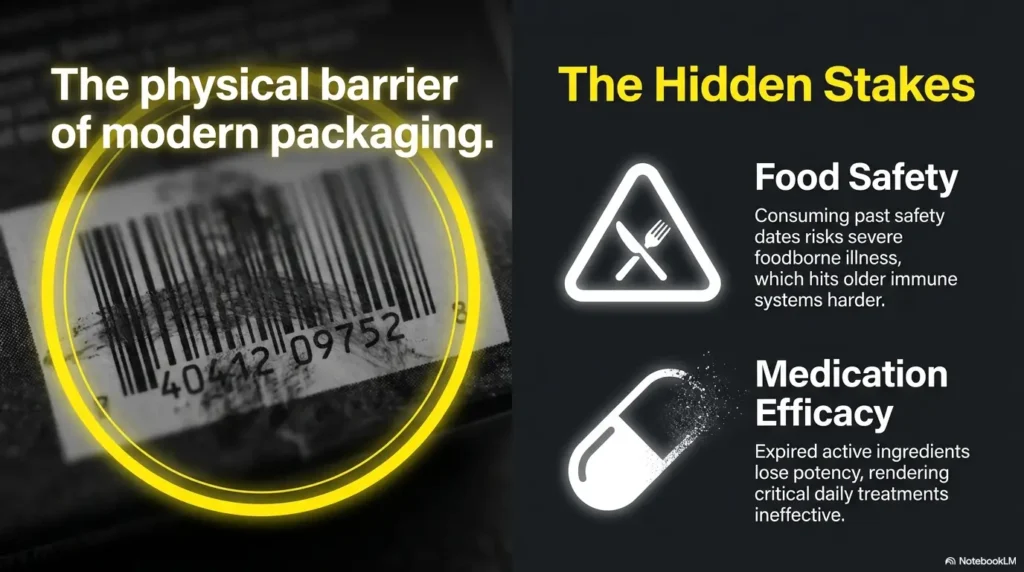
Expiration dates are especially difficult because they leave almost no room for error. A recipe can survive a little guessing. A medicine date cannot. A can with a deep dent, a faded label, and a questionable date is not a puzzle prize. It is a decision point.
The danger is “low-margin reading.” The print is small. The ink may be pale. The label may be shiny. The product may be cold, wet, curved, or crinkled. A senior may be standing, tired, hungry, or trying not to wake the whole house at 6:00 a.m. for eye drops. That is when mistakes slip in wearing socks.
Why expiration dates hide in the worst places
Manufacturers often print dates where machines can stamp them quickly, not where older eyes can read them comfortably. The date may be on the neck of a bottle, the crimp of a tube, the bottom of a jar, the silver edge of a blister pack, or the fold of a cardboard box.
That placement creates a tiny gymnastics routine. You tilt the bottle. The light glares. The date slides around the curve. Your hand blocks the lamp. Then the “8” and “3” start impersonating each other.
For seniors with shaky hands, arthritis, tremor, cataract glare, macular degeneration, diabetic eye changes, or dry eyes, the task becomes even harder. A label-reading plan should not assume steady hands, perfect lighting, or a heroic squint.
The kitchen-counter trap: good room lighting, terrible label lighting
A kitchen can look bright while the label itself remains badly lit. Ceiling lights shine down, but the date may be tucked under a lip or printed in low contrast. Under-cabinet lights may help, but glossy packaging can bounce glare back into the eyes.
This is why “just turn on the light” is not enough. You need task lighting aimed at the label, not general lighting floating above the room like a polite moon.
For a deeper home-safety connection, expiration checks pair naturally with broader kitchen appliance safety for seniors. The same idea applies: reduce rushing, improve visibility, and make the safe action the easy action.
What changes after 40, 60, and 70 with near vision
Presbyopia often becomes noticeable in middle age, but the practical impact can grow later. After 60 or 70, a person may also have slower contrast sensitivity, more glare sensitivity, less flexible focusing, and other eye conditions. The eyes may technically “see” the label, but the brain needs more time and better conditions to interpret it correctly.
That is why the safest method is not “try harder.” It is “change the setup.” Sit down. Bring the label to the right light. Use the right glasses. Enlarge the print. Confirm out loud if needed.
| Reading challenge | Why it happens | Safer response |
|---|---|---|
| Numbers blur together | Near focusing is reduced | Use current readers or prescription glasses |
| Glare hides the date | Shiny labels scatter light | Angle the package and use task lighting |
| Curved bottle dates distort | Print bends around the surface | Use magnifier or phone camera zoom |
| Year is misread | Small print and date compression | Confirm the full year before use |
Who This Is For, And Who Needs More Than a Label-Reading Hack
Best fit: seniors who can read up close with help but miss tiny print
This guide fits seniors who can usually read with glasses, magnification, good lighting, or a phone camera, but who sometimes miss tiny dates on food, medicine, eye drops, or household products.
It is especially helpful for people who say things like, “I can read books fine, but these labels are ridiculous,” or “I know the date is there, but I cannot find it.” Both statements are common, reasonable, and worthy of a better system.
Caregivers managing pill bottles, pantry checks, and fridge cleanouts
Adult children and caregivers often discover the problem during a fridge cleanout or medication review. They find two bottles of the same eye drop, one expired ointment, a faded cough syrup, and three sauces whose dates appear to be written in invisible squirrel.
The key is to help without taking over. Seniors do not need a household audit delivered with courthouse energy. They need a routine that respects independence while reducing risk.
For families already simplifying home systems, this topic connects well with low-vision medication safety and how to read labels aloud. Those habits make expiration checks easier because the label is not treated as a one-time struggle.
Not enough: sudden vision loss, confusion with medicines, or repeated dosing mistakes
A label-reading station can help with tiny print. It cannot solve sudden vision changes, memory issues, medication confusion, or repeated dosing errors. If someone keeps mixing up bottles, taking expired medicine, using someone else’s medication, or forgetting whether a product was checked, a stronger support plan is needed.
That may mean a pharmacist consultation, a pill organizer system, large-print prescription labels, caregiver check-ins, or a medication list that is updated and easy to read. Safety is not a test of willpower. It is a system design problem wearing reading glasses.
“I can see it” is not the same as “I read it correctly”
This is the small sentence that saves trouble. Seeing a date is not the same as reading it correctly. A person may identify numbers but reverse the month and day, miss the year, confuse a lot code for an expiration date, or read the date on the box while the inner bottle has a different opened-use window.
When the item affects health, use a confirmation habit. Read the date twice. Say it out loud. Compare the box and bottle. Ask for help before using anything that feels uncertain.
Readiness checklist: who needs a better expiration-date system?
- Someone uses eye drops, insulin, rescue inhalers, antibiotics, or multiple prescriptions.
- Food, medicine, and household products are stored in crowded drawers or dark cabinets.
- The person often says, “I think this is still good.”
- Boxes get separated from bottles or blister packs.
- The person has low vision, glare sensitivity, tremor, arthritis, or memory concerns.
Build the Safe Reading Station Before You Open the Bottle
Use a seated setup: table, chair, lamp, and no balancing acts
The safest place to read expiration dates is not the open fridge, the bathroom sink, or the medicine cabinet while standing on tiptoe. It is a stable seated spot with a clear table surface.
Set the item down. Sit. Turn on a lamp. Put on the correct glasses. Then read. This sounds almost too simple, but many mistakes happen because people check labels while standing, reaching, twisting, or holding several items at once.
A chair with arms can help someone who feels unsteady. A non-glare placemat or dark towel can provide contrast under light-colored packaging. A small tray can keep pill bottles from rolling away like tiny fugitives.
The 3-item kit: reading glasses, magnifier, and black marker
A senior-friendly expiration check kit does not need to be fancy. Start with current reading glasses or prescription near-vision glasses, a handheld magnifier or stand magnifier, and a black permanent marker.
The marker is not for guessing. It is for marking after confirmation. Once the original date has been read correctly, circle it, write a large date on the top or front, or add a removable label. The marker turns the second check into an easier task.
If hand tremor makes handheld magnifiers difficult, consider a stand magnifier. A related guide on handheld vs stand magnifiers for tremor can help families choose a tool that matches real hands, not catalog photographs.
Why daylight bulbs can help, but glare still matters
Many people read better under bright, neutral task lighting. A small adjustable lamp can make a big difference, especially if it can be aimed at the label from the side rather than straight down.
But brighter is not always safer. Too much light on glossy packaging can create glare. The goal is controlled light, not interrogation-room drama. If the label shines, tilt the item, move the lamp slightly to the side, or place the item on a matte surface.
For homes where glare is already a problem, glare-free under-cabinet lighting and reading lamp position for central vision loss are useful companion topics.
Keep the station where checking actually happens
The best magnifier in the house is the one within reach when the label needs reading. If the tool lives across the house, the habit collapses. Convenience is not laziness. It is safety engineering in slippers.
Consider placing one small kit near medicines and another near the pantry or kitchen counter. If that feels excessive, place a magnifier and marker in a small labeled container near the highest-risk area: eye drops, prescription medicines, or refrigerated items.
Key takeaway
- A safe expiration check starts before the item is opened.
- Seated reading reduces fall risk and rushing.
- Mark the date only after confirming the original label.
Apply in 60 seconds: Move a magnifier, readers, and marker into the drawer where medicines are checked.
The Four-Step Date Check: Look, Light, Zoom, Confirm
Step 1: Look for the date area before reading the numbers
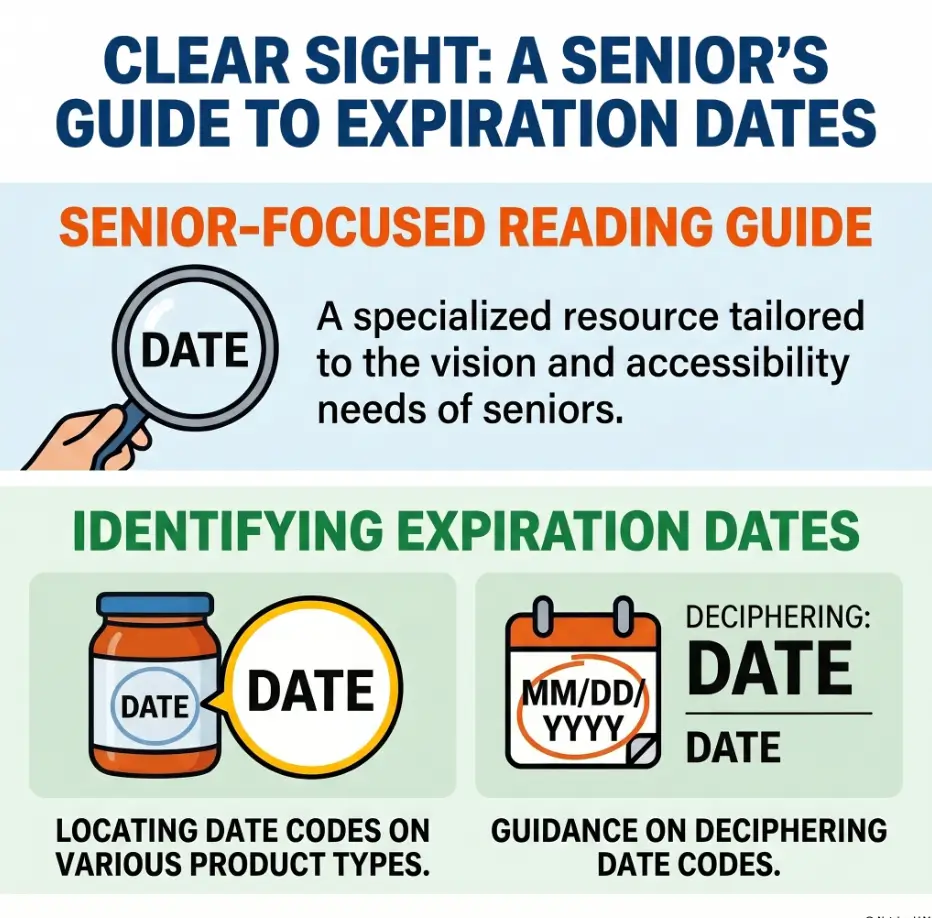
First, find where the date is printed. Do not start by trying to interpret every tiny mark. Scan for common date labels: “EXP,” “Use By,” “Best By,” “Best if Used By,” “Sell By,” or “Freeze By.”
On medicine packages, look on the bottle label, the crimped end of a tube, the bottom of a box, the side flap, or the blister pack. On food, check the lid, bottom, seam, neck, or label edge.
Step 2: Light the label, not the room
Move the item under task lighting. Turn it slowly until the printed date catches the light without glare. If the surface is shiny, angle it away from the lamp slightly.
For white or pale packaging, place the item on a darker background. For dark packaging, use a lighter background. Contrast is the quiet hero here.
Step 3: Zoom with a phone camera before guessing
A phone camera can be a powerful magnifier. Open the camera app, point it at the date, tap to focus, and pinch to zoom. You do not always need to take a photo, although taking one can help a caregiver or pharmacist review it later.
For iPhone users, built-in magnification tools can also help. The guide on iPhone Back Tap Magnifier may be useful for seniors who want quick access without hunting through settings.
Step 4: Confirm the year, because “06/28” and “06/23” are not cousins
The year is where many mistakes hide. A date like “06/28” might mean June 2028 on one product, but a person may glance quickly and remember it as 2026. A date like “03/08/26” can be misread if the print is tiny or the person is used to another date style.
Say the date out loud: “Expires June 2028.” If someone else is nearby, ask them to confirm the year. This is not overkill for medicines, eye drops, infant formula, or anything that could cause harm if used incorrectly.
The safer expiration-date flow
1
Look
Find EXP, Use By, Best By, or the date area first.
2
Light
Aim task light at the label and reduce glare.
3
Zoom
Use a magnifier or phone camera before guessing.
4
Confirm
Check the full date, especially the year.
Do Not Trust the First Number: Date Formats That Cause Costly Mix-Ups
Month/day/year vs month/year: how labels compress meaning
Some labels show a full date, such as “06/15/2027.” Others show only a month and year, such as “EXP 06/2027.” Some use letters, such as “JUN 2027.” Others compress the year into two digits.
The safest habit is to translate the label into plain speech. “June fifteenth, twenty twenty-seven.” “Expires at the end of June twenty twenty-seven.” This slows the brain just enough to catch mistakes.
Lot numbers are not expiration dates, even when they look official
Lot numbers can look impressive. They may include letters, numbers, and a neat stamped code. But a lot number is not automatically an expiration date. It helps the manufacturer track a batch.
If you see “LOT” or “Batch,” keep looking for “EXP,” “Use By,” or another date label. If the only code is unclear, contact the manufacturer, pharmacist, or store before using a high-risk item.
“Best if used by” is usually quality language, but baby formula is different
Many food dates are about quality, not an automatic safety cutoff. A box of cereal past its “Best if Used By” date may taste stale before it becomes dangerous, assuming it was stored well and shows no signs of spoilage.
But infant formula is different. Its “Use By” date matters because nutrients and product quality are regulated for infant needs. Seniors may not be using formula themselves, but grandparents and caregivers sometimes keep it in the house. Do not buy or use infant formula after its “Use By” date.
For official food date language, USDA FSIS is a useful reference.
The slash problem: when 03/08/26 becomes a tiny riddle
Slash dates are compact, efficient, and occasionally traitorous. “03/08/26” may look simple until lighting, glare, and habit interfere. Some people read quickly and assume the wrong month or year.
When in doubt, find supporting clues. Does the box also show a month in letters? Is there a pharmacy label? Is the product from another country? Is it a food item where the date label wording changes the meaning? If the item is medicine, ask a pharmacist rather than inventing confidence.
| Label wording | Common meaning | Senior-safe action |
|---|---|---|
| EXP | Expiration date | Do not use medicine after this date unless a pharmacist or clinician gives specific guidance |
| Use By | Last recommended date for use at best quality; stricter for infant formula | Check product type and risk level |
| Best By / Best if Used By | Often quality, not safety | Inspect storage and spoilage signs |
| Sell By | Store inventory guidance | Do not treat as the only safety clue |
| LOT | Batch tracking code | Do not mistake it for an expiration date |
Medicine Labels Need a Stricter Rule Than Pantry Labels
Use the printed expiration date, not smell, color, or “it looks fine”
Medicine is not leftover soup. You cannot safely judge it by sniffing, shaking, or deciding the tablet “looks normal.” Once a medicine is expired, there is no guarantee it will remain safe and effective.
This matters most when the medicine treats something serious or time-sensitive. Rescue inhalers, nitroglycerin, insulin, seizure medication, antibiotics, EpiPen-style epinephrine auto-injectors, eye drops after surgery, and infection-related medicines all deserve extra caution.
Why eye drops, antibiotics, insulin, and rescue medicines deserve extra caution
Eye drops can become contaminated after opening, and some have specific discard windows. Antibiotics that are too weak may fail to treat an infection. Insulin and rescue medicines need reliable strength. In these cases, “probably fine” is not a plan. It is a coin toss wearing a lab coat.
If a senior uses multiple drops or medicines, store the original box with the bottle when possible. Boxes often have larger print, lot information, and instructions that the small bottle cannot carry comfortably.
For eye-drop routines, preservative-free eye drops for seniors and low-vision medication management can help build safer daily habits around small containers.
Ask the pharmacist when the pharmacy label and box date disagree
Sometimes the original manufacturer date, pharmacy label date, and opened-use instructions can feel like three different clocks. Do not guess which one wins.
Call the pharmacy and ask: “I have this medicine in the original bottle and box. The label says one date and the package says another. Which date should I follow?” Read the medicine name, strength, prescription number if available, and both dates.
Pharmacist question list
- Which date should I follow: bottle, box, or pharmacy label?
- Does this medicine have a discard date after opening?
- Can this medicine be stored in a pill organizer?
- Is it dangerous if the medicine is expired, or mainly less effective?
- How should I dispose of it safely?
- Can I get large-print labels or easier-to-open packaging?
Do not move pills into unlabeled containers “just for convenience”
Moving pills into an unlabeled jar may feel tidy for five minutes and become dangerous for five months. Without the original label, it becomes harder to confirm the drug name, strength, instructions, prescriber, pharmacy, refill date, and expiration date.
Pill organizers can be helpful, but they should be filled using a current medication list and original containers. If the organizer is filled by a caregiver, pharmacist, or nurse, use a consistent schedule and double-check the medicine list.
Key takeaway
- Medicine expiration dates are not casual suggestions.
- Ask a pharmacist when the label is unreadable or dates conflict.
- Keep medicines in labeled containers unless a safe system is in place.
Apply in 60 seconds: Check one eye drop or rescue medicine today and confirm its full date.
Show me the nerdy details
Drug expiration dates are based on stability testing. The date is meant to reflect the period when the product is expected to retain strength, quality, and purity under labeled storage conditions. Home storage is not always ideal. Heat, moisture, sunlight, bathroom humidity, car glove boxes, and opened containers can shorten practical reliability.
That is why the safest consumer rule is simple: do not use medicine after expiration without professional guidance. The risk is not always that a product becomes poisonous. Often the risk is reduced effectiveness, contamination, or uncertainty when reliability matters.
Food Dates Without Panic: What to Check Before Tossing or Eating
The label is only one clue: storage history matters too
Food dates are more complicated than medicine dates. Many food labels describe peak quality, not an automatic safety line. But storage history matters. A food kept cold, sealed, and handled well is different from one that sat warm in a grocery bag, lived in a hot garage, or was opened and forgotten behind the pickles.
For seniors with presbyopia, the first goal is still to read the date correctly. Then use common food-safety checks: Was it refrigerated as required? Is the package damaged? Does it look, smell, or feel spoiled? Has it been opened too long?
Check cans for swelling, rust, leaks, and deep dents
Canned goods often sit around for years, which makes them a senior pantry classic. They are useful, affordable, and patient. But cans should be checked before use.
Do not use cans that are swollen, leaking, badly rusted, or deeply dented, especially along seams. If the label date is unreadable and the can has damage, do not treat dinner as an archaeological expedition.
Refrigerated foods: when “just one more day” becomes a gamble
Refrigerated foods can be less forgiving. Deli meats, leftovers, opened dairy products, prepared meals, cooked rice, seafood, and cut fruit need more caution because bacteria can grow even when a food looks normal.
If a senior has low appetite, lives alone, or cooks in batches, leftovers can linger. Use large-print labels with the date opened or cooked. A simple “Cooked Mon 5/25” note on painter’s tape can save a week of memory math.
The nose is useful, but it is not a food-safety laboratory
Smell can help detect obvious spoilage. It cannot detect every risk. Some harmful bacteria do not announce themselves with a dramatic stink. The nose is a helpful assistant, not the entire food-safety department.
When the date is unreadable, the storage history is unknown, or the food is high-risk, choose safety. Tossing a questionable item may feel wasteful. Foodborne illness is far more expensive, unpleasant, and exhausting.
Food date decision table
| Item | Main concern | Safer action |
|---|---|---|
| Unopened dry pantry food | Quality loss | Check date, packaging, pests, odor, and texture |
| Opened refrigerated food | Bacterial growth | Use opened-date labels and discard when uncertain |
| Damaged canned food | Seal failure or contamination | Avoid swollen, leaking, badly rusted, or deeply dented cans |
| Infant formula | Nutrition and product quality | Do not use after the Use By date |
Short Story: The Yogurt Date That Changed the Routine
Marian, 74, used to check breakfast yogurt while standing at the refrigerator, one hand on the door, one hand holding the cup, glasses somewhere on the counter. She could “mostly” read the date. Mostly was good enough until one morning it was not.
The numbers looked like 05/28. Her daughter later zoomed in with a phone and saw 05/23. Not a disaster that day, but it made them both quiet for a moment.
They made a small change. A tray, a lamp, a magnifier, and a black marker moved to the breakfast table. New groceries got checked and marked before going into the fridge.
Marian liked it because no one hovered. Her daughter liked it because the system caught mistakes before worry had to raise its voice.
Common Mistakes That Make Expiration Dates Harder to Read
Mistake 1: Reading while standing in poor light
Standing in a dim kitchen while holding a cold bottle is a poor setup for accuracy. Add a little fatigue, a phone ringing, or soup boiling on the stove, and the brain starts filling in gaps.
Fix it by making seated checking normal. Bring the item to the reading station. If the item is refrigerated, set a small timer if needed so it does not sit out too long while being checked.
Mistake 2: Using old readers with the wrong strength
Reading glasses are easy to buy and easy to keep past their usefulness. If a person keeps leaning back, holding items at arm’s length, or getting headaches after reading labels, the glasses may no longer fit the task.
Over-the-counter readers can help many people, but anyone with significant vision changes, different vision between eyes, eye disease, or persistent strain should get professional guidance. For a related overview, see senior near vision problems.
Mistake 3: Guessing the year from memory
Memory is useful. It is not a label. A senior may remember buying a medicine “recently,” but recently can mean last month, last winter, or before the grandchild got that haircut everyone pretended to like.
Confirm the year every time on high-risk items. If the year is not readable, do not use the product until someone confirms it.
Mistake 4: Keeping boxes separate from bottles
Boxes often contain the clearest expiration date, directions, warnings, and lot number. Once the box is thrown away, the tiny bottle has to carry the whole safety conversation by itself.
For eye drops, ointments, and small medicine tubes, consider keeping the box until the product is finished. Use a rubber band or small bin to keep the box and bottle together.
Mistake 5: Trusting faded marker notes without checking the original label
Large marker notes are helpful, but only when they are accurate and still readable. A faded “6/24” note on a cap might mean opened June 2024, expires June 2024, or someone’s attempt to label shelf number six. Charming, but not safe.
Use marker notes as a support, not the source of truth. The original package date, pharmacy guidance, and opened-use instructions matter.
Key takeaway
- Most label mistakes come from bad setup, not laziness.
- Wrong glasses, poor lighting, and separated packaging create avoidable risk.
- Marker notes should confirm the original label, not replace it.
Apply in 60 seconds: Reunite one small bottle with its original box today.
Tools That Help Without Turning the Kitchen Into a Science Lab
Reading glasses: simple, cheap, and easy to misplace
Readers are often the first tool for presbyopia. They can be inexpensive, familiar, and effective for routine label reading. The problem is placement. A pair in the bedroom does not help with a medicine bottle in the kitchen.
Place readers where the task happens. One pair near the medicine station, one near the pantry, and one near a favorite chair may prevent a lot of squinting.
Handheld magnifiers: best for curved bottles and foil packs
A handheld magnifier can work well for curved bottles, tiny foil packs, and small printed codes. Choose one that feels comfortable, has enough viewing area, and does not require the user to hold it perfectly still.
Some magnifiers include built-in lights. That can help, but test glare before relying on it. A bright light shining directly into glossy plastic may create a white flare right where the date should be.
Phone camera zoom: the secret weapon already in your pocket
The phone camera is often the easiest tool because it enlarges the label and allows the user to hold the view steady on screen. It is especially helpful when a caregiver is not nearby.
Teach one simple routine: open camera, point, tap to focus, pinch to zoom. Avoid turning it into a full technology lesson with twelve settings and a family argument. The goal is readable dates, not a software certification.
Voice assistants and caregiver photos: helpful when hands shake or light is poor
If hands shake, a senior can take a photo and send it to a caregiver with a simple question: “Can you read this expiration date?” A caregiver can reply with the date in large text.
Some seniors also use voice assistants to set reminders for monthly checks. For example: “Remind me on the first Saturday to check eye drops and fridge door items.” A reminder will not read the label, but it can start the routine.
Tool comparison for tiny date reading
| Tool | Best for | Watch out for |
|---|---|---|
| Reading glasses | Routine near reading | Wrong strength or misplaced pair |
| Handheld magnifier | Curved labels and small print | Hand tremor or glare from built-in light |
| Stand magnifier | Shaky hands | Less convenient for tall bottles |
| Phone camera zoom | Quick enlargement and caregiver sharing | Focus issues, battery, or unfamiliar controls |
When to Seek Help or Stop
Call an eye care professional for vision red flags
Stop treating the problem as normal presbyopia if vision changes are sudden, worsening, painful, or one-sided. New flashes, floaters, dark curtains, severe eye pain, sudden double vision, or sudden reading trouble should be evaluated quickly.
Even without emergency symptoms, repeated trouble reading medicine labels is a good reason to schedule an eye exam. Sometimes the answer is a new prescription. Sometimes it is better lighting. Sometimes it is a diagnosis that should not wait.
Ask a pharmacist before using any questionable medicine
If a medicine date is unreadable, expired, conflicting, or missing, ask a pharmacist. This is especially important for prescription medicines, eye drops, antibiotics, insulin, rescue medicines, children’s medicines, and anything taken daily for a serious condition.
Do not combine old bottles, scrape pills into one container, or continue using a medicine because “it has always looked like that.” A pharmacist can also advise on disposal, refills, large-print labels, and packaging that is easier to manage.
Contact Poison Control if the wrong product was swallowed or used
If someone swallowed a household chemical, used the wrong medicine, put the wrong drops in the eye, mixed products incorrectly, or may have taken a harmful dose, contact Poison Control or emergency services. If the person collapses, has trouble breathing, has a seizure, or cannot be awakened, call emergency services right away.
For non-emergency uncertainty, Poison Control can help decide what to do next. Keep the product container nearby so you can read the name, ingredients, strength, and any date information.
Involve a caregiver if expiration checks are repeatedly missed
If expired items keep showing up, the solution is not scolding. It is redesign. Maybe the labels are too small, the cabinet is too crowded, the lighting is poor, or the task is too mentally tiring.
Try a monthly shared check. Keep the tone gentle and specific: “Let’s make the eye drop drawer easier to read,” rather than “You never check these.” Dignity is not decorative. It is part of whether the system will last.
Key takeaway
- Sudden vision changes need professional attention.
- Questionable medicine should be checked with a pharmacist.
- Possible poisoning or wrong-product use needs prompt help.
Apply in 60 seconds: Save Poison Control, pharmacy, and eye doctor contact details in large print near the medicine area.
FAQ
Why are expiration dates so hard for seniors with presbyopia to read?
Presbyopia makes near focusing harder, and expiration dates are often printed in tiny, low-contrast text on curved, shiny, or folded surfaces. The task becomes harder in poor light or when the person is standing, rushed, or using the wrong reading glasses.
What is the safest way to read tiny medicine expiration dates?
Sit at a table, use bright task lighting, wear current reading glasses, use a magnifier or phone camera zoom, and confirm the full date out loud. If the date is expired, missing, unreadable, or conflicting, ask a pharmacist before using the medicine.
Can seniors use a phone camera to read expiration dates?
Yes. A phone camera can enlarge tiny print quickly. Open the camera app, tap the date area to focus, and pinch to zoom. Taking a photo can also help a caregiver or pharmacist confirm the date.
Are food “Best By” dates the same as expiration dates?
Usually no. Many food “Best By” dates relate to quality, not automatic safety. Still, storage, packaging condition, spoilage signs, and the type of food matter. Infant formula should not be used after its “Use By” date.
Should expired over-the-counter medicine ever be used?
The safest rule is not to use medicine after its expiration date. Expired medicine may be less effective or risky. Ask a pharmacist if you are unsure, especially for medicines used for pain, infection, breathing, heart symptoms, allergies, diabetes, or eye care.
How can caregivers help without making seniors feel embarrassed?
Frame the task as a shared home-safety upgrade, not a personal failure. Say, “Let’s make these labels easier to read,” and create a simple system: better light, magnifier, large-print notes, and a monthly check.
What label-reading tools work best for shaky hands?
A stand magnifier, phone camera zoom, or caregiver photo check may work better than a small handheld magnifier. The best tool is the one the person can use steadily and comfortably in the place where labels are checked.
When should blurry near vision be checked by an eye doctor?
Schedule an eye exam if near vision keeps getting worse, causes headaches or strain, or makes medicine labels unsafe to read. Seek urgent care for sudden vision loss, eye pain, flashes, new floaters, curtain-like shadows, or sudden double vision.
Next Step: Make One Drawer Safer in 15 Minutes
The whole point of this guide is not to admire a better system from across the room. It is to make one risky place safer today.
Choose one drawer, shelf, bin, or fridge door area. Pick the highest-risk spot first: prescription medicines, eye drops, insulin supplies, rescue medicines, OTC pain relievers, refrigerated leftovers, or household chemicals. Do not start with the entire house unless you enjoy turning Tuesday into a warehouse inventory opera.
15-minute drawer reset
- Put on reading glasses and sit at a well-lit table.
- Remove every item from one drawer or bin.
- Set aside anything expired, unreadable, leaking, unlabeled, or duplicated.
- Use a magnifier or phone camera to confirm dates on remaining items.
- Circle confirmed expiration dates with a dark marker.
- Add large-print notes only after the original date is verified.
- Place soon-to-expire items in front with a “use first” note.
- Put the magnifier, marker, and flashlight where the next check will happen.
If you find questionable medicine, call the pharmacy. If you find damaged food packaging, discard it safely. If you find household products that are leaking, unlabeled, or easy to confuse with food or medicine, remove them from daily-use areas.
The quiet victory is not a perfect pantry. It is one less guess. One clearer label. One safer morning when someone reaches for eye drops, breakfast, or cough medicine and does not have to wrestle with tiny gray print before coffee.
Key takeaway
- Start small: one drawer beats an abandoned whole-house project.
- Use the same routine every time: look, light, zoom, confirm.
- Keep the tools where the risk lives.
Apply in 60 seconds: Choose the drawer now. Put the magnifier beside it before you forget.
Last reviewed: 2026-05