
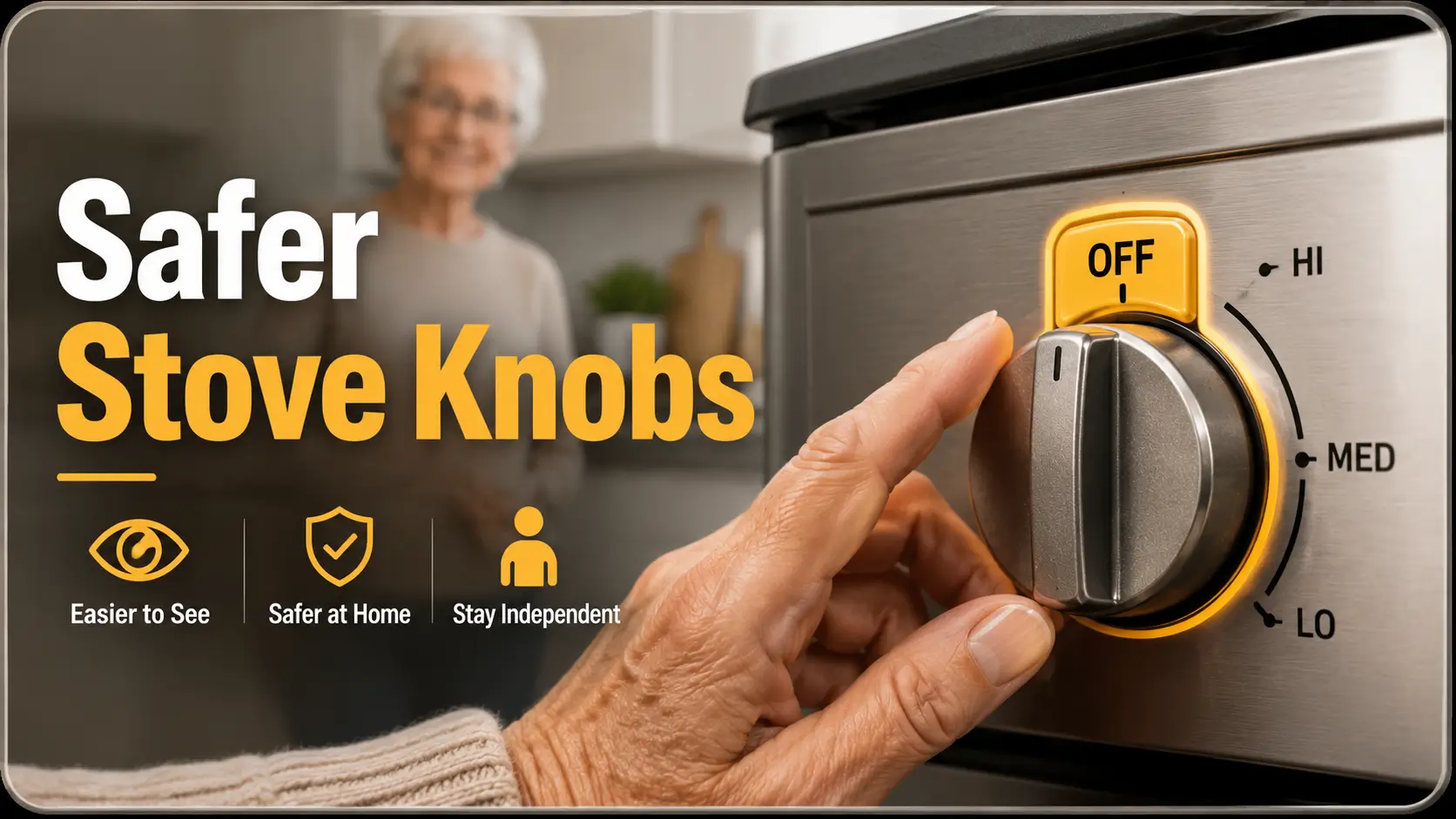
Senior kitchen safety guide
Stove Knob Safety Tips for Seniors
with Aging Eyes
A stove knob seems small until it becomes the tiny gatekeeper between dinner and danger. For older adults with changing eyesight, the problem is rarely “not paying attention.” It is often contrast, glare, tiny markings, poor lighting, weak hands, memory load, and controls that were never designed for tired eyes at 7:30 p.m.
This guide is for adult children, family caregivers, aging-in-place planners, and seniors who want safer cooking without turning the kitchen into a locked museum. The goal is practical: make “off” unmistakable, reduce accidental turns, choose covers or removable knobs wisely, and know when labels are no longer enough.
Think of this as a kitchen safety tune-up. Not dramatic. Not shame-based. Just a clear way to make the stove easier to read, easier to feel, and harder to misuse when vision, contrast, depth judgment, or confidence begins to change.
See the danger sooner
Improve contrast, lighting, and off-position visibility.
Choose safer tools
Compare labels, tactile dots, knob covers, locks, and shutoff support.
Know when to escalate
Spot the signs that call for professional help or a different cooking setup.
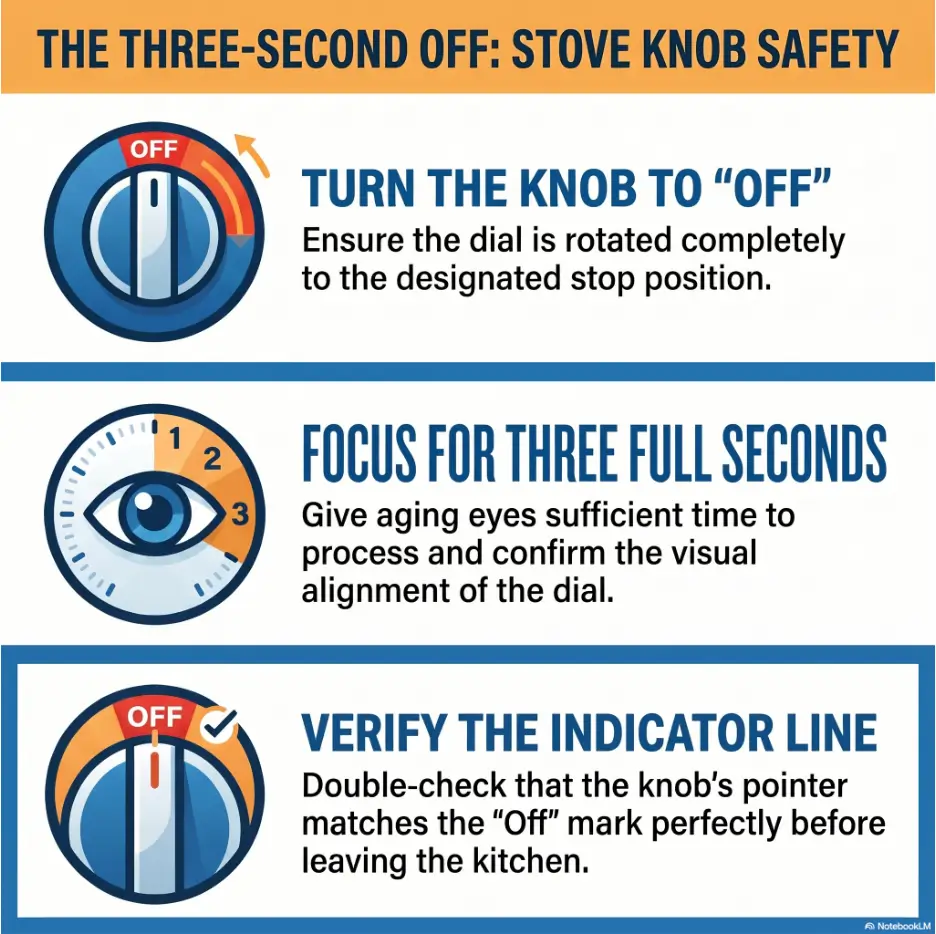
A safer stove begins with one humble question: can “off” be found in three seconds? 🔥
Snapshot
This article is for seniors who still cook, caregivers who worry about stove safety, and families trying to support aging in place. You will learn how to make stove knobs easier to see and feel, compare low-cost fixes with paid safety tools, and decide when a forgotten burner, gas smell, or repeated near-miss needs professional help.
Table of Contents
Before You Change the Stove
Stove knob safety for seniors with aging eyes is not just a decorating problem. It is a fire, burn, gas, and independence problem wearing a very small plastic hat.
The best fix depends on why the knob is unsafe. A senior who cannot see low-contrast markings may need bold labels and better light. A senior with arthritis may need easier-grip controls. A senior who forgets burners may need automatic shutoff support, meal changes, or supervised cooking.
Before you act
This guide offers general home-safety information, not personalized medical, occupational therapy, appliance, electrical, or gas advice. If there has been a fire, gas smell, repeated forgotten burner, damaged stove, or worsening confusion, confirm the next step with a qualified professional. Labels can help vision problems. They cannot repair a broken appliance or solve unsafe cooking habits by themselves.
Who this advice fits best
These tips fit older adults who still understand how the stove works but struggle with reading the knob position, seeing markings in low light, or checking whether a burner is off.
It also fits caregivers who want a middle path between “do nothing” and “take away cooking entirely.” Many families live in that difficult middle room, where independence matters and worry still sits at the table.
When DIY fixes are not enough
DIY markings are not enough when the person has dementia symptoms, repeated stove mistakes, unsafe transfers, severe tremor, frequent falls, or trouble responding to smoke alarms. In those cases, the stove knob is only the visible corner of a larger safety issue.
If gas is smelled, do not test more labels. Leave the area when appropriate, avoid flames and switches, and contact the gas utility or emergency services according to local guidance.
Key takeaway
Start by identifying the problem: vision, lighting, touch, hand strength, memory, or appliance condition. The safest fix is the one that matches the real cause.
For broader room-by-room safety planning, a related guide on a home safety checklist for seniors with vision changes can help you place the stove issue inside the full home setup.
The “Off” Position Problem
Many stove knobs make “off” surprisingly easy to miss. The line is tiny. The text is gray on silver. The pointer is worn down. The kitchen light hits the stainless panel and turns the whole area into a shiny puzzle.
For younger eyes, this may be annoying. For aging eyes, especially with presbyopia, cataracts, macular degeneration, glaucoma, diabetic eye disease, or general contrast loss, it can become a daily hazard.
Make “off” impossible to miss
The “off” position should be the loudest visual cue on the stove. Not the brand logo. Not the decorative trim. Not the caregiver’s clever color code that requires a secret decoder ring.
Use a single high-contrast cue for each knob. For many stoves, that means a bold mark above or below the knob that lines up clearly when the knob is off. Keep it simple enough that the senior can explain it without prompting.
Test the view from real standing height
Do not judge your label from six inches away with your phone flashlight on. Stand where the senior naturally stands. Use the lighting they usually use. Ask them to identify the off position without bending close.
If they need to lean, squint, touch the hot-adjacent panel, or guess, the marking is not clear enough.
Mini checklist: the three-second off test
- Can the senior find “off” within three seconds?
- Can they do it without reading glasses?
- Can they do it in evening kitchen light?
- Can they explain what the mark means?
- Can they tell if a knob is partly turned?
Fix the Lighting Before You Add Labels
Labels fail when the light is wrong. A beautiful high-contrast sticker under a shadow is still a whisper. Before buying a drawerful of tactile dots and knob covers, check whether the stove area has enough even, glare-controlled light.
Good lighting helps the hand land accurately, helps the eyes confirm the setting, and helps caregivers spot hazards quickly. It is one of the least glamorous safety upgrades, which is exactly why it gets ignored.
Put light where the hand reaches
Under-cabinet lights often brighten the counter but leave the control panel dim. The right question is not “Is the kitchen bright?” It is “Can the senior see the exact point where the knob indicator meets the off mark?”
Task lighting should be even and stable. Avoid lighting that creates hard shadows from the person’s own hand. If a glossy cooktop or stainless panel reflects glare, softer placement may work better than simply adding a brighter bulb.
For more low-vision kitchen context, see this guide to glare-free under-cabinet lighting.
Check the stove at night
Many families test safety changes on a sunny afternoon. Real mistakes often happen in dim morning light, after dinner, during fatigue, or when someone gets up for tea and the kitchen is half-lit.
Do one test during the day and one at night. If the knob position disappears after sunset, the setup is not finished.
Key takeaway
If the stove controls are hard to see, improve lighting before adding more labels. Darkness plus clutter creates false confidence.
Tactile Cues for Tired Eyes and Hands
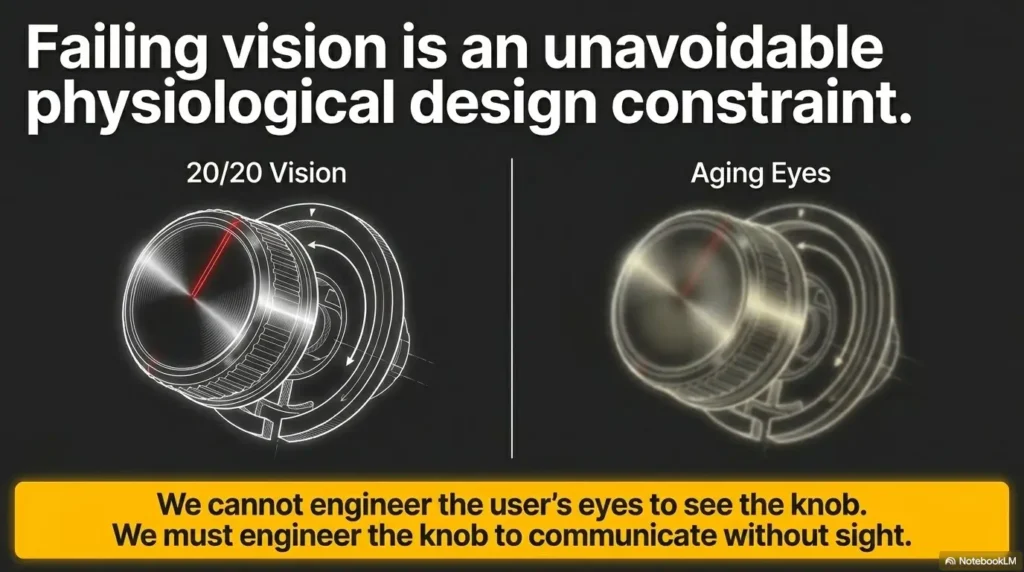
Tactile cues can be a quiet miracle when eyes get tired. Raised dots, bump markers, textured tape, and simple tactile labels let a senior confirm a position by touch, not sight alone.
Still, tactile cues need restraint. Too many raised marks can turn the control panel into a tiny mountain range. The senior should not have to read Braille by accident while soup is boiling.
Mark only the positions that matter most
For most homes, the most important tactile cue is “off.” After that, consider “low” and “high” only if the senior actually uses those positions and can remember the system.
One raised dot for off may be better than five different textures. Safety improves when the cue is memorable, repeatable, and boring in the best possible way.
If you are comparing tactile options, this related guide on bump dots versus tactile tape can help you think through texture, placement, cleaning, and durability.
Avoid heat, grease, and cleaning trouble
Never use flammable tape near heat zones. Do not place labels where they block manufacturer warnings, cover gas markings, trap grease, or make cleaning difficult.
Also consider the stove’s cleaning routine. A label that peels after two wipe-downs is not a safety system. It is a tiny piece of future confusion.
Knob Covers, Locks, and Removable Knobs
Stove knob covers, locks, and removable knobs can help, but they are not all the same. Some protect against accidental turns. Some slow down unsafe cooking. Some frustrate arthritic hands and create a new problem in a plastic shell.
The best stove knob cover for an older adult is not automatically the strongest one. It is the one that matches the stove type, hand strength, vision, cognition, and daily cooking pattern.
When knob covers help
Knob covers may help when a senior accidentally brushes against knobs, when grandchildren visit, or when the stove is bumped by walkers, aprons, towels, or leaning hips.
They may also help a caregiver feel more comfortable leaving the kitchen briefly while preserving some cooking independence. But the senior must be able to open, close, clean, and understand the cover without strain.
When removable knobs may be safer
Removable knobs can be useful when stove use should happen only at certain times or with supervision. They are often simpler than covers because the control is physically absent.
However, removable knobs need a clear storage plan. If the caregiver hides them in a place only they know, the system may create frustration, conflict, or risky improvisation.
What to compare before buying
Before paying for knob covers or locks, compare fit, grip difficulty, cleaning access, visibility, stove compatibility, and whether the product interferes with normal off-position confirmation.
For a focused buying angle, this related article on safe stove knob covers for seniors may help you compare common options without treating every kitchen the same.
Gas, Electric, and Induction Stove Risks
Different stoves create different hazards. A gas stove can release fuel if a knob is partly turned. An electric burner can stay hot after it looks quiet. An induction cooktop may reduce some heat risks but can confuse users with touch controls, icons, and silent operation.
That means the right safety plan should match the appliance, not just the person.
Gas stoves: the smell test is not a plan
Gas stove knobs should not turn too easily by accident. If a knob can be brushed into a partly open position, treat that seriously.
Make emergency shutoff information visible to the people who need it, but do not expect a printed note to solve a gas hazard. If the household has repeated gas odor incidents, damaged knobs, or confusion about flame status, get qualified help.
Electric stoves: heat can hide in plain sight
Electric burners and smooth cooktops can remain hot after the visible glow fades. Residual heat indicators must be visible and understood.
If the senior cannot reliably see which zone is hot, consider stronger visual routines: a cooling zone rule, a pot placement habit, and a verbal check before leaving the kitchen.
Induction stoves: safer in some ways, confusing in others
Induction can reduce some open-flame and hot-burner risks, but it may introduce control-panel confusion. Flat touch controls, icons, beeps, and child locks can be difficult for seniors with low vision or memory changes.
Before switching appliances, ask whether the senior can operate the new controls calmly, repeatedly, and without a caregiver translating every symbol.
Key takeaway
Do not buy a “safer” stove only by category. Match the appliance to the person’s vision, memory, hand strength, cooking habits, and ability to learn new controls.
Good, Better, Best Stove Knob Safety Setup
Families often ask about the best stove knob safety tool for seniors. The honest answer is less shiny: the best setup is the lowest level of restriction that reliably prevents the actual risk.
A budget-conscious family may start with lighting and labels. A cautious caregiver dealing with repeated near-misses may need a more robust shutoff or monitoring setup. A senior with memory changes may need a cooking plan that does not depend on independent burner use.
Free versus paid options
Free or low-cost changes can be enough when the senior simply cannot see the existing markings. Better light, a bold off cue, and a short daily habit may solve the issue without buying a device.
Paid options may be worth comparing when the risk involves accidental knob turns, recurring worry, or a need for stronger backup. Compare tools by fit, ease of use, cleaning, installation, return policy, and whether the senior can operate them without embarrassment or strain.
Short Story: The Label That Looked Perfect at Noon
Marian’s daughter added neat silver labels around the stove knobs on a Saturday afternoon. In daylight, they looked tasteful. The kitchen felt calmer. Everyone exhaled.
Two nights later, Marian made tea and called out, “Is this one off?” The silver labels had vanished into the stainless panel. The tiny arrow on the knob was a rumor.
They changed the plan. A warm under-cabinet light went in. The off position got one bold dark mark and one raised dot. Nothing else was labeled.
The lesson was plain: a safety fix is not proven when it looks good. It is proven when the person can use it during the ordinary, tired, imperfect moments when mistakes actually happen.
A Simple 10-Minute Stove Knob Safety Check
You do not need a clipboard empire to begin. Ten minutes at the stove can reveal whether the problem is visibility, touch, lighting, strength, or memory.
Do the check with the senior present. A system created only by the caregiver may look efficient and still fail because the person who cooks cannot understand it.
- Stand where the senior naturally stands while cooking.
- Ask them to identify every knob’s off position.
- Turn each knob slightly and ask whether it looks fully off or partly on.
- Repeat the check in lower light.
- Ask them to explain the marking system back to you.
- Remove confusing labels before adding new tools.
- Write down any near-misses from the past month.
Use the “one change at a time” rule
Do not add labels, dots, covers, lights, and a new routine all in one afternoon unless there is immediate danger. Too many changes can make the stove feel foreign.
Start with the clearest risk. If “off” is hard to see, fix that first. If knobs turn accidentally, address that next. If burners are forgotten, move beyond visibility fixes.
Stove Knob Safety Flow
1. See
Make off visible from standing height.
2. Feel
Add one tactile cue if sight is unreliable.
3. Block
Use covers or removable knobs for accidental turns.
4. Shut off
Consider automatic support for repeated mistakes.
5. Get help
Escalate for gas smell, damage, or cognition changes.
Mistakes That Backfire
Most stove safety mistakes come from good intentions moving too fast. A caregiver sees danger, buys something, installs it, and hopes anxiety will leave by the side door.
But safety tools can backfire when they add clutter, hide information, frustrate hands, or create a system the senior does not understand.
Mistake checklist
- Using tiny printed labels that only work close up.
- Marking every setting until nothing stands out.
- Relying on memory instead of visual and tactile confirmation.
- Ignoring arthritis, tremor, hand weakness, or poor grip.
- Using flammable tape or materials near heat.
- Covering manufacturer warnings or gas markings.
- Treating a forgotten burner as “just one of those things.”
Pretty is not the same as safe
Low-contrast beige, pale gray, clear, metallic, or decorative labels may look calm in a kitchen photo. They can be nearly useless for aging eyes.
Safety markings need contrast, not charm. A bold mark that works is better than a tasteful label that disappears at dinner time.
A system must work for the senior, not just the caregiver
If only the caregiver understands the setup, it is not a complete safety system. Ask the senior to demonstrate it. Watch quietly. Let the stove tell the truth.
If they hesitate, guess, or become irritated, simplify before adding another product.
When to Get Professional Help
Some stove problems should not be solved with a label maker. Knowing when to get help is part of keeping independence realistic and dignified.
Professional help may cost money, but it can prevent wasted purchases and reduce risk. The right expert depends on the problem: appliance repair, gas safety, occupational therapy, vision rehabilitation, medical review, or family care planning.
Call an appliance professional for physical stove problems
Loose, broken, missing, or misaligned knobs should be checked by a qualified appliance professional. If a knob does not clearly line up with off, a homemade mark may give false reassurance.
Also get help if the stove behaves unpredictably, clicks unusually, smells of gas, or has controls that no longer match the burner response.
Ask an occupational therapist about vision and hand strength
An occupational therapist can often suggest safer ways to adapt the kitchen for low vision, arthritis, tremor, fatigue, and routine memory. This is especially useful when the family is unsure whether the issue is eyesight, strength, cognition, or layout.
For appointment preparation, this guide on questions to ask a low-vision occupational therapist can help families arrive with clearer concerns.
Talk with a clinician if cooking mistakes are increasing
Repeated burner mistakes, missed steps, confusion, or unsafe choices may signal more than vision trouble. A clinician can help evaluate medication effects, cognition, sleep, vision changes, dizziness, or other health issues that may affect cooking safety.
Show me the nerdy details
Stove knob safety works best when it lowers cognitive load. A senior should not have to remember a complicated code while also managing heat, timing, cookware, food texture, and fatigue. Good design makes the safest action obvious.
- Contrast: the control mark must stand apart from the stove surface.
- Redundancy: sight and touch should confirm each other when possible.
- Consistency: every knob should use the same logic.
- Feedback: the senior should know when a burner is on, off, or still hot.
- Failure backup: repeated mistakes need more than reminders.

FAQ
What is the safest way to mark stove knobs for seniors?
The safest marking is simple, high-contrast, easy to clean, and understandable from normal standing height. Start with the off position. Add a tactile cue only if it helps the senior confirm the setting without confusion.
Are stove knob covers safe for older adults with arthritis?
Sometimes. A cover that is easy for a young adult may be painful or frustrating for arthritic hands. Before buying, compare opening force, grip size, visibility, cleaning access, and whether the senior can use it calmly.
Should seniors with poor eyesight use gas stoves?
It depends on vision, cognition, appliance condition, cooking habits, and available support. Poor eyesight alone does not always mean gas cooking must stop, but gas smell, accidental knob turns, or repeated mistakes should be taken seriously.
How can I make the off position easier to see?
Use a bold, high-contrast mark aligned with the knob’s off position. Improve task lighting first, test the mark in low light, and ask the senior to identify off without leaning close or using a flashlight.
Are removable stove knobs better than knob covers?
Removable knobs may be better when stove use should be limited or supervised. Knob covers may be better for accidental bumps when the senior still cooks safely. The best choice depends on the risk you are trying to reduce.
What should I do if my parent leaves burners on?
Do not rely on labels alone. Write down when it happens, what was cooking, whether fatigue or distraction was involved, and whether gas, smoke, or heat remained. Consider shutoff support, supervised cooking, simpler meals, and a medical or occupational therapy review.
Can smart stove shutoff devices help seniors age in place?
They can help in some homes, especially when the issue is forgetting burners or needing backup monitoring. Compare compatibility, installation needs, alerts, privacy, ongoing fees, and whether the device actually matches the stove type and household routine.
When is it time to stop independent stove use?
Consider stopping or limiting independent stove use when there are repeated forgotten burners, unsafe responses to smoke or gas, confusion about controls, worsening cognition, burns, fires, or strong caregiver concern. A clinician or occupational therapist can help make this decision less emotional and more practical.
Do the “Off Position” Test Today
The safest next step is wonderfully ordinary: stand at the stove in normal kitchen light and ask whether every knob’s off position is obvious within three seconds.
If the answer is yes, check again at night. If the answer is no, add one clear visual or tactile cue where confusion happens. Not ten labels. Not a full kitchen renovation. One useful change.
If there has been a forgotten burner, gas smell, burn, smoke, or repeated near-miss, skip the cosmetic fixes and move toward stronger support. That may mean knob covers, removable knobs, automatic shutoff tools, appliance repair, occupational therapy, or a new cooking routine.
Your 15-minute action plan
- Check whether “off” is visible from standing height.
- Repeat the check in low light.
- Ask the senior to explain the knob system back to you.
- Remove any confusing or low-contrast labels.
- Choose one next step: light, label, tactile cue, cover, shutoff support, or professional help.
A stove knob is small, but the relief of making it safer is not. One clear off mark, one better light, one honest conversation: sometimes aging in place begins with a tiny circle of plastic and the courage to look closely.
Last reviewed: 2026-07