
The Hidden Hazards of Presbyopia: Making Home Easier to Read and Trust
A cord beside the favorite chair. A white pill on a white counter. A shampoo bottle that looks exactly like the conditioner at 6:12 a.m. These are not dramatic hazards, which is precisely why they win.
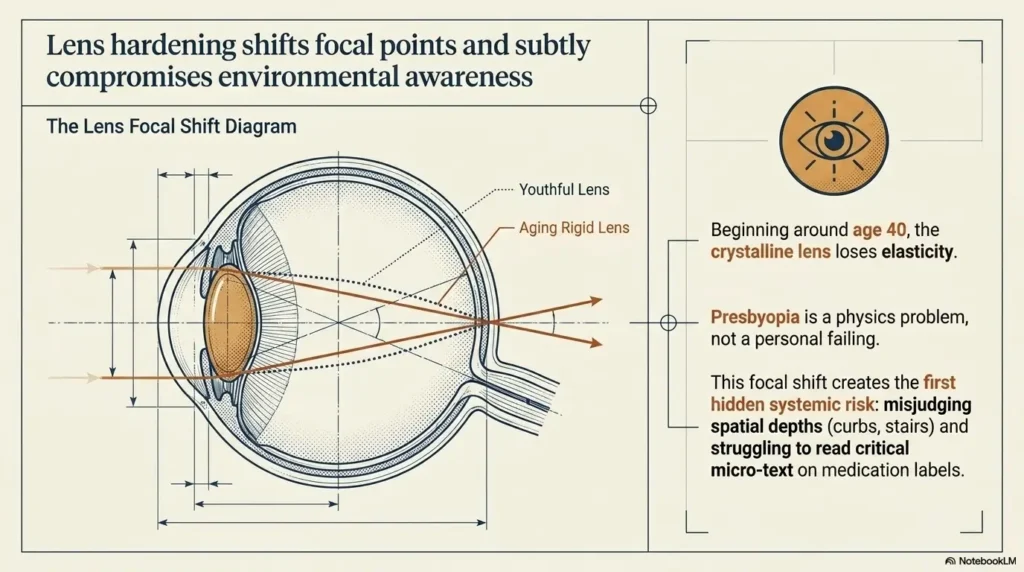
A home safety checklist for seniors with presbyopia should begin with the small, close-up things aging eyes are asked to judge every day: labels, buttons, steps, medicine bottles, stove knobs, mail, phone screens, and bathroom edges. Presbyopia is the common age-related change that makes near vision harder, often becoming noticeable after the mid-40s. But for older adults, the issue is not just reading menus. It is daily safety.
Guessing has a cost. It can mean a wrong pill, a missed step, a burned hand, a spoiled food mistake, or another tense “I thought I saw it” moment at home.
Good news: the fix is usually not a total remodel. Start small. Make the home easier to read. Then make it easier to trust.
- Improve lighting where close work actually happens.
- Add contrast where edges disappear.
- Create stable homes for glasses, medicine, remotes, keys, and phones.
- Check the riskiest rooms first: bathroom, bedroom, kitchen, and nighttime routes.
Quick Safety Snapshot
The goal is not a picture-perfect house. The goal is a home where the person can see what matters before the mistake happens.
Bathroom, especially at night.
Low contrast, not just low light.
Add one task lamp and one large-print label station.
Table of Contents
Safety / Disclaimer
This guide is for general home safety education. It is not medical, optometry, occupational therapy, pharmacy, electrical, or construction advice. Presbyopia can make close-up tasks harder, but sudden vision changes, new double vision, eye pain, new confusion, repeated falls, dizziness, medication mistakes, or trouble navigating familiar rooms should be evaluated by a qualified clinician.
The National Eye Institute describes presbyopia as a common age-related near-vision focusing problem. The CDC also emphasizes that falls in older adults can often be reduced through prevention steps, but falls should not be brushed off as “just aging.” When the house starts feeling like an obstacle course with curtains, it is time to slow down and bring in the right help.
Start with the Presbyopia Problem, Not the Furniture
Most home safety advice starts with objects: rugs, cords, chairs, stairs. Useful, yes. But presbyopia adds a different layer. It changes the way the person reads the room at hand distance.
That means the danger may not be the furniture itself. It may be the tiny instruction printed on the bottle, the low-contrast edge of the step, or the small black-on-black stove marking that seems to have been designed by a raccoon with a design degree.
Why “just add a lamp” is usually too small a fix
A lamp can help, but only if it lands light where the eyes need it. A beautiful floor lamp across the room may make the living room glow while the pill bottle still sits in a tiny shadow canyon.
Task lighting should support the activity. Reading medicine labels, checking food dates, trimming nails, sorting mail, using the microwave, and reading a phone screen all need local, glare-controlled light.
For deeper background on how near vision changes affect daily routines, connect this checklist with senior near-vision problems that show up at home. The two topics are cousins wearing the same bifocals.
The real hazard is near-vision blur plus low contrast
Presbyopia makes close print and small details harder to focus on. Low contrast makes those details harder to separate from the background. Together, they create a fog machine for daily decisions.
Think of white pills on a white counter, clear soap on a clear shelf, beige slippers on beige carpet, or a gray threshold on a gray floor. Nothing is technically hidden. Everything is practically hidden.
Here’s what no one tells you: the tiny things become the dangerous things
Many serious home mistakes begin as small visual guesses. Was that the morning pill or the evening pill? Is the burner off or low? Is the shampoo bottle the one with the blue cap or the almost-blue cap? Is that rug edge flat?
When near vision gets fuzzy, tiny objects start making executive decisions. The house becomes safer when those decisions are taken away from blur and given back to design.
- Start with labels, controls, edges, and nighttime routes.
- Improve contrast before buying more gadgets.
- Place light close to the task, not just in the room.
Apply in 60 seconds: Pick up one pill bottle, one remote, and one kitchen control. Ask whether the person can read each without guessing.
Who This Is For, and Who Needs More Than a Checklist
This checklist is for the ordinary household where someone says, “I can see fine, I just need more light,” then holds the mail at arm’s length like it owes them money.
It is also for adult children, spouses, neighbors, and caregivers who want to improve safety without turning a beloved home into a clinical waiting room.
Good fit: seniors who squint at labels, phones, bills, and medicine bottles
This guide fits when the main problem is close-up clarity. Common signs include moving reading material farther away, needing brighter light for bills, mixing up similar containers, struggling with small remote buttons, or avoiding fine-print tasks.
It also fits when the person is proud, independent, and allergic to anything that feels like being “managed.” Respect matters. A safety reset should feel like restoring control, not installing a committee in the kitchen.
Good fit: caregivers doing a weekend safety reset
A caregiver can make meaningful changes in one weekend. The best upgrades are simple: brighter labels, better task lights, visible edges, clear walking paths, easy-to-find glasses, and a repeatable medicine setup.
For a focused bedroom reset, use bedroom safety ideas for seniors with poor vision alongside this full-home checklist. The bedroom is where nighttime blur, slippers, phone charging cords, and sleepy decision-making form a tiny orchestra of chaos.
Not enough: recent falls, sudden vision loss, double vision, or new confusion
A checklist cannot replace medical evaluation. Sudden blurry vision, double vision, eye pain, new floaters or flashes, one-sided visual loss, sudden balance problems, or confusion should be treated seriously.
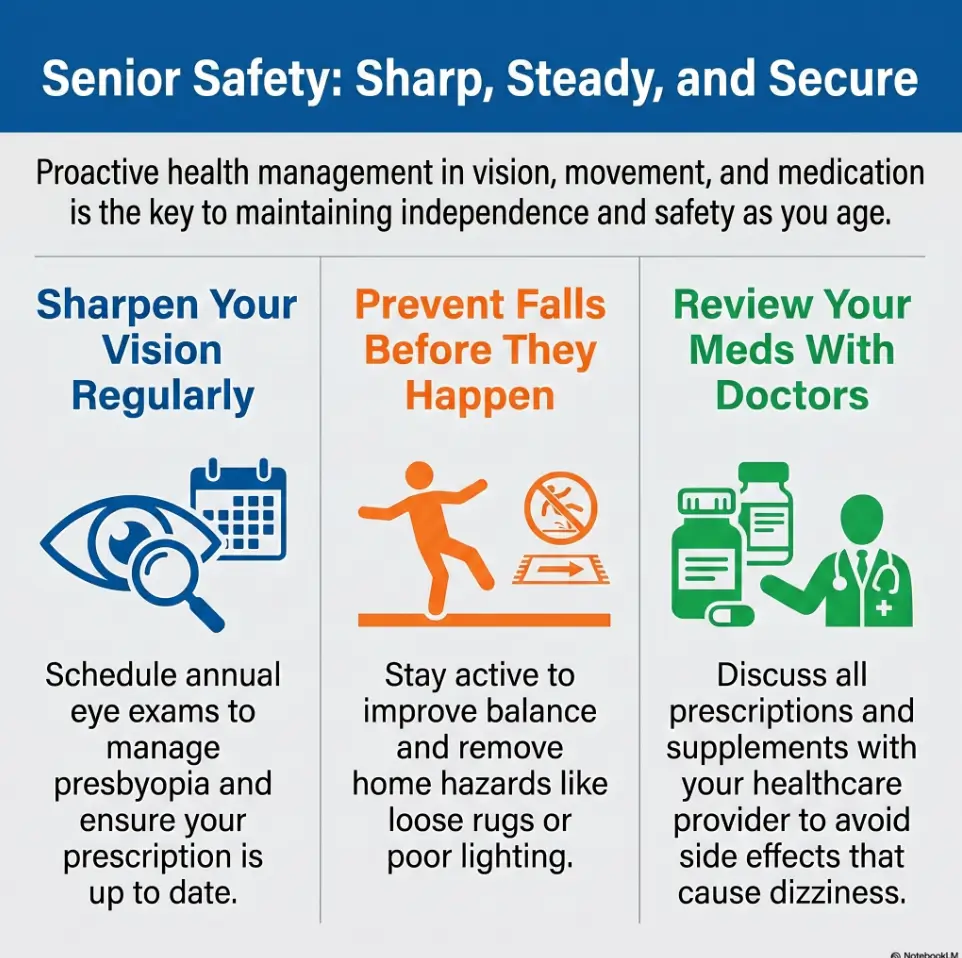
Repeated falls, dizziness, medication side effects, and weakness deserve a medical conversation. A primary care clinician, eye care professional, pharmacist, physical therapist, or occupational therapist may all have a role.
Money Block: Is a DIY Safety Reset Enough?
Use this quick yes/no screen before spending money or rearranging the house.
- Yes: The person mainly struggles with small print, labels, dim corners, or finding glasses.
- Yes: There have been no recent unexplained falls, fainting episodes, or sudden vision symptoms.
- Yes: The person can explain what feels hard and what helps.
- No: There is new confusion, repeated falls, sudden vision change, or unsafe medication use.
- No: The person cannot safely walk a normal route even after obvious hazards are removed.
Neutral action line: If any “No” applies, pair home changes with a clinician or occupational therapy conversation.
The 15-Minute Walkthrough That Finds the Hidden Hazards
The fastest way to find problems is not to inspect the house like a real estate agent. Walk it like the person actually lives there.
Start at the chair they use most. Go to the bathroom. Go to the kitchen. Go to the bedroom. Touch what they touch. Read what they read. Turn what they turn.
Walk the house at the senior’s normal pace, not your “busy adult” speed
Caregivers often move too fast during safety checks. They glide through the room, declare victory, and miss the hazard hiding in plain sight.
Walk at the person’s pace. Notice where they pause. Notice where their hand reaches for support. Notice where they lean forward to read. A pause is not always indecision. Sometimes it is the home whispering, “This part is harder than it looks.”
Check what they actually touch: remotes, pills, faucets, stove knobs, mail, keys
Presbyopia safety is tactile and visual. The most important objects are often small: the TV remote, the thermostat, the faucet handle, the pill organizer, the phone charger, the house key, the microwave keypad.
A large-button TV remote for seniors can reduce one common daily annoyance, but the same principle applies everywhere: fewer tiny choices, clearer labels, and less squinting.
Pattern interrupt: crouch, squint, and read the room like tired eyes would
Try this: dim the room to its normal evening level. Stand where the person stands. Squint slightly. Look for edges, cords, pills, bottles, and controls.
Then crouch to see what falls below normal attention: baskets, slippers, pet bowls, heater cords, and rug corners. The floor has opinions. It usually shares them after dinner.
Short Story: The Blue Tape on the Bathroom Door
Marian’s daughter came over one Saturday with a bag of “safety things,” which sounded to Marian like a polite invasion. They started in the bathroom, because that was where Marian kept saying the light was “weird.” The light was fine. The problem was that the white door, white wall, white towel, white grab bar, and white bath mat had merged into one polite snowstorm.
Her daughter placed a strip of blue painter’s tape along the door edge and another near the tub lip, just as a test. Marian laughed at first. Then she walked out, turned back, and said, “I can actually see where the room starts.” They later replaced the temporary tape with better contrast markers and a darker towel. The practical lesson was simple: safety did not arrive as a lecture. It arrived as one visible edge.
Lighting Fixes That Help Close-Up Vision Without Turning the House Into an Airport Runway
Better lighting is often the first fix, but “more light” can backfire. Too much glare can wash out labels, bounce off glossy counters, and make a bathroom mirror feel like a solar event.
The best lighting plan for presbyopia is layered: general light for moving around, task light for close work, and gentle route light for night walking.
Put task lighting where reading happens, not where the lamp looks pretty
Task lighting belongs at the medicine zone, favorite reading chair, kitchen prep area, bill-paying spot, bathroom sink, and bedside table. It should shine on the object, not directly into the eyes.
If a person has glare sensitivity or other eye conditions, lamp placement matters even more. A guide such as reading lamp position for older eyes and central vision challenges can help you think beyond wattage.
Reduce shadow traps near stairs, bathrooms, closets, and medication areas
Shadows are little traps with excellent manners. They sit quietly near stair edges, closet floors, hallway corners, and bathroom thresholds.
Look for spots where the person must read, step, turn, or reach. If the hand blocks the light while reading a pill bottle, the light is in the wrong place. If the body casts a shadow over the sink, the mirror lighting may be decorative instead of useful.
Use night lights for routes, not decoration
Night lights should mark the path from bed to bathroom, bedroom to hallway, and hallway to kitchen if late-night water or medication is part of the routine. Place them low enough to guide feet but not so harsh they wake the whole nervous system.
For many homes, a gentle night route is safer than one bright overhead light that turns a sleepy walk into a courtroom interrogation. If brightness is a problem, compare ideas from red versus amber night lights for older eyes and motion sensor lights that feel too bright at night.
Money Block: Lighting Decision Card
| Need | Better choice | Trade-off |
|---|---|---|
| Reading labels | Adjustable task lamp | Needs careful angle to avoid glare |
| Night bathroom route | Low, warm route lights | May need several small lights |
| Kitchen prep | Under-cabinet lighting with glare control | Glossy counters may reflect light |
Neutral action line: Test the light at the exact time of day the task usually happens before buying multiples.
Contrast Is the Quiet Hero of Senior Home Safety
Contrast is what tells the eye, “This is the edge. This is the object. This is where the floor changes.” Without it, the home becomes a watercolor painting where the stairs, towels, counters, and grab bars all politely blur into one another.
For presbyopia, contrast helps close-up tasks too. Large print is better. Large print with strong contrast is better still.
Make edges visible: steps, counters, chair seats, toilet seats, and door thresholds
Start with edges that affect movement: stair fronts, threshold strips, chair seats, toilet seats, tub lips, and countertops. A dark chair on a dark rug may look stylish in a catalog and invisible at 10 p.m.
In bathrooms, contrast can be unusually powerful. A darker toilet seat, a colored towel, or a visible grab bar can help the person understand the room faster. For a specific example, see how toilet seat contrast color can support low-vision bathroom safety.
Choose contrasting mats and towels so objects do not disappear into the background
Use contrast for objects the person must find quickly: towels, bath mats, pill trays, glasses trays, phone docks, remote controls, and key bowls.
A bright tray for reading glasses on a wood table can do more than a long lecture about “putting things back.” The tray becomes a small stage. The glasses finally get their spotlight.
Don’t do this: all-white bathrooms with white towels and white grab bars
All-white bathrooms can look calm, clean, and magazine-ready. They can also erase every important boundary. White tub, white floor, white towel, white soap, white grab bar, white toilet. Beautiful, yes. Readable, not always.
You do not need neon tape on everything. Aim for contrast that fits the home: navy towels, charcoal bath mat, colored soap pump, darker toilet seat, or matte contrast strips around the tub edge.
The “See It Before It Matters” Framework
Put light where hands read, sort, cut, pour, and press buttons.
Make steps, tub lips, toilet seats, counters, and thresholds stand out.
Use large print or tactile cues on medicine, appliances, remotes, and bottles.
Show me the nerdy details
Presbyopia reduces the eye’s ability to focus clearly on near objects because the lens becomes less flexible with age. Home safety problems often appear when near blur combines with poor contrast, glare, low light, patterned surfaces, or similar-looking containers. This is why a larger label may still fail if it is printed in low-contrast gray text, placed under a shadow, or wrapped around a curved bottle. Good design stacks advantages: larger text, plain background, strong contrast, consistent placement, and lighting that does not reflect directly into the eyes.
Reading Glasses Need Parking Spots, Not Treasure Hunts
Reading glasses are helpful only when they are available at the moment of decision. A perfect pair in another room is a museum exhibit.
For seniors with presbyopia, glasses placement is not tidiness. It is safety infrastructure.
Create “glasses stations” in the kitchen, bathroom, bedside area, and medicine zone
Place reading glasses where close-up decisions happen. That may mean one pair near the medicine organizer, one by the bed, one in the kitchen, one near the favorite chair, and one in a purse or entryway basket.
The bedside pair matters more than people think. A late-night phone call, medicine check, or bathroom trip can go sideways when the glasses are across the room. A low-vision bedside organization system can keep glasses, phone, water, tissues, and medications from becoming a sleepy scavenger hunt.
Add a bright tray or stand so glasses are easy to spot
Use a tray, stand, small bowl, or dock in a high-contrast color. Place it on a stable surface at waist-to-chest height when possible.
A tray creates a repeatable habit. It also gives caregivers a simple way to help without saying, “Where did you put your glasses?” which, after the 400th time, begins to sound like a tiny courtroom drama.
The tiny rescue: keep one backup pair where mistakes are most expensive
Backup glasses belong where mistakes cost more: medication area, kitchen, and bedside. If the person uses different strengths, label each pair clearly.
Do not rely on a mystery drawer filled with old glasses. Test each pair. Remove scratched, wrong-strength, or bent frames that create more blur than help.
- Set up stations for medicine, kitchen, bedside, and reading areas.
- Use bright trays or stands to make glasses visible.
- Remove old pairs that no longer match the person’s needs.
Apply in 60 seconds: Put one pair of readers in a high-contrast tray beside the medicine area today.
Medication Safety When Small Print Starts Playing Tricks
Medication safety is one of the most important reasons to take presbyopia seriously at home. Tiny labels, similar bottles, low light, and fatigue can turn a routine into a risk.
The FDA advises older adults to ask pharmacists about larger print labels when medicine labels are hard to read. That one request can be a hinge that swings the whole routine toward safety.
Replace tiny-label chaos with large-print labels and simple sorting
Ask the pharmacy whether large-print labels, easy-open caps, medication information in larger type, or talking label options are available. If children visit the home, discuss safe storage before changing cap types.
At home, separate morning and evening medicines. Use a plain, light surface or tray. Avoid sorting pills on patterned cloth, dark counters, or near food prep clutter.
For a deeper routine, pair this article with low-vision medication safety strategies, large-print prescription label tips, and a one-page medication list template that can travel to appointments.
Keep pills under bright, glare-controlled task lighting
Pills should be sorted under steady task lighting. The light should not create glare on plastic bottles or shiny foil packs.
Use a tray with a raised edge. Keep only the current medicine task on the tray. Put away unrelated bottles. The brain loves fewer choices, especially when it has already spent the day negotiating with tiny print.
Don’t do this: sorting medication at dusk on a patterned tablecloth
Dusk is when contrast fades. Patterned tablecloths hide dropped pills. TV noise distracts. Similar bottle caps create confusion. That setup is not a routine; it is a small casino with blood pressure medication.
Choose a consistent time, surface, light, and method. If a caregiver helps, have one person read the label aloud and the other confirm the bottle. For phone-based support, learning how to read labels aloud clearly can reduce confusion without sounding patronizing.
Money Block: Medication Setup Checklist
- Yes/No: Can the person read the drug name without guessing?
- Yes/No: Can they tell morning pills from evening pills at a glance?
- Yes/No: Is the sorting surface plain and high contrast?
- Yes/No: Is there task lighting that does not reflect off the bottle?
- Yes/No: Is an updated medication list stored where caregivers can find it?
- Yes/No: Are expired or discontinued medicines removed from the active area?
Neutral action line: If two or more answers are “No,” call the pharmacy and simplify the setup before the next refill.
Kitchen Safety for Seniors Who Can’t Easily Read Small Controls
The kitchen asks the eyes to do several hard things at once: read small labels, judge heat, distinguish similar containers, see knife edges, find expiration dates, and interpret tiny appliance buttons.
Presbyopia does not make cooking impossible. It does mean the kitchen needs fewer visual riddles.
Label stove knobs, microwave buttons, and expiration dates in large print
Use large-print labels or tactile markers for important controls: stove off position, microwave start and stop, timer buttons, kettle settings, and frequently used appliances.
If stove knobs are hard to distinguish, review safe stove knob covers for seniors and consider whether the issue is visibility, memory, accidental bumps, or all three. For microwaves, tactile dots on microwave buttons can make the most-used buttons easier to locate without reading the entire keypad.
Use high-contrast cutting boards to reduce knife and food-prep mistakes
Cutting boards should contrast with the food. A white onion on a white cutting board is a tiny snowdrift with a knife involved. Use darker boards for pale foods and lighter boards for dark foods.
Knife storage also matters. Loose knives in a drawer are risky even for perfect eyes. A visible knife block, magnetic strip placed safely, or labeled drawer insert can help. See low-vision knife storage ideas for a more detailed kitchen setup.
The “hot surface” problem: when steam, glare, and blur gang up
Heat is not always visible. Steam fogs glasses. Glossy counters reflect under-cabinet lights. Black stovetops hide spills and burner outlines. A person may reach toward a hot pan while trying to read a timer or label.
Use big, visible timers. Keep oven mitts in a consistent, high-contrast spot. Label hot zones if needed. For boiling water routines, low-vision kettle safety is worth reviewing because hot water is wonderfully useful and spectacularly unforgiving.
Bathroom Safety Where Water, Blur, and Bare Feet Meet
The bathroom deserves special attention because it combines water, hard surfaces, small containers, glare, privacy, and nighttime use. It is also the room where people are least dressed for a fall. The tile does not care.
For presbyopia, bathroom safety is partly about labels and partly about orientation. The person should be able to tell what they are holding and where their next step is.
Make shampoo, soap, and medication visually distinct
Use different bottle shapes, large-print labels, tactile bands, or contrasting containers. Shampoo and conditioner should not be identical twins with tiny name tags.
If the person uses eye drops, creams, or bathroom medications, keep them separated and clearly labeled. For bath products, tactile labels for shampoo and conditioner can prevent the classic shower mystery: “Why is my hair squeaking like a clean plate?”
Use non-slip surfaces that are visible, not invisible
Non-slip strips or mats should be easy to see against the tub or shower floor. Clear strips may preserve the look of the tub, but if the person cannot see where the safe footing is, half the benefit evaporates.
Placement matters too. Anti-slip shower strip placement can help you think about where feet actually land, not where packaging photos look tidy.
Add contrast around toilet edges, tub lips, and grab bars
Contrast around the toilet seat, tub lip, and grab bars helps the person locate support and boundaries quickly. Grab bars should be professionally installed when possible, especially if they will bear weight.
Bathroom glare can also reduce visibility. Glossy tile, mirrors, and bright overhead lights may bounce light into the eyes. If the room feels bright but hard to use, bathroom mirror glare fixes may help.
- Use visible non-slip surfaces.
- Make bottles visually and tactually different.
- Add contrast around edges and support points.
Apply in 60 seconds: Replace one low-contrast bath item with a contrasting towel, mat, label, or soap pump.
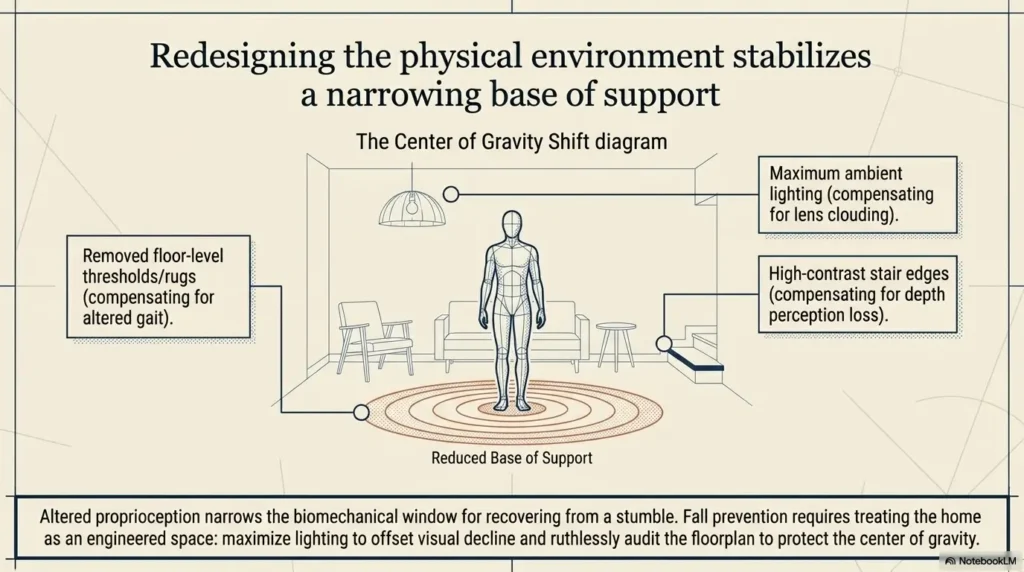
Fall Prevention Begins Where the Eye Looks Down Too Late
Presbyopia is a near-vision issue, but home safety is not neatly divided into “near” and “far.” A person looks down to read the floor, judge a threshold, find slippers, or avoid a cord. If the edge is low contrast, the eyes may not catch it in time.
Falls often happen during ordinary routines. That is what makes prevention so powerful. You are not trying to defeat a dragon. You are trying to move the laundry basket.
Clear cords, curled rugs, low baskets, pet bowls, and slippers from daily routes
Focus on daily routes first: bed to bathroom, chair to kitchen, entryway to living room, bedroom to phone charger, bathroom to closet.
Remove cords from walking paths. Secure or remove curled rugs. Move low baskets and pet bowls out of foot traffic. Give slippers a parking spot that is visible but not in the route.
For broader fall prevention ideas connected to aging vision, use aging vision fall prevention at home as a companion resource.
Mark stair edges and thresholds with high-contrast tape or visual cues
Stair edges should be visible in daylight and evening light. High-contrast stair tape, better lighting, and clutter-free landings can reduce uncertainty. Thresholds should stand out from the floor on both sides.
Temporary painter’s tape can help test contrast before making a permanent change. If the tape helps, replace it with a durable, appropriate material that will not peel into a new trip hazard. Safety should not molt.
The hallway test: can they see the next safe step before taking it?
Stand at the bedroom door at night. Can the person see the path to the bathroom? Is the floor clear? Is the bathroom doorway visible? Does the light switch require crossing a dark room?
Low night lighting, clear route edges, and stable furniture placement can help. If walking guidance is part of the family routine, low-vision walking guidance can help caregivers offer support without grabbing, steering, or startling.
Common Mistakes That Make Presbyopia Safety Worse
The most common mistakes come from good intentions wearing roller skates. Someone wants to help quickly, buys three products, moves five things, and accidentally makes the home less familiar.
Safety changes should be visible, consistent, and respectful. The person using the home should know what changed and why.
Mistake 1: assuming brighter always means safer
Brighter can mean safer, but it can also mean glare. The better question is: can the person see the detail without discomfort?
Glossy mail, shiny pill bottles, white tile, and reflective counters can make bright light harsh. If glare is part of the problem, articles like reading glossy mail without glare and white tile floor glare fixes may help refine the setup.
Mistake 2: buying tiny “senior gadgets” with unreadable buttons
Some products marketed to seniors still have tiny buttons, low contrast, confusing menus, or glossy labels. A gadget that requires a magnifying glass to operate is not a solution. It is a prank in retail packaging.
Before buying, check button size, contrast, sound, tactile feedback, battery changes, and whether the person can use it on a tired day.
Mistake 3: fixing the living room but ignoring the bathroom at 2 a.m.
The living room is easy to notice because everyone sits there. The 2 a.m. bathroom route is easy to ignore because nobody schedules a design meeting in the hallway at midnight.
But nighttime routes are high stakes. Prioritize bed, bathroom, hallway, slippers, phone, glasses, and light switches. A dedicated guide to low-vision nighttime bathroom safety can help you sharpen that route.
Mistake 4: organizing for the caregiver instead of the person using the home
A caregiver may create a beautiful system that makes sense to the caregiver’s brain. The senior may use it once and quietly return to the old method because the new one feels foreign.
Ask the person to demonstrate the routine. Then adjust the system around their actual habits. A system that gets used imperfectly is safer than a perfect system that becomes furniture.
Money Block: Before You Buy Anything
- Gather: A list of the three most frustrating daily tasks.
- Photograph: The current lighting and contrast problem in each spot.
- Measure: Shelf space, counter space, cord length, and walking clearance.
- Test: Whether large print, contrast tape, or a tray fixes the issue first.
- Ask: Whether the senior would actually use the product every day.
Neutral action line: Spend ten minutes testing the problem before spending money on a product.
Room-by-Room Home Safety Checklist for Seniors with Presbyopia
Use this checklist as a practical lap through the home. The goal is not to fix every possible hazard in one heroic afternoon. Heroic afternoons tend to end with a sore back and three unlabeled bins.
Choose the rooms used most, then the routes used when tired.
Entryway: keys, shoes, mail, steps, and glare
- Place keys in a high-contrast bowl or hook near the door.
- Keep shoes out of the walking path.
- Add lighting that does not glare through glass doors or shiny flooring.
- Use a visible tray for mail that needs reading later.
- Mark step edges or thresholds if they blend into the floor.
If keys are a recurring headache, a low-vision key identification system can reduce fumbling at the door.
Living room: remotes, cords, rugs, seating edges, and reading spots
- Move cords away from walking routes.
- Remove or secure curled rugs.
- Put reading glasses in a bright tray beside the favorite seat.
- Use a large-button remote if the current one requires squinting.
- Add a task lamp for books, mail, crafts, or crossword puzzles.
- Make chair edges visible if the seat blends into the floor.
For screen glare, compare options such as an anti-glare screen protector or TV glare reduction steps before buying a new device.
Kitchen: labels, stove controls, knives, timers, and food dates
- Label frequently used controls in large, high-contrast print.
- Use tactile markers for important appliance buttons.
- Choose cutting boards that contrast with common foods.
- Store knives visibly and safely.
- Use big timers with clear sound or vibration.
- Mark food expiration dates in large print when needed.
Expiration dates are especially sneaky because they often hide in folds, ink dots, or shiny packaging. A guide to reading expiration dates with low vision can make this kitchen task less maddening.
Bathroom: bottles, wet floors, toilet edges, grab bars, and night lighting
- Make shampoo, conditioner, body wash, and lotion visually distinct.
- Use visible non-slip mats or strips.
- Add contrast around toilet seat, tub edge, and grab bars.
- Keep floor clutter out of the route.
- Use gentle night lighting from bed to bathroom.
- Check that glasses, eye drops, or medications are not stored where they can fall into water.
Bedroom: glasses, medications, phone, slippers, and nighttime route
- Put reading glasses in the same visible place every night.
- Keep phone charging cords away from the walking path.
- Place slippers beside the bed, not in the route.
- Use a clock with large, readable numbers if needed.
- Keep emergency information easy to find.
- Make the route to the bathroom visible without harsh overhead light.
A low-vision clock can help if the person checks time at night and struggles with small numbers. For emergency details, consider a wallet card emergency information template so critical information is not trapped in someone’s memory during a stressful moment.
- Check the rooms used when tired or rushed.
- Make daily objects visible before organizing rarely used items.
- Keep routines consistent after each change.
Apply in 60 seconds: Choose one room and remove three objects from the walking path before adding anything new.
When to Seek Help Instead of Rearranging One More Lamp
Home changes are powerful, but they are not a substitute for care when symptoms change. A house can be made safer, but it cannot diagnose dizziness, medication side effects, eye disease, or balance problems.
Use the home safety reset as a starting point. If the same near-misses keep happening, widen the circle of help.
Call an eye care professional for worsening blur, headaches, eye strain, or new symptoms
Schedule an eye exam if near blur is worsening, reading causes headaches, glasses no longer help, or the person reports new distortion, double vision, flashes, floaters, eye pain, or sudden changes.
For broader warning signs, review senior vision changes warning signs and an annual eye exam checklist for seniors.
Ask a primary care clinician about falls, dizziness, medication side effects, or balance issues
Falls can involve vision, blood pressure, strength, medications, footwear, dehydration, inner ear issues, or home hazards. A primary care clinician can help sort the possibilities.
If dizziness or blurry vision appeared after medication changes, bring an updated list to the appointment. Articles such as polypharmacy and vision problems and blood pressure medication, dizziness, and blurry vision can help families prepare better questions.
Consider an occupational therapist for home setup after surgery, illness, or repeated near-misses
An occupational therapist can observe real routines and recommend practical home changes. This can be especially useful after surgery, stroke, illness, a fall, or a major change in vision.
Before an appointment, gather photos of problem areas, a list of daily tasks that feel risky, and examples of near-misses. For preparation, use low-vision occupational therapy questions to make the visit more productive.
FAQ
What is the biggest home safety issue for seniors with presbyopia?
The biggest issue is not only blurry reading. It is blurry reading combined with low contrast, poor lighting, similar-looking objects, and rushed routines. Medication labels, stove controls, bathroom bottles, cords, stair edges, and nighttime routes deserve the first safety check.
Can presbyopia increase fall risk at home?
Presbyopia is mainly a near-vision focusing problem, but it can contribute to unsafe moments when the person cannot clearly see objects, edges, labels, or floor hazards at close range. Fall risk is usually multifactorial, so vision, balance, medications, footwear, lighting, and clutter should all be considered.
What kind of lighting helps seniors with presbyopia?
Use layered lighting: general room lighting for movement, focused task lighting for reading and medication, and gentle route lighting at night. Avoid harsh glare. The best light is positioned near the task and angled so it illuminates the object without reflecting into the eyes.
How can I make medication bottles easier to read?
Ask the pharmacist about large-print labels, clearer instructions, easy-open caps when appropriate, and accessible medication information. At home, use a plain high-contrast tray, strong task lighting, a current medication list, and a simple sorting system. Keep medicines away from patterned surfaces and dim evening light.
Are reading glasses enough to make the home safe?
Reading glasses help, but they are not the whole safety plan. The home still needs good task lighting, visible contrast, clear labels, safe walking paths, readable controls, and consistent places for glasses. A perfect pair of readers in the wrong room cannot prevent a wrong-button or wrong-bottle mistake.
What rooms should caregivers check first?
Start with the bathroom, bedroom, kitchen, and the route from bed to bathroom. These areas combine fatigue, water, small labels, heat, medication, cords, slippers, and nighttime movement. After that, check the living room, entryway, laundry area, and any place where the person reads or sorts important items.
How do I make stairs safer for someone with aging eyes?
Improve lighting, remove clutter from landings, add high-contrast visual cues on stair edges, and make sure handrails are secure and easy to find. Avoid loose tape or mats that can become hazards. If there have been falls or balance problems, ask a clinician or occupational therapist for guidance.
When should blurry close-up vision be checked by an eye doctor?
Routine near-vision blur should be discussed at regular eye exams, especially when current glasses no longer help. Seek prompt care for sudden vision changes, eye pain, double vision, flashes, floaters, new distortion, or vision loss. Do not assume every new symptom is normal aging.
Next Step: Do One Safety Lap Before Dinner
The “I didn’t see that” moment usually starts small. A cord. A bottle. A label. A step edge. A pair of glasses resting in another room like a retired witness.
The practical win is that small hazards often respond to small changes. Better light at the pill tray. A contrasting bath mat. A large-print stove label. A glasses station by the bed. A clear path to the bathroom. None of this requires the home to become a showroom or a clinic.
Before dinner today, choose one route: bed to bathroom, chair to kitchen, or entryway to living room. Remove three hazards, add one useful light, and improve one label. Take a phone photo before and after. The photo matters because safety should become visible, not theoretical.
That is the quiet promise of a good presbyopia safety reset: fewer guesses, fewer near-misses, and a home that reads back clearly.
Last reviewed: 2026-05.