

Semaglutide and Sudden Vision Loss in Seniors: 7 Shocking NAION Warning Signs I Wish I Knew
For anyone worried about semaglutide and sudden vision loss in seniors, the hardest part isn’t memorizing rare statistics. It’s knowing what to treat as an emergency when life is already crowded with meds, appointments, and fatigue.
NAION (non-arteritic anterior ischemic optic neuropathy) is a sudden blood-flow problem affecting the front of the optic nerve. It typically causes painless, one-eye vision loss or a new fixed shadow, often noticed on waking. Risk can rise with age and common overlaps like diabetes, hypertension, and sleep apnea.
The cost of guessing is simple: hours of delay can mean a bigger permanent blind spot.
This guide helps you recognize the seven same-day warning signs, spot the “stacking factors,” and use the exact phrases that unlock faster triage—without panic, and without self-adjusting meds.
I built this as a decision tool, not a fear engine.
Read this once calmly.
Save the script.
Know your baseline.
Outrun delay.
- A fast symptom-to-action path you can follow half-asleep
- A short risk-stack checklist for your next visit
- A one-minute call script that gets you routed correctly
Table of Contents
Why this matters for seniors on semaglutide
Semaglutide sits in an awkward space for older adults: it can be genuinely life-changing for blood sugar control and weight reduction, but the conversation around rare eye risks has gotten louder and more confusing. The problem isn’t just fear. The problem is timing. If something serious happens, your outcome can hinge on whether you treated the signal like a mild nuisance or an urgent event.
I’ve watched smart, careful people do the “wait a week and see” dance because they didn’t want to be dramatic. That hesitation isn’t character failure—it’s a normal bias toward optimism. But with sudden vision changes, optimism is the wrong tool.
Bold takeaway: With rapid vision changes, your best move isn’t perfect certainty—it’s fast evaluation.
Newer discussions in late 2024 and early 2025 continued to explore links between GLP-1 drugs and certain optic nerve events; the clinical nuance is still evolving, but the practical response remains stable: recognize the pattern and act quickly. (Source, 2025-02)

NAION in plain English: the 90-second anatomy
NAION stands for non-arteritic anterior ischemic optic neuropathy. Translation: a blood-flow problem at the front part of the optic nerve that can damage vision. It’s often described as sudden, painless vision loss, frequently noticed on waking. The optic nerve is like a high-speed cable carrying visual information to your brain. When its blood supply dips at the wrong time, you can lose a chunk of your visual field quickly.
Many clinicians also talk about a “crowded optic disc” anatomy in some patients, which can make the nerve more vulnerable. Add common senior risk factors—diabetes, hypertension, sleep apnea—and you get a stack that deserves respect.
Show me the nerdy details
NAION is typically distinguished from arteritic optic neuropathy (often linked to giant cell arteritis). The clinical urgency is different, but both require rapid evaluation. The key practical point: sudden field loss or new shadow without pain can still be a nerve emergency.
1 number to keep in mind: hours matter more than days for triage. A tiny delay can mean a bigger permanent deficit. This isn’t a scare tactic—it’s the logic of ischemic injury.
The 7 warning signs that deserve same-day action
These are not meant to turn you into a self-diagnosing detective. They’re meant to cut through the fog when you’re tired, busy, or unsure whether you’re “overreacting.” If you recognize any of these, treat it as an urgent eye evaluation issue.
- 1) Sudden dimming or “gray curtain” in one eye. Especially if it appears within hours.
- 2) New blind spot or missing patch of your visual field. The world can look “cropped.”
- 3) Vision noticeably worse on waking. A classic pattern clinicians take seriously.
- 4) Painless, rapid drop in clarity. No redness or gritty irritation to explain it.
- 5) Colors look washed out in one eye. Subtle but meaningful.
- 6) New difficulty reading despite stable glasses. Letters look incomplete or smudged.
- 7) A “shadow” that doesn’t move or blink away. Not the same as fleeting floaters.
When I first read patient stories describing the “missing corner of the world” feeling, I realized how easy it would be to dismiss as fatigue. The uncomfortable truth: fatigue doesn’t usually carve out a clean chunk of your field.
- Sudden + painless is a red flag
- Morning-worse pattern matters
- One-eye asymmetry is a clue
Apply in 60 seconds: Cover each eye separately and check for any “missing zone.”
Who is higher risk: the “stacking factors” list
Risk isn’t a single switch. It’s a stack. For seniors considering or already using semaglutide, these are the factors that deserve a clearer conversation with your prescriber and, when appropriate, your eye specialist.
- Age over 50, with higher baseline risk as decades add up.
- Diabetes or long-term glucose variability.
- Hypertension, especially if blood pressure dips overnight.
- Sleep apnea (diagnosed or strongly suspected).
- History of NAION in the other eye.
- Anatomy described as a small or “crowded” optic disc by your ophthalmologist.
I used to think risk discussions were mostly paperwork theater. But the older I get, the more I respect the boring logic of stacked probabilities. You don’t need to be “high-risk” to act fast; you just need to be honest about your baseline bundle.
Show me the nerdy details
Some hypotheses proposed in recent literature focus on vascular regulation, rapid metabolic shifts, and pre-existing vulnerability of the optic nerve head. Evidence is still emerging; this is why the action plan should be symptom-driven rather than rumor-driven.

Eligibility checklist: are you in the higher-caution group?
Answer Yes/No:
- Are you 60+?
- Do you have diabetes or long-standing hypertension?
- Have you been told you might have sleep apnea?
- Have you ever had unexplained sudden vision changes?
- Did an eye doctor mention a “crowded” optic nerve?
Next step if you answered “Yes” to 2+: Ask for a brief, documented risk-benefit note and clarify what symptoms should trigger same-day care.
Save this checklist and confirm your personal risk profile at your next eye exam.
What to do today if you notice a symptom
This is the section you hope you never need. But you’ll be glad you read it once, calmly, before a stressful morning makes everything feel louder.
- Step 1 (now): Cover each eye separately. Note what’s missing or dim.
- Step 2 (within 10 minutes): Take a photo of your medication list and dose schedule.
- Step 3 (same-day): Call an eye clinic or emergency department and say: “I have sudden painless vision change in one eye.”
- Step 4: If you have headache, jaw pain, scalp tenderness, or systemic symptoms, mention them immediately to rule out arteritic causes.
I once wrote down a “future emergency script” after realizing my brain goes blank under stress. It felt theatrical until the day a family member woke up with a new visual shadow. That little script shaved at least 20 minutes off the chaos.
- Describe the symptom clearly
- Bring your med list
- Ask for same-day triage
Apply in 60 seconds: Save a note in your phone titled “Vision Emergency Script.”
Medication decision card: continue, pause, or switch
This is where fear can hijack logic. The goal is not to demonize semaglutide. The goal is to handle a potential optic nerve emergency with the same disciplined process you’d use for a chest pain workup: symptom first, then risk-benefit recalibration.
When A vs B (fast logic):
- A) You have sudden vision loss or a new fixed shadow. Treat as emergency. Do not self-adjust doses without clinician instructions, but be prepared that your team may advise a temporary pause while evaluating.
- B) You have no symptoms but worry about risk. Schedule an eye check, review sleep apnea and blood pressure management, and ask for a written risk-benefit plan.
Time/cost trade-off: A same-day evaluation may cost an afternoon; waiting may cost permanent field loss.
In 2024-2025 discussions, clinicians emphasized that stopping a diabetes or weight-loss medication abruptly without a plan can introduce its own risks. That’s why your best move is to show up fast and let your care team document the decision path. (Source, 2025-03)
Quote-prep list: what to gather before you call
- Current semaglutide dose and start date.
- Recent changes in weight, appetite, or blood sugar.
- Blood pressure readings if you track them.
- Sleep history: snoring, daytime fatigue, CPAP use.
- Any prior eye diagnoses (AMD, glaucoma suspect, diabetic retinopathy).
Save this list and confirm the current clinical advice on your provider’s official page.
Coverage and cost planning for urgent eye care, 2025 (US)
Even if you’re reading this from outside the U.S., the structure of the decision is useful: urgent eye symptoms often route through emergency care, which means insurance rules and out-of-pocket uncertainty can become a second layer of stress. The trick is to prepare a tiny “coverage packet” so you don’t waste your first 30 minutes in a panic spiral about costs.
For U.S. seniors, this might include Medicare Part B details, any Medicare Advantage plan documents, and your preferred in-network hospital list. Yes, it’s dull. Yes, it can save you 20–40 minutes during an urgent episode.
Quick planner (2025-ready):
- Coverage tiers to check: emergency department, urgent ophthalmology, imaging, specialist consult.
- Deductible status: note whether it’s met for the year.
- Prior authorization: usually not for true emergency evaluation, but follow-up imaging may vary by plan.
Neutral action line: Save this note and confirm your plan’s current emergency and specialist benefits before your next refill.
Because this topic touches both medical urgency and insurance reality, I treat it like a two-lane road: protect the eye first, then clean up the billing questions after you’re safely evaluated.
If you’re in Korea: the practical, low-friction path
In South Korea, access to ophthalmology is often faster and more geographically dense than in many countries. That’s a quiet advantage—but only if you use it promptly. If you notice sudden one-eye dimming, a fixed shadow, or a field gap, the most realistic path is to head to a hospital emergency department that can coordinate urgent ophthalmology evaluation or to a large eye center with same-day triage.
The cultural temptation to “endure a day and see” is understandable. But with optic nerve events, that extra day is rarely a bargain. If you’re older and on semaglutide, this is one of the few times where being “a little dramatic” is actually being responsibly fast.
Bold takeaway: In Korea, speed is your advantage—use it.
The 60-second risk conversation starter (discussion tool)
This is not a medical risk calculator. It’s a conversation accelerator. Its only job is to help you walk into a visit with clarity, not anxiety.
Save this script and confirm your personalized plan with your prescriber and eye specialist.
Visual roadmap infographic: from symptom to action
Short Story: The morning I learned “painless” doesn’t mean “safe”
Short Story: A retired teacher I know kept a neat routine: morning tea, glucose check, a quiet walk. One day she noticed a faint dark wedge in her right eye. No pain, no redness, no drama. She almost postponed calling because she didn’t want to “waste a doctor’s time.” Her daughter insisted they go in. The ophthalmology team took it seriously immediately. The phrase that changed everything was simple: “sudden, painless, one-eye field loss.” That wording unlocked the right triage path. The teacher later told me the hardest part wasn’t the clinic visit—it was admitting she needed urgency without certainty. The lesson landed hard: sometimes your body whispers, and the correct response is still a sprint.
Less-obvious symptoms and look-alikes
Not every visual disturbance is NAION. In fact, most aren’t. But confusion is exactly why you need a short mental sorting hat.
- Floaters: Often moving specks; still urgent if accompanied by flashes or a curtain-like shadow.
- Dry eye: Scratchy, variable blur that improves with blinking or drops.
- Medication-related transient blur: Can occur with glucose shifts, but typically doesn’t create a fixed field defect.
I used to lump all blur into one bucket—a mistake that makes you slow when speed matters. The cleaner rule is this: fixed, new, one-eye gaps get urgent evaluation.
- Moving specks ≠ fixed wedge
- Scratchy variability suggests surface issues
- Field loss suggests nerve/retina urgency
Apply in 60 seconds: Write down whether the symptom moves, fades, or stays fixed.
How to talk to your doctor without getting brushed off
Clinicians triage by keywords and patterns. It’s not personal. It’s survival in a crowded system. Using the right phrase can save you 15–30 minutes and get you onto the correct pathway.
- Say: “Sudden painless vision change in one eye.”
- Add: “New field defect / fixed shadow.”
- Mention: semaglutide dose, start date, and any recent rapid metabolic changes.
- Ask: “Do I need same-day ophthalmology or emergency evaluation?”
I’ve learned that a short, structured explanation feels less like panic and more like a clean signal. Your goal is to hand them a triage-ready story.
Show me the nerdy details
Structured symptom language helps differentiate optic nerve events from surface or refractive issues and guides decisions about imaging, inflammatory workup, and urgent referrals.
Balancing benefits and risks without emotional whiplash
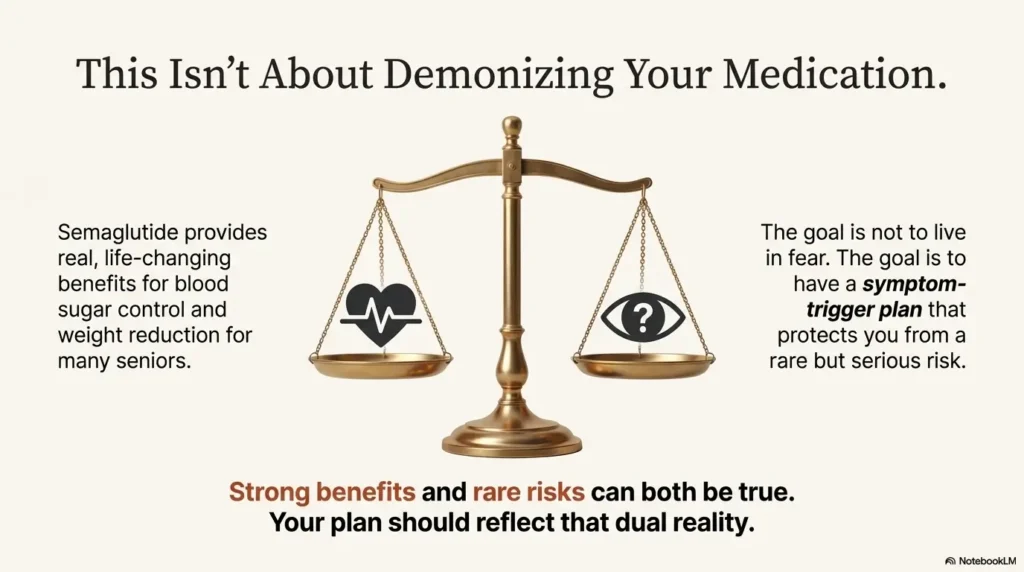
Semaglutide can reduce cardiovascular and metabolic risk for many patients with diabetes and obesity. For a lot of seniors, that benefit is not theoretical—it shows up as steadier glucose, lower weight strain on joints, and fewer day-to-day spikes that erode quality of life.
So the question isn’t: “Is semaglutide good or bad?” The question is: “Do I have a symptom-trigger plan and a risk-stack review that makes me feel protected rather than lucky?”
Bold takeaway: Strong benefits and rare risks can both be true—your plan should reflect that dual reality.
That mindset turns anxiety into a checklist you can actually complete in 5–10 minutes.
Questions to ask at your next visit
If you want a high-value, low-drama consultation, these questions keep the conversation crisp and documented.
- “Given my age and conditions, am I in a higher-caution NAION group?”
- “Should I have a baseline eye exam or optic nerve note before dose escalation?”
- “If I get sudden vision changes, should I call you first or go straight to urgent care?”
- “How do we balance my glucose and cardiovascular goals with this eye safety plan?”
I prefer a written note in the chart that states the plan plainly. It reduces confusion later and protects you from the “I thought you said…” fog in an emergency.
Late-article safety net: what you should remember tomorrow morning
If nothing else sticks, keep this compact triad:
- Sudden + painless + one eye is urgent.
- Fixed shadow or missing patch is not a “wait a week” symptom.
- Bring your med list and your risk-stack snapshot.
The world is full of health advice that demands you become a part-time clinician. This isn’t that. This is a time-poor person’s rulebook for one specific cliff-edge scenario.
- Save the emergency script
- Know your risk stack
- Don’t self-manage dose changes mid-crisis
Apply in 60 seconds: Screenshot your current medication list and pin it to your phone’s favorites album.
Last-mile steps, plus a simple update log
By this point, the “seven warning signs” should feel less like a scary headline and more like a practical map. That was the whole point. You’re not trying to predict a rare event. You’re trying to outperform delay if it ever shows up.
Commercial entities worth knowing in neutral context: the FDA for safety labeling, the American Academy of Ophthalmology for patient education, and your insurer’s plan documents if you’re navigating Medicare Advantage or private coverage tiers. None of these are perfect, but together they give you a safer decision triangle.
Last reviewed: 2025-12; informed by current labeling awareness, major ophthalmology guidance, and peer-reviewed discussions available through 2024-2025 summaries.
FAQ
Is NAION common in people taking semaglutide?
Current discussions suggest the overall event remains uncommon, but attention has increased because semaglutide use is widespread among older adults with overlapping vascular risk factors. The practical takeaway is unchanged: focus on sudden symptom patterns rather than internet odds. Apply in 60 seconds: Save a note that lists the three red flags: sudden, painless, one-eye field loss.
Should I stop semaglutide if I’m scared?
Don’t stop abruptly without a clinician plan. The medication may be providing real cardiometabolic benefit. A safer approach is to request a brief, documented risk-benefit review and ask what symptoms would justify urgent evaluation or temporary adjustment. Apply in 60 seconds: Message your clinic asking for a “semaglutide + vision symptom action plan.”
What’s the single most important warning sign?
A new, fixed shadow or missing wedge of vision in one eye—especially noticed on waking—deserves same-day evaluation. This is the pattern most likely to be misread as fatigue. Apply in 60 seconds: Do the one-eye cover test right now so you know your normal baseline.
If I already have AMD or diabetic retinopathy, does that change anything?
It can complicate the symptom picture and raises the value of baselines and rapid triage. You may need a more explicit plan for distinguishing typical fluctuations from sudden new deficits. Apply in 60 seconds: Ask your eye clinic to document your baseline optic nerve and retinal status at your next visit.
How fast should I seek care?
Hours matter. If the change is sudden and persistent, same-day evaluation is the safer rule. Think “urgent now,” not “watchful optimism.” Apply in 60 seconds: Put the nearest eye-capable emergency department in your phone favorites.
Does sleep apnea really matter here?
Sleep apnea is a commonly cited risk factor in optic nerve ischemic events, and it’s underdiagnosed in older adults. Addressing it is one of the few risk levers you can actually pull. Apply in 60 seconds: If you snore loudly or wake unrefreshed, note it and bring it up at your next primary care visit.
Conclusion: the calm, fast next step
This headline is dramatic for a reason: sudden vision loss is one of the rare health moments where a small delay can carry an outsized cost. But the antidote is refreshingly simple. You don’t need to live in fear of semaglutide. You need a plan that respects both its benefits and the reality of optic nerve emergencies.
Close the loop from the intro: the thing I “wish I knew” wasn’t a secret statistic. It was a behavioral rule: treat sudden, painless, one-eye field changes as urgent until a professional proves otherwise.
Your 15-minute next step: run the discussion tool above, screenshot your medication list, and draft a two-sentence emergency script. If you have diabetes, hypertension, or suspected sleep apnea, ask your clinician to document a brief risk-benefit note at your next visit. That tiny paper trail can make your future self faster, calmer, and safer.