


Wet AMD Injections After 75: How to Ask Adult Children for Rides and Appointment Help (Without Losing Independence)
The hardest part of wet AMD injections after 75 often isn’t the procedure.
It’s the quiet reality that a “quick visit” can swallow a 2–4 hour block and require a driver, a calendar, and a calm backup plan.
If you’ve spent a lifetime running your own life, needing help for anti-VEGF injection days can feel like an identity tax. The friction isn’t weakness. It’s the fear that one ride request will turn into a slow handoff of authority.
Keep guessing, and you risk missed appointments, unnecessary family tension, and a creeping sense that your world is shrinking.
A wet AMD injection day is a recurring treatment visit that may include dilation, bright lights, temporary blur, and post-procedure caution—making same-day driving risky for many patients. The clinical routine is predictable; the logistics should be, too.
This post helps you ask for help without surrendering your role—using short scripts, a two-layer transport system, and decision tools that respect your leadership. I’ve built this like a practical playbook, not a pep talk.
Here’s the shift that changes the mood: Small, specific, time-bound. Plan A and Plan B—no guilt loops.
- Protect your independence with bounded asks.
- Reduce scheduling chaos with a repeatable ride system.
- Keep control of medical decisions while delegating transport.
Table of Contents
Why this ask feels so hard
When you’ve lived long enough to solve your own problems for decades, asking for rides can feel like surrender. Not because you can’t handle logistics. But because the subtext screams, “I’m becoming dependent.” And that’s a lie your nervous system believes faster than your intellect can correct.
I’ve watched people who can still manage finances, meals, and complex decisions freeze at the simple sentence: “Can you drive me?” They’re not weak. They’re protecting identity.
Here’s the reframed truth: wet AMD injections after 75 often require a safe plan for transport and recovery, and that plan can be a sign of strength. You’re not handing over your autonomy; you’re delegating a task so you can keep your bigger role.
- Your identity is more than one task
- Delegation protects dignity
- Clarity reduces family stress
Apply in 60 seconds: Write one sentence that starts with “I’m still in charge of my care, and I need help with…”
What wet AMD injection days really require
Wet AMD is commonly treated with anti-VEGF injections. The schedule can vary, but many people experience a pattern of more frequent visits early on, with follow-ups that might be spaced to every few weeks or months depending on response. The point isn’t the exact interval; the point is the predictable disruption.
Injection day can include dilating drops, bright lights, a temporarily irritated eye, and a short recovery window. Even if you feel steady, your clinic may recommend avoiding driving immediately after. That transforms a 15-minute procedure into a 2–4 hour life event, especially when you add commute, waiting, and pharmacy stops.
I once underestimated how much energy “just one appointment” steals. By the time I’d finished the visit, I still had the mental load of texting updates, finding lunch, and deciding whether I was “fine enough” to be independent on the way home. That’s the sneaky fatigue that makes a clean ride plan feel like oxygen.
Your goal isn’t to need less help. Your goal is to need help in a way that is structured, finite, and respectful of your authority.
Show me the nerdy details
Anti-VEGF therapy is designed to reduce abnormal vessel growth and leakage in the macula. Clinicians may adjust schedules based on imaging and symptoms. For you and your family, the practical implication is simple: assume a repeating cadence, build a reusable ride plan, and update it when the clinical interval changes.
The independence-first ask script you can use today
This is the sentence that changes everything: lead with your plan, not your need.
Adult children often worry about two things you may not say out loud: safety and uncertainty. If you remove uncertainty, you reduce emotional friction by about 50%—not by magic, but by logistics.
Script A (direct + calm, 20 seconds):
“I’m managing my treatment schedule, and my next injection is on Tuesday. I need a ride there and back because of the dilation. Can you be my primary driver for this month? I’ll send the exact times and a backup plan.”
Script B (boundaries built in):
“I want to stay independent while I protect my vision. I’m asking you for rides on injection days only—nothing else. I’ll handle booking, reminders, and paperwork.”
Script C (for busy families):
“If you can’t do the full ride, could you do the drop-off? I’ll use a backup option for the return.”
I used a version of Script B once and felt the emotional temperature drop instantly. Not because my family suddenly became saintly—but because I made the ask small, specific, and time-bound.
- Make it time-bound
- Name the exact task
- Protect your leadership role
Apply in 60 seconds: Text your child a two-line version of Script B with the next date and time window.
Build a two-layer ride system, 2025 (US), with backups
Hope is not a transport strategy. A two-layer system is.
Layer 1 is your “human-first” plan: an adult child, spouse, friend, or trusted neighbor. Layer 2 is your “no-drama backup” plan: rideshare, community senior transport, paratransit, or a paid caregiver driver.
The emotional relief of Layer 2 is massive. It turns the question from “Will I be a burden?” into “Which option do I activate if Plan A is unavailable?” That single mental flip can save 10–20 minutes of anxious thinking the night before an appointment.
Mini transport estimator (60 seconds)
Input 1: One-way travel time (minutes)
Input 2: Expected clinic time (minutes)
Input 3: Your backup ride budget per visit (USD)
Output: Your injection-day “real time” window and a comfort budget band.
Example: 25 + 90 + $25 → plan a 3-hour block and keep $20–$40 available for backup rides.
This is a planning tool, not a price quote; costs vary widely by city and provider.
Neutral next step: Save this estimate and confirm today’s local transport rates on the official provider page.
Eligibility checklist and transport options that don’t feel like defeat
Let’s name the quiet problem: many people avoid community options because they feel like a “senior label.” But the right framing is performance, not age. You’re choosing the tool that best protects your eyes and energy.
Eligibility checklist (yes/no)
- Is your vision blurred or light-sensitive after dilation? Yes → plan a driver for return.
- Do you have at least 1 reliable person for Layer 1? No → formalize Layer 2 now.
- Does your clinic offer guidance on post-injection driving? No → ask at your next visit.
- Can you budget a small backup amount per visit? Yes → add it to your monthly plan.
Neutral next step: Screenshot this list and ask your clinic which item they consider non-negotiable for your case.
Fee/Rate planning table (heuristic, 2025)
| Option | Planning range per round trip | Best for | Notes |
|---|---|---|---|
| Adult child / family | $0–$15 | Emotional safety + continuity | Offer a predictable schedule to reduce friction. |
| Rideshare/taxi | $20–$60 | Fast backup, short notice | City, distance, and surge pricing change totals. |
| Community senior ride | $0–$25 | Budget-friendly routine | May require advance booking. |
| Paratransit / medical transport | $5–$40 | Mobility or safety needs | Eligibility rules vary by region. |
These are planning bands to reduce surprise. They are not official quotes.
Neutral next step: Save this table and confirm the current fee with your local service.
Decision card: adult child vs rideshare vs community ride
If your brain tends to overthink this at 11 p.m., you’re not alone. Decision cards exist to stop the spiral.
Choose Adult Child when: you want emotional ease, consistent communication, and help with check-in.
- Time cost for them: 2–4 hours including travel.
- Your benefit: less cognitive load on a high-stress day.
Choose Rideshare when: schedules collide, you need short-notice coverage, or you want to keep family bandwidth for bigger tasks.
- Budget trade-off: plan a backup band per visit.
- Time benefit: reduces family coordination by 10–15 minutes.
Choose Community/Paratransit when: you have a stable, recurring schedule and want predictable cost control.
- Best with early booking and a repeat route.
- Works well as Layer 2 for reliability.
Neutral next step: Pick one default option for the next 2 appointments and review after you’ve experienced the workflow.
- Default to a two-layer system
- Make one option automatic
- Review every 2 visits
Apply in 60 seconds: Write “Plan A / Plan B” at the top of your appointment note.
How to keep your role, not just your ride
Independence is not a binary switch. It’s a portfolio.
You can keep the tasks that signal leadership while delegating the ones that carry safety risk. The simplest split looks like this:
- You keep: booking the appointment, choosing the clinic, tracking symptoms, asking clinical questions.
- They handle: driving, waiting-room companionship (if you want it), and the “second set of ears” during instructions.
I’ve seen families stabilize emotionally when the older parent explicitly names this division. It reassures adult children that you’re not handing them a blank check of responsibility.
Small boundary phrases help:
- “I’m asking for rides on injection days only.”
- “I’ll keep the medical decisions and updates.”
- “If you’re busy, I’ll activate my backup plan.”
That last sentence is not just polite. It’s power.
Short Story: The morning I stopped apologizing for my eyes (120–180 words)
I used to rehearse my request like a guilty teenager. “Sorry to bother you.” “I know you’re busy.” “It’s just one appointment.” I didn’t realize I was shrinking myself before I even asked. The day I changed it, nothing about my eyes was different—but everything about my posture was.
I texted my daughter: “I’m protecting my vision. Dilation means I need a driver. Can you take me Tuesday 10–1? If not, I’ll use my backup ride.” That was it. No apology. No over-explaining. Just a clean plan with a clean escape hatch.
She replied within minutes: “Of course. Thanks for making it easy.”
In the car, we talked about groceries and a new song she loved. The ride became a normal life moment—not a dramatic chapter. I realized independence isn’t proven by doing everything alone. It’s proven by choosing help without surrendering your voice.
Appointment-day checklist that saves 20 minutes
Injection days run smoother when you treat them like a repeatable flight plan. Not romantic, but very effective.
- 24 hours before: confirm time window, parking, and your Plan B ride.
- Morning of: bring sunglasses, eye drops if advised, and a simple snack.
- At check-in: ask one clear question about your next interval.
- After: text one-line status update to reduce family worry.
Micro-habit that helps: I keep a single note called “Eyes – Injection Day.” It holds my last two appointment dates, the name of the medication if I’m told it, and my transport plan. Updating it takes 60–90 seconds and prevents memory fog from turning into anxiety.
Quote-prep list for transport services
- Your address and clinic address
- Your appointment pattern (monthly vs every 2–3 months)
- Whether you need door-to-door assistance
- Your backup budget band
Neutral next step: Keep this list in your phone and request a written estimate from any paid service you consider.
A brief note for readers in Korea
If you’re reading from Korea, your transport ecosystem may look different from the U.S. Many cities have senior-friendly options through local districts, welfare taxi programs, or community ride services, and some hospitals maintain guidance desks that can point you to regional resources. The cultural challenge can be sharper: asking family can feel emotionally heavier because it’s wrapped in deeper expectations.
That’s exactly why the two-layer system matters. Pair a family-first plan with a formal backup option so your request stays bounded. Even if you never use the backup, knowing it exists lowers guilt and reduces the “all-or-nothing” family dynamic that can quietly exhaust everyone.
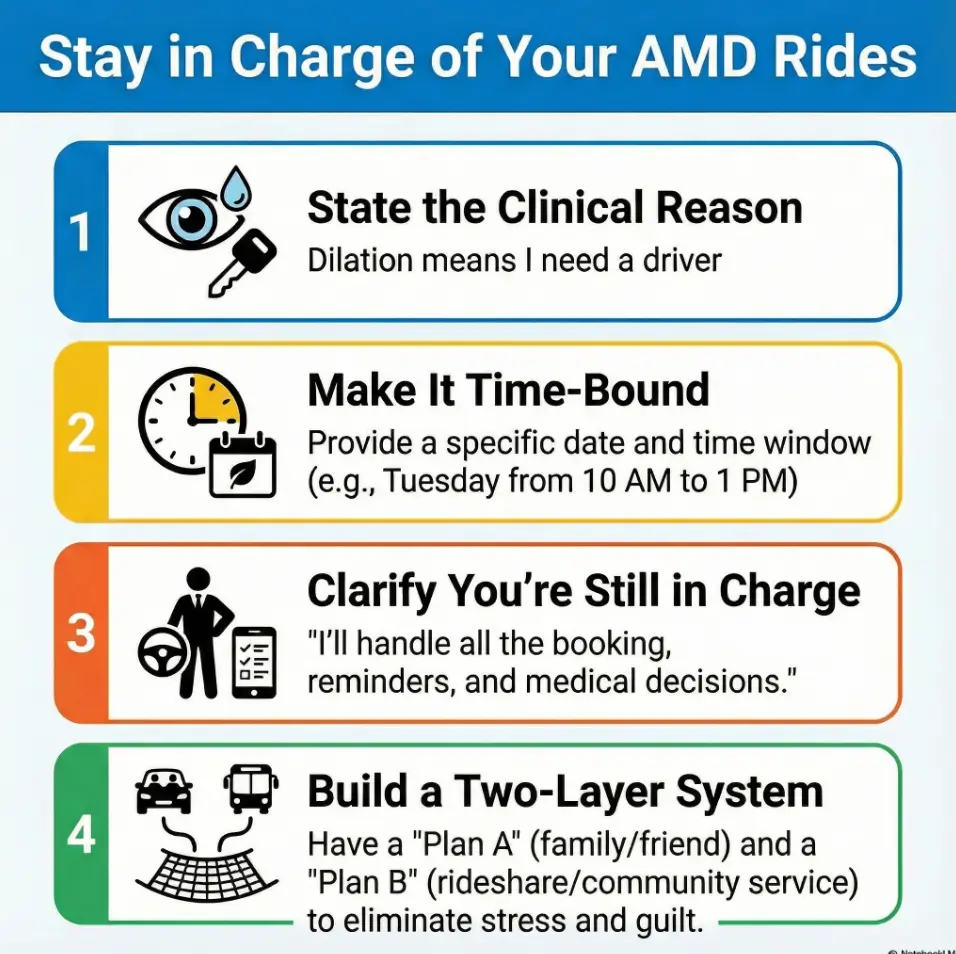
Infographic: the ride-help independence map
“Dilation means I need a driver.”
Reduces debate in 10 seconds.
“Tuesday 10–1 this month.”
Protects everyone’s calendar.
“I’ll handle booking and decisions.”
Signals leadership.
- Plan A: adult child / trusted person
- Plan B: rideshare / community / paratransit
Goal: fewer guilt loops, safer returns, more energy for your real life.
Build your shared calendar and micro-updates without feeling managed
Many older adults fear the “project management takeover.” The trick is to keep the system small enough that it feels like support, not surveillance.
Try a three-item rhythm:
- One shared calendar event with a 2–3 hour block.
- One pre-appointment text: “Appointment tomorrow, Plan A confirmed.”
- One post-appointment text: “Done. Heading home. Next date pending.”
That’s it. Three messages, zero drama.
I once experimented with a longer update chain. It felt efficient for my family but exhausting for me—like I owed a live broadcast of my own body. The smaller script restored dignity and still gave everyone what they needed.
Coverage tier map (help intensity)
| Tier | What changes | Who does what |
|---|---|---|
| 1 | Ride only | You lead; they drive |
| 2 | Ride + check-in support | They assist; you decide |
| 3 | Ride + note-taking | You ask questions; they record |
| 4 | Coordination help | Shared scheduling |
| 5 | Full care-day support | Only if you choose it |
Neutral next step: Choose a tier for the next two visits and tell your family which tier you prefer.
- Three-message rule
- Short time windows
- Tiered help prevents overreach
Apply in 60 seconds: Create a recurring calendar template labeled “Injection Day – Plan A/Plan B.”
When the conversation gets emotional: what to say and not say
Sometimes the first ride request opens a deeper family fear—your fear of losing independence and their fear of losing you. That’s a tender collision.
Two phrases that often help:
- “I’m not asking you to carry everything.”
- “I’m building a system so this stays sustainable.”
Two phrases to avoid (not because they’re wrong, but because they often inflame guilt):
- “I hate being a burden.”
- “I guess I have no choice.”
I said the first one once and watched my son look like he’d been handed a brick. The next time, I led with the system. The mood softened. We were on the same side again.
Neutral next step: Practice your opening sentence out loud one time before you message anyone.
Research and support you can skim in 2 minutes
If you want a fast refresher on treatment basics and patient resources, these organizations provide clear overviews you can share with family. This can save you 10–15 minutes of explanation and turns your children into informed teammates rather than anxious bystanders.
Red flags you should never ride solo for
Most injection days are routine, but there are moments when caution is smart. If you experience sudden worsening of vision, severe pain, or unusual symptoms after a procedure, you should contact your clinic promptly. This isn’t about fear; it’s about protecting outcomes.
In practical terms: if your body is sending an urgent signal, the “independence move” is not toughing it out alone. The independence move is activating the right support quickly.
- Same-day severe discomfort
- Rapid new blur or dark spots
- Feeling faint or unsafe to travel
Neutral next step: Store your clinic’s after-hours number in your phone favorites.
How to make this sustainable for busy adult children
Your children may love you fiercely and still be juggling work, school drop-offs, and their own health. The solution is not to ask less—it’s to ask smarter.
- Offer a two-appointment horizon: “Can you cover the next two visits?”
- Use repeatable time windows: mornings or early afternoons.
- Let them choose the role: driver only, or driver + check-in buddy.
One family I observed quietly stabilized when the parent created a simple rotation: Child A for odd months, Child B for even months, with rideshare backup. That’s a 2-minute system that can preserve relationships for years.
Neutral next step: Propose a simple rotation with an easy opt-out and your Plan B stated upfront.
FAQ
Do I always need someone to drive me after wet AMD injections?
Many people prefer or are advised to arrange a driver, especially when dilation is used or when the eye feels irritated after the procedure. Your clinic’s guidance should be your final reference. Apply in 60 seconds: Ask your provider, “For my case, is same-day driving a no?”
How do I ask my adult children without feeling dependent?
Lead with a bounded plan and your leadership role: “I’m managing my care. I need a driver on injection days only.” It frames help as a specific task, not a life transfer. Apply in 60 seconds: Send a two-line text with the date, time window, and your backup option.
What if my children can’t help consistently?
That’s exactly why you build Layer 2. A backup option reduces guilt and prevents last-minute chaos. Apply in 60 seconds: Price and bookmark one local rideshare or community transport option today.
How much should I budget for backup rides?
Costs vary by city and distance, but creating a planning band for each visit reduces stress. A modest backup budget can protect family relationships and keep your care consistent. Apply in 60 seconds: Choose a personal comfort band and add it to your monthly notes.
Can I use community or paratransit services for eye appointments?
Often yes, depending on local eligibility and scheduling rules. These services can be ideal for recurring wet AMD injection schedules. Apply in 60 seconds: Call your city or district senior line and ask what documentation is needed.
What should my child do during the appointment if they come with me?
The most helpful roles are simple: drive, help with check-in, and listen for next-visit instructions. You keep the medical decisions. Apply in 60 seconds: Tell them, “I’d love you to just be my driver and note-taker today.”
Closing the loop: why this is actually a strong form of independence
Let’s return to the real tension you came here with: the fear that asking for rides means you’re losing yourself. But the opposite is closer to the truth.
When you build a bounded, two-layer ride system, you’re practicing modern independence: you keep decision authority, protect safety, and reduce emotional debt. You’re not shrinking your world—you’re maintaining it with smarter scaffolding.
I’ve seen this shift turn injection days from dread to rhythm. The family stops bracing for emergencies. You stop apologizing for a predictable medical reality. Your life gets wider again in small, meaningful ways.
- Plan A + Plan B prevents guilt
- Short scripts protect identity
- Repeatable templates save time
Apply in 60 seconds: Write your Plan A/Plan B into your next appointment note and send one calm request text.
Conclusion
You don’t need a new personality to handle wet AMD injections after 75. You need a new structure. Start with one clean sentence, one time-bound ask, and one backup option. That’s enough to protect your dignity and your calendar in the same breath.
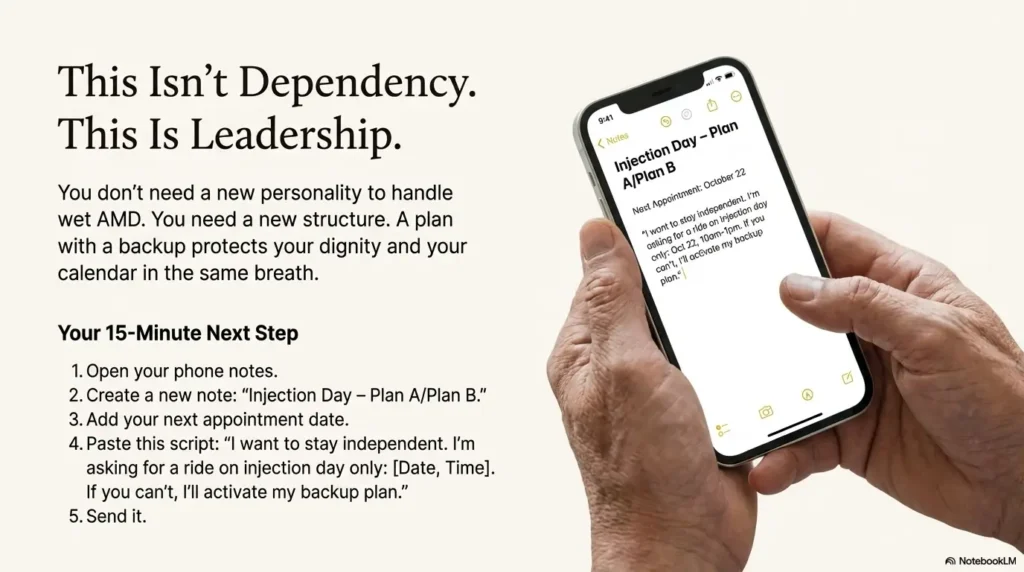
Your 15-minute next step: open your phone notes, create “Injection Day – Plan A/Plan B,” add your next appointment date, and paste Script B. Then send it to the one person most likely to say yes. If they can’t, you already have a backup. That’s not dependency. That’s leadership in a body that deserves care.