
Navigating the “Almost” Normal:
Journaling with Macular Degeneration
Some mornings with age-related macular degeneration feel almost normal, and that “almost” can be the cruellest part. The light is decent, the letters behave, and then later the page turns bright and slippery, like it’s politely refusing your hands.
If you’re a senior living with AMD, you’re not just dealing with eyesight. You’re negotiating labels, faces across a table, appointments, independence, and the quiet identity-shift nobody warned you about. Keep guessing your way through it, and the cost piles up in small ways: more anxiety loops at night, more friction with family, and more days where you feel edited out of your own life.
These journaling prompts for seniors with macular degeneration are built for real days, not perfect ones:
- • One-line “hard day” entries
- • Richer “good vision day” reflections
- • Grief-without-guilt prompts
- • Dignity-first relationship scripts
Everything stays low-vision friendly, including large print options, thick-marker notes, and voice memos or dictation when writing feels like a fight. This approach comes from watching rigid plans fail, then finally stick once the prompts matched the day.
Table of Contents
Fast Answer (Snippet-ready)
Journaling with macular degeneration (AMD) can reduce overwhelm by giving your brain a calmer “place to put things.” Use short prompts that fit your vision on tough days, and longer reflection prompts on “good vision days.” Focus on identity, grief, gratitude without guilt, and practical coping scripts for appointments and relationships. Keep it accessible: big print, voice notes, or one-sentence entries count.
- Hard days: one sentence is enough
- Good vision days: capture details you can re-read later
- Use voice notes if the page fights back
Apply in 60 seconds: Write or say: “Right now I feel ___, and what I need is ___.”
Who this is for / not for (quick fit check)
For you if: AMD is changing your routine, confidence, reading, driving, hobbies, or social life
If your days now include little negotiations you never asked for (lighting, labels, faces across a room), journaling can be a private place where you don’t have to “perform fine.” I’ve watched people do something quietly heroic here: they stop arguing with reality long enough to find a workable next step.
Also for: spouses/adult children helping a parent process vision changes (without taking over their voice)
Caregivers: your role is support, not narration. This article includes prompts for you too, but it’s designed to protect the older adult’s identity. Translation: you can hold the flashlight without holding the pen. If you’re in that role, you may also want this companion guide on helping a spouse with vision loss without taking over their voice.
Not for you if: you want medical treatment advice, supplement plans, or diagnosis guidance (this is emotional support + coping writing)
We’ll stay gently in the lane of coping and communication. For medical decisions, your eye clinic’s guidance matters most.
Not a match today if: journaling feels like “homework” right now (use the 2-minute voice-note option later)
If you’re tired, you’re not failing. Think of this as a menu, not a contract. Pick a tiny bite when you can.
Eligibility checklist: Is this journaling approach a good fit today?
- Yes/No: Can you tolerate 2 minutes of reflection without feeling worse?
- Yes/No: Do you have one accessible method (big print, thick marker, dictation, or voice memo)?
- Yes/No: Are you willing to keep entries non-judgmental (no “I should be over this”)?
- Yes/No: Do you agree to pause if distress spikes and switch to grounding?
Neutral next step: If you answered “no” to any item, choose the “hard day” one-liner section and stop there.
Start here: “Good vision days” vs “hard days” (pick the right prompt set)
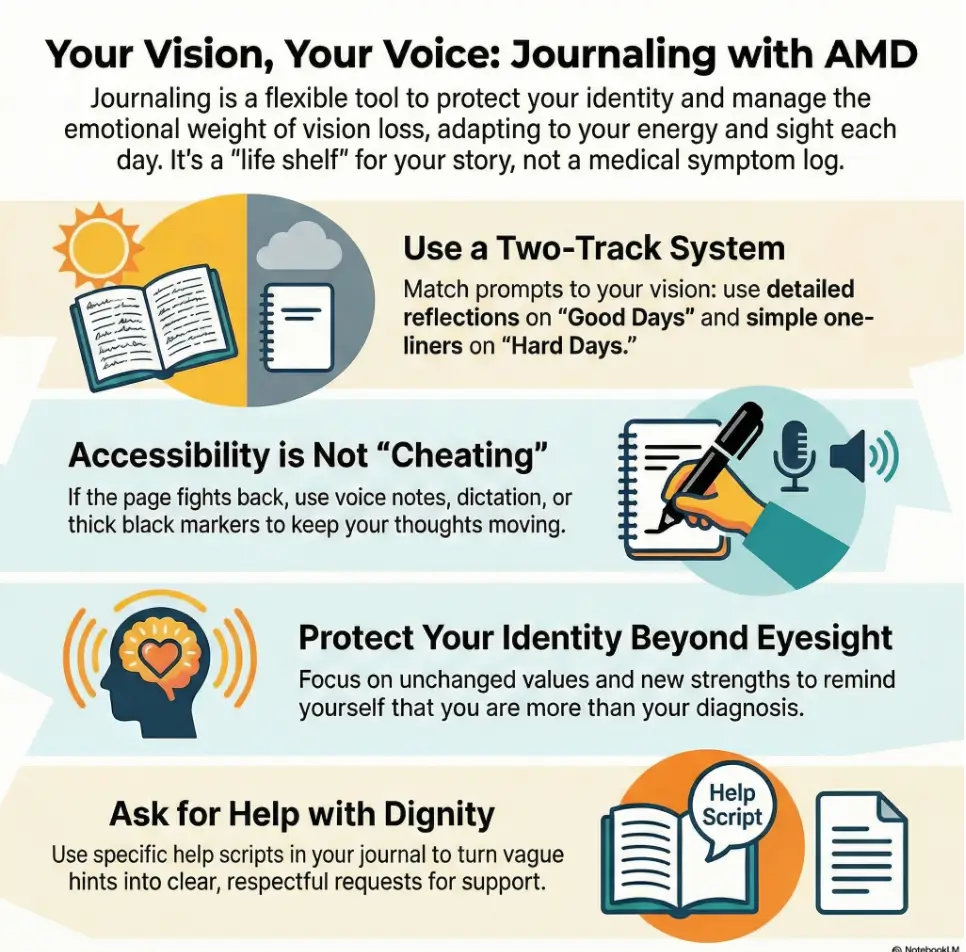
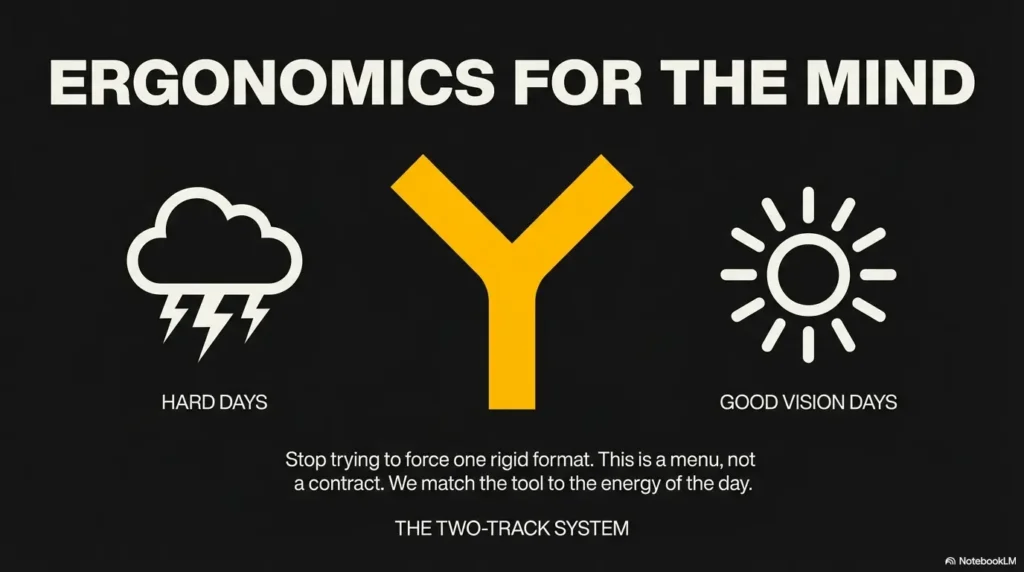
AMD often comes with variability. Some mornings you wake up and the world cooperates. Other days, the page is too bright, the letters swim, and your patience runs out before breakfast. So we match the prompt to the day. It’s not “motivation,” it’s ergonomics for the mind. (If glare is one of your biggest triggers, you might also explore glare-free lighting setups that reduce visual fatigue.)
A small personal confession: the first time I tried to help a family member set up a “daily journal,” we failed by Day 3. Not because they were lazy. Because we used one rigid format for many different kinds of days. When we switched to a two-track system, it finally stuck.
Good vision day prompts (use detail while you’ve got it)
- “Today I noticed… (3 specific visual details I still enjoy)”
- “If my eyes were a camera, the best frame today was…”
- “One thing I did because I had a clearer day was…”
Hard day prompts (minimum viable entry)
- “Right now I feel ___, and what I need is ___.”
- “One small win today was…”
- “The kindest thing I can say to myself is…”
Let’s be honest… some days the page is too bright
On those days, you’re allowed to switch tools. Use a voice memo. Use dictation. Use a thick black marker on a notecard. Or do the “one-sentence entry” and close the notebook like you’re gently putting a lid on a pot that’s boiling over. (If screens feel harsh even at the lowest setting, see how to make an iPhone screen dimmer than the minimum so the “page” stops fighting back.)
Tiny counts. One sentence is not “less journaling”
One sentence can be a whole life raft. The point isn’t length, it’s honesty and relief.
Show me the nerdy details
When your brain is stressed, it tends to recycle the same worries, especially at night. Short, structured prompts act like mental “containers” so thoughts don’t slosh everywhere. The goal is not perfect insight, just fewer loops.
The identity shift: “I’m still me” (even if the map changed)
AMD can poke at identity in sneaky ways. It’s not only “I can’t see,” it’s “I can’t do things the way I did them,” and then the mind whispers the cruel sequel: “So who am I now?” This section is for reclaiming the parts of you that were never located in the retina to begin with.
I once heard an older gentleman describe it perfectly: “My eyes changed, and suddenly everyone started talking to my daughter instead of me.” That’s not just inconvenient, it’s existential. Your journal can be a quiet rebellion against being edited out of your own story.
Prompts for selfhood beyond eyesight
- “I am more than my eyes because…”
- “What parts of me are unchanged? (3 traits, 3 values)”
- “What new strengths are emerging that I didn’t ask for?”
Prompts for roles that feel threatened (driver, reader, helper, caregiver)
- “The role I miss most is… what that role gave me was…”
- “A different way to keep that meaning might be…”
- “The kind of help that respects me is…”
What if this isn’t the end of the story, just the chapter title?
Try writing the chapter title for this season of your life. Not the ending. The title. Examples: “Learning New Routes,” “Braver Lighting,” “The Year I Stopped Apologizing.” You’re allowed to choose something that doesn’t taste like defeat.
Decision card: “Good vision day” journaling vs “hard day” journaling
Choose A: Good vision day prompts
- Best for: capturing detail, confidence, joy
- Time: 5–12 minutes
- Payoff: a “memory bank” for tougher days
Choose B: Hard day one-liners
- Best for: overwhelm, fatigue, frustration
- Time: 30–120 seconds
- Payoff: fewer spirals, more self-kindness
Neutral next step: Pick A or B for the next 3 days and reassess, instead of switching hourly.
Grief without guilt: naming losses without drowning in them
Grief with AMD can look like sadness, but also like irritability, numbness, or “I’m fine” said through clenched teeth. Many seniors were taught to be stoic, which can accidentally turn grief into a private pressure cooker. Journaling lets you name the loss without making it your whole identity.
A small scene I remember: a woman at a family dinner laughed along until dessert, then quietly said, “I miss seeing faces across the table.” No drama. Just truth. The room softened. That’s what honest naming can do.
Prompts to separate “loss” from “worth”
- “What I lost is… What I did not lose is…”
- “If I could speak to my younger self, I’d say…”
- “What I still offer the people I love is…”
Prompts for anger, envy, and shame (the uninvited guests)
- “I’m angry about… because it matters that…”
- “What I envy is… what I actually long for is…”
- “A shame-thought that visits me is… A truer sentence is…”
What emotion is under the emotion?
Sometimes anger is grief wearing armor. Sometimes numbness is exhaustion asking for a nap. Write: “Under this feeling is…” and let yourself be surprised.
- Name one specific loss, not the whole future
- Pair it with one unchanged value
- End with one gentle request for tomorrow
Apply in 60 seconds: Write: “Today’s loss: ___. Unchanged in me: ___.”
Anxiety, scanning, and uncertainty (the mental load nobody sees)
There’s the visible part of AMD, and then there’s the invisible part: the constant scanning, the second-guessing, the worry about what’s next. Many people describe it as carrying a small, buzzing radio in the back of the mind. Journaling helps you turn the volume down by giving worry a specific time and place.
Another true moment: I once watched someone rehearse how to describe a vision change for an appointment, over and over, like an actor afraid of forgetting their lines. When they wrote a simple “clinic script,” their shoulders literally dropped. Prepared felt better than certain. (If you’re noticing anxiety spiking around procedures or appointments, you may find comfort in this guide on anxiety before eye surgery.)
Prompts for fear spirals (appointments, progression, independence)
- “The thought that keeps looping is…”
- “Worst-case story / Most likely story / Best-case story”
- “If my worry had a job, it would be trying to…”
Prompts for control you can reclaim
- “One thing I can influence this week is…”
- “A boundary that protects my energy is…”
- “One support I can ask for without apologizing is…”
What if ‘prepared’ feels better than ‘certain’?
Try a “preparedness paragraph”: 3 bullet points on what you’ll do if tomorrow is a hard day. Not because you expect disaster, but because you’re building trust with yourself. If you also want a clinical overview to pair with your coping plan, you can read the official AMD guidance from the National Eye Institute: https://www.nei.nih.gov/learn-about-eye-health/eye-conditions-and-diseases/age-related-macular-degeneration
Mini calculator: How long should today’s entry be?
Input 1: Energy (0–10) | Input 2: Vision comfort (0–10) | Input 3: Stress (0–10)
- If Energy ≤ 3 or Vision comfort ≤ 3 → do 1 sentence or a 30-second voice memo.
- If Stress ≥ 7 → do “Worst/Most likely/Best” in 3 lines.
- If all three are ≥ 6 → do a 5–12 minute “good vision day” prompt.
Neutral next step: Choose your entry length once, then stop when the timer ends.
Relationships: asking for help without losing dignity
Needing help can be emotionally louder than needing glasses ever was. The goal is not “independence at all costs,” but dignity. Clear requests prevent misunderstandings and reduce that painful dynamic where loved ones guess, hover, then everyone ends up frustrated. If you’re navigating this together, you may also appreciate coping with vision loss as a couple as a practical companion read.
I’ve seen families do the accidental tango: the older adult drops hints, the caregiver misses them, the older adult feels ignored, the caregiver feels criticized. A simple “help preference script” can spare you hours of emotional static.
Prompts for “help” scripts that don’t shrink you
- “When I need help, I prefer people to…”
- “A phrase I can use in public is…”
- “What I wish my family understood is…”
Prompts for loneliness and social friction
- “A situation I’m avoiding is… the fear behind it is…”
- “One safe person I can text today is…”
- “The smallest social step that still counts is…”
Here’s what no one tells you… people need instruction, not hints
Many helpers are willing, but untrained. They don’t know whether to offer an arm, describe what’s on the menu, read a label, or wait. Your journal can be the drafting table for clear, kind instructions.
- Ask for one task, not a lifestyle takeover
- Use scripts to reduce awkwardness
- Thank people without shrinking yourself
Apply in 60 seconds: Write a one-liner: “Could you help me with ___ for 2 minutes?”
Memory, meaning, and legacy (the journal as a life shelf, not a symptom log)
A journal can be a “life shelf,” not a symptom log. Especially later in life, writing can preserve stories that deserve to outlive the details of a particular diagnosis. This is where you put the gold: the lessons, the jokes, the resilience you earned the hard way.
A personal favorite moment: I once listened to a voice-note journal where someone described the smell of oranges in a winter coat pocket. Nothing to do with AMD. Everything to do with being alive. That’s the point.
Prompts that preserve stories (especially powerful in later life)
- “A story I want remembered is…”
- “The best advice I received was… I used it when…”
- “A turning point I survived was… and it taught me…”
Prompts for “still possible” joy
- “Three pleasures not dependent on fine detail are…”
- “A hobby I can adapt (not abandon) is…”
- “The version of beauty I can still access is…”
What is the version of this joy that still fits?
Write two columns: “The old version” and “The adapted version.” Example: “Reading tiny print novels” becomes “Audiobooks + large-print short stories.” “Driving to see friends” becomes “daytime rides + shorter visits + porch chats.” Not lesser, different.
Show me the nerdy details
Memory is easier to keep when it’s stored in sensory language (sound, smell, texture) rather than only visuals. If vision is variable, sensory storytelling keeps the door open.
Practical coping pages: appointments, devices, and daily friction (without turning life into paperwork)
Practical journaling is not about tracking every symptom like you’re running a laboratory. It’s about reducing overwhelm in the moments that matter: before appointments, while trying new tools, or when daily friction makes you want to throw a perfectly innocent lamp out the window.
A small real-life moment: someone tried a new magnifier for 10 minutes, hated it, and declared “nothing works.” Later, we set a 3-day trial with one task (reading mail). By Day 2, it wasn’t magic, but it was usable. The journal entry became proof of progress, not perfection.
Prompts for clinic visits (reduce overwhelm)
- “My top 3 questions for the doctor are…”
- “The symptom I most want to describe clearly is…”
- “After the appointment, I want to remember…”
Prompts for tools and adaptations (lighting, magnifiers, routines)
- “The change that helped most was…”
- “One friction point I can redesign is…”
- “The best time of day for visual tasks seems to be…”
If I try one new tool, I’ll judge it after ___ days, not 10 minutes
Pick a fair trial window. Many low-vision tools (task lighting, reading stands, phone accessibility settings, magnifiers) need a few tries before your brain stops resisting them. Your journal can hold the experiment so your mood doesn’t have to. If you want a practical next step beyond journaling, consider reading about finding a low vision specialist for macular degeneration to match tools to the tasks you actually care about.
Quote-prep list: What to gather before you compare tools or services
- Your top 2 tasks to improve (mail, phone, TV captions, cooking labels, faces)
- Your best lighting situation (daylight, warm lamp, glare triggers)
- Your preferred format: handwriting, large print, dictation, voice memo
- Any constraints: arthritis, tremor, hearing limits, fatigue
- Devices you already use: iPhone/Android, smart speaker, tablet
Neutral next step: Bring this list to your next appointment or rehab consult to save time.
Common mistakes (and the gentler alternatives)
Mistake 1: Using journaling to “prove I’m fine” (instead of telling the truth)
Alternative: write what’s true, then write what’s still possible. Example: “I’m scared about losing independence.” Then: “Today I can ask for help with one task without apologizing.”
Mistake 2: Writing only on bad days (the journal becomes a storm archive)
Alternative: on good vision days, capture one detail, one action, one kindness. You’re stocking the pantry for winter.
Mistake 3: Turning entries into medical detective work (spiral fuel)
Alternative: keep medical notes short and factual (what changed, how fast, what’s different). Then shift to coping: “What do I need today?” If you prefer a ready-made structure, consider using a printable symptom diary for seniors so the “facts” stay factual.
Mistake 4: Comparing your day to someone else’s eyes (apples-to-lighthouses 🍏🔭)
Alternative: compare you to yesterday you. Even that can be optional. Some days the only comparison is: “Did I get through it?”
Mistake 5: Waiting for the “perfect setup” (format matters less than consistency)
Alternative: choose the easiest format. One notebook. One phone note. One audio folder. No fancy stationery required. If handwriting is still comfortable but reading your own entries later is the problem, options like large-print labels and other large-print solutions can inspire the same “bigger, clearer, kinder” approach for journaling tools too.
- Shorten the entry
- Switch to voice
- Use a kinder prompt
Apply in 60 seconds: Replace “I’m a burden” with “I’m adapting, and that takes effort.”
Don’t do this: journaling traps that backfire
Trap: “I can’t write like I used to, so why bother?”
Reframe prompt: “What counts today is…” (One sentence. One breath. One honest line.)
Trap: Using the journal to rehearse arguments with loved ones
Redirect prompt: “What outcome do I want, and what request supports it?”
Trap: Shame-spiral language (“I’m a burden”)
Counter-script prompt: “I contribute by… even in small ways.” (Kindness, humor, listening, wisdom, presence. Those are not small.)
Trap: Making every page about AMD
Redirect prompt: “What would I write about if AMD wasn’t in the room for 10 minutes?” Give yourself non-AMD pages. Your life deserves them. (If spiritual practices are part of how you steady yourself, you might also find support in faith-based coping for low vision as a gentle complement.)
Safety / Disclaimer (short, restrained)
Journaling can support coping, but it’s not medical care and doesn’t diagnose or treat AMD, depression, or anxiety. If writing increases distress, pause and switch to brief grounding notes or talk with a licensed professional. In the US, urgent mental health support is available via 988 (call/text/chat) if you feel unsafe or at risk.
When to seek help (eyes and mood both matter)
Eye-related: sudden vision changes, distortion, new blind spots, flashes/floaters, or rapid worsening should be evaluated promptly
If something changes quickly, treat it as worth a call. Your journal can help you describe what’s happening, but it shouldn’t replace contacting your clinic. If you’re unsure whether a change is “normal aging” or something that needs attention, this guide on senior vision changes and warning signs can help you decide what deserves a prompt call.
Mood-related: persistent hopelessness, inability to function, panic that won’t ease, or thoughts of self-harm
If your mood is sinking for weeks, or if you feel unsafe, you deserve real-time support. Journaling is a tool, not a test of toughness.
Relationship-related: caregiver conflict escalating into isolation or emotional harm
If support is becoming control, or conflict is shrinking your world, it’s okay to ask for outside help (a counselor, support group, trusted clinician). Your safety includes emotional safety.
If you’re unsure: write “What changed? How fast? What’s different today?” and call your clinic for guidance
This is the most practical “journal page” you can keep: simple, factual, and brief.
FAQ
Is journaling safe if thinking about vision loss makes me anxious?
Usually, yes, if you keep it short and structured. Start with “hard day” prompts (one sentence). If anxiety spikes, switch to grounding: write or say what you can hear, feel, and smell right now. If journaling reliably makes you feel worse, pause and consider talking with a professional.
What are the best journaling prompts for seniors with macular degeneration?
The best prompts match the day. On good vision days: detail-based prompts (“3 visual details I enjoyed”). On hard days: need-based prompts (“Right now I feel ___, and what I need is ___.”). Add one relationship script prompt weekly to reduce friction with family.
How do I journal if reading and writing are hard with AMD?
Use dictation or voice memos. Many people use iPhone VoiceOver or Android TalkBack, plus large text settings. A “real journal” can be audio. If you want paper, try bold felt-tip markers and unlined notecards. The goal is access, not aesthetics.
Should I track symptoms in my journal or keep it emotional only?
Keep symptom notes brief and factual (what changed, how fast, what’s different). Then return to coping prompts. This prevents the journal from becoming spiral fuel while still giving you useful notes for appointments.
What’s the difference between “good vision days” and “bad days” journaling?
Good vision day journaling captures detail, joy, and confidence in 5–12 minutes. Bad day journaling is a 30–120 second emotional check-in that reduces overwhelm. Both are valid. Think “camera roll” versus “first aid kit.”
Can journaling help with depression related to vision loss?
It can support coping by helping you name grief, reduce isolation, and plan small next steps. It’s not treatment by itself. If sadness is persistent, functioning is dropping, or you feel unsafe, professional support matters. You don’t have to white-knuckle this alone.
What should caregivers write if they’re supporting a parent with AMD?
Try: “What support did I offer that felt respectful?” and “What did I do that accidentally took over?” Also write a “permission statement”: “I will ask before helping.” Caregivers can journal too, but avoid rewriting the older adult’s story.
How often should I journal to actually feel better?
Aim for 3–4 short entries per week, plus one “good vision day” entry when available. Consistency beats intensity. If you miss days, restart without punishment. This is a practice, not a streak.
What if I can’t remember details like I used to?
Use sensory anchors instead of visual detail: sound, texture, temperature, scent. Also try “one sentence truth” entries. Memory is not a moral score. The purpose is relief and meaning, not perfect recall.
Are voice memos or dictation “real journaling”?
Absolutely. If your thoughts are captured in a way you can revisit, it counts. Many seniors build an “audio journal” folder with dated recordings. That’s a journal with a heartbeat.

Next step (one concrete action)
Do this today: Create a “2-Minute Good Vision Days” note
Open your phone notes (or a large-print notebook). Title it Good Vision Days. Add three lines:
- “One detail I saw and loved:”
- “One thing I did because I could:”
- “One kindness I’ll repeat tomorrow:”
Fill it once today. That’s your starter ritual.
- One note lives in one place
- Three lines create a repeatable pattern
- Good days become future support
Apply in 60 seconds: Create the note title right now and write just the three prompts.
Conclusion
Remember the hook: that feeling of life being reprinted in smaller font. Here’s the quiet twist. Journaling doesn’t magically restore the old print size, but it does give you a clean margin where your identity can breathe. On good vision days, you collect details like pressed flowers. On hard days, you write one honest sentence and refuse to turn it into a verdict on your worth.
Infographic: Your AMD journaling map (60 seconds)
Hard day (30–120 sec)
- Feel: “I feel ___”
- Need: “I need ___”
- Win: “One small win ___”
Goal: reduce spirals, protect dignity
Good vision day (5–12 min)
- Detail: 3 things you enjoyed
- Action: what you did because you could
- Kindness: one repeatable support
Goal: build a memory bank for tougher days
If distress rises: pause, switch to voice, or seek support. You’re building steadiness, not perfection.
If you have 15 minutes: create your “Good Vision Days” note, record one 30-second voice memo on a hard day, and write one help-script sentence you can use this week. That’s enough to start changing the tone of your days without pretending they’re easy.
Last reviewed: 2026-02