


Beyond the Center:
Mastering Eccentric Viewing
You can stare straight at a word, tighten every muscle in your face, and still watch the letters slip away. That is one of the cruel little tricks of central vision loss: more effort does not always mean more clarity.
“The problem is not laziness or poor concentration—it is that the center of vision may no longer be the best place to aim.”
Eccentric viewing is a practical skill where you look slightly beside your target to utilize your remaining side vision. This guide offers a simple, seated home drill designed to make daily visual tasks less random and more manageable.
Table of Contents
Fast Answer
Eccentric viewing is a low vision strategy where a person with central vision loss learns to look slightly away from what they want to see, using a clearer side area of remaining vision. At home, practice should be short, seated, well-lit, and simple: choose one letter, word, or object, gently shift gaze around it, notice where it appears clearest, and stop before fatigue. It works best as part of vision rehabilitation guidance, not as a self-diagnosis method.
The National Eye Institute explains that vision rehabilitation can help people with low vision manage daily life and maintain independence. That matters because low vision is not just about reading a menu or seeing a face across the table. It can touch medication use, cooking, walking, phone use, money handling, hobbies, and the quiet confidence of moving through a room without feeling ambushed by it.
- Start with one large letter or one short word.
- Practice seated for one to three minutes.
- Stop before fatigue turns practice into frustration.
Apply in 60 seconds: Write one bold word on matte paper and notice whether it looks clearer when you look slightly above, below, left, or right of it.
Safety / Disclaimer: Practice Is Not a Diagnosis
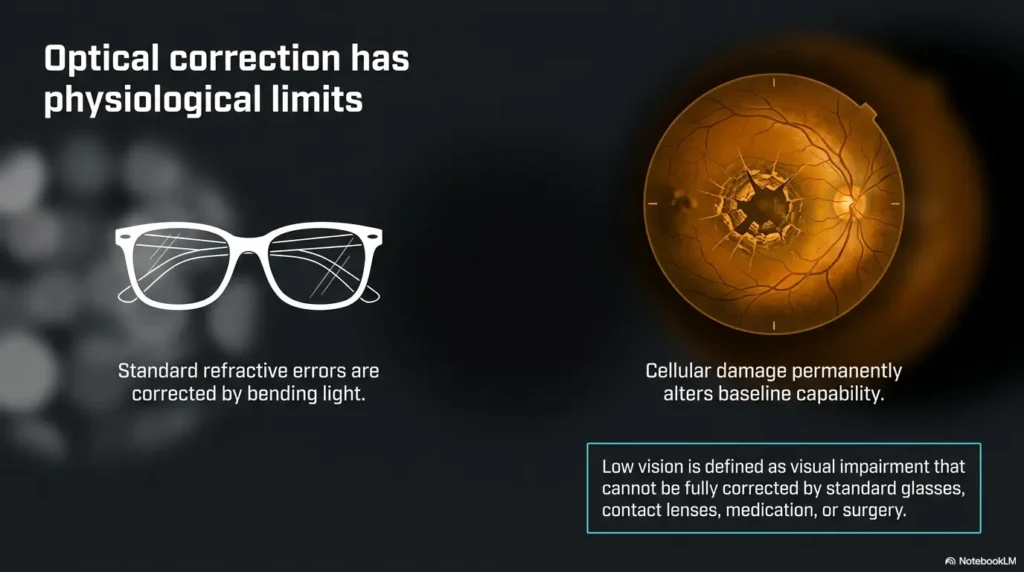
This article is for general education and home skill practice only. It is not medical advice, eye treatment, or a substitute for an eye exam, low vision evaluation, occupational therapy, or vision rehabilitation plan. Low vision is commonly described by the National Eye Institute as vision loss that makes daily activities difficult and is not fully corrected by glasses, contact lenses, medicine, or surgery.
That definition is important because it keeps the expectations honest. Eccentric viewing is not a secret cure hiding behind a curtain. It is a skill. More specifically, it is a way of exploring whether a person can use a different part of remaining vision to notice details that are harder to see straight ahead.
Think of it less like fixing a camera lens and more like learning a new route through a familiar neighborhood after one street closes. The old route may not work well anymore. But another route may still get you home.
Do Not Use This Drill to “Test” Eye Disease
Eccentric viewing practice should not be used to decide whether vision is improving, worsening, or “stable.” That is clinician territory. A home drill cannot replace a dilated eye exam, imaging, visual field testing, acuity measurement, or a low vision evaluation.
At home, the question is smaller and safer: “Does this position make this practice target easier to locate?” That is all. It is a functional question, not a medical verdict.
A person may have a good practice day because the lighting is better, the print is larger, the paper is less shiny, they are less tired, or the target is simpler. They may have a hard day because the room is dim, their eyes are dry, the page is cluttered, or they are simply worn out. None of that should be turned into a diagnosis at the kitchen table.
Keep the Drill Seated and Boring on Purpose
The safest home version is quiet, seated, and low-stakes: no stairs, no cooking, no street crossing, no medication labels, no sharp tools. Boring is not a flaw here. Boring is a safety feature with its sleeves rolled up.
Use a chair with good support. Put both feet on the floor. Place the practice target on a table or clipboard. Keep the lighting steady. Set a timer. Stop early. That may sound too simple, but simplicity protects attention. When the body is steady, the brain can spend less energy on balance and more energy noticing where the target becomes easier to see.
Ask Your Eye Care Team Where This Fits
The National Eye Institute notes that vision rehabilitation may involve eye care professionals, low vision specialists, occupational therapists, orientation and mobility specialists, counselors, and social workers. That team-based approach matters because low vision is rarely a one-tool problem.
One person may need eccentric viewing practice. Another may need lighting changes, magnification, contrast, screen accessibility settings, glare control, scanning training, mobility support, or a safer medication system. Many people need a mix.
If you already have a low vision professional, bring this question to them: “Should I practice eccentric viewing, and where should I look in relation to the target?” That one question can save a surprising amount of home confusion.
Start Here: Eccentric Viewing Is “Looking Beside,” Not Looking Harder
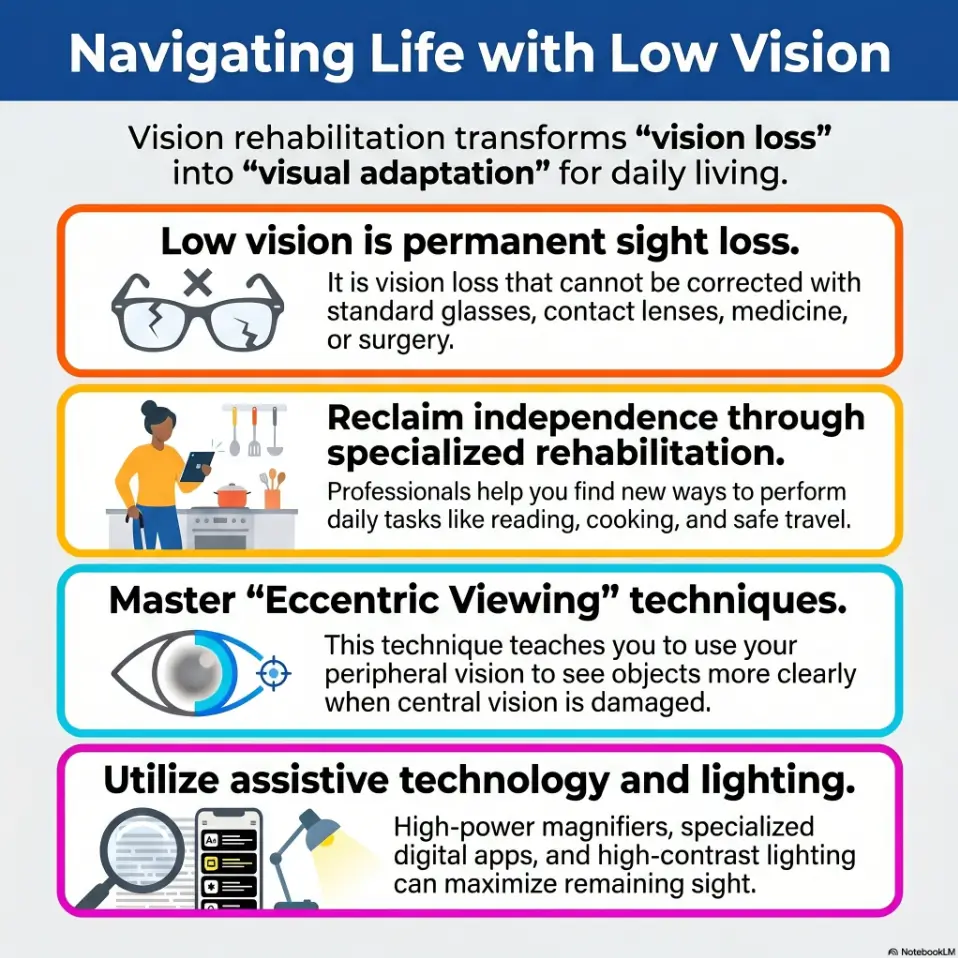
The plain-English version is this: eccentric viewing means looking slightly away from what you want to see so a stronger area of remaining side vision can help. Prevent Blindness describes eccentric viewing as looking slightly away from the subject to view it with another area of the visual field.
That sentence sounds simple until you try it. Most of us have spent a lifetime aiming our eyes directly at what matters: the face, the clock, the medicine bottle, the crossword square, the price tag, the phone notification. Direct looking feels natural. Looking beside the thing feels suspicious, like trying to hear a piano by facing the wall.
But with central vision loss, the center of the visual field may not be the most useful place for details anymore. The clearer spot may sit a little above, below, left, or right of the target. Eccentric viewing is the practice of finding and using that more helpful angle.
The Core Idea in Plain English
Imagine placing one large word in front of you. If staring directly at the center of the word makes it disappear, blur, break apart, or feel swallowed by a gray spot, the instinct is to stare harder. The forehead tightens. The shoulders rise. Someone nearby says, “Look carefully,” which is usually well-meant and almost never helpful.
Eccentric viewing changes the instruction. Instead of “look harder,” the prompt becomes: “Look slightly beside it.” Try above. Try below. Try left. Try right. Notice which position gives the word the best chance of appearing.
The skill is not a dramatic eye movement. It is usually a small shift. A few degrees may matter. At first, the movement may feel awkward or backward. That is normal. New skills often arrive wearing the wrong shoes.
Why Central Vision Loss Changes the Rules
Central vision is the part many people rely on for fine detail: reading, recognizing faces, seeing labels, watching television, threading a needle, checking a phone, or finding the right button on a remote. When central vision is reduced, details may become distorted, missing, blurred, dim, or difficult to hold steady.
Some surrounding vision may still be useful, but it may not automatically take over. The brain has to learn a new habit. Instead of pointing the center of gaze directly at the target, the person may learn to position the target just off-center so another part of vision can do more work.
This is why eccentric viewing can feel less like “eye exercise” and more like a navigation lesson. You are not trying to overpower the blind or blurred area. You are trying to route around it.
The Small Shift That Feels Wrong at First
Here is the beginner problem: the brain wants to stare directly at the word, but the clearer viewing spot may sit somewhere else. That mismatch can be maddening. People may say, “I know the word is there, but I can’t hold it.” Or, “It shows up for a second, then runs away.”
That is why the first drill should be tiny. One letter. One word. One button. One target that does not move. No paragraph. No pressure. No audience performing helpful panic in the background.
A useful practice session does not need to look impressive. It may look like a person sitting at a table, slowly testing four gaze positions around the word “tea.” That is not small work. That is the beginning of a new map.
Show me the nerdy details
In low vision rehabilitation, the clearer off-center viewing area is often discussed in relation to a preferred retinal locus, sometimes shortened to PRL. The practical home version does not require memorizing the terminology. What matters is whether a person can repeatedly use a more helpful viewing area for safe, simple tasks. A trained low vision professional can help identify and refine that strategy more precisely.
Who This Is For, and Who It Is Not For
This drill is for a specific kind of moment: the person has central vision loss or low vision, the situation is stable enough for non-urgent home practice, and the goal is functional skill-building. It is not for sudden symptoms, dangerous tasks, or proving whether an eye condition has changed.
A useful home practice plan is not brave because it is intense. It is brave because it is restrained. It refuses to turn the kitchen table into a clinic. It respects the fact that vision loss can make even ordinary tasks emotionally loaded.
Good Fit: Stable Low Vision With Rehab Guidance
This practice may be a good fit for adults who have already been evaluated for low vision and want a simple, low-risk way to practice a strategy discussed by an eye care or low vision professional.
For example, someone with central vision loss may already know that reading straight ahead is unreliable. They may have been told that looking slightly above or beside a target could help. At home, the challenge becomes repetition. Not a grand performance. Not an hour-long ordeal. Just a few quiet minutes with a large target and a notebook.
This kind of practice can be especially useful when the person wants to bring better observations back to a professional visit. Instead of saying, “Reading is hard,” they can say, “Large words looked a little clearer when I looked just above them, but only under bright task lighting.” That is practical information. It has handles.
Caregiver Fit: Someone Helping Without Taking Over
Caregivers can help beautifully when they understand their role. The caregiver is not there to test, grade, rush, or cheerlead with the intensity of a sports documentary. The caregiver is there to make the environment calmer.
A helpful caregiver can set up lighting, print large practice words, tape the paper in place, time the session, and write down what the person notices. They can say, “Which position feels least blurry?” instead of “Can you see it now?” That small language shift protects dignity.
I have watched family members accidentally turn a simple task into a courtroom drama. Everyone leans in. The target becomes evidence. The person practicing feels examined rather than supported. The room gets tight. The better approach is almost comically quiet: one target, one timer, one calm voice, and permission to stop.
Not For: Sudden, New, or Changing Vision Symptoms
This article is not for sudden vision loss, new distortion, eye pain, flashes, many new floaters, a curtain-like shadow, injury, or rapidly worsening vision. Those symptoms need prompt medical guidance, not a home drill. If your family is unsure what is normal aging and what is not, a guide to senior vision changes warning signs can help you prepare better questions before a visit.
If vision changes suddenly, do not try to “practice through it.” Do not test different lighting for an hour. Do not wait to see whether the word looks clearer tomorrow. The safer move is to contact an eye care professional or seek urgent care based on the symptom and the guidance you have been given.
Practice belongs to stable skill-building. Sudden change belongs to medical evaluation.
Not For: Driving, Stairs, Medication Labels, or Cooking Tasks
The drill should not be practiced during safety-critical tasks. That includes driving, crossing streets, using stairs, reading medication labels, handling knives, cooking near heat, pouring boiling water, managing finances, or making decisions that require accurate detail recognition.
Begin with harmless targets. A large letter. A bold word. A clock number while seated. A remote-control button placed on the table. The practice target should be boring enough that a mistake costs nothing.
- Use practice words before real labels.
- Use seated table tasks before standing tasks.
- Use professional guidance for anything risky or confusing.
Apply in 60 seconds: Choose one harmless word for practice today, not a pill bottle, bill, recipe, or legal form.
The One-Minute Setup: Make the Drill Easier Before You Begin
A good eccentric viewing session begins before the eyes do any work. The room matters. The chair matters. The paper matters. The mood matters. Low vision practice is not only about the eye and the word. It is about the entire little ecosystem around the task.
People often blame their eyes first. Sometimes the real culprit is shiny paper, dim light, a cluttered table, a moving target, or a caregiver standing too close with the anxious energy of a smoke alarm.
Choose One Target, Not a Whole Page
Use a single large printed letter, one short word, a bold number, or a high-contrast object. The goal is to find a clearer viewing position, not to finish a reading assignment.
For the first session, avoid paragraphs. Paragraphs are visually noisy. They bring line tracking, spacing, memory, contrast, and fatigue into the room all at once. That is too many guests for a beginner drill.
Start with one target. One large letter such as “M” or “T.” One word such as “tea,” “door,” “home,” “milk,” or “phone.” Print it in bold type on matte white or off-white paper. Make it large enough that failure is not baked into the exercise.
If you are helping someone else, resist the urge to make the target “realistic” too soon. Real life can wait five minutes. Practice begins in miniature.
Fix the Lighting Before You Blame Your Eyes
Use steady task lighting, reduce glare, and avoid shiny paper. Vision rehabilitation often includes tools, training, and support for everyday activities, so the environment matters as much as effort. For a more detailed setup, compare your lamp angle with a practical guide to reading lamp position for central vision loss.
Good lighting does not always mean more lighting. Too much glare can wash out the target. A lamp pointed into the eyes may make things worse. A glossy magazine page can throw reflections like tiny knives. Matte paper is usually kinder.
Try placing a task lamp so it shines onto the paper, not into the face. Check whether shadows from the hand, head, or lamp are falling across the word. If the person uses a magnifier or prescribed device, use it as instructed rather than improvising with a drawer full of mystery lenses.
Sit Down, Feet Planted, Timer Ready
A seated setup reduces fall risk and keeps the practice from becoming a balance challenge. Use a stable chair. Put both feet on the floor. Keep the paper at a comfortable distance. Place the timer within reach, or let the caregiver manage the time.
Set the timer for one to three minutes. That short window is not laziness. It is intelligent pacing. Beginners often over-practice because they want to make the session “worth it.” Then fatigue arrives, the target gets worse, frustration rises, and the brain files the whole experience under “never again.”
Stop while the session still feels manageable. It is better to end with a small clean note than a dramatic sigh and a crumpled practice sheet.
Eligibility Checklist: Is Today a Good Practice Day?
Use this quick yes/no check before starting. If several answers are “no,” make the session easier or skip it.
| Question | Yes / No | Next step |
|---|---|---|
| Are vision symptoms stable today? | Yes / No | If no, stop and seek guidance. |
| Can the person practice seated? | Yes / No | If no, adjust setup before starting. |
| Is the target large and harmless? | Yes / No | If no, switch to one large letter or word. |
| Is the lighting steady and low-glare? | Yes / No | If no, fix lighting before practicing. |
| Is the person calm enough to notice, not perform? | Yes / No | If no, wait for a quieter moment. |
Neutral action line: Use the checklist to decide whether to practice, simplify, or pause today.
Simple Drill: The Four-Direction “Clock Face” Method
The four-direction method is simple enough to remember and structured enough to be useful. Place one target in the center. Then test four gaze positions around it: above, below, left, and right. Think of the target as the center of a clock face. You are checking whether one viewing direction gives the word a better chance to appear.
This is not a race. A slow test is better than a fast guess. If the person practicing feels rushed, the eyes may jump around, the body may tense, and the result becomes muddy.
Step 1: Put the Word in the Center
Place one large word at comfortable reading distance. Use your usual glasses or low vision device if prescribed. Keep the word still. Tape the paper down if it slides. A moving target can turn a gentle drill into a carnival game nobody asked to play.
Choose a word with emotional neutrality. “Tea” is better than “hospital.” “Door” is better than “insurance.” A practice word should not arrive carrying a suitcase full of worry.
Step 2: Look Slightly Above the Word
Do not move your head much. Let your gaze rest just above the target and notice whether the word becomes clearer, dimmer, broken, or easier to locate.
The instruction is not “look at the ceiling.” It is “look slightly above the word.” Small movements matter. If a caregiver is helping, use a calm cue: “Try resting your gaze just above the word. What changes?”
The answer may be, “Nothing.” That is still useful. You are gathering information, not trying to win a prize.
Step 3: Try Below, Left, and Right
Move gently around the target like a clock face: above, below, left, right. This helps the reader notice whether one side view works better than another.
Give each direction a few seconds. Do not bounce around so quickly that the person cannot compare. The goal is to notice patterns. Maybe below is worse. Maybe left is surprisingly better. Maybe the word appears faster above but holds longer to the right. Those details are worth writing down.
If the person becomes confused, simplify. Try only two directions: above and below. The drill does not need to include all four directions every time.
Step 4: Mark the Clearest Direction
Use a notebook phrase such as: “Best when I look slightly above the word” or “clearer when I look to the left of it.” Keep the wording plain. Future-you does not need poetry here. Future-you needs usable notes.
Also note the target size, lighting, distance, and fatigue level. Those details can explain why a session worked or failed. A note that says “left worked” is helpful. A note that says “left worked with lamp on right side, large bold word, after breakfast, two minutes” is a small treasure map.
Step 5: Stop While It Still Feels Too Easy
End after one to three minutes at first. Fatigue can make a useful strategy feel like failure. When the person says, “I could do one more,” that may be the best moment to stop.
This feels counterintuitive. We like to drain the cup when something is going well. But skill practice often grows better when it ends before the brain starts associating it with strain.
Infographic: Four-Direction “Clock Face” Practice
above
left
target stays still
right
below
How to use it: Keep the word still. Try each direction gently. Mark the direction that feels clearest, easiest to locate, or least broken.
Tiny Target Ladder: Move From Letters to Real-Life Reading
The fastest way to ruin a low vision practice session is to begin with something too hard. Medicine bottles, bills, appointment letters, dense books, recipes, and tiny remote buttons may be real life, but they are not good first practice targets.
A target ladder keeps the work honest. You begin with the smallest safe challenge and move upward only when the current level feels repeatable. Not perfect. Repeatable.
Level 1: One Letter
Start with a large single letter. This removes the pressure to “read” and lets the person focus on where the image clears.
Use a bold letter on matte paper. Try “T,” “M,” “L,” or “O.” Choose high-contrast print. Avoid decorative fonts. Fancy fonts are charming in wedding invitations and deeply annoying in low vision practice.
The goal at this level is simple: can the person notice whether the letter appears better when looking slightly above, below, left, or right?
Level 2: One Short Word
Move to a word like “tea,” “door,” “phone,” or “milk.” Choose words that feel ordinary, not medical.
Short words add a little complexity. Now the person is not only locating a shape but recognizing a small pattern of letters. Keep the word large. Keep the background clean. Use one word per card if possible.
If the person has a better viewing direction from Level 1, try using that direction first. Then compare one or two other directions. The goal is to build recognition, not confusion.
Level 3: One Line Only
Use one bold line, not a paragraph. Cover surrounding text with blank paper if visual clutter steals attention.
One line adds tracking. The person may need to find the beginning, move along the line, and avoid losing their place. This is harder than it sounds. Keep the line short. A phrase such as “The cup is on the table” is enough.
At this level, the question becomes: does the helpful viewing direction still work when the target stretches across a line? Sometimes it does. Sometimes the person needs more training from a low vision professional.
Level 4: One Real Object
Try a remote-control button, a large clock number, or a labeled drawer. Keep it safe and stationary.
This is where practice begins to touch daily life. But choose carefully. A clock number is safer than a stove knob. A labeled drawer is safer than a medication bottle. A remote button placed on a table is safer than something used while walking.
Keep the rule: harmless first. Real-life practice should feel like a bridge, not a cliff.
Coverage Tier Map: How Practice Can Grow Safely
| Tier | Practice target | What changes | When to move up |
|---|---|---|---|
| 1 | One large letter | Lowest reading pressure | A best direction appears more than once |
| 2 | One short word | Adds recognition | The word appears faster or feels less random |
| 3 | One short line | Adds tracking | The person can find the start without distress |
| 4 | One safe object | Adds daily-life relevance | The task is harmless and stationary |
| 5 | Professional-guided task | Adds complexity safely | A low vision professional approves the next step |
Neutral action line: Stay on the easiest tier that gives useful information without strain.
Don’t Do This: The Staring Trap That Wastes Practice
The staring trap is sneaky because it feels responsible. The person wants to see the word, so they stare harder. The caregiver wants to help, so they say, “Look closely.” Everyone means well. Nobody is trying to make the room worse.
But with central vision loss, staring directly at the target may be the least helpful strategy. It can turn practice into a tug-of-war with the part of vision that is already unreliable.
Staring Harder Is Not the Skill
The goal is not to force central vision to behave. The goal is to discover and repeat a more useful viewing angle.
That difference matters. “Try harder” tells the person to apply more pressure to the same failing method. “Try slightly above the word” gives the person a specific experiment. One creates shame. The other creates information.
A good prompt sounds like this: “Let’s see whether the word is easier when your gaze rests just above it.” That sentence lowers the temperature in the room. It turns practice into curiosity instead of performance.
More Minutes Can Make Less Progress
Long sessions may cause frustration, eye fatigue, headache, or sloppy practice. Short repetition is the little metronome here.
If three minutes goes well, it is tempting to stretch to ten. If ten goes well, someone suggests fifteen. Soon the person is exhausted, the target looks worse, and the final memory of the session is failure. That is bad practice design.
Try shorter sessions more often, if your professional guidance supports it. A few calm repetitions beat one heroic session that ends with everyone silently resenting the alphabet.
Let’s Be Honest: “Try Harder” Is Bad Coaching
Replace “look carefully” with specific prompts: “Try looking just above the word,” “Now try slightly below,” or “Which position feels least blurry?”
Better coaching gives the person agency. It does not demand a yes/no performance. It asks for comparison. It lets “not sure” be a valid answer.
In a home setting, that emotional permission matters. Low vision already takes enough. Practice should not take dignity too.
- Ask “which position is clearer?” instead of “can you see it?”
- Stop before fatigue becomes the loudest thing in the room.
- Write down patterns instead of judging performance.
Apply in 60 seconds: Replace one vague prompt with one specific direction: above, below, left, or right.
Common Mistakes: Small Habits That Make the Drill Feel Useless
When eccentric viewing practice feels useless, the problem is not always the strategy. Sometimes the setup is quietly sabotaging the session. Too-small print, glare, clutter, movement, fatigue, and emotional pressure can bury useful information under noise.
Before deciding “this does not work,” simplify the practice environment. Strip the task down until you can actually tell what is helping.
Practicing on Tiny Print Too Soon
Jumping straight to medicine bottles, bills, or dense books makes the exercise feel impossible. If medication paper is already a daily frustration, save it for later and use a separate plan for how to read medicine leaflets with low vision safely.
Tiny print brings multiple challenges at once: small letters, low contrast, curved surfaces, shiny labels, unfamiliar names, safety consequences, and emotional weight. That is not a beginner drill. That is a tiny battlefield with a prescription label.
Start with large print. Then reduce difficulty only with professional guidance or careful observation. The first goal is to locate a helpful viewing direction, not to conquer the smallest print in the house.
Changing Too Many Things at Once
Do not change lighting, distance, font size, device, posture, and target all in the same session. You will not know what helped.
This is a common home-practice trap. Someone moves the lamp, changes the word, hands over a magnifier, shifts the chair, and suggests a different pair of glasses, all within 90 seconds. Suddenly the session has more variables than a badly organized science fair.
Change one thing at a time. If the target is too hard, make it larger but keep the lighting and distance the same. If glare is the problem, fix glare but keep the word size the same. Clean comparisons create better notes.
Using a Moving Target
Scrolling screens, handheld paper, or a caregiver waving an object can turn practice into a blur circus.
Keep the target still. If the paper slides, tape it down. If the phone screen keeps dimming, use printed paper first. If the caregiver is holding the card, have them place it on the table instead.
Movement adds tracking demands. For some people, that may be appropriate later. For beginners, it often makes the drill harder than necessary.
Practicing When Tired, Rushed, or Upset
Low vision practice asks for attention. Emotional static makes the signal harder to hear.
A tired person may not have the patience to compare four viewing positions. A rushed caregiver may accidentally push too fast. An upset room can make even a simple word feel like an exam.
Choose a calm time. For some people, that may be morning after breakfast. For others, it may be early afternoon. Avoid practicing when pain, hunger, medication timing, glare, or household chaos is already chewing on the edges of attention.
Mini Calculator: How Hard Was Today’s Drill?
Use this tiny self-check after practice. It does not diagnose anything. It simply helps you decide whether to repeat, simplify, or ask for guidance.
Neutral action line: Use the numbers to adjust the next session, not to judge the person practicing.
Caregiver Script: Help Without Becoming the Vision Police
Caregiving can become strangely verbal. We talk because we want to help. We repeat because we want to be clear. We ask “Can you see it?” because it feels like the obvious question.
But low vision practice often improves when the caregiver speaks less, slows down, and asks better questions. The caregiver’s job is not to interrogate the eye. The job is to protect the conditions for noticing.
Say This Instead of “Can You See It?”
Use functional prompts: “Where does the word look clearest?” “Is it better above or below?” “Should we make the target bigger?”
These prompts are better because they allow comparison. They do not force the person into a yes/no answer that may feel like failure. Many low vision experiences are not cleanly yes or no. A word may be partly visible, briefly visible, clearer on one side, or easier to find but still hard to read.
Good language leaves room for that complexity.
Keep Notes, Not Scores
Track comfort, best gaze direction, lighting setup, and target size. Do not grade the person.
A score says, “You did well” or “You did poorly.” A note says, “This setup gave us information.” Notes are kinder and more useful. They can be brought to an eye care professional or low vision therapist. They can show patterns over time without turning the person into a project.
Write down the practical details: “large black word on matte paper,” “lamp on left side,” “best when looking above,” “stopped after two minutes,” “felt tired after lunch.” That is enough.
Here’s What No One Tells You…
The caregiver’s calm voice may matter as much as the drill. Pressure makes people stare harder, rush, and quit sooner.
If the person practicing starts apologizing, slow down. If they say, “I should be able to do this,” pause the drill. If the caregiver feels impatience rising, it is better to stop than to keep going with a tight jaw and a cheerful voice that fools absolutely no one.
Support sounds like this: “This is just practice. We are only looking for patterns.” Couples and family caregivers may also need emotional language beyond the drill itself, especially when helping a spouse with vision loss begins to reshape ordinary routines.
Quote-Prep List: What to Gather Before a Low Vision Visit
If you plan to discuss eccentric viewing, magnifiers, lighting, or reading aids with a professional, gather the following before the appointment:
- Current glasses, magnifiers, and low vision devices.
- Practice notes showing best gaze direction and target size.
- A sample of print that is difficult, such as mail, labels, or books.
- A list of daily tasks that have become harder.
- Questions about lighting, glare, screen use, and safe home practice.
Neutral action line: Bring real examples so the visit focuses on daily function, not vague frustration.
Short Story: The Word That Finally Stopped Running Away
A daughter once told me her father could “see the newspaper but not read it,” which sounded impossible until she described the scene. He sat at the table every morning, coffee cooling beside him, staring at headlines that seemed to break apart when he looked directly at them. She kept enlarging the print. He kept trying harder. Both of them left the table defeated.
They changed the practice. One word only: “home.” Large black letters on matte paper. Lamp angled onto the page. Feet planted. No newspaper. No test. He tried looking above the word, then below, then left, then right. When he looked slightly above it, the word did not become perfect, but it stopped running away so quickly. His daughter wrote one sentence in the notebook: “Above works better, two minutes, morning light.”
It was not a miracle. It was smaller and sturdier than that. It was a clue.
When to Seek Help: Stop Practice and Get Guidance
Eccentric viewing practice should never become a reason to delay care. Low vision strategies belong inside a larger safety frame. When symptoms are sudden, changing, painful, frightening, or connected to daily risks, stop practicing and get professional guidance.
Home practice can support a plan. It cannot replace one.
Sudden Vision Changes Need Prompt Care
Seek urgent medical help for sudden vision loss, new eye pain, flashes, many new floaters, new distortion, a curtain-like shadow, trauma, or sudden trouble seeing faces, words, or objects.
Those symptoms are not “bad practice days.” They may signal medical problems that need prompt attention. A home drill is not the right tool for sudden change.
If you are unsure what counts as urgent, ask your eye care team in advance what symptoms should trigger immediate action. Write that list down. Put it somewhere easy to find. During a scary moment, nobody wants to hunt for instructions in a drawer full of expired coupons.
Daily Tasks Are Getting Riskier
Ask for low vision rehabilitation guidance if reading, cooking, walking, medication management, phone use, money handling, or home safety is becoming harder. The National Eye Institute states that vision rehabilitation can help people with visual impairment manage daily life and keep independence.
This is where families often wait too long. They adapt quietly. Someone stops cooking certain meals. Someone avoids mail. Someone guesses at buttons. Someone says, “I’m fine,” with the ancient human tone that means “I am absolutely not fine, but please do not make a fuss.”
Low vision rehabilitation is not an admission of defeat. It is a way to protect function before the workarounds become risky. If the risky moments are happening around pills, refill timing, or confusing bottles, start with a practical low vision medication management system rather than trying to read every label by force.
The Drill Causes Distress or Dizziness
Stop if practice causes dizziness, nausea, headache, fear, disorientation, or repeated frustration. Bring those notes to a low vision professional.
A drill that repeatedly causes distress may be too hard, too long, poorly lit, visually confusing, or simply not the right strategy without professional adjustment. That does not mean the person failed. It means the plan needs tuning.
Progress Signs: Look for Function, Not Perfect Vision
Progress in eccentric viewing may be quiet. It may not arrive as crisp letters or easy reading. It may arrive as less searching, less panic, faster locating, or a more predictable viewing direction.
That kind of progress can be easy to miss if everyone is waiting for perfect clarity. Do not wait for fireworks. Low vision skill-building is often more compass than fireworks.
The Word Appears Faster
A useful sign is not perfect clarity. It may be finding the target more quickly.
For example, in the first session, the person may need 20 seconds to locate the word. Later, they may find it in 8 seconds using the same viewing direction. The word may still be blurry. It may still require effort. But faster locating can matter in real life.
Small improvements in locating can make daily tasks feel less random. That can reduce frustration, even when vision itself has not changed.
The Best Direction Becomes More Predictable
The person may begin to know, “I do better when I look slightly above the word.”
Predictability is valuable. It turns a chaotic experience into a usable habit. Instead of searching in every direction each time, the person has a starting point. That starting point may later be refined by a low vision professional.
Write down when the direction works and when it does not. Does it work better with large print? Does it fail with glare? Does it change when the person is tired? These are the details that help practice become practical.
Reading Feels Less Random
Even small repeatability matters. If the person can use the same viewing direction to locate one letter, then one word, then one safe object, reading practice may begin to feel less like a slot machine.
This does not mean every task becomes easy. It means the person may gain a little more control over how they approach a visual target. That control has emotional value. It can make a person more willing to practice, ask for tools, or try a safer setup.
- Track what becomes easier to find.
- Notice whether one viewing direction repeats.
- Measure comfort as well as clarity.
Apply in 60 seconds: After practice, write one sentence that begins, “Today, the target was easiest when…”
Home Practice Decision Card: When to Make It Easier or Stop
A decision card helps families avoid the two classic practice errors: pushing too hard and quitting too early. The right move depends on what happened during the session.
Use this card after a one-to-three-minute practice attempt. It is not a medical tool. It is a practical home guide for adjusting the next session.
| What happened | Do this next | Why it helps |
|---|---|---|
| One direction seemed clearer | Repeat with the same target tomorrow | Checks whether the pattern is repeatable |
| No direction helped | Make the target larger or improve lighting | Reduces difficulty before judging the strategy |
| The person became tired or upset | Shorten the session or stop for the day | Protects confidence and attention |
| The target moved or clutter interfered | Tape down paper and cover extra text | Makes comparison cleaner |
| Symptoms changed suddenly | Stop and seek medical guidance | Sudden changes are not practice problems |
Neutral action line: Let the session result choose the next step: repeat, simplify, pause, or seek guidance.
Simple Practice Log: What to Write Down
A practice log does not need to be fancy. In fact, fancy is usually the enemy. Use a notebook, index card, large-print sheet, or voice note. The log should help the person and caregiver remember what worked without turning the practice into homework with a scowl.
Keep each entry short. The best practice note is the one someone will actually use.
The Five Useful Details
Write down five things after each session:
- Target: one letter, one word, one line, or one object.
- Lighting: lamp position, glare, daylight, or room light.
- Distance: roughly how far the target was from the eyes.
- Best direction: above, below, left, right, or unclear.
- Comfort: easy, tiring, frustrating, dizzy, or okay.
This gives the low vision professional something concrete. It also helps the family stop repeating setups that do not work.
A Sample Log Entry
Here is a useful entry:
Tuesday morning: Large word “door” on matte paper. Lamp on right side. About 16 inches away. Clearer when looking slightly above the word. Stopped after two minutes. No headache.
That note is short, but it contains the bones of the session. It shows target, environment, distance, direction, time, and comfort.
What Not to Write
Avoid notes like “failed again,” “bad eyes,” or “couldn’t do it.” Those notes do not help anyone. They also make the next practice session feel heavier before it begins.
Use neutral language. “No clear direction today” is better than “did badly.” “Target may have been too small” is better than “couldn’t read.” Practice notes should be lanterns, not little hammers.
FAQ
Is eccentric viewing safe to practice at home?
It can be a low-risk home practice when done seated, briefly, with simple targets, and ideally after low vision guidance. It should not replace an eye exam or rehabilitation plan. The safest version uses one harmless target, steady lighting, and a short timer.
How long should a beginner practice eccentric viewing?
Start with one to three minutes. Stop before fatigue. A few calm repetitions are better than one heroic session. If the person feels tired, dizzy, upset, or pressured, stop and make the next session easier.
Should I practice with one eye or both eyes?
Do not guess. Ask your eye care or low vision professional, especially if one eye has very different vision from the other. Some people may receive specific instructions based on their condition, devices, or rehabilitation plan.
Can eccentric viewing improve eyesight?
Eccentric viewing should be framed carefully. It is a strategy for using remaining vision more effectively. It is not a cure for the underlying eye condition, and it should not be presented as a way to medically restore vision.
What should I practice reading first?
Start with a single large letter or short bold word. Avoid medication labels, bills, recipes, legal forms, stove controls, or anything safety-critical at the beginning. Practice should begin with targets where a mistake has no real consequence.
Why does looking away help sometimes?
For some people with central vision loss, looking slightly away from the target may allow a clearer surrounding area of vision to pick up the image. The best direction may be above, below, left, or right of the target, and it may need professional refinement.
What if no direction looks clearer?
Stop, note what happened, and ask a low vision professional. The issue may be target size, lighting, contrast, fatigue, eye condition, glare, device use, or the need for a different strategy.
Can caregivers teach eccentric viewing?
Caregivers can help set up safe practice and take notes, but they should not diagnose, pressure, or replace trained vision rehabilitation support. Their best role is to keep the environment calm, the target simple, and the notes practical.
Can I practice eccentric viewing on a phone screen?
It may be possible later, but printed practice cards are usually easier for beginners because they do not dim, scroll, glare, or shift unexpectedly. If using a phone, increase text size, reduce glare, keep the device still, and follow professional guidance. For iPhone users, the built-in Magnifier can also support some everyday reading tasks, especially when paired with iPhone Magnifier filters for pill bottles under safer, non-practice conditions.
How often should I practice?
Follow the guidance of your eye care or low vision professional. In general, brief and calm practice is usually more useful than long, tiring sessions. The better question is not only “how often?” but “can we practice without fatigue, pressure, or safety risk?”
Next Step: Try One Safe Practice Card Today
Here is the cleanest place to begin: one word, one chair, one lamp, one timer. No drama. No test. No tiny print pretending to be character-building.
Make a One-Word Practice Card
Write one large, bold word on matte paper: “home,” “tea,” “door,” or “phone.” Sit at a table with good lighting. Try looking slightly above, below, left, and right of the word. Circle the direction that feels clearest. Stop after three minutes.
If no direction feels clearer, that is still information. Make the target larger next time, reduce glare, shorten the session, or ask for professional guidance. The point is not to force success. The point is to build a safer way of noticing.
Bring the Note to Your Next Visit
Write down: target size, lighting, distance, best direction, and what felt difficult. That small note can become a useful bridge between home practice and professional guidance.
And this is the quiet loop we opened at the beginning: staring harder is not the answer. The better question is often, “Where does the word become easier to find?” Sometimes the answer is slightly above. Sometimes left. Sometimes nowhere yet. But each careful note gives you and your care team a better map.
Try this within the next 15 minutes: make one large-word card, practice for no more than three minutes, and write one neutral sentence about what happened. Small, safe, repeatable. That is how this skill begins.
Last reviewed: 2026-04.