

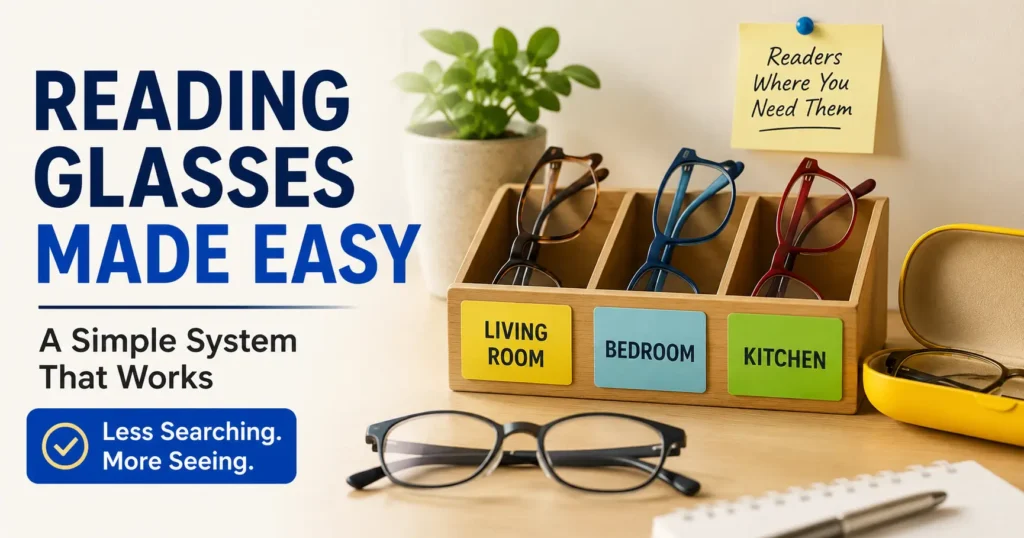
The Reading Glasses Are Never Truly Gone
They are usually resting under yesterday’s mail, hiding beside the recliner, riding in a coat pocket, or sitting in the one room nobody checked because, naturally, that would be too reasonable. The best reading glasses setup for seniors who keep misplacing them is not one heroic “perfect pair.” It is a small, visible home system that makes the right pair appear where reading actually happens.
That matters more than it sounds. Misplaced readers can turn a normal day into a chain of tiny delays: unread medicine labels, missed appointment cards, blurry phone screens, dim restaurant menus, and bills left for later until “later” becomes a paper avalanche.
Here is the better approach:
- ✔ Less searching.
- ✔ More landing zones.
- ✔ Fewer lectures.
- ✔ A setup that treats glasses like keys, not like a moral exam.
This guide will help you build a practical system using multiple labeled pairs, fixed stations, bright cases, wearable backups, better lighting, and a simple replacement plan. It also explains when the problem may not be organization at all, but a sign that an eye exam is due.
Quick Answer: The Small System That Works
The most reliable reading glasses setup for seniors is a five-part system: place several pairs in fixed reading zones, make each pair visually different, store them in bright cases or trays, keep one wearable backup, and write down the strength and preferred frame style for easy replacement. If readers still feel uncomfortable or vision changes suddenly, schedule an eye exam instead of buying stronger readers.
- Best first move: create three visible glasses stations today.
- Best caregiver move: label cases by room, not by personality.
- Best safety move: connect reader problems with medication, fall, and vision-warning signs.
Table of Contents
Safety Note Before You Buy More Readers
Reading glasses can make close-up tasks easier, but they do not replace a comprehensive eye exam. Over-the-counter readers are usually designed for near vision only. They may not correct astigmatism, different vision in each eye, cataracts, glaucoma, macular degeneration, diabetes-related eye disease, or double vision.
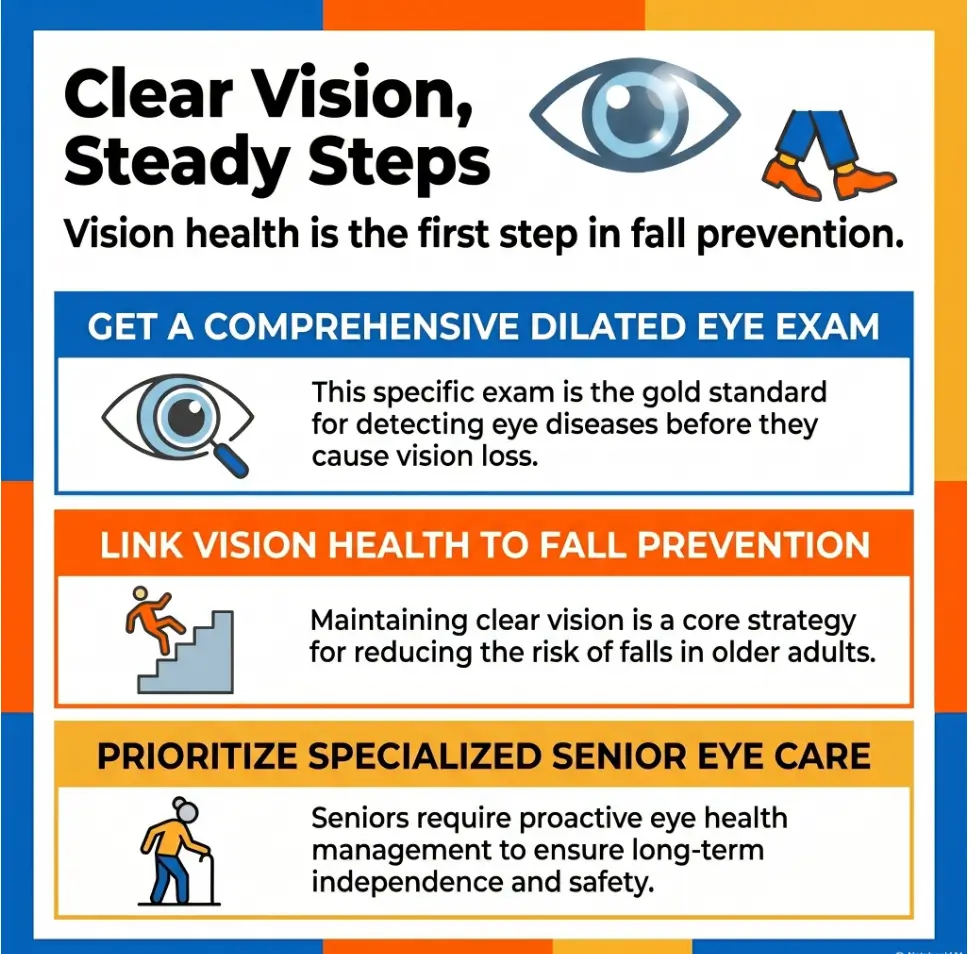
A senior should contact an optometrist, ophthalmologist, or medical professional if they have sudden vision changes, eye pain, new headaches, dizziness, double vision, new floaters, trouble reading despite readers, or falls that may be linked to poor vision. The American Academy of Ophthalmology and the National Eye Institute both emphasize that many age-related eye conditions are easier to manage when found early.
Also, treat medication reading as a safety task, not a “squint and hope” task. If pill bottles, dosage instructions, or pharmacy leaflets are hard to read, pair this glasses setup with a safer system for low vision medication safety and, when needed, ask the pharmacy about large-print labels.
The Real Problem Is Not Forgetfulness, It Is Friction
Why “Where did I put them?” becomes a daily tax
Misplacing reading glasses is rarely one dramatic event. It is usually a hundred small handoffs: mail at the kitchen table, a phone text in the hallway, a prescription label near the sink, a crossword near the recliner, a church bulletin in a tote bag, a recipe card beside the stove.
Each task asks the same quiet question: “Can I see this right now?”
If the answer depends on finding one pair of readers, the day starts charging a nuisance fee. A senior may delay opening mail, guess at small print, stop reading favorite books, or avoid tasks that used to feel simple. That is not laziness. That is friction wearing a cardigan.
The hidden cost: missed bills, medication mix-ups, and tiny frustrations
The cost is not only time. Misplaced readers can affect independence. A bill gets set aside because the due date is hard to see. A pill bottle looks similar to another bottle. A phone notification gets ignored because the text is too small. A recipe becomes annoying enough that dinner turns into toast and a muttered negotiation with the refrigerator.
For seniors with reduced contrast sensitivity, glare, or central vision trouble, the problem can become heavier. Readers help with magnification, but they work best when paired with good lighting, clear labels, and predictable storage. If reading mail is also difficult because of shiny paper or glare, the advice in reading glossy mail without glare fits beautifully beside this setup.
Here’s what no one tells you: one pair is a trap
One pair sounds tidy. It feels economical. It even looks responsible in that crisp little case by the bed.
Then life moves.
The pair follows the person to the kitchen, then to the laundry room, then to the couch, then into a sweater pocket, then into the couch dimension, where all small household objects eventually apply for residency.
A single pair creates a fragile system because it assumes every task happens in one place. Real life disagrees. The solution is not to scold the person into “being more careful.” The solution is to design a home where readers are already waiting.
- One pair creates unnecessary searching.
- Reading tasks happen in several rooms.
- Visible stations reduce daily friction.
Apply in 60 seconds: Name the three places where reading happens most often today.
Who This Setup Is For, And Who Needs Something Different
Good fit: seniors who use readers only for close-up tasks
This setup works best for seniors who see distance reasonably well but need help with near tasks. Think books, labels, menus, phone screens, pill bottles, sewing, puzzles, checkbooks, and appointment cards.
These are the classic “I only need them for reading” situations. The glasses are tools, not medical mysteries. Place the tools near the jobs and the whole day breathes easier.
Not enough: seniors with changing vision or complex prescriptions
Drugstore readers may not be enough when vision is uneven between eyes, distorted, suddenly blurry, or affected by cataracts, glaucoma, macular degeneration, diabetes, stroke, or surgery. They may also fall short for people with significant astigmatism or double vision.
If a senior has recently had cataract surgery and now feels that one eye sees differently from the other, that is a different situation than ordinary reader misplacement. A guide to anisometropia after cataract surgery may help explain why a simple reader setup is not always enough.
Caregiver note: do not turn this into a “memory test”
Caregivers often mean well. Unfortunately, “Mom, where did you put them this time?” can land like a tiny courtroom drama.
A better sentence is: “Let’s make a place where they always wait for you.”
That change matters. It moves the issue from blame to design. The same principle helps with bedside supplies, medication tools, remotes, magnifiers, and calendars. A home can be gently edited so the day has fewer traps.
Money Block: Is This a Reader-Station Problem or an Eye-Exam Problem?
| Question | If yes | Next step |
|---|---|---|
| Does the senior see clearly with readers when they can find them? | Likely a storage setup issue. | Build three stations first. |
| Do readers cause headaches, dizziness, or blur? | Strength or prescription may be wrong. | Schedule an eye exam. |
| Are there new falls, confusion, or medication mistakes? | This may be broader than readers. | Call the clinician or care team. |
Neutral action line: If comfort and clarity are uncertain, choose an eye exam before buying a drawer full of stronger readers.
Build the “Glasses Station” System Before Buying More Pairs
Map the five places where reading actually happens
Before buying anything, walk through the home with a practical eye. Where does the senior actually read?
Common reading zones include the bedside table, kitchen counter, favorite chair, bathroom or medication area, entryway, purse, craft table, computer desk, and car console for parked reading tasks. Do not build stations around where glasses “should” be. Build them around where hands reach for small print.
A bedside setup is especially powerful because mornings and nights are full of little reading moments: phone screens, pill organizers, devotional books, alarm clocks, appointment notes, and “What did I write on this sticky note at 11 p.m.?” archaeology. For a broader system, pair this with low vision bedside organization.
Use trays, not drawers
Drawers hide things. Trays announce them.
A small tray on the side table is easier than a drawer because it creates a visible landing zone. The goal is not museum-level tidiness. The goal is fewer searches. A shallow tray, bright bowl, or small open box gives the glasses a predictable “parking space” without requiring a fiddly routine.
For seniors with tremor or arthritis, choose trays with low edges and enough room to drop the glasses without careful aim. Precision is lovely in watchmaking. It is overrated when someone is tired and just wants to read the soup label.
The 10-second reset rule
The rule is simple: before leaving the room, readers go back to the nearest station.
Not the “correct” station. The nearest station.
This matters because the system should accept real behavior. If readers migrate from the kitchen to the living room, the living room tray catches them. If they move from the bedside to the bathroom, the medication-area station catches them. The system works because it has several nets.
The Five-Station Reader Map
Books, phone, night meds, alarm labels.
Recipes, food dates, appliance buttons.
Mail, books, TV menus, puzzles.
Pill bottles, leaflets, dosage notes.
Menus, receipts, appointment cards.
Framework: Put one visible tray, one labeled case, and one pair in each zone you actually use.
Short Story: The Blue Tray Beside the Lamp
Marian’s daughter bought her three pairs of readers after the third “lost glasses” phone call in one week. The first attempt failed immediately because all three pairs were identical black frames in identical black cases. They looked dignified, yes. They also vanished against the coffee table like tiny formalwear ninjas. So they changed the system.
A blue tray went beside the lamp, a red case went in the kitchen, and a yellow hard case stayed in Marian’s purse. The breakthrough was not the number of glasses. It was the visibility. Within a week, the phone calls changed. Marian still misplaced a pair now and then, but the backup was no longer a search party. The lesson was plain: when the home gives an object a visible address, memory gets to rest.

Buy Multiple Pairs, But Make Them Intentionally Different
Color-code by room, not by fashion
Multiple pairs help only if they are easy to tell apart. Use color as a location cue.
Try red readers for the kitchen, blue for the bedroom, tortoise for the living room, and black for the purse. The colors do not need to be elegant. They need to be obvious enough to find during a tired Tuesday evening when the lamp is not quite bright enough and patience has left the building.
If the senior dislikes bright frames, keep the frames neutral and make the cases bright instead. The point is contrast, not a forced makeover.
Label the case, not the glasses
Labels on glasses can rub off, look messy, or irritate the person wearing them. Labels on cases work better.
Use large-print labels such as “KITCHEN,” “BED,” “CHAIR,” “PURSE,” and “MEDS.” For shared homes, add the person’s name. In assisted living, labels can prevent accidental pair-swapping. A small label can save a surprisingly large amount of family diplomacy.
Don’t do this: buying five identical pairs
Five identical pairs may look efficient online. In practice, they create a blur of sameness.
If every pair is black, every case is black, and every station is a dark wooden surface, the home becomes a camouflage course. Buying identical readers also makes it harder to notice which room is missing a pair. If the red kitchen readers keep disappearing, the kitchen routine needs attention. If “one of the black ones” disappears, good luck to the investigation committee.
- Use room-based color coding.
- Label cases in large print.
- Avoid identical pairs unless the cases are clearly different.
Apply in 60 seconds: Choose one color or label for the kitchen pair before buying more.
Choose the Right Strength Without Playing Guess-the-Diopter
Start with the lowest comfortable strength
Many people assume stronger readers are better. That is not always true. Stronger magnification may help at a very close distance but feel awful at a normal book or tablet distance.
A safer practical rule is to use the lowest strength that lets the person read comfortably at the actual task distance. If +1.50 works for a book, jumping to +2.75 because “bigger sounds better” may create blur, strain, or an awkward chin-forward posture that looks like the body is trying to negotiate with gravity.
Match the strength to the task distance
Different tasks may need different strengths. Phone reading happens close. A computer screen sits farther away. Sewing, pill labels, and tiny package instructions may need more help than a paperback.
Some seniors keep one strength for books and another for close detail work. That can work, but only if the cases are labeled clearly. A label such as “BOOKS +2.00” or “PILL LABELS +3.00” is more useful than a mystery pair floating around the kitchen.
For low-vision tasks where ordinary readers are not enough, a magnifier may be more appropriate. If hand tremor is part of the problem, compare handheld versus stand magnifiers for tremor before assuming another reader strength will solve it.
When “stronger readers” make the room worse
Too much magnification narrows the comfortable working distance. That means the print may look clear only when held very close. Looking up across the room may feel disorienting because readers are not meant for distance viewing.
This is why seniors should not walk around the house wearing strong readers unless their eye doctor has advised it. Reading glasses can make floors, steps, and pets look blurry. The cat may forgive many things. Being mistaken for a rug is not one of them.
Show me the nerdy details
Reading glasses are labeled in diopters, a measure of focusing power. Higher numbers focus at shorter distances. A +1.50 pair may feel comfortable for a book held farther away, while +3.00 may work only for closer detail. The “right” strength depends on the reader’s focusing ability, working distance, lighting, eye alignment, prescription needs, and whether both eyes see similarly. This is why comfort testing at the actual task distance matters more than guessing by age alone.
Add One Wearable Backup for the Pair That Always Wanders
Neck readers: best for active home routines
Neck readers or hanging readers can be useful for seniors who move between tasks all day. Cooking, sorting mail, checking labels, watering plants, answering texts, and reading appointment cards all create stop-start reading moments.
The benefit is simple: the backup pair moves with the person. It does not replace station pairs. It covers the in-between spaces, the little corridors of daily life where objects love to wander off.
Magnetic readers: clever, but not for everyone
Magnetic readers that connect at the bridge can be handy, but they are not universal magic. Some people dislike how they feel. Others may find them tricky with hair, skin sensitivity, dexterity limits, or certain clothing. The best design is the one the person will actually use when nobody is watching.
That last part matters. A gadget that lives in a drawer is not a solution. It is a tiny museum exhibit called “Good Intentions, 2026.”
Glasses chains are not old-fashioned; they are logistics
A glasses chain is not a surrender flag. It is a retrieval tool.
For some seniors, a lightweight chain is the easiest fix. It keeps readers nearby without requiring a case, tray, or pocket. Choose one that is comfortable, not too heavy, and easy to detach. If the senior dislikes the look, try a neutral cord or a sport-style retainer.
Money Block: Wearable Backup Decision Card
| Option | Best for | Watch for |
|---|---|---|
| Neck readers | Cooking, mail, chores, frequent short reading. | Fit, weight, and comfort. |
| Magnetic readers | People who like quick on-off access. | Dexterity, hair, and skin comfort. |
| Glasses chain | Simple, low-cost, familiar routines. | Snagging, heaviness, and personal preference. |
Neutral action line: Test one wearable option for a week before buying multiples.
Make the Cases Bright, Big, and Slightly Annoying
Tiny black cases disappear into the furniture forest
Small dark cases are elegant until they land on a dark table, dark chair, dark purse lining, or patterned blanket. Then elegance becomes camouflage.
Choose bright, high-contrast cases: yellow, orange, blue, red, white, or patterned. Texture also helps. A ribbed, quilted, or rubberized case is easier to feel inside a bag. For seniors with low contrast sensitivity, a large case can be far easier to spot than a thin sleeve.
Contrast is not only a glasses issue. It helps throughout the home, from appliance buttons to bathroom safety. If contrast markings are useful, compare bump dots versus tactile tape for other household items that vanish under fingertips or in low light.
Add a “parking case” to bags and cars
A purse, backpack, walker pouch, or coat pocket can have a dedicated parking case. So can the car console, with one important clarification: car readers are for parked reading tasks such as receipts, appointment cards, or phone screens.
Driving vision should follow the person’s prescription and eye doctor’s advice. Reading glasses are not a casual driving accessory. They can blur distance and make the road unsafe.
Let’s be honest: ugly can be useful
A neon case may not win a design award. It may, however, prevent a twenty-minute hunt before a doctor’s appointment.
Useful objects do not always need to whisper. Sometimes they need to wave from the table wearing a tiny safety vest.
Common Mistakes That Keep the Glasses Vanishing
Mistake 1: keeping readers only where they “should” be
A neat home fantasy says glasses belong in one drawer, one box, or one bedside case. Real life says reading happens wherever small print ambushes the day.
Put readers where the task happens. If the senior reads recipes in the kitchen, keep a pair in the kitchen. If they read mail in the recliner, keep a pair by the recliner. If they check medication in the bathroom, keep a pair near the medication area, away from moisture and clutter.
Mistake 2: using drawers, baskets, and mystery bowls
Deep baskets create archaeological digs. Drawers require remembering. Mystery bowls collect coins, cough drops, batteries, old receipts, and the emotional residue of errands.
Use shallow, dedicated trays instead. One job per tray. Glasses only. Maybe a microfiber cloth if you are feeling generous.
Mistake 3: buying only cheap pairs that bend, scratch, or pinch
Cheap readers can be useful. But if they scratch quickly, slide down the nose, pinch behind the ears, or bend out of shape, the senior may stop wearing them.
A good setup may include a mix: inexpensive backups in low-risk stations and one or two better pairs for the most-used spots. Comfort is not luxury when it determines whether the tool gets used.
Mistake 4: ignoring lighting
Sometimes the glasses are innocent.
Dim light, glare, shiny paper, and tiny print can make a correct pair feel inadequate. Before increasing strength, improve the lighting. Use a reading lamp aimed at the page, reduce glare, and enlarge phone text. If bright screens or glare make reading tiring, an anti-glare screen protector may help with phones and tablets.
- Use open trays instead of drawers.
- Make cases bright and tactile.
- Improve reading light before increasing strength.
Apply in 60 seconds: Move one pair from a drawer to a visible tray today.
Create a Caregiver-Friendly Replacement Plan
Keep one unopened backup pair in the same place every time
Every good system needs a quiet reserve. Keep one unopened pair in a predictable location, such as a labeled bin, medication cabinet, caregiver folder, or home command center.
The key is consistency. Do not move the backup to “a better place” every month. That better place will become an unsolved riddle with hinges.
Write down the strength, brand, and preferred frame style
Create a simple reader card with the strength, brand, frame style, and where each pair belongs. Store it in a caregiver folder, phone note, or printed home checklist.
Include details such as:
- Preferred strength for books.
- Preferred strength for pill labels or crafts.
- Frame shape that feels comfortable.
- Case color for each room.
- Date of last eye exam.
This turns replacement from a guessing game into a two-minute task.
Use a monthly “reader sweep”
Once a month, do a relaxed sweep. Check chair cushions, bedside tables, kitchen counters, laundry areas, coat pockets, purses, walker baskets, cars, bathrooms, and the strange little ledge where objects gather as if summoned.
Keep it low-pressure. The goal is recovery, not accusation. If the same place keeps collecting runaway readers, add a station there. The missing pair is giving you data, not defying you.
Money Block: Reader Replacement Prep List
- Strength: Write the diopter number from the frame or lens sticker.
- Use: Mark whether it is for books, phone, computer, pill labels, or crafts.
- Fit: Note frame width, nose comfort, and whether it pinches.
- Color: Record the room color or case label.
- Eye care: Add the last exam date and eye doctor’s office number.
Neutral action line: Put this information in one phone note or printed folder before the next pair breaks.
When Misplacing Glasses May Signal a Bigger Issue
Look for pattern changes, not one bad Tuesday
Everyone misplaces things. A single lost pair after a busy morning is normal human weather.
Pay closer attention when the pattern changes. For example, a senior who usually manages well suddenly cannot keep track of glasses, medications, appointments, bills, or familiar routines. That shift deserves gentle curiosity.
Also look for whether the person is avoiding reading tasks. Avoidance may look like forgetfulness, but the true cause may be blur, glare, fatigue, or fear of making mistakes.
Vision problems can look like memory problems
A person who cannot read labels may seem careless. A person who cannot see contrast may seem disorganized. A person who cannot read appointment cards may seem forgetful.
Sometimes the brain is doing fine. The visual input is the bottleneck.
This is especially important with medication. If reading pill bottles has become difficult, combine readers with large-print labels, tactile markers, and a medication list. A one-page medication list template can make appointments, refills, and caregiver handoffs safer.
When to seek help
Seek professional help if misplacing glasses comes with new confusion, repeated falls, medication errors, sudden vision changes, eye pain, headaches, dizziness, double vision, new floaters, or trouble managing daily tasks.
For eye symptoms, start with an eye care professional. For sudden severe symptoms, follow urgent medical guidance. For ongoing daily-function concerns, bring notes to the primary care clinician, eye doctor, or occupational therapist. A low-vision occupational therapy visit can also help families design safer home routines; bring questions from a resource such as low vision OT questions if you are preparing for that conversation.
The Best Setup by Living Situation
For seniors living alone
Prioritize visible stations and redundancy. A senior living alone should not have to search the house to read a phone message or medication label.
Start with bedside, kitchen, favorite chair, and medication area. Add a purse or entryway pair if they go out often. Keep one unopened backup in a labeled place. Use bright cases and a written reader card.
For seniors who also struggle with phone notes, appointment reminders, or spoken reminders, a voice recorder for low vision seniors can support the same goal: reduce tiny memory burdens by making the environment more forgiving.
For couples sharing a home
Shared homes need boundaries that do not feel fussy. Use different frame colors, separate trays, and labeled cases.
For example, one person gets blue trays and the other gets green trays. Or one gets rectangular cases and the other gets zip cases. Keep the system visible enough that nobody accidentally borrows the other person’s best pair and triggers a domestic mystery in three acts.
For assisted living or frequent caregivers
In assisted living, labeling becomes even more important. Add the resident’s name, room label, and reader strength to the case. Keep a backup pair in a known drawer or care folder, and tell staff or family where it is.
A short note can help:
“Reading glasses: +2.00. Blue case by chair, red case by bed, yellow backup in top drawer.”
That one sentence can spare a lot of searching during medication time, meal choices, activities, or appointment prep.
- Living alone requires easy access and backup pairs.
- Couples need separate colors or trays.
- Assisted living benefits from name labels and strength labels.
Apply in 60 seconds: Write the reader strength on one case with a large-print label.
Next Step: Build the First Three-Station Setup Today
Pick three reading zones
Do not redesign the whole home in one burst. That is how simple projects become weekend furniture negotiations.
Pick three zones first:
- Bedside table.
- Kitchen counter or recipe area.
- Favorite chair or mail-reading spot.
Those three stations usually cover the biggest daily pain points. If medication labels are a frequent issue, swap the favorite chair for the medication area.
Place one pair, one case, and one tray in each zone
Each station needs three simple pieces: one comfortable pair of readers, one bright case, and one open tray.
Put the tray where the hand naturally lands. Not behind the lamp. Not inside the drawer. Not under the noble pile of magazines from 2019. Visible means visible.
Test it for seven days before buying more
Use the setup for one week. Notice where the glasses still disappear. That missing pair is a tiny map. If readers keep landing near the laundry room, add a station there. If the kitchen pair keeps migrating to the recliner, the recliner needs its own pair.
After seven days, adjust the system. Buy more pairs only after the home reveals where they are needed.

FAQ
How many pairs of reading glasses should a senior have?
Most seniors who regularly misplace readers do better with at least three to five pairs. Start with bedside, kitchen, favorite chair, medication area, and purse or entryway. The exact number depends on where reading tasks happen, not on a fixed rule.
Are drugstore reading glasses okay for seniors?
Drugstore reading glasses can be fine for simple near-vision tasks when both eyes work comfortably together and there are no new symptoms. They are not a substitute for an eye exam, especially when vision changes, headaches, dizziness, eye pain, double vision, or reading trouble continues.
What strength reading glasses do most seniors need?
There is no single strength that fits most seniors. The right strength depends on age, task distance, lighting, eye health, and prescription needs. Start with the lowest comfortable strength for the actual reading distance. If comfort is uncertain, schedule an eye exam.
Are neck reading glasses better than regular readers?
Neck reading glasses can be better for seniors who move between tasks and frequently need quick close-up help. They are not automatically better for everyone. Comfort, weight, fit, appearance, and daily habit matter more than clever design.
What is the best way to stop losing reading glasses at home?
The best way is to create fixed, visible stations. Put readers in open trays near real reading tasks, use bright cases, label cases by room, avoid drawers, and keep one backup pair in the same place every time.
Should seniors keep reading glasses in the car?
A car pair can be useful for parked reading tasks such as appointment cards, receipts, or phone screens. Reading glasses should not be used for driving unless prescribed for that purpose. Distance vision for driving should follow the eye doctor’s guidance.
When should a senior stop using over-the-counter readers?
A senior should stop relying on over-the-counter readers alone when they no longer help, cause discomfort, create headaches or dizziness, or vision changes suddenly. Complex prescriptions, cataracts, glaucoma, macular degeneration, diabetes-related eye changes, and double vision may require professional care.
Can losing glasses be a sign of memory problems?
Sometimes, but it is wise to check simpler causes first: poor storage design, dim light, glare, low contrast, changing vision, uncomfortable frames, or medication-management difficulty. If misplacing comes with new confusion, falls, missed medications, or trouble with familiar tasks, seek medical advice.
Conclusion: Give the Glasses a Home Before They Wander Again
The missing pair was never the whole story. The real problem was a home asking one small object to appear in too many places at once.
A better reading glasses setup gives the day more mercy. Put readers where tasks happen. Make cases bright. Label by room. Keep one wearable backup. Write down the strength. Improve the lighting. Watch for signs that the issue may be vision health, not organization.
Within the next 15 minutes, build the first three stations: bedside, kitchen, and favorite chair. Use any small tray or bright container you already own. Place one pair in each zone, then test the system for seven days. The goal is not perfection. It is fewer searches, safer reading, and a little more calm in the ordinary rooms of the day.
Last reviewed: 2026-05.