
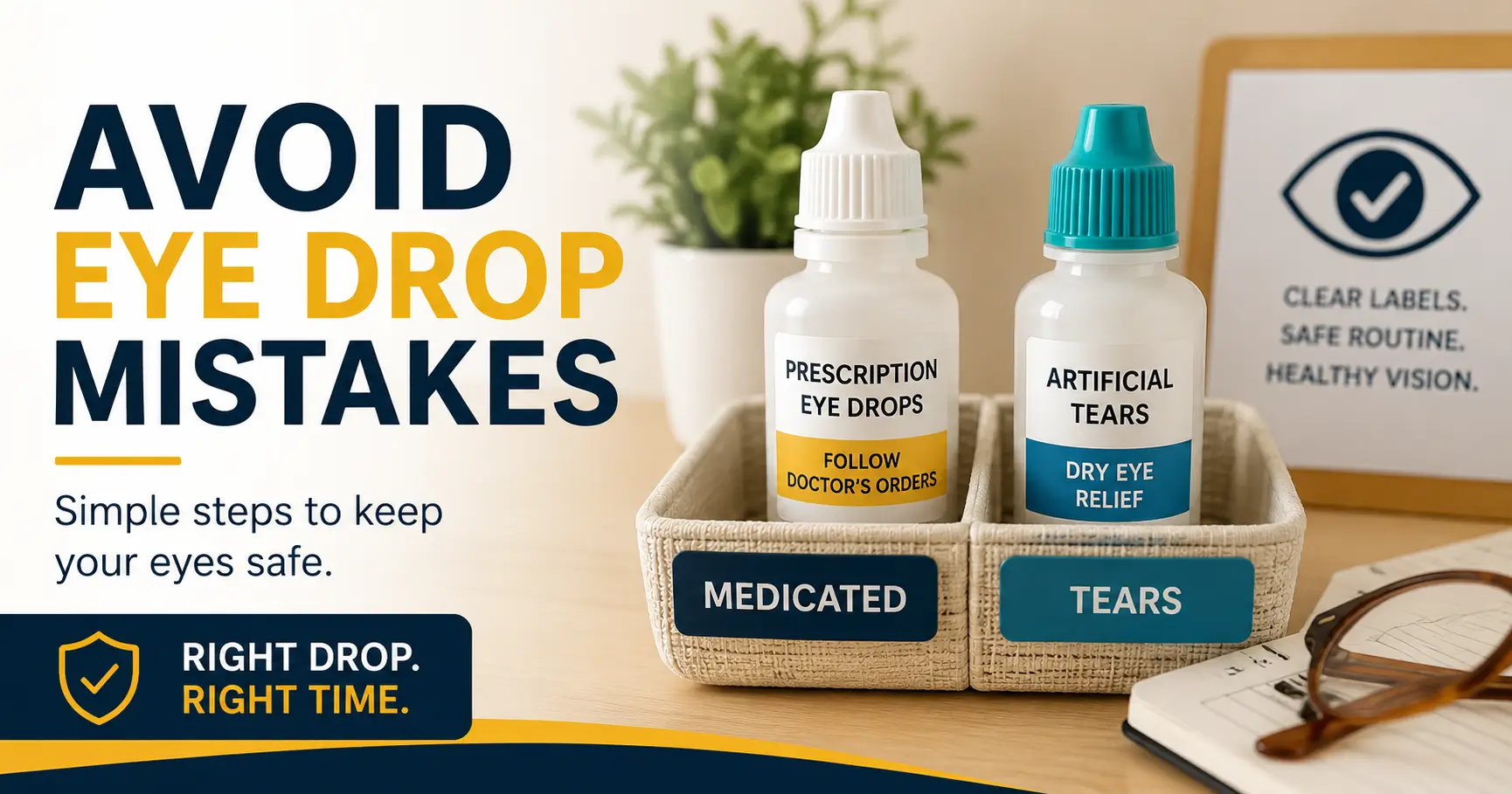
Senior eye-drop safety guide
How Seniors Can Avoid Confusing Eye Drops
with Artificial Tears
A tiny bottle can carry a surprisingly large responsibility. One drop may simply soothe dryness after reading, watching TV, or sitting near a heating vent. Another may protect vision after cataract surgery, lower eye pressure for glaucoma, treat inflammation, or help prevent infection. When the bottles look alike, feel alike, and live in the same bathroom cabinet, even a careful person can reach for the wrong one.
This guide is built for the real morning: dim light, stiff fingers, small print, a ringing phone, and a caregiver trying to help before coffee has finished its small opera. The goal is not to make seniors memorize more labels. The goal is to make the safe choice easier to see, easier to touch, and easier to repeat.
You will learn how to separate prescription eye drops from artificial tears, build a simple two-basket system, label bottles in plain English, create a one-page dosing card, and know when a pharmacist, eye doctor, or urgent care professional needs to step in. Think of it as a small home safety rail for the medicine routine.
Prevent the grab-and-go mistake
Make the wrong bottle harder to pick up in the first place.
Build a caregiver-friendly setup
Use labels, photos, and quick checks so everyone follows the same map.
Know when to call
Spot the moments when guessing is not safe enough.
Small promise: by the end, you can make a safer eye-drop station in about 15 minutes. 👁️
Snapshot
This article is for seniors, caregivers, adult children, spouses, and home aides who want to prevent mix-ups between prescription eye drops and over-the-counter artificial tears. It solves the practical problem of look-alike bottles, tiny labels, vague routines, and forgotten stop dates. By the end, you can set up separate storage, make large-print labels, build a dosing card, and know when to ask a pharmacist or eye doctor before the next drop.
Safety First Before You Change Any Eye-Drop Routine
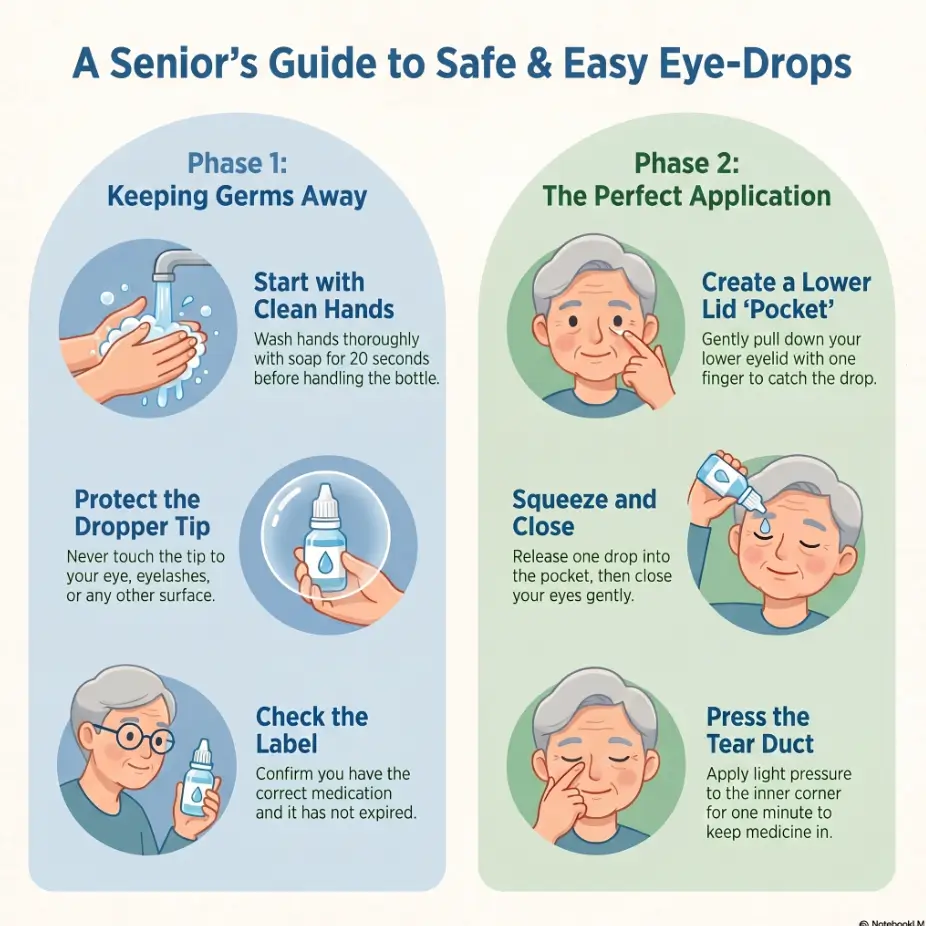
This guide is for organization and safety, not for changing treatment. Prescription eye drops should be used exactly as directed by the prescribing clinician. Artificial tears may be sold over the counter, but they still go into the eye, which means clean handling, safe storage, and product checks matter.
Do not replace a prescription drop with artificial tears because the eye “feels fine.” Do not add extra prescription drops because the eye “feels dry.” Those two instincts are understandable, especially when the bottles are small and the symptoms overlap, but they can lead the routine into a ditch.
Eye drops can treat very different problems. A glaucoma drop may help control eye pressure. A post-surgery drop may follow a strict calendar. An antibiotic or anti-inflammatory drop may be used for a limited time. Artificial tears usually lubricate the surface of the eye. Same doorway, different rooms.
Safety note
If there is sudden vision loss, severe eye pain, chemical exposure, eye injury, rapidly worsening redness, pus-like discharge, severe light sensitivity, swelling, or confusion after using the wrong product, do not troubleshoot at home. Contact an eye doctor, urgent care service, emergency care service, pharmacist, or poison control based on the situation.
Why this topic is higher-risk than it looks
Eye-drop confusion can sound minor until you imagine the context. A senior may have cataracts, glaucoma, dry eye, arthritis, hand tremor, low contrast sensitivity, or memory changes. A caregiver may be managing several bottles with different start dates and stop dates. The bathroom shelf becomes a tiny pharmacy with bad lighting.
The risk is not only “one missed drop.” It may be repeated missed doses, delayed post-surgery care, contamination from old bottles, or using a product that was supposed to be discarded. The safest system reduces decisions at the moment of use.
What this guide will not ask you to do
You do not need a color-coded palace, a spreadsheet worthy of a NASA launch, or a drawer full of fancy gadgets. The best setup is simple enough to survive a tired Tuesday.
You will need a clean surface, two small containers, large-print labels, a pen, a current medication list, and a few minutes with the bottles. If the routine is complicated, a pharmacist can help turn the fog into plain language.
Key takeaway
The safest eye-drop routine is not the one that depends on perfect memory. It is the one that makes the correct bottle obvious before it ever reaches the hand.
Start With the Bottle, Not the Memory
Most eye-drop mix-ups begin with a reasonable assumption: “I know which one this is.” That confidence is a slippery little fish. It may be true at noon under bright light, but not at 7 a.m. when the label is small, the hands are stiff, and three bottles are standing shoulder to shoulder.
For seniors with low vision or recent surgery, the bottle itself should carry the first layer of safety. Size, label, cap, texture, and location should all help answer the same question: “What is this for?”
Why “I know which one this is” becomes risky at 7 a.m.
Morning routines are full of small traps. The eyes may be blurry from sleep. The room may be dim. Glasses may still be on the nightstand. A spouse may ask a question from the doorway. The label may be turned away. If a person has cataracts, macular degeneration, glaucoma field loss, or contrast sensitivity problems, the little print on a bottle can turn into gray snow.
Even people with sharp memory can make selection errors when items look similar. The brain is efficient, not flawless. It sees “small bottle near sink” and fills in the rest from habit. That is useful when finding socks. It is less useful when choosing a medication.
A safer routine asks less of memory and more of the environment. The correct bottle lives in a clearly marked place. The label uses plain words. The chart sits nearby. The setup quietly whispers the answer before the person has to guess.
The one-question test before every drop
Before using any eye drop, pause for one question: “Is this treating a medical condition, or only adding moisture?”
If the drop treats glaucoma, infection, inflammation, allergy, surgery recovery, or another diagnosed eye condition, it belongs in the medical-drop category. If it is used for dryness, mild irritation, wind, screen use, reading fatigue, or comfort, it belongs in the comfort-drop category.
This is not a perfect medical classification. Some dry-eye drops are prescribed. Some allergy drops are over the counter. Some post-surgery instructions include lubricating drops. That is exactly why the question helps. It reminds the user to check purpose, not just packaging.
What no one tells you about eye-drop feel
Artificial tears and prescription drops may both feel cool, wet, and ordinary. The eye does not announce, “This one is lowering pressure,” or “This one is only lubricating.” Sensation is a poor label.
Some prescription drops may sting. Some artificial tears may blur vision for a few minutes. Some gels and ointments feel thicker. But comfort, sting, blur, or relief are not reliable ways to identify purpose.
Use the bottle label, written schedule, storage location, and professional instructions. The eye is an excellent organ. It is not an inventory manager.
Mini habit
Say the purpose out loud before each dose: “Pressure drop, left eye, bedtime” or “Comfort tears, both eyes, as needed.” Speaking the purpose slows the hand just enough for safety to catch up.
Prescription Eye Drops Are Not Just Stronger Tears
A common misunderstanding is that prescription eye drops are simply “stronger” versions of artificial tears. That is not how to think about them. Prescription drops are often targeted tools. Some affect eye pressure. Some reduce inflammation. Some treat infection risk. Some are part of a surgical recovery schedule.
Artificial tears are usually comfort support. They can be very helpful, but they do not take over the medical job of a prescription drop unless a clinician gives that instruction. A warm blanket is useful. It is not an antibiotic.
Glaucoma drops have a job artificial tears cannot do
Glaucoma drops may be prescribed to help control eye pressure. Many people with glaucoma do not feel symptoms day to day, which makes skipping drops deceptively easy. The eye may feel normal even when pressure control matters.
This is where artificial tears can accidentally become a decoy. If the eye feels dry or irritated, a senior may reach for comfort drops and feel better, then forget the prescription dose. The comfort problem was answered, but the medical routine was not.
For glaucoma routines, labels should not simply say the drug name. They should include plain purpose language, such as “pressure drop,” “glaucoma, bedtime,” or “doctor-ordered, right eye.” A prescription name alone can look like a bowl of alphabet soup.
Surgery drops follow a timeline, not a feeling
After cataract surgery or another eye procedure, drops may follow a schedule that changes over days or weeks. One bottle may be used several times daily at first, then tapered. Another may have a stop date. Another may be added only if the surgeon instructs it.
This is not the moment for memory theater. A printed surgery-drop calendar should be attached to the storage area, placed in a clear sleeve, or taped near the drop station if safe to do so. The schedule should show start date, stop date, eye, dose, and time of day.
Old surgery drops should not be kept “just in case” beside current drops. Yesterday’s instructions can become today’s wrong turn.
Cap colors help, but they are not foolproof
Some prescription eye drops use cap colors that may help clinicians and patients identify drug categories. This can be useful, especially when a senior has several bottles. But color should never be the only safety system.
Packaging can vary by manufacturer, refill, pharmacy, country, or product type. A person with low vision may also have trouble distinguishing colors, especially under warm bathroom lighting. Green, teal, gray, and blue can become cousins after sunset.
Use cap color as a supporting clue, not the captain of the ship. The stronger system combines color, large-print wording, tactile markers, separate storage, and a written chart.
| Drop type | Plain-language purpose | Why mix-ups matter | Storage cue |
|---|---|---|---|
| Glaucoma prescription drop | Pressure control | Skipping may reduce treatment effectiveness | Medical basket, bedtime label |
| Post-surgery prescription drop | Recovery, inflammation, infection risk | Wrong timing may disrupt the recovery plan | Medical basket with stop date |
| Artificial tears | Dryness and comfort | Can be mistaken for treatment | Comfort basket |
| Gel or ointment | Longer-lasting lubrication | May blur vision and should not be confused with daytime medicine | Comfort basket, nighttime note |
Artificial Tears Are Helpful, But Still Need Rules
Artificial tears are not villains in this story. For many seniors, they are small bottles of relief. They may help with dryness, burning, scratchiness, wind irritation, reading discomfort, or that tired-eye feeling after a long day of screens and paper bills.
The problem begins when “over the counter” gets translated as “not important.” Anything placed in or near the eye deserves clean hands, clean bottle tips, safe storage, and a quick check for expiration or product warnings.
Dry-eye relief is different from medical treatment
Artificial tears usually add moisture or support the tear film. They may make the eye feel better, but feeling better does not prove that the medical problem is treated. A senior with glaucoma, recent surgery, infection, or inflammation may still need the prescription routine exactly as directed.
Caregivers can help by using the phrase “comfort drops” for artificial tears. It is clearer than “eye drops,” because “eye drops” describes the form, not the purpose. A glass of water and a blood pressure pill both go in the mouth, but nobody would store them under the same label.
Preservative-free drops deserve their own lane
Some artificial tears contain preservatives. Others are preservative-free, often packaged in small single-use vials or special multi-dose bottles. Frequent users, people with sensitive eyes, and people using several eye products may be told to consider preservative-free options.
The safety challenge is practical: preservative-free vials can be tiny, plain, and easy to scatter. If several products use small vials, confusion can bloom like weeds after rain.
Keep preservative-free tears in their box when possible, or put them in a clearly labeled comfort-only container. If the box says single-use, follow the discard guidance. Do not save mystery vials in pockets, purses, car cup holders, or bedside drawers.
Tiny vials, big confusion
Single-use vials are convenient, but they are also easy to detach from their original instructions. Once a vial leaves the box, it may lose the name, expiration date, and purpose. For a senior with low vision, a loose vial may be nothing more than a small plastic question mark.
Use a small zip pouch or cup labeled “comfort tears only.” Keep only one day’s supply loose. Store the rest in the original box. This gives convenience without letting the routine dissolve into tiny anonymous bottles.
Key takeaway
Artificial tears can be useful comfort tools, but they should be stored, labeled, and handled with the same seriousness as anything that touches the eye.
The Two-Basket System That Prevents Most Mix-Ups
The two-basket system is beautifully unglamorous. That is its charm. Instead of asking a senior to decode every bottle from scratch, it divides the routine into two physical zones: doctor-ordered drops and comfort drops.
When bottles do not mingle, the odds of a wrong grab drop sharply. The system works especially well for seniors who manage glaucoma drops plus artificial tears, cataract-surgery drops plus lubricants, or allergy drops plus dry-eye products.
Basket one: “Doctor-ordered drops”
The first container is for prescription drops and any drop that a clinician specifically ordered as part of a treatment plan. Use a container that is stable, easy to clean, and easy to recognize by touch. A small plastic bin, shallow tray, handled basket, or divided organizer can work.
Label it in large print: DOCTOR-ORDERED DROPS. Under that, add plain purpose words if helpful: “pressure,” “surgery,” “infection,” “inflammation,” or “allergy.” Keep the pharmacy label visible on each bottle. Do not cover the official label with tape or stickers.
If there are multiple prescription drops, place a small card in the basket listing each one. The card should say name, purpose, eye, dose, time, and spacing instructions. The bottle and the instructions should live together, not as distant relatives.
Basket two: “Comfort drops only”
The second container is for artificial tears, gels, and ointments used for dryness or comfort. Label it COMFORT DROPS ONLY. Add “not a prescription substitute” if the senior is at risk of mixing them up with medical drops.
Gels and ointments deserve a special note because they may blur vision. Many people use them at night, but routines vary. If a gel or ointment is for bedtime, write “bedtime comfort” on the label or card.
For seniors with poor vision, make the comfort basket feel different from the medical basket. Use a different shape, texture, or location. One might be a smooth blue tray and the other a textured white cup. The point is not decoration. The point is recognition.
Do not let bottles mingle
The same-shelf problem is sneaky. Bottles placed together eventually get shuffled. Someone cleans. A visitor moves things. A rushed morning puts a bottle down in the wrong spot. Soon the “system” is just a pile wearing a polite hat.
Use the kitchen-drawer rule: if the corkscrew, batteries, rubber bands, takeout menus, and spare keys all live together, one day you will find the wrong thing with great confidence. Eye drops deserve better than the junk drawer treatment.
Simple eye-drop safety flow
1
Identify
Ask what the drop is for: treatment or comfort.
2
Separate
Use one medical basket and one comfort basket.
3
Label
Write purpose, eye, time, and stop date in large print.
4
Review
Check bottles weekly with the current medication list.
| Setup item | Medical basket | Comfort basket |
|---|---|---|
| Large label | Doctor-ordered drops | Comfort drops only |
| Examples | Glaucoma, surgery, antibiotic, steroid, allergy if directed | Artificial tears, lubricant gels, nighttime ointment |
| Extra note | Use exactly as prescribed | Do not replace prescription drops |
| Best location | Clean, dry, well-lit routine spot | Separate clean, dry location nearby but not mixed |
| Caregiver check | Match to current medication list | Check expiration and opened date |
Label Like Vision Depends on It
Labels should not be tiny riddles. A good label answers the human question first: “What is this for, and when do I use it?” The drug name can stay on the pharmacy label. Your added label should translate the routine into everyday language.
For seniors with low vision, high contrast matters. Use thick black marker on white label tape, or large-print labels made with a label maker. Avoid pale ink, shiny tape, and decorative fonts that look lovely until they become unreadable.
Use big-print labels with plain words
The best labels are almost boring. “GLAUCOMA, LEFT EYE, NIGHT.” “DRY EYES, COMFORT ONLY.” “SURGERY DROP, RIGHT EYE, STOP JUNE 12.” Boring is good here. Boring is a guardrail.
Place added labels where they do not cover the official pharmacy label, expiration date, lot number, or instructions. If the bottle is too small, label the storage cup or attach a large tag to the bottle with a rubber band, keeping the original information visible.
Add tactile cues for low vision
Tactile cues help when print is hard to see. A rubber band around one bottle, a raised sticker on a storage cup, or textured tape on the medical basket can provide a second signal. This is especially useful for seniors who reach for drops at night.
Keep tactile systems simple. One raised dot might mean “bedtime pressure drop.” Two rubber bands might mean “morning drop.” But if the code becomes too clever, it collapses under its own tiny architecture.
Write down the tactile code on the dosing card. Caregivers, spouses, and visiting family should not have to decode the system by folklore.
Write the purpose, not just the name
Many medication names are hard to remember and harder to read. Generic names can be long. Brand names can change. Refills may look different. Purpose words travel better across those changes.
A bottle labeled “latanoprost” may not mean much to a tired patient. A bottle labeled “pressure drop, both eyes, bedtime” is easier to act on. This does not replace the prescription label. It adds a practical translation layer.
Key takeaway
A good eye-drop label should say the job, the eye, and the time. The name alone is rarely enough for a safe senior routine.
Show me the nerdy details
Medication routines fail more often when the user must perform several mental steps in a row: identify the bottle, remember the purpose, remember the eye, remember the time, remember the spacing rule, and remember whether the medicine is still current. A strong home system reduces that mental stack.
That is why environmental cues matter. Separate containers reduce selection choices. Large-print labels reduce visual strain. Tactile markers add a nonvisual signal. A dosing card moves information out of memory and into the room. Weekly review catches old bottles before they become future confusion.
The routine becomes safer because the environment does part of the thinking. That is not a weakness. It is good design.
Timing Rules: The Quiet Safety Net
Even when the right bottle is selected, timing can still cause trouble. Some drops are used once daily. Some are used several times daily. Some should be spaced apart. Some surgery drops taper. Some artificial tears may be used as needed, but not at the exact moment they interfere with prescription dosing.
A one-page eye-drop schedule is the quiet safety net under the whole routine. It should be simple enough for the senior to use and clear enough for a caregiver to understand at a glance.
Build a one-page eye-drop schedule
The schedule should include the drop name, purpose, eye, dose, time, and spacing rule. If there is a stop date, make it loud. Post-surgery drops especially need clear stop dates because old instructions can linger in the home long after they belong there.
Keep the schedule where the drops live. A perfect chart in a folder is less useful than a simple chart beside the basket. The chart should be readable without hunting for glasses, though glasses are still a good idea for checking labels.
| Drop name | Purpose | Eye | Time | Spacing or note |
|---|---|---|---|---|
| Prescription pressure drop | Glaucoma pressure control | Both eyes | Bedtime | Use before comfort ointment unless clinician says otherwise |
| Artificial tears | Dry-eye comfort | Both eyes | As needed | Ask pharmacist how to space from prescription drops |
| Post-surgery anti-inflammatory | Surgery recovery | Right eye | Morning, afternoon, evening | Stop date: write exact date |
Use alarms, but avoid alarm clutter
Phone alarms can help, but five identical alarms can become a flock of digital pigeons. The senior hears the sound, silences it, and still may not know which drop is due.
Name the alarm clearly: “Pressure drop, both eyes,” “Surgery drop, right eye,” or “Comfort tears if dry.” If the phone allows spoken reminders, use plain language. If a senior dislikes phone alarms, use a paper checklist divided into morning, afternoon, evening, and bedtime.
For caregivers, a shared reminder system can help, but do not let technology become the only safety layer. Batteries die. Phones get left in another room. Paper is not glamorous, but it is wonderfully stubborn.
Leave space between different drops
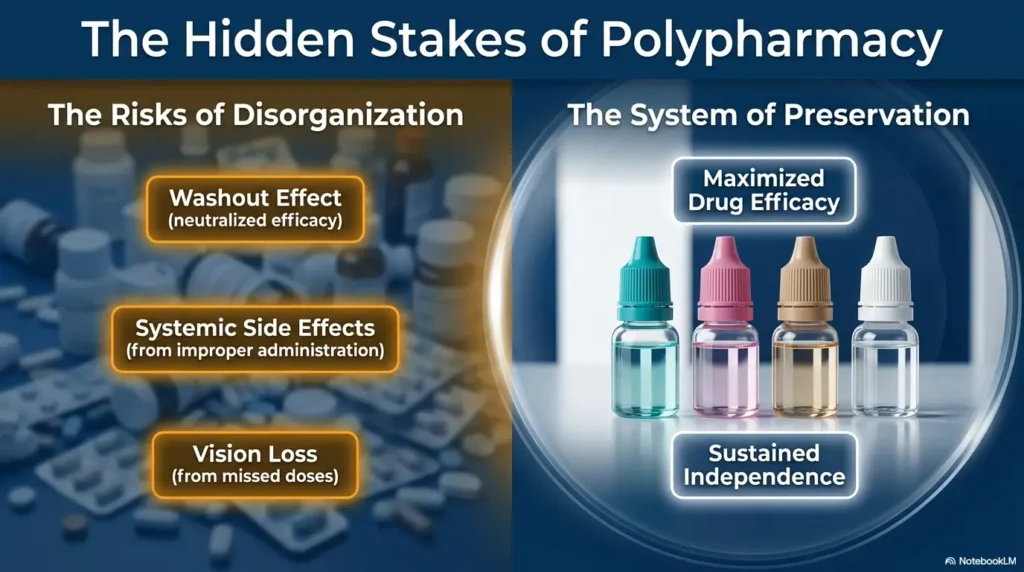
When several eye drops are used around the same time, spacing may matter. One drop can wash out or dilute another if used immediately after it. The exact spacing advice should come from the pharmacist or eye doctor because routines differ.
Do not invent a spacing rule if surgery, infection, glaucoma, or inflammation treatment is involved. Ask directly: “How many minutes should I wait between these drops?” Then write the answer on the card.
Short Story: The Bottle That Moved
Marian kept two bottles by the bathroom sink. One was for dry eyes. One was for glaucoma. She knew the difference, or at least she did on ordinary days.
Then her grandson cleaned the counter before a family visit. He meant well. He lined both bottles neatly beside the toothbrush cup, labels facing the mirror. The next morning, Marian woke early, reached for the familiar shape, and used the comfort drops instead of the pressure drop.
Nothing dramatic happened. That was almost the problem. Because nothing felt wrong, she nearly repeated the mistake.
Her daughter fixed the system that afternoon. Prescription drops went into a red-labeled tray. Artificial tears went into a white cup across the shelf. A large card sat between them. The lesson was gentle but firm: a safe routine should survive helpful hands.
Common Mistakes That Turn Safe Drops Into Trouble
Most eye-drop mistakes are not reckless. They are ordinary. Someone keeps an old bottle because medicine is expensive. Someone assumes an over-the-counter product is always harmless. Someone uses artificial tears right before a prescription drop because the eye felt scratchy.
Safety improves when these mistakes are named without shame. Once named, they can be designed out of the routine.
Mistake 1: Keeping old surgery drops “just in case”
Old surgery drops are magnets for confusion. They may have been important once, but that does not make them useful now. A senior may see the bottle and think, “This was for my eye, so maybe I should use it again.”
After surgery recovery is complete, ask the eye doctor or pharmacist which drops should be discarded and which, if any, should remain. Do not keep discontinued prescriptions in the active drop station.
Mistake 2: Assuming all over-the-counter drops are harmless
Over-the-counter does not mean risk-free. Some redness-relief drops may not be right for frequent use. Some products may contain preservatives. Some bottles may become contaminated if handled poorly. Some products may be recalled or warned against by authorities.
A practical rule helps: buy eye drops from reputable sources, keep packaging until the product is finished, check expiration dates, and avoid using any bottle that looks damaged, cloudy, dirty, or unfamiliar.
Mistake 3: Using artificial tears right before prescription drops
Dry eyes are impatient. They ask for relief now. But if artificial tears are used immediately before a prescription dose, the routine may need spacing. The concern is not that artificial tears are “bad.” The concern is that timing can affect how drops sit on the eye.
Ask the pharmacist or eye doctor for a spacing rule. Then put it on the schedule in plain words: “Wait ___ minutes between drops.” Empty blanks on the card should be filled by a professional, not by guesswork.
Mistake 4: Letting the bathroom cabinet run the routine
The bathroom cabinet often has steam, clutter, shadows, and look-alike packaging. It is convenient, but it is not always the best command center for eye-drop safety.
Follow storage instructions first. Some drops may have special storage requirements. If room-temperature storage is allowed, choose a clean, dry, well-lit location tied to the routine. A small tray near a reading chair, bedside lamp, or kitchen counter may work better than a crowded cabinet.
Mistake checklist
- Old surgery drops still sitting with current drops
- Artificial tears and prescription bottles mixed together
- No large-print purpose label
- No written spacing rule
- Loose single-use vials outside the original box
- No weekly bottle review
Caregiver Check: Five Minutes, Once a Week
A weekly caregiver check is one of the most powerful safety habits in this whole guide. It does not need to be dramatic. It is not an inspection with a clipboard and thundercloud. It is a small reset that keeps the routine from drifting.
Choose the same day each week. Sunday afternoon, Monday morning, or the day after pill organizers are filled can work. The goal is to match every bottle to the current plan and remove anything that does not belong.
Match every bottle to the current medication list
Line up the bottles. Read the label. Compare each one with the current medication list, surgery instructions, or doctor visit summary. If a bottle is not on the current list, do not keep it in the active basket until a pharmacist or clinician confirms its role.
This is also a good time to connect with a broader medication-safety system. If the senior already uses a one-page medication list, add the eye drops there. Eye drops are medications too, even when they are small enough to disappear behind a coffee mug.
Helpful related reading: use a one-page medication list template to keep eye drops, pills, creams, and supplements in one readable place.
Check the opened date
Some eye drops have discard guidance after opening. Some single-use vials should be discarded after use. Some prescriptions may have expiration dates or instructions that differ from artificial tears. The safest approach is to write the opened date on the box, bottle tag, or dosing card.
If the date is unknown and the product has been sitting for months, ask a pharmacist before using it. When eyes are involved, “probably fine” is not a sturdy bridge.
Photograph the safe setup
A simple phone photo can save the system after travel, cleaning, house guests, or a rushed morning. Take a picture of the medical basket, comfort basket, and dosing card in their correct places.
Share the photo with the main caregiver and, if appropriate, another family member. The photo becomes a reset button. If the station gets rearranged, anyone can restore it without arguing with memory.
Weekly five-minute caregiver audit
- Wash hands and clear a clean surface.
- Place all eye-drop bottles and boxes on the surface.
- Separate medical drops from comfort drops.
- Compare each bottle with the current medication list.
- Remove expired, discontinued, duplicate, or mystery bottles from the active station.
- Check opened dates and stop dates.
- Confirm labels are readable and tactile markers still make sense.
- Update the phone photo of the correct setup.
Key takeaway
A weekly eye-drop audit catches the quiet problems: old bottles, missing stop dates, unreadable labels, and comfort drops that wandered into the medical basket.
When to Seek Help or Stop Before the Next Drop
Some eye-drop questions can wait for the next routine call. Others should not. The hard part is knowing which is which. A simple rule helps: if there is pain, vision change, infection concern, surgery timing, product warning, or uncertainty about a prescription, stop guessing and contact a professional.
Caregivers should make this easy by placing phone numbers near the dosing card: eye doctor, pharmacy, primary care office, after-hours clinic, and poison control. In a stressful moment, nobody wants to search contacts while holding a suspicious bottle.
Call the pharmacist when the label is unclear
A pharmacist can often explain whether a bottle is a prescription medicine, artificial tear, allergy product, redness reliever, or something else. Pharmacists can also help clarify storage, discard dates, and spacing between drops.
Use a clear script: “I am helping my parent organize eye drops. Can you tell me what this bottle is for, whether it is still current, and how it should be spaced from artificial tears?”
For seniors with low vision, ask about large-print prescription labels or spoken-label options. Related reading: this low-vision pharmacy help script can make that call easier.
Call the eye doctor after surgery confusion
Post-operative drops are not a casual routine. If a senior missed a surgery drop, used the wrong bottle, restarted an old bottle, or cannot remember whether a dose was taken, call the eye doctor’s office for instructions.
Do not double up unless the clinician says to. Do not restart old drops because they seem familiar. Do not stop early because the eye feels fine. Surgery recovery is a calendar, not a mood ring.
Seek urgent help for red-flag symptoms
Urgent symptoms include sudden vision loss, new severe eye pain, rapidly worsening redness, pus-like discharge, swelling around the eye, severe light sensitivity, chemical exposure, injury, or symptoms after using a product that may be recalled, contaminated, expired, or not meant for the eye.
If a prescription drop was used incorrectly and the senior feels unwell, has severe symptoms, or may have used a product not intended for eye use, contact a medical professional or poison control. Keep the bottle nearby so the professional can identify it.
Stop-and-call risk scorecard
- Call pharmacist: unclear label, unknown expiration, storage question, spacing question.
- Call eye doctor: missed glaucoma dose, surgery-drop confusion, new symptoms during treatment, uncertain stop date.
- Seek urgent help: severe pain, sudden vision change, injury, chemical exposure, pus-like discharge, serious swelling, or suspected contaminated product.
FAQ
Can artificial tears replace prescription eye drops?
No. Artificial tears usually lubricate the eye for dryness or comfort. Prescription drops may treat pressure, infection risk, inflammation, allergy, or post-surgery recovery. Replacement should happen only if the prescribing clinician says so.
Should seniors keep artificial tears and prescription drops together?
Usually no. Separate storage reduces the chance of grabbing the wrong bottle. Use one labeled container for doctor-ordered drops and another for comfort drops only.
What should I do if I used artificial tears instead of my prescription eye drop?
Check the prescription instructions and call the pharmacist or eye doctor if the dose was missed, delayed, or related to glaucoma, surgery, infection, or inflammation. Do not double the next dose unless a professional tells you to.
What should I do if I used prescription drops instead of artificial tears?
Do not keep dosing to “balance it out.” Check the bottle, note what was used, and call a pharmacist, eye doctor, or poison control for guidance, especially if symptoms appear or the medication was not prescribed for that situation.
Are preservative-free artificial tears safer for seniors?
They may be preferred for frequent use or sensitive eyes, but the best choice depends on the person’s condition, other eye medications, and clinician advice. Store single-use vials carefully so they do not become loose mystery drops.
How can low-vision seniors tell eye-drop bottles apart?
Use large-print labels, high-contrast writing, separate containers, tactile markers, good lighting, and a written dosing card. Do not rely on cap color alone.
Can eye drops expire after opening?
Yes. Some drops have expiration dates, discard dates, or single-use instructions. Write the opened date on the box or card, and ask a pharmacist if the date is unclear.
Should eye drops be kept in the refrigerator?
Only if the label, pharmacist, or clinician says so. Some drops have special storage instructions, while others do not. If refrigeration is required, keep the two-basket idea by using clearly labeled separate bags or containers inside the refrigerator.
Make a Two-Column Drop Card Today
The safest next step is wonderfully small: make a two-column drop card. It does not require a medical degree, an app subscription, or a heroic afternoon. It simply turns a confusing handful of bottles into a readable plan.
Take 15 minutes. Gather every eye-drop bottle, box, and instruction sheet. Put prescription and doctor-ordered drops on the left. Put artificial tears, gels, and ointments on the right. If any bottle is mysterious, place it aside and ask a pharmacist before returning it to active use.
Column one: “Medical drops”
List every prescription or doctor-ordered drop. Include the name, purpose, eye, dose, time, doctor, spacing rule, and stop date if there is one. Use plain words large enough to read without squinting.
Example: “Pressure drop, both eyes, bedtime, wait before ointment.” Another example: “Surgery anti-inflammatory, right eye, three times daily, stop June 12.” The wording should match the clinician’s instructions, but it should be understandable to the person using it.
Column two: “Comfort drops”
List artificial tears, gels, and ointments. Include when they are used, whether they are preservative-free, and any discard notes. Add a reminder: “Comfort only, not a substitute for prescription drops.”
If the senior uses a magnifier, phone camera, or reading app to check labels, keep that tool near the drop station. Related reading: how to read labels aloud can help when print is too small.
Put the card where the drops live
The card and bottles should be neighbors, not pen pals. Place the card in a clear sleeve, tape it near the drop station if safe, or keep it upright in the basket. If the senior travels, take a photo of the card and pack the bottles in separate labeled bags.
Then do the final safety move: remove everything that does not belong. Old drops, duplicates, loose vials, and unknown bottles should not stay in the active station. A clean system is calmer to use and easier to maintain.
Two-column drop card template
Medical drops
- Name:
- Purpose:
- Eye:
- Dose:
- Time:
- Spacing:
- Stop date:
- Doctor:
Comfort drops
- Name:
- Purpose:
- When used:
- Preservative-free?
- Opened date:
- Discard note:
- Not a prescription substitute:
Key takeaway
The 15-minute win is simple: separate the bottles, write the purpose in large print, add timing rules, and remove anything that is expired, discontinued, duplicated, or mysterious.
The article began with a tiny bottle and a large worry. It ends with a table, two containers, and a calmer hand. That is the point. Senior safety often improves through humble objects placed wisely: a label, a tray, a card, a photo, a phone number.
Today, make the two-column card. Tomorrow, the morning routine will have one less trap hiding in plain sight.
Last reviewed: 2026-05