


The Tiny Print on a Soup Can Should Not Require a Household Search Party
For many adults over 40, reading glasses around the house become less of a luxury and more of a daily navigation tool. They help with medicine labels, oven buttons, text messages, bills, grocery lists, hobby supplies, and the mysterious numbers printed on every charger made after 2019.
When the glasses are missing, the day develops little snags. You squint. You guess. You walk back into the bedroom—and forget why. That guessing has a cost: wasted time, broken frames, eye strain, clutter, and even safety risks from glasses left on stairs, beds, sofas, or floors.
A practical, caregiver-friendly home map built around real behavior, not magazine-perfect counters:
- ✓ Start small.
- ✓ Make the glasses visible.
- ✓ Give every pair a home before they become household fossils.
The Quick Home Map for Reading Glasses
The best locations are not random rooms. They are task zones. Put reading glasses near the bedside lamp, favorite chair, kitchen labels, medication station, bathroom grooming supplies, entryway mail, home office, and hobby area. Then protect each pair with a tray, case, hook, or drawer insert.
- Most useful starter spots: bedside table, favorite chair, kitchen, medication area.
- Most risky spots: stairs, floors, beds, sofas, sinks, hot cars.
- Best caregiver upgrade: bright cases and consistent placement.
Table of Contents
Safety / Disclaimer
This article is for general home organization and aging-in-place planning. It is not medical advice, diagnosis, or a replacement for an eye exam.
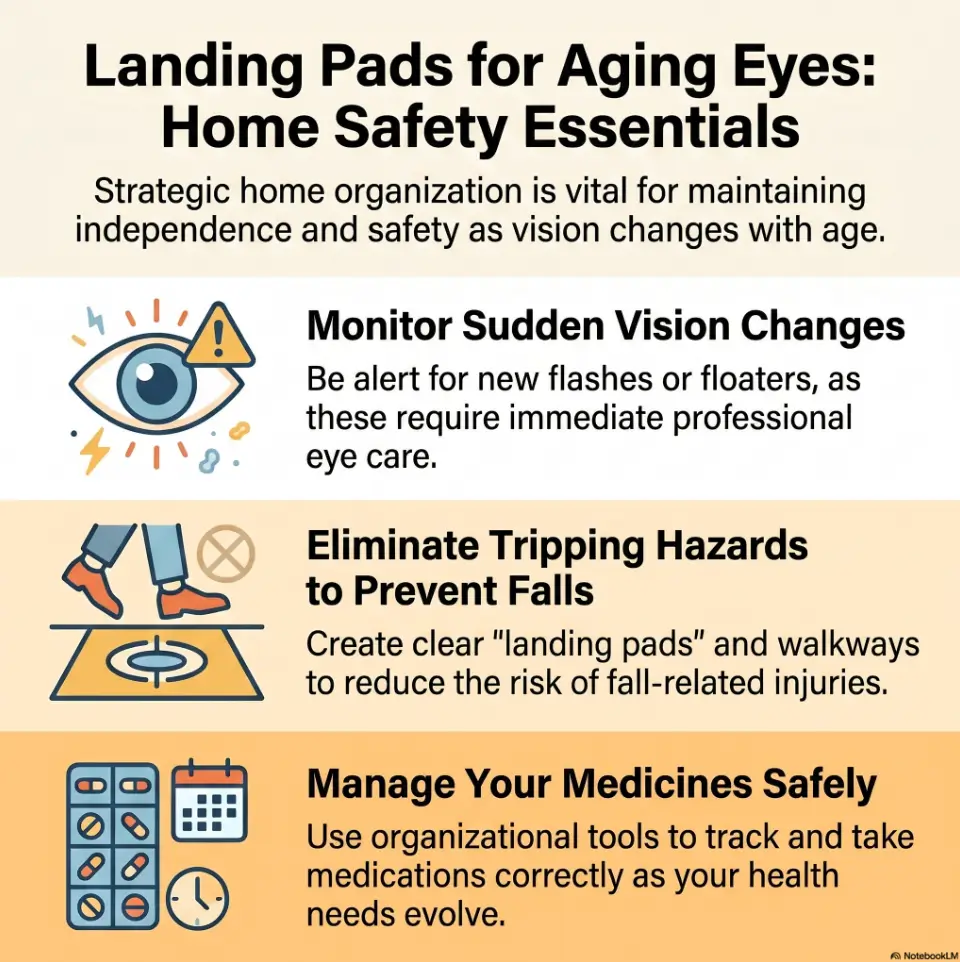
Reading glasses can help with near tasks, but they do not explain every vision change. Sudden vision loss, new flashes or floaters, severe eye pain, new double vision, one-sided changes, or distortion should be evaluated promptly by an eye care professional. If you are unsure whether a symptom is urgent, call your clinician, local emergency line, or eye doctor’s office for direction.
For medication instructions, glasses are only one layer of safety. If a label is confusing, unclear, damaged, or too small to read with confidence, ask a pharmacist or clinician to confirm the directions.
Start With the Real Problem: Glasses Disappear Where Habits Collide
The “I Just Had Them” Pattern
Reading glasses usually disappear during transitions, not during reading. You answer the door with a bill in your hand. You set the glasses on the hallway table. You check the pasta box, then move to the phone. You read a pill bottle, then carry laundry to the bedroom. The glasses are not lost in a dramatic way. They are simply released into the wild.
That is why the best storage system is not built around rooms alone. It is built around moments. Mail needs one spot. Medication needs another. Cooking, grooming, screens, hobbies, and bedtime all need their own tiny landing strip.
Think of reading glasses as a tool, not an accessory. You would not keep the can opener in a sock drawer. Well, most days.
Why One Pair Usually Fails
One pair can work in a small apartment with a consistent routine. In a multi-level home, shared household, or caregiver setting, one pair often becomes a slow-motion scavenger hunt.
For aging eyes, the friction is real. Presbyopia, the common age-related loss of near focusing, typically becomes noticeable in the 40s and 50s. Readers help with close-up work, but only if they are close enough to use before the squinting begins.
If someone has reduced contrast sensitivity, tremor, arthritis, memory changes, glaucoma field loss, macular degeneration, or post-surgery vision changes, the storage system matters even more. A misplaced pair can turn a simple label into a committee meeting.
Here’s what no one tells you…
The best storage spot is not always the neatest spot. It is the spot where the hand naturally lands before frustration starts.
A beautiful drawer system that no one uses is decor. A slightly imperfect tray beside the chair that catches the glasses every night is a working system. Let the house confess its habits. Then place the glasses where the confession points.
- Watch where glasses get set down during transitions.
- Give each high-use zone one visible landing spot.
- Use containers that are easy to see and easy to reach.
Apply in 60 seconds: Name the three places where you most often say, “Where did I put my glasses?”
Money Block: The Reader Placement Checklist
Use this yes/no check before assigning a pair to any location.
| Question | Yes Means | Next Step |
|---|---|---|
| Do you read small print there daily? | This is a priority zone. | Add a case, tray, or stand. |
| Is the surface dry and stable? | The pair is less likely to slide or warp. | Keep it away from edges. |
| Can you spot the case from standing height? | The system supports aging eyes. | Use contrast or a brighter case. |
| Could someone step, sit, or spill on them? | The spot is risky. | Move the pair higher or into a case. |
Neutral action: Approve only the spots that pass at least three of the four checks.
Bedside Table Strategy: The First Pair Should Live Where the Day Begins
Best Setup for Night Reading
The bedside pair is often the most valuable pair in the house. It handles books, phones, clocks, medication labels, devotional reading, nighttime notes, and the tiny print on charging bricks that seem designed by moonlight goblins.
Set up the pair beside the lamp, not behind it. A hard case protects the frames if a hand sweeps across the table at 2 a.m. A shallow tray works well if the person removes glasses before sleep and wants one easy target. A small basket near the phone charger can hold glasses, lip balm, hearing aid case, and a cleaning cloth.
For older adults with poor vision, a bedroom system should also support lighting and safe movement. A related setup guide on bedroom safety for seniors with poor vision can help you think beyond the glasses themselves.
Keep Them Reachable, Not Buried
Drawers can be useful, but only if they are shallow, simple, and predictable. A deep drawer packed with receipts, batteries, cough drops, mystery keys, and a 2008 instruction manual will swallow readers like a tiny cave.
Try one of these bedside options:
- A hard case on top of the nightstand for maximum protection.
- A shallow drawer insert labeled “glasses” for a cleaner look.
- A soft-lined tray beside the lamp for easy reach.
- A wall-mounted pocket near the bed if table space is limited.
If the person uses medication at night or first thing in the morning, keep the glasses near the medication list, not under a stack of books. For a broader bedside layout, low-vision bedside organization offers a useful companion routine.
Don’t Do This: Loose Glasses Under Pillows
Glasses under pillows feel convenient until they bend, crack, vanish into bedding, or poke a cheek at dawn. Beds and blankets are soft traps. They hide frames beautifully and protect them poorly.
A simple rule works: if the surface moves, do not store glasses there. Beds, blankets, towels, robes, and laundry piles are all temporary weather systems. Readers need furniture, not fabric fog.
Favorite Chair Zone: Build a Reading Glasses Landing Pad
The Living Room Pair
Most homes have a command chair. It may not look official, but everyone knows. It is where mail gets opened, TV menus are negotiated, magazines are half-read, tablets are charged, and crossword puzzles begin with hope.
That chair deserves its own reading glasses landing pad. Place a pair within arm’s reach, but not under remote controls or snack bowls. Side tables are ideal if they have a small tray or case. A book basket can also work if the glasses have a dedicated pocket.
If TV captions, remotes, or screen glare are part of the routine, related tools such as a large-button TV remote or strategies for TV glare reduction may make the whole chair zone easier.
Side Table, Remote Caddy, or Book Basket?
A side table is best for people who remember visual cues. A remote caddy works for people who like vertical pockets and fewer loose objects. A book basket works when reading materials already live beside the chair.
| Storage Option | Best For | Watch Out For |
|---|---|---|
| Side table tray | People who need visible cues | Crowded surfaces |
| Remote caddy | Small living rooms | Deep pockets that hide glasses |
| Book basket | Readers and puzzle lovers | Glasses crushed under books |
Let’s be honest…
If the chair has become a tiny kingdom of remotes, receipts, cough-drop wrappers, and half-read magazines, the glasses need a throne, not “somewhere nearby.”
Give the pair one small container that is visually different from the clutter around it. A blue case on a brown table. A white tray on a dark shelf. A red pouch in a neutral basket. Contrast is not vanity. It is a retrieval strategy.
Short Story: The Chair Beside the Window
Marian kept three pairs of reading glasses, yet every afternoon she searched for the same one. It was always near the chair beside the window, except “near” meant under the newspaper, inside the knitting bag, on the windowsill, or once, tucked into a seed catalog like a pressed flower. Her daughter did not buy a fancy organizer.
She placed a small yellow tray on the side table and said, “This is the landing pad.” At first Marian laughed. A landing pad sounded dramatic for readers from the drugstore. But a week later, the tray had done its quiet work. The glasses returned to it after mail, after knitting, after reading church notes. The lesson was not that Marian became more organized. The house became more forgiving. The tray caught the habit before the habit scattered.
Kitchen Counter Rules: Keep Glasses Near Labels, Not Spills
Why the Kitchen Needs Its Own Pair
The kitchen is a close-up task factory. Nutrition labels. Recipe cards. spice jars. oven settings. appliance buttons. grocery lists. expiration dates. The print is small, the lighting is often uneven, and hands are busy.
That makes the kitchen a strong candidate for its own pair of readers. It is also one of the easiest rooms to get wrong. Water, heat, grease, flour, and elbow traffic can turn glasses into a scratched, sticky little regret.
For senior households, kitchen organization overlaps with safety. If small print on appliances or food labels is a regular problem, kitchen appliance safety for seniors and how to read expiration dates with low vision both connect naturally with this setup.
Safer Kitchen Storage Spots
Choose a dry, stable location away from the sink and stove. A wall hook, upper cabinet shelf, magnetic organizer on the side of the fridge, or small counter tray outside the prep zone can work well.
Good kitchen spots include:
- A labeled case inside a cabinet near cookbooks or measuring cups.
- A wall hook near the grocery list, away from splashes.
- A tray beside the recipe stand, not beside the sink.
- A drawer insert near food labels and meal-planning supplies.
Food prep can already be visually busy. If glare or low contrast makes labels harder, ideas from glare-free under-cabinet lighting and cutting board color for low vision can help reduce the “where did the edge go?” problem.
Don’t Do This: Glasses Beside the Sink
The sink is a villain in a cardigan. It looks harmless. Then come water spots, soap film, grease, heat, and the sudden elbow of doom.
Do not store readers beside the sink, on the stove ledge, near a toaster oven, or in the direct path of food prep. Heat can warp some frames or affect coatings. Grease can make lenses harder to clean. Water turns the whole situation into a tiny smear festival.
The Glasses Placement System
Where do you read tiny print?
Is it dry, stable, and off the walking path?
Can the case or tray be seen quickly?
Do the glasses go back after each task?
Best result: one pair, one task zone, one obvious container.
Medication Station: Make Tiny Print Less Risky
Put Glasses Where Labels Are Read
A medication station is one of the most important places to keep reading glasses. Prescription labels, supplement bottles, pill organizers, glucose meters, blood pressure logs, eye drop instructions, and appointment notes all depend on readable details.
Keep a pair in the same place where medication instructions are reviewed. This may be a kitchen cabinet, bedroom tray, bathroom drawer, or dining table organizer. The key is consistency. The glasses should live where the reading happens, not wherever they last escaped.
If medication safety is already a concern, link the glasses system with a written medication list. A one-page medication list template, low-vision medication management, and low-vision medication tracker can all support the same routine.
Use a Bright Case for Fast Recognition
Medication areas are often visually crowded. Bottles, boxes, pill cutters, cups, pens, notes, and receipts compete for attention. A bright case helps the glasses stand out.
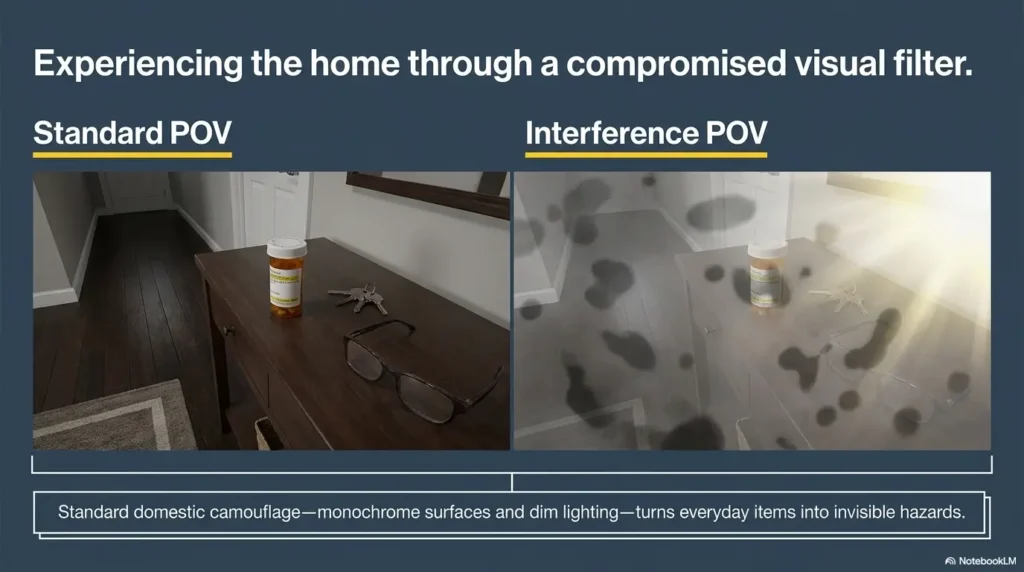
Choose a case that contrasts with the surface below it. A dark case on a dark counter is a camouflage experiment. A yellow, red, white, or turquoise case can be easier to spot. Larger cases are also easier to handle for people with arthritis or reduced hand strength.
Safety Note for Medication Mix-Ups
Glasses improve readability, but they do not solve unclear directions. If a label says something confusing, or if two pills look similar, do not guess. Call the pharmacist. Ask for larger print. Ask whether medication synchronization, pill packaging, or clearer labels are available.
The FDA notes that pharmacists may be able to print prescription labels in larger type when labels are hard to read. That one small request can turn medication time from a squinting ritual into a calmer routine.
Money Block: Medication Station Decision Card
| Choose This | When It Works Best | Trade-Off |
|---|---|---|
| Bright hard case | Shared counters, cluttered surfaces, caregivers involved | Takes one extra second to open |
| Open tray | Glasses are used many times daily | Less protection from dust or spills |
| Drawer insert | Medication area must stay visually clean | Can be forgotten if not labeled |
Neutral action: Pick the option the person will actually use with sleepy eyes and ordinary patience.
- Keep glasses beside the labels or pill organizer.
- Use a bright case that stands out from bottles and papers.
- Ask a pharmacist for larger labels when needed.
Apply in 60 seconds: Put one pair in a bright case beside the medication list today.
Bathroom Placement: Useful, But Only With Moisture Control
When Bathroom Glasses Make Sense
Bathroom readers can be useful for grooming labels, skincare instructions, contact lens packaging, thermometer displays, and magnifying mirrors. They help when close-up tasks happen after a shower or before bed.
But bathrooms are not gentle environments. Steam, water spots, slippery counters, hair products, and sink edges create problems. If you keep glasses in the bathroom, they need a protected home.
For people with low vision, tactile systems can help with bathroom routines too. Guides on tactile labels for shampoo and conditioner and tactile faucet marking pair well with a safer glasses station.
Best Bathroom Storage Choices
Use a closed case, drawer insert, high shelf, or wall pocket away from sink edges. A microfiber cloth nearby helps manage fog and smudges. Keep the case in the same direction every time, especially if the person reaches for it without full attention.
A good bathroom glasses spot should be:
- Dry.
- Away from the sink edge.
- Easy to find by sight or touch.
- Protected from sprays, lotions, and toothpaste.
The Humidity Problem
Steam does not merely fog the lenses. It also encourages wiping with whatever towel is nearby. That towel may contain grit, product residue, or laundry texture that can scratch coatings over time.
A bathroom pair should be a convenience pair, not the most expensive pair in the house. If someone has prescription readers or specialty lenses, keep the best pair in a safer room and use a backup pair for bathroom labels.
Entryway Pair: The Underrated Spot for Mail, Receipts, and Errands
Why the Doorway Matters
The entryway is where outside paper enters the house. Mail, package labels, appointment cards, store receipts, delivery notes, and shopping lists often land there first. If no glasses live nearby, people either guess or carry the paper to another room, which is how mail becomes archaeology.
An entryway pair can reduce those small daily loops. It helps you read a return address, sort a bill, check a prescription pickup receipt, or confirm a package name before it moves deeper into the home.
If paper clutter is a recurring issue, a broader low-vision filing system can support the same idea: readable, repeatable, and not dependent on heroic memory.
Build a Small “Out-the-Door” Kit
Pair reading glasses with keys, wallet, reusable bags, sunglasses, and medication reminders. The goal is not to create a boutique display. It is to reduce the number of decisions required before leaving home.
A small tray, shelf, or wall organizer can hold:
- Reading glasses in a hard case.
- Keys.
- Wallet or purse hook.
- Reusable shopping bags.
- Appointment card or errand list.
For older adults who rely on written reminders, a low-vision calendar system for appointments can connect the entryway to the larger household routine.
Mistake to Avoid: Tossing Them Into the Junk Bowl
The junk bowl is where good intentions go to collect crumbs. Coins, batteries, paper clips, keys, cough drops, and receipts can scratch lenses and hide frames.
If you love the entryway bowl, keep it. Just add a separate case or small upright stand for the glasses. One container for chaos, one container for clarity. Domestic diplomacy at its finest.
Home Office Setup: Protect the Pair That Does the Heavy Lifting
Desk Pair vs. Computer Glasses
Reading glasses and computer glasses are not always the same. Readers usually help at close distances, such as books, labels, and phones. Computer distance may require a different strength, especially if the monitor sits farther away than a book.
If someone constantly leans toward the screen, enlarges text every hour, or gets headaches after desk work, the issue may not be storage. It may be lens strength, lighting, screen height, glare, dry eye, or uncorrected vision change.
For screen comfort, digital eye strain in seniors, anti-glare screen protector, and Reduce White Point vs Night Shift may help refine the setup.
Keep a Cleaning Cloth Within Reach
A desk pair works hard. It gets handled during calls, forms, spreadsheets, text messages, sticky notes, and online portals. Keep a microfiber cloth, case, and small stand nearby. Do not use tissues, napkins, shirt hems, or the corner of a blanket if you want lenses to stay clear.
Lighting matters too. A reading lamp should illuminate the work without shining directly into the eyes or bouncing off glossy paper. If central vision loss or glare sensitivity is part of the picture, reading lamp position for central vision loss gives a more specialized framework.
When Screen Strain Becomes a Clue
Repeated squinting, headaches, blurred near work, neck strain from leaning forward, or frequent changes in screen distance are clues. They may point to a poor workstation, but they may also point to a prescription or eye health issue.
Do not keep solving a vision problem with furniture alone. Furniture helps habits. Eye care helps eyes.
Show me the nerdy details
Reading glasses are task-distance tools. The useful strength depends partly on how far the object is from the eyes. A book at 14 to 16 inches, a phone at 12 inches, and a monitor at 24 to 30 inches may not feel equally clear through the same pair. Lighting, contrast, pupil size, dry eye, cataracts, macular changes, and screen glare can all change comfort. That is why a home storage system should separate “where the glasses live” from “whether these are the right glasses for the task.” If a person sees well with readers at a book distance but struggles at a monitor, the storage spot may be fine while the lens strategy needs review.
Hobby and Utility Zones: Put Glasses Where Precision Happens
Craft Table, Garage Bench, Sewing Kit, or Puzzle Corner
Hobby zones are where small details gather in little armies. Needle eyes, model parts, puzzle edges, labels, paint numbers, seed packets, fishing line, batteries, hardware, glue warnings, and tiny screws all demand close focus.
Keep a pair near the task, but protect it from sharp tools and dust. A hard case clipped to a pegboard, a drawer insert inside a sewing table, or a stand near the puzzle board can work well.
If tremor or low vision makes magnification part of the routine, compare a handheld vs stand magnifier for tremor or review a stand magnifier for tremor. Reading glasses can help, but they are not always the whole toolkit.
Laundry Room and Closet Uses
Laundry rooms are sneaky close-up zones. Clothing tags, care symbols, detergent caps, stain remover labels, buttons, receipts in pockets, and closet labels all need readable detail.
A utility pair can live in a small case on a shelf away from detergent leaks. For clothing routines, a low-vision clothing tag system may reduce the need to read tiny tags every time.
The “Sharp Tools” Rule
For tools, needles, blades, adhesives, solvents, and chemicals, readable labels matter more than tidy aesthetics. Keep the glasses close enough to use before opening anything risky.
But do not place readers directly on the workbench under scraps, sawdust, pins, glue caps, or hardware. Use a dedicated case. The glasses should help you see the sharp thing, not become the next sharp thing.
Money Block: Task-Zone Tier Map
| Tier | Zone Type | Best Storage |
|---|---|---|
| Tier 1 | Medication and health labels | Bright hard case or dedicated tray |
| Tier 2 | Kitchen and appliance labels | Dry cabinet shelf or wall hook |
| Tier 3 | Bedside and favorite chair | Tray, stand, or shallow drawer |
| Tier 4 | Office, mail, hobby zones | Task-specific case or organizer pocket |
| Tier 5 | Backup locations | Labeled spare pair in a protected spot |
Neutral action: Set up Tier 1 and Tier 2 first if safety is the priority.
Common Mistakes: Where Reading Glasses Should Not Live
Avoid Stairs, Floors, Beds, and Sofas
Some places are not storage spots, even if glasses keep landing there. Stairs, floors, beds, and sofas create breakage and fall risks. Soft surfaces hide frames. Walking paths turn a misplaced pair into an obstacle. Sofas invite the classic crunch: sit, hear snap, regret everything.
The CDC’s fall-prevention materials consistently emphasize reducing home hazards and keeping walking areas clear. Reading glasses may be small, but small objects can still cause big trouble in the wrong path.
If fall risk is part of the bigger home picture, aging vision fall prevention at home and glaucoma field loss home safety can help connect vision, lighting, contrast, and movement.
Avoid Hot Cars and Sunny Windowsills
Cars and windowsills can expose glasses to heat and strong sunlight. Some frames may warp. Coatings may suffer. Lenses may become harder to keep clear.
If you need readers outside the home, keep a pair in a protective case in a bag rather than leaving them loose on the dashboard. A glove compartment may still get hot in warm weather, so use it cautiously.
Avoid Mystery Piles
Paper stacks, overfilled drawers, laundry baskets, kitchen counters, and bedside piles transform glasses into household fossils. They are technically present, but good luck excavating them before coffee.
The cure is not a full decluttering campaign. The cure is one dedicated spot that wins against the pile. Put the case on top, label the tray, or move the glasses to a wall hook where paper cannot bury them.
- Keep readers off stairs, floors, beds, and sofas.
- Avoid sinks, stoves, hot cars, and sunny ledges.
- Move glasses out of clutter piles before they vanish.
Apply in 60 seconds: Remove one pair from a risky soft surface or walking path right now.
Choose a System: One Pair Everywhere or One Home Base?
Multi-Pair System for Larger Homes
A multi-pair system works best for larger homes, multi-level homes, busy caregivers, and people who read tiny print in several zones. Keep inexpensive backup pairs in high-use areas, while protecting prescription-quality or specialty pairs more carefully.
Good multi-pair zones include:
- Bedside table.
- Favorite chair.
- Kitchen or medication station.
- Home office.
- Entryway or mail area.
- Hobby or utility zone.
This does not mean every room needs a pair. It means every repeated close-up task deserves support.
Home-Base System for Minimalists
A home-base system works best for people who dislike extra objects or have one main living area. In this approach, all reading glasses return to one central tray, drawer, or docking station.
The home base must be easy to access. If it is behind a cabinet door, under paperwork, or in a decorative box with a lid that requires two hands and a prayer, it will fail.
Minimalism only works when the system is easier than the old habit.
Color Coding That Actually Works
Color coding can help if it stays simple. Assign colors by room, strength, or task. For example, blue for bedroom, yellow for kitchen, red for medication, black for office.
Do not create a tiny optical bureaucracy. If the system requires a legend, a meeting, and a laminated chart, it is too complicated. Two to five obvious categories are usually enough.
Money Block: Mini Glasses Map Calculator
Use this simple calculator to estimate how many pairs may be useful at home. It is only an organization aid, not medical guidance.
Neutral action: Start with the top three task zones before buying extras.
Who This Is For / Not For
This Is For…
This system is for adults with typical near-vision changes, people who misplace readers often, caregivers setting up safer routines, and households preparing for aging-in-place comfort.
It is especially useful for homes where reading glasses are needed for medicine labels, phone screens, mail, recipes, hobby tools, forms, and small appliance buttons.
If the person also uses magnifiers, tactile labels, audio tools, or phone accessibility settings, readers can still be part of the system. They simply become one tool in a larger daily-life kit. For example, some households pair readers with how to read labels aloud strategies or voice recorder support for low-vision seniors.
This Is Not For…
This article is not for sudden or severe vision symptoms. It is not a substitute for an eye exam, diagnosis, or treatment plan.
Seek medical guidance promptly for sudden vision loss, severe eye pain, new double vision, new distortion, flashes, floaters, curtain-like shadows, or major one-sided changes. Those are not “where did I put my glasses?” problems.
Caregiver-Friendly Adjustments
Caregivers can make the system easier by reducing decisions. Use larger labels, contrasting trays, consistent placement, simplified routines, and fewer storage spots at first.
Ask the older adult where they naturally reach. Then design around that. A system imposed from above often becomes a museum exhibit. A system built around real habits becomes muscle memory.
When a spouse or family member is adjusting to vision changes, emotional patience matters too. Helping a spouse with vision loss and offering help to someone with low vision can make the practical changes feel less like criticism and more like partnership.
When to Seek Help: Signs It Is More Than a Storage Problem
Reading Glasses Stop Helping
If reading glasses no longer make near tasks clear, the next step is not always stronger readers from the drugstore. The issue could be a prescription change, dry eye, cataract, macular change, diabetic eye disease, medication effect, lighting problem, or another eye-health concern.
A comprehensive eye exam can sort out what is happening. For older adults, regular dilated eye exams are often part of catching eye disease before it quietly steals useful vision.
If you are trying to decide whether the change is normal aging or something more, senior near vision problems, senior vision changes warning signs, and how often seniors should get dilated eye exams offer useful next reading.
Sudden Changes Need Prompt Attention
Sudden vision loss, new flashes or floaters, new distortion, new double vision, severe pain, or one-sided changes deserve prompt medical attention. The American Academy of Ophthalmology notes that new flashes and floaters can sometimes signal a retinal tear or detachment, which needs quick evaluation.
Falls, Medication Errors, or Daily Frustration
If misplaced glasses are contributing to falls, medication mistakes, missed appointments, cooking errors, or daily anger, widen the lens. The problem may involve lighting, contrast, organization, mobility, vision, memory, or medication complexity.
That does not mean panic. It means the home is giving feedback. Listen early, while changes can still be small.
- Do not ignore sudden vision changes.
- Ask for larger medication labels when print is hard to read.
- Review lighting, contrast, and home hazards if safety issues repeat.
Apply in 60 seconds: Write down one symptom or safety issue that keeps repeating and decide who should review it.

FAQ
How many pairs of reading glasses should I keep around the house?
Most households benefit from two to five pairs. A small home may need only a bedside pair and a living-room pair. A larger home may need readers near the kitchen, medication station, office, and hobby area. Start with the places where you read small print every day.
Where should I keep reading glasses in the bedroom?
Keep them on a bedside tray, in a hard case, or in a shallow drawer near the lamp and reading material. Avoid putting loose glasses under pillows, on blankets, or inside deep drawers where they can bend, crack, or disappear.
Is it okay to keep reading glasses in the kitchen?
Yes, the kitchen is one of the best places for a dedicated pair because labels, recipes, appliance buttons, and grocery lists often require close focus. Keep them away from water, grease, heat, and busy prep areas. A dry cabinet shelf, wall hook, or protected tray works better than the sink edge.
Should I keep reading glasses in the bathroom?
Bathroom glasses can help with grooming labels, skincare instructions, contact lens packaging, and mirrors. Because bathrooms are humid and slippery, use a closed case, drawer insert, or shelf away from the sink. Do not store your best pair where steam and water splashes are constant.
What is the safest place to keep reading glasses for medication labels?
The safest place is near the medication organizer or prescription bottles, preferably in a bright case or dedicated tray. If label print is still hard to read, ask the pharmacy about larger labels or clearer instructions. Never guess medication directions from blurry print.
Why do I keep losing my reading glasses?
Reading glasses are often lost during transitions. You set them down while answering the door, carrying laundry, opening mail, cooking, or moving between rooms. A fixed landing spot in each routine zone reduces the number of places they can wander.
Should older adults use a glasses chain or neck cord?
A glasses chain or neck cord can help some people, especially if they put readers on and off many times a day. It should be comfortable, easy to remove, and safe for the person’s mobility and activities. Avoid cords that snag during cooking, tool use, or transfers.
Can cheap reading glasses be kept in every room?
Many people use inexpensive backup readers in several rooms. That can work if the strength is comfortable and the person does not need prescription-specific lenses. If readers cause headaches, blur, dizziness, or uneven vision, an eye care professional should review the setup.
What color case is best for reading glasses?
The best color is the one that contrasts with the surface where it lives. A yellow case on a dark table, a red case in a neutral drawer, or a white tray on a wood shelf can be easier to spot. Contrast beats elegance when the goal is finding the glasses quickly.
Are reading glasses enough for low vision?
Not always. Reading glasses help with near focus, but low vision may require better lighting, stronger contrast, magnifiers, audio tools, tactile labels, screen settings, or low-vision rehabilitation. If ordinary readers no longer make daily tasks clear, schedule an eye exam or ask about low-vision support.
Next Step: Make a 10-Minute Reading Glasses Map
Walk the House With One Question
Walk through the home and ask one question: “Where do I squint, search, or read tiny print?”
Do not start with storage containers. Start with behavior. Notice the bedside table, favorite chair, kitchen counter, medication station, bathroom drawer, entryway, desk, laundry area, and hobby zone. The house will show you the answer if you let it talk for ten minutes.
Pick Three Starter Spots
Start with three locations: bedside table, favorite chair, and kitchen or medication station. Those usually cover the highest-friction moments.
Then choose one visible container for each. A tray, hard case, bowl, hook, drawer insert, or organizer pocket is enough. You are not building a museum of optical accessories. You are building a small kindness into the day.
Add One Small Container Today
The curiosity loop from the beginning was simple: why do reading glasses vanish when we need them most? Because the home has transitions, and transitions need landing pads.
Today, give one pair a visible home before the next disappearing act begins. Within 15 minutes, you can place a tray beside the favorite chair, move a pair away from the sink, or put a bright case near the medication list. Tiny change, large relief. The best household systems often arrive quietly, like a lamp turned on before dusk.
Last reviewed: 2026-05.