
Navigating the Pharmacy Kiosk with Confidence
Pharmacy pickup can unravel in less than 60 seconds. One bright kiosk, one rushed gesture from behind the counter, one screen you cannot read clearly, and a routine errand turns into a small public stress test. A good low-vision help script is not about sounding polished. It is about getting through the moment accurately, with less fumbling and fewer risks.
The real frustration is rarely the pharmacy itself. It is the combination of glare, vague pointing, time-out screens, and the pressure of a queue. When that happens, many people either over-explain or nod through steps they did not actually catch.
The right wording helps you ask for spoken guidance, verify the correct prescription, handle payment safely, and move the interaction to the counter when the kiosk is simply not workable. This approach stays grounded in practical, task-based requests that protect your medication accuracy.
- ✔ Shorter works better under pressure.
- ✔ Shaping “help” into specific requests works best.
- ✔ Leave with the right bag and less wear on your nervous system.
Fast Answer: A pharmacy pickup kiosk low vision help script should be short, direct, and easy to repeat under stress. The goal is not to tell your whole story. It is to get practical help fast: reading the screen, confirming the right prescription, reviewing payment steps, and making sure you leave with the correct medication and instructions.
Table of Contents
Start here first: what this script is really for
This is not about “special treatment,” it is about accurate pickup
The first thing to settle, quietly and firmly, is this: asking for low-vision help at a pharmacy kiosk is not a favor request wrapped in apology paper. It is an accuracy request. A pharmacy pickup is not a trivia game. It involves your name, your medication, your payment confirmation, and sometimes instructions that matter later at home when the kitchen light is softer and nobody from the pharmacy is nearby.
I have watched many people try to make themselves “easy” in public systems. They shrink the request, laugh it off, or wave away the need for help because they do not want to be difficult. But the bag you carry out is not improved by politeness alone. Accuracy matters more.
The real goal is fewer errors, less fumbling, and less public stress
A good script does three jobs at once. First, it tells staff what you need. Second, it helps them act quickly without guessing. Third, it keeps your own brain from scattering when the screen feels brighter than the sun and the line behind you acquires a personality.
That last part matters more than people admit. Stress steals language. Under pressure, even confident people start explaining sideways. They say too much, then too little, then nod at things they did not catch. A repeatable script is like a handrail. You do not need a speech. You need one sentence that survives fluorescent lighting.
Why the right sentence matters more than a perfect explanation
The best sentence is rarely the fanciest. It is the one that gets a useful response. A staff member does not need your full medical biography to help you read a screen aloud, confirm the medication name, or guide the next payment step. They need a clear request.
- Lead with the need, not the backstory
- Ask for help that is specific and practical
- Think accuracy first, comfort second, speed third
Apply in 60 seconds: Say out loud once: “I have low vision. Could you help me read the pickup screen and guide me through it?”
Who this is for, and who it is not for
Who this helps: low vision, limited screen readability, glare sensitivity, and hard-to-see kiosk prompts
This guide helps people who can use some visual information but not enough to trust a pharmacy kiosk on their own. That can include low vision, blurred text, poor contrast sensitivity, glare sensitivity, trouble reading dim prompts, difficulty tracking where buttons appear, or fatigue that gets worse under bright retail lighting. It also helps people whose vision changes from day to day. Some days the screen is manageable. Some days it looks like a moon reflected in water. If bright surfaces are a recurring problem beyond the pharmacy, you may also recognize the same pattern in daily tasks like reading glossy mail without glare or managing reflective household lighting.
Who may need a different plan: full medication counseling, interpreter help, or urgent prescription issues
A kiosk help script is not the whole answer for every situation. If you need a full medication review, have questions about side effects, cannot confirm the dosage, are picking up something new and confusing, or the prescription itself seems wrong, you may need direct staff counseling rather than kiosk navigation. The FDA regularly encourages patients to ask questions about how to use medicines safely, and that matters even more when you cannot reliably read labels in the moment.
Likewise, if you need language interpretation, detailed consent support, or help beyond screen reading, go to the counter and say so directly. The machine is not the boss. It is just furniture with ambition.
Caregivers, teens, and older adults can use these scripts too
These lines work not only for the patient but also for the person standing beside them. A caregiver can say, “She has low vision. Could you read the prompts aloud and confirm the medication name before we finish?” A teen can say, “I need help reading this screen.” An older adult does not need to sound formal to be taken seriously.
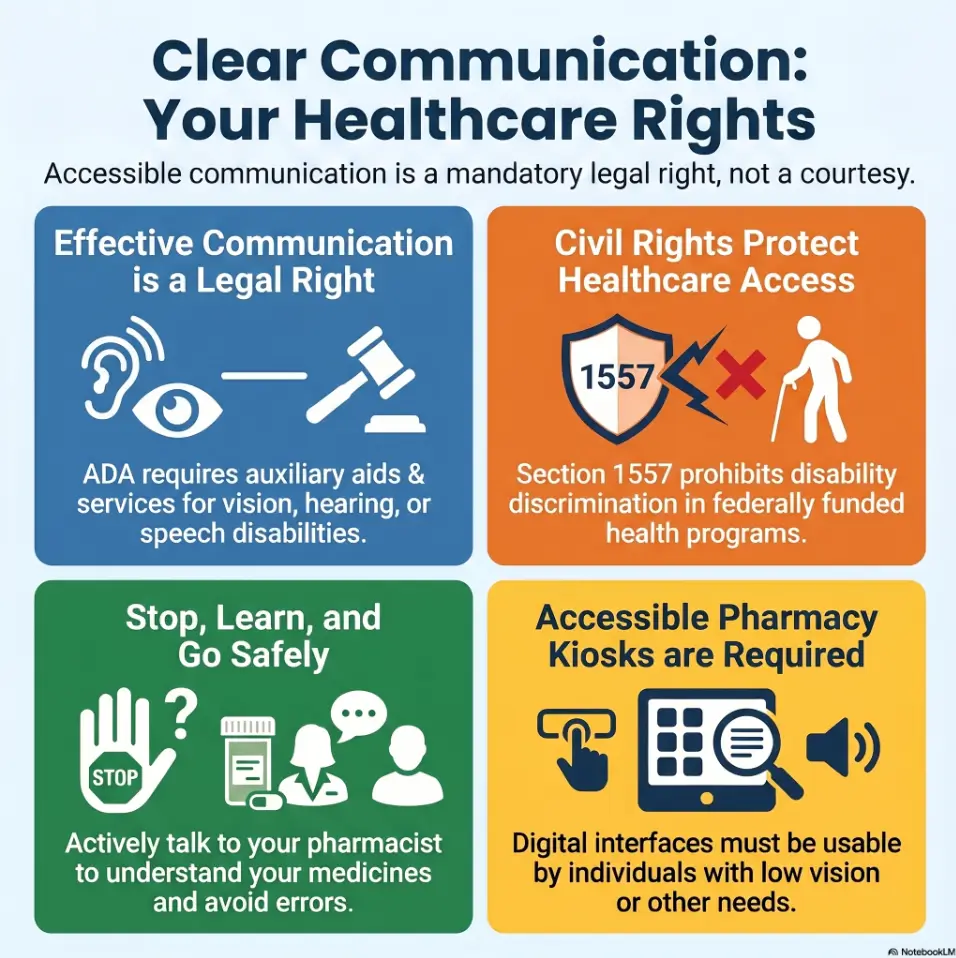
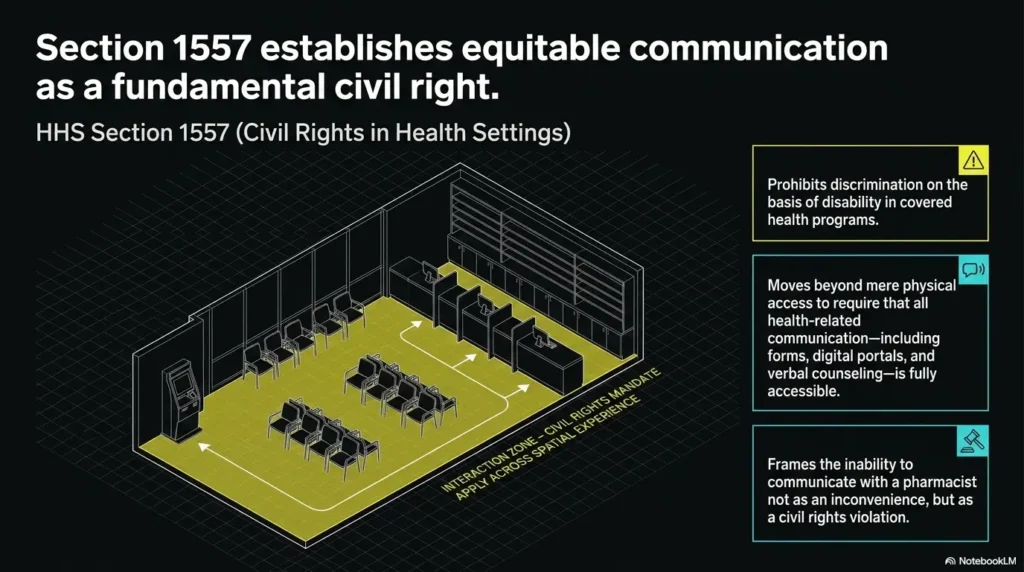
In many health settings, effective communication matters as much as physical access. Guidance from ADA resources and health civil-rights materials makes that principle plain, even if the day-to-day version is less grand. In ordinary life, it sounds like this: say what you need in a way the other person can act on.
Show me the nerdy details
Communication barriers are not limited to speech and hearing. In real pharmacy settings, visual barriers often show up through poor contrast, glare, time-limited interfaces, small text, and staff habits that rely on pointing rather than spoken guidance. A usable script reduces the number of assumptions both sides make.
Say this first: the one-sentence help script that opens the door
Core script: “I have low vision. Could you help me with the pickup screen and read the prompts aloud?”
This is the base line. It is simple, concrete, and hard to misunderstand.
Core script: “I have low vision. Could you help me with the pickup screen and read the prompts aloud?”
Notice what it does well. It names the access issue briefly. It asks for help. It specifies the kind of help needed. And it does not wander off into biography. The request is useful immediately.
Shorter version for crowded moments: “I have low vision and need help using the kiosk.”
Sometimes there is no appetite for elegance. The store is busy. The person behind the counter is moving fast. Your own energy is thin. Use the shorter version:
Short version: “I have low vision and need help using the kiosk.”
That is enough to open the door. If the staff member responds well, you can add the next line: “Please read each screen aloud and tell me what to press.”
Softer version for people who prefer less detail at first
Some people do not want to mention low vision right away. That is valid. You can begin with function instead of condition:
Softer version: “I’m having trouble reading this screen. Could you guide me through it out loud?”
This version is especially useful when privacy matters, when you are testing whether the staff member is actually helpful, or when you simply do not feel like offering a label before you know whether the moment deserves one.
Decision card: Which opening line should you use?
| Situation | Best opening line | Why |
|---|---|---|
| You want direct clarity | “I have low vision…” | Fastest path to useful help |
| You want less personal detail | “I’m having trouble reading this screen…” | Keeps the focus on the task |
| You are under stress and need brevity | “I need help using the kiosk.” | Easy to remember under pressure |
Neutral next step: Save your preferred line in your phone notes exactly as you want to say it.
Keep it moving: what to say when you need step-by-step help
Script for screen navigation: asking staff to guide each prompt out loud
Once the first door opens, the next problem often appears: vague help. A finger points. A phrase floats by. “Just hit that one.” That one, naturally, is hiding somewhere in a galaxy of glare.
Use this line:
Screen navigation script: “Please read each prompt aloud and tell me where the button is before I press it.”
That sentence matters because it changes the mode from pointing to verbal guidance. It asks for sequence. It reduces guessing. It also slows the interaction just enough to make it usable.
Script for payment steps: confirming what button, card slot, or signature step comes next
Payment screens are where confidence goes to wander. Copay amount, card slot, card orientation, tap versus insert, signature pad, confirm button, maybe one more confirm button because machines adore sequels. Use this:
Payment script: “Could you tell me each step out loud, including where to insert or tap my card and whether I need to sign?”
That keeps the request practical. It also helps you avoid the awkward ritual of waving a card near every visible surface like a hopeful wizard. For some readers, building a safer system for signatures and small transaction steps outside the pharmacy can help too, especially if you already rely on a signature guide frame for more accurate signing.
Script for pickup verification: making sure the right name and medication are being processed
Before money and after money, verify. The kiosk may be handling the correct pickup. It may also be presenting something unclearly. Use this line:
Verification script: “Before we finish, could you confirm the patient name and the medication being picked up?”
This is not paranoid. It is tidy. Especially if your family has multiple prescriptions or shared surnames, this simple check saves confusion later when kitchen counters start resembling small paper airports.
Let’s be honest… the hardest part is often the second screen, not the first
The first screen gets attention. The second screen steals accuracy. By then, staff may assume you are fine. You may assume the hard part is over. It rarely is. The second screen often contains consent text, payment confirmation, or details that are easy to nod through without truly seeing.
That is why step-by-step language is worth repeating, even if it feels slightly formal. The goal is not elegance. The goal is no accidental button presses and no mystery transactions.
Do not over-explain: the mistake that makes pickup harder
Too much backstory can bury the real request
Many thoughtful people over-explain because they are trying to be reasonable. They think more context will make the request feel justified. But in rushed public settings, extra detail often acts like fog. By the time you reach the actual need, the staff member has already decided the moment is complicated.
You do not need to explain when the vision problem began, what diagnosis you have, how today compares to yesterday, or whether the kiosk used to be easier three winters ago. All of that may be true and important. It is just not the first move here.
Why “I need help reading the screen” often works better than a long medical explanation
Function beats history in real-time service moments. “I need help reading the screen” tells the other person exactly what to do. It gives them a task. A long explanation gives them context without a clear assignment. Humans are better with assignments.
There is also dignity in concise language. You are not minimizing your need. You are presenting it in a form that travels well across noise, hurry, and human awkwardness.
When simple, plain wording feels stronger than polite rambling
There is a kind of politeness that becomes self-erasure. You hear it in phrases like, “Sorry, this is probably silly, but I just kind of have this issue sometimes and was wondering if maybe…” By the middle of the sentence, the request has already slipped out the back door.
Try this instead: “I need spoken guidance for this screen.” That is polite enough. It is also useful.
- Lead with the task you need done
- Skip the long apology
- Do not trade clarity for niceness
Apply in 60 seconds: Replace “Sorry, I just…” with “I need help reading the screen out loud.”
Ask for accuracy, not speed: the safer script most people skip
Script for confirming patient name, prescription name, and pickup details
When staff are busy, many interactions tilt toward speed. That makes emotional sense. It does not always make medication sense. Ask for accuracy explicitly:
Accuracy script: “Could we go a little slower and confirm the patient name, medication name, and pickup details before I finish?”
This sentence is helpful because it tells the staff member what “help” means. Not vague assistance. Not general kindness. Confirmation.
Script for checking whether anything needs to be signed before you leave
Pharmacy pickups sometimes involve one more step hiding in the wings: a signature, an acknowledgment, a payment confirmation, or counseling prompt. Ask directly:
Signature check script: “Before I leave, is there anything else I need to sign, approve, or review?”
That single line catches a surprising number of loose ends. It is the verbal equivalent of checking the stove twice, except here the stove might be your medication bag.
Script for asking staff to separate one prescription from another if there is confusion
Families often pick up more than one prescription at a time. The names may sound similar. The bags may look identical. The labels may not be readable in the moment. Use this:
Separation script: “Could you separate these and tell me which one is for which person before I take them?”
That tiny pause can prevent the kind of household confusion that does not reveal itself until later, when someone says, “Wait, why is my refill in your bag?” If that kind of confusion follows you home, it may help to build a simple low-vision medication management system so bottles, labels, and refill timing stop competing for the same tired moment.
Eligibility checklist: Is this the moment to slow the pickup down?
- Yes: you cannot clearly read the screen or labels
- Yes: there are multiple prescriptions or family pickups
- Yes: the medication is new, changed, or confusing
- No: you can independently confirm every step and label
Neutral next step: If you checked any “yes,” use an accuracy script before payment is complete.
If the kiosk gets weird: what to say when the screen, glare, or prompts break your flow
Script for glare, dim text, and unreadable contrast
Retail lighting can turn a kiosk into a tiny sun with bad manners. A screen that is technically visible can still be unusable because of glare, low contrast, dim text, or washed-out prompts. Use this line:
Glare script: “The screen is too hard for me to read with the glare. Could you read the prompts aloud or move this to the counter?”
The beauty of this sentence is that it does not argue with the machine. It simply states the barrier and asks for a workable alternative. If screen brightness is a repeat offender in your day, the same logic behind Reduce White Point versus Night Shift settings can make other digital tasks much calmer before and after the pharmacy run.
Script for timeout screens and rushed moments in line
Timeouts create false urgency. Suddenly the whole scene feels like a game show nobody studied for. When that happens, say:
Timeout script: “The screen timed out before I could read it. Could you restart it and guide me one step at a time?”
If the line behind you begins performing impatience, remember this: the goal is not to become the fastest person in the store. The goal is to leave with the correct medication and clear next steps.
Here’s what no one tells you… embarrassment rises fastest when the machine stalls in public
Embarrassment is often less about need than about audience. A machine freeze in private is annoying. A machine freeze with six strangers standing behind you feels like public theater with terrible lighting. That is exactly when a short practiced line helps most.
I once saw someone start strong, then unravel the moment the kiosk beeped and reset. It was not lack of intelligence. It was simply pressure. A memorized line gives your mind something to hold while the room gets loud.
Infographic: The 4-step calm pickup flow
1. Open
“I have low vision and need help using the kiosk.”
2. Guide
“Please read each prompt aloud and tell me where to press.”
3. Verify
“Please confirm the patient name and medication name.”
4. Pause
“Is there anything else I need to sign, review, or know before I go?”
Common mistakes that quietly raise the risk of a bad pickup
Accepting vague help instead of asking for each prompt to be read clearly
One common mistake is accepting help that sounds helpful but is not usable. “Just hit the green one.” “It says continue.” “Tap there.” None of these are reliable if you cannot clearly track the screen. Vague help creates the illusion of access while leaving the actual barrier in place.
Nodding through a payment or confirmation screen you could not actually see
Another mistake is nodding through uncertainty because the scene feels socially expensive. This happens all the time in public systems. A person does not want to hold the line, so they move forward without confidence. But a pharmacy pickup is not the place to gamble with a yes-shaped nod.
If you did not read it, ask for it to be read aloud. If you are not sure what you approved, stop and ask. Better ten extra seconds now than twenty minutes of confusion in the car.
Leaving without checking whether counseling, copay, or additional bags are still pending
The last quiet mistake is assuming the bag means the interaction is complete. Sometimes there is another bag. Sometimes a counseling note. Sometimes a remaining balance. Sometimes a printed sheet with important instructions. The bag is not always the ending. It is just the object that looks most final.
That is why a closing check matters. A calm question at the end often catches what speed tried to skip.
Show me the nerdy details
Most pickup errors in ordinary life are not dramatic system failures. They come from layered micro-friction: poor contrast, vague verbal guidance, social pressure, repeated assumptions, and incomplete verification. A good script interrupts that chain at two points: before payment and before exit.
Do not leave yet: the two questions to ask before the bag touches your hand
“Can you confirm this prescription is for me and tell me the medication name?”
If you remember only one closing question, make it this one:
Question one: “Can you confirm this prescription is for me and tell me the medication name?”
It is clean, direct, and grounded in the actual risk. If the answer is rushed, ask the person to repeat it. You are not being difficult. You are completing the pickup properly.
“Is there anything on the label or paperwork I should know before I go?”
This is the second question, and it is quietly excellent:
Question two: “Is there anything on the label or paperwork I should know before I go?”
That line invites the staff member to mention important instructions, warnings, timing notes, or next steps. It is especially useful when you cannot easily read the print before leaving. The FDA encourages patients to ask questions and understand medication use. This question is the practical version of that advice. If reading inserts later is part of the challenge, a guide on how to read medicine leaflets with low vision can extend this same accuracy-first approach once you get home.
Why this matters even more when multiple family prescriptions are in play
In households with several prescriptions, pickup can turn into a small choreography of names, bags, and assumptions. Similar surnames, matching white bags, and rushed counters are not a recipe for elegance. They are a recipe for mix-ups unless you slow the moment down on purpose.
- Confirm whose prescription it is
- Confirm the medication name
- Ask what you need to know before leaving
Apply in 60 seconds: Add those two questions to your saved phone note under “Before I leave.”
When privacy matters: low-vision help without saying more than you want
Script for asking quietly, briefly, and without naming your condition in detail
Some days privacy matters more than explanation. You may not want to announce anything personal in a crowded store. You do not have to. Try:
Privacy-first script: “I’m having trouble reading the screen. Could you help me through this quietly?”
This line keeps the request functional and discreet. It also tells the staff member how to help: not louder, not broader, just more privately.
Script for moving from the kiosk to the counter when the kiosk is not workable
If the kiosk simply is not working for you, use the direct version:
Counter shift script: “This kiosk isn’t workable for me. Could we complete the pickup at the counter instead?”
That sentence is useful because it does not ask the machine for permission. It moves the interaction to a human setting where spoken confirmation is easier and less fragmented.
How to ask for help without sounding apologetic
Many people lower their voice and their claim at the same time. Try not to. A calm, even tone is enough. You do not need the performance of distress to justify an accessible interaction. You also do not need a courtroom brief.
Plain tone works. “I need spoken guidance for this pickup.” Full stop. That sentence has backbone without theater. For readers who like to prepare quietly in advance, even setting up a quick phone shortcut like Back Tap to open Magnifier can make the handoff between public stress and practical help feel less jagged.
Quote-prep list: Three lines to rehearse if privacy is your top concern
- “I’m having trouble reading this screen.”
- “Could you guide me through it quietly?”
- “If needed, can we do this at the counter instead?”
Neutral next step: Practice these in a normal speaking voice once before your next pharmacy visit.
If staff seem rushed: calm phrases that still protect your pickup
Script for repeating the request without sounding confrontational
Sometimes the first request lands softly and evaporates. The staff member is not unkind, just fast. You may need to repeat the need in a way that stays calm and firm:
Repeat script: “I still need the prompts read aloud so I can complete this accurately.”
This is a good line because it frames the issue around accuracy, not attitude. It keeps the conversation anchored to the task.
Script for redirecting from “just tap there” to actual verbal guidance
If someone points and says, “Just tap there,” try:
Redirect script: “I can’t follow pointing alone. Please tell me the location and the label of the button out loud.”
That sentence is especially effective because it explains what does not work and what does. It is not a complaint. It is a conversion from vague help to usable help.
Script for asking someone to slow down one step at a time
When instructions come too fast, use:
Pacing script: “Please slow down and do one step at a time. I want to make sure I get this right.”
A surprising amount of stress melts when you say the quiet truth plainly. Most people respond better to a concrete pace request than to visible fluster. Not all, of course. Retail life has its own weather. But clarity still improves your odds.
Short Story: A friend once picked up two prescriptions after a long day, already tired from screen glare at work. At the kiosk, the staff member pointed quickly and said, “Tap the lower one, then confirm.” My friend could not tell which lower one, nodded anyway, and felt the familiar panic bloom. This time, though, she stopped and said, “I can’t follow pointing alone. Please read each step aloud.” The whole interaction changed.
It was not suddenly charming. Nobody burst into applause. But it became usable. The staff member slowed down, read the prompts, confirmed the medication name, and caught that one bag still required a signature. The lesson was not about bravery in some cinematic sense. It was smaller and more useful. The right sentence turned a stressful pickup into a correct one. Sometimes that is the whole victory, and it is enough.
When to seek help beyond the kiosk
If you are unsure the prescription is yours, stop and ask before leaving
If there is any uncertainty about whose medication you are receiving, do not let momentum decide for you. Stop at once and ask for confirmation at the counter. A good rule is simple: uncertainty plus medication equals pause.
If you cannot read dosage, warnings, or medication name, ask for verbal review at pickup
A kiosk help script can get you through the transaction. It may not be enough for the information that follows. If you cannot read the label, warnings, or dosage instructions clearly, ask for a verbal review before you leave. Say, “Could someone review the label and key instructions with me before I go?”
This is especially important with a new medication, a changed dose, or anything that feels unfamiliar. Practical help beats post-purchase guessing every time. The same goes for small print on the bottle itself, which is why some readers also benefit from strategies for large-print prescription labels or better contrast tools for home medication routines.
If the situation feels confusing, rushed, or potentially unsafe, request staff assistance at the counter instead of forcing the kiosk
There is no prize for finishing at the kiosk if the kiosk is the wrong tool. Move the interaction to the counter when the screen is unreadable, the prompts are unclear, the staff guidance is too vague, or the whole thing feels one wobble away from a mistake.
Health settings should communicate effectively, and official guidance from ADA materials and HHS civil-rights resources reflects that broader principle. In daily life, the translation is simple: if the communication method is not working, ask for a different one before the pickup is complete.
FAQ
What is the best short script to ask for low vision help at a pharmacy kiosk?
The strongest short script is: “I have low vision. Could you help me with the pickup screen and read the prompts aloud?” It is short, direct, and specific enough to be useful immediately.
Can I skip the kiosk and ask for counter help instead?
Yes. If the kiosk is not workable for you, say, “This kiosk isn’t workable for me. Could we complete the pickup at the counter instead?” You do not need to force a system that is creating confusion or risk.
Do I need to explain my diagnosis to get help reading the screen?
No. You can keep it functional. “I’m having trouble reading this screen. Could you guide me through it out loud?” is often enough. The point is to communicate the need clearly, not to provide a full diagnosis narrative.
What should I say if the pharmacy staff only point at the screen?
Try: “I can’t follow pointing alone. Please tell me the location and the label of the button out loud.” This redirects the help into a form you can actually use.
How do I make sure I am getting the correct prescription?
Before leaving, ask: “Can you confirm this prescription is for me and tell me the medication name?” If there are multiple family prescriptions, also ask staff to separate them and identify which is for which person.
What should I ask before paying at the kiosk?
Ask for each step to be spoken aloud, including the copay amount, where to insert or tap your card, and whether a signature or confirmation is required. Payment screens often hide the most confusion.
How can I ask for help without feeling embarrassed?
Use a brief, practiced sentence. Embarrassment often grows when you are trying to improvise under pressure. A script reduces that burden. You are not asking for a favor. You are asking for a usable interaction.
What if the screen times out while I am trying to read it?
Say: “The screen timed out before I could read it. Could you restart it and guide me one step at a time?” Timeouts are frustrating, but they are also a perfectly good reason to slow the interaction down.
Next step: build your one-line script before your next pickup
Pick one base script and save it in your phone notes
Choose one line that feels natural in your own mouth. That matters. A script only works under stress if it sounds like something you would really say. Save it in your phone notes. Put it near the top. Title it something obvious like “Pharmacy help script.”
Practice one follow-up line for payment or screen reading
Then add one follow-up line. My vote is this one: “Please read each prompt aloud and tell me where the button is before I press it.” If you can remember two lines, you can handle most kiosk moments without improvising from scratch.
Use the same wording each time so stress does not have to improvise
Repetition is not laziness here. It is a tool. The more often you use the same wording, the less your mind has to compose under pressure. Today’s small preparation can save tomorrow’s public scramble. If you already keep household routines in one place, pairing this with a low-vision calendar system for appointments or a simple one-page medication list template can make pharmacy days feel less improvised from start to finish.
Mini calculator: How much stress can one saved note shave off?
If a pickup script saves even 2 minutes of confusion across 2 pickups a month, that is roughly 48 minutes a year of reduced public friction, plus fewer chances of a wrong-step moment.
Neutral next step: Save one opening line and one verification line in your phone now.
The curiosity loop we opened at the beginning is a small one, but it matters. The goal was never to sound perfect at the counter. The goal was to leave with the right medication, a clear understanding of what just happened, and a little less wear on the nervous system. In the next 15 minutes, build your two-line note. One line to open the door. One line to verify before you leave. That tiny preparation can change the whole texture of your next pharmacy pickup.
Last reviewed: 2026-04.
Safety / Disclaimer
This content is educational and practical, not medical or legal advice. Pharmacy pickup errors can matter because they affect medication identity, instructions, payment confirmation, and safe use. When the screen, labels, or pickup process are not clear enough to trust, pause and ask for direct staff help before leaving with the prescription.
Differentiation Map
| What competitors usually do | How this article avoids it |
|---|---|
| Give generic disability etiquette advice | Focuses on exact pickup wording the reader can actually say |
| Treat kiosk help as a tech problem only | Frames it as an accuracy, safety, and communication problem |
| Offer vague encouragement like “ask for assistance” | Breaks the moment into repeatable scripts for screen, payment, and verification |
| Ignore the emotional friction of public pickup | Addresses embarrassment, rushing, glare, and timeout pressure directly |
| End with broad accessibility talk | Ends with one concrete next action the reader can use at the next pharmacy visit |