
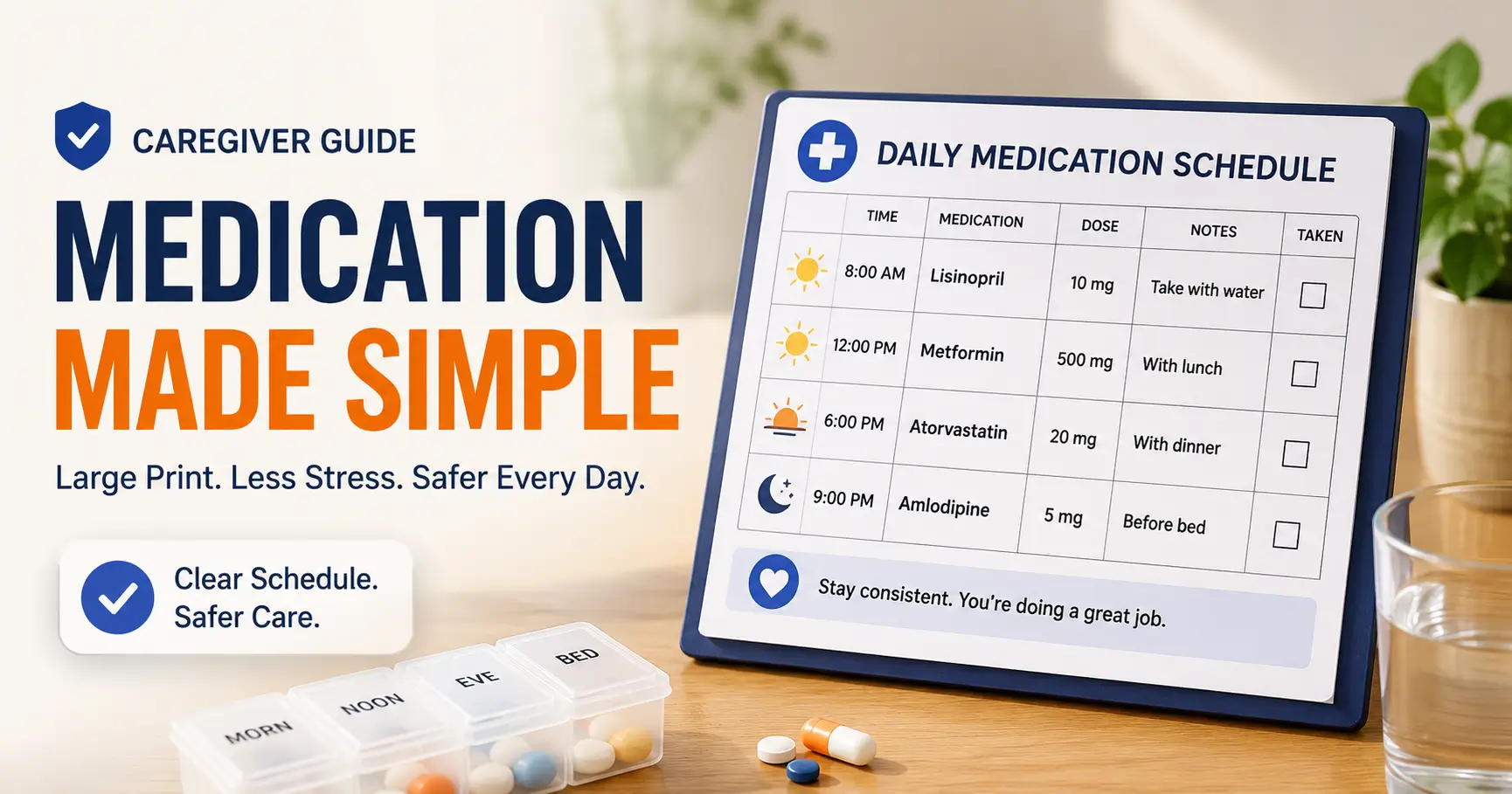
Caregiver medication safety guide
How to Create a Large Print Medication Schedule
for Aging Parents Without Guesswork
A medication schedule looks simple on paper: name, dose, time, checkmark. But in a real home, medicine rarely behaves like tidy office stationery. Bottles move from bathroom counters to bedside tables. A hospital discharge sheet arrives with new instructions. A tiny white tablet looks suspiciously like another tiny white tablet. Suddenly, the kitchen table becomes a small command center.
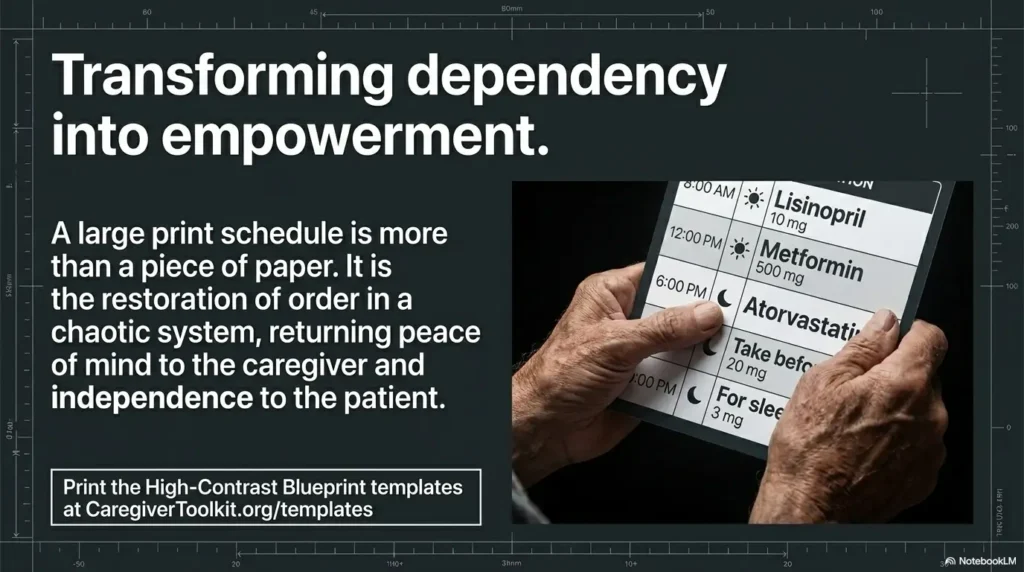
For adult children caring for aging parents, the goal is not to create a beautiful chart. The goal is to reduce missed doses, double doses, duplicate bottles, visual strain, and that familiar 8 p.m. question: “Did Mom already take the blue pill?” A good large print medication schedule should make the safe action feel obvious, even when everyone is tired.
This guide walks you through a practical, printable system: medication audit, font size, time blocks, checkboxes, caregiver notes, pharmacist review, and when to get help. Think of it as turning a drawer full of pharmacy thunder into one calm sheet of paper.
Prevent common errors
Build the chart around missed doses, double doses, and post-visit changes.
Make it readable
Use large type, high contrast, plain language, and repeatable visual cues.
Share the routine
Design it for parents, spouses, weekend helpers, aides, and pharmacists.
Best promise: one verified page that makes the next dose easier to see, safer to confirm, and harder to forget. 🧭
Snapshot
This article is for adult children, spouses, and home caregivers who need a large print medication schedule for an aging parent. You will learn how to gather every medicine, separate daily and as-needed items, choose readable formatting, add checkboxes, avoid risky chart mistakes, and prepare a one-page draft to review with a pharmacist or clinician.
Table of Contents
Before You Print, Treat This Like a Safety Tool
A large print medication schedule is not just a household organizer. It is a safety tool. That means the chart should be clear, current, and checked against reliable instructions before your parent starts using it.
This article can help you organize medication information, design a readable schedule, and prepare better questions for a pharmacist or clinician. It cannot tell you whether a dose is medically right, whether two medicines are safe together, or whether your parent should stop or change anything.
Before you act
Do not change medication timing, dose, frequency, or combinations based on a homemade chart. Confirm important questions with a licensed pharmacist, doctor, nurse, or other qualified health professional. If a medication mistake may have happened, do not wait for a blog article to reassure you. Contact Poison Control, a pharmacist, the prescribing clinician, emergency services, or your local urgent care pathway depending on the medicine and symptoms.
Why large print is not enough by itself
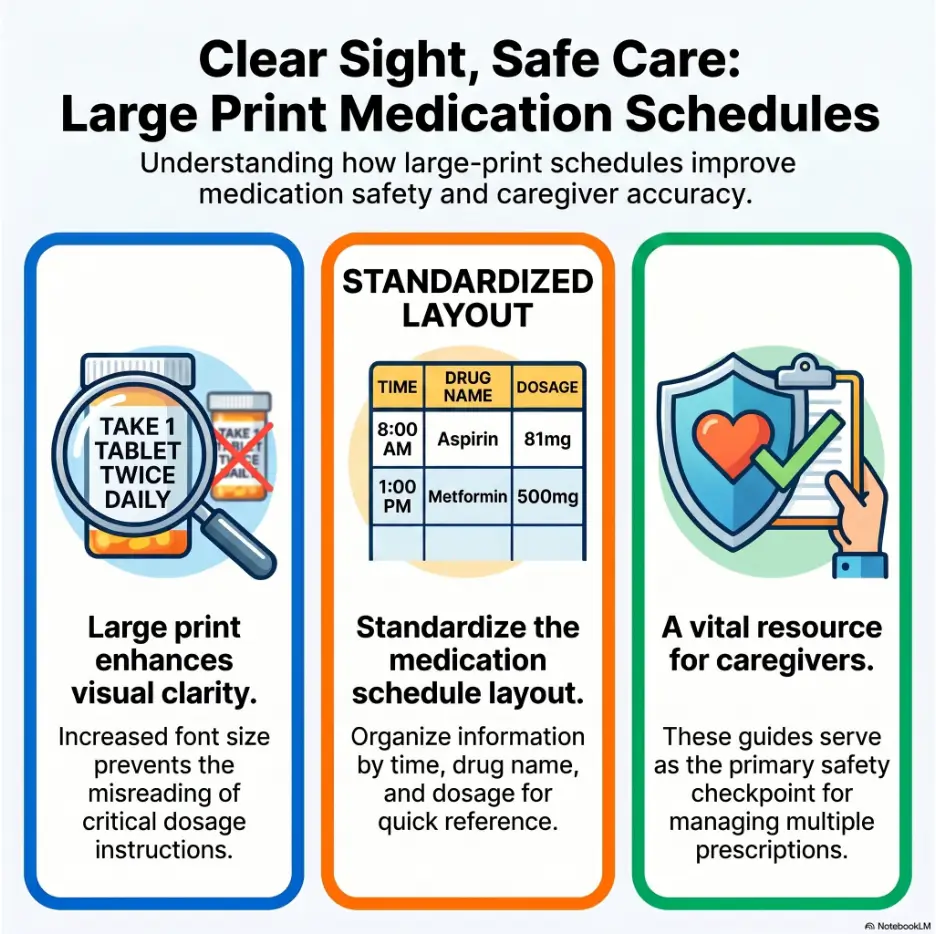
Large print helps your parent see the schedule. It does not automatically make the information correct. A beautifully formatted chart with an old dose is still dangerous, just wearing better shoes.
The safest medication schedule begins with verification. That means checking the current prescription bottle, discharge papers, patient portal, and caregiver notes. When those sources disagree, the chart should pause until a professional reconciles the list.
Who should check the final list
A pharmacist is often the most practical first reviewer because pharmacists think about names, doses, interactions, duplicate therapies, refill timing, and real-world use. A doctor or nurse may also need to confirm the intended plan, especially after a hospital stay, surgery, fall, new diagnosis, or new symptom.
If your parent sees several specialists, ask which clinician owns the full medication list. Many families discover that each doctor knows one chapter, while nobody has edited the whole book.
Official resources worth saving
For a general safety baseline, the FDA explains why older adults should take medicines as prescribed, keep an updated medication list, and talk with health professionals about questions or side effects. MedlinePlus also has plain-language information on taking multiple medicines safely.
Key takeaway
A large print schedule is only as safe as the medication list behind it. Before choosing fonts or colors, make sure the medicine names, doses, timing, and special instructions match the current care plan.
Start With the Brown-Bag Medication Audit
The old-fashioned “brown-bag” method still works because it refuses to trust memory. You gather every medication container into one place, preferably the same table where you will build the chart.
This includes prescription pills, eye drops, inhalers, creams, patches, injections, vitamins, herbal products, sleep aids, pain relievers, allergy medicine, stomach medicine, and anything purchased over the counter. If it goes in, on, under, or near the body for a health reason, it belongs in the audit.
Gather every bottle before writing anything
Do not start the schedule from memory. Memory is a slippery little fish, especially when several medicines have similar names or the pharmacy label has changed.
Walk through the home and check the kitchen, bathroom, bedroom, purse, car, refrigerator, pill organizer, and travel bag. Many families find old prescriptions in one room and newer versions in another. That is exactly why the audit matters.
- Prescription bottles and blister packs
- Over-the-counter medicines
- Vitamins, minerals, and supplements
- Eye drops, ear drops, nasal sprays, and inhalers
- Creams, ointments, patches, injections, and medical devices used with medicine
- Hospital discharge instructions and clinic medication lists
- Pharmacy printouts and refill paperwork
Separate daily, as-needed, and stopped medicines
Medication confusion often begins when everything lives in one crowded basket. A daily blood pressure pill, an old antibiotic, a sleep aid, and a rescue inhaler should not all compete for the same visual attention.
Create three piles before making the chart: daily, as needed, and no longer taking. Do not throw anything away yet unless you already know how to dispose of it safely. The first goal is sorting, not tidying with a flamethrower.
| Category | What belongs here | Why it matters |
|---|---|---|
| Daily or scheduled | Medicines taken at planned times every day or every week | These form the main schedule grid |
| As needed | Pain medicine, nausea medicine, rescue inhalers, sleep aids, constipation medicine | These need separate instructions so they are not mistaken for daily doses |
| No longer taking | Old prescriptions, changed doses, duplicate bottles, discontinued medicine | These should be reviewed before storage or disposal |
| Needs verification | Anything with conflicting instructions or unclear purpose | These should not be added to the active chart until checked |
Write down the purpose, but avoid vague nicknames
Including the reason for each medicine can help caregivers understand the routine. For example, “blood pressure,” “thyroid,” “cholesterol,” “pain,” or “glaucoma drops” may be useful. But do not replace the actual medication name with a nickname.
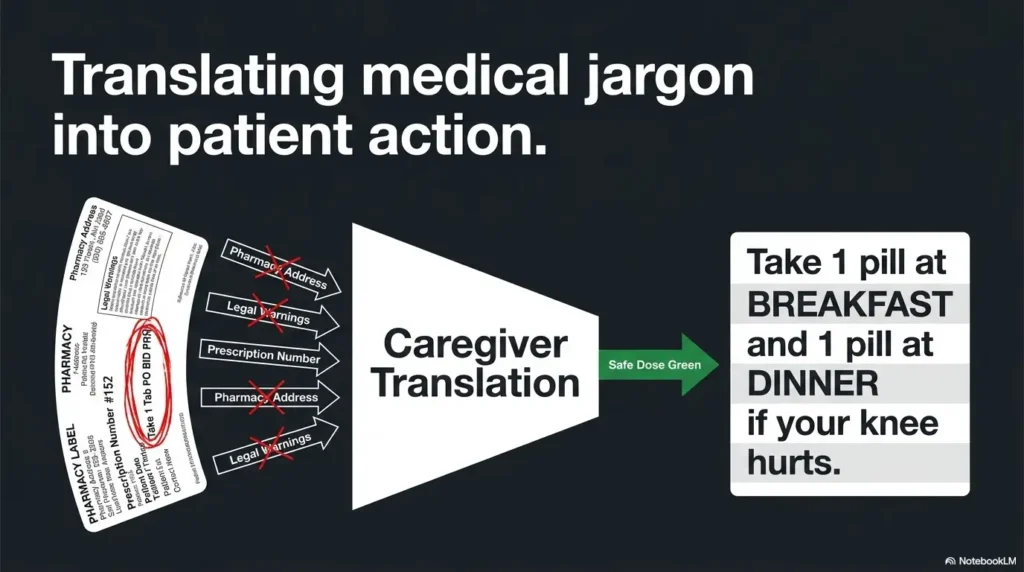
“Heart pill” is not enough. “Small white pill” is even worse. Medication names should match the prescription label, while the purpose can sit beside the name as a helpful translation.
Caregiver shortcut
Take a clear photo of every current label before you rewrite the schedule. If a question comes up later, you can compare the chart with the bottle instead of trusting a tired memory at the end of the day.
The Large Print Design Rules That Actually Matter
Medication schedules fail when they look good to the person making them but feel exhausting to the person using them. The parent should not need to squint, tilt the page, search for glasses, or decode tiny boxes before breakfast.
Large print is not one magic number. It is a combination of font size, contrast, spacing, plain wording, and layout. The best chart feels calm before anyone reads the first line.
Use 18 to 24 point type for core instructions
For many older adults, medication name, dose, and time should be large enough to read at a comfortable distance. A practical range is often 18 to 24 point type for core instructions, with larger headings if space allows.
Do a kitchen-table test. Put the page where your parent normally takes medicine. Ask them to read one row aloud without leaning in. If they hesitate, shrink the chart content, not the font.
Choose plain readable fonts over decorative ones
Use a clean font such as Arial, Helvetica, Verdana, or a similar highly readable sans-serif font. Avoid script fonts, narrow fonts, novelty fonts, and light gray text that looks elegant on your laptop but turns into fog on paper.
Bold can help with labels such as “Morning” or “Bedtime.” All caps can be useful for short warnings, but do not use all caps for long instructions. Long all-caps text becomes a brick wall with letters.
Use color as a helper, not the message
Color can organize the day: morning, noon, evening, bedtime. But never rely on color alone. Some parents have color vision changes, cataracts, glare sensitivity, or print quality issues that make color unreliable.
Use words, placement, bold headings, and icons if they help. A morning section should still say “Morning,” not only appear in yellow.
Large print schedule design checklist
- Core medicine rows use large, readable type.
- Dark text appears on a white or very pale background.
- Medication names are not squeezed into narrow columns.
- Each dose has its own checkbox.
- Food instructions appear beside the dose, not hidden at the bottom.
- Color supports the layout but is not required to understand it.
- The chart still works if printed in black and white.
Build the Schedule Around Real-Life Time Blocks
Many medication charts become cluttered because they try to make every dose look like a train timetable. Exact times matter for some medicines, but many daily routines are easier to follow when grouped into familiar parts of the day.
Morning, noon, evening, and bedtime often work better than a page full of 7:00 a.m., 8:30 a.m., 12:00 p.m., 5:00 p.m., 6:30 p.m., and 10:00 p.m. The right schedule should match the medical instructions and the parent’s actual life.
Use exact times only when the medicine truly needs them
Some medicines must be taken at specific times or spaced carefully. Others are usually tied to meals, bedtime, or once-daily habits. Your job is not to guess which is which. Your job is to ask and document the answer.
When a label says “take once daily,” ask whether timing matters. When a label says “take every 12 hours,” write the actual times clearly. When hospital paperwork changes the pattern, verify before reusing the old chart.
Put food instructions next to the dose
“Take with food,” “take on an empty stomach,” “avoid grapefruit,” and “do not crush” should not be buried in a note section. These instructions belong right beside the dose they affect.
A parent should not have to look in three places to decide what to do. One row should answer the immediate question: what is it, how much, when, and with what caution?
Make the routine repeatable
The safest schedule usually behaves like a quiet metronome. Same place. Same paper. Same box checked after each dose. Same method for asking questions.
If your parent takes morning medicine at the kitchen table, the chart should live there. If bedtime medicine happens near a lamp and water glass, a second simplified reminder may be useful, but the master schedule should stay in one consistent location.
The safer schedule flow
1. Gather
Put every bottle, drop, patch, cream, and supplement in one place.
2. Verify
Check labels against current instructions before printing.
3. Group
Use morning, noon, evening, and bedtime blocks when appropriate.
4. Print
Use large type, high contrast, and enough spacing.
5. Check
Mark one checkbox after each dose, not before.
6. Review
Update after every prescription, hospital visit, or confusing symptom.
Create a Check-Off System That Stops the Second-Guessing
The question “Did I take it?” can become stressful for parents and caregivers. A check-off system gives the household a visible answer. It also helps a weekend helper or home aide step into the routine without reading everyone’s mind.
The key is to make each dose individually accountable. One checkbox for the whole day is too vague. One checkbox per dose is much safer.
Use one checkbox per dose, not one per medicine
If a medicine is taken twice daily, it needs two separate checkboxes. If eye drops are used in both eyes at bedtime, the row should make that clear. If a patch changes weekly, the checkbox should reflect the day and time of the patch change.
The safest checkmark is made after the dose is taken. Checking first and taking later creates a tiny gap where mistakes breed.
Choose a weekly grid or daily sheet based on complexity
A weekly grid works well when the routine is stable and repeated. It lets caregivers spot missed doses quickly. A daily sheet can be better when there are many medicines, changing instructions, or short-term post-hospital routines.
| Format | Best for | Watch out for |
|---|---|---|
| Weekly grid | Stable routines with repeated daily medicines | Can get crowded if there are many medications |
| Daily sheet | Complex routines, recovery periods, caregiver handoffs | Needs fresh printing or copying more often |
| One-page medication list | Appointments, emergency folders, pharmacy reviews | Usually does not replace a dose-by-dose checkbox schedule |
| Pill organizer plus chart | Parents who benefit from both visual storage and paper confirmation | The organizer must match the current verified schedule |
Short Story: The Checked Box That Saved a Phone Call
At 9:40 one Thursday night, Daniel called his mother to ask about her new evening pill. She sounded cheerful, then uncertain. “I think I took it,” she said. “Or maybe I only took the white one.”
Before the schedule, that sentence would have turned into a family weather system: three calls, one worried sibling, and a long stare at identical bottles.
But that week they had taped a large print chart beside the tea kettle. His mother walked over, read the row aloud, and found the box already marked for bedtime. The pill had been taken. No guessing. No second dose. No midnight spiral.
The chart did not make the family perfect. It simply gave them one reliable witness in the room.
Key takeaway
A checkbox is not decoration. It is a tiny timestamp for the household. Make one box for each dose and mark it only after the medicine is actually taken.
Common Medication Chart Mistakes That Create Risk
A medication chart can be almost correct and still create trouble. In fact, “almost correct” may be the riskiest version because it feels trustworthy while quietly carrying an old instruction or missing medicine.
Use this section as a mistake filter before you print the final copy.
Mistake: using nicknames for medications
“Water pill,” “heart pill,” “sugar pill,” and “the tiny one” may feel convenient at home, but they can become unsafe when medicines change. Use the medication name from the label and add the purpose in a separate column.
This is especially important if several caregivers help your parent. A visiting aide, sibling, spouse, or pharmacist cannot safely interpret family shorthand.
Mistake: mixing old and new instructions
Medication instructions often change after a hospital visit, urgent care appointment, surgery, infection, fall, or new specialist visit. A chart that worked last month may not work today.
When something changes, print a new copy. Crossed-out instructions and handwritten edits can work for a day, but they should not become the permanent system. Paper with too many corrections starts sounding like five people giving directions at once.
Mistake: hiding as-needed medicines in the daily grid
As-needed medicines need their own section. They may have limits, spacing rules, symptom triggers, or warnings. Putting them in the daily grid can make them look scheduled when they are not.
For example, a rescue inhaler, pain medicine, nausea medicine, constipation medicine, or sleep aid should not be treated like a routine breakfast tablet unless a clinician specifically says so.
Mistake: forgetting drops, patches, creams, and inhalers
Non-pill medicines are easy to miss because they live in different places. Eye drops may be in the bathroom. Inhalers may be in a purse. Creams may be beside the bed. Patches may be in a drawer.
The schedule should include every active medicine, not just pills. If your parent has vision problems, you may also want to connect this system with practical label strategies, such as a larger medication label setup for seniors or a similar-looking pill safety routine.
| Risky shortcut | Safer alternative | Why it helps |
|---|---|---|
| “Blue heart pill” | Use the exact medication name plus purpose | Prevents confusion after refills or changes |
| One checkbox for the whole day | One checkbox per dose | Reduces missed or repeated doses |
| Old bottles mixed with current bottles | Separate “no longer taking” items for review | Prevents discontinued medicine from reappearing |
| Food instructions in tiny notes | Place instructions beside the dose | Makes the correct action easier in the moment |
| Color-only labels | Use color plus words and placement | Supports low vision and black-and-white printing |
Free, Low-Cost, and Paid Options for Making the Schedule
You do not need expensive software to create a good medication schedule. Many families can make a safer system with a word processor, spreadsheet, printer, clipboard, and pharmacist review.
Paid tools or professional help may be worth considering when the medication routine is complex, several caregivers are involved, or the parent has low vision, memory changes, tremor, or frequent medication adjustments.
Good, better, best setup options
| Option | Typical cost level | Best for | What to compare before choosing |
|---|---|---|---|
| Good: printable DIY chart | Free to low cost | Simple medication routines with one main caregiver | Font size, checkbox space, ease of updating, printer readability |
| Better: DIY chart plus pill organizer | Low to moderate cost | Parents who need both paper confirmation and physical sorting | Compartment size, opening ease, morning/evening separation, caregiver refill process |
| Best: pharmacist-reviewed system plus caregiver log | Often free review, possible service cost depending on provider | Complex routines, recent hospital discharge, multiple prescribers, memory concerns | Medication reconciliation support, refill coordination, written instructions, update process |
| Specialized support: low-vision or occupational therapy input | Varies by coverage and provider | Parents with low vision, tremor, cognitive changes, or repeated errors | Home setup advice, label visibility, lighting, storage safety, caregiver training |
When a free DIY chart may be enough
A free DIY chart may be enough when your parent has a small number of stable medicines, no recent medication changes, good understanding of the routine, and one consistent caregiver checking the system.
Even then, the final list should be compared against current labels. Free does not mean casual. It means you are doing the formatting yourself while still respecting the safety step.
When paid help or extra professional support may be worth it
Extra help may be worth considering when medication changes are frequent, several doctors prescribe medicines, the parent has memory gaps, the family lives far away, or caregivers keep finding mismatched instructions.
Ask the pharmacy whether they offer medication review, large print labels, synchronized refills, blister packaging, or other adherence support. Ask the clinician whether an occupational therapist, home health nurse, or care manager could help with the home routine.
What to ask before paying for tools or services
- Will this tool make the medication list easier to update after a prescription change?
- Can the parent read and use it without a smartphone?
- Does it support one checkbox or confirmation per dose?
- Can multiple caregivers understand it without training?
- Will the pharmacy or provider review the medication list?
- Does the system handle non-pill medicines, such as eye drops, patches, inhalers, or creams?
- What happens after a hospital visit or medication change?
Show me the nerdy details
A medication schedule has two jobs: information design and error reduction. Information design makes the page readable. Error reduction makes the correct next step easier than the wrong one.
That is why one checkbox per dose matters. It creates a simple external memory system. The chart becomes a shared record instead of a private guess inside one person’s head.
The best schedules also reduce decision points. They do not ask the parent to interpret “daily,” remember whether breakfast happened, or compare two similar bottles. They present the next safe action in a visible, repeatable pattern.
Add Caregiver Notes Without Turning the Chart Into Wallpaper
A medication schedule should not become a scrapbook of every symptom, question, refill reminder, and doctor conversation. Too much information makes the important dose instructions harder to see.
The trick is to separate the main schedule from supporting notes. The schedule answers “what do we do now?” The caregiver log answers “what should we ask next?”
Include pharmacy and prescriber details in one small area
A small box can include the pharmacy name and phone number, primary doctor, specialist names, and the date the schedule was last reviewed. This helps when a caregiver needs to call for clarification.
Keep this box small and separate from the dose grid. Emergency details should be easy to find, but they should not crowd the morning medicine row.
Track side effects and questions separately
If your parent has dizziness, sleepiness, appetite changes, confusion, stomach upset, blurry vision, falls, or new weakness, write it down in a caregiver log with the date and time. Do not squeeze long symptom notes into the medication grid.
A clean log helps clinicians see patterns. A crowded chart makes everyone squint at the wrong moment.
Keep emergency information visible
Allergies, major diagnoses, emergency contacts, preferred hospital, and advance care notes may belong near the medication station or in an emergency folder. They do not need to sit inside the dose grid itself.
If your site or home setup already uses a one-page medical document, connect the medication schedule with that system. A related one-page medication list template can be useful for appointments, while the daily schedule handles actual dose tracking.
Caregiver notes box template
- Schedule last reviewed: date and reviewer name
- Primary pharmacy: name and phone number
- Primary doctor: name and office number
- Medication allergies: confirmed list
- Emergency contact: name and phone number
- Questions for next review: keep this brief or move to a separate log
When to Call a Pharmacist, Doctor, Poison Control, or 911
A medication schedule should make everyday routines safer. It should not make caregivers feel responsible for medical judgment they are not trained to make.
When something does not make sense, ask. When a possible overdose, dangerous combination, severe symptom, fall, breathing problem, chest pain, fainting, or sudden confusion occurs, treat it as urgent.
Call a pharmacist when instructions conflict
If the bottle says one thing, discharge papers say another, and your parent remembers a third version, do not average the answers. Call the pharmacy or prescribing office and ask for medication reconciliation.
Use plain language: “We are making a large print medication schedule. Can you confirm the current medication name, dose, time, and whether it should be taken with food?”
Call the doctor after new confusion, dizziness, falls, or sleepiness
New confusion, dizziness, drowsiness, blurry vision, falls, appetite changes, or unusual weakness may have many causes. Medication can be one of them. Do not brush off sudden changes as “just aging.”
Bring the medication schedule, bottle photos, and symptom log to the conversation. Specific notes help the clinician see the pattern more quickly.
Call Poison Control or emergency services after a possible dangerous dose
If your parent may have taken the wrong medicine, too much medicine, someone else’s medicine, or a risky combination, do not wait and guess. In the United States, Poison Control can help with many medication exposure questions, and emergency services may be needed for serious symptoms.
If the person is unconscious, has trouble breathing, has chest pain, has a seizure, has severe confusion, or seems seriously ill, call emergency services immediately.
Red flag reminder
A chart is not a substitute for urgent care. If a medication mistake may have happened and symptoms are serious, get immediate medical help. If you are unsure, contact Poison Control, a pharmacist, the prescribing clinician, or emergency services based on the situation.
FAQ
What should be included on a medication schedule for elderly parents?
Include the medication name, dose, time, instructions, purpose, prescriber, pharmacy details, refill notes, allergies, and one checkbox for each dose. Include prescription medicines, over-the-counter medicines, vitamins, supplements, drops, inhalers, patches, creams, and injections.
What font size is best for a large print medication chart?
Core medication instructions should usually be large enough to read comfortably, often around 18 to 24 point type depending on the parent’s vision. Test the chart in the place where medicine is actually taken.
Should vitamins and supplements go on the schedule?
Yes. Vitamins, supplements, herbal products, and over-the-counter medicines can matter because they may interact with prescriptions or affect medical decisions. Make them visible on the list and ask the pharmacist or clinician what should stay, change, or stop.
How often should a medication schedule be updated?
Update it any time a prescription changes, after a hospital or urgent care visit, after a specialist changes instructions, and during regular medication reviews. Add a “last reviewed” date so caregivers know whether the chart is current.
Is a paper medication schedule better than an app?
For many aging parents, paper is easier because it is visible, shareable, and does not require a password, battery, notification settings, or app navigation. Apps can help some families, especially remote caregivers, but the best system is the one your parent and helpers will actually use.
Where should the medication schedule be kept?
Keep it where the medication routine happens: kitchen table, breakfast counter, bedside area, or caregiving station. A plastic sleeve or clipboard can keep the page clean and make check-off marking easier.
Can I make the schedule myself?
Yes, you can make the layout yourself. The medication instructions should still be checked against current prescription labels and ideally reviewed by a pharmacist or clinician, especially after changes or if multiple prescribers are involved.
What should I do if my parent took the wrong medication?
Contact Poison Control, a pharmacist, the prescribing clinician, urgent care, or emergency services depending on the medicine, amount, timing, and symptoms. If symptoms are serious, call emergency services immediately. Do not rely on guessing.
Your 15-Minute Next Step: Make the First Verified Draft
You do not need to build the perfect medication system today. You need to start with one calm, accurate draft. Fifteen minutes is enough to move from scattered bottles to a safer first version.
Put every medicine container on the table. Separate daily, as-needed, and no-longer-taking items. Write one large print draft with medication name, dose, time, instructions, and checkboxes. Then ask the pharmacist or clinician to review it before your parent relies on it.
That is the quiet win: not a fancy chart, not a color-coded masterpiece, but a single verified page that helps the next caregiver make the next safe choice.
The 15-minute first draft
- Gather every medicine, supplement, and non-pill treatment.
- Sort into daily, as needed, stopped, and needs verification.
- Write the daily medicines into morning, noon, evening, and bedtime blocks.
- Add one checkbox for each dose.
- Add the date and “needs pharmacist review” at the top.
- Call or visit the pharmacy before using the final version.
Last reviewed: 2026-07