
Senior vision and driving safety
Driving Safety Tips for Seniors with Presbyopia
A Clearer, Safer Road Plan
Presbyopia is often described as “needing longer arms to read,” which sounds harmless enough. But behind the wheel, near-vision blur can become a quiet little thief. It can steal attention when a driver looks down at the dashboard, checks a GPS prompt, reads a warning light, or reaches for climate controls on a rainy afternoon.
For many older adults, the biggest driving concern is not one dramatic moment. It is the extra second spent squinting, the small delay after glare, the confusing pair of glasses in the cup holder, or the map instruction that arrives just as traffic thickens. Safety often improves when those tiny frictions are removed before they become close calls.
This guide gives seniors and caregivers a practical way to reduce visual strain, plan easier drives, compare helpful car setup options, and know when an eye doctor or driver rehabilitation specialist should be part of the conversation.
Reduce dashboard blur
Set up glasses, seat position, brightness, and GPS before the car moves.
Handle glare wisely
Use cleaner glass, better timing, and smarter night-driving limits.
Protect independence
Build a safer driving routine without jumping straight to “stop driving.”
Start with the parked-car vision check, then build from there. A safer drive begins before the key turns. 🚗
Snapshot
This article is for older drivers, adult children, caregivers, and senior-living readers who want practical driving safety tips for seniors with presbyopia. You will learn how near-vision blur affects dashboard reading, GPS use, night driving, glare, route planning, and when to seek professional help.
Table of Contents
Before You Act: Vision Safety Comes First
This guide is educational. It can help you organize safer driving habits, prepare better questions, and notice warning signs earlier. It cannot tell whether a specific person is safe to drive, whether a license should be restricted, or whether a symptom is ordinary presbyopia.
Presbyopia is common with aging, but not every vision change in later life is “just age.” Sudden vision loss, double vision, eye pain, new severe glare, new night-driving trouble, or a sudden change in depth judgment deserves prompt medical attention.
Older drivers should confirm important decisions with an eye doctor, primary care clinician, occupational therapist, or driver rehabilitation specialist when needed. A calm professional review can preserve independence while removing unnecessary risk.
Key takeaway
Do not treat new or sudden vision changes as a glasses problem. Presbyopia usually develops gradually. Fast changes, pain, double vision, or major night-driving difficulty should be checked by a qualified professional.
Why Presbyopia Changes Driving in Sneaky Ways
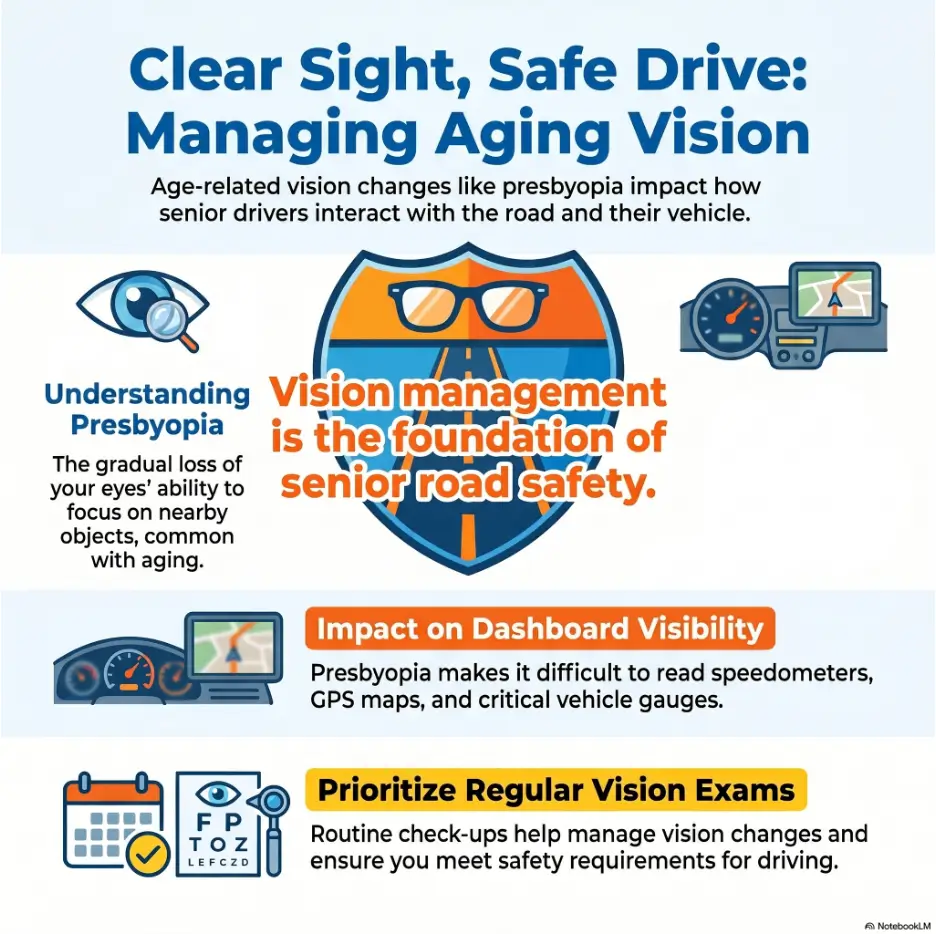
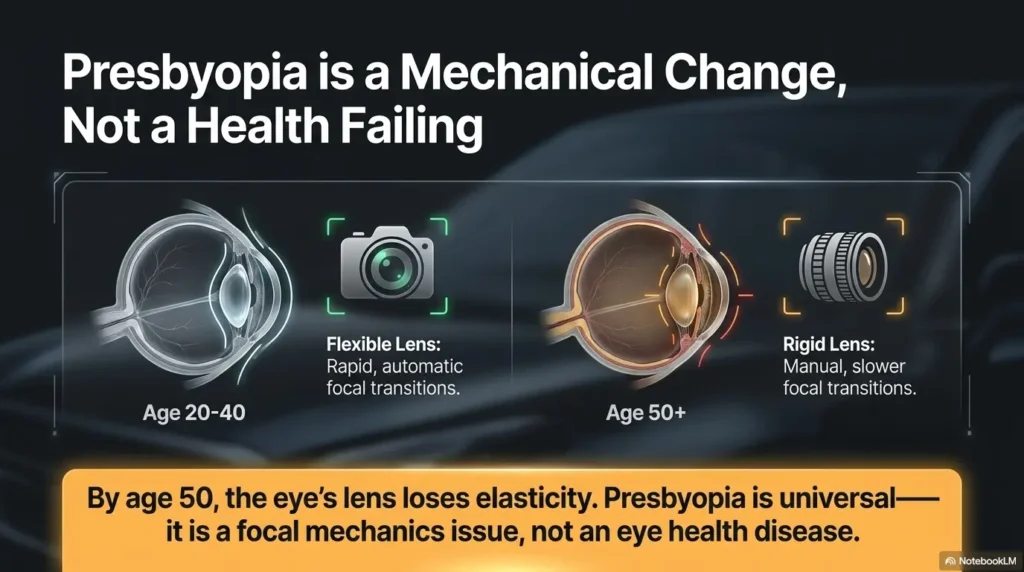
Presbyopia mainly affects near focusing. That sounds separate from driving, since the road is far away. The surprise is that modern driving asks the eyes to jump between far, intermediate, and near tasks all the time.
A driver may look at the road, then the speedometer, then a mirror, then the GPS, then the road again. Each shift asks the visual system to refocus. When that process slows down, the road can lose attention in tiny slices.
Near Vision Is Not Just Reading Vision
Near vision includes reading a gas pump screen, toll ticket, parking meter, prescription label, insurance card, phone mount, dashboard symbol, or tiny “cancel route” button. A senior who reads books with glasses may still struggle with the odd middle distance of a dashboard.
That middle distance matters. It is where instrument panels, infotainment screens, climate controls, and many backup camera displays live.
The Dashboard Becomes the Hidden Danger Zone
The dashboard is not dangerous because it is complicated. It becomes risky when it takes too long to read. Two extra seconds may not feel like much in a kitchen, but on the road it is a long little tunnel.
Common trouble spots include low-contrast speed displays, small warning icons, dim climate-control labels, crowded touchscreens, and unfamiliar rental cars.
Caregivers Should Watch for Small Behavior Changes
Adult children often notice driving changes before a parent does. The signs may be subtle: more daytime-only errands, reluctance to use highways, missed turns, repeated GPS confusion, or jokes about “the car having too many buttons.”
The goal is not to pounce. The better first move is to ask what feels harder. A conversation that begins with curiosity usually goes farther than one that begins with judgment.
Short Story: The Map That Waited
Martin still drove to church every Sunday. Same road, same parking lot, same gentle wave from the usher near the side door. He did not think of himself as unsafe.
Then his daughter rode with him to a pharmacy across town. At one intersection, the GPS rerouted. Martin glanced down, frowned, tapped once, tapped again, and drifted slightly toward the lane marker.
Nothing happened. No horn, no scrape, no dramatic story for dinner. But his daughter noticed the pause. Later, in the driveway, they changed the GPS text size, saved favorite destinations, and agreed that routes would be entered before leaving.
The lesson was simple: the safest navigation screen is the one that does not ask for a tiny decision in moving traffic.
Prescription First: The Quiet Safety Upgrade
Before buying gadgets, changing cars, or arguing about night driving, start with the prescription. It is the unglamorous tool that quietly affects every other decision.
A senior driver may need correction for distance vision, dashboard distance, glare sensitivity, cataracts, dry eye, astigmatism, or other conditions. Drugstore readers are not designed to solve that full set of tasks.
Bring Real Driving Glasses to the Exam
Do not bring only the “good pair.” Bring the glasses actually used in the car, including the scratched pair, the spare pair, the sunglasses, and the readers that somehow migrated into the glove box.
This gives the eye care team a practical view of what happens on the road. It also helps reveal whether a driver is switching between lenses in a way that creates confusion.
Ask About Distance, Intermediate, and Near Needs
Driving is not a single-distance task. Ask directly: “Can these lenses help me see the road, dashboard, mirrors, and GPS without awkward head movement?”
For some people, progressive lenses work well. Others may need a different lens design, separate driving glasses, anti-reflective coating, or more time to adapt. The right answer depends on the person, the car, and the prescription.
Do Not Guess With Drugstore Readers
Over-the-counter readers can be useful for books, menus, pill bottles, and hobby work. They are usually not appropriate as a whole-trip driving solution because they can blur distance vision.
If a senior is lifting readers on and off while driving, that is not a charming quirk. It is a system asking to be redesigned.
Key takeaway
Ask the eye doctor about driving as a real task, not just distance vision on an eye chart. Mention dashboards, GPS screens, night glare, mirrors, and lane confidence.
Dashboard Blur: Fix the Two-Second Trap
Dashboard blur is one of the most practical problems to solve because many fixes are free. A better seat position, cleaner display, larger map text, and pre-set controls can reduce the need to stare down while moving.
Think of the dashboard as a cockpit, not a junk drawer with lights. Every control should earn its place in the driver’s attention.
Adjust Seat Distance Before Adjusting Your Eyes
A seat that is too far back can make the dashboard harder to read. A seat that is too close can reduce comfort and control. The best position allows clear dashboard reading while keeping safe access to pedals, steering, mirrors, and airbags.
After any seat change, recheck mirrors. A small seat shift can quietly undo mirror alignment.
Use Larger GPS Text and Simple Map Views
Many navigation apps and built-in car systems allow larger text, simpler map views, louder voice prompts, saved addresses, and fewer on-screen details. These settings can be more valuable than a fancy new mount.
For a caregiver helping a parent, set up “Home,” “Doctor,” “Pharmacy,” “Grocery Store,” and frequently visited family addresses while parked at the kitchen table. The car should not become a tiny touchscreen classroom at a stoplight.
Keep Essential Controls Familiar by Touch
A driver should be able to find basic controls without searching: defrost, hazard lights, headlights, wipers, volume, temperature, and windshield washer. This is especially important in rain, fog, and low light.
Practice while parked. Say the control out loud, touch it, then return eyes forward. It may feel almost too simple, but simple is often where safety hides its silverware.
Night Driving and Glare: Know When Possible Is Not Wise
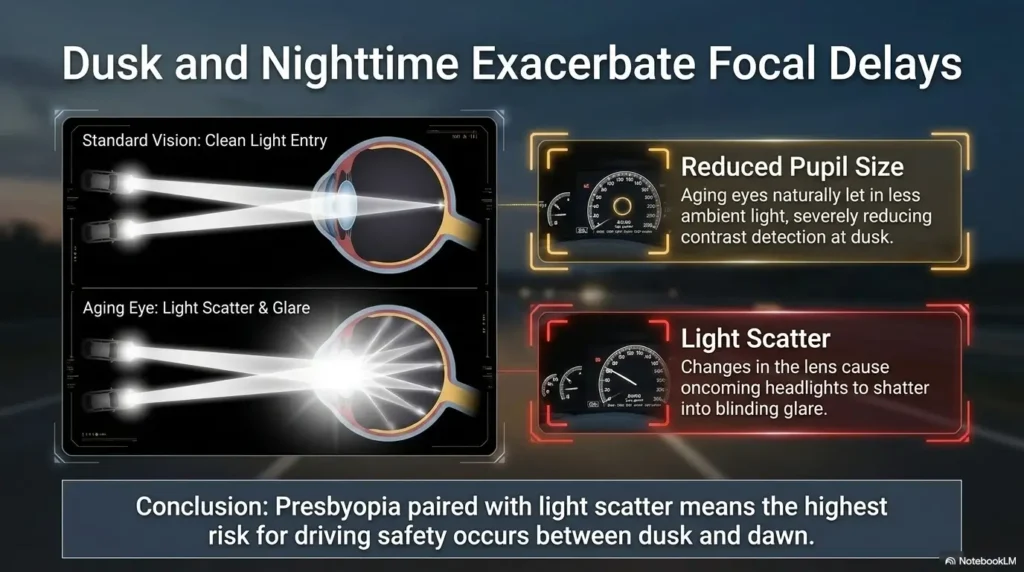
Night driving is not just “day driving with the lights off.” Aging eyes may need more light, recover from glare more slowly, and struggle with contrast when rain, headlights, or dirty glass enter the scene.
A senior may technically be able to drive at night but still make a wise choice to limit it. That is not defeat. It is strategy wearing sensible shoes.
Watch for Glare, Halos, and Lane Uncertainty
Important signs include seeing halos around headlights, feeling blinded by oncoming cars, needing extra time to recover after glare, missing lane markings, or feeling tense on roads that used to feel routine.
These symptoms may involve presbyopia, but they may also involve cataracts, dry eye, medication effects, or other eye conditions. Mention them clearly at the next eye exam.
Avoid Tinted Lenses at Night
Sunglasses and tinted lenses can reduce the amount of light reaching the eyes. At night, that can make driving more hazardous, even if the lenses seem to soften glare.
If glare is severe enough that a driver wants tinted lenses after dark, that is a sign to ask an eye doctor what is going on instead of improvising from the glove box.
Build a Personal No-Night-Driving Rule
A good rule is specific. “I do not drive after dark on rainy days” is more useful than “I will be careful.” So is “I schedule appointments before 3 p.m. in winter.”
Caregivers can help by offering alternatives without making the older adult feel cornered: ride-share practice, family ride calendars, community transportation, senior center shuttles, or daytime appointment planning.
Cleaning Is a Safety Habit, Not a Chore
Glare gets worse when light scatters across dirty windshields, greasy interior glass, scratched lenses, worn wiper blades, foggy mirrors, or cloudy headlight covers.
Clean the inside windshield, not only the outside. Interior film can build up slowly, especially in cars that sit in the sun. It turns headlights into smeared little fireworks exactly when clarity matters most.
Show me the nerdy details
Driving vision is a switching task. The eyes move between far distance, intermediate dashboard range, mirrors, side traffic, near screens, and changing light levels. Presbyopia makes near focus harder, while common age-related changes can reduce contrast sensitivity and slow glare recovery. That is why safety improvements should lower visual workload, not merely sharpen one reading distance.
Car Setup and Tools That Reduce Visual Load
A safer car setup does not always mean buying a new vehicle. Often it means reducing visual clutter, simplifying displays, and choosing tools that make the driver look at the road more often.
For budget-conscious readers, start with free settings and cleaning. For cautious buyers, compare features based on what problem they solve, not what sounds impressive in a showroom.
Good, Better, Best Setup Options
| Setup level | What it includes | Best for | Cost mindset |
|---|---|---|---|
| Good | Clean glass, adjusted mirrors, larger GPS text, saved destinations, pre-set controls | Drivers with mild dashboard blur or occasional GPS confusion | Mostly free |
| Better | Updated prescription, anti-reflective lens discussion, voice navigation, clearer phone mount position | Drivers who squint, lean forward, or avoid unfamiliar routes | Low to moderate, depending on exam and lenses |
| Best | Professional driving evaluation, adaptive strategies, vehicle feature review, family transportation plan | Drivers with near-misses, medical complexity, or family concern | Higher cost, but may prevent bigger safety and mobility problems |
Features Worth Comparing Before Buying
If a senior is comparing cars, phone mounts, GPS devices, or driving aids, focus on readability and simplicity. The best option is not always the one with the largest number of features.
- Large, high-contrast displays
- Physical controls for essential functions
- Clear voice navigation
- Adjustable dashboard brightness
- Automatic headlights
- Blind-spot monitoring
- Backup camera clarity in daylight and darkness
- Simple steering-wheel controls
Free Fixes vs Paid Help
Free fixes are enough when the problem is mostly clutter, dirty glass, tiny map text, or poor preparation. Paid help may be worth considering when the driver has repeated close calls, confusing lens needs, night-driving trouble, or medical conditions that may affect driving.
| Problem | Free first step | When paid help may be worth it |
|---|---|---|
| Hard to read GPS | Increase text size and use voice prompts | Consider a simpler mount or device if the current screen remains distracting |
| Dashboard blur | Adjust seat and display brightness | Ask about lens design if the dashboard remains unclear |
| Night glare | Clean windshield, mirrors, headlights, and lenses | Schedule an eye exam if glare feels severe or new |
| Family worries | Ride together and list specific concerns | Consider a driver rehabilitation specialist after near-misses or medical changes |
The Safer Drive Loop
Five-step safer drive loop
1. Check
Use the real driving glasses and test dashboard clarity while parked.
2. Simplify
Enlarge text, save destinations, and remove reflective clutter.
3. Plan
Choose easier roads, daylight times, and simple parking exits.
4. Limit
Avoid night, rain, rush hour, or low-sun glare when vision feels strained.
5. Review
Write down what felt blurry, slow, or stressful and bring it to an exam.
Route Planning: The Safer Drive Begins Before the Key Turns
Route planning is one of the most underrated driving safety tips for seniors with presbyopia. The easiest visual task is the one removed before the drive begins.
A good route reduces left turns, confusing intersections, glare windows, lane changes, parking stress, and last-second decisions.
Choose Familiar Roads With Fewer Left Turns
Left turns across traffic require timing, depth judgment, speed estimation, and confidence. If near-vision blur is adding dashboard or GPS delays, a route with fewer left turns can lower total mental load.
This does not mean every drive must be longer. It means the shortest route is not always the safest route.
Avoid Rush Hour, Rain, and Low-Sun Glare
Low sun can be brutal, especially through a dirty windshield. Rain adds reflections, glare, and reduced lane contrast. Rush hour adds impatience from other drivers, which is not exactly a vitamin.
For regular errands, choose quieter times. A 10 a.m. grocery run may be safer than a 5 p.m. one, even on the same road.
Park Where Exiting Is Simple
Parking is part of the trip. Choose spaces that make leaving easier, especially at medical buildings, busy pharmacies, churches, restaurants, and stores with crowded lots.
Look for good lighting, clear lane markings, fewer pedestrians behind the car, and an exit path that does not require a sharp reverse into traffic.
Key takeaway
A safe route is not only about distance. It is about fewer visual surprises, simpler decisions, easier parking, and enough time to avoid rushing.
For more home and daily-life vision setup ideas, you may also find related guides on senior driving safety, night driving after 70, and progressive glasses safety tips for seniors helpful.
Common Mistakes Seniors Make With Presbyopia and Driving
Mistakes are not moral failures. They are clues. Once a pattern is visible, it can often be redesigned with less drama and more dignity.
Mistake: Using Reading Glasses for the Whole Trip
Reading glasses may make the dashboard clearer but blur the road. That tradeoff is not safe. If the driver needs help seeing both the road and dashboard, ask an eye doctor about better driving-specific correction.
Mistake: Programming GPS After Moving
Entering an address while driving asks for near focus, typing accuracy, decision-making, and divided attention. That is too many plates spinning on one skinny stick.
Preload the destination while parked. Use voice prompts. Save frequent places. If the route changes and the driver feels unsure, pull over safely before making adjustments.
Mistake: Keeping Multiple Unlabeled Glasses in the Car
A car with several mystery glasses can become a tiny optical casino. One pair for reading, one pair for distance, one old prescription, one scratched pair, and no clear system.
Label glasses cases clearly. Keep only appropriate driving glasses within reach. Remove outdated or confusing pairs from the vehicle.
Mistake: Letting Pride Become the Passenger
Driving represents freedom, privacy, adulthood, usefulness, and identity. That is why safety conversations can feel so sharp around the edges.
But safer driving does not always mean less independence. It can mean better timing, clearer lenses, easier routes, shared rides after dark, and a plan that lets the older adult keep driving where it still makes sense.
| Common workaround | Why it backfires | Safer alternative |
|---|---|---|
| Driving with readers | May blur distance vision | Ask about proper driving correction |
| Tinted lenses at night | Can reduce needed light | Discuss glare with an eye doctor |
| Guessing at dashboard icons | Delays response to warnings | Learn controls while parked |
| Relying on familiar routes only | Can hide growing difficulty | Review close calls and stress points honestly |
| Waiting for a scare | Risk rises before the lesson arrives | Make small changes early |
When to Seek Help Before a Small Problem Grows
Presbyopia is common, but driving safety depends on more than near focus. Distance vision, side vision, reaction time, cognition, medications, sleep, balance, and confidence all matter.
Help is not one-size-fits-all. Sometimes it is a new prescription. Sometimes it is cataract evaluation. Sometimes it is a driving assessment. Sometimes it is a family plan for night transportation.
See an Eye Doctor for Worsening Blur or Glare
Make an appointment if near blur is worsening quickly, dashboard symbols feel harder to read, glare recovery is slower, or night driving has become stressful. Bring examples, not vague summaries.
Instead of saying “I do not see well,” say “I cannot read the dashboard without leaning forward,” or “headlights blind me for several seconds after passing.” Specific details lead to better questions.
Ask About Other Eye and Medication Factors
Ask whether cataracts, glaucoma, macular degeneration, dry eye, diabetes-related eye disease, medication side effects, or neurological issues could be affecting driving.
For seniors managing several medications, it may also be wise to review dizziness, sleepiness, blurred vision, or slowed reaction time with a clinician or pharmacist.
Consider a Driver Rehabilitation Specialist
A driver rehabilitation specialist can evaluate driving-related abilities and suggest strategies, restrictions, adaptive equipment, or alternatives. This can be especially helpful after near-misses, stroke, cognitive changes, major surgery, or family concern.
The point is not to punish the driver. The point is to replace guesswork with a clearer plan.
Key takeaway
Seek urgent care for sudden vision loss, double vision, eye pain, or abrupt major changes. For gradual trouble, document the pattern and schedule a professional review before a close call forces the conversation.
FAQ
Can Seniors With Presbyopia Still Drive Safely?
Many can, especially with updated vision correction, smart route planning, glare control, and honest limits around night driving. Safety depends on the whole picture, including distance vision, reaction time, medications, cognition, fatigue, and road conditions.
Does Presbyopia Affect Distance Vision While Driving?
Presbyopia mainly affects near focusing. However, driving requires frequent switching between distance vision and near or intermediate tasks, including dashboards, mirrors, GPS screens, and controls.
Are Progressive Lenses Safe for Senior Drivers?
Progressive lenses can be safe for some drivers, but they require proper fitting and adaptation. Seniors should ask whether their lens design supports driving, dashboard viewing, side awareness, and comfortable head movement.
Should Seniors Use Reading Glasses While Driving?
Reading glasses alone are usually not appropriate for driving because they are designed for close-up tasks and may blur the road. A driver may need prescription lenses that support both distance vision and dashboard viewing.
Why Is Night Driving Harder With Age-Related Vision Changes?
Night driving can be harder because of reduced light, glare, slower glare recovery, dry eyes, cataracts, and other age-related changes. Presbyopia may also make dashboard and navigation tasks harder in low light.
How Often Should Older Drivers Get Their Eyes Checked?
Older adults should follow their eye doctor’s exam schedule, especially if they notice blur, glare, night-driving difficulty, headaches, or trouble reading dashboard information. Drivers should not wait until road signs become difficult to read.
What Car Features Help Seniors With Presbyopia?
Helpful features may include large digital displays, voice navigation, simple physical controls, blind-spot monitoring, backup cameras, automatic headlights, and adjustable dashboard brightness. The best feature is the one that reduces distraction and is easy to use.
When Should a Senior Stop Driving at Night?
A senior should consider avoiding night driving if glare feels overwhelming, lane position feels uncertain, signs are hard to read, fatigue increases, or family members notice repeated close calls. A professional evaluation can help guide next steps.
Do One Parked-Car Vision Check Today
The most useful next step does not require an argument, a new car, or a drawer full of gadgets. It takes about 15 minutes and starts with the car safely parked.
Sit in the driver’s seat with the engine off or parked safely. Wear the glasses actually used for driving. Then check whether the dashboard, mirrors, GPS, warning lights, climate controls, and phone mount are clear enough to use without leaning, squinting, or guessing.
Write down what feels blurry, dim, slow, or confusing. Bring that list to the next eye exam or family driving conversation. A written list turns vague worry into practical evidence.
- Check dashboard clarity from normal seating position.
- Test GPS readability and voice instructions.
- Find defrost, hazards, headlights, and wipers by touch.
- Clean the inside windshield and mirrors.
- Remove extra glasses and label the correct driving pair.
- Choose one safer driving rule for the week, such as no rainy night driving.
Presbyopia does not have to turn every drive into a negotiation with tiny print and bright headlights. With the right prescription, cleaner glass, simpler controls, better timing, and a willingness to ask for help early, many older adults can make driving calmer and safer.
The road does not ask for perfection. It asks for attention. Give the eyes fewer small battles, and the driver gets more of that attention back.
Last reviewed: 2026-07