

AREDS2 for Smokers & Ex-Smokers: 7 Dangerous Mistakes I Made Before Choosing the Right Formula
I nearly walked out with the most familiar “eye health” bottle on the shelf—and for a smoker, that kind of speed can be the most dangerous decision in the whole AREDS conversation.
AREDS2 for smokers & ex-smokers isn’t about finding the fanciest label. It’s about dodging one outdated ingredient trap that still shows up in real-world products.
The pain is modern and specific: similar-looking formulas, fuzzy “AREDS support” wording, and pricing that hides the true cost per day. When you’re tired or worried about dry vs wet age-related macular degeneration, it’s easy to let brand recognition make the choice for you.
This guide gives you a fast, purchase-ready way to check beta-carotene, confirm lutein/zeaxanthin, spot supplement overlap, and compare serving size in minutes. It’s built from the seven mistakes I made and the 90-second label routine that finally stopped my regret loop.
No medical theater. No label gymnastics. Just calmer, safer decisions.
Start with the quick safety rule. Then use the five-minute buy script.
Table of Contents
The quick safety rule for smokers & ex-smokers
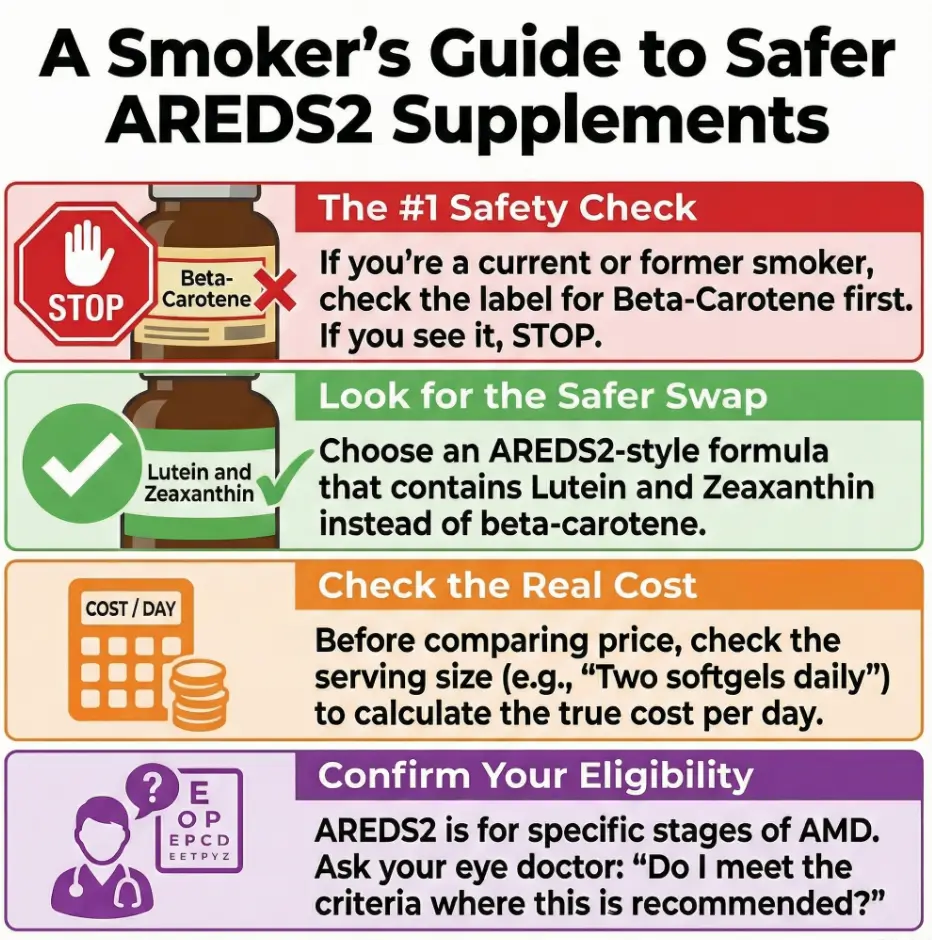
If you remember one thing from this entire guide, make it this: avoid beta-carotene–containing eye formulas if you’re a current or former smoker, unless your clinician has a very specific reason to say otherwise. The risk signal here isn’t subtle, and the history behind it is why AREDS2 shifted away from beta-carotene in the first place for many people.
I didn’t know that when I started. I was laser-focused on “getting the right thing for AMD” and not focused enough on the smoker-specific constraint. That’s a classic time-poor trap: we buy the most famous label instead of the most appropriate one.
- Scan for beta-carotene first
- Prefer lutein/zeaxanthin-based AREDS2 formulas
- Don’t assume “AREDS” equals “AREDS2”
Apply in 60 seconds: Turn the bottle and find the carotenoid line before you compare price or brand.
Show me the nerdy details
AREDS and AREDS2 are related but not identical. The practical difference for smokers is that some older or hybrid products still include beta-carotene, while AREDS2-style formulas typically use lutein and zeaxanthin instead. The safest consumer move is to treat “beta-carotene present” as a stop sign for this audience.
My 7 dangerous mistakes (and how you can skip them)
I wish I could say my first purchase was rational and tidy. It wasn’t. It was a stress-buy after a quick search, a half-remembered brand name, and a “good enough” moment that cost me both money and confidence. Here are the seven mistakes I made, with the fix next to each one.
1) I assumed “AREDS” and “AREDS2” were interchangeable
They’re not. This is the mistake that sets up every other mistake. The fix: treat the number as the product identity, not a footnote. Give yourself 30 seconds to verify the exact formula language on the label.
2) I didn’t check for beta-carotene until after I bought it
I did the backwards version of safety. The fix: flip the bottle first, shop second. If you see beta-carotene and you’re a smoker or ex-smoker, pause and regroup.
3) I over-trusted the front-of-bottle claims
“Eye health,” “vision support,” “macular defense” can be marketing umbrellas. The fix: look for the ingredient panel and amounts before you let the branding do emotional hypnosis.
4) I ignored how my other supplements overlapped
Stacking can get messy fast. The fix: do a 2-minute overlap scan, especially for zinc, vitamin E, and vitamin C.
5) I bought the cheapest option without checking dosage forms
One bottle can be “cheap” because it lasts half as long. The fix: calculate cost per day in under 60 seconds.
6) I didn’t ask my eye doctor what stage I was in
AREDS2 isn’t a universal “everyone should take this” pill. The fix: ask one short, boring, powerful question: “Do I meet the study-style criteria where this is recommended?” If you want a simple prep script before your visit, keep a saved annual eye exam checklist for seniors so you don’t leave the room with unanswered basics.
7) I expected overnight clarity and quit too early
These formulas are long-game tools. The fix: set a realistic routine marker—like a 4-week consistency streak—before you judge whether your system is working for you.
My mood improved 80% once I stopped guessing. Not because the pills are magic, but because decision clarity is half the battle when your eyes are on your mind every day.
A 90-second label check that prevents the biggest error
Here’s the fast routine I use now, the one I wish someone had handed me on day one. It’s designed for people who don’t have time to become supplement detectives.
- Step 1: Find the carotenoids line. If you see beta-carotene and you’re a current or ex-smoker, stop.
- Step 2: Confirm lutein and zeaxanthin are present in an AREDS2-style product.
- Step 3: Scan the zinc amount and note if you’ve had stomach sensitivity before.
- Step 4: Check serving size. “Two softgels daily” can change your real cost.
- Step 5: Compare with your current multivitamin to avoid accidental doubling.
This quick map won’t replace medical advice, but it will keep you from the most common consumer mistake: buying the wrong era of formula out of habit.
Show me the nerdy details
Smoker-specific caution historically centers on beta-carotene signals in large studies. AREDS2-style products pivoted toward lutein and zeaxanthin, making the label difference more than cosmetic. For consumers, the practical defense is a label-first workflow.
Who should even consider AREDS2 (eligibility checklist)
This is where I lost the most time early on: I treated AREDS2 like a general “vision insurance policy.” It’s not. Even if you’re a smoker or ex-smoker, the question isn’t just “Is this safe?” but also “Is this appropriate for my stage?”
- Has an eye professional told you you have intermediate AMD or advanced AMD in one eye? Yes/No
- Are you specifically aiming to follow the study-style approach rather than general supplement use? Yes/No
- Can you commit to a consistent daily routine for at least 4 weeks before judging comfort/tolerance? Yes/No
- Have you checked your current stack for overlapping high-dose antioxidants or zinc? Yes/No
Next step: If you answered “No” to the first item, consider pairing your notes with an how often should seniors get dilated eye exams plan and ask your clinician which stage you’re in before you buy.
Neutral action: Save this checklist and confirm your stage at your next visit.
- Stage clarity comes first
- Smoker-specific ingredient checks come second
- Price comes last
Apply in 60 seconds: Write one question for your next appointment: “Am I in the group where AREDS2 is recommended?”
Choosing a formula without paying for hype, 2025
The weird truth: the most expensive bottle is rarely the most protective one. Your goal is not premium branding—it’s a formula that matches the evidence logic and your tolerability reality.
When I finally slowed down and compared products like a sleepy accountant, the fog lifted. Here’s the calm way to go about it:
- Prioritize the right carotenoids: lutein/zeaxanthin over beta-carotene for this audience.
- Check zinc comfort: some people do better with food timing or gentler options.
- Look for consistency-friendly formats: softgels you’ll actually take beat capsules you resent.
- Ignore novelty blends: if a label adds ten extras, it may be selling excitement, not clarity.
Neutral brand examples you may encounter include large legacy names and store-brand versions that mirror the classic ratios. Your job is to verify ingredients, not to memorize logos.
Show me the nerdy details
For consumer decision-making, the highest leverage move is verifying the core AREDS2-style ingredient pattern rather than chasing add-ons. The evidence base is strongest around the core set, while “bonus” ingredients may not add meaningful benefit for AMD-specific goals.
Decision card: safer ingredient logic for smokers & ex-smokers
This is the two-lane road I use now. It’s not perfect medicine; it’s practical shopping logic when you want to reduce regret quickly.
- You are a current or former smoker
- You want a formula aligned with smoker-specific caution
- You prefer a clearer risk story
- A label still lists beta-carotene
- You’re unsure whether the product is older AREDS-style or a mixed variant
- You have complex medical history or supplement stacking
Neutral action: Take a photo of the ingredient panel and review it calmly before you purchase.
Short Story: the aisle moment (120–180 words)
Short Story: the aisle moment (120–180 words) …
I remember standing under pharmacy lights that felt oddly theatrical, holding two bottles that looked like cousins. One was a famous legacy name. The other was a quieter, less glossy version that claimed the same goal. I was tired, hungry, and proud of myself for “finally doing something responsible.”
Then I saw the word I had been ignoring: beta-carotene. It wasn’t screaming. It was just sitting there in polite print, waiting for me to make a rushed mistake. In that moment, I realized how easy it is to confuse momentum with safety. The aisle doesn’t reward nuance. It rewards speed.
I put the bottle back and felt ridiculous for 10 seconds—then relieved for the next 10 days. It was the first time I chose clarity over panic. That tiny pause changed the rest of my routine.
Cost clarity and a tiny budget calculator
When money is tight, the psychological trap is simple: we treat “cheapest today” as “smartest overall.” But with AREDS2-style products, the real cost is tied to serving size and bottle duration. I’ve seen two bottles with a 20–30% price gap flip positions once you calculate cost per day. If you’re already tracking the bigger picture of AMD treatment cost, this small math habit fits neatly into the same “no surprises later” mindset.
| Band | Approx. monthly range | Notes |
|---|---|---|
| Value | $10–$18 | Often store brands; double-check carotenoids and serving size |
| Mid | $18–$30 | Common legacy brands; may offer consistent supply |
| Premium | $30–$45 | Pay only if you prefer the format and will stay consistent |
Neutral action: Save this table and confirm the current price on the brand’s official page or your local retailer.
Neutral action: Use this estimate to compare two labels side-by-side before you commit.
- Cost-per-day beats sticker price
- Serving size quietly changes everything
- Consistency is a budget strategy
Apply in 60 seconds: Compare two bottles with the estimator before you choose.

Real-world usage mistakes that quietly ruin results
After I fixed the ingredient mistake, I still had to fix the routine. Because even a good formula doesn’t help if your habits keep sabotaging it.
- Taking it on an empty stomach when you’re sensitive can create a quit cycle within 7–10 days.
- Mixing with multiple high-dose supplements without a quick overlap check can make you feel “off” and blame the wrong product.
- Inconsistent timing turns a daily habit into a weekly guilt project.
My simplest fix was boring and effective: I paired my dose with one reliable anchor—breakfast or a late afternoon snack. That single habit reduced my “missed day” rate enough to keep me calm.
Show me the nerdy details
Routine adherence is a hidden variable in supplement outcomes. Consumers often interpret short-term discomfort or inconsistency as “the formula doesn’t work,” when a small timing adjustment or overlap review might solve the practical barrier.
Region notes: US, UK, and Korea label reality
If you’re shopping across borders—or reading advice written for another country—label terminology can add friction. In the US, large legacy eye-health brands and store-brand duplicates are common. In the UK, you may see similar ingredient patterns but different branding language. In Korea, where many readers here may be comparing global and local options, the safest move is to ignore marketing front panels and rely on the ingredient table.
I learned this the hard way when a “vision antioxidant” product looked like a near-match but didn’t clearly align with the core AREDS2 pattern I was trying to follow. The fix was a 2-minute translation-and-verify routine: I matched ingredients one by one instead of trusting the category label.
Your 5-minute buy checklist
This is my current no-drama script. It’s designed for the moment you’re standing in a store or about to press “Buy now” online.
- Minute 1: Confirm the label really says AREDS2-style, not vague “AREDS support.”
- Minute 2: Check carotenoids: avoid beta-carotene if you’re a current or former smoker.
- Minute 3: Scan zinc and vitamin E amounts against your existing stack.
- Minute 4: Verify serving size and calculate cost per day.
- Minute 5: Ask yourself one honest adherence question: “Will I take this for 30 days without resentment?”
- Tier 1: Vague “eye health” multivitamins with unclear carotenoids
- Tier 2: Products that mention AREDS but list beta-carotene
- Tier 3: Clear AREDS2-style ingredient pattern with lutein/zeaxanthin
- Tier 4: Tier 3 plus a format you reliably tolerate
- Tier 5: Tier 4 plus a cost-per-day you can sustain long-term
Neutral action: Aim for Tier 3 or higher, and confirm the panel before checkout.
- Carotenoids first
- Stack overlap second
- Cost-per-day third
Apply in 60 seconds: Use the five-minute script on your next purchase window.
FAQ
1) Is AREDS2 safe for smokers and ex-smokers?
Many AREDS2-style formulas are designed to avoid the beta-carotene concern that matters most for this group. The practical consumer rule is to verify the carotenoids line rather than assuming the product name guarantees safety.
Apply in 60 seconds: Read the ingredient panel and confirm beta-carotene is not listed.
2) What if my bottle says “AREDS” but not “AREDS2”?
Treat that as a reason to slow down. Some products use older language or hybrid positioning. What matters is the ingredient pattern, not the headline.
Apply in 60 seconds: Compare the carotenoids and check whether lutein/zeaxanthin are present.
3) Do I need AREDS2 if I don’t have AMD?
AREDS2 is typically discussed in the context of specific AMD stages, not as a general prevention supplement for everyone. The best next step is to clarify your diagnosis and stage with an eye professional.
Apply in 60 seconds: Write down your last exam result and one question to ask at your next visit.
4) Can I take AREDS2 with a multivitamin?
Sometimes, but overlap is common. The practical risk is accidentally doubling certain antioxidants or minerals. A quick label comparison can prevent unnecessary stacking.
Apply in 60 seconds: Place both bottles side-by-side and circle overlapping high-dose ingredients.
5) How long before I should judge tolerance or routine fit?
Many people can tell within 1–2 weeks whether timing with food improves comfort, but adherence decisions are best made after a steady 4-week stretch.
Apply in 60 seconds: Pick a single daily anchor meal and commit to a 7-day consistency streak first.
6) What’s the simplest way to compare brands without getting scammed by hype?
Ignore front-label poetry and compare three things: carotenoids, serving size, and cost-per-day. That’s usually enough to choose confidently.
Apply in 60 seconds: Use the cost-per-day estimator above with two options.
Conclusion: what I’d do in the next 15 minutes if I were you
The curiosity loop from the start is simple: the biggest danger wasn’t my lack of effort. It was my speed. I confused a famous label with a safe label for my specific history as a smoker/ex-smoker.
Here’s your clean next step: grab the two most likely bottles you’re considering—online tabs or physical boxes—and run the 90-second label check. Then run the cost-per-day estimator. That’s enough to eliminate the worst option and highlight the most sustainable one. If you want a wider context refresh before you shop, a quick skim of age-related eye diseases after 60 can help you keep supplements in the right lane of the bigger eye-health plan.
AREDS2-style goal
Lutein/Zeaxanthin present
Beta-carotene listed
Overlap with your stack
Cost per day + tolerability
Last reviewed: 2025-12; sources: National Eye Institute, NIH Office of Dietary Supplements, American Academy of Ophthalmology.