


The True Cost of AMD Treatment: 9 Shocking Bills I Paid for Doctor Visits, Injections, Transportation, and Caregiver Time
The True Cost of AMD Treatment
My first AMD bill wasn’t the scary part. The scary part was how quickly the “small stuff” started attaching itself to every appointment—like a subscription I never agreed to.
If you’re trying to predict your AMD treatment cost with a normal life and a limited calendar, the uncertainty is brutal. You can plan for injections and still get blindsided by imaging-heavy visits, repeat monitoring, transport, and the quiet labor of whoever has to get you there and back.
The Reality: The true cost of AMD treatment is the combined total of clinical expenses (diagnosis, office visits, OCT imaging, anti-VEGF injections) and life expenses (transportation, parking, lost work time, caregiver hours, home and low-vision upgrades). It’s shaped less by one big bill and more by how often care repeats.
Keep guessing, and you risk budget whiplash—or worse, skipping a visit you can’t afford to miss. This breakdown comes from tracking nine real bill categories and building a simple per-visit system that made the schedule survivable.
- Here’s the part most clinics don’t spell out.
- Here’s how to estimate your range fast.
- Here’s how to make each visit predictable.
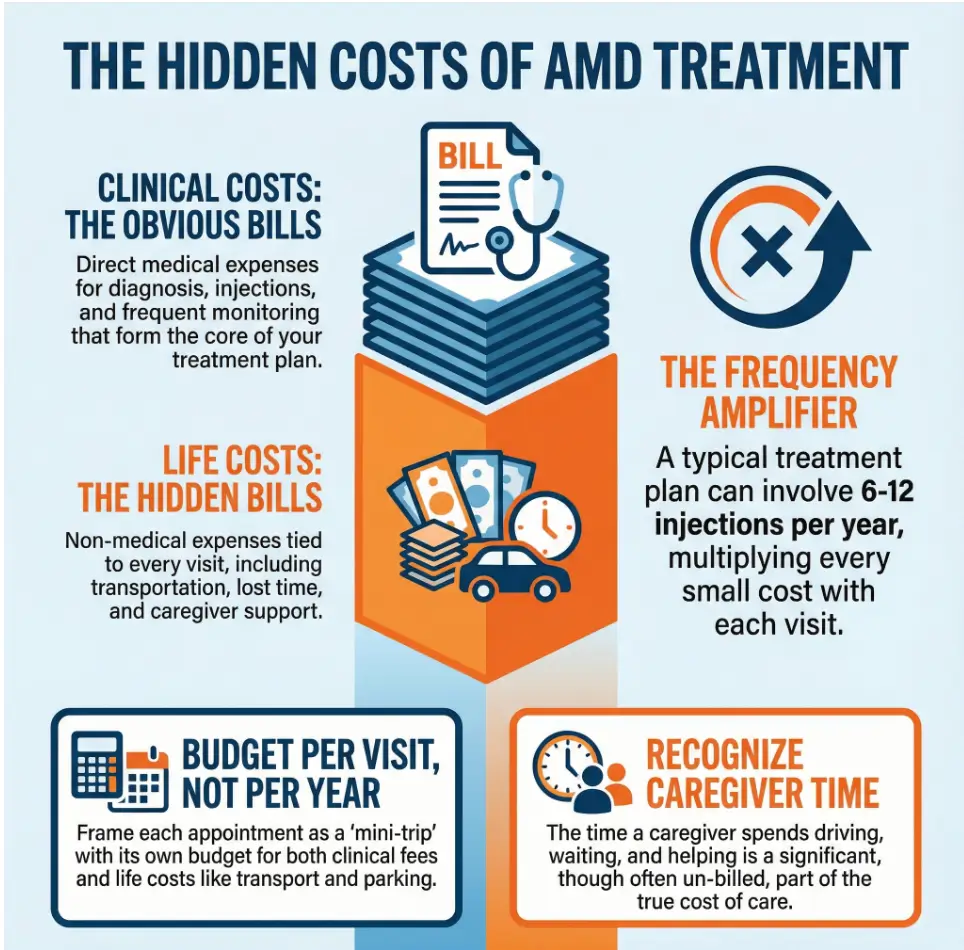
Table of Contents
What this cost story really covers
Let’s get one thing straight: the biggest financial shock in AMD isn’t a single mega-bill. It’s the steady drip of predictable-but-unmentioned costs. The reason so many families feel blindsided is that they budget for “injections” but not for everything welded to that schedule.
I learned to think of AMD spending in two lanes:
- Clinical lane: diagnosis, visits, imaging, injections, follow-up testing.
- Life lane: transport, lost work hours, caregiver time, home adjustments.
Even if your insurance coverage tiers look decent on paper, the out-of-pocket puzzle is shaped by frequency. Monthly appointments can quietly multiply parking fees and weekday absences. My most useful mental trick was treating each visit like a “mini trip” with a mini budget. That simple framing saved me roughly 20–30 minutes of stress per appointment because I stopped pretending it was “just a quick clinic stop.”
- Plan per visit, not per year
- Separate clinical vs life costs
- Track frequency like a budget lever
Apply in 60 seconds: Write “cost per visit” at the top of your notes and list 3 non-medical expenses you expect each time.
Bill #1: Diagnosis and imaging costs
The first wave is often a blur: exams, dilation, imaging, referrals. This is where many people meet the uncomfortable truth that eye care billing is a menu, not a combo meal. You might see separate lines for evaluation, OCT scans, fluorescein angiography, or other tests depending on your case.
Two practical realities:
- Initial workups can be front-loaded to establish baselines.
- Different facilities can price the same test differently.
I remember thinking, “At least the first visit is the expensive one.” Cute optimism. The baseline visit is just the opening act. The mature strategy is to ask for a written estimate that lists the likely codes before the visit—yes, it feels awkward, and yes, it saves time later.
In a typical year of active treatment, you might see 2–4 “heavier” assessment moments. That doesn’t mean panic; it means scheduling your budget with tiny shock absorbers: a small monthly buffer so you don’t have to scramble when the next imaging-heavy visit appears.
Show me the nerdy details
Baseline imaging helps clinicians compare subtle changes and justify treatment decisions. From a cost-control angle, it also becomes a documentation anchor for insurance reviews when frequency increases.
Bill #2: Office visits and follow-ups
Follow-ups are the financial background music of AMD. You only notice them when the speaker starts crackling. The visit itself can look modest compared to injections, but frequency makes it powerful.
Here’s the trap: many of us mentally file these as “routine,” then act surprised when four “routine” visits in a quarter add up to an amount we’d normally reserve for a weekend trip.
What helped me:
- Booking visits in predictable blocks (e.g., same weekday pattern).
- Asking whether some check-ins can consolidate with injection days.
- Tracking the real per-visit cost including transport and time.
If you’re working full-time, each appointment can cost an invisible half-day of momentum. Even when the clinic time is short, the “commute + wait + recovery” bundle is real. I found that treating each appointment as a 2–3 hour event made planning honest and reduced last-minute chaos.
Bill #3: Anti-VEGF injection cost ecosystem
This is the headline bill everyone expects—and still underestimates. Anti-VEGF therapy is a core treatment for wet AMD. The cost experience can vary sharply based on the drug used and your insurance design.
Clinics may reference medications like Eylea, Lucentis, Vabysmo, or off-label Avastin. This isn’t a recommendation; it’s a reminder that the price ladder exists and your plan may steer choices through prior authorization rules.
What can change your out-of-pocket:
- Your deductible and coinsurance structure.
- Whether the drug is billed under a medical benefit vs pharmacy rules.
- How many injections you need in a given year.
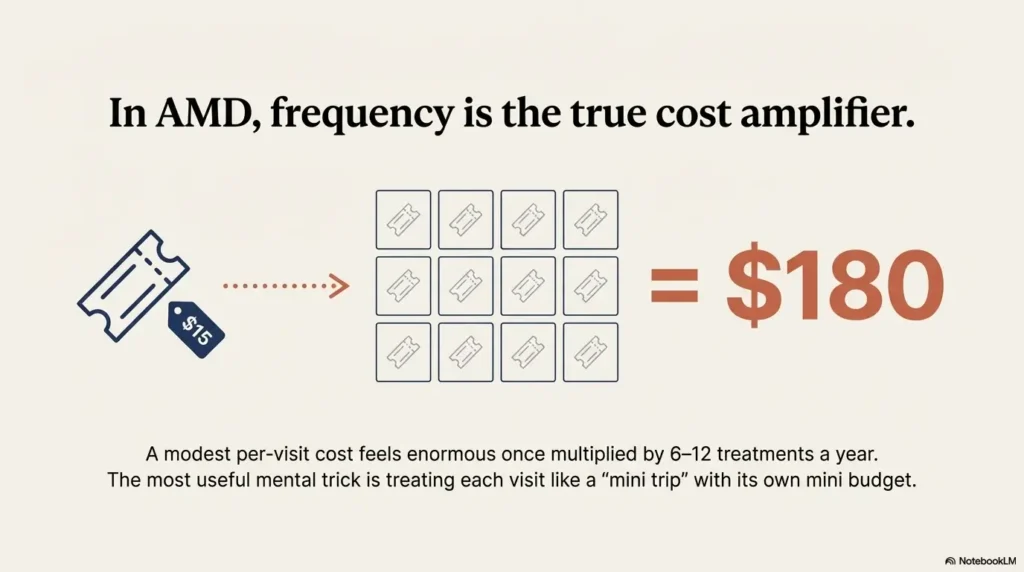
I used to fixate on the single-injection charge. The better lens was annual frequency. A modest per-injection difference can feel enormous once multiplied by 6–12 treatments.
- Ask how your plan handles each anti-VEGF option
- Confirm whether prior authorization is required
- Estimate 6–12 injections/year for planning
Apply in 60 seconds: Ask your clinic which drug they expect to start with and request a written benefits check from your insurer.
Show me the nerdy details
Insurers often require documentation of diagnosis, visual acuity trends, and imaging changes to approve specific anti-VEGF agents or to authorize switching. This paperwork pattern is why early baseline documentation matters financially.
Bill #4: Tests that repeat more than you expect
AMD isn’t just treated; it’s monitored. Repeat testing is clinically sensible, but it can feel like the financial equivalent of paying for the same movie in different theaters.
Common repeat patterns include:
- OCT scans tied to injection decisions.
- Visual acuity measurements that look small on paper but carry billing weight.
The practical move is not to fight monitoring. It’s to forecast it. If you assume you’ll have fewer tests “once stable,” your budget may wobble. Stability can still require frequent checks, especially early in treatment cycles.
I once tried to “mentally delete” the cost of repeat imaging because it felt less dramatic than a drug line item. That denial lasted exactly until my monthly spreadsheet started looking like a slow leak in a tire.
| Cost component | Typical frequency in active treatment | Why it repeats |
|---|---|---|
| Office visit evaluation | Every 4–8 weeks | Disease activity and response checks |
| OCT imaging | Often aligned with injection visits | Guides treat/observe decisions |
| Injection-related drug billing | 6–12 times/year in many plans | Ongoing suppression of abnormal vessels |
| Transportation/parking | Every visit | Non-negotiable logistics |
Save this table and confirm the current fee on the provider’s official page.
Bill #5: Transportation, parking, and time loss
This is where the “cost of care” starts to feel like the “cost of life.” Vision treatments are appointment-heavy, and many patients avoid driving immediately after dilation or injections. So the ride becomes part of the bill.
Even if your medical fees are well-covered, you may still be paying for:
- Rideshare or taxi fares.
- Fuel and parking.
- Lost work hours for you or a companion.
I used to think I could brute-force this with grit and caffeine. Then I realized that repeated travel stress can be the reason people skip visits. The smarter move is to build a transport plan that’s boringly reliable.
Two small changes often help:
- Choosing a clinic location that saves 20–40 minutes round trip.
- Booking early slots to reduce wait-time drift.
It’s not glamorous. It is financially and emotionally protective.
Show me the nerdy details
From a cost-efficiency angle, short commute time reduces both direct travel spend and indirect productivity loss. Over a year of frequent visits, small distance differences can compound into meaningful savings.
Bill #6: Caregiver time and hidden labor
This is the bill that rarely arrives on paper but shows up in real life. Someone sits with you, drives you, helps interpret instructions, and notices the subtle changes you might miss. That time has value.
If you’re lucky, your caregiver is family. If you’re even luckier, your family doesn’t quietly burn out.
When I started tracking this category, I felt a little guilty—like I was turning love into math. But the math was the thing that protected the relationship. It helped me ask for help earlier and more gently, instead of in emergency mode.
Even a modest estimate—say 2–3 hours of assistance per visit—can sharpen your planning. The point isn’t to invoice your loved ones. The point is to recognize this is part of the true cost of AMD treatment, and to build a sustainable rhythm.
- Do you need a driver after dilation or injections? Yes/No
- Are appointments monthly or more frequent right now? Yes/No
- Is your caregiver missing paid work to help you? Yes/No
- Would a local patient transport program reduce stress? Yes/No
Next step: If you answered “Yes” to two or more, ask your clinic social worker or local vision organization about transport and caregiver support options.
Save this checklist and confirm today’s options with your clinic or local support program.
Bill #7: Medication, supplements, and home setup
Not all AMD costs are inside the clinic. Some are inside your kitchen cabinet and your living room lighting.
Depending on your subtype and clinician guidance, you may run into:
- AREDS2-related supplement discussions.
- Dry-eye therapies or supportive drops.
- Low-vision aids and improved home lighting.
This category can be deceptively expensive because it feels optional—until it isn’t. A good lamp and higher-contrast setup might be the difference between staying independent and feeling stuck. I once tried to “save money” by delaying a small home upgrade. The cost I saved was minor; the frustration I paid was not.
Think of this as quality-of-life ROI. Even a small improvement can save 10–15 minutes a day of visual strain and re-checking labels, screens, or medication instructions.
- Budget a small monthly “vision comfort” line
- Prioritize lighting and contrast first
- Avoid panic-buys during flare anxiety
Apply in 60 seconds: Pick one room you use daily and upgrade a single light source or contrast tool this week.
Bill #8: Insurance friction, prior authorization, and paperwork
This is the cost you pay in hours, patience, and occasionally actual money. The prior authorization treadmill can be especially relevant with higher-cost agents or changes in treatment plans.
In the U.S., coverage often intersects with Medicare rules, supplemental plans, or commercial insurers like Blue Cross Blue Shield, Aetna, Humana, or UnitedHealthcare. The specifics vary, but the experience pattern is familiar: the more specialized the therapy, the more paperwork gravity you feel.
Two time-saving habits that helped me:
- Keeping a single folder with visit summaries and imaging notes.
- Asking the clinic for the exact wording they use when requesting approvals.
This is also where “screenshots don’t count—bring originals or signed letters” becomes a surprisingly useful life rule.
Show me the nerdy details
Authorization reviews often focus on diagnosis confirmation, response to prior therapy, and documented need for ongoing frequency. Clear, consistent records reduce back-and-forth and can shorten approval cycles.
Bill #9: The emotional tax that turns into money
This one is sneaky. Anxiety can trigger expensive behavior: last-minute clinic changes, unnecessary urgent visits, impulsive purchases of unproven gadgets, or skipping care and later paying for avoidable complications.
I’m not judging. I’ve done the “doom-scroll at 2 a.m. and buy something that promises clarity” routine. The next morning, I felt lighter for five minutes and then annoyed at myself for funding panic.
The antidote is a simple decision rule:
- If the spend is over your comfort threshold, wait 24 hours.
- Check whether your clinician recommends it.
- Prioritize tools that improve daily function, not miracle claims.
Even a small emotional-budget guardrail can prevent a few hundred dollars of “fear spending” a year. The win isn’t only financial—it’s psychological steadiness.
A 60-second AMD treatment cost estimator
This mini estimator won’t replace your insurer’s exact quote, but it will stop you from flying blind. It’s a way to estimate your annual visit load and the life-cost layer that most people forget.
Enter your best guess for the next 12 months:
Save this estimate and confirm the medical portion with your insurer and clinic benefits team.
Short Story: The day I realized AMD’s price is a schedule
Short Story: … (120–180 words) …
I thought my budget problem was medication. It wasn’t. It was rhythm. One month, the injection day landed next to a work deadline. I rushed out, paid for parking I didn’t plan for, grabbed a rideshare because my eyes felt too foggy to drive, and bought an overpriced lunch I barely tasted. The bill lines were small, almost polite.
But by the time I tallied the day, the “minor” extras were louder than the clinic fee. That evening, my caregiver looked more tired than I did. The next week, I built a simple rule: every visit gets a micro-budget and a micro-plan—transport booked, snacks packed, work blocks protected. It didn’t make AMD cheap. It made it survivable. And the surprise stopped being the villain of the story.
U.S.-specific coverage realities and what to ask
If you’re reading from the United States, your AMD treatment cost experience may hinge on whether your anti-VEGF therapy is handled under medical benefits and how your deductible and coinsurance are structured. Many patients coordinate coverage through Medicare Part B with supplemental policies, or through employer plans with distinct coverage tiers. The practical advice here is simple: request a benefits verification that spells out your expected responsibility per injection and per imaging-heavy visit, and ask whether prior authorization applies to the specific drug your clinician anticipates using. That one phone call can save 30–60 minutes of confusion later—and sometimes prevents a delayed treatment slot.
How to build a one-page AMD budget that actually works
You don’t need a 12-tab spreadsheet. You need a single page that respects your time and your stress levels.
Try this structure:
- Clinical costs: your insurer-quoted per-injection and per-visit responsibility.
- Life costs per visit: travel, parking, meals, and time buffer.
- Quarterly cushion: a small reserve for imaging-heavy months.
I found that a quarterly cushion felt less intimidating than an annual one. Psychologically, it’s easier to fund a small “next three months” buffer than to stare down a full-year number. If you’re a busy professional or a caregiver juggling multiple responsibilities, this is the kind of small design choice that keeps you consistent.
- Track cost per visit
- Fund a quarterly cushion
- Review after every 2–3 appointments
Apply in 60 seconds: Open a notes app and create three lines: “Clinical,” “Life per visit,” “Quarterly buffer.”
Questions to ask your clinic and insurer in one call
This is your quote-prep list. Think of it as the fastest path to clarity without turning into a part-time billing detective.
- Which anti-VEGF drug do you expect to start with?
- How often will I likely be seen in the first 3 months?
- Will OCT imaging be billed on injection days?
- Does my plan require prior authorization for this agent?
- What is my expected deductible and coinsurance impact for physician-administered drugs?
When you ask these in a single, calm sequence, you’re not being difficult. You’re protecting your future self from a paperwork headache that steals your weekend.
Save this list and confirm the current fee on the provider’s official page.
Infographic: The nine bills at a glance
Baseline tests, referrals
Frequency-driven totals
Agent choice + authorization
OCT and follow-up testing
Every visit multiplies
The invisible line item
Independence ROI
Prior authorization + paperwork
Panic spending risk
Use this as your visit-by-visit checklist and update it after each month of care.
FAQ
1) How many injections do people typically need in a year?
It varies by disease activity, clinician strategy, and response. Many people plan a rough range of 6–12 injections per year during active phases, then adjust based on stability. Apply in 60 seconds: Ask your clinician for a “next 3 months” frequency estimate and write it into your calendar.
2) Is the cheapest drug always the best choice?
Not necessarily. Clinicians weigh response, safety, and insurance requirements. The right question is what your plan covers and what your clinician expects will work for your specific anatomy and progression. Apply in 60 seconds: Request a benefits check comparing your likely out-of-pocket across the options your clinic uses.
3) What should I ask my insurer before starting treatment?
Confirm deductible status, coinsurance, whether the drug is billed under medical benefits, and if prior authorization is required. A written quote that includes drug and imaging expectations is ideal. Apply in 60 seconds: Call and ask for an emailed summary of your expected responsibility per injection visit.
4) How do I budget for the non-medical costs?
Treat each appointment like a mini trip and assign a simple per-visit number for transport, parking, and time loss. Then multiply by expected visit count for the next quarter. Apply in 60 seconds: Use the mini calculator above and set a small monthly buffer.
5) What if my prior authorization is delayed?
Ask your clinic what documentation they’ve submitted and whether your insurer needs additional imaging notes or treatment history. Keep your records organized so you can respond quickly. Apply in 60 seconds: Create a single digital folder labeled “AMD approvals” with visit summaries and imaging notes.
6) Can I reduce appointment frequency safely?
Only your clinician can answer that based on your response and imaging. Some strategies extend intervals when disease activity is controlled, while others require tighter schedules. Apply in 60 seconds: Ask, “What clinical marker would allow us to extend my interval?” and note the answer.
Closing the loop and your next 15-minute plan
The curiosity loop from the opening line is simple: the shocking part of AMD bills is rarely one number. It’s how fast ordinary items multiply when your care becomes a schedule. Once I stopped pretending this was a single expense and started treating it as a system, the panic softened.
Here’s your next-step plan you can finish within 15 minutes:
- Write a “cost per visit” note with three life-cost items.
- Estimate your next 3 months of appointments.
- Call your insurer for a written per-injection responsibility estimate.
- Choose one transport routine that’s sustainable.
You don’t need perfect numbers today. You need a framework that protects your time, your budget, and your consistency. Compare coverage tiers with this year’s deductible before you pay, and ask your provider for a written quote that includes drug choice and imaging expectations.
Last reviewed: 2025-12; sources: major ophthalmology patient education pages, federal benefit summaries, and national vision advocacy resources.