


Wet AMD Injections and Anxiety in Your 70s: How to Cope Before, During, and After Treatment
Wet AMD Injections and Anxiety in Your 70s
The injection isn’t the only hard part—the anticipation is. If you’re dealing with wet AMD injections and anxiety in your 70s, you already know how a “quick procedure” can still swallow the night before, the waiting room, and the quiet hours after you get home.
Wet AMD injections are anti-VEGF treatments placed in the eye to slow abnormal blood vessel growth and leakage, helping protect vision over time. The injection itself is usually seconds; the stress often lives in everything wrapped around it—uncertainty, past medical fatigue, and the fear of moving at the wrong moment. If you want a broader overview of what these treatments are and how they fit into modern care, see this guide on AMD injections.
Keep guessing and you pay in sleep, skipped appointments, and a nervous system that never gets to stand down.
This guide helps you treat anxiety like a real side effect with a plan: a 24-hour prep routine, minute-by-minute coping in the chair, a simple “monitor vs call” map for the first 48 hours, and cost-clarity steps for Medicare Part B and clinic billing.
It’s built on the practical tools that show up throughout the body—short scripts, tiny rituals, and decision cards you can use with your retina team.
- Here’s the calm you can rehearse.
- Here’s the language you can borrow.
- Here’s how to get through the next visit without losing your whole week.
Table of Contents
Why this anxiety is so common
Let’s say the quiet part out loud: a needle near your eye is a primal fear, not a “mindset problem.” Even when the procedure is quick, the human brain treats it like a high-alert event. That’s especially true in your 70s, when you’ve already lived through enough medical surprises to know that “routine” can still feel heavy.
I once watched an older family member do the brave-face shuffle in the waiting room—joking with nurses, smiling at strangers—then whisper, “I hate this part.” That single sentence changed how I think about treatment days. Anxiety isn’t a character flaw; it’s a signal to build a plan.
- Anticipatory anxiety often peaks 12–24 hours before the appointment.
- Many people report the waiting room feels worse than the injection itself.
- Having a script and a small ritual can reduce panic spirals in under 5 minutes.
- Name the fear out loud once
- Build a 3-step plan for the day
- Let your clinic do the heavy lifting
Apply in 60 seconds: Write one sentence: “What I’m afraid of most is ___.”
Show me the nerdy details
Anticipatory anxiety can amplify pain perception and memory of discomfort. A structured plan shifts attention from threat-monitoring to task completion, which helps many patients feel more in control.
What happens at a wet AMD injection visit
Wet AMD injections are usually anti-VEGF treatments designed to slow or stop abnormal blood vessel growth and leakage. If you’re newer to the diagnosis, this quick primer on dry vs wet age-related macular degeneration can make the “why now, why injections” part feel less abstract. The visit often follows a predictable rhythm: check-in, vision testing, sometimes imaging, numbing, cleansing, then the injection.
For most people, the actual injection step is brief. The uncertainty that fuels anxiety is usually about the steps around it: “Will it hurt this time?” “What if I move?” “What if my vision gets worse anyway?”
One small thing that helps: ask the nurse to narrate the steps as they happen. A calm countdown can make 2–3 minutes feel shorter and safer.
- Typical visit length can range from about 30 to 90 minutes, depending on imaging and clinic flow.
- The injection itself is often seconds, with most time spent on preparation.
- Many clinics use antiseptic and anesthetic drops to reduce infection risk and discomfort.
Mini script you can use today: “I get anxious before the injection. Could you talk me through each step and give me a short countdown?”
Your 24-hour prep plan
This is where most anxiety wins—and where you can take it back. The goal is to reduce uncertainty and prevent the nighttime spiral.
I’m not a fan of heroic willpower. I’m a fan of tiny systems. The evening before, make the plan so your morning self doesn’t have to negotiate with fear.
Money Block: 60-second eligibility-style self-check
- Yes/No: Do you have a ride plan if your eye feels irritated afterward?
- Yes/No: Do you know the name of your medication and your next follow-up interval? If your plan is still taking shape, you may find this breakdown of a wet AMD injection schedule helpful for setting expectations.
- Yes/No: Do you have your questions written down in one list?
- Yes/No: Do you know your urgent warning signs?
Next step: If you answered “No” to two or more, call the clinic and ask for a 2-minute pre-visit review. Save this list and confirm the current visit instructions on the provider’s official page.
- Pack a small “calm kit”: tissues, water, sunglasses, a mint, and one grounding note.
- Set a two-alarm morning plan to avoid rushing.
- Pick a single phrase for the moment you sit in the chair: “Still. Breathe. Done.”
Show me the nerdy details
Reducing decision load the night before can lower stress responses on procedure day. Simple checklists and scripts are effective because they cut uncertainty, a major driver of anticipatory anxiety.
Coping during the injection, minute by minute
Your brain will try to time-travel into worst-case futures. Your job is to anchor it to the current minute. The chair is not a courtroom; you don’t need to prove bravery.
I’ve heard people say, “I’m embarrassed I’m still scared after three injections.” That’s like being embarrassed the ocean is still wet. Repetition helps familiarity, not immunity.
- Minute 1: Tell the team your preference: quiet, narration, or countdown.
- Minute 2: Use a physical anchor—press thumb to fingertip, gently.
- Minute 3: Exhale longer than you inhale for 3 cycles.
- Minute 4: Ask for a pause if your body tenses.
One-line rescue phrase: “I need a 10-second reset.”
- Ask for a countdown
- Use one physical anchor
- Let the team pace you
Apply in 60 seconds: Practice your rescue phrase once out loud.
Aftercare and the first 48 hours
Post-injection anxiety can be sneaky. You go home, the adrenaline drops, and suddenly every sensation feels suspicious. A scratchy feeling, mild redness, or a gritty sensation can be common after eye procedures, but your clinic will have specific red flags to watch for.
This is one of those moments where reassurance should be structured. When you have a plan for “normal vs urgent,” your mind doesn’t have to improvise.
Decision card: When to monitor vs when to call
- Monitor: Mild irritation that improves over hours.
- Call same day: Worsening pain, rapidly increasing redness, or a sudden big change in vision.
- Emergency: Severe pain with significant vision change.
Save this card and confirm the exact warning signs and aftercare instructions on the provider’s official page. If you like having something printable to reduce second-guessing, this printable symptom diary for seniors can also help you track what’s normal for your eye between visits.
One small habit: set a two-check routine—once at 2 hours, once at bedtime. Outside those windows, give yourself permission not to “scan for danger.” That can save you 15–30 minutes of worry loops in a single day.
Show me the nerdy details
Post-procedure hypervigilance is common. Time-boxed symptom checks reduce rumination while still supporting safety.
Cost, coverage, and decision points, 2025 (US)
If you’re reading this in the United States, wet AMD injections often fall under Medicare Part B when administered in a clinical setting. That typically means cost-sharing rules may apply, and supplemental coverage can change your out-of-pocket experience. Clinics may also use prior authorization depending on your plan and medication.
Money anxiety compounds medical anxiety. When you don’t know the numbers, your brain fills the gap with dread.
Money Block: Fee/coverage orientation table (general ranges)
| Item | What affects your cost | Notes for 2025 |
|---|---|---|
| Anti-VEGF drug + injection visit | Medication used, site of care, insurance tier, supplemental plan | Ask for the billing code used and whether your plan requires prior authorization. If you want a deeper Part B-specific example, this guide on Medicare coverage for Eylea injections can help you frame your questions. |
| Imaging (e.g., OCT) | Frequency, clinical necessity, plan rules | Bundling policies can vary by clinic and payer |
| Copay/coinsurance | Medicare + Medigap or Medicare Advantage design | Confirm your plan’s current fee schedule before the next cycle. For a broader overview of pricing drivers across meds and visit types, see AMD treatment cost. |
Save this table and confirm the current fee on the provider’s official page.
Money Block: Mini cost-clarity calculator (no storage)
This is a planning tool only. Actual costs depend on your plan, medication, and clinic billing. Save this estimate and confirm the current fee on the provider’s official page.
To reduce surprises, ask for a written cost estimate that includes the medication name, imaging frequency, and your plan’s coinsurance. This can save 20–30 minutes of phone ping-pong—and sometimes much more. If you want to compare how different clinics and drug choices shift the big picture, this summary of AMD treatment cost can give you a clearer baseline before you call.
- Ask for the medication name
- Request a written estimate
- Check if prior authorization applies
Apply in 60 seconds: Write down one question: “What will my out-of-pocket be per visit?”
Long-term calm between visits
Between injections, anxiety often returns in waves. You might have a good month, then a bad week where every blur feels like a warning sign. The trick is to separate monitoring from ruminating.
A small personal note: I’ve seen people regain a sense of normal life by treating injection days like a predictable quarterly chore—like taxes, but with better snacks. The point isn’t to love the process. It’s to stop letting it steal the weeks around it.
-
-
-
-
-
-
-
- Schedule your appointments at your best energy time of day.
-
-
-
-
-
-
-
-
-
-
-
-
-
- Use one trusted friend or family member as your “appointment anchor.”
-
-
-
-
-
-
-
-
-
-
-
-
-
- Keep a simple log of “what felt normal last time.”
-
-
-
-
-
-
Show me the nerdy details
Consistency and routine reduce cognitive load. When patients can predict the sequence, anxiety tends to shift from catastrophic to manageable.
When anxiety needs more than self-help
Sometimes coping tips aren’t enough—and that doesn’t mean you failed. If you’re losing sleep for multiple nights before each injection, skipping appointments, or feeling panicked in ways that spill into daily life, you deserve more support.
Options can include brief counseling, targeted anxiety strategies, or a conversation with your clinician about how the visit environment can be adjusted. A calm, practical request can change a lot.
Short Story: The waiting-room reset (120–180 words)
Short Story: … (120–180 words) …
The first time my neighbor told me about her wet AMD injections, she sounded like a retired teacher describing a storm she already survived. But on her fourth visit, she confessed the night-before fear had gotten worse, not better. She’d started rehearsing bad outcomes in the dark, then arriving exhausted and angry at herself.
We built a simple plan: she would call the clinic two days ahead to request a quieter room and a short verbal countdown; she’d bring a single-page “questions + reassurance” sheet; and she’d schedule a small reward afterward—coffee with her sister, no medical talk allowed. The next month she didn’t magically love the injection. She just stopped being eaten alive by the lead-up. Her words were simple: “I’m still scared, but I’m not alone in it anymore.”
-
-
-
-
-
-
-
- If your anxiety feels constant, ask your primary care team for a short-term plan.
-
-
-
-
-
-
-
-
-
-
-
-
-
- Consider bringing someone to appointments for the next 2–3 visits.
-
-
-
-
-
-
-
-
-
-
-
-
-
- Use a written script so your mind doesn’t blank in the chair. If this is your starting line, you may appreciate this walkthrough of your first anti-VEGF injection for wet AMD.
-
-
-
-
-
-
Two-sentence script: “These injections are important to me, but my anxiety is getting in the way. Can we adjust the visit flow or add a brief check-in so I can stay consistent with treatment?”
Your questions to ask your retina team
This section is about turning anxiety into a short list of honest, high-value questions. The right question is a form of control that doesn’t require you to be fearless.
-
-
-
-
-
-
-
- “Which medication are we using today, and why?”
-
-
-
-
-
-
-
-
-
-
-
-
-
- “How many weeks until my next likely injection?”
-
-
-
-
-
-
-
-
-
-
-
-
-
- “What exact symptoms should trigger an urgent call?”
-
-
-
-
-
-
-
-
-
-
-
-
-
- “Will imaging be done every visit or based on changes?”
-
-
-
-
-
-
-
-
-
-
-
-
-
- “Can you note in my chart that I prefer a countdown?”
-
-
-
-
-
-
- Print or screenshot five questions
- Hand them to the nurse
- Ask for answers in plain language
Apply in 60 seconds: Circle your top two questions now.
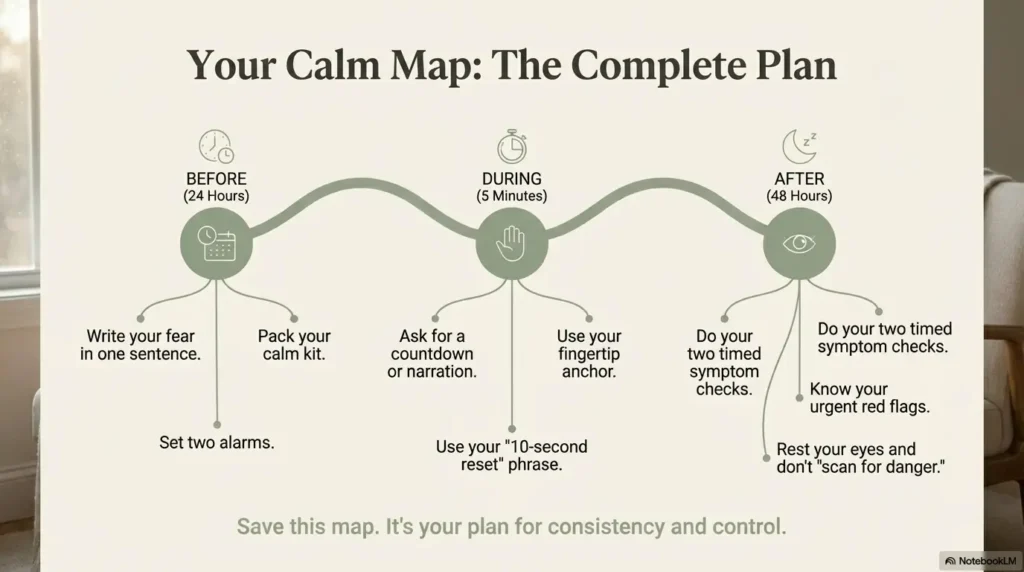
A simple infographic you can save
- Write the fear sentence
- Pack a calm kit
- Set 2 alarms
- Prepare your script
- Ask for narration
- Use fingertip anchor
- Long exhale x3
- Request a 10-second reset
- 2 timed symptom checks
- Know your red flags
- Rest your eyes
- Log “what was normal”
Save this map and confirm your clinic’s exact instructions for your next visit.
Trusted reading if you want a deeper dive
If you prefer to cross-check what you’ve read here with major eye-health organizations, these pages are good starting points for understanding wet AMD and anti-VEGF treatment basics.
FAQ
Do wet AMD injections usually hurt?
Many patients describe pressure or brief discomfort rather than sharp pain, because numbing steps are used. If your anxiety magnifies your sensation, ask for a slower countdown and a short pause option. Apply in 60 seconds: Write, “I prefer a countdown and a 10-second reset if I tense.”
How long does a typical injection visit take?
Visits often include vision checks and imaging, so total time can feel longer than the injection step itself. Plan for roughly 30–90 minutes depending on clinic flow. Apply in 60 seconds: Choose an appointment time that matches your best energy window.
What symptoms after an injection should make me call right away?
Clinics commonly want you to report worsening pain, rapidly increasing redness, or a sudden major change in vision. Your team will give you the exact list for your medication and situation. Apply in 60 seconds: Save your clinic’s urgent phone number in favorites.
How often will I need injections?
Frequency varies by response and medication strategy. Some plans start more frequently and then adjust based on stability. Your retina specialist will tailor the schedule to your eye’s progress. Apply in 60 seconds: Ask, “What’s our likely interval for the next three visits?”
How can I reduce anxiety the night before?
Use a simple ritual: write your fear in one sentence, pack your calm kit, and set two alarms. The goal is to remove decisions in the morning. Apply in 60 seconds: Put your questions on one note page now.
What about costs with Medicare or insurance?
In the U.S., wet AMD injections are often billed under Medicare Part B in clinical settings, and your out-of-pocket depends on your plan design and supplemental coverage. Ask for a written estimate that includes medication and imaging. Apply in 60 seconds: Call and ask, “What will my estimated out-of-pocket be per visit?” For a more detailed, patient-friendly breakdown of price drivers, you can also review AMD treatment cost.
More official guidance for your next visit
If you want a second and third trusted reference point before your next appointment, these organizations offer patient-friendly summaries of macular degeneration and treatment approaches.
Conclusion
The fear you feel around wet AMD injections isn’t a side note—it’s part of the treatment reality. The good news is that anxiety responds well to rehearsed structure: a pre-visit plan, a one-line script, and a time-boxed aftercare routine. You don’t need to be fearless to be consistent.
In the next 15 minutes, do three things: write your fear sentence, save your clinic’s urgent number, and create your five-question list. Then place that note where you’ll see it the night before your appointment. The injection day will still be a day you’d rather skip—but it won’t own your whole week.
Last reviewed: 2025-12; sources: AAO/NEI/NHS.