
Beyond the Flash: Designing Safer, Smarter Nighttime Lighting
A motion sensor light that is too bright at night can make a familiar hallway feel briefly unusable. What looks like a lighting upgrade on paper often behaves like a flash event in real life, especially for those with low vision, glare sensitivity, or eyes that adjust slowly to the dark.
The trouble is usually not darkness. It is the wrong mix of lux, angle, diffusion, color temperature, and timing. A harsh fixture can wash out floor detail, bounce off mirrors, and leave you squinting at the exact moment you need clear footing.
This guide helps you fix the problem with precision. You will learn how to calm nighttime glare and protect usable contrast without turning your path into a dim blur. Our method is grounded in what actually changes results:
- ✦ Walking-surface light
- ✦ Fixture aiming
- ✦ Reflective finishes
- ✦ Real 2 a.m. testing
Most people shop for a bulb, but the room is part of the problem. The fix is usually smaller, cheaper, and smarter than it first appears.
Table of Contents
Fast Answer: A motion sensor light that feels painfully bright at night usually needs better control, not brute-force dimming. For low-vision households, the best fix is often a combination of lower lux at walking height, warmer color temperature, better aiming, a softer diffuser, and longer sensor timing. Done well, that gives you safer navigation, less glare, fewer hard brightness jumps, and less of that “I can’t see because the light is on” feeling.
Too bright is not better when low vision meets sudden nighttime glare
A brighter bulb can make the path harder to see, not easier
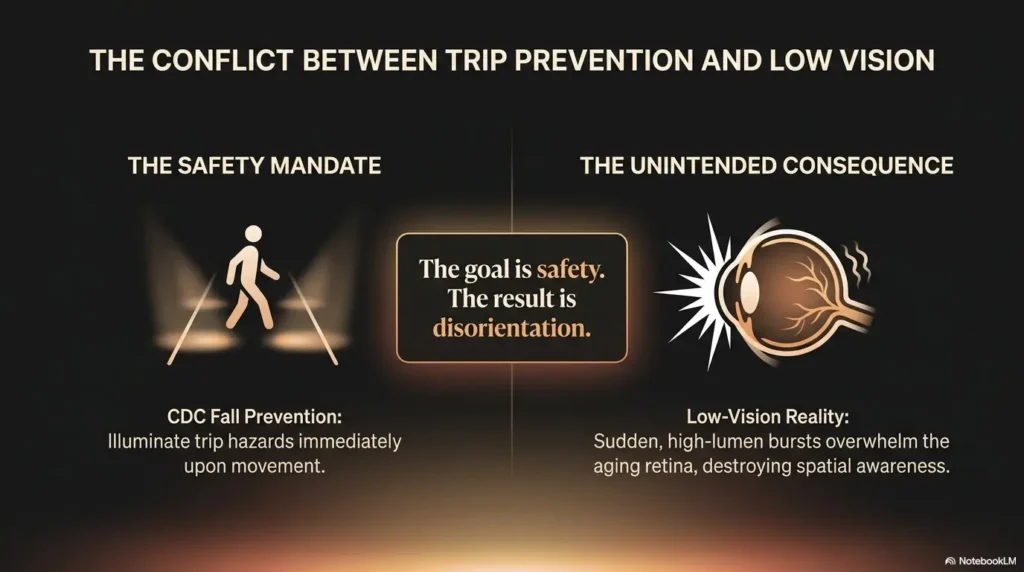
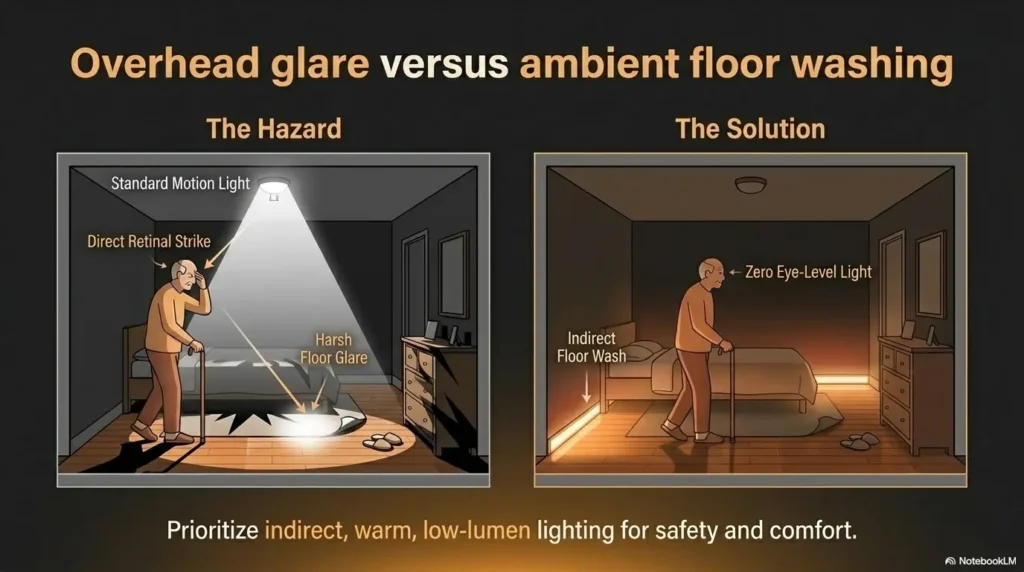
People often assume nighttime safety is a simple arithmetic problem: more light equals more visibility. In real homes, it behaves more like a violin string pulled too tight. Yes, it gets louder. No, it does not get kinder. A motion light that fires a harsh beam straight into the eyes can wipe out floor detail, flatten depth cues, and make thresholds, rugs, and edges harder to read.
I have seen this in ordinary spaces that should have been easy: a glossy hallway, a bathroom with pale tile, an entry with one eager bulb behaving like a tiny interrogation lamp. The user did not need “more.” They needed usable contrast. That distinction matters.
Why nighttime visibility depends on contrast control, not raw intensity alone
The National Eye Institute explains that people with low vision often benefit from better lighting, but also from practical adaptations that make movement and everyday tasks easier. The American Academy of Ophthalmology also notes that reducing glare and covering shiny surfaces can help. That is the key: the problem is not only total light output. It is where the light lands, how sharply it arrives, and what it bounces off.
At night, the eyes are already working through a slower adaptation rhythm. A sudden blast from a cool-white sensor light can feel less like assistance and more like a visual shove. The floor may be technically illuminated, but subjectively lost.
The real problem is often the light jump, not only the light level
Many people describe the issue as “too bright,” but what bothers them most is actually the transition. Darkness. Then boom. A sharp jump in brightness can be startling even for fully sighted users. For glare-sensitive eyes, it can create a short period where navigation gets worse before it gets better.
That is why a smarter fix usually targets the jump itself: softer diffusion, warmer output, side-aimed placement, or slightly longer delay so the light does not keep snapping on and off like a caffeinated lighthouse.
- More light can reduce usable floor detail if the source is harsh
- Nighttime comfort depends on contrast, angle, and reflection
- Sudden brightness jumps can be worse than steady moderate light
Apply in 60 seconds: Stand where glare hits you and note whether the pain comes from the bulb’s intensity, its angle, or the sudden on/off jump.
Who this is for, and who it is not for
Who this helps: low vision, glare sensitivity, aging eyes, and light-triggered discomfort at night
This guide is for people who walk through a home at night and feel ambushed by their own lighting. That includes low-vision adults, older adults who need more time to adapt to changing light levels, people with cataract-related glare issues, renters using landlord-provided fixtures, caregivers setting up a safer bathroom or hallway, and households trying to reduce eye strain without creating a fall hazard.
It is especially relevant when the complaint sounds like this: “The light turns on and I still can’t see.” That sentence tells you the issue is not mere darkness.
Who may need a different plan: security-first setups, shared building lighting, and fixed landlord-controlled fixtures
If the fixture is part of a security system, a shared apartment hallway, a condo HOA setup, or a landlord-controlled exterior light, your options may be narrower. In those cases, your best win may come from a renter-safe layer: temporary shielding, non-permanent diffusion, surface de-glossing nearby, or adding a second, gentler guide light closer to the floor.
If the concern is outdoors on steps, ramps, or icy walkways, be careful. Comfort matters, but safety wins the tiebreaker every time.
When the issue is not brightness alone, but sensor timing, angle, or placement
Sometimes the bulb is perfectly reasonable. The real villain is placement. A sensor mounted near face level, aimed toward a mirror, or triggered only when you are already under it can feel much harsher than a similar bulb positioned off to the side. A too-short delay can also create repeated flashes, which is both irritating and disorienting.
That is the quiet comedy of home lighting: we blame the bulb for crimes committed by the fixture, the wall, and the tile.
Eligibility checklist
- Yes: The light feels harsh, but you still need a lit path
- Yes: Glare is worse in certain rooms or when half-awake
- Yes: Reflections from tile, mirrors, paint, or floors make the issue worse
- No: The fixture is legally or structurally fixed and you cannot touch it at all
- No: You have sudden new eye pain, dramatic vision change, or a medical issue driving the sensitivity
Neutral next step: if you checked the first three, start with angle and reflection before buying a new bulb.
Lux first, bulb second: start with the measurement that changes everything
Why “too bright” becomes easier to fix when you think in lux, not guesses
Lumens tell you what a bulb emits. Lux tells you what actually reaches a surface. For walking paths, that second number is often more useful. It explains why one bulb feels tolerable in a big porch fixture but savage in a narrow bathroom. Distance, fixture shape, wall color, and surface reflectivity all change the result.
You do not need lab equipment. A basic light meter app can give a rough working estimate. Is it perfect? No. Is it better than guessing with your wallet? Absolutely.
How pathway lighting, entry lighting, and bathroom night lighting need different targets
A short indoor path usually needs gentler, more controlled illumination than an exterior entry with steps. Bathroom nighttime lighting often works best when it helps orientation without blasting mirrors and white surfaces. Hallways need enough floor guidance to show edges and turns. Porch lighting needs spread, not a theatrical spotlight worthy of a reluctant opera debut.
As a practical starting point, many households do better with moderate walking-surface illumination rather than high-output security brightness. The right target depends on the user, but the test is simple: can the person read the floor and edges comfortably within 2 to 5 seconds of activation?
Here’s what no one tells you: the same bulb can feel wildly different depending on distance and reflection
A 500-lumen lamp behind a frosted cover at the end of a hall can feel gentle. That same bulb in a naked fixture above eye level near a mirror can feel like an accusation. The trick is to stop treating bulbs as isolated products and start treating lighting as a little system.
In one bathroom setup I helped assess, the cheapest useful fix was not a new bulb at all. It was rotating the fixture slightly away from the sink mirror and adding a softer cover. Total cost was lower than a premium “low-glare” bulb, and the result was better.
Show me the nerdy details
Lux is measured on the surface where light lands, not at the bulb. Two fixtures with identical lumen ratings can create very different lux levels at the floor depending on beam angle, mounting height, shade design, nearby reflectance, and distance from the walking path. That is why a moderate lamp can still feel brutal in a narrow room and why measuring at ankle-to-knee height on the route often reveals more than the package label.
Mini calculator
Input 1: distance from fixture to walking surface in feet
Input 2: room finish, choose one: matte / mixed / glossy
Input 3: user comfort on activation, choose one: okay / squints / stops walking
Output idea: If the user squints or stops walking, treat the setup as a glare problem first. If finishes are glossy, test angle and diffusion before buying a brighter bulb.
Neutral next step: make one small change, then recheck comfort during an actual night walk.
Diffusion matters more than people expect when the light source itself feels sharp
Bare exposure vs softened spread: why the eye reacts so differently
A bare bulb or exposed LED point source often feels sharper because the eye is responding to a concentrated bright source, not just the lit room. A diffuser spreads and softens that intensity. In plain language, it turns a stab into a wash.
That can be extremely helpful for low-vision users who are bothered by glare but still need enough environmental information to move safely.
Frosted covers, shades, films, and indirect bounce compared
Frosted covers are usually the cleanest first move if the fixture allows one. They soften the source while keeping the setup visually tidy. Temporary films can help in renter situations, though they need careful heat and material compatibility checks. Small shades or shields can block direct eye-level exposure. Indirect bounce, such as aiming light toward a wall or ceiling corner, can feel dramatically calmer in hallways and bedrooms.
Each option changes the room differently:
- Frosted covers soften the source and preserve a broad glow
- Shields reduce direct glare at the eye
- Films can help, but may cut more output than expected
- Indirect bounce feels gentle, but can blur edge definition if overdone
When diffusion helps, and when it quietly steals too much usable visibility
Diffusion is not magic dust. Too much can flatten the scene and make steps, thresholds, and objects blend together. This is especially risky in bathrooms, entries, and porches. You want the light source softer, not the floor unreadable.
The sweet spot is usually a diffuser that reduces sharpness while leaving enough directional clue to find the path. Think “calmer,” not “misty spa cave.” Charming for a hotel brochure. Less charming on a staircase. If the biggest offender is reflected bounce rather than the bulb itself, fixing bathroom mirror glare or even choosing the right window film for glare may help more than diffusing the fixture alone.
- Reduce the sharpness of the source first
- Do not assume softer automatically means safer
- Test edge visibility on thresholds and steps after any change
Apply in 60 seconds: Hold a temporary shield to block direct eye-level exposure and notice whether comfort improves before changing the fixture permanently.
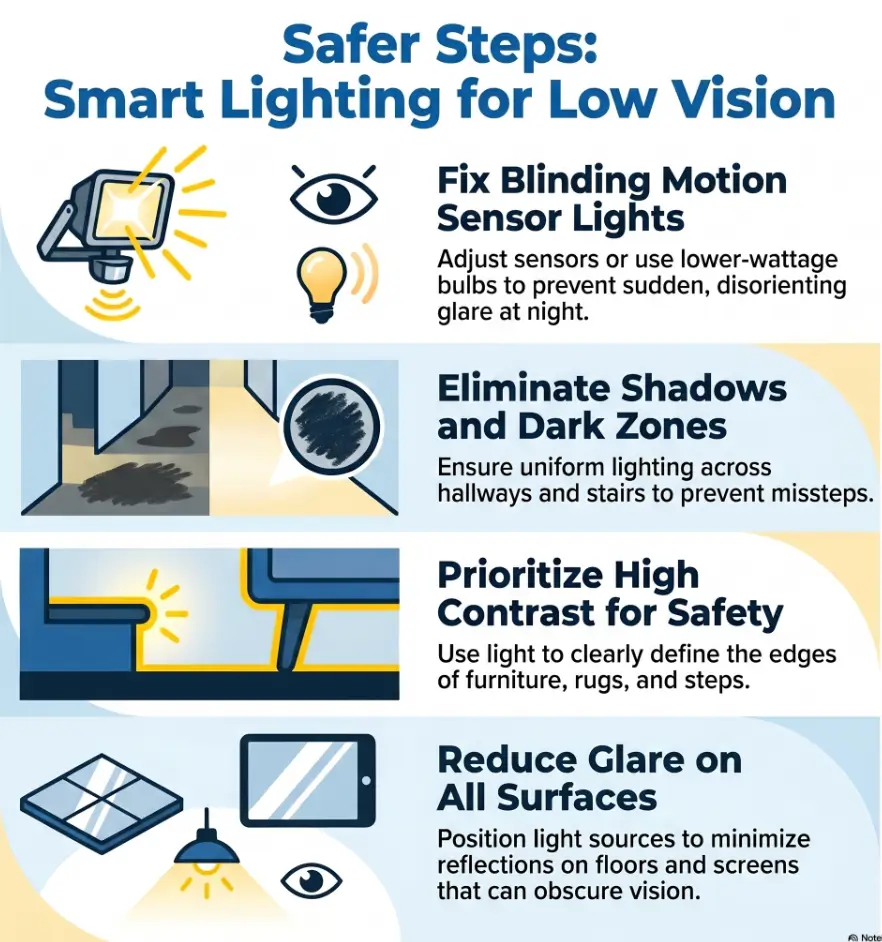
Don’t dim blindly: one wrong fix can trade glare for unsafe shadow
Why lowering output too far can create depth-perception problems
This is where good intentions can wander off the map. A user hates glare, swaps in a very low-output bulb, and suddenly the path looks comfortable but vague. That can be dangerous. Reduced glare is not automatically improved navigation.
CDC fall-prevention materials repeatedly emphasize the importance of safer home lighting and visibility in areas where people walk. The lesson is simple: your eyes need comfort, but your feet need information.
The hidden risk of soft light with poor edge definition on steps and thresholds
Steps, bathtub edges, hallway turns, and doorway lips need enough contrast to be recognized quickly. If a dimmer setup softens everything into one tonal soup, you may feel less pain and still have a worse outcome. That is why testing at the actual walking surface matters more than admiring the room from the doorway.
One homeowner described a new dim bulb as “finally peaceful,” then admitted they started touching walls to navigate. That is useful honesty. Comfort had improved, but function had not.
Let’s be honest: “less painful” is not always the same as “easier to navigate”
That sentence is worth keeping on a sticky note. For low vision, the right result is usually a compromise with elegance: low enough glare to keep the eyes open, bright enough structure to keep the body oriented.
Decision card: When A vs B
A. Lower bulb output first
Best when the source is clearly overpowering and surfaces are matte. Usually lower cost and faster.
B. Keep output but change angle or add diffusion
Best when the path still needs light, but direct glare is the real problem. Often safer for steps and bathrooms.
Time/cost trade-off: Bulb swaps are fast. Angle and shielding often take a few more minutes but can preserve better navigation.
Neutral next step: choose the option that reduces direct eye exposure without hiding edges.
The angle problem: glare often starts where the fixture points, not how strong it is
Eye-level exposure is the enemy in hallways, porches, and bathrooms
A fixture aimed into the face will usually feel harsher than one aimed past the body toward the floor or side wall. This is why a small tilt change can outperform a bulb swap. It changes the geometry of discomfort.
In many homes, the fixture is not absurdly bright. It is just pointed like a gossip columnist, directly where it should not be.
How a small tilt change can do more than swapping the bulb
Try this before spending money: change the angle slightly downward, away from mirrors, away from eye-height approach lines, and toward the walking surface. Even a modest adjustment can reduce direct glare while keeping guidance where it belongs.
Outdoor motion lights often improve when aimed to wash steps rather than blast outward. Indoor sensor lights often improve when the source is offset so the person enters the lit zone before seeing the bright point source head-on.
Why reflective floors, mirrors, and pale walls can multiply brightness at night
Glossy tile, polished stone, mirror cabinets, white tubs, satin paint, and glass can all magnify perceived brightness. The bulb is only the first actor; the room is the chorus. If the room is reflective, a moderate bulb can behave like an overachiever with no social calibration.
Before changing the lamp, inspect the bounce. Sometimes a mirror angle, a matte accessory, or a small shield on the fixture solves more than a new product ever could. In especially reflective rooms, problems such as white tile floor glare or the choice between matte vs. glossy paint can quietly decide whether a “reasonable” bulb feels humane or hostile.
Warm light, soft cover, lower output: the trio that usually calms nighttime spaces fastest
Why cooler white light often feels harsher after dark
Many people find cooler color temperatures feel sharper and more clinical at night, especially in bathrooms and hallways. Warmer light often feels calmer because it reduces that crisp, icy edge that some LED fixtures produce. This is not universal, but it is common enough to be a strong first test.
When people say, “It feels too white,” they are usually giving useful data, not being dramatic.
How warmer color temperature changes comfort without always reducing function
A warmer bulb can preserve a usable amount of brightness while making the experience less abrasive. Combined with a frosted cover and a slightly lower output, it often creates a gentler nighttime path without plunging the room into murk.
That trio works because each part does a different job:
- Warmer color reduces harshness
- Soft cover reduces point-source glare
- Lower output reduces overload if the setup was simply excessive
Where this trio works best: bathrooms, entryways, bedrooms, and indoor paths
It is especially effective in indoor circulation zones where people are sleepy, barefoot, or visually adapting from darkness. Bathrooms are famous for this problem because mirrors and pale surfaces bounce light around with great enthusiasm and very little mercy. Bedrooms and hallways benefit because the goal is orientation, not task lighting. Entryways benefit if the route is short and the fixture is not the only safety light.
Short Story: A caregiver once described her father’s bathroom light as “technically useful, emotionally rude.” Every midnight trip began with a wince. They did not replace the whole fixture. They changed to a warmer bulb, added a soft cover, and nudged the angle away from the mirror. The room looked less dramatic, which was exactly the point.
He stopped pausing at the doorway, stopped squinting with one eye closed, and started moving through the space in one clean rhythm. Nothing about the setup was fancy. It was simply designed for a real human body at 2 a.m., not for a showroom photograph taken at noon. If you are deciding between bulb warmths, a comparison like 2700K vs. 3000K for glare-sensitive eyes can make that choice much less guessy.
- Warmth changes the feel of the light
- Diffusion changes the sharpness of the source
- Moderate output changes overload without collapsing visibility
Apply in 60 seconds: Write down your current bulb type and room finish so you can compare one warm, softer setup against the current one instead of guessing from memory.
Common mistakes that make motion sensor lighting harder on low vision
Using the brightest “security” bulb for a short indoor path
This is perhaps the most common mistake. A bulb chosen for driveways, garages, or backyard flood coverage gets installed in a short hall or bathroom. The result is visual overkill. Indoors, close range changes everything.
Adding diffusion without checking whether the sensor still works properly
Some modifications change how the sensor reads movement or how the light spreads into the trigger zone. That can create annoying non-performance: the light turns on late, misses slower walkers, or behaves like a moody theater technician. Always test after any change.
Fixing the bulb while ignoring glossy surfaces that throw light back into the eyes
If the room has shiny tile, bright counters, mirror doors, polished floors, or even pale walls with sheen, you can chase bulbs forever and still feel miserable. Surface reflection is often the multiplier.
Leaving the sensor delay too short, so the body keeps getting startled over and over
A short delay can be awful at night. The light shuts off, then snaps back on, then off again as the person shifts or returns. Repeated transition stress matters. Sometimes the kindest adjustment is simply giving the light more time to remain steady.
Quote-prep list: what to gather before comparing products
- Current bulb type and approximate brightness
- Whether the fixture has a cover, shield, or exposed source
- Room finishes: matte, mixed, or glossy
- Where the user stands when glare feels worst
- Whether the sensor delay feels too short
Neutral next step: gather these details before comparing bulbs, diffusers, or replacement fixtures.
Do not put the fix in the wrong place
When the bulb is fine but the fixture cover is the real culprit
A clear or cracked cover can turn an otherwise acceptable bulb into a sharp glare source. Replacing the cover may do more than replacing the lamp. This is one of those boring fixes that wins quietly. No dramatic unboxing. No heroic product story. Just better light.
When the light is acceptable but the trigger zone is too close to the face
If the light turns on only when you are already beneath it, your eyes get the full surprise at close range. Moving the trigger zone farther out, or using a setup that activates a little earlier, can make the same brightness feel much easier.
Why doorway placement can feel harsher than side-wall placement, even at similar brightness
Doorways funnel attention forward. A fixture placed directly in that line often feels harsher because it is encountered head-on. Side-wall placement can feel gentler because the eyes receive the light as environment rather than confrontation. The number on the box may be the same. The experience is not.
This is where lighting starts to feel like choreography. The body enters, turns, pauses, reaches. A good fixture supports that dance. A bad one stomps on your toes.
Room-by-room fixes work better than one-rule-for-everywhere lighting
Bathroom night lights need gentleness before they need punch
Bathrooms often have mirrors, white fixtures, tile, and hard surfaces that multiply brightness. A lower-output warm bulb, frosted cover, and off-mirror angle usually beats a brighter cool-white setup. If the bathroom includes a step, threshold, or narrow turn, keep enough floor cue to read that edge clearly. In many homes, the broader safety conversation overlaps with low-vision nighttime bathroom safety, not just bulb selection.
Hallway motion lights need floor guidance more than ceiling blast
Hallways work best when the floor path is readable. A shielded or side-aimed fixture that sends light downward can be more useful than a brighter overhead source. If the hallway walls are glossy or pale, reflectance control matters more than people think.
Porch and entry lights need enough spread to guide steps without creating a white wall effect
Entries are a balancing act. Too dim, and steps disappear. Too bright, and the door area becomes a white sheet. A wider, softer spread is usually better than a single hard beam. Outdoors, weather, step depth, and footwear add another layer, so test carefully. For older adults, that same logic sits inside the bigger project of aging-vision fall prevention at home.
| Tier | What changes | Best for |
|---|---|---|
| Tier 1 | Adjust angle or delay only | Users testing zero-cost fixes first |
| Tier 2 | Change bulb warmth or lower output | Harsh but basically functional fixtures |
| Tier 3 | Add cover, shield, or renter-safe diffusion | Point-source glare and reflection-heavy rooms |
| Tier 4 | Pair fixture change with room-surface adjustments | Bathrooms, glossy halls, or tricky entries |
| Tier 5 | Replace fixture or rethink placement entirely | Persistent discomfort or unsafe navigation |
Neutral next step: choose the lowest tier that directly addresses the real failure point.
Before you buy anything, test the setup like a person who is half-awake
How to check brightness transitions during actual night conditions
Do not test at noon and declare victory. Night is a different country. Test in the actual conditions that create the problem. Let the room go dark. Walk naturally. Do not “perform competence” for the test. Shuffle if you shuffle. Blink if you blink. Real life is the whole point.
A simple test: stand, turn, walk, and pause where glare hits hardest
Use a four-step check:
- Stand where the sensor first triggers
- Turn your head toward the path and then toward the source
- Walk the route at normal pace
- Pause at the mirror, threshold, step, or doorway where discomfort peaks
Ask three questions. Did I squint? Did I slow down? Did I lose floor detail? If yes, the setup still needs work.
Here’s what no one tells you: a setup that looks fine at installation can fail at 2 a.m.
This is the whole hook, now closed. Lighting judged by daytime installation logic often fails at human-hour reality. The user is sleepy, the pupils are adapted to dark, and the task is not “admire the fixture.” It is “reach the bathroom without feeling attacked by photons.”
That is why real testing beats product optimism. Every time. The same principle shows up in smaller personal-lighting choices too, such as learning how to make an iPhone flashlight less harsh when a quick light source feels painfully sharp.
- Test the route in darkness, not daylight
- Watch for squinting, stopping, and lost edges
- Judge comfort and navigation together
Apply in 60 seconds: Tonight, walk the route once without trying to “adjust” to the light and notice where your body hesitates.
FAQ
What lux level feels more comfortable for low-vision nighttime navigation?
There is no single perfect number for every person or room. A comfortable level is one that makes the floor, edges, and turns readable without forcing squinting or causing a stop-start reaction when the light switches on. For most homes, moderate, controlled illumination at the walking surface works better than high-output glare.
Is diffusion better than dimming for nighttime glare?
Often, yes, if the real problem is a sharp point source aimed toward the eyes. Diffusion softens the source. Dimming lowers total output. Many homes do best with a small amount of both rather than an extreme version of either.
Are warm bulbs better than daylight bulbs for motion sensor lights at night?
Many people find warmer bulbs feel calmer and less harsh after dark, especially in bathrooms, bedrooms, and hallways. That does not mean warm is always better outdoors or on long paths with steps, but it is a strong first test for indoor nighttime glare.
Can a motion sensor light be too dim for safety after adding a diffuser?
Absolutely. If the diffuser reduces edge definition or makes steps and thresholds harder to read, the setup may become less safe even if it feels nicer. Always test navigation after adding any cover or film.
Why does the light feel harsher in the bathroom than in the hallway?
Bathrooms often contain mirrors, glossy tile, pale fixtures, and hard surfaces that reflect light back into the eyes. The same bulb can feel much more aggressive there than in a matte hallway.
Does a frosted cover reduce glare without ruining motion detection?
It can, but you need to test. Some covers and add-ons affect how the sensor performs or how the light spreads into the trigger zone. Check whether activation still feels timely and reliable.
Should I change the bulb, the fixture angle, or the sensor setting first?
Start with the lowest-risk change that directly targets the problem. If the source is hitting the eyes, begin with angle. If the light is simply overpowering, test a lower-output or warmer bulb. If repeated on/off cycles are the annoyance, adjust delay first.
What is the safest fix for renters who cannot replace the fixture?
Renter-safe options often include temporary shields, approved removable diffusion solutions, adjusting nearby reflective surfaces, and adding a second, gentler path light that reduces dependence on the harsh fixture. Just make sure any temporary material is suitable for the fixture and heat conditions.
Next step: change one variable tonight, not five at once
Start with the easiest low-risk adjustment: angle, shielding, or lower-lux bulb
The smartest fixes are often embarrassingly modest. Tilt the fixture. Block direct eye-level glare. Try a warmer, lower-output bulb. Extend the sensor delay. Remove the bright bounce from a mirror or glossy surface. Small changes stack beautifully when they are pointed at the real problem.
Test the result on an actual nighttime walk path, not in daytime
That is your 15-minute action step. Change one variable. Walk the path in the dark. Repeat once. Keep notes simple: better, worse, or different. The goal is not to become a home-lighting philosopher, though there are worse fates. The goal is a safer route with less strain. For some homes, this is also a useful moment to compare the route against a broader home safety checklist for vision loss.
Keep the winner simple enough that everyone in the home can live with it
A good lighting setup should not require a family seminar. It should just work. The path should read clearly. The source should feel calmer. The room should stop behaving like a surprise exam at midnight.
If you take only one idea from this article, let it be this: the best nighttime motion light is not the brightest one. It is the one that helps a real person move safely without glare stealing the scene. The same design instinct shows up elsewhere in the home, from reading lamp position for central vision loss to quieter fixes for glare-free under-cabinet lighting.
Last reviewed: 2026-04.