


Reclaiming Your Space:
A Senior’s Guide to Prism Glasses
The first few hours in new prism glasses can make a familiar hallway feel quietly rearranged, as if the floor and doorframes held a private meeting without you.
For seniors adjusting to prism glasses for double vision, that “off” feeling is not just annoying. It can change how stairs, rugs, curbs, screens, and even a short walk to the bathroom feel underfoot. Guessing your way through adaptation can cost more than comfort—it can raise fall risk or blur the line between normal eyestrain and symptoms that deserve prompt medical care.
The Practical Method: Protect balance first, then build visual confidence.
- • Start boring
- • Move slowly
- • Respect stairs
- • Log your changes
Prism correction is not just about seeing one image. It is about helping the eyes, brain, and body trust the room again.
Table of Contents
Safety first: This article is general education, not medical advice. Prism strength, lens type, wear schedule, and driving guidance should come from an ophthalmologist, optometrist, neuro-ophthalmologist, or other qualified clinician.
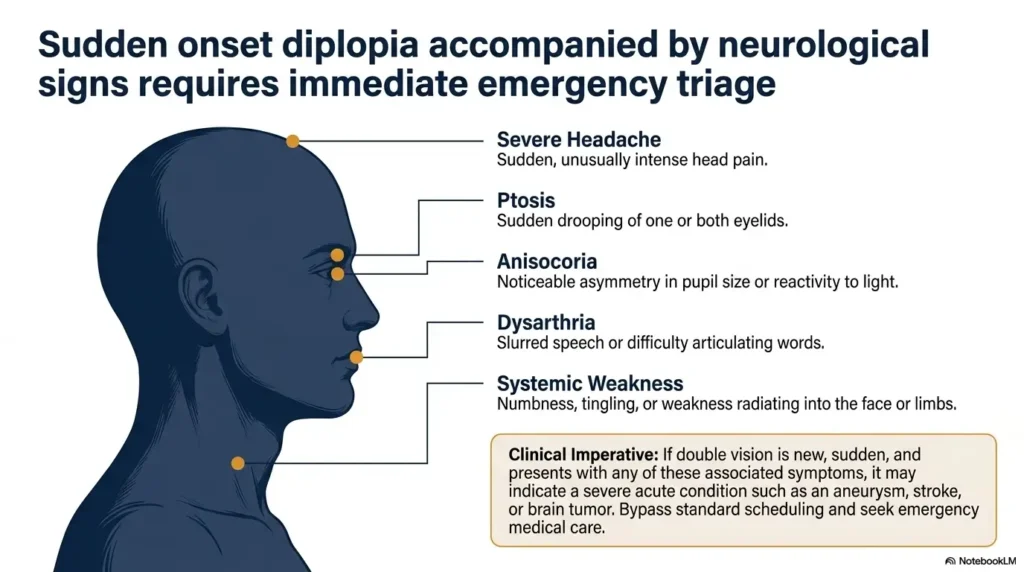
Sudden, painful, worsening, or unexplained double vision should not be treated as a normal glasses-adjustment problem, especially if it comes with headache, weakness, facial droop, confusion, trouble speaking, imbalance, eye pain, or vision loss.
Prism Glasses Feel Strange Because Your Brain Is Relearning the Room
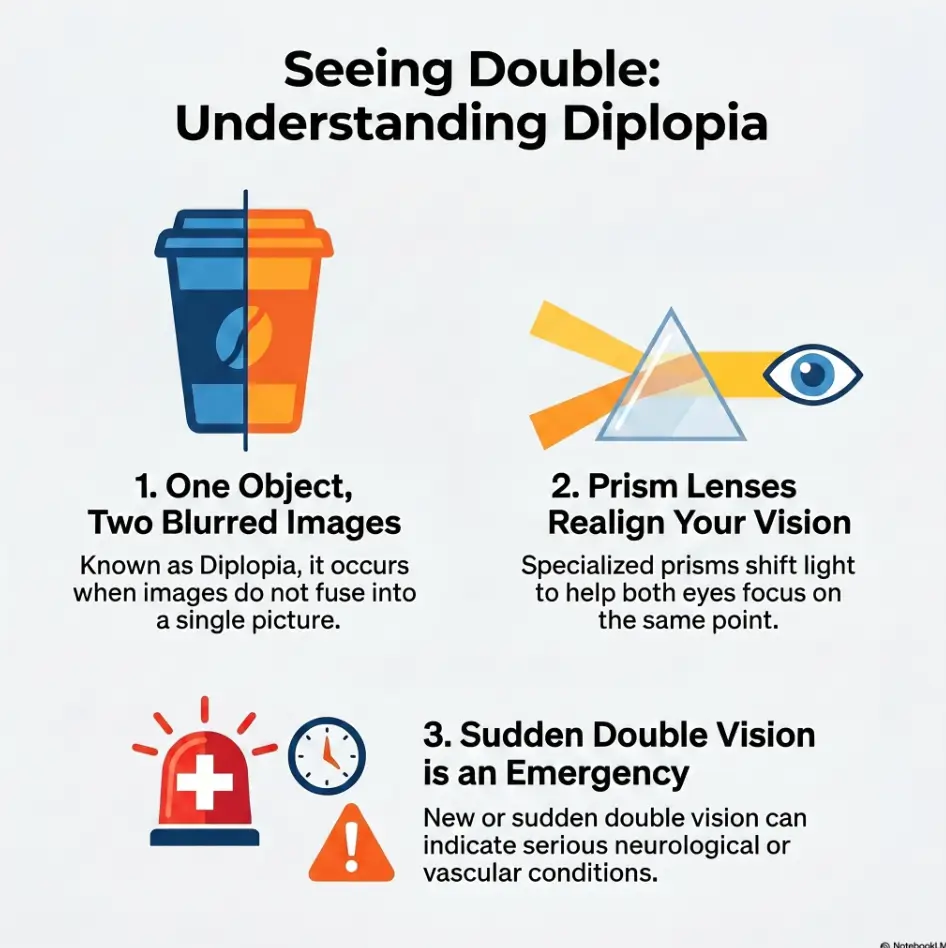
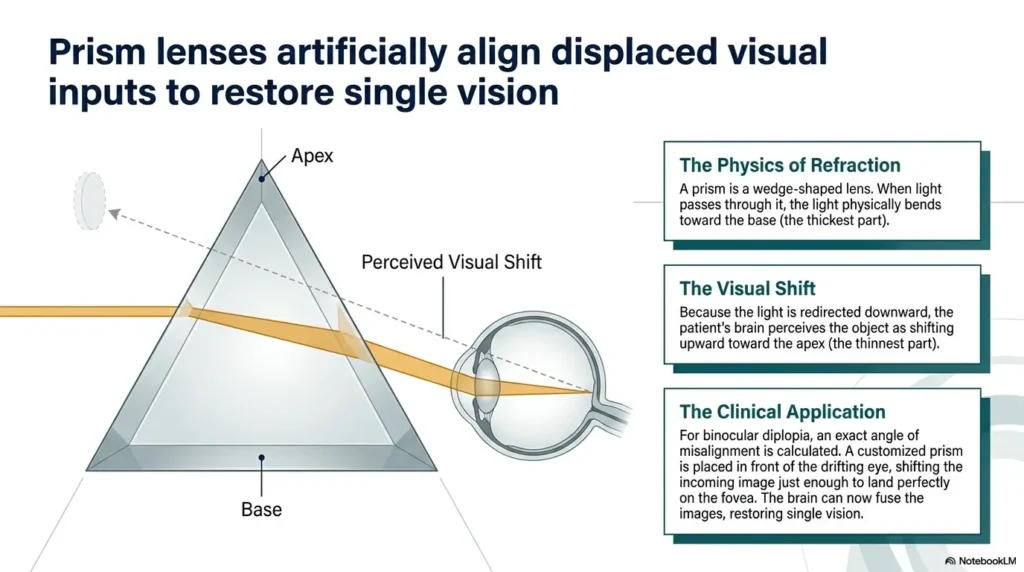
Prism glasses do not simply make the world sharper. They shift light so the brain has a better chance of combining two images into one. That is useful, but it can feel uncanny at first, especially for seniors who rely on small visual cues for balance.
I once watched an older neighbor try new prism glasses at her kitchen table. She looked at the mug, then the tile floor, then the doorway. “The room is behaving,” she said, “but I do not trust it yet.” That sentence is practically the whole adaptation period in miniature.
What prism lenses actually do to double images
When the eyes are not pointing in a perfectly coordinated way, the brain may receive two images of one object. Prism lenses bend incoming light before it reaches the eyes, helping those images land in a way the brain can fuse more comfortably. The American Academy of Ophthalmology explains prism correction as a lens feature used for some people with diplopia, the medical term for double vision.
That does not mean prism glasses cure every cause of double vision. They are a correction tool. The underlying cause still matters, which is why proper diagnosis comes before lens heroics.
Why straight lines, doorways, and floors may feel “shifted”
Door frames, floor seams, stair edges, and countertops are visual rulers. When prism changes how images are shifted, those rulers can feel slightly unfamiliar. The room has not moved. Your visual map is being recalibrated.
For a younger adult, this may feel like a mild visual oddity. For an older adult with arthritis, neuropathy, vestibular issues, low lighting, or slower reaction time, the same oddity can become a fall-risk whisper. If the home already has dim paths, glare, rugs, or nighttime bathroom hazards, a broader aging-vision fall prevention check at home can make prism adaptation feel less like a hallway audition.
Why seniors may notice balance changes before visual comfort
Balance is not just inner ear magic. It is a committee meeting between vision, joints, muscles, feet, and the nervous system. New prism glasses change one loud voice in that meeting. The rest of the body may need time to stop arguing.
- Floors may seem closer, farther, or slightly slanted.
- Turning the head may feel different than looking straight ahead.
- Steps may require more deliberate foot placement.
- Busy patterns may feel visually noisy.
The tiny adjustment nobody warns you about: your feet may distrust your eyes first
It is normal to want the glasses to prove themselves instantly. But adaptation is not a courtroom drama. It is more like tuning a piano in a room where someone is still vacuuming.
Early goal: do not ask, “Are these perfect?” Ask, “Can I move safely while my brain learns what this new visual map means?”
- Expect the room to feel slightly different at first.
- Take balance changes seriously.
- Do not test new lenses in risky places first.
Apply in 60 seconds: Put the glasses on while seated and look at three stable objects: a wall, a table edge, and the floor.
First-Day Rules: Make the House Boring on Purpose
The first day with prism glasses should not be a grand tour of stairs, sidewalks, grocery aisles, and glossy parking lots. Make the environment boring. Boring is underrated. Boring is the safety engineer wearing slippers.
The goal is to reduce visual surprises while your brain checks the new prescription against familiar objects. A quiet living room is kinder than a patterned rug, a barking dog, and a heroic decision to reorganize the pantry.
Start in one familiar room before testing the whole house
Choose one room where the senior knows the furniture layout well. A living room, bedroom, or kitchen table area can work. Sit down first. Look straight ahead, then gently look side to side. Do not begin with walking.
A simple first-day rhythm might look like this:
- 5 minutes seated with the glasses on.
- 2 minutes looking across the room.
- 2 minutes looking at a near object, such as a book.
- 1 slow stand near a stable surface.
Use bright, even lighting instead of dramatic lamp shadows
Shadows make floors ambiguous. Glare makes edges disappear. Soft, even lighting helps the brain compare the new visual input with the old room memory.
Turn on overhead lights if they are comfortable. Open blinds if daylight is not glaring. Avoid trying new glasses in a dim hallway at 9 p.m., when the carpet has become a philosophical question. If brightness itself becomes uncomfortable, adjust the room gently rather than flooding it; even a motion sensor light that is too bright can turn a safety upgrade into a glare trap.
Sit before judging whether the prescription feels wrong
Some early strangeness may settle after a short, calm trial. But severe symptoms should not be ignored. Sit first, observe, then decide. Standing while dizzy is not a diagnostic method. It is a tiny circus with bad insurance.
Let’s be honest: the hallway is not the place to “see how it goes”
Hallways are narrow, visually repetitive, and full of turning decisions. Save hallway practice for after seated looking and counter-supported standing feel manageable.
Infographic: The Safe First-Day Prism Path
🪑
1. Chair
Start seated. Let the room settle before standing.
💡
2. Light
Use even lighting. Avoid glare and shadowy floors.
🧍
3. Counter
Stand near support before walking freely.
🚪
4. Hallway
Walk only after seated and standing vision feel stable.
The 3-Zone Adaptation Plan: Chair, Counter, Hallway
A good adaptation plan should feel almost too simple. That is the point. Prism glasses are already giving the brain a new puzzle; the home routine should not add confetti cannons.
Use three zones: chair, counter, hallway. Each zone asks a little more of the eyes and body.
Zone 1: seated tasks for early visual confidence
Start with seated activities where a fall is unlikely. Read a large-print page. Look at the television. Study a clock across the room. Look down at your shoes without bending sharply.
Try 10 to 15 minutes if the clinician has not given a different wear schedule. Stop sooner if symptoms become intense, especially if dizziness, nausea, headache, or double vision worsens quickly.
Zone 2: kitchen counter practice for near-distance switching
The counter is useful because it gives support while the eyes switch between near and far tasks. Look at a cup, then a cabinet handle, then the floor line near your feet. Slow is elegant here. Fast is just panic wearing cologne.
Keep one hand lightly near the counter. Do not grip unless needed. The point is confidence, not white-knuckle furniture worship.
Zone 3: hallway walking only after the room stops swimming
When seated and counter-supported vision feel tolerable, try a short hallway walk. Use shoes or slippers with secure soles. Avoid socks-only walking, especially on smooth floors.
Walk 10 to 15 steps, turn slowly, and return. If the hallway seems to shift when turning, note it. That detail may help the eye doctor fine-tune the prescription or wearing instructions. For a practical companion to this step, review low-vision walking guidance before turning hallways, curbs, and store aisles into full-body experiments.
Why this stepwise approach protects confidence and hips
Older adults often lose confidence after one scary near-fall. A staged plan prevents the first prism-glasses story from becoming “I almost went down by the laundry basket.” Confidence is not a mood. It is evidence gathered safely.
Eligibility checklist: Are you ready to move to the next zone?
- Yes/No: Can you sit with the glasses on for 10 minutes without worsening symptoms?
- Yes/No: Can you look from near to far without strong nausea?
- Yes/No: Can you stand near a counter without feeling pulled sideways?
- Yes/No: Is the floor clear of rugs, cords, and clutter?
Neutral action: If any answer is “No,” stay in the easier zone and call the prescribing office if symptoms are severe or worsening.
Don’t Drive Yet: The Mistake That Turns “Almost Okay” Into Risk
Driving asks vision to do several jobs at once: depth judgment, speed tracking, lane position, mirror checks, glare handling, and peripheral awareness. New prism glasses may make the indoor world tolerable before the road is safe.
That difference matters. A hallway does not contain cyclists, headlights, construction cones, or a pickup truck drifting into your lane while your brain is still negotiating with the new lenses.
Why “clear enough” is not the same as road-safe
Clear enough to watch TV is not the same as safe enough to drive. Road vision is dynamic. Objects move. Distances change. Head turns matter. Side-view mirrors can feel different with prism correction.
Ask the prescribing clinician directly: “When should I drive with these glasses?” If the answer is “not yet,” treat that as protection, not punishment. Families weighing independence against risk may also want a wider senior driving safety conversation before the first post-prescription grocery run.
Depth perception, lane judgment, and side-view surprises
Depth perception can feel unusual during adaptation. Curbs, parking lines, garage edges, and lane markings may need more cautious interpretation. If stairs look strange indoors, parking lots are not the next logical classroom.
Ask your eye doctor what “safe to drive” means for your prescription
Different prism strengths, lens designs, diagnoses, and symptoms change the answer. Some people may be told to wear prism glasses full-time before driving. Others may need follow-up testing or a temporary driving pause.
The grocery run can wait; your peripheral vision cannot negotiate
There is a particular kind of optimism that says, “I’ll just drive two blocks.” That optimism has never met a poorly painted crosswalk in rain.
Decision card: Drive now vs. pause and test safely
| Choice | When it fits | Risk trade-off |
|---|---|---|
| Pause driving | New glasses, dizziness, shifted stairs, uncertain depth | Costs convenience; protects safety |
| Ask clinician | Symptoms improving but not fully stable | May require follow-up; gives clearer rules |
| Resume only when cleared | Vision stable, no concerning symptoms, clinician agrees | Best balance of independence and caution |
Neutral action: Write down your driving question before the appointment so it does not vanish under fluorescent-office amnesia.
Stairs, Rugs, and Curbs: The Adaptation Traps Seniors Should Respect
Stairs are where prism adaptation becomes practical. They demand accurate edge detection, depth judgment, balance, timing, and confidence. A senior who feels “mostly fine” in a chair may still feel uncertain on the second step.
Respect that. The staircase is not judging anyone. It is simply unforgiving.
Why stairs may look subtly taller, flatter, or shifted
Prism lenses can change how visual space feels while the brain adapts. A stair edge may look a touch different than expected. That small mismatch can make the foot hesitate, especially when descending.
Descending stairs is often harder than climbing because the eyes must judge where the next lower surface begins. Add bifocals, low lighting, or patterned carpet, and the brain has a crowded inbox.
Remove loose rugs during the adjustment window
Loose rugs are not charming during visual adaptation. They are tiny ambush carpets. Remove them temporarily, especially near the bed, bathroom, kitchen sink, and entryway.
Also check cords, pet toys, laundry baskets, and low stools. A clear floor is not a design aesthetic. It is a visual runway.
Use railings even when pride clears its throat
Use the railing every time during the adjustment window. Pride can file a complaint later. For now, hands are part of the safety system.
If there is no railing on a frequently used stairway, consider avoiding that route until vision feels stable or until a caregiver can assist.
Practice curbs with a companion before doing errands alone
Curbs combine outdoor glare, uneven surfaces, cars, distractions, and time pressure. Practice a curb with a companion before solo errands. Step slowly. Pause before stepping down. Look at the edge, then place the foot with intention. If a companion is helping, using a clear sighted guide assistance method can feel calmer than grabbing, steering, or guessing.
Headaches, Dizziness, and Nausea: What Is Normal, What Is Not
Mild visual discomfort can happen when adapting to new prism glasses. But “mild” is doing important work in that sentence. Symptoms that are severe, escalating, one-sided, sudden, or paired with neurologic changes deserve medical attention.
I have seen people try to be polite about symptoms, as if dizziness were a houseguest they did not want to offend. Please do not host dizziness past the point of safety.
Mild early discomfort versus symptoms that escalate
Early discomfort may include a strange sense of space, mild eyestrain, or brief dizziness when changing gaze. Concerning symptoms include severe headache, worsening double vision, vomiting, new weakness, confusion, trouble speaking, eye pain, vision loss, or a fall.
Mayo Clinic guidance treats sudden double vision and sudden vision changes as reasons to seek prompt medical help, especially when other neurologic symptoms appear. Mechanism matters: double vision can come from eye alignment issues, but it can also reflect neurologic, muscular, vascular, or systemic problems. For a broader family-friendly checklist, compare your symptoms with senior vision changes warning signs instead of quietly filing them under “probably nothing.”
When a prism prescription may need adjustment
Call the prescribing office if the glasses only work when the head is tilted, if double vision persists in the main gaze position, if symptoms worsen after repeated use, or if one lens seems physically misaligned.
Temporary Fresnel prisms may also feel visually different from ground-in prisms. They can reduce clarity slightly or create more visible lines, depending on the lens and prescription. That does not make them bad. It makes expectations important.
Why “pushing through” can backfire for older adults
Pushing through may cause fatigue, less careful walking, and more risk-taking. Older adults often pay for visual fatigue with balance errors later in the day. The body keeps receipts.
Here’s what no one tells you: tired eyes can make brave people careless
Visual fatigue can turn a sensible person into someone who steps over a cord “just this once.” That is the danger zone. When symptoms rise, simplify the environment and stop testing limits.
- Track headache, dizziness, nausea, and double vision changes.
- Report falls or near-falls promptly.
- Seek urgent help for sudden double vision with neurologic symptoms.
Apply in 60 seconds: Write today’s top symptom in one sentence: “When I look ___, I feel ___.”
- American Academy of Ophthalmology: What Is Prism Correction in Eyeglasses?
- Mayo Clinic: Eye Problems in Adults and When to Seek Medical Advice
- CDC STEADI: Older Adult Fall Prevention Resources for Patients and Caregivers
Wear Schedule Questions: Full-Time, Part-Time, or Task-Based?
The right wear schedule is not universal. Some seniors may be told to wear prism glasses full-time. Others may use them for specific tasks. The prescribing clinician’s instructions come first because the diagnosis, prism amount, and lens design matter.
Online advice gets twitchy here. Anyone promising one perfect schedule for every pair of prism glasses is selling certainty from a folding table.
Follow the prescribing clinician’s wearing instructions first
Ask exactly when to wear the glasses: reading, walking, TV, driving, computer, stairs, outdoors, or all waking hours. Also ask when not to wear them. That second question can be surprisingly useful.
Why switching between old glasses and prism glasses can confuse adaptation
Switching back and forth may make the brain compare two visual maps all day. Sometimes that is necessary. Sometimes it makes adaptation harder. Do not assume your old glasses are safer for stairs unless your clinician says so.
When temporary Fresnel prisms may feel different from ground-in prism lenses
Fresnel prisms are thin press-on prisms often used temporarily. They can be practical when the prescription may change, but they may look different than permanent ground-in prism lenses. Some people notice blur, glare, or visible lines.
Show me the nerdy details
Prism is measured in prism diopters. One prism diopter shifts an image by 1 centimeter at a distance of 1 meter. That does not mean patients need to calculate their own prescription; it simply explains why even small prism changes can feel noticeable in real-world space.
How to track wear time without turning life into a spreadsheet dungeon
Use a simple log for 3 to 7 days. Keep it human-sized:
- Time worn
- Task attempted
- Symptom level: mild, moderate, severe
- One visual note: shifted, clearer, doubled, dizzy, okay
If paper notes disappear into drawers, a printable symptom diary for seniors can turn scattered impressions into something your clinician can actually use.
Mini adaptation tracker
Use this tiny calculator to estimate how many safe indoor practice blocks you completed this week. It stores nothing.
Enter your numbers, then calculate.
Neutral action: Use the result to guide a conversation with your clinician, not to force longer wear time.
Reading, TV, and Phone Use: The Near-Vision Puzzle
Reading and walking are different visual jobs. A senior may read comfortably with prism glasses but feel strange walking. Or walking may improve while reading still feels tiring. That mismatch is frustrating, but it is not rare.
Near tasks ask the eyes to converge, focus, and hold steady. Walking asks the eyes to scan, judge space, and cooperate with balance. Same glasses, different orchestra.
Why reading may feel different from walking
Reading keeps the target close and fairly still. Walking forces constant updates. If near work feels hard, check whether the book, phone, or tablet is being held at a stable distance.
Do not test reading while slumped on a couch with the phone low in the lap. That posture makes the neck, eyes, and lenses form a small committee of complaints.
Hold screens steady before blaming the lenses
Use a tablet stand, larger text, and steady lighting. Keep the screen at a comfortable height. For phones, increase font size and brightness enough to reduce squinting without creating glare.
Use larger text and stable contrast during the first week
Large text lowers effort. High contrast helps the brain anchor shapes. A book with tiny gray type on cream paper may be aesthetically tasteful and visually rude. For longer reading sessions, the angle and shadow pattern matter too, so consider a safer reading lamp position before deciding the glasses are the only problem.
Avoid multitasking your eyes: no phone scrolling while walking
This is not just a prism-glasses rule. It is a life rule with better marketing. During adaptation, do not scroll while walking, climbing stairs, crossing parking lots, or entering bathrooms.
Simple rule: eyes on the task, feet on the floor, phone on pause.
Common Mistakes That Make Prism Glasses Harder to Adapt To
Most prism adaptation mistakes come from good intentions. People want to be independent. They want to know if the glasses work. They want to get back to normal. Unfortunately, “normal” sometimes tries to sprint before the visual system has tied its shoes.
Mistake 1: testing new prism glasses outdoors first
Outdoor light, curbs, uneven sidewalks, traffic, moving people, and reflections make a chaotic first test. Start indoors. If the glasses feel strange in a quiet room, they will not become magically simpler beside a curb cut.
Mistake 2: judging the prescription after five chaotic minutes
Five minutes in a loud room after rushing from the optical shop is not a fair trial. Try the glasses in a calm setting, unless symptoms are severe or clearly unsafe.
Mistake 3: wearing old glasses “just for stairs” without asking
Old glasses may feel familiar, but familiar does not always mean safer. Switching can confuse the brain, and the old pair may not address the double vision problem. Ask the clinician what to do for stairs.
Mistake 4: ignoring new imbalance, falls, or worsening double vision
A fall is not a footnote. A near-fall is not a silly little incident. Report them, especially during the first days of prism use.
Mistake 5: assuming all double vision is the same problem
Double vision can have many causes. Some are eye-related. Some are neurologic or systemic. Cleveland Clinic’s patient education on diplopia describes double vision as a symptom with multiple possible causes and treatments. That is why diagnosis matters more than guesswork.
- Do not start outdoors.
- Do not use stairs as the first test.
- Do not ignore worsening symptoms.
Apply in 60 seconds: Choose one safe indoor test route: chair to counter, counter to doorway, doorway back to chair.
Who This Is For, and Who It Is Not For
This guide is for seniors and caregivers navigating newly prescribed prism glasses after an eye-care evaluation. It is not for people trying to diagnose double vision at home or order prism readers online because a forum comment sounded confident.
Confidence online is cheap. Good prism correction is measured.
For seniors newly prescribed prism glasses for stable double vision
This article fits best when the double vision has been evaluated and the prism glasses were prescribed by a clinician. The adaptation tips can help make the first days safer and less bewildering.
For caregivers helping someone avoid falls during adaptation
Caregivers can help by clearing clutter, improving lighting, walking early stair tests, and asking specific questions. The best caregiver is not a hovering drone. The best caregiver is a quiet stagehand making the room safer.
Not for sudden, unexplained double vision that has not been evaluated
Sudden double vision deserves prompt medical evaluation. This is especially true when paired with headache, weakness, confusion, dizziness, speech trouble, eye pain, bulging eye, recent head injury, or vision loss.
Not for people trying to buy prism readers online without an exam
Prism is not just magnification. It changes image position. The wrong prism can worsen symptoms or hide a problem that needs care. Please do not let a shopping cart cosplay as an eye exam.
Before comparing optical shops or lens options, gather:
- Your written prescription, including prism amount and direction.
- Whether the prism is temporary Fresnel or ground-in.
- Your clinician’s wear schedule.
- Your main symptoms: headache, dizziness, nausea, blur, doubling, imbalance.
- Your must-do tasks: stairs, reading, TV, cooking, driving, computer use.
Neutral action: Bring this list to the optical shop or follow-up visit so the conversation stays practical. A simple doctor appointment note-taking system can also help caregivers capture the exact wearing instructions instead of relying on parking-lot memory.
When to Seek Help: The “Call, Don’t Guess” List
There is a difference between adaptation and warning signs. Adaptation usually improves with careful, clinician-directed use. Warning signs escalate, appear suddenly, or come with symptoms outside ordinary eye strain.
When in doubt, call. The phone is lighter than regret.
Call promptly if double vision worsens instead of improving
If the double vision grows worse, appears in new directions of gaze, or only clears when the head is held in one odd position, contact the prescribing office. The glasses may need adjustment, or the underlying condition may need reassessment.
Seek urgent care for sudden double vision with neurologic symptoms
Get urgent medical help for sudden double vision with weakness, facial droop, trouble speaking, confusion, severe headache, new imbalance, numbness, or dizziness. These symptoms can point beyond a glasses issue.
Report falls, near-falls, severe headache, eye pain, or new weakness
Falls and near-falls are useful clinical information. So are severe headache, eye pain, new weakness, nausea with visual symptoms, or sudden vision changes. Do not sand down the truth to sound cheerful.
Ask for reassessment if the glasses only work in one head position
If the glasses only help when the chin is tucked, head tilted, or eyes held in a narrow position, tell the clinician. That pattern can help identify whether the prism correction is working as intended.
Do not patch, tape, or modify lenses without clinician guidance
Covering one eye can sometimes reduce double vision temporarily, but patching changes depth perception and may not be safe for walking or driving. Do not tape, patch, bend frames, or modify lenses without guidance.
Caregiver Setup: Make Adaptation Safer Without Hovering
Caregivers have a delicate job. Too little help, and the senior may face avoidable risks. Too much help, and the room begins to feel supervised instead of safe. The sweet spot is quiet design.
Move the obstacle before giving the lecture. That advice works for rugs, cords, and most family conversations.
Walk the first stair test with them, not behind them
Stand nearby and slightly to the side, not looming behind like a nervous museum guard. Ask the senior to use the railing. Go slowly. Stop after one short trial if the steps look shifted or confidence drops.
Move clutter before giving advice
Clear the walkway from bed to bathroom, chair to kitchen, and entryway to car. Remove low baskets, cords, shoes, pet bowls, and decorative items that have become ankle-level riddles. The same principle applies at night: a safer low-vision bedside organization setup can reduce frantic reaching before the feet even touch the floor.
Ask better questions than “Are the glasses okay?”
“Are they okay?” invites a vague answer. Better questions reveal patterns:
- Did anything look shifted when you turned?
- Did the floor feel closer or farther away?
- Did stairs look strange going down?
- Did the double vision improve, worsen, or move?
- Did you feel dizzy after reading or walking?
Try this instead: “Did anything look shifted when you turned?”
Turning is often where visual uncertainty shows up. Ask about turns, floor edges, stair edges, and near-to-far switching. These details help the clinician more than a general “not great.” For family members who feel awkward stepping in, a guide to offering help to someone with low vision can keep support respectful instead of bossy.
- Clear the route first.
- Use specific symptom questions.
- Respect independence while protecting high-risk moments.
Apply in 60 seconds: Walk the bed-to-bathroom route and remove one trip hazard before the next prism-glasses practice block.
Next Step: Run a 10-Minute Home Vision Safety Check
This is the practical bridge between “these feel strange” and “I know what to report.” It takes about 10 minutes and should be done in a familiar room with good lighting.
Do not use this check to override medical advice. Use it to notice patterns safely.
Put on the prism glasses in a seated position
Sit in a stable chair with arms if possible. Put on the glasses. Look straight ahead. Breathe. Let the room introduce itself again, politely.
Look across the room, then at a book, then at the floor
Choose three points: far wall, near page, floor edge. Move slowly between them. Notice double vision, blur, dizziness, or shifted space.
Stand near a counter and take five slow steps
Stand near a counter or sturdy surface. Take five slow steps. Pause. Turn slowly. Return. If you feel pulled sideways, sit down and write it down.
Write down one symptom, one safe task, and one question for the eye doctor
Your note can be simple:
- Symptom: “The floor looked shifted when I turned left.”
- Safe task: “Reading at the table felt okay for 10 minutes.”
- Question: “Should I wear these on stairs or use another plan?”
FAQ
How long does it take seniors to adapt to prism glasses?
Some people feel better within days, while others need longer. The timeline depends on prism strength, diagnosis, lens type, age, balance, medication effects, and whether the double vision is stable. Ask the prescribing clinician what adaptation window is reasonable for your case.
Is dizziness normal with new prism glasses?
Mild early dizziness can happen, but severe, worsening, sudden, or persistent dizziness should be reported. Seek urgent help if dizziness appears with sudden double vision, weakness, confusion, severe headache, trouble speaking, or imbalance.
Can prism glasses make double vision worse at first?
They may feel strange at first, but they should not cause steadily worsening double vision. If double vision gets worse, appears in new gaze positions, or only improves with an odd head tilt, contact the eye-care office.
Should seniors wear prism glasses all day?
Follow the prescribing clinician’s schedule. Some people are told to wear them full-time, while others use them for certain tasks. Do not switch between old and new glasses for stairs, driving, or walking unless your clinician says that is safe.
Can you drive with new prism glasses?
Do not drive until your vision feels stable and your clinician says it is safe for your situation. Road vision requires depth judgment, mirror checks, peripheral awareness, and quick decisions. “Mostly okay indoors” is not the same as road-ready.
Why do stairs look strange with prism lenses?
Prism lenses shift visual input, and the brain may need time to recalibrate depth and edges. Stairs are especially demanding because they require precise foot placement. Use railings, good lighting, and caregiver support during early adaptation.
What should I do if prism glasses cause headaches?
Track when headaches happen, how severe they are, and whether they improve with rest. Mild eyestrain may occur early, but severe headache, worsening symptoms, eye pain, sudden double vision, or neurologic symptoms deserve prompt medical attention.
Are Fresnel prisms harder to adapt to than regular prism lenses?
Fresnel prisms can feel different because they are press-on lenses with visible lines and may slightly reduce clarity. They are often used temporarily when prism needs may change. Ask your clinician what visual trade-offs to expect.
Can prism glasses stop working over time?
They can feel less effective if the underlying eye alignment changes, the medical condition changes, the frame fit shifts, or the prescription is no longer appropriate. Worsening or changing double vision should be reassessed.
When is double vision an emergency?
Sudden double vision can be urgent, especially with severe headache, weakness, facial droop, confusion, trouble speaking, dizziness, imbalance, eye pain, bulging eye, vision loss, or recent head injury. In those situations, seek urgent medical care.
Conclusion
The odd first feeling in prism glasses is not imaginary. The room may look familiar but behave slightly new, and for seniors that can affect balance before confidence catches up.
The safest answer is not panic. It is pacing. Start seated. Make the room boring. Practice chair, counter, hallway. Treat stairs, rugs, curbs, and driving as serious tests, not casual errands. Most importantly, separate normal adjustment from warning signs.
Your next 15-minute step: do the 10-minute home vision safety check, write down one symptom and one question, then place that note beside the glasses or near the phone. If double vision is sudden, worsening, painful, or paired with neurologic symptoms, skip the home experiment and seek medical help.
Prism glasses are not just lenses. They are a new agreement between the eyes, the brain, and the floor. Give that agreement a calm room, good lighting, and enough respect to keep everyone upright.
Last reviewed: 2026-05.