

Educational only—not medical advice. Seek urgent care or an eye professional if you have new severe eye pain, light sensitivity, sudden vision changes, thick discharge, injury/chemical exposure, or symptoms after recent eye surgery.
Table of Contents

Preservative-free first: the senior-safe default
If your eyes are sensitive, the most useful words on the label are often the least exciting: preservative-free. Preservatives help multi-dose bottles stay safe on the shelf, but frequent exposure can irritate some eyes—especially older eyes that already have a thinner, more fragile tear film. The Mayo Clinic notes that preservative-free drops are generally recommended if you apply artificial tears more than four times a day, or if your dryness is moderate to severe. That’s not marketing. That’s a “your eyes deserve fewer irritants” decision.
I learned this the annoying way: I kept “upgrading brands” and still felt the sting. The problem wasn’t the logo. It was the add-ons and how often I was using them.
- Preserved drops can be fine for occasional use.
- Preservative-free (PF) is often the smarter default for frequent use or sensitive eyes.
- PF can come in single-use vials or preservative-free multi-dose bottles (special bottle designs to reduce contamination).
- Frequent use is where preservatives become a problem for many people.
- PF options reduce “mystery irritation” from additives.
- Packaging choice (vial vs PF bottle) is your next lever.
Apply in 60 seconds: Look for “preservative-free” first—then decide on vial vs multi-dose based on your hands.
- Do you use drops more than 4 times/day? → Yes = PF is strongly worth it.
- Do preserved drops cause burning/stinging? → Yes = PF is the safer bet.
- Are you post-op (especially if you’re choosing preservative-free tears after cataract surgery), on multiple eye meds, or have very sensitive eyes? → Often PF-first (confirm with your clinician).
Neutral next action: If you answered “yes” to any, shop PF first—then choose packaging that matches your dexterity.

What “PF” actually protects you from (and what it doesn’t)
PF reduces exposure to preservatives that can irritate the ocular surface over time, especially with frequent dosing. It does not guarantee “no stinging,” and it doesn’t treat every cause of dry eye (like clogged oil glands). Think of PF as removing one common “irritation tax” so you can judge what’s left.
The “4+ times/day” line—rule, myth, or safety fence?
It’s a practical fence, not a moral law. Multiple reputable medical sources use the “more than four times a day” threshold as a reasonable point to consider preservative-free. If you’re dosing that often, you’re basically telling the truth about your symptoms: your eyes need frequent support. PF reduces the chance the preservative becomes part of the problem.
Quick label scan: words that signal sensitive-eye friendly
- Preservative-free (or “PF”) clearly stated
- Lubricant eye drops / artificial tears (not “redness relief”)
- “For dry eye” / “lubricating” (avoid vasoconstrictor-only products)

Single-use vs multi-dose: hygiene vs handling vs cost
This is where seniors win or lose the battle—not because they’re doing anything wrong, but because hands change. Arthritis. Tremor. Reduced grip strength. A multi-dose bottle might be “cheaper,” but if the tip touches lashes or skin (which happens more than anyone admits), the contamination risk climbs. Single-use vials are the cleanest from a hygiene standpoint because you open, use, and discard.
Also: life isn’t a lab. I’ve watched a loved one “aim” perfectly… then reflex-blink and tap the tip on the eyelid. Nobody’s fault. It’s physics and reflexes.
Contamination risk in plain English (tip touches, caps, counters)
- Single-use vials: lowest contamination risk, because you don’t store an opened container.
- PF multi-dose bottles: designed to reduce contamination, but still depends on handling (tip hygiene matters).
- Standard preserved bottles: preservatives help resist bacteria, but frequent use can irritate sensitive eyes.
Cost-per-day math that doesn’t lie (30 seconds)
Here’s the part that surprises people: “cheaper per bottle” can be more expensive per day if it’s hard to use, you miss the eye, or you over-squeeze. Seniors often waste drops simply because the bottle fights back.
Enter what you see on the shelf. This doesn’t store anything; it just does the math.
Estimated cost/day: —
<div style="flex:1;min-width:260px;border:1px solid #f1f5f9;border-radius:10px;padding:.8rem;">
  <b>Option B (PF multi-dose bottle)</b>
  <div style="margin-top:.5rem;">
    <label>Price per bottle ($)
      <input id="b_price" type="number" inputmode="decimal" style="width:100%;padding:.5rem;margin-top:.25rem;">
    </label>
  </div>
  <div style="margin-top:.5rem;">
    <label>Total doses in bottle (count)
      <input id="b_doses" type="number" inputmode="numeric" style="width:100%;padding:.5rem;margin-top:.25rem;">
    </label>
  </div>
  <div style="margin-top:.5rem;">
    <label>Doses you use per day (count)
      <input id="b_perday" type="number" inputmode="numeric" style="width:100%;padding:.5rem;margin-top:.25rem;">
    </label>
  </div>
  <p id="b_out" style="margin:.75rem 0 0 0;"><b>Estimated cost/day:</b> —</p>
</div>Neutral next action: If the “cheaper” option costs more per day in your real use, switch formats without guilt.
Real talk: “easy-open” caps are a senior accessibility issue
Here’s what no one wants to admit at the pharmacy: packaging designers are not living in arthritic hands. If opening the vial hurts, it becomes a barrier—and barriers get ignored. If you’re a caregiver, the most “effective” drop is the one that can be used consistently without a wrestling match.
Quick handling tip: If grip is limited, look for PF multi-dose bottles with easier ergonomics—or ask a pharmacist about assistive “bottle squeezers.” It’s not fancy. It’s functional.
My dad used to treat eye drops like a last resort—something you do when you’re already frustrated. He’d squeeze the bottle, miss the eye, blink hard, and then squeeze again. By the time the drop actually landed, he was mad at the drop, mad at his hands, and quietly mad at his eyes for needing help.
One afternoon, I put a few preservative-free single-use vials in a small dish by his favorite chair. No “new routine,” no lecture. Just… there. The first night he tried one, he said, “This is cleaner.” What he meant was, “This is easier.” He could open it once, use it, and stop thinking about it. The biggest change wasn’t comfort—it was the moment he stopped feeling like he was failing a simple task. That’s what good packaging does: it returns dignity along with relief.
Sensitive eyes sting: why “gentle” drops still burn
Let’s clear a common panic: a preservative-free label doesn’t promise zero sensation. Sensitive eyes can sting because of tear chemistry (pH/tonicity), surface inflammation, or tiny abrasions that make “normal” solutions feel sharp. The American Academy of Ophthalmology explains that preservative-free drops can lower toxicity risk, and also notes that thinner liquid drops tend to blur less—good for daytime use. But “PF” doesn’t automatically mean “perfect match.”
I once tried a highly rated PF drop and felt an instant “nope.” Two minutes later, it was fine—but my first impression nearly sent the bottle to the trash. That first 10 seconds matters, but it’s not the whole story.
pH, tonicity, thickness: the 3 levers that change feel
- Tonicity: If your eye surface is irritated, certain solutions can feel sharper.
- Viscosity (thickness): Thicker drops may soothe longer but blur more.
- Surface inflammation: If the surface is already inflamed, almost anything can sting at first.
Show me the nerdy details
Your tear film is not just “water.” It’s a layered system (oil + aqueous + mucin). Drops change lubrication, surface friction, and how evenly the tear film spreads. That’s why two PF products can feel wildly different—one may spread smoothly while another “beads” and triggers reflex blinking. Sensation isn’t just preference; it’s often physics plus surface health.
The 10-second clue your eyes give you (and how to interpret it)
- Quick sting that fades in under a minute: may be surface dryness catching up; try again later and track it.
- Burning that builds or lasts: consider switching formulations/format, and don’t brute-force it.
- One eye reacts much worse than the other: treat that as a clue—sometimes it’s not “just dry eye.”
When burning is a red flag, not a “normal adjustment”
If burning comes with severe pain, notable light sensitivity, marked redness in one eye, thick discharge, or sudden vision changes, don’t play the “maybe it’ll settle down” game. Dry eye is common—yet eye emergencies exist, and they’re not polite about timing.
Dry eye isn’t one thing: match the drop to the pattern
Most people shop as if dry eye is a single condition. It isn’t. The National Eye Institute describes dry eye symptoms like burning, scratchiness, blurry vision, and redness, and notes diagnosis involves evaluating tear quantity and quality. Translation: there are different “patterns,” and the right OTC drop supports the pattern you likely have.
My simplest advice: don’t ask, “What’s the best drop?” Ask, “What’s my pattern?” That question saves money and frustration.
- Evaporative patterns often need better oil-layer support (and lid care).
- Aqueous-deficient patterns often need frequent lubrication (PF helps here).
- Screen patterns need consistency more than intensity.
Apply in 60 seconds: Choose one “pattern” below and shop one product format that matches it.
Evaporative/MGD pattern: when lipid support matters
If your eyes feel worse in wind, heating/AC, or late in the day, and your lids feel “gritty,” you may be losing tears to evaporation. Some drops are designed to support the oil layer; but don’t ignore the boring basics—warm compresses and lid hygiene are often the real MVPs here. (If you do nothing else, do those for 5 minutes daily.)
Aqueous-deficient pattern: when you need “water layer” support
If your eyes feel dry soon after waking, or you constantly need drops just to function, you may simply be short on tear volume. PF options shine here because frequent use is common—and frequent use is where preservatives can become a recurring irritant.
Screen pattern: blink-rate dryness and “midday crash”
Long screen time lowers blink rate. Seniors who read on tablets, use phones, or watch TV for hours can get a “midday crash” where eyes go from fine to furious. For this pattern, schedule beats heroics: drops at predictable times work better than emergency splashes.

Day vs night: when gels and ointments earn their place
Not all “stronger” products are better. They’re different tools. In the daytime, you want comfort without fog. At night, blur is less of a problem—so thicker gels or ointments can protect longer. The trick is to use the right thickness at the right time, instead of suffering through blur at 2 p.m. because you wanted “maximum relief.”
I once tried a nighttime-style product in the middle of a workday and spent 40 minutes feeling like I was viewing life through a steamed-up bathroom mirror. Lesson learned. Time and context matter.
Daytime drops: comfort without foggy vision
- Choose thinner lubricating drops for daytime tasks (driving, reading labels).
- If blur is a dealbreaker, avoid heavy ointments until bedtime.
Nighttime protection: gel vs ointment (and who should avoid each)
- Gel drops: thicker than tears, often a good “middle ground.”
- Ointments: thickest, longest lasting, most blurring—best for bedtime.
Let’s be honest… blur at bedtime can be a feature, not a bug
If you’re going to sleep, blur is irrelevant. Comfort is the goal. Many seniors do better with a bedtime routine: lid hygiene + a thicker product, then lighter drops in the morning.
Who this is for / not for: a quick eligibility filter
This guide is for time-poor people who want safe relief without trial-and-error chaos. But OTC choices have limits. A quick filter can save you from “self-treating” something that needs real evaluation.
Best fit: sensitive eyes, frequent users, medication dryness, older tear film changes
- You want OTC drops for daily comfort (especially with frequent use).
- You’ve noticed stinging with preserved drops.
- You’re managing age-related dryness, screen dryness, or medication-related dryness.
Not a fit: “something else is going on” symptom patterns
- Sudden, severe pain or light sensitivity
- Sudden vision change
- Thick discharge, significant swelling, or injury/chemical exposure
- New symptoms after eye surgery (call your surgeon/clinic)
Caregiver lens: what to buy when the story is fuzzy
If you’re buying for a parent who can’t clearly describe symptoms, favor the safest default: preservative-free and packaging they can actually manage. Then track two things for a week: “stings or not?” and “how often do you reach for it?” That data is gold at an appointment.
Common mistakes: the comfort-killers seniors repeat
Dry eye makes people do desperate things. I get it. When your eyes feel like sandpaper, you’ll try anything with a soothing promise. But a few common habits quietly backfire—and they’re especially common when you’re rushing, tired, or your hands aren’t cooperating.
Mistake #1: using “get the red out” drops as dry-eye treatment
Redness-relief drops often work by constricting blood vessels. They can make eyes look whiter temporarily, but they don’t address dryness and can worsen irritation for some people—especially with repeated use. If the label screams “redness relief” but whispers “lubrication,” pause.
Mistake #2: touching the bottle tip (and why it keeps happening)
It happens because eyes blink. Lids move. Hands shake. The fix isn’t shame; it’s strategy: stabilize the hand on the cheekbone, look up, and aim for the lower lid pocket. If that still feels hard, single-use vials can reduce the “stored-open” risk, and PF bottle designs can reduce contamination risk when used properly.
Mistake #3: swapping brands instead of swapping format (PF, vial, gel)
People often try five brands of the same format and stay miserable. Format matters more than logo: preservative-free vs preserved, single-use vs multi-dose, thin vs gel/ointment. Change one variable at a time so you learn something.
- You use drops frequently (often >4/day).
- Your hands shake or you tend to touch the tip.
- You travel or want the cleanest option.
Trade-off: more packaging; opening can be harder.
- You want convenience and fewer tiny pieces.
- You can keep the tip clean and capped.
- You want better cost-per-day (often).
Trade-off: handling matters more; tip hygiene is key.
Neutral next action: Pick one lane for 7 days before you judge results.
Don’t re-cap like this: single-use vial safety in real life
Single-use vials look wasteful until you understand what they buy: a clean start each time. The risky behavior isn’t “using vials.” It’s the totally human temptation to re-cap and reuse them across the day like they’re a tiny bottle. Sometimes people do this to save money; sometimes because they hate waste; sometimes because they forgot where they put the open vial. The point is not judgment. The point is reducing infection risk.
I’ve done the “cap on the counter” move. Once. Then I watched a pet tail sweep the counter like a feather duster and never did it again.
What’s risky: purse lint, bathroom humidity, “cap on the counter”
- Putting the open vial in a pocket or bag
- Leaving it uncapped on a counter
- Touching the tip and then “saving it for later”
What’s reasonable: if you must, the least-bad method (timing + storage)
Follow the product instructions first. If you’re ever unsure, treat “single-use” literally. If you’re tempted to reuse a vial, the least-bad approach is: keep it capped, store it cleanly, and keep the time short. If the tip touched anything, discard. Sensitive eyes usually do better with fewer gambles.
Travel playbook: flights, heat, and why cars are drop graveyards
- Airplanes: low humidity can spike symptoms—plan PF dosing (and if you’re packing other meds, use a TSA carry-on checklist for glaucoma and eye drops so you don’t get stuck without them).
- Hot cars: heat can degrade products faster than you think.
- Easy win: keep vials in a small clean case, not loose in a purse.
When to seek help: the “don’t wait” symptom list
Dry eye is common—especially with age. But not every “dry eye feeling” is harmless dryness. A short red-flag list keeps you from treating a problem that needs actual evaluation. MedlinePlus notes dry eye becomes more common with older age and can be related to changes in tear production and tear film quality. That’s the common track. This section is about the uncommon, urgent track—and about the moments when it’s not just getting older: signs that point to more serious eye disease.
- Severe pain and light sensitivity deserve prompt evaluation.
- Thick discharge or swollen lids can signal infection.
- Post-surgery symptoms should be discussed with your surgical team.
Apply in 60 seconds: If you’re hesitating, call—don’t “wait one more day.”
Same-day: severe pain, light sensitivity, sudden vision change
These are not “normal dryness.” Seek urgent evaluation.
Within 24–48 hours: discharge, swollen lid, worsening one-eye redness
If symptoms are escalating or clearly one-sided, don’t keep layering OTC drops and hoping. Get checked.
Post-surgery or glaucoma meds: ask before changing routines
If you’ve had cataract surgery or are using glaucoma drops, spacing and compatibility matter. An eye professional can tell you the safest timing and what to avoid for your specific regimen—especially if you’re due for how often seniors should get dilated eye exams based on your risk factors.
Next step: run a 7-day “comfort trial” (one change at a time)
If you want a confident answer without buying the entire shelf, do this: a short, disciplined trial. Seven days is long enough to notice pattern changes, and short enough to stay realistic. This is also the caregiver’s secret weapon—because “it feels better” becomes trackable.
The 3 fields to track: frequency, sting, blur film
- How many times per day you reach for drops
- Whether the first 10 seconds sting (yes/no)
- Whether vision gets filmy or blurry (and for how long)
- Any eye meds you’re using (for example, glaucoma eye drop side effects in seniors can change how people describe “burning”), plus allergy drops, etc.
- Hand constraints: arthritis, tremor, weak grip (yes/no)
- If you wear contacts, note that too—especially if you’re juggling glaucoma drops with contact lenses.
Neutral next action: Bring this list (or a phone note) to your next appointment or pharmacist consult—ideally alongside an annual eye exam checklist for seniors so nothing important gets missed.
Switch format first (PF single-use ↔ PF multi-dose) before switching “brands”
This is the move that saves time and money. If preserved drops sting, go PF. If PF multi-dose feels hard to use cleanly, try vials. If daytime blur is the main complaint, go thinner. One variable at a time. Your future self will thank you.
Bring the tracker to your next eye visit for faster, clearer guidance
Clinicians love patterns. A 7-day tracker turns “I think it’s worse” into “It spikes at 3 p.m., I’m using drops 6 times/day, and it stings for 30 seconds.” That’s actionable—especially if you use a printable symptom diary for seniors so your notes stay consistent.
FAQ
Q: Are preservative-free eye drops safer for long-term use in seniors?
A: Often, yes—especially if you use drops frequently or your eyes are sensitive. Multiple reputable medical sources note PF drops are generally recommended when artificial tears are used more than four times per day, because preservatives can irritate with frequent exposure.
Q: Single-use vials vs PF multi-dose bottles—what’s more hygienic?
A: Single-use vials are typically the cleanest because you don’t store an opened container. PF multi-dose bottles can also be safe when used correctly, but handling and tip hygiene matter more.
Q: How many times a day can I use preservative-free artificial tears?
A: Many people can use PF tears more frequently than preserved drops, but follow the product label and your clinician’s guidance—especially if you’re using other eye medications or have recent surgery.
Q: Why do my eyes water if they’re “dry”?
A: Watery eyes can be reflex tearing—your eyes overreacting to dryness or irritation. It can feel like “too many tears,” but the tear film may still be poor quality or unstable.
Q: Can I use artificial tears with glaucoma drops—how far apart should I space them?
A: Spacing helps each drop work properly and reduces washout. Many clinicians recommend separating different eye drops by several minutes. Because regimens vary (including common prostaglandin drops—see latanoprost vs bimatoprost), confirm timing with your eye professional.
Q: What’s easiest for arthritis hands: vials or bottles?
A: It depends. Vials can be hygienic but harder to open. PF multi-dose bottles can be more convenient but require steady handling. If opening is painful, prioritize the format you can use consistently and safely.
Q: Are gel drops better at night for seniors?
A: Often, yes—gels and ointments last longer but blur more. Nighttime is the right place for thicker options because blur is less disruptive.
Q: When should OTC drops not be used?
A: Don’t rely on OTC drops alone if you have severe pain, light sensitivity, sudden vision changes, thick discharge, significant swelling, injury/chemical exposure, or concerning symptoms after eye surgery.
Wrap-up: your 15-minute next step
You came here for one thing: a safe, confidence-building choice. Here’s the simplest truth that closes the loop: for sensitive eyes, “best” usually means preservative-free—and then the real decision is single-use vs PF multi-dose based on hands, habits, and frequency. If you’re using drops often, PF is a sensible default. If handling is hard, choose the format you can actually use. Consistency beats perfection.
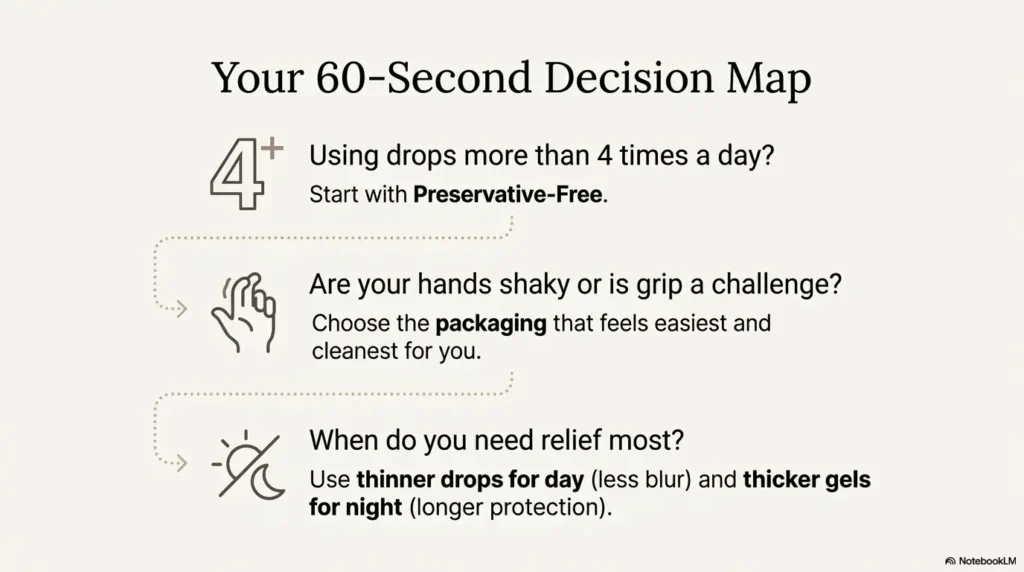
If you use drops often (commonly >4/day), go preservative-free first.
If opening/aiming is hard: choose packaging that matches your dexterity, not your pride.
Day = thinner (less blur). Night = thicker (longer protection).
Best use: Screenshot this and match it to your next purchase.
Your 15-minute next step: Pick one preservative-free format (single-use vials or PF multi-dose), run the 7-day comfort trial, and write down your “sting + blur + frequency” notes. That small record turns a confusing shelf into a clear plan.
💡 Read the American Academy of Ophthalmology guide to lubricant drops
Last reviewed: 2025-12-17