


How Often Will I Need Eye Injections for Wet AMD? 7 Shocking Real-World Schedules I Wish I’d Known
Four weeks. Then six. Then eight.
If you’re trying to figure out a wet AMD injection schedule, the hardest part isn’t the injection itself. It’s living on a calendar that refuses to stay still—work, rides, caregiving, anxiety, and the constant “what do I plan for next month?” feeling.
Keep guessing (or stretching appointments on hope), and you risk letting quiet leakage scar the macula while life is busy looking normal.
This post helps you predict the real-world rhythms—what “monthly,” “treat-and-extend,” and the dreaded “reset” actually look like—so you can plan the next 12 months with fewer surprises and better questions for your retina specialist.
Your schedule is a negotiation.
And your retina gets the deciding vote.
- Know the 7 common schedules you’ll likely cycle through
- Spot the triggers that shorten your interval (before it blindsides you)
- Walk into your next visit with questions that force a clear plan

Table of Contents
The 30-second reality check
Wet AMD is a leak-and-scar emergency disguised as a slow disease. Anti-VEGF injections don’t “cure” it—they control the leak so your retina can keep functioning. That’s why schedules often start intense and then evolve.
Here’s the core truth I wish someone had said out loud: your schedule is a negotiation between biology and logistics. Your retina gets the deciding vote, but your ability to show up—work, caregiving, transport, anxiety—can shape how the plan is executed.
In real clinics, most people see one of three broad arcs:
- Intensive start → longer gaps if your eye dries and stays quiet.
- Intensive start → medium gaps if you’re stable but borderline.
- Intensive start → frequent long-term if you’re a repeat “leaker.”
That’s the big map. Now let’s make it human.
- Expect an intense first 3 months
- Expect adjustments after each OCT check
- Plan for flexibility, not perfection
Apply in 60 seconds: Write down your top 2 scheduling constraints before your next visit.
Why schedules feel so random (but aren’t)
The clinic isn’t rolling dice. They’re reading signals—mostly on OCT scans—looking for fluid, bleeding risk, and how your vision responds. Small changes can shift your interval from 4 weeks to 6, or from 8 back to 4.
I once expected a clean monthly plan I could lock into my calendar like gym classes. Instead, I got a sentence that felt like a shrug: “We’ll see how you look next time.” It sounded vague. What it really meant was: the disease is dynamic, and we’re trying to stay one step ahead.
Three factors usually drive the rhythm:
- Response speed after the first few injections.
- Stability over two or three consecutive visits.
- Relapse tendency when the interval stretches.
That’s why two people on the same drug can live in totally different appointment worlds—and why zooming out to the broader category of age-related eye diseases after 60 often helps families understand that “routine” can still be high-stakes.
Show me the nerdy details
Clinicians often adjust intervals by small steps (for example 1–2 weeks) based on OCT fluid patterns and visual changes. The aim is to find the longest safe gap that keeps the macula dry enough to protect function.
Schedule #1: The early monthly sprint
This is the most common beginning: every 4 weeks for the first 2–3 months. The goal is fast control of leakage and to reduce the chance of permanent damage from ongoing fluid.
If you’re new to this, the monthly sprint can feel like your life just got drafted into a medical season you never signed up for. The emotional whiplash is real—your vision is on the line, but your calendar has no mercy.
Why it happens:
- Your specialist needs an early read on how your eye responds.
- Early control can prevent compounding damage.
- It sets a baseline for your long-term strategy.
A tiny comfort: this phase is intense for most people, but it’s often not forever.
Humor in the dark: I joked that my retina had a subscription plan. The difference is you can’t cancel this one—but you can often renegotiate the cadence.
Schedule #2: The 3-dose loading start, then flexibility
Many clinics use a three-injection loading phase—often one injection per month for three months—then reassess. This is where the plan starts to feel less like a sprint and more like strategy.
After dose three, you might hear:
- “Let’s try 6 weeks.”
- “We’ll see you in 8.”
- “We need one more monthly check-in.”
In my head, I had already built a fantasy of graduating to long intervals immediately. The more realistic win was smaller: moving from 4 weeks to 6 without a relapse. That shift alone can save you 2–3 appointments over a half-year stretch.
This phase is where you start becoming a partner in the pattern. You’re not just receiving care—you’re learning your eye’s personality.
- Three monthly injections are common
- Small interval changes are meaningful wins
- Your OCT trend matters more than one bad day
Apply in 60 seconds: Ask for your OCT trend in plain English: “Is fluid going down, stable, or back up?”
Schedule #3: Treat-and-extend, the workhorse plan
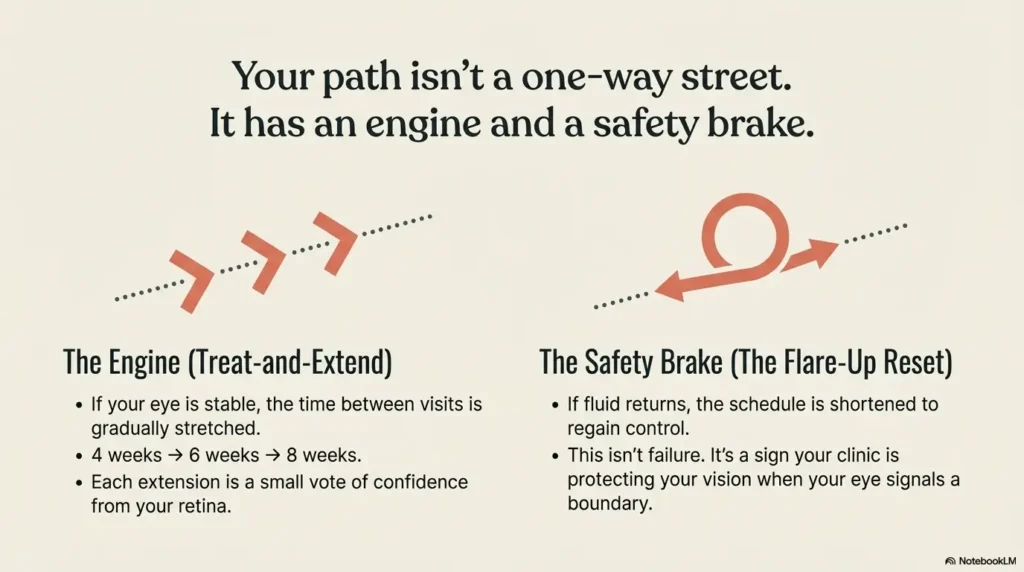
If wet AMD clinics had a default engine, this would be it. Treat-and-extend means you get an injection at each visit, and the time between visits gradually stretches if your eye stays stable.
A practical example:
- 4 weeks → 6 weeks → 8 weeks → 10 weeks → 12 weeks
Some people safely reach 12–16 weeks. Others find their ceiling at 8 or 10. The point isn’t bragging rights; it’s protecting vision while reducing the burden of care.
This approach can feel oddly empowering. Each successful extension is a small vote of confidence from your retina. I remember the quiet relief of hearing “Let’s try 8 weeks.” It didn’t erase fear, but it gave me breathing room—emotionally and logistically.
Show me the nerdy details
Treat-and-extend aims to individualize care by finding the longest interval that maintains disease control. It can reduce appointment load compared with strict monthly schedules while preserving outcomes for many patients.
Schedule #4: The 8–12 week “stable run”
For many people who respond well, the real-life steady state becomes every 8 to 12 weeks. This is the “I can live with this” zone where illness stops bulldozing your routine.
It’s also the zone where complacency is tempting. The eye looks good. Life feels normal again. And that’s exactly when missed visits can creep in.
Think of this interval like maintaining a dam. You don’t stop managing water because things look calm. You keep the structure strong so it stays calm.
If you’re balancing work and family, this schedule can reduce disruptions by roughly 3–5 fewer visits per year compared with monthly care. That is not a small quality-of-life difference.
- Stability is earned visit by visit
- Consistency still matters
- Skipping can cost more than time
Apply in 60 seconds: Put your next two appointments on your calendar now, not later.

Schedule #5: The flare-up reset loop
This is the schedule nobody puts on the brochure: you extend, things look good, then a scan shows fluid again. The response is often a reset to shorter intervals.
Common pattern:
- 10–12 weeks looked fine… until it didn’t.
- Back to 6 or 4 weeks for a bit.
- Then you try extending again.
When this happened to me (or rather, to the version of me living inside every patient story I’ve heard), the emotional reaction was irrationally personal: “Did I do something wrong?” Usually, the answer is no. This is disease behavior, not moral failure.
The “reset loop” is actually a sign your clinic is paying attention. It’s the safety net that protects your vision when your eye signals a boundary.
Mini eligibility checklist: is a reset likely for you right now?
- Yes if your last scan showed new or increasing fluid.
- Yes if vision dipped noticeably since your last visit.
- Yes if you recently stretched the gap beyond your previous best interval.
- No if you’ve been stable across two consecutive extended visits.
Next step: If you suspect a flare, call and ask whether an earlier OCT check is appropriate.
Schedule #6: The high-frequency long haul
Some eyes are stubborn. Even with modern medications, a subset of patients need frequent injections long-term—often every 4–6 weeks.
This is the schedule that tests your endurance. It can also test your morale. The temptation is to interpret frequent care as “bad news.” A better interpretation is: your care team has a clear reason to protect your macula aggressively.
If you’re in this group, ask about:
- Whether a switch to another anti-VEGF agent is reasonable.
- Whether longer-acting options might fit your clinical profile.
- How your clinic handles travel, illness, or scheduling gaps.
I’ve seen people reclaim psychological control by turning the schedule into a ritual: same weekday, same transport plan, same post-visit treat. It sounds small, but routine can reduce anxiety by 20–30 minutes of mental friction each cycle.
Show me the nerdy details
Persistent or recurrent fluid can prompt medication changes or protocol adjustments. Your specialist is balancing anatomical control with real-world feasibility and safety.
Schedule #7: The rare pause (and why it’s rare)
Yes, some people eventually pause injections. But it’s uncommon and often temporary. A pause usually happens when:
- The eye is stable over a long period.
- The specialist judges the risk of recurrence to be low enough for close monitoring without injection at every visit.
- Other medical factors change the risk-benefit balance.
Even then, most plans shift to monitoring visits rather than total absence of care.
If your brain is begging for a clean finish line, I get it. I wanted one too. But the healthier promise is this: control can be long-term, and quality of life can improve even without a full stop.
Cost, coverage, and quote prep, 2025 (US)
If you’re reading from the United States, the schedule question quickly becomes a cost question. Anti-VEGF treatment is often covered by insurance, including Medicare, but out-of-pocket costs can vary based on plan type, deductible, coinsurance, and whether the drug and facility are in-network.
Two reality anchors:
- Monthly care and high-frequency long-term plans can create more copays/coinsurance events across a year.
- Even when drug costs are covered, visit-related costs may accumulate.
Quote-prep list: what to gather before comparing
- Your plan name and drug formulary tier if available.
- Your deductible and out-of-pocket maximum.
- In-network vs out-of-network rules for specialist visits.
- Whether prior authorization is required for your anti-VEGF agent.
Neutral next step: Save this list and confirm the current coverage details on your insurer’s official page.
Decision card: monthly vs treat-and-extend
- Newly diagnosed with active fluid
- History of quick relapse
- Vision is changing fast
- Fluid controlled after the initial phase
- Stable OCT over multiple visits
- High logistical burden from frequent appointments
Time/cost trade-off: If you safely extend from 4 to 8–12 weeks, you could reduce several visits per year while maintaining control.
Neutral next step: Ask for a written plan that states your current interval goal and the trigger that would shorten it.
Quick forecast tools you can run in under 2 minutes
These are not medical predictions. They’re planning aids. The aim is to help you estimate life impact so you can prepare—work leave, transport, caregiver support, and budget planning—without spiraling.
Mini calculator: estimated visits in the next 12 months
Result: Enter your numbers to estimate.
This is a planning estimate, not a treatment promise.
- Use your current interval as a baseline
- Add 1–2 “life happens” visits
- Recalculate after each extension
Apply in 60 seconds: Share your estimate with a family member who helps with logistics.
What to ask your retina specialist
When you’re overwhelmed, it’s surprisingly hard to ask the one sentence that changes everything. Try these short, clinic-friendly questions:
- “What interval are we aiming for if my eye stays stable?”
- “What specific scan change would shorten my schedule?”
- “If I miss a visit by a week, what’s the risk in my case?”
- “Are we using monthly, PRN, or treat-and-extend for me?”
- “Would a medication switch be reasonable if I keep relapsing?”
I once left a visit with nothing but the next appointment date. The next time, I asked one anchor question—“What’s the plan if this works?”—and suddenly I had a roadmap instead of a fog bank.
A quick note for readers in South Korea
If you’re in Korea, your schedule may still look similar to global patterns—early monthly care, then extension if stable—but coverage rules and hospital pathways can influence how smoothly you move between intervals. Ask your clinic’s billing desk how National Health Insurance applies to your specific drug and diagnosis, whether any pre-approval steps are needed, and how often OCT monitoring is bundled into visit costs.
The practical win is clarity: knowing the administrative steps can save you a frustrating extra trip. If you’re juggling multiple age-related concerns in the household, keeping a simple annual eye exam checklist for seniors can also reduce the “what did we forget?” stress around appointments.
Show me the nerdy details
Questions about protocol type and interval triggers help translate a scan-based strategy into a real-life plan. This reduces uncertainty, which is a major hidden burden in chronic eye disease care.
Infographic: Your first-year schedule map
A simple visual of how schedules often evolve
Most patients start with a high-control phase.
- Often every 4 weeks
- Early response check
- Baseline OCT trend
Stability testing begins.
- Possible move to 6–8 weeks
- Adjustments based on fluid
- Medication strategy clarified
Your personalized rhythm emerges.
- Some reach 8–12+ weeks
- Some need 4–6 weeks
- Flares can reset the clock
How to use this: Match your current phase to the questions in the next section so you leave appointments with a clearer plan.
Short Story: The day I stopped counting weeks
Short Story: I used to count weeks the way people count calories—obsessively, anxiously, as if the number could protect me. Four weeks felt like a verdict. Six weeks felt like a fragile reward. Eight weeks felt like a miracle I didn’t deserve to enjoy. One afternoon, I sat in the waiting room with a calendar open on my phone, flipping through possible futures: summer trips, family birthdays, work deadlines. I realized I was planning life around a number I didn’t control.
When the specialist said, “Let’s try eight,” I nodded—but this time I asked the question I avoided: “What would make us shorten it?” The answer gave me something better than hope. It gave me rules of engagement. I went home and planned two versions of the next three months—one with eight-week visits, one with a possible reset. The fear didn’t vanish. It finally had boundaries.
The 7 schedules in one glance
If you want the condensed version to save time, here it is:
- #1 Monthly early phase: common start for control.
- #2 Loading then flexibility: three monthly doses then reassess.
- #3 Treat-and-extend: extend stepwise if stable.
- #4 8–12 week stable run: common real-life steady state.
- #5 Flare-and-reset: extend, relapse, shorten, try again.
- #6 High-frequency long haul: persistent activity requires tight control.
- #7 Rare pause: monitoring without injection in carefully selected cases.
None of these is “better” in the abstract. The best schedule is the one that keeps your macula as stable as possible while keeping your life intact.
- Most plans start intense
- Extensions are earned, not assumed
- Resets are protective, not punitive
Apply in 60 seconds: Screenshot this list and bring it to your next visit.
The hidden drivers that change your interval
Sometimes a schedule shifts without you feeling much difference day-to-day. That can be unsettling. These are common drivers your clinic may be weighing:
- OCT micro-changes that signal early fluid return.
- Vision fluctuations that suggest instability even if subtle.
- Fellow-eye risk and overall retinal health.
- Systemic health factors that make the risk-benefit picture more complex.
One small anecdote many patients share: the scan looks “a little wet,” the doctor shortens the interval, and the patient feels fine. The lesson isn’t that the doctor is overreacting. The lesson is that retinal damage can accumulate quietly.
Show me the nerdy details
Interval decisions aim to reduce cumulative fluid exposure and bleeding risk. The macula can be vulnerable to repeated low-grade activity, so subtle imaging changes may trigger proactive adjustments.
How to protect your life while protecting your vision
Wet AMD care is a marathon of small logistics. The patients who thrive long-term are rarely the ones with zero fear. They’re the ones with repeatable systems.
Here are low-friction tactics that often save 10–20 minutes per visit and reduce missed appointments:
- Pick a default weekday and time window.
- Keep a “retina day” bag: drops list, sunglasses, snack, taxi app ready.
- Ask your clinic how far in advance you can book the next two visits.
- Use a family group chat to confirm transport 48 hours before.
It’s not glamorous. It’s how you win against the slow grind—and it pairs well with simple prevention habits like following guidance on how often seniors should get dilated eye exams so other issues don’t sneak into the same season of life.
When a medication switch enters the chat
Patients often worry that asking about a different anti-VEGF agent is “challenging the doctor.” In reality, it can be a normal part of optimization if your eye keeps relapsing at a certain interval.
Three neutral reasons a switch might be discussed:
- Your fluid control is incomplete on the current agent.
- Your extension ceiling seems stuck at a burdensome interval.
- Your specialist believes another drug profile may suit your pattern better.
Real entities you might hear about in clinic include different anti-VEGF agents and newer longer-interval options. You don’t need to memorize names. What matters is the clinical logic: better control, longer safe gaps, or both.
Neutral next step: Ask, “What would have to be true for us to consider a switch?”
The psychology of living on a medical clock
No one prepares you for how a schedule can colonize your identity. You’re not just a person with a condition; you become a person with a countdown.
The coping shift that seems to help most:
- Stop asking, “When will this end?”
- Start asking, “What’s the safest rhythm I can sustain?”
I’ve watched patients transform the story in a single sentence: “I’m not stuck with injections; I’m stable because of them.” That reframing doesn’t erase reality. It makes the reality livable.
- Expect grief and relief to coexist
- Build routines that reduce decision fatigue
- Celebrate small interval wins
Apply in 60 seconds: Write one sentence you want to believe on your hardest appointment week.
Red flags that should speed up your visit
Even with a solid plan, there are moments when you should contact your clinic sooner rather than waiting for the next scheduled injection.
- A sudden drop in central vision.
- New distortion or a darker patch in your reading area.
- A noticeable change in one eye compared with the other.
- New symptoms after a long interval stretch.
Neutral next step: If you notice a sudden change, call the clinic and ask whether a sooner OCT or evaluation is appropriate. And if you or a family member are managing systemic risk factors, it may help to review how diabetic retinopathy can overlap with other retinal concerns in older adults.
FAQ
Is it normal to need injections for years?
Yes. Many people manage wet AMD as a long-term condition. The goal is sustained control, not a quick finish line. Apply in 60 seconds: Ask your doctor what “long-term control” looks like for your specific eye.
What is the most common starting schedule?
A frequent real-world start is monthly injections for the first few months, often followed by reassessment. Your exact plan depends on your scan response. Apply in 60 seconds: Confirm whether your clinic is using a loading phase for you.
Can I safely extend to 12 weeks or longer?
Some patients can, especially under a treat-and-extend strategy with stable OCT findings. Others cannot without recurrence. Apply in 60 seconds: Ask, “What’s my current extension ceiling based on my last two scans?”
What happens if I miss an appointment?
The risk depends on your disease activity and your recent stability. A short delay might be low risk for some and higher risk for others. Apply in 60 seconds: Call your clinic and ask for guidance specific to your last OCT results.
Are there cost differences between monthly and extended schedules?
Yes, more frequent visits can mean more copays or coinsurance events depending on your plan. Coverage rules also vary by insurer and drug. Apply in 60 seconds: Check your deductible and out-of-pocket maximum before your next authorization cycle.
How do I know if my treatment is working?
Clinicians look for reduced or stable fluid on OCT and stable or improved vision. Progress can be gradual. Apply in 60 seconds: Ask for a simple trend summary: “Better, stable, or worse since last visit?”
Conclusion: Your next 15 minutes
The shock isn’t that wet AMD needs injections. The shock is that the schedule is an evolving story you co-write with your retina. The seven patterns above aren’t meant to scare you—they’re meant to replace the fog with options and logic.
Here’s the honest promise: you may not control whether you start at 4 weeks or plateau at 8. But you can control how prepared you are, how clearly you ask for the plan, and how well your life supports your care.
Your next 15 minutes:
- Open your calendar and pre-block two likely visit windows.
- Write down your top two constraints (transport, work, caregiving).
- Bring the three questions that matter most: your protocol type, your interval goal, and your reset trigger.
If you do that, you’ll walk into your next visit less like a passenger and more like a partner. And if you’re supporting an older parent who is juggling “normal aging” worries, it can help to keep a broader lens on when vision changes are more than just getting older and revisit family risk with a quick read on how family history of eye disease shapes screening and urgency.
Last reviewed: 2025-12; sources: AAO, NEI, NHS.