
The Art of Reading Aloud:
Preserving Dignity in Small Print
A cereal box, a prescription bottle, or a laundry label can become awkward in seconds if read with the wrong tone. Helping isn’t just about knowing the words—it’s about keeping the other person in charge.
Whether you are a caregiver, friend, or professional, this guide provides a respectful label-reading script for kitchens, pharmacies, and checkout lines.
- ✔️ Start with permission
- ✔️ Keep the voice ordinary
- ✔️ Avoid unnecessary commentary
- ✔️ Return the decision-making power
“Get it right, and you make small print usable without turning someone’s choice into a public performance.”
Table of Contents
Fast Answer: To read labels aloud without sounding patronizing, ask first, read only what the person wants, use a normal adult tone, and avoid adding unnecessary commentary. Focus on useful details: product name, dosage, expiration date, allergens, directions, price, size, or warnings. The goal is not to “perform helpfulness,” but to give clear information while preserving dignity and choice.
Start Here: Reading a Label Is Not the Same as Explaining a Life
Why tone matters as much as the words on the package
A label is small, but the moment around it can feel large. Someone may be asking because the print is tiny, the lighting is terrible, their glasses are missing, their vision has changed, the language is unfamiliar, or their brain is tired after a long day of decoding small print.
That does not mean they need a lecture. It means they need access to information.
I once watched a cashier read a shampoo label to an older customer with the same bright voice people use for toddlers choosing stickers. The words were technically helpful. The tone landed like a velvet rope. The customer smiled politely, but her shoulders folded inward by half an inch. That half-inch is the whole article.
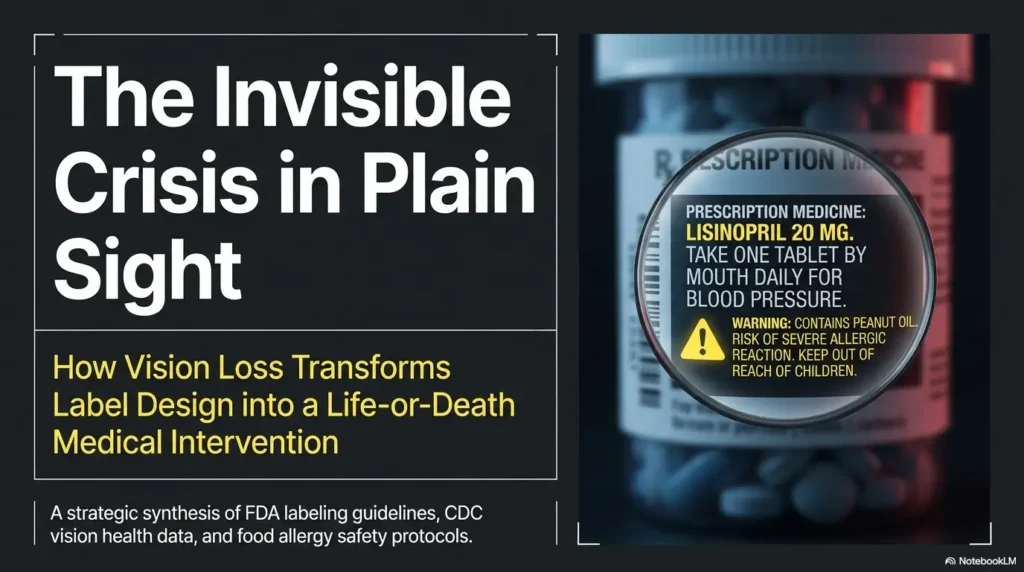
The CDC notes that millions of adults in the United States live with vision impairment, including blindness, and vision loss becomes more common with age. That makes label-reading help a normal part of daily life, not a rare emergency or a grand act of rescue.
The quiet difference between assistance and taking over
Assistance says, “You are still in charge. I am just making the print available.” Taking over says, “I have decided what matters, and I will now manage the scene.”
The difference can be as small as one sentence:
- Taking over: “Here, let me see it. You need this one.”
- Assistance: “Would you like me to read any part of that?”
One grabs the steering wheel. The other turns on the dashboard light.
What “just reading it” can accidentally communicate
Even a well-meant helper can accidentally communicate impatience, pity, correction, or control. That usually happens when the helper adds emotional seasoning the person did not order: “That’s expensive,” “That has too much sodium,” “This is probably better for you,” or “You don’t need to worry about all that.”
Reading a label is not an invitation to become a tiny judge in the aisle. It is a service of accuracy.
- Ask before touching the item.
- Read the exact words when accuracy matters.
- Save opinions for when they are clearly requested.
Apply in 60 seconds: Replace “Let me read that for you” with “Would you like me to read any part of that?”
Ask First: The Five-Second Permission Script That Changes Everything
“Would you like me to read the label, or just the key parts?”
The best script is short enough to use while holding a jar of pasta sauce, a pharmacy bag, or a jacket with a laundering label designed by someone who apparently owns a microscope.
Try this:
“Would you like me to read the label, or just the key parts?”
That sentence does 3 useful things at once. It asks permission. It offers options. It does not assume the person needs every word read aloud like a courtroom transcript.
In real life, people often want one of 5 things: the name, the date, the price, the warning, or the part they already know might be tricky. Asking first can save 2 minutes and a small fogbank of unnecessary information.
Why permission protects independence, not just politeness
Permission is not decorative etiquette. It is the doorway between help and intrusion.
When someone has low vision, blindness, dyslexia, fatigue, tremor, limited English, or a temporary problem like dilated eyes after an exam, strangers may suddenly treat their private decisions as public property. Reading labels without permission can turn a simple task into a performance.
Permission says, “Your privacy still belongs to you.” That matters in a pharmacy line. It matters in a grocery aisle. It matters in a kitchen where someone is choosing what to eat, not auditioning for other people’s wellness opinions.
Let’s be honest: guessing what someone needs is where awkwardness starts
Guessing feels efficient until it is wrong. Then everyone is standing near the frozen peas, pretending the moment did not just grow antlers.
Maybe the person does not want calories read aloud. Maybe they only need the expiration date. Maybe they want the exact allergy statement because “may contain” and “contains” are not the same emotional weather. Maybe they already know the product and only need to check whether the packaging changed.
Mini Infographic: The Respectful Label-Reading Flow
“Would you like the full label or key parts?”
Use exact wording for dates, warnings, allergens, and directions.
Let the person process before you add more.
“Do you want anything else from this label?”
Read Like an Adult: Normal Voice, Normal Pace, No Baby-Talk Theater
Keep your voice conversational, not ceremonial
The person asked for access, not a ribbon-cutting ceremony.
Use the same voice you would use to read a street address to a friend. Clear, ordinary, adult. No sing-song. No exaggerated softness. No sudden volume increase unless the person has asked you to speak louder.
A useful rule: if your voice would sound strange reading a menu to your coworker, it will probably sound strange reading a label to someone with low vision. The same plain approach helps when you read restaurant menus with low vision: useful information first, performance never.
Avoid over-enunciating unless the person asks
Over-enunciation can feel surprisingly patronizing. “This. Says. Whole. Grain. Oats.” may be technically clear, but it can also sound as if you are defusing a bomb in a cereal factory.
Instead, read in short, natural units:
- “Product name: Extra-strength acetaminophen.”
- “Directions: take 2 caplets every 6 hours while symptoms last.”
- “Warning: do not use with other medicines containing acetaminophen.”
For unfamiliar words, slow down without turning the word into theater. If needed, spell it. That is not failure. That is honest accuracy wearing comfortable shoes.
The goal is clarity, not a dramatic grocery-store audiobook
Some helpers accidentally overperform. They read labels with suspense, commentary, and a rising tone at the end of every line. A soup can becomes a serialized drama. The carrots never asked for this.
Plain reading works better. Use pauses after important items. Let numbers breathe. Repeat only when asked.
Decision Card: Normal Reading vs. Extra Support
| Situation | Use this approach | Neutral next step |
|---|---|---|
| The person asks for a price or date | Read the detail once, clearly | Ask if they want anything else |
| The label has medicine directions | Read exact wording slowly | Suggest pharmacist confirmation if unclear |
| The person asks you to compare 2 items | Compare the same fields in the same order | Let them choose without nudging |
Action line: Match your reading style to the risk level of the label, not to assumptions about the person.
Lead With Choice: Let the Person Decide What Matters First
Ask whether they want ingredients, warnings, directions, price, or expiration date
A label is not one thing. It is a crowded little apartment: ingredients in the kitchen, warnings in the hallway, price on the door, expiration date hiding in the basement.
Before reading, ask what room they want to visit first:
- “Do you want ingredients or allergen information?”
- “Do you want the directions or the warnings?”
- “Should I check the price, size, or sale condition?”
- “Are you looking for the expiration date?”
This matters because “read the label” can mean 10 different things. Asking narrows the task without shrinking the person.
Why “everything on the label” can become information fog
Reading every word can be useful for high-stakes labels, but it can also bury the useful part under a landslide of packaging poetry. Some labels contain marketing claims, legal statements, icons, recycling details, nutrition panels, QR codes, batch numbers, and enough punctuation to make a copy editor sigh into the distance.
If the person wants everything, read everything. But do not assume everything is the helpful default.
A better default is:
“What part should I check first?”
The small phrase that keeps control in their hands: “What part should I check?”
That one phrase is useful because it transfers control back to the person immediately. It also prevents the helper from becoming the narrator, analyst, and purchasing committee.
I have used this phrase in a pharmacy, a thrift store, a hotel bathroom, and one memorable kitchen where 4 spice jars had the same shape and none of them wanted to confess. It works because it is humble. It does not pretend to know the destination before the person points to the map.
- Ask which label area matters first.
- Read in small chunks.
- Pause before moving to the next detail.
Apply in 60 seconds: Before reading, ask, “Are you looking for price, ingredients, directions, warnings, or the date?”
Say the Label, Not Your Judgment
Read “contains 18 grams of sugar,” not “Wow, that’s a lot of sugar”
Labels often touch sensitive areas: food, medicine, money, body size, age, independence, language, memory, and health. That is why commentary can sting even when it was meant as friendly conversation.
Say what the label says:
- “Total sugars: 18 grams.”
- “Sodium: 480 milligrams.”
- “Price: $6.99.”
Do not add:
- “That’s a lot.”
- “You shouldn’t get that.”
- “This one is healthier.”
Unless the person asks for help deciding, your job is not to become a pocket-sized nutrition panel with opinions.
Read “may cause drowsiness,” not “You probably shouldn’t take this”
Medication warnings deserve even more restraint. Read the warning exactly. Then stop.
You can say, “It says, ‘may cause drowsiness.’ Do you want me to read the rest of the warning?” That is different from saying, “You should not take this tonight.” One is access. The other is advice wearing borrowed authority.
If the person asks what it means, separate the label from your understanding:
“The label says this may cause drowsiness. I’m not a pharmacist, so I wouldn’t want to guess about your situation.”
Here’s what no one tells you: commentary can feel like surveillance
For people who often need help reading small print, commentary can start to feel like being watched. Every snack becomes a referendum. Every price becomes a lesson. Every medication becomes a little tribunal under fluorescent lights.
Silence can be respectful. Neutrality can be warm. Accuracy can be kind without wearing a cape.
Show me the nerdy details
When reading labels for someone else, separate three layers: exact text, plain-language clarification, and personal interpretation. Exact text is safest for medicine directions, allergen statements, expiration dates, warnings, and prices. Plain-language clarification can help when the person asks what a sale condition or label phrase means. Personal interpretation should wait until invited, especially for health, diet, money, or safety decisions.
Common Mistakes: What Makes Label Reading Feel Patronizing
Mistake 1: Calling every product “this one” without naming it
“This one says…” is fine when there is only one object. In a store aisle, kitchen counter, or medicine cabinet, it can become confusing fast.
Name the item first:
- “The blue bottle says…”
- “The store-brand ibuprofen says…”
- “The 16-ounce jar says…”
That tiny orientation cue prevents mix-ups. It also lets the person build a mental map of what is in front of them.
Mistake 2: Summarizing before reading the actual wording
Summaries can be helpful, but not when they replace the actual label too early. “It’s basically fine” is not enough when the person asked for allergy information, medication directions, or a warranty condition.
Read first. Summarize only if asked.
Good order:
- Read exact wording.
- Pause.
- Ask whether they want a plain-language summary.
Mistake 3: Adding moral commentary about food, medicine, money, or health
“That’s pricey.” “That has a lot of carbs.” “Do you really need another one?” These phrases may sound casual to the helper, but they can feel like a hand placed on the person’s wallet, pantry, or medicine cabinet.
Money and health are private rooms. Knock first.
Mistake 4: Talking to the companion instead of the person who asked
This one deserves a small gong. If the person who needs the label read is standing there, speak to that person directly.
Not to their adult child. Not to their spouse. Not to the volunteer beside them. Not to the ceiling tiles, which are famously bad at informed consent.
Speak directly, unless the person has asked someone else to coordinate.
Eligibility Checklist: Are You About to Help or Take Over?
- Did you ask permission? If no, ask before touching or reading.
- Did you ask what part matters? If no, narrow the task first.
- Are you reading exact wording for safety details? If no, slow down and quote the label.
- Are you adding advice? If yes, pause unless the person asked.
- Are you speaking to the person directly? If no, redirect your attention.
Action line: Use this checklist when the label affects health, money, food safety, or privacy.
Don’t Do This: The “Helpful” Phrases That Land Badly
“Are you sure you want this?”
This phrase may be meant as care, but it often sounds like inspection. If the person asks for your opinion, give it gently. If they only asked for the label, read the label.
Better:
“It says the price is $14.99. Do you want me to check the size or compare another one?”
“This is too complicated for you”
This one should be retired immediately and sent to live on a small island with expired coupons and tangled charging cables.
Labels can be complicated. That does not mean the person is incapable. It means the packaging is doing a poor job, the print is small, or the stakes are high enough to deserve care.
Better:
“This label has a lot on it. Want me to read it section by section?”
“Let me just handle it”
Sometimes “let me handle it” is efficient. Sometimes it is a velvet bulldozer.
Use it only when the person clearly wants you to take the task. Otherwise, keep them in the loop:
“I can read it while you decide.”
Why protective language can still feel like a locked door
Protective language often comes from love, especially in families. A daughter worries about medication. A spouse worries about allergies. A friend worries about a confusing price tag. The care is real.
But care can still crowd the person out of their own decision.
Short Story: The Orange Bottle in the Kitchen
At a family dinner, an older uncle asked someone to read the warning on a small orange prescription bottle. Three relatives leaned in at once. One said, “You shouldn’t take that with dinner.” Another said, “Give it to me, I’ll check.” The uncle went quiet, still holding the bottle. Finally, his niece said, “Let’s just read what it says first.”
She read the drug name, strength, directions, and warning in a normal voice. Then she said, “Do you want me to call the pharmacy number on the label?” He nodded. The room softened. Nothing magical happened. No speech. No lesson. Just the return of order: read first, decide second, call the right expert when needed.
That is the whole practice in miniature. The helper does not have to disappear. The helper just has to stop standing in the doorway.
Medication Labels: Read Slowly, Then Pause Before Interpreting
Start with the drug name, strength, directions, warnings, and expiration date
Medication labels are not the place for improvisational jazz. Read slowly. Read exactly. Pause often.
A practical order is:
- Patient name, if privacy allows and the person wants it confirmed.
- Medication name.
- Strength, such as 10 mg or 500 mg.
- Directions.
- Warnings.
- Expiration date or discard date.
- Pharmacy phone number, if follow-up is needed.
If medication print is a recurring problem at home, it may help to pair respectful reading with large-print prescription labels, a consistent storage routine, or a simple pharmacy call script.
The FDA explains that prescription drug labeling is a key tool for communicating drug information to health professionals, patients, and caregivers. Patient-facing materials may include Medication Guides, Patient Package Inserts, and Instructions for Use. In ordinary language: labels are there because details matter.
Separate exact label wording from your own understanding
Use this phrase when the label gets serious:
“The label says…”
That phrase creates a clean boundary. It tells the person you are not inventing, softening, or translating beyond the text.
For example:
- “The label says: take 1 tablet by mouth twice daily.”
- “The label says: avoid alcohol.”
- “The label says: may cause dizziness.”
If the person asks, “Does that mean I should skip it?” the safest non-professional answer is not a guess. It is a handoff.
When the safest answer is: “Let’s call the pharmacist”
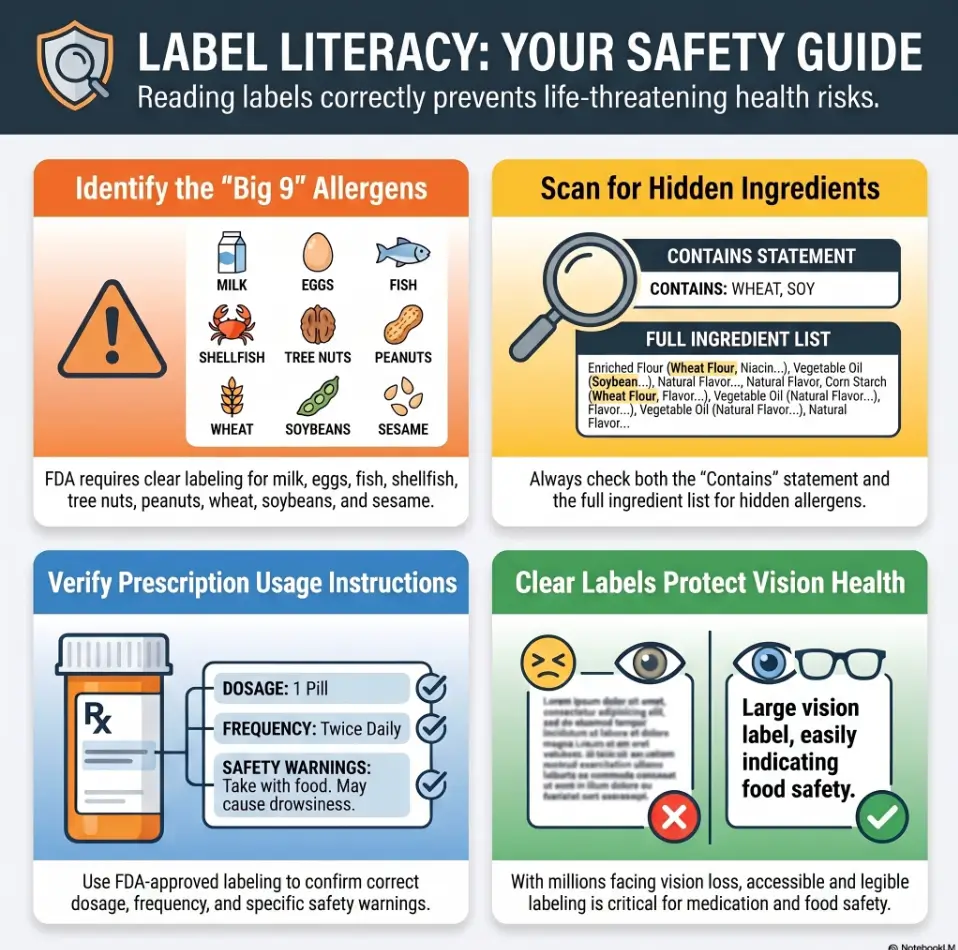
Call the pharmacist for dosing uncertainty, possible interactions, duplicate ingredients, unclear instructions, missing labels, changed pills, or warnings that conflict with the person’s routine.
This is not overreacting. It is basic risk management with less drama than a medical mystery show. For a fuller wording example, use a low vision pharmacy help script that keeps the question clear, calm, and specific.
- Read name, strength, directions, warnings, and dates.
- Do not guess about interactions or missed doses.
- Use the pharmacist when the label raises questions.
Apply in 60 seconds: Save the pharmacy phone number in the person’s contact list if they want that support.
Food Labels: Allergens, Dates, and Ingredients Without Food Policing
Read allergen statements exactly as printed
Food labels can be casual for one person and high-stakes for another. If allergies are involved, do not paraphrase too loosely.
Read exact phrases such as:
- “Contains milk and soy.”
- “May contain tree nuts.”
- “Manufactured in a facility that also processes wheat.”
The FDA states that U.S. food labels must identify the food source of major food allergens used as ingredients. As of current FDA food allergy guidance, major allergens include milk, eggs, fish, crustacean shellfish, tree nuts, peanuts, wheat, soybeans, and sesame.
That does not mean every real-life risk is simple. Advisory statements such as “may contain” can vary, and restaurant or unpackaged foods may require a different level of caution. When the person has a serious allergy, exact wording matters more than your confidence.
Name the serving size before nutrition numbers
Nutrition numbers without serving size can mislead. “Eight grams of protein” means one thing per cup and another thing per tiny serving that would leave a squirrel filing a complaint.
Read in this order:
- Serving size.
- Servings per container.
- The specific number requested, such as sodium, sugar, fiber, or protein.
That order helps the person compare products fairly.
Avoid diet talk unless the person specifically asks for comparison help
Food labels are not moral scorecards. People buy food for many reasons: budget, allergies, taste, culture, time, comfort, blood sugar goals, dental comfort, texture, cooking ability, appetite, and the ancient human need for crackers at 10 p.m.
If someone asks, “Which has less sodium?” answer that. If they ask, “Which is healthier?” you can say, “What are you comparing for: sodium, sugar, protein, ingredients, or something else?”
Mini Calculator: Two-Product Label Comparison
Use this simple 3-input comparison when someone asks you to compare packaged foods.
- Input 1: Serving size for Product A and Product B.
- Input 2: The one nutrient or allergen detail requested.
- Input 3: Price or package size, if the person cares about value.
Output: “Product A has ___ per serving. Product B has ___ per serving. The serving sizes are the same/different.”
Action line: Compare the same field in the same order so the person can decide without being steered.
Store Labels and Price Tags: Give the Practical Details First
Product name, size, price, sale condition, and limit per customer
Store labels are often designed like little puzzles: bold price, tiny unit price, loyalty-card condition, sale dates, limit per customer, and a fine-print trapdoor at the bottom.
Read the practical details first:
- Product name.
- Size or count.
- Regular price.
- Sale price.
- Any condition, such as loyalty card, digital coupon, or minimum quantity.
- Limit per customer.
Retail staff can make this feel respectful by speaking directly to the customer and avoiding commentary. “This one is $8.49 with the store card” is useful. “You probably want the cheaper one” is a tiny shopping coup.
When “two for one” pricing needs a plain-language explanation
Sale signs can be oddly theatrical. “Buy 2, get 1 free” may require buying exactly 3 items. “10 for $10” may or may not require buying 10. Digital coupons may need app activation. The shelf tag may not match the register if the sale ended yesterday or the item is in the wrong slot.
Good plain-language explanation sounds like this:
“The sign says 2 for $6, but it also says you need the store card. I don’t see a limit listed.”
That gives facts without pushing a purchase.
The tiny trap: reading the sale sign but missing the fine print
The biggest price-tag mistake is reading the big number and skipping the condition. The big number is the parade. The fine print is the permit.
When reading price tags, scan below and beside the main price. Look for dates, exclusions, loyalty requirements, unit price, and quantity rules. The same respect-for-control principle also applies at registers and kiosks, where a low vision self-checkout routine can reduce guessing without turning the purchase into a public scene.
- Include size or count with price.
- Read loyalty-card or coupon requirements.
- Check sale dates and quantity limits.
Apply in 60 seconds: For sale tags, read the big price and then say, “I’m checking the fine print now.”
Who This Is For, and Who It Is Not For
This is for everyday helpers who want to be useful without taking over
This guide is for people who read labels in ordinary places: adult children helping parents, home health aides organizing supplies, volunteers assisting shoppers, friends comparing snacks, retail workers helping customers, and family members standing near a medicine cabinet wondering how to be careful without becoming bossy.
It also helps when someone has low vision, blindness, aging-related vision changes, dyslexia, fatigue, migraine, tremor, limited English, or a temporary situation that makes print hard to use.
This helps in pharmacies, kitchens, grocery aisles, closets, mail piles, and medical offices
Labels are everywhere. Pill bottles. Eye drops. Soup cans. Laundry tags. Tax forms. Medical intake papers. Price tags. Cleaning products. Mail from insurance companies. Tiny stickers on fruit that seem printed for ants with law degrees.
The core skill stays the same: ask, read, pause, check, and hand back control.
This is not a substitute for medical, legal, financial, or pharmacist advice
Reading is not the same as advising. If the label affects dosing, allergies, legal rights, insurance, safety instructions, or major spending, bring in the right professional.
This guide does not tell anyone what medicine to take, what food is safe for their allergy, what product to buy, or how to interpret legal or financial documents. It teaches a respectful way to make printed information available.
Quote-Prep List: What to Gather Before Asking a Professional
- Medication question: drug name, strength, directions, warning, pharmacy name, and prescription number if appropriate.
- Food allergy question: product name, ingredient list, allergen statement, lot number, and manufacturer contact details.
- Price or coverage question: product name, size, price tag wording, sale dates, receipt, and plan or store-card details.
Action line: Read and gather facts first so the pharmacist, manufacturer, clinician, or customer service staff can answer accurately.
When Labels Are Too Important to Wing It
Call a pharmacist for medication confusion, dosing uncertainty, or warning conflicts
Some labels should not be handled with “I think.” Medication is the clearest example.
Call a pharmacist when:
- The directions are unclear.
- The pill looks different from last time.
- The person may have taken a missed or extra dose.
- The warning conflicts with another medication or routine.
- The label mentions drowsiness, dizziness, alcohol, driving, food timing, or duplicate ingredients.
A pharmacist is not a last resort. A pharmacist is part of the safety system. For longer inserts and folded papers, a separate routine for how to read medicine leaflets with low vision can make the question less frantic before the call.
Contact the manufacturer when allergy, ingredient, or safety wording is unclear
For food, supplements, cosmetics, cleaning products, or personal care items, the manufacturer may be the right next call if the label does not answer the question. This is especially true for allergen risk, cross-contact questions, fragrance ingredients, latex concerns, or confusing safety language.
Read the product name, size, UPC, lot number, and expiration date before calling. Those details are often what customer service needs to identify the exact product.
Ask a professional when a label affects health, legal rights, insurance, or major spending
Labels on insurance mail, medical forms, warranties, leases, medical devices, and safety equipment can carry consequences. Reading the words aloud is useful. Interpreting them may require someone qualified.
Use this boundary sentence:
“I can read what it says, but I don’t want to guess about what it means for your situation.”
That sentence is respectful because it is honest. It protects the person from bad advice and protects you from pretending to be an expert in a room where expertise matters.
A Better Script: Read, Pause, Check, Hand Back Control
Step 1: “Do you want the full label or the key parts?”
Start with choice. This is the hinge that keeps the door from swinging into patronizing territory.
Use one of these:
- “Do you want the full label or just the key parts?”
- “What part should I check first?”
- “Do you want the exact wording?”
That last one is especially useful for medicine, allergens, legal language, and product warnings.
Step 2: “It says…” followed by the exact wording
“It says” is wonderfully plain. It keeps the label in the foreground and your opinion backstage, where it can sip tea quietly until invited.
Examples:
- “It says: use by May 12, 2026.”
- “It says: contains wheat and sesame.”
- “It says: wash cold with like colors.”
- “It says: sale price applies with digital coupon.”
Step 3: “Do you want me to compare anything else?”
Comparison can be helpful, but it should be structured. Compare the same details in the same order.
For example:
“The first one is 12 ounces for $4.99. The second one is 16 ounces for $5.49. Do you want the unit price too?”
That is cleaner than “This one is obviously better,” which may be true, false, or just your inner bargain goblin getting too much microphone time.
Step 4: Stop when the person has enough information
Stopping is a skill. Helpers often keep reading because silence feels awkward. But if the person says, “That’s enough,” believe them.
Hand back the item if you are holding it. Return the decision to them. Let the moment become ordinary again.
- Ask what level of detail they want.
- Use “It says…” for exact wording.
- End when the person has enough.
Apply in 60 seconds: Practice the sentence once before you need it: “Would you like the full label, or just the part you’re looking for?”
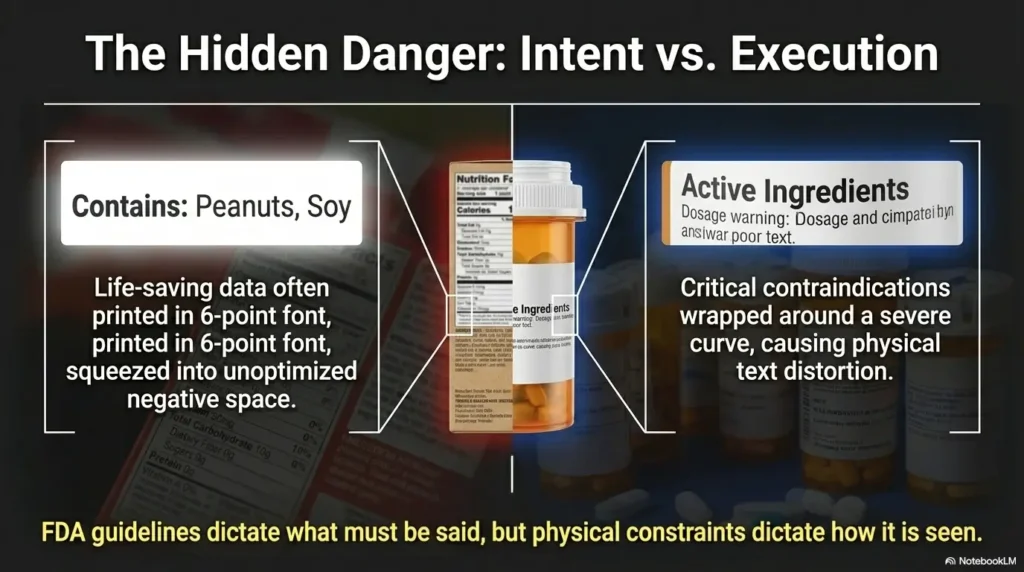
When the print itself is the obstacle, not the helper’s wording, a tool can quietly change the scene. A stand magnifier, phone magnifier, or better lighting setup may let the person read more independently next time, especially if tremor, glare, or bottle curvature makes the label hard to hold steady.
FAQ
How do I offer to read a label without embarrassing someone?
Ask casually and privately when possible: “Would it help if I read any part of that label?” Keep your tone ordinary. Do not announce the person’s need to everyone nearby. The offer should feel like opening a window, not ringing a bell.
Should I read the whole label or summarize it?
Ask first. Some people want exact wording. Others only want price, ingredients, directions, warnings, or expiration dates. For date-specific questions, it may also help to use a repeatable method for reading expiration dates with low vision so the person can compare items without rushing.
What should I do if I cannot pronounce an ingredient or medicine name?
Say so plainly. You can spell the word, read the letters from the label, or suggest checking with a pharmacist, clinician, manufacturer, or official product source when accuracy matters. Guessing confidently is still guessing.
Is it rude to explain what the label means?
It can be, unless the person asks. A good rule is: read first, interpret only when invited, and clearly separate the label’s wording from your opinion. For medicine bottles that are hard to distinguish by touch, pill bottle tactile label placement can reduce how often someone needs another person to interpret the cabinet.
How do I read a medication label safely?
Read the medication name, strength, instructions, warnings, expiration date, and pharmacy notes exactly. Do not guess about dosing, missed doses, duplicate ingredients, or interactions. When uncertain, contact a pharmacist.
What if the person asks me to compare two products?
Compare the same details in the same order: name, size, price, active ingredient, allergen statement, warnings, or directions. Avoid steering the decision unless asked. Consistent comparison gives the person a clean set of facts.
How can retail workers read labels respectfully?
Speak directly to the customer, not their companion. Ask what information they want, read it clearly, and avoid personal comments about the customer’s purchase. Include price conditions, sale dates, and loyalty-card requirements when relevant.
What if someone gets annoyed when I offer help?
Accept it gracefully. A simple “Of course” is enough. The offer should open a door, not become a tug-of-war. If they decline, step back without explaining why you were only trying to help.
Next Step: Use the One-Sentence Label Script Today
The concrete action: “Would you like the full label, or just the part you’re looking for?”
The line that solves most of the awkwardness is beautifully small:
“Would you like the full label, or just the part you’re looking for?”
It closes the loop from the opening moment. The goal was never to read louder, explain more, or become the hero of the soup aisle. The goal was to make information available while keeping dignity intact.
Why this sentence works in a kitchen, pharmacy, grocery aisle, or closet
It works because it respects time, privacy, and control. It also works across different needs. A person with low vision may want the expiration date. A person with dyslexia may want the exact medication warning. A person with limited English may want the price condition. A tired caregiver may simply need the tiny laundry symbol translated from hieroglyphic into human.
The sentence adapts without making assumptions. Around the house, the same idea shows up in ordinary systems too: tactile shampoo labels, clothing tag routines, spice jar labels, and grocery lists all work best when they make information available without making the person feel managed.
Make dignity the default, then let the details follow
For the next 15 minutes, try this once in a low-stakes setting. Read a pantry label, a care tag, a price sign, or a medicine bottle with the full rhythm: ask, read, pause, check, stop.
You do not need a perfect script voice. You need a respectful order of operations. The person remains the decision-maker. You become the clear light over the small print.
Last reviewed: 2026-04.