

Driving After Cataract Surgery: 7 Shocking Lessons From My First Terrifying Week Behind the Wheel
So… Can I Drive Yet? What I Wish Someone Told Me After Eye Surgery
If you’ve ever stood in your driveway, squinting at your car keys like they’re a pair of alien artifacts and muttering, “Am I actually okay to drive right now?”—you’re definitely not the only one. I’ve been there. And let me tell you: those first few days after eye surgery can make your everyday routine feel like it’s been run through a funhouse mirror.
The encouraging news? Most people—myself included—are cleared to start driving again during daylight within 24 to 72 hours. That’s if your surgeon gives you the green light and you meet your local legal vision requirements. But—and here’s the part no one emphasizes enough—that timeline is more of a general guideline, not some superhero challenge. Just because the clock says it’s been 48 hours doesn’t mean your depth perception is ready to dodge a rogue cyclist.
That’s why I put this together: a brutally honest, no-med-school-degree-needed guide for the first week after eye surgery. The stuff your doctor didn’t have time to walk you through, like how blinding sunlight really feels when it hits your freshly zapped corneas, why stop signs suddenly feel like they’re playing hide-and-seek, and how to avoid turning a “quick grocery run” into a $2,000 insurance headache.
We’ll break things down into real talk—no jargon. I’ll even throw in a quick DIY checklist to figure out if you’re actually ready to drive, a mini cost calculator (because Uber bills pile up fast), and some realistic planning tips that helped me avoid dumb mistakes. The goal? Help you feel confident getting back behind the wheel without gambling with your eyesight, your nerves, or your car insurance premium.
If you’re overwhelmed, sleep-deprived, or just sick of vague internet advice, don’t worry—this guide is made to help you figure out your next step in under 15 minutes. You’ve got this. Let’s keep your eyes safe, your wallet intact, and your dignity mostly preserved.
Table of Contents
Can You Drive After Cataract Surgery? The Boring, Important Truth
Let’s start with the question you actually care about: “When can I drive again?”
Most people are told some version of: “Not today. Maybe in a day or two, once I’ve checked your eye and you meet the legal vision standard.” That’s because after cataract surgery:
- Your vision can be blurry for 24–48 hours while the anesthetic wears off.
- You may have a protective shield or patch that makes depth perception weird or lopsided.
- You’re often still under the effect of sedating medication, which is an absolute no-go for driving.
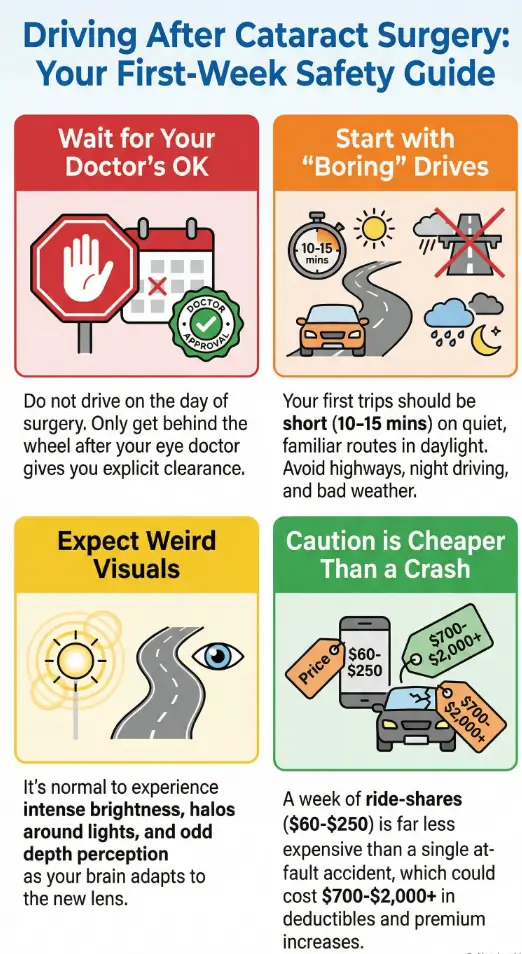
Eye organizations and hospitals repeat the same bottom line in different accents: do not drive on the day of surgery, and do not resume driving until your surgeon or optometrist confirms that your vision meets your country’s legal standard and you personally feel safe and in control.
Here’s the part I didn’t appreciate until I was staring at my car in the driveway: you’re not just protecting your eyes. You’re protecting your license, insurance coverage, and bank account. If you crash while your vision is below legal standards—or while you’re still drowsy from sedation—your insurer may have awkward questions later.
- Wait until your eye doctor confirms you meet legal vision standards.
- Never drive while still groggy from anesthesia or pain meds.
- Remember: you’re protecting your license and finances, not just your pride.
Apply in 60 seconds: Open your calendar and block out “no driving” for at least 24 hours after surgery; extend it later once your doctor gives you the green light.
My First Week Behind the Wheel: Terror, Relief, and One Bad Left Turn
Three days after my cataract surgery, I sat in the driver’s seat for the first time. The dashboard looked sharper than it had in years. The world outside the windshield? Too sharp. Every reflection, every headlight, every white line on the road seemed to shout at me.
On my first short drive, I chose the most boring route possible: no highway, no roundabouts, no pressure. My heart rate still felt like it belonged in a boxing match. At one junction, a car appeared faster than my brain expected—it was my first “oh no” moment. I stopped in time, but I realized something important: my vision was technically legal, but my brain was still catching up.
That mismatch is normal in week one. Your eye has a new lens, your brain is recalibrating depth and brightness, and your habits from the “old vision” days don’t quite fit. For a few days, you may:
- Overestimate stopping distances.
- Underestimate how bright headlights and brake lights feel.
- Struggle to judge gaps in traffic, especially for left turns/right turns across traffic.
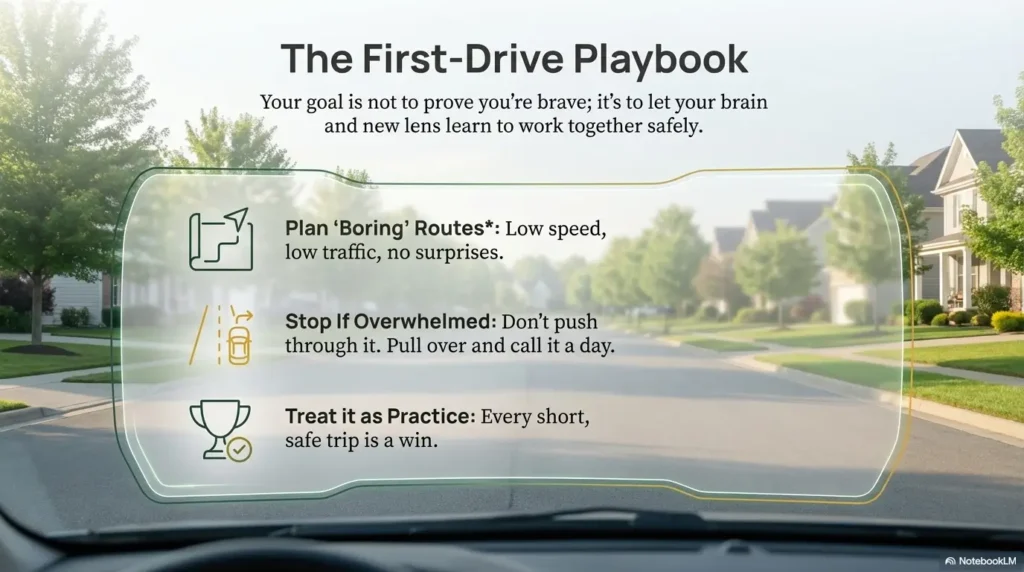
Think of your first drives as road therapy sessions, not performance tests. The goal is not “prove you’re brave”; it’s “let your brain and new lens learn to work together while risk stays low.” I tell friends now: your first trip should feel boring, slightly awkward, and completely uneventful. If you end it with a tiny sigh of relief and zero drama, that’s a win.
- Plan “boring” routes with low speed and low traffic.
- Stop driving the moment you feel overwhelmed, not five minutes later.
- Treat each short, safe trip as practice—not a test of character.
Apply in 60 seconds: Pick one ultra-simple 10–15 minute route you’ll use as your first “training drive” and save it in your navigation app.
Legal & Vision Rules in 2025: When Are You Actually Allowed to Drive?
Here’s the unglamorous side of driving after cataract surgery: it’s partly about the law, not just how you feel. Most countries have vision standards you must meet to hold a driver’s license—usually a certain visual acuity (how well you read the chart) and a minimum field of vision.
Several hospital and eye-clinic guidelines say roughly the same thing:
- You cannot drive on the day of surgery and must arrange a ride home.
- You may be able to drive again once your vision meets the legal standard and you’re free of sedating medication effects.
- Some clinics suggest waiting until your first post-op review (often within a few days to a couple of weeks) before driving again.
In the UK, for example, you must be able to read a number plate at 20 meters with both eyes and have an adequate field of vision according to DVLA rules. NHS advice emphasizes not driving until your vision is “back to normal” and your clinician is happy. In many parts of the US, the bar is set via visual acuity requirements determined by your state’s Department of Motor Vehicles.
Medical experts also stress a simple principle: if your vision in the operated eye is still fluctuating, if you have significant glare, or if you feel you can’t concentrate fully, you’re not ready to drive yet, even if your paperwork technically says you can.
Money Block #1 – 60-Second Eligibility Checklist (Legal & Safety)
Use this quick yes/no eligibility checklist before you even touch your keys:
- Have you had your first post-op check? Has your eye doctor clearly said it’s okay to drive?
- Can you comfortably read a license plate or road sign at the required distance in your country with both eyes open?
- Are you completely free from sedating meds? (No lingering drowsiness, fuzzy thinking, or slowed reaction time.)
- Do you feel steady, pain-free, and not distracted by your eye or by worry?
- Is it daytime, with good weather and no urgent time pressure?
If you hit “no” on any of these, your safest move is to wait or arrange alternative transport. Eligibility first, driving second—you’ll often save yourself hundreds of dollars in potential traffic fines, extra insurance premiums, or medical bills by being conservative here.
Apply in 60 seconds: Screenshot this checklist and keep it in your notes app; run through it every time you’re tempted to drive in the first week.
Show me the nerdy details
Legal vision standards usually focus on visual acuity (for example, 20/40 or better with correction in many US states) and visual field (how wide your usable vision is). After cataract surgery, acuity often improves rapidly, but other visual functions—contrast sensitivity, glare tolerance, depth perception—may lag behind. That’s why an eye chart alone doesn’t tell the whole story of your driving safety. Surgeons and optometrists look at how stable your refraction is, any post-op inflammation, corneal swelling, and how your brain is adapting to the new intraocular lens before advising you to drive.

How Your Vision Really Changes in Week One (And Why Lights Look So Weird)
Most brochures make cataract surgery sound like a before-and-after Instagram filter: cloudy today, crystal clear tomorrow. Real life is messier, especially in the first week.
Common, usually temporary visual experiences after cataract surgery include:
- Increased brightness: everything looks like someone turned the exposure up two stops.
- Halos and starbursts around headlights and streetlights, especially at night.
- Color shock: whites look whiter, blues look bluer, and that old beige couch might suddenly look… very beige indeed.
- Depth-perception oddities if only one eye has been operated on so far.
On my day-two check-up, I told my surgeon, “It’s like someone polished half my brain and left the other half in the attic.” He laughed and said that was actually a pretty good description. Your brain is doing fast, complicated recalibration to match a new lens, new brightness, and sometimes a completely different glasses prescription—or no glasses at all.
All of this matters for driving, because:
- Bright brake lights and reflective signs can feel aggressively intense.
- Judging the distance to the car in front may feel slightly “off” at first.
- Switching your gaze between dashboard, mirrors, and road can feel more tiring.
The good news: for most people, these effects improve significantly over the first few days to weeks. Large studies show that cataract surgery can reduce crash risk and “near-miss” events by nearly half once your eyes and brain settle into their new normal.
- Expect halos and extra brightness, especially at night.
- Let your first drives be shorter and slower than you think you “should” need.
- Reassess day by day, not hour by hour.
Apply in 60 seconds: Add a note in your phone: “Halos and brightness = normal adaptation. Recheck in 3 days before making big driving decisions.”
Infographic – Typical Driving Timeline After Cataract Surgery (Illustrative Only)
Day 0–1
- No driving at all.
- Eye shield, possible blur.
- Arrange rides in advance.
Days 2–3
- Post-op check in many clinics.
- May be cleared for very short daytime drives.
- Stick to local, familiar routes.
Days 4–7+
- Gradually increase distance if safe.
- Delay night driving until glare improves.
- Recheck with your eye doctor as advised.
This timeline is illustrative, not a personal medical plan. Always follow your own surgeon’s advice and local laws.
Insurance, Liability, and Hidden Costs If You Drive Too Soon
Now we get to the part nobody talked to me about before surgery: what happens financially if you drive too soon and something goes wrong?
Imagine this scenario: you feel “mostly fine,” drive on day two, misjudge a gap, and tap another car. No one is badly hurt, but your car needs work, theirs does too, and someone suggests you might still have been under the influence of sedating medication or not meeting vision standards.
Suddenly, the conversation is not about bravery—it’s about:
- Your insurance deductible (often $250–$1,000+).
- Future premium increases that can quietly cost you hundreds of dollars a year.
- Potential arguments about whether you were medically and legally “fit to drive.”
Insurers generally expect you to comply with medical advice and local driving laws. If your doctor said “don’t drive yet,” and you did, you’re giving them a reason to scrutinize the claim. That doesn’t automatically mean they’ll refuse it—but it hands them leverage in a conversation you don’t want to be having.
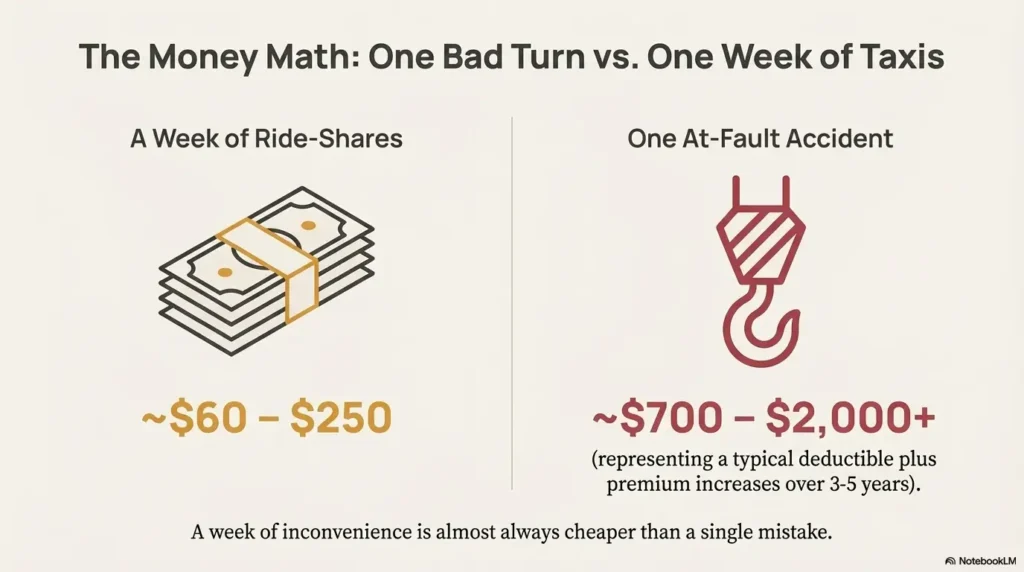
Here’s the uncomfortable but empowering question: is the short-term convenience of driving today worth the long-term cost if you’re wrong? For most of us, paying for a week of taxis or ride-share is still cheaper than a single at-fault accident plus a jump in premiums.
Money Block #2 – Decision Card: Wait for Clearance vs. Drive Now
Option A – Wait for Clear Approval
- Cost: ride-shares, taxis, or favors from friends for 3–7 days.
- Benefit: very low risk of claim disputes or legal issues.
- Stress level: short-term inconvenience, long-term peace of mind.
Option B – Drive “Because You Feel Okay”
- Cost: potentially $500–$1,000+ deductible if a crash happens.
- Risk: premium hikes for 3–5 years, plus awkward questions.
- Stress level: low today, high if anything goes even slightly wrong.
Apply in 60 seconds: Write down your car insurance deductible and your best guess at a premium increase if you had an at-fault accident. Put those numbers next to a 7-day ride-share estimate and see which feels smarter.
- Know your deductible and basic premium numbers.
- Driving too early can create insurance and liability headaches.
- Conservative choices buy financial and emotional safety.
Apply in 60 seconds: Log in to your insurer’s app or portal and note your current deductible, annual premium, and accident surcharge rules.
The Money Math: Is It Cheaper to Wait or Drive Now?
Driving after cataract surgery isn’t just a safety decision; it’s a money decision. If you’re a practical person who thinks in spreadsheets, this section is for you.
Let’s compare two main costs:
- Short-term transport costs if you don’t drive (ride-shares, taxis, public transport, asking family or friends).
- Potential out-of-pocket costs in the unlikely event of a minor crash: deductible, premium increase, lost time.
Money Block #3 – Illustrative Cost Table (2025, Typical Ranges)
| Item | Typical 2025 Range (US) | Notes |
|---|---|---|
| Week of local ride-shares | $60–$250 | Depends on distance and city; assume 2–4 short trips/day. |
| Collision deductible | $250–$1,000+ | Check your policy; higher deductibles lower monthly premiums but increase risk. |
| Annual premium increase after at-fault crash | $150–$600/year | May last 3–5 years depending on carrier and state rules. |
| Extra medical copays (if injured) | $20–$300+ | Varies by plan; includes urgent care, physio, etc. |
Even using conservative numbers, one small at-fault accident could easily cost $700–$2,000+ over a few years. A week of ride-shares? Often less than a decent pair of glasses.
Money Block #4 – 60-Second “Is It Cheaper to Wait?” Calculator
Estimate your own numbers:
This is a rough illustration, not financial advice. Confirm your deductible and ride costs with your actual providers.
Apply in 60 seconds: Run the calculator once with your real numbers, then decide: “Is driving this week really worth more than this total?”
Practical First-Week Driving Checklist (Day-by-Day)
Let’s translate all of this into a realistic first-week plan. Think of this as your “behind-the-wheel survival guide”—one I wish someone had handed me with my post-op eye drops.
Day 0–1: Absolutely No Driving
- Go home with a trusted driver; don’t “just move the car” yourself.
- Keep the protective shield on as directed.
- Arrange rides, food, and any necessary errands for the next 48 hours.
Day 2–3: Vision Check & Micro-Drives (If Cleared)
- Attend your post-op check; ask directly: “Am I safe to drive short distances in daylight this week?”
- If cleared and you feel ready, start with a 10–15 minute drive on quiet streets.
- No highways, no peak traffic, no tight deadlines. If you feel overwhelmed, pull over safely and call it a day.
Day 4–7: Gradual Expansion, Still No Heroics
- Slowly increase distance and complexity: a slightly busier road, a small roundabout, a familiar store.
- Delay night driving until glare and halos are clearly improving.
- Keep drives optional—if you’re tired or anxious, you choose not to go.
On my own day-four experiment, I tried a slightly busier route “just to see.” Halfway through, a bus swung a little closer than expected and my brain screamed, “Too much.” I went home, made tea, and gave myself permission to go back to boring routes for another few days. No medal ceremony, but a much calmer nervous system.
- Use a day-by-day plan instead of deciding in the moment.
- Stop any drive the second your brain feels overloaded.
- “Too cautious” is cheaper than “Oops.”
Apply in 60 seconds: Put three calendar events in your phone: “Day 2–3 micro-drive,” “Day 4–5 practice route,” and “Reassess night driving after 7 days.”
Short Story: One evening near the end of my first week, I decided to test a short twilight drive. The sky was that soft purple that normally makes everything feel calm. Then the first oncoming car rounded the bend with its headlights on. For a split second, the light burst into a star-shaped flare across half my windshield. My hands tightened on the wheel; I eased off the accelerator and focused on the lane markings like they were a lifeline.
Nothing dramatic happened—no horn blasts, no screeching tires—but when I pulled into my driveway, I realized my shoulders were up near my ears. I sat there, engine off, and admitted to myself: “I’m not ready for this yet.” The next evening, I rode in the passenger seat instead and watched how the light looked without the pressure of driving. Two days later, I tried again, and the same stretch of road felt completely manageable. The difference wasn’t courage; it was timing.
Night Driving, Glare, and Bad Weather: How to Avoid the Worst Traps
If daytime driving after cataract surgery is a cautious stroll, night driving is an obstacle course. Headlights, reflections, and wet roads can turn minor glare into a confusing light show.
Common experiences in the first weeks include:
- Halos and “starburst” patterns around headlights and traffic lights.
- Extra shimmer on wet roads, making lane markings harder to see.
- Feeling like everything is just a bit too bright and busy.
Many experts recommend delaying night driving until your glare symptoms have clearly settled and your daytime driving feels easy and predictable again. That might be days for some people and weeks for others, especially if only one eye has been done so far.
Practical steps that helped me:
- Starting with very short night drives on familiar streets, once daytime driving felt genuinely boring.
- Keeping the windshield and mirrors spotlessly clean inside and out (grime magnifies glare).
- Wearing a well-fitted pair of non-polarized driving glasses, as advised by my optometrist, to gently tame brightness without making things too dim.
And, bluntly: if you look outside and see heavy rain, fog, or fresh snow in your first few weeks after surgery, that might be a good night to let someone else drive or to stay home.
- Delay first night drive until your glare symptoms are clearly improving.
- Test in perfect conditions before adding rain or fog.
- Keep glass and mirrors ultra-clean to reduce light scatter.
Apply in 60 seconds: Decide now: “No night driving for at least X days after my surgeon clears me,” and write that number down.
Country-Specific Notes (US, UK, Canada, Australia) in 2025
Because driving rules aren’t the same everywhere, it’s worth a quick regional reality check.
- United States (2025): State DMVs set vision standards; many require something like 20/40 vision or better with correction for an unrestricted license. Clinics routinely insist you arrange a ride home and avoid driving until your vision meets the standard and your eye doctor is happy with your recovery.
- United Kingdom (2025): You must meet DVLA vision rules, including reading a number plate at 20 meters. NHS materials emphasize not driving until your vision is back to normal; several hospitals advise waiting until your post-op review before driving again, even if legal standards are technically met earlier.
- Canada & Australia (2025): Provincial and state rules vary, but guidance is similar: no driving on the day of surgery, then gradual return once your vision meets the legal requirement and your clinician confirms it’s safe. Some Australian resources suggest that many patients can drive again after about 24 hours, while others recommend waiting longer, especially if you rely on both eyes for good depth perception.
If you’re reading this from a different country (including Korea or EU states), the same principle holds: check your national or regional driving standards, then confirm with your surgeon or optometrist when you’re personally cleared to drive.
Apply in 60 seconds: Search your country + “driver’s license vision standard” and save the official page. Bring it to your post-op visit if you want to discuss it with your eye doctor.
The Emotional Side: Fear, Confidence, and “Am I Just Being Weak?”
One of the most surprising parts of my first week behind the wheel wasn’t the light, or the new sharpness of road signs. It was the quiet voice in my head saying, “You’re being dramatic. Normal people just drive.”
If any part of you feels that way, I want to say this clearly: you are not weak for taking driving after cataract surgery seriously. You just had surgery on the organ you rely on most when you drive. Sitting with that reality for a week does not make you anxious; it makes you responsible.
Many people—especially those who’ve been driving for decades—tie a lot of identity and independence to their car keys. Losing them even temporarily can feel like losing part of yourself. That’s why some people rush back onto the road too fast.
In my case, the turning point came on a day when I almost forced myself to drive because “I didn’t want to be a burden.” Instead, I asked a friend for help. She shrugged, grabbed the keys, and said, “You literally just had eye surgery. This is not a character test.” That one ride probably saved me from either a panic attack behind the wheel or a badly timed mistake.
- Feeling nervous does not mean you’re incapable; it means you’re paying attention.
- You’re allowed to ask for rides without apologizing every five seconds.
- Your independence returns faster when you heal safely.
Apply in 60 seconds: Text one trusted person: “I might need a ride once or twice after my surgery—could I call you if I’m not feeling ready to drive?”
How to Talk to Your Eye Doctor and Car Insurer like a Pro
The difference between vague anxiety and calm confidence is often just better questions. Two conversations matter most: one with your eye-care team (surgeon, optometrist) and one with your car insurer or broker.
With Your Eye Doctor or Optometrist
At your post-op visit, don’t just accept “You’re doing fine.” Try asking:
- “Would you be comfortable with me driving short local trips in daylight this week?”
- “What specific signs (more glare, more blur, pain) mean I should stop driving and call you?”
- “How long do you usually recommend people wait for night driving after this kind of lens?”
In many countries, cataract surgery has standardized billing or procedure codes; these can show up in your health insurance coverage and may matter if you’re coordinating time off work, transport benefits, or medical expense claims. Ask which code they used and keep it in your records—it’s surprisingly useful wallpaper for future paperwork conversations.
With Your Car Insurer
You don’t need to confess your soul story to your insurer, but you can ask smart, neutral questions like:
- “How does a recent eye surgery affect my coverage, if at all, as long as I follow my doctor’s advice and legal standards?”
- “What is my current collision deductible and how would an at-fault accident affect my premiums?”
- “Do you offer any telematics or safe-driving programs that might help if I drive less while I recover?”
Money Block #5 – Quote-Prep List for Safer Calls
Before calling your insurer or asking HR about transport benefits, gather:
- Your policy number and an image/PDF of your latest declaration page.
- Your current deductible and premium, with a note of any existing discounts.
- Approximate dates of your cataract surgery and follow-up appointments.
- Any written instructions from your surgeon about driving restrictions.
Walking into these conversations prepared tends to save 20–30 minutes of back-and-forth and helps you get clearer, more concrete answers.
Apply in 60 seconds: Start a simple digital folder called “Cataract + Driving” and drop in your surgery paperwork, policy PDF, and notes from your next appointment.
FAQ
1. How soon can I drive after cataract surgery if everything goes perfectly?
If your surgery and recovery are straightforward, many people are cleared for short daytime drives within 24–72 hours once their eye doctor confirms they meet the legal vision standard and are free from sedating medication. Some clinics and hospitals prefer that you wait until your first post-op visit; others may be more flexible. Your own surgeon’s advice and your country’s rules should always win over generic timelines.
60-second action: At your post-op visit, ask for a clear, written note: “From [date], daytime driving on local roads is acceptable if the patient feels comfortable.”
2. Is it illegal to drive if my eye still feels blurry after cataract surgery?
The law generally cares less about how your eye feels and more about whether you meet the vision standard for driving with both eyes open and whether you’re impaired by medication. That said, if your vision is noticeably blurry, your glare is severe, or your concentration is poor, you may be unsafe even if you technically meet the chart standard. In practice, you should only drive when both the legal standard and your own sense of safety are firmly in the “yes” column.
60-second action: Try reading a license plate or sign at the required legal distance with both eyes; if it feels like a struggle, don’t drive—call your eye doctor instead.
3. What if I have surgery in both eyes—does that change the driving timeline?
Many people have cataract surgery done one eye at a time, a few days or weeks apart. Between surgeries, depth perception can feel odd, so clinics may encourage extra caution or suggest avoiding driving until both eyes are treated and stable. After the second surgery, many people report that once their glasses prescription is updated and healing is underway, driving actually feels safer and clearer than before surgery. Still, that transition period is when conservative choices pay off most.
60-second action: Ask your surgeon to outline a “driving plan” that covers the gap between first and second eye surgeries, and save it in your phone.
4. Will my car insurance go up just because I had cataract surgery?
Simply having cataract surgery usually doesn’t trigger a premium increase. In fact, once your vision stabilizes, your risk of certain accidents may drop. What can affect your premiums is an at-fault crash, especially if there’s any suggestion you were unfit to drive at the time. That’s why following medical advice and local laws is so important: it protects you on the road and in any post-accident conversations with your insurer.
60-second action: Call or message your insurer with a simple question: “Does recent eye surgery change anything about my coverage as long as I follow my doctor’s advice and driving laws?”
5. What should I do if I panicked during my first drive after surgery?
First, take a breath and know this: you did not “fail.” A surge of anxiety on your first or second drive is extremely common. The simplest approach is to pause, go back to passenger mode for a day or two, and review the basics: are you driving only in daylight, on familiar roads, without time pressure? Sometimes small adjustments—earlier in the day, shorter routes, or a calm friend in the passenger seat—are enough to restore confidence.
60-second action: Write down exactly what made you panic (e.g., oncoming headlights, merging traffic) and design your next practice drive to avoid that trigger while you rebuild trust in your new vision.
6. How long should I wait before driving at night after cataract surgery?
There’s no single answer, but many clinicians suggest waiting until your glare, halos, and brightness sensitivity have clearly improved and your daytime driving feels easy. For some people, that’s about a week; for others, it can be several weeks. Night driving combines lower contrast, more glare, and higher speeds, so it’s wise to treat it as the final step in your return-to-driving plan, not the first.
60-second action: Set a personal rule like “no night driving for two weeks after clearance” and revisit it with your eye doctor if you’re unsure.
Conclusion: Your Next 15 Minutes After Reading This
When I look back at my first terrifying week behind the wheel after cataract surgery, I don’t remember the exact distances I drove. I remember the moment I realized this wasn’t just about being brave. It was about giving my eyes, my brain, and my finances a chance to line up on the same team.
Here’s how you can do the same in the next 15 minutes:
- Run the quick eligibility checklist in this article and decide, honestly, whether you’re ready for even a short daytime drive.
- Use the mini calculator to compare a week of rides with your deductible and potential premium increase.
- Write down three questions for your next eye appointment, including “When would you personally start driving if you were me?”
Cataract surgery exists to make your life safer and clearer, not to rush you into a heroic comeback drive you’ll regret. Take the cautious route now, and in a few weeks, you may find that driving feels not just possible, but better than it has in years—with road signs you can actually read and headlights that no longer feel like an attack.
Your keys will still be there tomorrow. Your eyes, your license, and your bank account are with you for the long haul. Drive again when all three are ready. Driving After Cataract Surgery, cataract surgery recovery, when can I drive after cataract surgery, cataract surgery driving restrictions, night driving after cataract surgery