
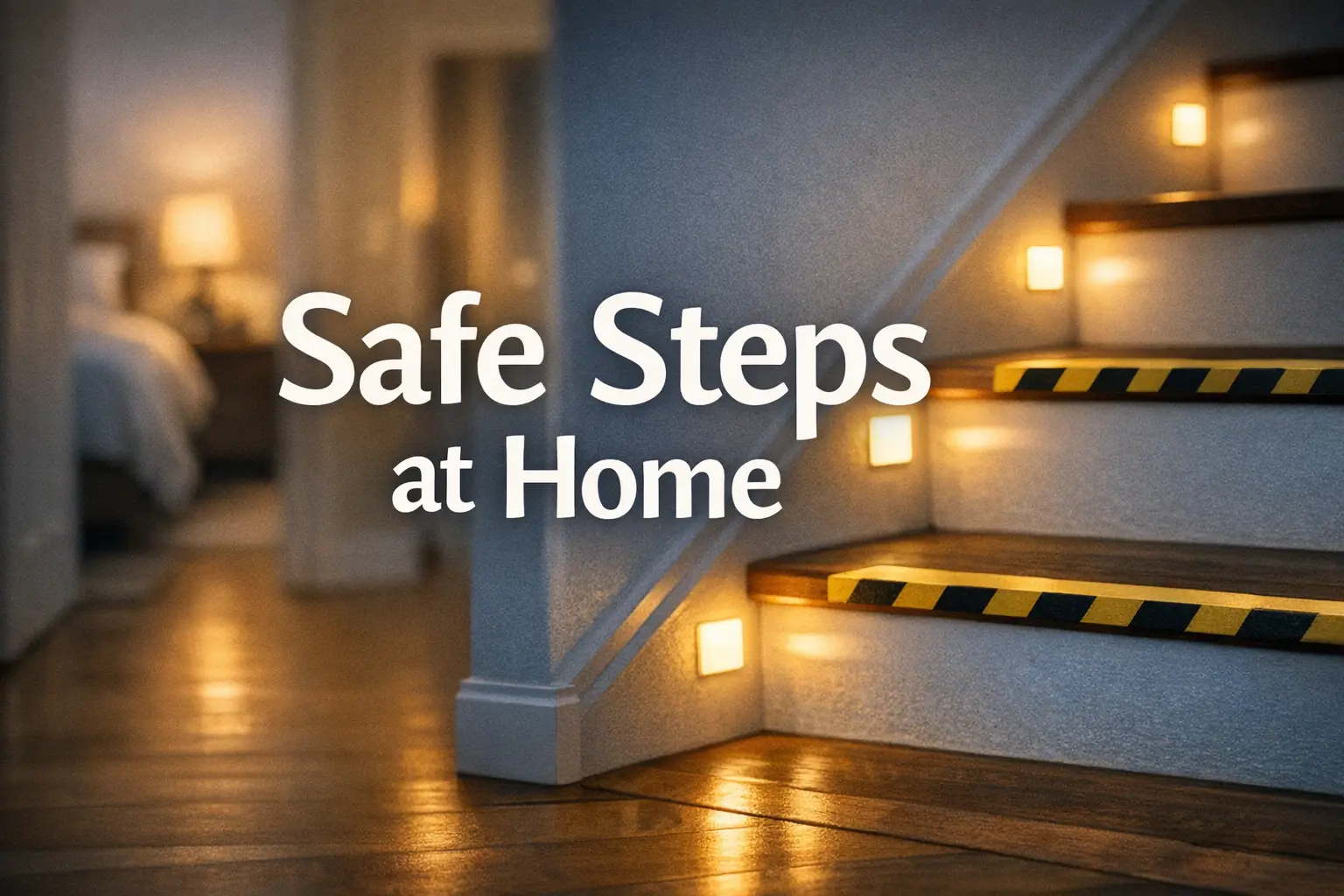

Small Changes, Zero Falls: Secure Your Independence with Aging Vision
Last month, one family cut nighttime near-falls to zero with three changes taking less than 15 minutes: a pathway light, contrast tape, and removing a “harmless” rug edge. No expensive remodel—just better visual cues where the body moves on autopilot.
The Challenge
Aging vision makes stairs look flatter and thresholds blur. Small frictions in low light lead to the “almost” moments that change everything.
The Strategy
Move from vague worry to a repeatable home-safety system using lighting transitions, edge contrast, and pattern tracking.
Practical, renter-friendly fixes you can implement tonight. Because independence belongs with you.
Table of Contents

1) Why depth cues fade first: what changed in your vision, not your willpower
The “distance feels off” moment: stairs, curbs, and thresholds
Depth perception is not one magical superpower. It’s a team effort: both eyes, contrast sensitivity, peripheral awareness, and brain timing. With age, that team can lose sharp coordination—especially in low light or glare. So the stair that was obvious at noon becomes ambiguous at dusk. A threshold looks flat until your toe finds it first.
I once visited a relative who insisted she “wasn’t clumsy.” She wasn’t. Her hallway had a glossy floor, weak overhead lighting, and a tiny level change near the bathroom. She nearly tripped in the exact same spot three times in one month. We changed one bulb, added one wall-level night light, taped one threshold edge. Near-falls dropped to zero that week.
Contrast collapse: why beige-on-beige becomes a hazard
Low contrast is the silent villain of aging eyes. When floor, furniture, and edges share similar tones, your brain works overtime to parse boundaries. That extra cognitive load shows up most during routine multitasking: carrying laundry, turning to answer someone, or walking while thinking about dinner.
- Beige rug on beige floor = invisible edge
- Dark step in dim corner = perceived as flat
- Glossy surfaces = glare that washes out detail
Open loop: the one room most people misjudge until a near-fall
Most people guess “bathroom.” It’s usually the bedroom-to-bathroom path that does the damage first. Why? Half-awake brain, low light, urgency, and confident autopilot. We’ll fix that corridor later with a tiny, renter-friendly setup that costs less than many takeout dinners.
- Low contrast hides edges
- Dim transitions distort distance
- Routine paths create risky overconfidence
Apply in 60 seconds: Stand at one doorway and ask: “Can I clearly see where this surface begins and ends?” If not, mark that zone for today’s fixes.
2) Fall risk stack-up: when vision and home design collide
Low light + clutter + multitasking = compounded error
Falls rarely happen because of one dramatic cause. They happen because ordinary frictions stack: dim bulb, phone in hand, dog toy on floor, slight dizziness, and one fast turn. Vision changes turn “minor frictions” into “major misses.”
Think of risk like a three-layer sandwich:
- Visual load: glare, low contrast, unclear edges
- Environment load: clutter, cords, rugs, wet surfaces
- Body load: fatigue, blood pressure shifts, medication effects
Any one layer might be manageable. Two or three together create surprise falls during very normal moments.
Medication side effects that mimic “just being tired”
Some medication patterns can look like “age” but function like fall accelerators: lightheadedness when standing, blurry focus at certain times, or delayed reaction speed. This includes blood pressure medications, sedating agents, and multi-drug timing mismatches. That doesn’t mean “stop meds.” It means review timing and side effects with your clinician or pharmacist.
In my own family, we learned this the hard way: one evening dose created nighttime wooziness exactly when bathroom trips were most frequent. Changing timing—under medical guidance—reduced near-falls within days. Same person, same home, different risk profile. If medication organization is getting harder, a low-vision-friendly medication management system can reduce evening errors before they compound.
Pattern interrupt: Let’s be honest—most falls happen during ordinary routines
No one plans a fall during a calm Tuesday night. That’s precisely why prevention must be built into normal movement, not saved for “careful mode.” If your setup only works when you concentrate hard, it won’t hold at 2:10 a.m.
Eligibility checklist (yes/no): Start here
- Near-fall in last 90 days? Yes/No
- Nighttime bathroom trip at least once most nights? Yes/No
- Any dim transition area at home? Yes/No
- Any loose rug/cord in walk path? Yes/No
- New medication in last 60 days? Yes/No
Neutral next step: If you answered “Yes” to 2 or more, do the 20-minute walkthrough in Section 9 this week.
3) Spot the hidden danger zones room by room
Entryways and hallways: transition-light traps
Eye adaptation lags when moving from bright to dim (or the reverse). That split-second adjustment window is enough to misjudge a shoe, pet, threshold, or bag strap. Entry zones also collect “temporary” objects that become permanent obstacles.
- Fix 1: brighter, diffused entry light
- Fix 2: one dedicated basket/bench for drop items
- Fix 3: mark step-downs or level changes with contrast tape
Kitchen and bathroom: wet surfaces + poor edge definition
Here, slip risk and visibility risk overlap. Water plus low edge contrast is a bad combo. If your shower curb is same color as tile, it’s a hidden math problem for your feet. If bathroom lighting throws shadows under your own body, you may misjudge placement during turns.
One client I advised refused grab bars at first because they felt “too hospital.” Fair. We started with contrast edits and better switch placement. Two months later she chose two matte bars voluntarily—because she wanted speed, not because someone scared her into it.
Bedroom to bathroom at night: the 12-foot high-risk corridor
This path deserves special treatment. Not the whole house. Just the one corridor where urgency and darkness meet. If your night route is 12 feet, protect all 12 feet.
Decision card: Where to invest first
| If your problem is… | Choose this first | Time/Cost trade-off |
|---|---|---|
| Can’t see edges at night | Low-level pathway lights | 10 minutes / low |
| Trips on same spot repeatedly | Edge contrast marking + declutter | 15 minutes / very low |
| Wobble with turns/transfers | Grab point + OT/PT review | Higher effort / high payoff |
Neutral next step: Pick one row, execute one action today, reassess in 7 days.

4) Lighting that prevents falls (without making your home feel clinical)
Layered lighting plan: ambient, task, and pathway
“Make it brighter” is lazy advice. Better guidance: layer lighting so your eyes do less emergency adaptation.
- Ambient: overall room visibility, soft and even
- Task: sink, stove, stairs, reading chair
- Pathway: low-level guidance for night movement
If you only improve one thing this week, improve transition zones: bedroom door, hall midpoint, bathroom entry. That’s where falls hide.
Reduce glare, increase control: bulbs, shades, and switch placement
Glare is detail theft. Very cool, harsh bulbs may feel “bright” but can reduce comfort and contrast for sensitive eyes. Aim for even, diffused light and easy control points. Put switches where you decide movement, not where electricians found convenient fifteen years ago.
Personal confession: I once installed one absurdly bright bulb over stairs and called it safety. It was basically a miniature interrogation lamp. Everyone squinted. Nobody loved it. We swapped to diffused fixtures and step-edge contrast. Function improved. Drama decreased. In kitchens, many households also benefit from glare-free under-cabinet lighting choices that preserve edge clarity without harsh hotspots.
Open loop: why brighter is not always safer
Because excessive brightness with poor diffusion creates shadows and discomfort glare. The right question is not “How bright?” It’s “Can I read edges clearly while moving naturally?”
Show me the nerdy details
Risk rises at adaptation boundaries: bright-to-dim doorways, glossy floors, and shadow-heavy stairwells. Diffused luminance and edge contrast reduce visual parsing load, which lowers missteps even when balance is otherwise stable.
- Light transition zones first
- Use diffused, controllable fixtures
- Add pathway cues for night routes
Apply in 60 seconds: Turn off main lights tonight and walk your route safely once—mark the darkest transition for an immediate fix.
5) Contrast wins: small visual edits with outsized safety payoff
Mark step edges, thresholds, and level changes
Contrast tape, matte nosing, or clearly differentiated trim can do what expensive gadgets often cannot: make boundaries obvious during movement. Prioritize:
- Top and bottom stair edges
- Single-step transitions
- Bathroom curb and doorway threshold
Rug strategy: remove, secure, or re-color for visibility
Not all rugs are villains. But loose, curled, low-contrast rugs in transition zones are. You have three options:
- Remove rug entirely (best in high-traffic routes)
- Secure with anti-slip backing + edge flattening
- Switch to higher contrast against flooring
If your rug is “pretty but sneaky,” relocate it to a low-traffic room where nobody speed-walks at night.
Furniture contrast: make obstacles visually “pop”
Coffee table corners in low contrast are toe magnets. Make obstacles visually distinct: lighter furniture on dark flooring or vice versa. This is not an interior-design failure. It’s visual ergonomics.
Mini calculator: Your night-route risk score
Add 1 point for each: (a) dim segment, (b) loose object on path, (c) unmarked threshold.
0–1: maintain and monitor. 2: moderate—fix this week. 3: high—fix tonight.
Neutral next step: Re-score after one week to confirm the changes are working.
6) Don’t do this: common “safety upgrades” that backfire
Mistake #1: ultra-cool white bulbs that increase discomfort glare
If lighting makes you squint, you did not improve safety—you changed the flavor of risk. Comfort matters because discomfort causes avoidance, and avoidance kills consistency.
Mistake #2: decorative rugs in transition zones
Yes, even the beautiful one. Especially the beautiful one if it slides, curls, or visually disappears into flooring. Keep design joy; move hazard away from routes.
Mistake #3: relying on memory instead of nighttime wayfinding cues
Memory is not a lighting system. Your home is dynamic: furniture shifts, pets move, your body state changes nightly. Build cues that survive sleepy decision-making.
Bold truth: If a “safety solution” only works when you are fully alert, it’s not a safety solution.
Short laugh, real point: if your night route requires ninja precision, your bedroom is not a dojo.
7) Don’t do this either: eyewear and mobility habits that raise risk
Progressive/bifocal lenses outdoors and on stairs: where distortion matters
Many people do great with progressives for daily life, but stairs and curbs can become tricky depending on prescription and adaptation. The lower lens zone can alter depth cues if gaze angle and pace mismatch. That doesn’t mean “ban progressives.” It means test your specific scenario with your eye-care professional and consider task-specific strategies. If nighttime confidence is also changing behind the wheel, compare your habits with this guide on night driving after 70.
“I’ll hold onto walls” as a long-term strategy (and why it fails)
Wall-surfing feels clever until it becomes dependency. Walls aren’t always where you need support, and they teach risky movement shortcuts. Better: deliberate handholds, better lighting cues, and paced turns.
Pattern interrupt: Here’s what no one tells you—confidence can hide declining visual function
Competence can mask drift. You still “manage,” so you postpone changes. Then one rushed moment exposes the gap. Confidence is valuable; calibration is safer. A quick senior driving safety self-check can also reveal whether the same visual drift is showing up beyond the home.
- Match eyewear to task and terrain
- Replace wall-holding with reliable supports
- Audit confidence against real near-fall data
Apply in 60 seconds: Write down your last two near-misses and the exact visual condition (glare, dimness, edge confusion).
8) Who this is for / not for
Best for: adults 50+, caregivers, post-cataract adjustment, low-light confidence issues
This guide is built for prevention-focused households: you’re still active, still independent, and not interested in waiting for a major incident before acting. It’s also helpful for family caregivers trying to avoid “nagging” while still reducing risk.
Not enough alone for: sudden vision change, recurrent falls, neurologic symptoms, acute dizziness
DIY edits are powerful, but they are not a substitute for urgent medical evaluation. Sudden or worsening symptoms deserve prompt care. Repeated falls are a medical signal, not a personality flaw. If symptoms appear abruptly, review red-flag scenarios like vision changes after stroke and seek immediate clinical guidance when appropriate.
If you rent: landlord-friendly, low-cost modifications first
Renter reality is real. Start with reversible changes:
- Plug-in pathway lights
- Removable contrast tape
- Non-permanent anti-slip pads
- Furniture repositioning to widen paths
Quote-prep list: gather before a professional home-safety assessment
- List of near-fall times/locations (past 30–90 days)
- Current medications and timing
- Photos of night route and transitions
- Specific goals (e.g., safer night bathroom trip in under 2 minutes)
Neutral next step: Bring this list to your eye-care or rehab visit to speed up practical recommendations.
9) 20-minute home safety walkthrough checklist
5-minute scan: floors, cords, loose mats, pet paths
Set a timer for 5 minutes. No perfection. Just first-pass hazard removal.
- Lift or secure loose mats
- Route cords away from walk lines
- Clear pet toys from path zones
- Check footwear landing areas near bed
10-minute scan: lighting transitions and stair visibility
Stand in the doorway of each key area and move through the transition. Ask: “Do edges remain clear while I move?” If not, fix one of these immediately:
- Add diffused light source
- Install pathway cue
- Mark edge/threshold contrast
5-minute scan: nighttime route from bed to bathroom
Walk it once in realistic low light. If you must slow down due to uncertainty, the setup is not good enough yet.
Infographic: The 20-Minute Anti-Fall Reset
Minute 0–5
Clear the path
Mats, cords, clutter, pet obstacles
Minute 5–15
Fix transitions
Doorways, stairs, threshold contrast
Minute 15–20
Night route test
Bedroom → bathroom confidence check
Rule: If the route needs “careful mode,” keep iterating until movement feels naturally safe.
Commercial-entity reality check: For evidence-based guidance and care pathways, households often coordinate between CDC educational guidance, the National Eye Institute for vision health education, and the American Academy of Ophthalmology for eye-care context. Clinical therapy pathways may involve OT/PT teams; medication reviews are often coordinated with primary care and pharmacists. For ongoing monitoring, a printable symptom diary for seniors can make clinician conversations faster and more precise.
10) When to seek help (and from whom)
Eye-care visit triggers: blurred depth, glare spikes, near-falls
Book an eye-care evaluation when you notice persistent depth confusion, worsening glare discomfort, frequent stumbles on level changes, or reduced confidence in familiar spaces. Annual dilated exams are a practical baseline for many older adults. If you need a practical prep flow, use an annual eye exam checklist for seniors before your visit.
Medical review triggers: dizziness, new meds, blood pressure swings
If you feel faint when standing, develop new dizziness, or notice timing-linked instability after medication changes, ask for a structured medication and vitals review. You are not “complaining.” You are presenting high-value safety data.
OT/PT home safety assessment: when DIY changes plateau
If you’ve done lighting + contrast + clutter control and near-falls continue, bring in professional assessment. OT/PT can translate movement patterns into home modifications that actually stick.
Short Story: Two years ago, a neighbor in her late sixties told me she was “fine, just slower at night.” She had no major diagnosis, just little signals: one toe catch on a rug edge, one shoulder bump near a doorframe, one “whoa” moment on the last stair. She resisted help because she feared the identity shift more than the fall itself. We started small—pathway lights, contrast tape at two thresholds, and moving one accent table that sat exactly where sleepy feet drifted.
Then she logged near-misses for two weeks and brought that list to her eye appointment. Her clinician adjusted her plan; her daughter helped reorganize nighttime essentials. Four months later, she said the best part wasn’t “safety.” It was walking to the bathroom half-asleep without the tiny jolt of panic. Independence didn’t shrink. It got quieter and more reliable.
- Eye exam for visual contributors
- Medical review for dizziness/med timing
- OT/PT assessment when home edits stall
Apply in 60 seconds: Put one appointment reminder on your calendar and attach a short near-fall note to bring with you.

FAQ
Can aging eyes alone cause poor depth perception?
Yes, they can contribute significantly, especially with reduced contrast sensitivity, glare issues, and lower-light performance. But depth problems can also reflect medication, neurologic, vestibular, or cardiovascular factors, so persistent changes deserve evaluation.
Are cataracts linked to higher fall risk at home?
Cataracts can reduce clarity and contrast, making edges and steps harder to detect. Many people report better confidence after appropriate treatment, but home environment and habit changes still matter. If you’re weighing timing and expectations, this breakdown of cataract surgery after 65 helps frame practical next steps.
Do progressive lenses increase fall risk on stairs?
For some people in some settings, they can complicate depth cues due to lens-zone distortion and gaze angle. This is individualized. Ask your eye-care professional about task-specific strategies and adaptation.
What light color temperature is safest for older adults?
There is no single perfect number for everyone. In practice, comfort, glare control, and consistent edge visibility matter more than chasing a trendy bulb spec. Diffused, well-placed, controllable lighting wins.
Should I remove all rugs or just certain ones?
Start with transition zones and nighttime routes. Remove or secure loose rugs first. Keep stable, high-contrast rugs in low-traffic areas if they don’t create edge confusion.
How often should older adults get dilated eye exams?
Many adults benefit from at least annual eye-care follow-up, but frequency depends on personal risk and existing conditions. Follow your clinician’s interval recommendations. If you want a focused primer, see how often seniors should get dilated eye exams.
Is nighttime motion lighting actually helpful?
Yes—when placed to guide movement without creating harsh glare. Keep light paths continuous from bed to bathroom and avoid “spotlight-only” setups that create strong shadows.
Can balance training still help if vision is the main issue?
Absolutely. Vision and balance are partners. Improving one helps the other, especially when combined with environmental safety edits and medication review.
What should caregivers prioritize first: lighting or clutter?
If time is tight, clear walk paths first (instant risk drop), then fix transition lighting the same day. Best results come from doing both within one week.
Are grab bars useful even without diagnosed mobility problems?
Yes. They can serve as proactive stability points in high-risk zones (bathroom, transfers, stairs) and reduce reliance on improvised support like walls or towel bars.
12) Next step
Remember the open loop from the beginning—the “ordinary” room most people misjudge? It wasn’t one room. It was the short nighttime route your body walks on autopilot. That’s where independence either frays quietly or gets reinforced, one visible edge at a time.
Do this in the next 15 minutes: choose one path (bedroom → bathroom), add one light cue, remove one trip hazard, and mark one threshold edge. Then test once in realistic low light. If movement still feels uncertain, schedule the eye/medical review and bring your near-fall notes.
You are not surrendering independence by adapting your home. You are engineering it.
Last reviewed: 2026-02.