
Making Every Step Predictable: Progressive Lenses & Stair Safety
The first step down can feel strangely dishonest. The stair is there, then it seems to dip, float, or arrive half an inch sooner than expected. For many older adults, progressive glasses safety tips for seniors walking down stairs are not about being timid. They are about understanding how progressive lenses, depth perception, balance, lighting, footwear, and handrails quietly negotiate every step.
Guessing is the expensive part. A small near-miss on Tuesday can become a bruising fall on Friday, especially when laundry, pets, dim hallway light, or a ringing phone joins the tiny parade of hazards.
Good news: stairs can become more predictable. Not heroic. Predictable. That is the goal.
Fast Answer: The Safer Stair Formula
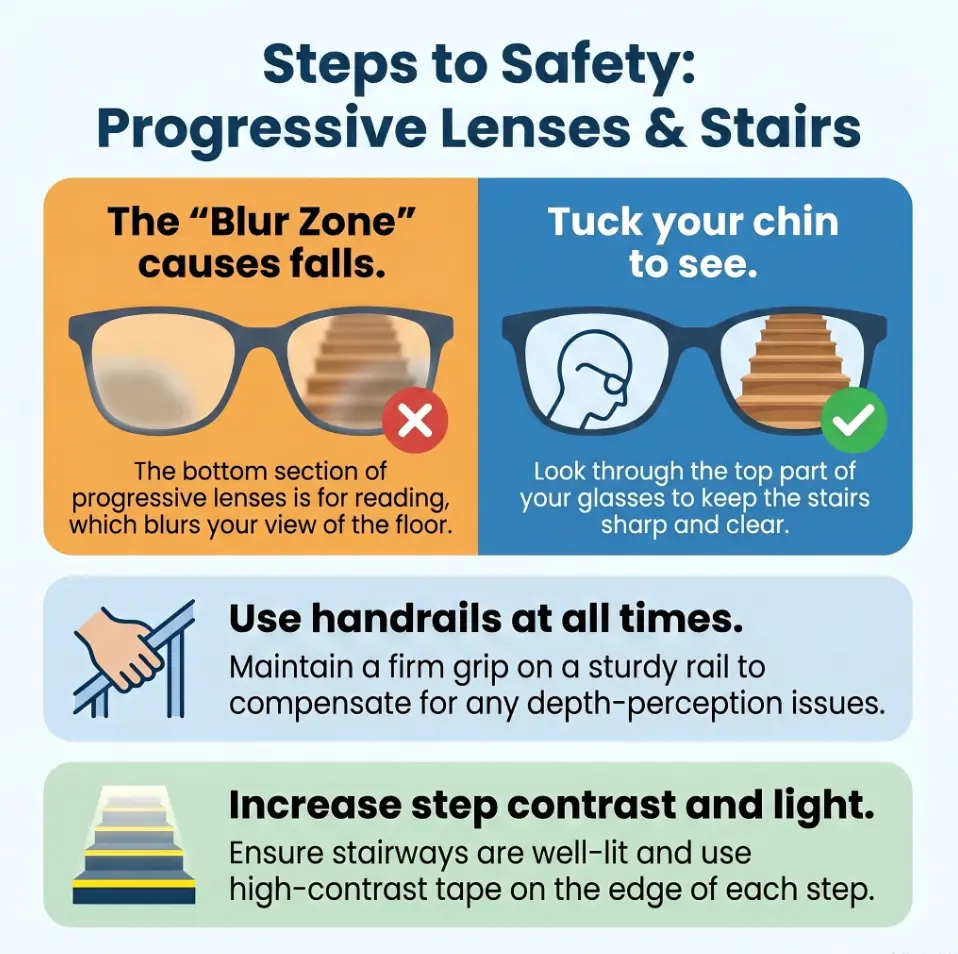
Progressive glasses can make stairs feel tricky because the lower part of the lens is designed for near vision, not step distance. Seniors should slow down, look through the distance zone, lower the chin slightly, use the handrail, improve stair lighting, and ask an eye doctor or optician to check lens fit if stairs look warped, blurry, or “floaty.”
- Eyes: Use the distance zone, not the reading zone.
- Body: Lower the chin instead of dropping only the eyes.
- Environment: Add light, contrast, rails, and clutter control.
- Care: Get help for repeated near-falls, dizziness, or sudden vision changes.
Table of Contents
Safety First: When Stairs Are Not Just a Glasses Problem
This guide is general education, not medical advice. Stair trouble with progressive lenses may come from lens design, poor fit, outdated prescription, cataracts, balance problems, medication side effects, neuropathy, vertigo, stroke-related vision loss, low blood pressure, or other health issues.
That matters because the wrong assumption can send you down the wrong hallway. Sometimes the glasses need adjustment. Sometimes the stairs need better lighting. Sometimes the body is waving a tiny red flag while wearing orthopedic shoes.
Seniors with repeated near-falls, dizziness, sudden vision changes, double vision, weakness, numbness, confusion, fainting, or trouble walking normally should contact a qualified clinician or eye-care professional. If there was a fall with head injury, severe pain, or new confusion, seek urgent care.
- Progressive lenses can affect stair judgment.
- Balance, medications, and vision conditions can also play a role.
- Repeated near-falls count as useful warning data.
Apply in 60 seconds: Write down when stair trouble happens, including lighting, shoes, glasses, and dizziness.
Why Progressive Glasses Can Make Stairs Feel Strange
Progressive lenses are clever little optical staircases. The top portion is usually for distance. The middle helps with intermediate tasks. The lower portion helps with near work, such as reading a phone, recipe card, or medicine label.
That design is useful at a desk. It is less forgiving when your foot is searching for the next tread.
The hidden lens zone problem
With progressive lenses, you do not have one single prescription across the whole lens. You have a gradual shift. That means the view changes depending on where your eyes look through the lens.
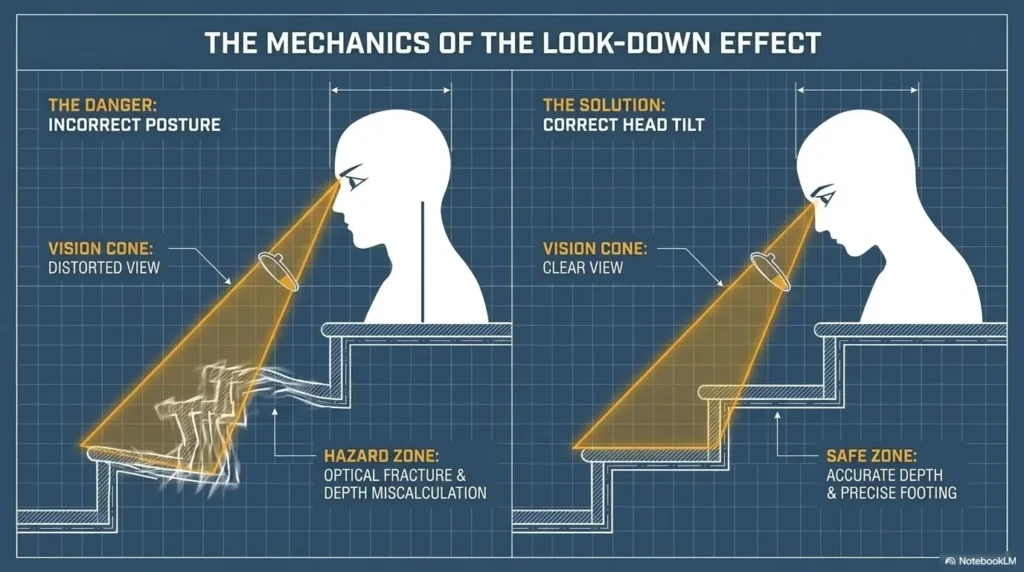
When you look down with only your eyes, you may accidentally look through the near zone. The stair is not at reading distance. It is usually farther away than a book, closer than a road sign, and moving relative to your body. That visual “in-between” zone can become a little opera of blur, distortion, and hesitation.
Why the bottom of the lens can betray your feet
The bottom of a progressive lens is often optimized for close objects. Great for reading a prescription bottle. Not great for judging the edge of the second step while your knees are doing committee work.
If the bottom lens area makes the stair edge look closer, lower, or wavier than it is, the foot may land too short or too long. Older adults may then compensate by gripping walls, tapping steps, or freezing at the top.
That is not “being dramatic.” That is the nervous system asking for better information.
Distance, intermediate, near: the stairway collision
Stairs ask the eyes to do several jobs at once:
- Find the step edge.
- Judge depth and height.
- Track motion while the body moves.
- Adjust to shadows, glare, and contrast.
- Coordinate with balance, knees, feet, and hand placement.
Progressives can help many daily tasks, but stairs expose the weak spot: the lens zone you use for reading may not be the safest zone for walking.
Show me the nerdy details
Progressive addition lenses change optical power gradually from top to bottom. The side and lower areas may include blur or distortion because the lens has to blend several focusing distances into one surface. When a person looks down through the near area while descending stairs, the visual information used for step edge location can be less accurate. Stair descent also requires motion, contrast sensitivity, depth judgment, and balance. That is why a tiny lens-position problem can feel much larger on stairs than while sitting still.
Here’s what no one tells you: stairs are not “reading distance”
A stair is not a book. It is not a phone. It is not the label on a soup can you bought because it was on sale and then forgot in the pantry until the next presidential term.
Stairs are a moving safety task. Treat them that way.
Best for distance. Use this zone to scan the staircase before moving.
May help intermediate tasks, but can vary by lens design and fit.
Near vision area. Useful for reading, risky for judging stair depth.
Lower chin slightly, keep eyes forward, use rail, pause before stepping.
The Safer Stair Habit: Chin Down, Eyes Forward, Hand on Rail
The safest stair habit with progressives is almost boring enough to win an award from a beige committee. That is the point. Falls love drama. Safety prefers routine.
Look through the distance zone before stepping
Before you start down, look at the staircase through the upper distance part of your lenses. Notice the first step, the landing, and any objects on the stairs.
Do not begin while your eyes are still scanning through the lower reading area. That lower area may be excellent for a paperback mystery, but stairs are not waiting patiently for chapter two.
Lower the chin instead of dropping the eyes too far
Many people instinctively drop only their eyes when looking down. With progressives, that can push the view into the near zone.
Instead, lower your chin slightly so your eyes can keep using a clearer distance or upper-intermediate portion of the lens. The move is small. Think “nod to the stairs,” not “bow to the staircase like royalty.”
Keep one hand on the rail before the first step
The handrail is not a decoration. It is a backup system. Put one hand on it before your first step down, especially at the top of the staircase, where visual uncertainty and balance shifts often meet.
For broader home safety, a related room-by-room plan for aging vision and fall prevention at home can help you connect stair habits with lighting, pathways, and daily routines.
Pause at the top: the two-second reset
At the top of the stairs, pause for two seconds. Find the rail. Check the first three steps. Plant your standing foot. Then go.
This tiny pause is not wasted time. It is the brain loading the stair map before the body starts moving.
Money Block: The 4-Part Stair Descent Checklist
- Yes / No: Is the staircase well lit from top to bottom?
- Yes / No: Is one hand already on the rail?
- Yes / No: Are both feet in secure shoes, not socks or loose slippers?
- Yes / No: Are you looking through the distance zone, not the reading zone?
Neutral action line: If any answer is “No,” pause and fix that one item before stepping down.
The First Week With Progressives: Do Not Trust the Stairs Yet
New progressive lenses require practice. Your eyes and brain need time to learn where the useful zones are. Some people adapt quickly. Others need more time, especially if the prescription changed, the frame shape changed, or this is the first multifocal lens.
Why adaptation takes real practice
Progressives change how you aim your head and eyes. Reading, walking, using a computer, and going downstairs all ask for different lens zones.
The first week is not the week to prove bravery on a dim basement staircase with a laundry basket and a cat doing figure skating nearby.
Start with familiar stairs, good lighting, and no rushing
Practice on a familiar staircase during the day or with bright, even lighting. Use the rail. Move slowly. Notice what part of the lens gives the clearest view.
If possible, have another adult nearby the first few times. Not hovering. Just present, like a quiet safety net with shoes.
Avoid carrying laundry, groceries, or pets at first
Carrying objects changes balance. It also blocks the view of your feet and the next step. During the adaptation period, keep hands free whenever possible.
If items must go downstairs, split the load. Use a small bag. Ask for help. Pride is light until it turns into a fall report.
Let’s be honest: confidence should arrive before speed
Speed is not the goal. Smoothness is. The safest sign is not “I can rush again.” It is “I can descend slowly without visual confusion, panic, or grabbing the wall.”
- Use familiar stairs first.
- Keep hands free until confidence improves.
- Report persistent distortion to the optician or eye doctor.
Apply in 60 seconds: Choose one staircase where you will practice slowly, with the rail, for the next few days.
Common Mistakes That Make Stair Falls More Likely
Most stair mistakes are ordinary. That is what makes them sneaky. Nobody announces, “Today I shall combine progressive lenses, weak lighting, smooth socks, and mild overconfidence.” It just happens.
Mistake 1: Looking through the reading zone while stepping down
This is the big one. If your eyes drop through the bottom of the lenses, the stair edge may blur or shift. Train the chin-lower habit instead.
Mistake 2: Wearing progressives for the first time on unfamiliar stairs
Unfamiliar stairs are less forgiving. Different tread depth, carpet pattern, lighting, and rail placement can confuse depth cues. Use extra caution in restaurants, churches, medical offices, theaters, older homes, and hotels.
If low vision or contrast problems are already part of daily life, the practical ideas in low vision walking guidance can pair well with progressive-lens stair habits.
Mistake 3: Skipping the handrail because “I’m fine”
“I’m fine” is not a fall-prevention plan. It is a sentence people say one second before the laws of physics clear their throat.
The rail should be used before the first step, not after you feel uncertain.
Mistake 4: Using old shoes, loose slippers, or socks on stairs
Footwear matters. Loose slippers slide. Socks slip. Worn soles reduce traction. Backless shoes can shift under the foot.
Choose shoes with secure backs, low heels, and non-slip soles. Indoors, consider supportive house shoes instead of floppy slippers.
Mistake 5: Ignoring blur because the glasses are “probably okay”
Blur, swim, distortion, or stair edges that seem to move are not tiny inconveniences. They are useful signals. If they persist after a reasonable adaptation period, ask for a lens and frame check.
Money Block: A vs B Stair Decision Card
| Situation | Safer Choice | Trade-off |
|---|---|---|
| New progressives, familiar stairs | Slow practice with rail | Takes extra time |
| New progressives, unfamiliar stairs | Use rail, pause, ask for support if needed | May feel cautious |
| Carrying laundry downstairs | Split load or ask for help | More trips, less risk |
Neutral action line: Choose the option that protects balance first, convenience second.
Check the Glasses Before Blaming Yourself
Many seniors blame themselves when stairs feel odd. Sometimes the issue is not the person. It is the fit.
Progressive lenses are customized around where your eyes sit in the frame. If the frame slides, tilts, or sits too high or low, the useful zones may move away from where your eyes naturally look.
Poor lens height can distort the stair view
If the progressive corridor is positioned incorrectly, the distance, intermediate, and near zones may not line up with your natural head posture. That can make stairs, curbs, and uneven sidewalks feel oddly uncertain.
Frame slipping can shift the useful viewing zones
Frames that slide down the nose can change everything. A tiny slip may move the near zone into your walking view. Add sweat, warm weather, or loose nose pads, and suddenly the staircase has joined a carnival funhouse.
For people who also struggle with near tasks, senior near vision problems may help separate ordinary close-up blur from broader lens-fit concerns.
Prescription changes can affect depth perception
A new prescription can change clarity, image size, and spatial judgment. Differences between eyes, cataract surgery history, prism correction, or double vision can make adaptation more complicated.
If one eye has recently changed after cataract surgery, the explanation in anisometropia after cataract surgery may be useful background before your appointment.
Ask the optician to watch how the glasses sit naturally
Do not only hand the glasses across the counter. Wear them. Walk a few steps. Look down naturally. Let the optician see where the frame rests on your face, whether it slides, and how you move your head.
Money Block: What to Bring to the Optician or Eye Doctor
- Your current progressive glasses and any older pair that felt safer.
- A note describing when stairs look blurry, warped, or “floaty.”
- Medication changes, recent falls, dizziness, or new health issues.
- The shoes you usually wear on stairs, if practical.
- Whether problems happen more indoors, outdoors, at night, or on patterned carpet.
Neutral action line: Bring one written example of the exact stair situation that feels unsafe.
Short Story: The Top Step That Would Not Sit Still
Marion had worn progressives for twelve years, so when her basement stairs began to look “soft at the edges,” she blamed age. She slowed down, then started gripping the wall even though a handrail was inches away. One morning, carrying towels, she stopped at the top step and felt the stair dip like a small boat. Her daughter noticed the hesitation and asked one simple question:
“Do they still look weird when your glasses are pushed up?” They did not. At the optician’s office, the frame was found to be sliding low on her nose, shifting the lens zones. A small adjustment did not turn Marion into a mountain goat, thankfully, because nobody needed that at breakfast. But the stairs became still again. The lesson was quiet and practical: before blaming confidence, age, or courage, check whether the glasses are sitting where the prescription expects them to sit.
Home Stair Fixes That Help Progressive Lens Wearers
A safer staircase is not one expensive object. It is a stack of small, boring improvements that work together. Lighting. Contrast. Rails. Shoes. Clutter control. The unglamorous orchestra of not falling.
Brighter lighting at the top and bottom of stairs
Stairs need even lighting from top to bottom. Shadows can hide step edges. Glare can wash them out. A bright bulb at only one end may leave the middle steps murky.
Consider light switches at both the top and bottom, motion-sensor lighting that is not harsh, and bulbs that show edges clearly. If glare sensitivity is an issue, the guide to motion sensor lights that feel too bright can help you soften the setup without returning to cave lighting.
High-contrast stair edges for better depth cues
Contrast helps the eyes locate the edge of each step. A strip of contrasting tape, a visible stair nosing, or a different edge color can make the staircase easier to read.
Do not rely on color alone if the lighting is poor. Contrast needs light. Otherwise, the stair edge becomes a shy ghost.
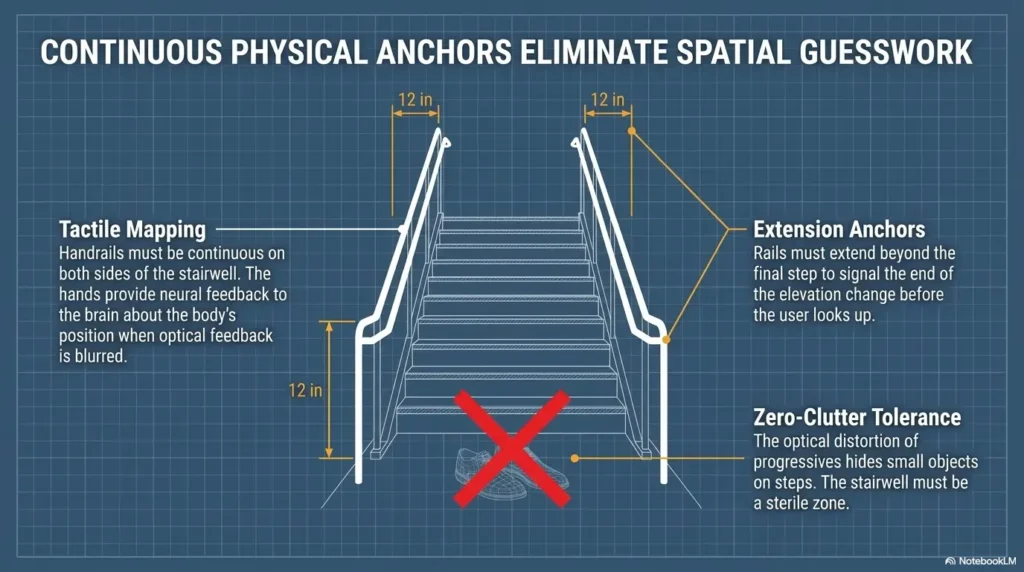
Clear clutter, rugs, cords, and “temporary” hazards
Temporary hazards love becoming permanent. A box “just for now” at the top of the stairs. A loose runner. A charging cord. Shoes parked on the landing like tiny traffic cones.
Clear the stairs completely. Keep landings open. Remove loose rugs near the top and bottom. Tape or route cords away from walking paths.
Handrails on both sides: boring, beautiful, effective
Handrails on both sides give options. This helps people with weakness on one side, joint pain, low vision, or a carrying habit they are trying to quit.
Rails should be secure, easy to grip, and continuous where possible. A rail that stops early is like a sentence with the last word missing.
- Add even lighting.
- Increase step-edge contrast.
- Use secure handrails and clutter-free landings.
Apply in 60 seconds: Stand at the top of the stairs and check whether you can clearly see the first three step edges.
When Progressives May Not Be the Best Stair Option
Progressives are useful for many people. They are not sacred tablets. If they make certain walking situations unsafe, ask about alternatives.
Single-vision distance glasses for risky walking situations
Some older adults may benefit from a separate pair of single-vision distance glasses for outdoor walking, stairs, or unfamiliar places. This is a conversation to have with an eye-care professional, especially for anyone with a fall history.
The trade-off is inconvenience. You must remember which glasses are for which task. But if one pair makes stairs clearer, inconvenience may be cheaper than a fall.
Occupational or task-specific lenses for certain needs
Occupational lenses can be designed for specific tasks, such as computer work, music reading, crafts, or kitchen tasks. They are not usually walking glasses. That distinction matters.
If a lens is designed for a desk distance, it may be the wrong tool for stairs. A violin bow and a garden rake are both useful. Swap them and the afternoon becomes strange.
When bifocals, progressives, and mobility needs collide
Bifocals have a visible line and a more abrupt change between distance and near zones. Progressives have no visible line but include a gradual shift. Both can affect stair judgment if the lower near area is used while walking.
The best option depends on prescription, habits, fall risk, visual conditions, and daily tasks. Do not choose based on fashion alone. Choose based on what lets you move safely.
A careful conversation to have with your eye doctor
Ask direct questions:
- Could my progressive lens design be affecting stairs?
- Is the fitting height correct?
- Would single-vision distance glasses be safer for walking or stairs?
- Could cataracts, double vision, glaucoma field loss, or another condition be involved?
- Should I be evaluated for balance or medication-related dizziness?
If peripheral vision loss is part of the picture, glaucoma field loss home safety can help you think beyond the lens and into room layout, contrast, and pathway planning.
Money Block: Lens Option Coverage Map
| Option | Best For | Stair Caution |
|---|---|---|
| Progressives | All-day mixed distance use | Avoid looking through lower near zone on stairs |
| Bifocals | Clear distance and near split | Lower segment can still disrupt step judgment |
| Single-vision distance | Walking, stairs, outdoor movement | May require separate reading glasses |
| Task-specific lenses | Computer, crafts, music, kitchen tasks | Often not appropriate for walking |
Neutral action line: Ask your eye-care professional which lens option matches your highest-risk daily movement task.
Caregiver Watchlist: Small Clues Before a Big Fall
Caregivers often notice the story before the person wearing the glasses can name it. Watch the hands, the pause, the little negotiations at the top step.
Hesitating at the first step
A pause is not always bad. A safety pause is good. But hesitation mixed with fear, confusion, or repeated false starts may mean the stairs are visually unclear.
Holding walls instead of rails
Walls are not designed as grip systems. If someone reaches for walls while ignoring the rail, the rail may be hard to reach, poorly placed, or not trusted. Or the person may be reacting too late.
Removing glasses before stairs
If a senior removes progressives before stairs, ask why. The answer may reveal distortion, blur, glare, or fear. Do not scold. Investigate.
Complaining that steps “move,” “dip,” or “blur”
These words are important. Write them down. They can help an optician or eye doctor understand whether the issue sounds like lens fit, adaptation, prescription, double vision, cataract, or another visual problem.
Near-falls count, even when no one gets hurt
A near-fall is not nothing. It is a gift wrapped in a rude package. Use it to adjust the environment, glasses, routine, or medical plan before injury happens.
For family conversations that feel tender, offering help to someone with low vision can make the safety talk feel less like criticism and more like teamwork.
- Notice grabbing, freezing, or removing glasses.
- Ask what the stairs look like, not just how the person feels.
- Track near-falls before a serious fall occurs.
Apply in 60 seconds: Ask, “Do the steps look clear, or do they shift, blur, or dip?”
Next Step: Do One Stair Safety Test Today
You do not need to renovate the house before dinner. Start with one staircase, one calm test, and one honest observation.
Walk one familiar staircase slowly with the rail
Choose a familiar staircase. Turn on the lights. Wear your usual stair shoes. Put one hand on the rail before the first step. Pause for two seconds. Lower your chin slightly. Walk slowly.
Notice blur, distortion, hesitation, or missed depth
After the test, write down what happened:
- Did the step edges look clear?
- Did the stairs seem to float, dip, blur, or curve?
- Did you grab the wall?
- Did you feel dizzy or unsteady?
- Did a different pair of glasses feel safer?
Check lighting, shoes, frame fit, and handrail access
Look for the simple culprits first. Dim light. Worn slippers. A frame sliding down. A rail that starts too late. A patterned runner that hides edges. A basket sitting on the landing like it pays rent.
Book an eye-care check if the stairs still feel unsafe
If the same staircase still feels unsafe after lighting, footwear, and rail habits are improved, schedule a professional check. Bring your notes. Specific details save time.
Money Block: 3-Input Stair Risk Mini Calculator
Use this simple self-check for planning only. It does not diagnose fall risk.
Result: Enter your numbers and calculate.
Neutral action line: Use the result to decide what to fix first, not to replace professional care.
When to Seek Help
Some stair issues should not be managed with habit changes alone. The line is simple: if the problem is repeated, sudden, neurological, painful, or frightening, get help.
Repeated near-falls or fear of stairs
Repeated near-falls deserve attention even without injury. Fear of stairs can also shrink daily life. People may stop using parts of the home, avoid social visits, or carry less because they no longer trust their feet.
That kind of fear is not weakness. It is data.
Sudden blurry vision, double vision, or loss of vision
Sudden vision changes should be evaluated promptly. Double vision, a curtain-like shadow, sudden loss of vision, new severe eye pain, or a sudden shower of floaters can signal conditions that need urgent care.
If double vision is already part of the story, prism glasses for double vision may help explain why stairs can feel especially confusing.
Dizziness, fainting, weakness, numbness, or confusion
These symptoms may point beyond the glasses. They can involve blood pressure, medication effects, vestibular problems, neurological issues, or other medical concerns. Do not try to solve them with tape on the stair edge alone.
New trouble after medication changes
Medication changes can affect dizziness, alertness, blood pressure, sleepiness, and vision. Seniors managing several prescriptions may benefit from a medication review with a clinician or pharmacist.
A simple written list, like the approach in one-page medication list template, can make that conversation easier.
Pain, head injury, or inability to walk normally after a fall
After a fall, do not minimize head injury, new pain, swelling, confusion, or trouble walking. Get medical advice. The staircase can wait. The brain, hip, wrist, and spine should not have to negotiate.
- Sudden symptoms need prompt care.
- Repeated near-falls deserve professional review.
- Medication and balance changes should be part of the conversation.
Apply in 60 seconds: Save a note on your phone or paper with the exact symptom that worries you most.
FAQ
Are progressive glasses safe for seniors on stairs?
Progressive glasses can be safe for many seniors, but stairs require extra care. The lower part of the lens is usually for near vision, so looking down through that zone can make step edges harder to judge. Seniors should use the distance zone, lower the chin slightly, hold the rail, and improve stair lighting.
Why do stairs look blurry with progressive lenses?
Stairs may look blurry because progressive lenses contain different viewing zones. If your eyes look through the lower near zone while walking down, the steps may appear distorted, closer, lower, or less stable. Poor frame fit, an outdated prescription, cataracts, or contrast problems can also contribute.
Should seniors look down when walking downstairs with progressives?
Seniors should check the steps, but not by dropping only the eyes into the reading zone. A safer habit is to lower the chin slightly while keeping the view through a clearer distance area of the lens. Use the handrail before starting down.
How long does it take to adjust to progressive glasses?
Adjustment time varies. Some people adapt within days, while others need longer, especially after a major prescription or frame change. If stairs still look warped, floaty, or unsafe after practice, ask the optician or eye doctor to check the lens fitting and prescription.
Are bifocals or progressives better for stairs?
Neither is automatically better for every person. Bifocals have a visible near segment, while progressives blend powers gradually. Both can interfere with stair judgment if the lower near area is used while walking. Seniors with fall risk should ask whether single-vision distance glasses may be safer for walking situations.
Can progressive lenses cause falls?
Progressive lenses may contribute to falls in some older adults by changing depth perception, peripheral clarity, or step-edge judgment, especially on stairs and unfamiliar surfaces. Falls usually have multiple causes, including lighting, footwear, balance, medications, clutter, and health conditions.
Should I wear different glasses for walking outside or using stairs?
Some seniors may benefit from separate single-vision distance glasses for walking, stairs, or outdoor activity. This should be discussed with an eye-care professional because the best choice depends on prescription, fall history, daily routines, and vision conditions.
What should I ask my eye doctor if stairs feel unsafe?
Ask whether your progressive lens fitting height, frame position, prescription, cataract status, depth perception, peripheral vision, or double vision could be affecting stairs. Also mention dizziness, medication changes, near-falls, and whether the problem happens more in dim light or unfamiliar places.
Conclusion: Make the First Step Boring Again
The first step down should not feel like a tiny negotiation with gravity. If progressive glasses make stairs look strange, the answer is not to rush, guess, or blame yourself. The answer is to make the visual task clearer and the movement routine safer.
Use the distance zone. Lower the chin slightly. Hold the rail before moving. Improve lighting and contrast. Wear secure shoes. Check whether the frames are slipping. Ask for professional help when blur, distortion, dizziness, or near-falls keep showing up.
Your 15-minute next step: choose one staircase today, turn on the best lighting, clear the landing, put on safe shoes, hold the rail, and walk it slowly while noticing whether the step edges look clear. If they do not, write down exactly what you see and book a glasses or eye-care check.
Boring stairs are beautiful stairs. Let them be boring again.
Last reviewed: 2026-05.