

Senior Vision Safety Guide
How Seniors Can Adjust to Progressive Lenses
Without Feeling Dizzy
New progressive lenses can feel strangely personal. One moment the kitchen counter looks crisp; the next, the hallway seems to sway like a boat that has read too much poetry. For seniors, that “swimmy” feeling is not just annoying. It can change confidence, walking speed, stair safety, and whether the glasses end up in a drawer by Thursday.
The goal is not to tough it out blindly. The goal is to train your eyes and brain safely, while knowing when the problem may be the lenses, the frame fit, the prescription, or a medical issue that should not be blamed on glasses. A good adjustment plan feels less like a test and more like learning a new room in soft morning light.
This guide is written for seniors, caregivers, and adult children who want practical steps: how to walk, read, use screens, handle stairs, compare options, avoid needless remakes, and decide when to call the optician or eye doctor. No panic. No shrugging. Just clear footing.
Safer first week
A gentle routine for wearing progressives without turning stairs into a surprise exam.
Fit-check clarity
What to ask before paying for a remake, upgrade, or second opinion.
Caregiver-friendly
Simple ways to help a parent adjust without hovering like a nervous chandelier.
One safe walk, one clear note, one useful conversation with the optician can save a lot of frustration. 👓
Snapshot
This article is for seniors adjusting to new progressive lenses and for caregivers helping a parent avoid dizziness, falls, eye strain, and unnecessary lens remakes. You will learn how progressive lens zones work, how to practice safely, when to compare lens or frame options, and when symptoms deserve professional help.
Table of Contents
Before You Act: Dizziness Is Not Always “Just the Glasses”
Progressive lenses can cause temporary blur, distortion, eye strain, or a mild floating sensation while your brain learns the new lens zones. That part is common enough that many opticians warn people ahead of time.
But dizziness in older adults deserves respect. It can increase fall risk, especially during stairs, curbs, nighttime bathroom trips, parking lots, and busy stores. It can also come from blood pressure changes, medication side effects, inner ear problems, neurological symptoms, dehydration, infection, or other medical issues.
Key takeaway
Mild adjustment discomfort can be normal. Sudden, severe, worsening, one-sided, or fall-related dizziness should be treated as a safety issue, not as a patience test.
What this guide can and cannot do
This guide can help you practice safer lens use, spot common progressive lens mistakes, prepare better questions for an optician, and decide when to contact an eye doctor or healthcare professional.
It cannot diagnose the cause of dizziness, confirm whether your prescription is correct, or decide whether progressive lenses are right for your medical situation. If dizziness feels unsafe, the wisest move is to pause, sit down, and get help rather than trying to “win” against the glasses.
When caregivers should pay attention
If a parent says, “These glasses make the floor move,” take that sentence seriously. It may be normal lens adaptation, but it also means the person may misjudge steps, rugs, thresholds, and curbs.
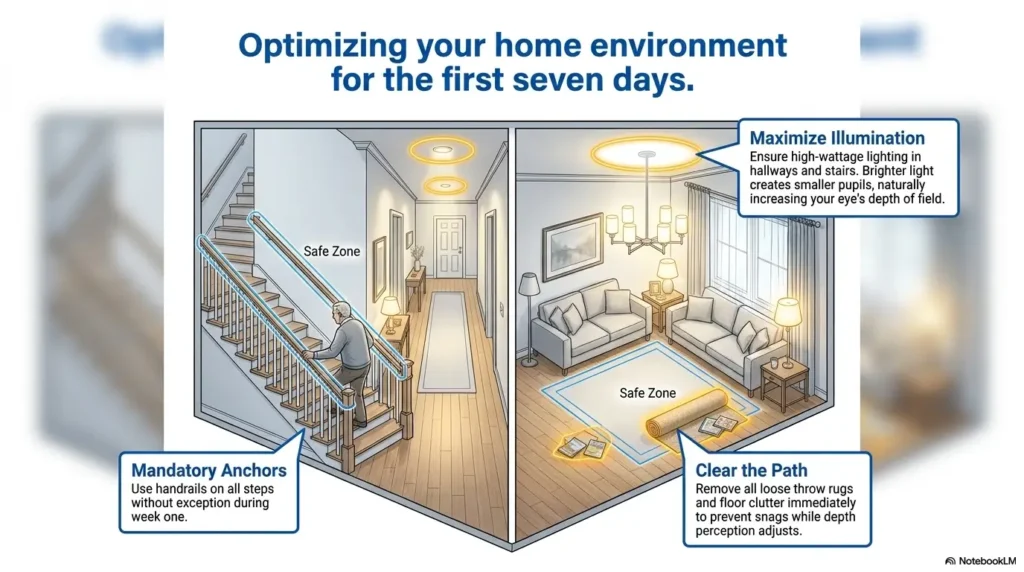
During the first week, caregivers can help by improving lighting, clearing walkways, encouraging handrail use, and writing down what feels difficult. A few practical notes are more useful than a dozen worried reminders.
Why Progressive Lenses Can Feel Dizzy at First
Progressive lenses are not one single prescription spread evenly across the whole lens. They are more like a quiet staircase of vision: distance at the top, intermediate vision through the middle, near vision lower down, with areas of blur or distortion toward the sides.
That design is useful because it avoids the visible line of bifocals. It can help with driving, cooking, reading, TV, menus, and everyday tasks. But the trade-off is that your eyes and brain must learn where to look.
The invisible zones your brain has to map
With single-vision glasses, you often look through many parts of the lens and get a similar result. With progressive lenses, looking through the wrong zone can make a clear object appear blurry or oddly tilted.
For example, looking down through the reading area while walking can make the floor seem closer, farther, or slightly curved. Glancing sideways instead of turning your head can push your view into the peripheral blur zone. The lens has not become a carnival mirror, but your brain may briefly complain as if it has.
Why side blur can feel like motion
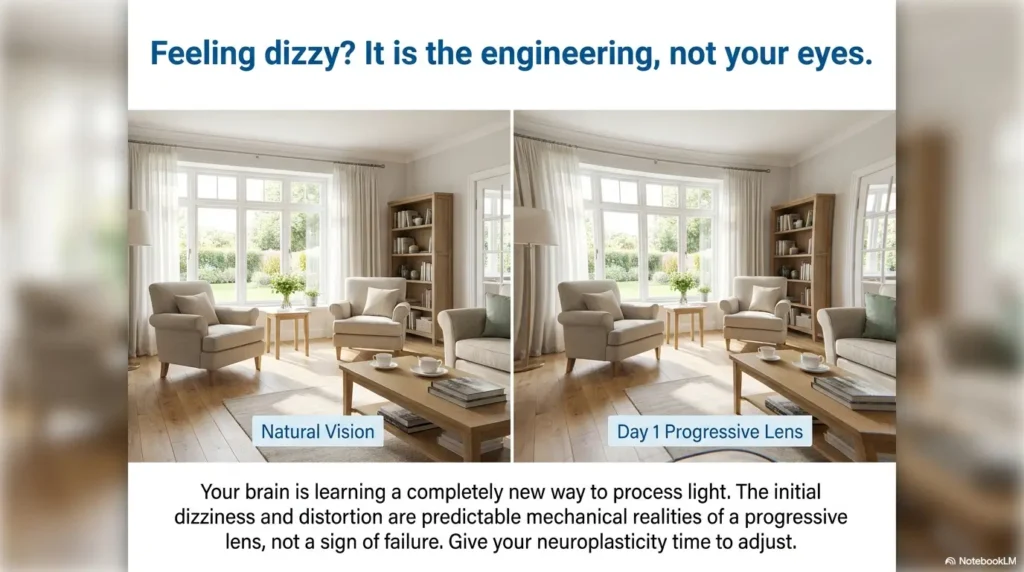
Many people describe progressive lens dizziness as “swim,” “wobble,” “floating,” or “the floor bending.” This often comes from peripheral distortion, especially when the head moves quickly or the eyes glance sideways without head movement.
Seniors may notice it more because depth perception, contrast sensitivity, balance, neck mobility, cataract changes, dry eye, or medication effects can already make visual processing less forgiving. The progressive lens is one more instrument joining the orchestra. At first, it may be playing a little sharp.
Progressive lens zones, in plain English
- Top zone: distance vision, such as TV, walking ahead, and across-the-room objects.
- Middle corridor: intermediate vision, such as counters, shelves, and some computer work.
- Lower zone: reading vision, such as books, phones, menus, and labels.
- Side areas: more distortion, especially noticeable when walking or turning quickly.
Strange does not always mean wrong
A strange first afternoon does not automatically mean your progressive lenses were made incorrectly. The brain often needs repeated, safe exposure to learn the new visual map.
That said, “give it time” should not be used as a blanket excuse. If the lenses feel impossible, if one eye seems off, if the frame slides constantly, or if symptoms do not steadily improve, a recheck is reasonable.
The First 72 Hours Matter More Than Most People Think
The first few days set the tone. Some people try new progressives in the hardest possible places: parking lots, polished grocery floors, escalators, crowded restaurants, or stairs. That is like learning piano during a thunderstorm while someone keeps moving the bench.
Start where the environment is predictable. Familiar rooms let your brain focus on lens learning without also solving a maze of glare, motion, and uneven flooring.
Start with safe indoor tasks
On day one, put the glasses on while seated. Look at a wall clock, a picture frame, a TV screen, a book, and a countertop. Move slowly between near and far objects.
Then stand near a stable surface, such as a counter or chair back. Practice turning your head toward objects rather than sliding your eyes sideways. The goal is not speed. The goal is predictable vision.
Use bright, even lighting
Poor lighting makes the brain guess. Smudged lenses, dim hallways, glossy floors, and low contrast can multiply the dizzy feeling.
During the first 72 hours, use steady lighting in the kitchen, bathroom, hallway, and reading spot. Avoid testing progressives in twilight, rain, or a cluttered room where the floor and furniture blend into the same gray soup.
Avoid hero mode
Do not make stairs, ladder work, driving, or busy errands your first serious test. Even if you are usually confident, progressive lens adjustment changes how your eyes use space.
For caregivers, this is the moment to be practical rather than dramatic. Offer a handrail reminder, not a lecture. Clear the hallway, improve lighting, and ask what feels strange: distance, reading, side vision, or steps.
Key takeaway
The first 72 hours should happen mostly in boring places. Boring is excellent when your brain is learning a new lens map.
Don’t Switch Back and Forth All Day Unless Safety Requires It
One of the most common progressive lens adjustment mistakes is wearing the new glasses for ten minutes, feeling odd, switching to old glasses, trying again later, switching back again, and repeating this until everyone in the house becomes tired of hearing the glasses case snap shut.
The brain adapts through consistent use. Constant switching can slow that learning because the old pair keeps inviting your visual system back to yesterday’s habits.
When switching is reasonable
Safety comes first. If the progressive lenses make you feel unsteady on stairs, while driving, or while walking outside, use a safer option and contact your optician or eye doctor for guidance.
Switching may also be reasonable for a specific task your new lenses are not suited for yet, such as long computer sessions. The key is to avoid random switching every time the lenses feel unfamiliar.
How to build wearing time without forcing discomfort
Start with safe blocks of time. For many seniors, that may mean morning indoor use, then a rest, then another indoor session. As comfort improves, add short walks in familiar areas.
What you are looking for is steady improvement. If day four feels exactly as bad as day one, write down the problems and schedule a recheck.
Safer wearing-time ladder
- Wear the glasses seated in a familiar room for 20 to 30 minutes.
- Stand and look around slowly near a counter or chair.
- Walk across a clear room with good lighting.
- Use them for simple kitchen or TV tasks.
- Add short hallway walks, then familiar outdoor walks.
- Delay harder settings until dizziness is clearly improving.
The Head-Turn Rule: Let Your Nose Lead the Way
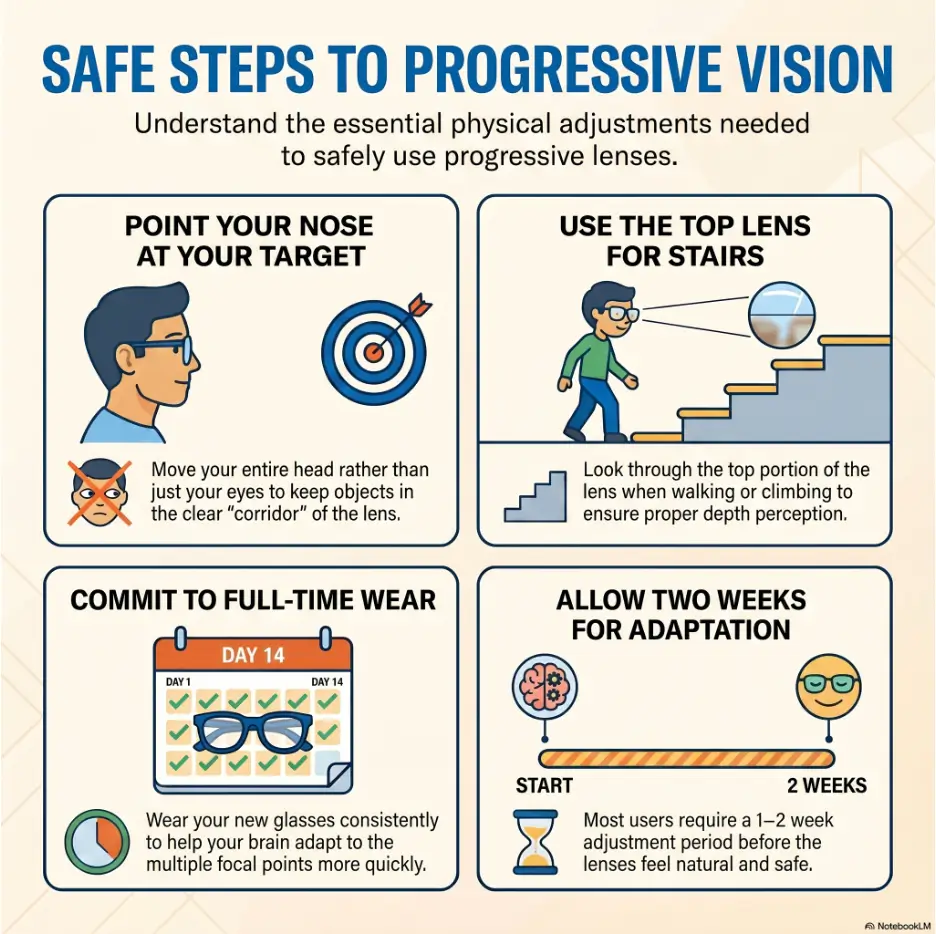
Progressive lenses reward head movement. If you only move your eyes, you may keep landing in the side distortion zones. If you turn your head toward what you want to see, you are more likely to use the clearest part of the lens.
Think of your nose as the pointer. Want to see the doorframe? Point your nose. Want to read a label? Point your nose and lower your gaze into the reading area. Want to check the side aisle at the store? Turn your head instead of throwing your eyes sideways like they are late for a bus.
Practice with doorways and counters
Doorways, countertops, cabinet handles, and TV captions are useful practice objects. They are familiar, stable, and easy to check for blur.
Stand still first. Turn your head slowly toward the object. Notice when the image becomes sharp. That sharp spot is the part your brain needs to find more quickly over time.
Reading with progressives
For reading, hold the material lower than you might with single-vision readers. Look through the lower portion of the lens, not the top distance zone.
If you have to tilt your head far back to read, or if you can only read through a tiny uncomfortable spot, the segment height, frame fit, or lens design may need review.
Walking with progressives
When walking, look ahead through the distance zone. Avoid staring down through the reading area as you move. If you need to inspect the floor, stop first, then look.
This small habit matters. Moving while looking through the lower reading zone can distort depth and make the floor seem unreliable.
The Progressive Lens Safety Flow
1. Light
Use bright, even rooms first.
2. Fit
Check slipping, tilt, and comfort.
3. Turn
Point your nose toward objects.
4. Pause
Stop before stairs and curbs.
5. Recheck
Ask for help if improvement stalls.
Stairs, Curbs, and Grocery Aisles Are the Sneaky Tests
Stairs deserve their own section because they combine depth perception, balance, movement, and confidence. Progressive lenses can make steps feel closer or farther at first, especially when looking down through the near-vision zone.
Curbs, escalators, uneven sidewalks, glossy floors, and grocery aisles can create the same challenge. The environment is moving, the lighting changes, and the lens zones are still new.
How to use stairs safely while adjusting
Use the handrail every time during the adjustment period. Look through the distance portion of the lens before stepping down. Pause, orient yourself, then move.
Do not rush because the stairs are familiar. Familiar stairs are still stairs. They do not become friendlier because you have known them for twelve years.
Stair safety checklist
- Use a handrail even if you normally do not need one.
- Pause before the first step.
- Look ahead through the upper distance zone, not down through the reading zone.
- Keep stairs well lit and free of loose objects.
- Avoid carrying large laundry baskets or bags during early adjustment.
- Ask for a recheck if steps still look distorted after steady practice.
Caregiver support without making it awkward
A caregiver can help by walking nearby, turning on lights, and encouraging the person to pause. Avoid grabbing an arm suddenly unless there is immediate danger. Sudden touch can startle someone and make balance worse.
A useful phrase is: “Let’s test the first step slowly.” It gives support without turning the moment into a performance review.
Common Mistakes and the Fit Check That Saves Money
Not every progressive lens problem requires a remake. Sometimes the issue is wearing habits, frame slippage, dirty lenses, poor lighting, or using the wrong lens zone. Other times, the glasses truly need adjustment.
The expensive mistake is guessing. A short, specific fit check can save money, time, and that weary feeling of owning glasses you avoid.
Mistakes that make dizziness worse
| Common mistake | Why it causes trouble | Safer alternative |
|---|---|---|
| Wearing progressives only for reading | Your brain never learns the full distance-to-near map. | Use them for safe daily tasks, not only books and phones. |
| Walking while looking through the lower zone | The floor may appear distorted or too close. | Look ahead through the distance zone and stop before looking down. |
| Judging them after one bad afternoon | Early discomfort can improve with safe practice. | Track symptoms for several days unless the dizziness feels unsafe. |
| Ignoring smears and glare | Smudges add blur on top of lens distortion. | Clean lenses properly and improve room lighting. |
| Letting the frame slide down | The visual zones shift out of position. | Ask the optician to adjust nose pads, temples, and frame tilt. |
Fit measurements that matter
Progressive lenses depend heavily on measurement. Pupillary distance, fitting height, frame angle, lens placement, and how the frame sits on the nose all affect comfort.
If the lenses feel unusable, ask the optician to check the measurements while you are wearing the frame the way you naturally wear it. A frame that was measured perfectly on paper but slides during real life can create moving blur.
Good, better, best options before spending more
Progressive lenses come in different designs and price ranges. A premium lens is not automatically necessary for everyone, but some people do benefit from wider usable zones, better customization, or task-specific lenses.
| Option | May be enough when | Questions to ask before paying |
|---|---|---|
| Good: frame adjustment and recheck | The frame slips, sits crooked, or feels different throughout the day. | Can you recheck fitting height, tilt, nose pads, and pupillary distance? |
| Better: lens design review | You need wider zones for daily walking, reading, or household tasks. | Would a different progressive design better match my main activities? |
| Best: task-specific pair | Screens, crafts, music, cooking, or desk work dominate your day. | Would computer progressives, office lenses, or dedicated readers be safer? |
Before buying a second pair, ask what problem the upgrade is meant to solve. “Better lenses” is vague. “A wider intermediate zone for laptop work” is a useful shopping sentence.
Key takeaway
Do not pay for a remake or upgrade until the frame fit, measurements, lens cleaning, and main-use problem have been checked clearly.
Questions to ask the optician
- Can you check whether the frame is sitting at the same height as when it was measured?
- Can you verify the pupillary distance and fitting height?
- Is the frame tilted correctly for progressive lenses?
- Could slipping nose pads be shifting the reading or distance zones?
- Does my daily routine suggest a different lens design?
- Would a separate computer or reading pair reduce strain for long tasks?
- What is the remake or adjustment policy, and how long do I have to decide?
Screens, Phones, and Reading Distance Can Make Progressives Feel Worse
Many seniors expect books to be the hard part. Often, the real troublemaker is the laptop. Screens sit higher and farther away than a book, and that can force the eyes into an awkward zone between distance and reading.
If the neck tilts up, the chin floats, and the shoulders tighten, the problem may not be your willingness to adapt. It may be the workstation setup.
Why laptops are harder than books
A book can usually be moved into the lower reading zone. A laptop screen may sit too high for the near zone and too close for the distance zone. The result is chin-lifting, neck strain, blur, and frustration.
Desktop monitors can be adjusted more easily. Lowering the monitor slightly, increasing font size, improving contrast, and reducing glare may help before you assume the lenses are wrong.
Phone reading tips
Hold the phone lower and centered. Increase text size so you are not hunting for a tiny clear spot. Clean the screen and the lenses because small smears can turn progressive adjustment into a fog parade.
If medication labels, appointment texts, or banking codes are hard to read, do not rely on squinting. Use accessibility settings, large print labels, or a magnifier when needed.
When computer progressives may be worth asking about
If you spend long hours at a computer, standard everyday progressives may not be the best single tool. Computer progressives or office lenses may provide more comfortable intermediate and near vision, though they are usually not meant for driving or general walking.
Ask your eye-care provider what the lenses are designed to do and not do. A task-specific pair can be useful when it solves a clear problem. It is less useful when bought out of desperation after one blurry afternoon.
Show me the nerdy details
Progressive lenses change optical power gradually from distance to near. That gradual change creates a usable corridor, but it also creates areas of unwanted blur toward the sides. The stronger the prescription change, the more noticeable the adaptation may feel for some wearers.
Frame size and shape matter because the lens needs enough vertical space for distance, intermediate, and near zones. A very small frame can squeeze the corridor. A loose frame can shift the corridor. A tilted frame can make the wearer chase clarity with head posture.
This is why “progressives make me dizzy” is not one problem. It can mean normal adaptation, poor fit, wrong task match, prescription change, eye alignment issue, dry eye blur, balance concerns, or a separate medical cause.
A Gentle 7-Day Progressive Lens Training Routine
A routine helps because it turns vague advice into visible progress. The point is not to force discomfort. It is to learn safely and notice whether things are improving.
Use this routine as a practical starting point. Adjust it based on safety, eye-care instructions, and any medical concerns.
Day 1 to 2: indoor mapping
Wear the glasses in a bright, familiar room. Practice looking at distance objects, intermediate objects, and reading material. Turn your head slowly toward targets.
Use seated tasks first: TV, reading a large-print note, looking at a wall clock, or sorting mail. Then try slow walking across a clear room.
Day 3 to 4: short familiar walks
Add short walks in familiar indoor spaces. Use handrails on stairs. Avoid rushing, carrying heavy items, or walking while looking through the reading zone.
Caregivers can observe without turning the room into a clinic. Notice whether the person hesitates at thresholds, reaches for walls, or complains that the floor bends.
Day 5 to 6: daily tasks and light errands
Try kitchen tasks, TV captions, short phone reading, and light errands if indoor use is improving. Choose well-lit places and avoid crowded rush-hour settings.
Do not make driving the experiment if you feel dizzy or visually uncertain. Ask your eye doctor or optician before using new progressives for driving if distance judgment feels off.
Day 7: review what improved and what did not
By the end of a week, many people should notice at least some improvement. It may not be perfect, but the direction should feel better.
If nothing is improving, or if dizziness is strong, unsafe, or linked to nausea, falls, double vision, or headaches, contact the appropriate professional. Your notes will make that conversation much more useful.
| Day | Main goal | Avoid for now | What to note |
|---|---|---|---|
| 1 to 2 | Safe indoor use | Stairs, driving, busy stores | Blur zone, dizziness level, reading comfort |
| 3 to 4 | Slow walking in familiar spaces | Fast head turns and carrying loads | Floor distortion, thresholds, balance |
| 5 to 6 | Daily tasks and light errands | Crowds, escalators, low-light walking | Screens, phone, stairs, fatigue |
| 7 | Decide if progress is clear | Ignoring persistent unsafe symptoms | What improved, what stayed unsafe |
Short Story: The Hallway Test
Mrs. Harris picked up her new progressives on a Tuesday and declared them “a tiny roller coaster.” Her daughter wanted to march straight back to the optical shop. Mrs. Harris wanted to put the glasses in a drawer and pretend Tuesday had never happened.
Instead, they made a hallway plan. Good lighting. Clear floor. One hand near the wall. Ten slow steps, then a note: “Fine looking ahead. Strange looking down. Phone hard. TV okay.”
By Friday, walking felt better. Reading still felt awkward. At the recheck, the optician adjusted the slipping frame and showed her where the reading zone started.
The lesson was not that every problem disappears with patience. It was that careful notes turn a vague complaint into a solvable map.
When to Seek Help Instead of Toughing It Out
Progressive lens adjustment should become safer and more predictable over time. If the experience stays chaotic, do not keep pushing without a recheck.
There are two kinds of help to consider: optical help for lens and frame issues, and medical help for dizziness or visual symptoms that may not be caused by the glasses.
Call the optician when
- The frame slides down your nose or feels crooked.
- You must tilt your head in an extreme way to see clearly.
- Reading is only clear through a tiny uncomfortable spot.
- Distance vision is blurry even when you look straight ahead.
- One side feels noticeably worse than the other.
- Symptoms do not steadily improve with safe, consistent use.
Call the eye doctor or healthcare professional when
- Dizziness is sudden, severe, worsening, or unsafe.
- You have double vision, vision loss, new severe headache, weakness, confusion, or trouble speaking.
- You fall, nearly fall, or start avoiding normal walking because of symptoms.
- You have nausea, spinning vertigo, one-sided symptoms, or new balance problems.
- You recently changed medication, blood pressure treatment, or dosage.
- You have a history of stroke, neurological issues, inner ear problems, or major eye disease.
Key takeaway
Do not let new glasses become the convenient explanation for every symptom. If dizziness feels medical, sudden, or unsafe, get professional guidance promptly.
What to bring to the appointment
Bring your new glasses, old glasses, and a short symptom note. Include when dizziness happens, what tasks trigger it, whether one eye seems worse, and whether stairs or screens are the biggest problem.
If medications recently changed, bring an updated medication list or ask a caregiver to help prepare one. Glasses are part of the story, but they may not be the whole story.
FAQ
How long does it take seniors to adjust to progressive lenses?
Many people need several days to a couple of weeks to feel more comfortable, but the timeline varies. Seniors may need a slower, safer routine if balance, stairs, lighting, or stronger prescription changes are involved. The key sign is steady improvement, not instant perfection.
Is dizziness normal with new progressive glasses?
Mild dizziness or swimmy vision can happen during adjustment. Severe dizziness, sudden dizziness, dizziness with falls, or dizziness with neurological symptoms is not something to dismiss. Sit down, avoid risky walking, and contact a qualified professional if symptoms feel unsafe.
Why do stairs feel strange with progressive lenses?
Stairs can feel strange because looking down may send your gaze through the lower reading area, which can alter depth perception. Use handrails, pause before stepping, and look through the distance zone as much as possible while moving.
Should seniors wear progressive lenses all day?
Consistent use often helps adaptation, but safety comes first. If the lenses make walking, stairs, or driving feel unsafe, use a safer option and ask your optician or eye doctor for guidance. Do not force all-day wear through severe symptoms.
Can progressive lenses cause headaches or nausea?
They can contribute to headaches or nausea during adjustment, especially if the prescription changed, the frame fit is off, or the wearer is searching for the clear zones. Persistent, severe, or worsening symptoms should be checked.
Are bifocals easier than progressives for older adults?
Sometimes. Bifocals have a visible line and clearer separation between distance and near zones, which some people prefer. Progressives offer smoother transitions and no visible line, but they require more adaptation. The best option depends on walking safety, reading needs, screen use, and comfort.
What should I do if my progressive lenses still feel blurry?
Clean the lenses, check lighting, use the head-turn rule, and note when blur happens. If blur stays the same or feels one-sided, ask the optician to recheck fit, measurements, and lens placement. If vision changes suddenly, contact an eye doctor.
Can the wrong frame make progressive lenses harder to use?
Yes. A frame that is too small, too loose, tilted poorly, or slipping down the nose can shift the useful lens zones. Frame fit is not cosmetic trivia. With progressives, it is part of the prescription experience.
Should I go back to the optician or the eye doctor?
Go to the optician for frame adjustment, measurement checks, lens placement concerns, and lens design questions. Contact the eye doctor or healthcare professional for sudden vision changes, double vision, severe dizziness, falls, neurological symptoms, or symptoms that may not be optical.
Do One Safe Fit-and-Walk Test Today
The best next step is small enough to do today and specific enough to matter. You do not need a grand plan, a shopping spree, or a dramatic verdict on the glasses. You need one safe test and one clear note.
Put the progressive lenses on in a well-lit room. Check distance vision first by looking across the room. Then check reading while seated. Then stand near a wall, counter, or railing and walk slowly for a short distance.
Your 15-minute fit-and-walk note
- Distance vision: clear, blurry, or uneven?
- Reading: comfortable, too low, too narrow, or strained?
- Walking: steady, swimmy, or unsafe?
- Stairs or curbs: normal, strange, or not ready to test?
- Frame fit: stable, sliding, crooked, or pressing?
- Symptoms: improving, unchanged, worsening, or severe?
If the note shows steady improvement, keep practicing safely. If the note shows persistent blur, sliding frames, stair distortion, or dizziness that worries you, bring the glasses and the note back to the optician or eye doctor.
Progressive lenses should help daily life feel clearer, not smaller. The right approach is patient, but not passive: use the glasses consistently in safe places, respect stairs, compare options carefully, and ask for help when the evidence on your little note says it is time.
Last reviewed: 2026-07