
When Stairs Blur: Navigating Progressive Lenses Safely
That uneasy feeling on the stairs isn’t clumsiness or “just aging”—it’s an optical riddle. Progressive lenses are designed for reading at the bottom, not for judging distant steps. A missed step can mean a sudden loss of independence, but you do not have to “tough it out.” Start with the lens, check the stairs, and change the habit.
Understand why stair edges look wrong through progressives.
Know when adaptation is normal and when it is risky.
Use a 10-minute home check before your next descent.
Talk to an eye doctor with better words than “these feel weird.”
Quick Safety Snapshot
The core issue: stairs are not close reading, but many people look down through the lower reading zone of progressive lenses when descending. That can make step edges blurry, distorted, or harder to place in space.
The safer approach: pause before the first step, look through the distance portion of the lens, hold the rail, improve contrast and lighting, and ask an eye doctor to check lens fit if the problem persists.
Do not ignore: falls, near-falls, dizziness, sudden vision changes, double vision, severe headaches, or new weakness. Those deserve prompt professional help.
Table of Contents
Safety Disclaimer
This guide is for general education and home-safety planning. It is not a diagnosis and cannot replace care from an optometrist, ophthalmologist, primary care clinician, physical therapist, occupational therapist, or emergency professional.
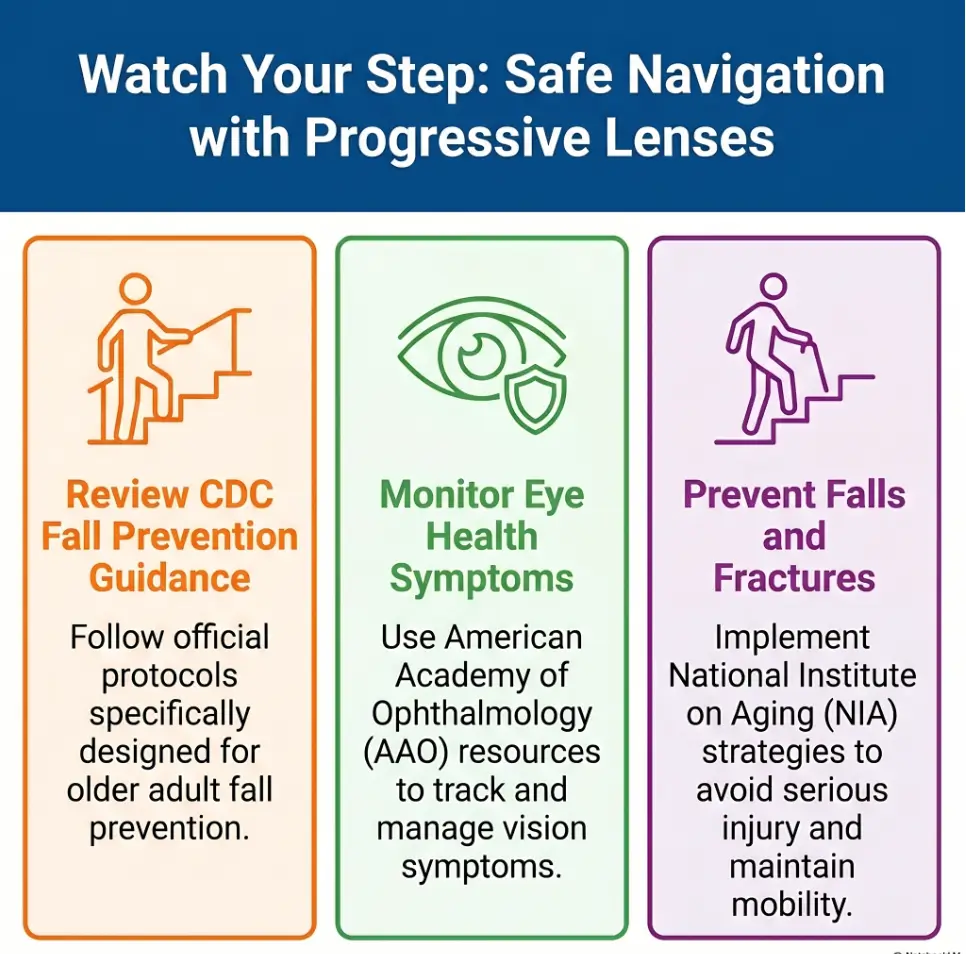
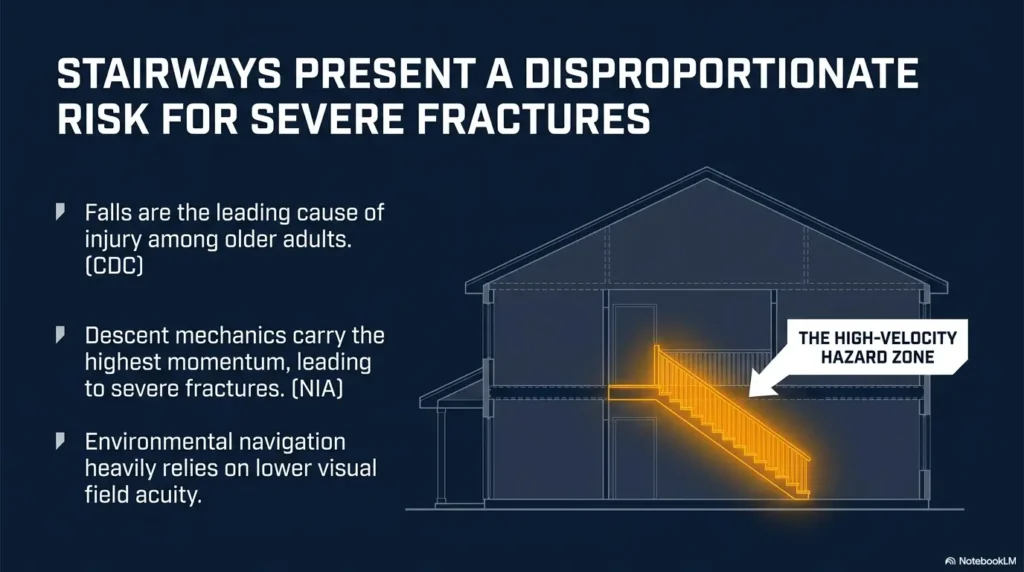
Any older adult who feels newly unsafe on stairs, has fallen, has nearly fallen, feels dizzy, notices double vision, or recently changed glasses should contact a qualified professional. Falls in adults 65 and older can cause serious injury, and vision is only one part of the bigger fall-risk puzzle.
New stair fear deserves respect. It is not “being dramatic.” It is the body tapping a little brass bell and saying, “Let’s check the system before the system checks the floor.”
- Vision changes can affect fall risk.
- Stairs require depth, contrast, balance, and timing.
- A professional review is wise after falls, near-falls, dizziness, or sudden changes.
Apply in 60 seconds: Write down when the stairs feel worst: morning, evening, dim light, carpeted steps, outdoor steps, or while carrying objects.
The Stair Problem Isn’t “Clumsiness”
Older adults often describe this problem quietly. They say, “I’m just not as steady as I used to be,” or “I don’t know why I hate the basement stairs now.” Family members may notice a parent gripping the handrail harder, pausing at the top step, or avoiding laundry trips.
But progressive lenses can change how the world lines up with the feet. The lens is doing several jobs at once: distance, intermediate vision, and near vision. That is useful at a grocery shelf, a phone screen, and a dashboard. On stairs, though, the visual demand is different. The person needs to see a step edge clearly while also judging distance, slope, light, shadow, and foot placement.
Why smart, careful adults suddenly hesitate on steps
Hesitation is often the brain’s practical side doing a safety audit. If the step edge is not crisp, the brain slows the body down. That may look like fear, but it is really quality control. A careful adult is not failing. The visual system is reporting incomplete data.
One daughter told me her father had “become scared of stairs overnight.” The overnight part was not exactly true. He had received new glasses three days earlier, and the house had dark wood treads with a glossy finish. His feet were being asked to trust a blurred edge in a hallway shadow. That is not courage. That is roulette with socks.
The hidden mismatch between reading zones and stair distance
The lower portion of a progressive lens is commonly used for near vision. That helps with books, phones, pill labels, receipts, and menus. But stair treads are not held twelve inches from the nose. They are below the body at a walking distance, often in changing light.
When someone tips the eyes down through the bottom of the lens, the stair may pass through a zone that is not ideal for that distance. The result can be blur, distortion, or a strange swimming feeling. People may compensate by dropping the chin, craning the neck, or moving more stiffly. The body becomes a committee meeting.
A simple way to describe the problem to your eye doctor
Instead of saying, “I don’t like my glasses,” try this:
Money Block: Eye Doctor Visit Prep List
Bring these details to the appointment:
- When the glasses were made and when stair trouble started.
- Whether going down is worse than going up.
- Whether carpeted, dark, glossy, or outdoor stairs are hardest.
- Whether you feel blur, distortion, dizziness, double vision, or loss of balance.
- Whether you use the same glasses for reading, walking, driving, and stairs.
- Whether the frame slips down your nose or sits crooked.
Neutral action: Take the glasses and this list to the eye doctor before buying a replacement pair.
If other home safety issues are also making vision tasks harder, a broader room-by-room check can help. For example, aging vision fall prevention at home is often less about one magic product and more about removing several small hazards that gang up together.
The Lower Lens Trap: Why Step Edges Look Wrong
Progressive lenses are elegant little optical sandwiches. The top area is generally used for distance, the middle for intermediate ranges, and the lower area for near work. There are no visible lines, which many people like. But no-line does not mean no zones.
On stairs, the eyes naturally look down. That is reasonable. Nobody wants to discover a missing step by philosophy. The trouble begins when looking down sends the step edge through the near portion of the lens.
How progressive lenses divide distance, middle, and near vision
A progressive lens gradually changes power from top to bottom. This lets someone see far away, mid-range, and close-up without switching glasses. The trade-off is that the clearest areas are placed in specific zones, and the sides can have unwanted blur or distortion.
That is why head movement matters. With progressives, many people must point their nose more directly at what they want to see. The eyes alone cannot always do the whole job, especially off to the side or below the main viewing path.
Why looking down through the reading zone can blur stairs
Descending stairs often asks the person to see a step edge at an intermediate distance. The lower lens zone may be too strong for that distance. The edge can look soft, doubled, curved, closer, farther, or just oddly uncertain.
This is not because the lenses are defective every time. Sometimes the lens is working exactly as designed, but the design is not matching the movement. A cookbook and a staircase do not ask the eyes for the same contract.
Here’s what no one tells you: stairs are not “near reading”
Reading is stable. The page does not move. The chair is usually still. The brain can take its time.
Stairs are motion. The body is shifting weight, the ankle is searching for an edge, the knee is bending, and the next step is arriving whether the brain has approved the paperwork or not. This is why stair safety should be treated as a movement problem, not just an eyesight problem.
Show me the nerdy details
Progressive addition lenses provide a gradual increase in plus power from distance to near. That helps with presbyopia, but it also creates areas where optical clarity changes depending on gaze angle, head posture, corridor length, frame position, and where the object sits in space. When descending stairs, the wearer may view tread edges through a lower or peripheral zone that is not optimized for the actual step distance. Even small changes in lens height, pantoscopic tilt, vertex distance, or frame slippage can shift the usable viewing area. That is why a dispensing check can matter as much as the written prescription.
Depth Perception Gets Quietly Complicated
Depth perception sounds like a grand museum term, but it is humble. It is the everyday ability to know where the next stair begins, how high it is, and whether your foot will land on the tread or on the argument between tread and air.
Progressive lenses can make depth judgment more complicated because the image may be clear in one part of the lens and less clear in another. If one eye sees differently from the other, or if the frame sits unevenly, the brain may have to reconcile competing messages.
Why stair height can feel flatter than it really is
Stair edges are often detected by contrast: light against shadow, carpet edge against riser, wood grain against nosing. If the lens blur softens those edges, the stair can look flatter. A shallow-looking step can invite a shallow step-down, which is exactly when toes catch or heels land poorly.
This can be worse on patterned carpet. Floral carpet on stairs may have seemed charming in 1987. Now it can act like camouflage for a tread edge. The carpet is not evil. It is merely overqualified for confusion.
How distortion at the lens edge affects foot placement
Some progressive lens designs have more usable width than others. If a person looks down and slightly sideways, the stair edge may pass through a less clear portion of the lens. That can make the edge appear bent or displaced.
A person may respond by stepping too early, too late, or too cautiously. Over time, this creates stiff movement. Stiff movement can reduce balance correction. The problem becomes a loop: unclear step, tense body, less fluid correction, more fear.
The small head movement that changes everything
Many people with progressives do better when they move the head, not just the eyes. On stairs, that means pausing, lowering the gaze through a clearer distance area as much as possible, and avoiding a quick glance through the bottom corner of the lens.
This does not mean staring at each step like it owes you money. It means giving the visual system a better angle before the foot commits.
Progressive Lenses on Stairs: The Safer Viewing Map
👓
Top lens zone
Usually best for distance. Better for scanning the stair path before stepping.
↘
Middle zone
May help with some intermediate tasks, depending on lens design and fit.
📖
Bottom lens zone
Often meant for reading. Looking through it at stairs can blur tread edges.
🪜
Safer habit
Pause, hold the rail, look through the clearest distance area, then step.
Who This Is For / Not For
This guide is for the gray-zone moment when stairs feel newly uncertain and progressive lenses may be part of the reason. It is also for caregivers who sense something has changed but do not want to pounce on a parent with the emotional subtlety of a marching band.
This is for older adults who feel cautious, wobbly, or unsure on stairs
You may notice that you grip the rail more tightly, avoid carrying objects downstairs, or dread the top step. You may also feel fine on flat ground but uneasy when descending. That pattern is worth noting because going down stairs is visually and physically more demanding than walking across a room.
If you also have low vision, glaucoma field loss, macular degeneration, cataracts, or contrast sensitivity problems, stair difficulty can have more than one cause. A guide to glaucoma field loss and home safety may be useful if missing objects at the side of your vision is part of the story.
This is for caregivers noticing slower stair behavior
Caregivers often spot patterns before the older adult names them. Maybe Mom stopped using the basement freezer. Maybe Dad waits for everyone else to go upstairs first. Maybe the laundry basket now lives on the landing like a small monument to avoidance.
Try to ask gently: “Do the steps look different with these glasses?” That question is better than “Why are you walking like that?” One invites useful information. The other invites a duel.
This is not a substitute for urgent care after a fall, dizziness, or sudden vision loss
If someone falls, hits their head, faints, has chest pain, develops sudden weakness, or notices sudden vision loss, do not frame it as a glasses problem first. Seek urgent help. Progressive lenses can contribute to stair trouble, but they are not the only possible cause.
Money Block: Is This a Progressive Lens Issue or a Medical Warning?
| What you notice | More likely next step |
|---|---|
| Stairs blurry only with new progressives | Eye doctor lens fit and prescription check |
| Dizziness, fainting, weakness, or confusion | Medical evaluation promptly |
| Sudden double vision or sudden vision loss | Urgent professional care |
| Fear plus dim lighting and low-contrast stairs | Home safety changes plus eye-care review |
Neutral action: Match the symptom pattern to the safest next step, and do not minimize sudden changes.
Don’t Just “Push Through” the First Few Weeks
Many people are told that progressive lenses require an adjustment period. That can be true. The brain may need time to learn where the clear zones are. But “adjustment” is not a permission slip to practice risky stair descents while carrying soup.
There is a difference between mild adaptation and unsafe movement. Mild adaptation might feel like a strange sense of lens zones while reading or turning the head. Unsafe movement means near-falls, stair avoidance, dizziness, severe distortion, or changing how you move through the house.
Why adaptation advice can become risky on stairs
The problem with “just get used to it” is that stairs are not a low-stakes training ground. A hallway blur may be annoying. A stair blur can be expensive, painful, and deeply inconvenient. Ankles are not known for their sense of humor.
If the glasses feel strange, practice in safe settings first: sitting, standing, looking across a room, reading labels, walking on flat floors, and scanning in good light. Stairs should be approached with caution, a handrail, and no load in your hands until confidence and clarity improve.
When “I’ll get used to it” needs a professional review
Call the eye doctor if stair trouble does not improve, if it feels severe, or if the glasses seem wrong from the start. Also call if the frame slides, the reading area seems too high or low, or you must tilt your head awkwardly to see.
A lens may need adjustment. The frame may need refitting. The prescription may need review. Sometimes a different progressive design, separate distance glasses, or task-specific glasses may be safer.
Let’s be honest: confidence is not a fall-prevention plan
Confidence is pleasant. It is not a handrail. A safer plan combines vision correction, movement habits, lighting, contrast, footwear, medication review when needed, and home hazard reduction.
For families, this is where tone matters. Instead of “You need to be more careful,” try “Let’s make the stairs easier to read.” That tiny language shift preserves dignity. Dignity is not decorative. It keeps people engaged in solving the problem.
The Glasses Check: Fit, Prescription, and Lens Design
Before replacing flooring, buying gadgets, or banning stairs from family mythology, check the glasses. Progressive lenses are sensitive to fit. A small measurement error or frame shift can turn a helpful lens into a tiny funhouse with nose pads.
Why lens height matters more than people expect
Progressives are measured for where the eyes sit in the frame. If the lens height is off, the wearer may enter the reading zone too soon or too late. On stairs, that can make the lower field feel unreliable.
Frame position matters too. If the glasses slide down, the zones shift. If the frame tilts or sits crooked, one eye may not be looking through the intended area. That can make depth judgment harder.
Signs the progressive corridor may not match daily movement
The corridor is the path of changing focus through the lens. Some designs feel narrower. Some feel more comfortable for active movement. People who walk a lot, use stairs often, or have balance concerns may need a design conversation, not just a prescription update.
Signs to report include:
- Stair edges blur unless you tilt your head oddly.
- The floor seems to swim when you walk.
- Side vision feels distorted enough to affect movement.
- You remove the glasses for stairs because they feel safer off.
- You feel better with older glasses, even if reading is worse.
Questions to ask before replacing the whole pair
Use practical questions. They keep the conversation grounded.
- Can you check the fitting height and pupillary measurements?
- Is the frame sitting where it was when measured?
- Could the corridor length or lens design be affecting stairs?
- Would single-vision distance glasses be safer for walking or stairs?
- Could any eye condition be affecting contrast, peripheral vision, or depth perception?
If near tasks are also becoming harder, the issue may extend beyond stairs. A separate guide on senior near vision problems can help families sort out whether reading blur, lighting, or eye disease should be discussed at the next appointment.
- Progressive lenses depend on accurate measurements.
- Frame slippage can move the useful zones.
- Different lens designs may suit different lifestyles.
Apply in 60 seconds: Stand in front of a mirror and see whether the glasses sit level or slide down your nose.
Common Mistakes That Make Stairs More Dangerous
Most stair mistakes are ordinary. They happen because people are busy, proud, tired, or carrying laundry. Nobody wakes up planning to audition for a gravity documentary.
Mistake 1: Looking through the bottom of the lens while descending
The bottom of the lens may sharpen a phone or paperback but soften the stair edge. Many people with new progressives instinctively look down through the lower lens. That can work poorly on stairs.
Try pausing at the top, looking ahead and downward through the clearest useful area, and moving the head more deliberately. Keep one hand on the rail. Do not rush because someone is waiting. The casserole can wait. The hip cannot.
Mistake 2: Carrying laundry, groceries, or pets before confidence returns
Carrying objects blocks the view, removes a hand from the rail, and changes balance. Pets add chaos in a fur coat. Until stairs look reliable again, keep loads small or ask for help.
A backpack or cross-body bag may be safer than a full basket because it leaves hands free, but only if it does not throw balance off. For heavier loads, split the trip or use another route.
Mistake 3: Blaming age instead of checking vision, lighting, and balance
Age can change vision, strength, reaction time, and balance. But “I’m old” is not a plan. It is a fog machine. Better questions are: Are the step edges visible? Is the lighting even? Do the glasses fit? Are medications causing dizziness? Has balance changed?
Medication and vision can overlap in sneaky ways. If blurry vision, dry eye, dizziness, or timing of medications seems relevant, resources like polypharmacy and vision problems can help families prepare better questions for a clinician.
Short Story: The Blue Tape on Maple Stairs
Marian had always moved through her house quickly. At 74, she could find the creaky hallway board in the dark and carry tea without spilling a drop. Then she got new progressive lenses. The maple stairs, once familiar, began to look polished into sameness. She laughed it off at first, calling herself “dramatic,” but her grandson noticed she had stopped going downstairs for the sewing box.
They did not remodel. They did not buy a gadget with twelve buttons and a suspicious charging cable. First, they put temporary blue painter’s tape on the front edge of the top three steps. Then they changed the hallway bulb, cleaned the lenses, and booked a glasses check. The optician adjusted the frame, and Marian learned to pause, rail first, eyes steady, then step.
The lesson was modest and powerful: safety improved when the staircase became easier to read.
Safer Stair Habits Without Turning the Home Into a Hospital
Home safety should not feel like surrender. Done well, it feels like making the house fluent again. The goal is not to wrap every corner in foam and live inside a polite bounce house. The goal is to reduce the number of small uncertainties that stack up at the worst moment.
Look through the distance zone before stepping
Before going down, pause at the top. Raise the head enough to avoid peering through the very bottom of the lens. Scan the first few steps through the clearest available distance area. Then step slowly.
This may feel overly formal for a familiar staircase. But routines are helpful because they reduce decision-making. A repeatable stair habit gives the body a script.
Use the handrail like equipment, not decoration
A handrail is not an admission of weakness. It is equipment. Use it every time, especially when adapting to new glasses. If the rail is loose, too short, hard to grip, or only on one side, that is a home-safety issue worth fixing.
If you already use low-vision mobility strategies outside the home, you may find helpful overlap with low vision walking guidance, especially around pacing, scanning, and accepting practical support without embarrassment.
Pause at the top step before descending
The top step is where many people feel the strongest uncertainty. Build a small ritual:
- Stop with both feet flat.
- Touch the rail.
- Look at the first few treads.
- Check for pets, objects, glare, or shadows.
- Step only when the edge is clear enough.
Money Block: Stair Habit Decision Card
| Situation | Safer choice | Trade-off |
|---|---|---|
| Hands full | Make two trips or ask for help | Takes longer, lowers risk |
| Dim stairwell | Turn on lights before stepping | Tiny delay, better edge detection |
| New progressives | Use rail and pause at top | Feels deliberate, builds safer habit |
Neutral action: Choose the safer option when vision, balance, or load-carrying is uncertain.
Home Fixes That Reduce the “Floating Step” Feeling
Sometimes the glasses are only part of the problem. The staircase itself may be visually stingy. Low contrast, shadows, glare, patterned carpet, and clutter can make step edges harder to judge.
Add contrast to stair edges without making the home ugly
Contrast helps the eye find the step edge. You can use stair nosing strips, contrasting tape, low-profile tread markers, or a design choice that makes the front edge visible. Start temporary if needed. Painter’s tape is not a forever solution, but it can reveal whether contrast helps.
For other rooms, the same principle applies. A contrasting toilet seat, a dark mat against a pale floor, or a visible edge marker can prevent visual guessing. The article on toilet seat contrast color is about bathrooms, but the contrast logic is very similar: make important edges easier to find.
Improve lighting where shadows hide tread depth
Stairs need even lighting, not interrogation-room brightness. A bright bulb at one end and shadows at the other can create glare and dark patches. Consider adding lighting at both top and bottom, using bulbs that provide clear but comfortable visibility.
If glare is part of the problem, a brighter bulb alone may backfire. For glare-sensitive eyes, home lighting needs to be placed and softened carefully. You may find useful ideas in 2700K vs 3000K lighting for glare-sensitive eyes and motion sensor lights that feel too bright.
Remove visual clutter near the first and last step
The first and last steps are decision points. Shoes, baskets, pet toys, extension cords, and decorative objects near those zones create visual and physical clutter. Keep landing areas boring. Boring is underrated. Boring does not trip anyone.
Also check glossy floors at the bottom of stairs. Reflections can make edges less clear, especially for people with cataracts, dry eye, glare sensitivity, or low vision. If glare is a wider home issue, white tile floor glare may help explain why some surfaces become visually noisy.
- Contrast helps the eye locate tread edges.
- Glare and shadow can hide depth.
- Clutter near the first and last step raises risk.
Apply in 60 seconds: Stand at the top of the stairs and ask, “Can I clearly see the first three step edges right now?”
When Progressive Lenses May Not Be the Best Stair Option
Progressive lenses are useful for many people. They are not a moral achievement. If they work well, wonderful. If they make stairs unsafe, the goal is not loyalty to the lens. The goal is safe movement.
When single-vision distance glasses may be safer for walking
Some older adults use single-vision distance glasses for walking, stairs, errands, or outdoor movement. These glasses do not include a reading zone at the bottom, so the lower field may feel more predictable for steps.
This is a conversation to have with an eye doctor, especially if the person has a fall history, balance issues, neuropathy, Parkinson’s disease, stroke history, severe arthritis, or eye disease affecting peripheral vision or contrast.
Why some adults keep separate glasses for stairs, errands, or outdoor walking
Separate glasses can be annoying. They can also be safer. A person might use progressives for general indoor tasks and separate distance glasses for walking outside, using stairs, or moving through unfamiliar places.
The trade-off is remembering which glasses to use. That requires a system. A labeled tray by the door, a case with tactile markers, or a simple note can prevent mix-ups. For families organizing practical vision supports, low vision bedside organization offers a useful model: put the right tool where the task actually happens.
How to discuss alternatives without sounding like you’re rejecting progressives
Try this at the eye appointment:
“I like the convenience of progressives for reading and daily tasks, but stairs feel unsafe. Can we discuss whether a different progressive design, frame adjustment, or separate distance pair would be safer for walking?”
That framing is clear and fair. It does not blame the doctor, the lens, or the wearer. It names the task: stairs.
Money Block: Progressive vs Single-Vision Distance Glasses for Stairs
| Option | May help when | Watch-out |
|---|---|---|
| Adjusted progressives | Fit or frame position is the main issue | May still require habit changes |
| Different progressive design | Current lens feels narrow or swimmy | Can cost more and still needs adaptation |
| Single-vision distance pair | Walking and stairs feel unsafe with multifocals | Not for reading; requires switching glasses |
Neutral action: Ask your eye doctor which option best fits your stair use, fall history, and daily routine.
When to Seek Help Quickly
Some stair trouble can wait for a scheduled glasses check. Some cannot. The difference matters. When the body sends a loud signal, do not answer with a calendar appointment three weeks away.
Call an eye doctor for new blur, double vision, severe distortion, or headaches
New blur after glasses can be lens-related, prescription-related, eye-disease-related, or a fit problem. Double vision deserves special attention because it can affect depth perception and may have causes beyond the glasses.
If severe headaches, eye pain, halos, sudden distortion, or sudden loss of vision appear, seek prompt care. People with conditions such as glaucoma, cataracts, macular degeneration, diabetic eye disease, or stroke-related vision changes should be especially careful about new visual symptoms.
For broader warning patterns, senior vision changes warning signs can help families decide what should be discussed urgently rather than filed under “normal aging.”
Contact a clinician after any fall, near-fall, dizziness, weakness, or balance change
A fall is not just a floor event. It is information. After any fall or near-fall, especially with dizziness or weakness, contact a clinician. Medication side effects, blood pressure changes, dehydration, neuropathy, vestibular issues, strength loss, and neurological conditions can all affect stairs.
Vision may be part of the puzzle, but it should not be forced to carry the whole explanation.
Get urgent help for sudden vision loss, chest pain, fainting, confusion, or head injury
Sudden vision loss, fainting, chest pain, confusion, stroke-like symptoms, or head injury after a fall should be treated as urgent. Do not test another pair of glasses first. Get medical help.
Next Step: Do the 10-Minute Stair Safety Check
This check is simple on purpose. It is not a medical test. It is a practical way to notice whether the problem is mostly lens angle, stair visibility, lighting, clutter, or something that needs professional review.
Put on the glasses you actually use at home
Use the real pair, not the pair you think you should use. Clean the lenses first. Make sure the frame sits normally. If the glasses slide down, note that. If they sit crooked, note that too.
Walk to the stairs slowly and notice blur, glare, shadows, and hesitation
Do not go down yet if you feel unsafe. Stand at the top with the rail in reach. Look at the first three steps. Notice:
- Can you see the edge of each tread?
- Does the edge blur when you look through the lower lens?
- Is one side darker than the other?
- Does glare bounce off wood, tile, or glossy paint?
- Do you feel dizzy, strained, or unsure?
If lighting is part of the problem, stair fixes often overlap with bedroom and nighttime safety. A guide to bedroom safety for seniors with poor vision may help families think about pathways, night lights, and clear zones beyond the staircase.
Write down what feels unsafe and bring that note to an eye doctor or clinician
Write plain observations, not polished sentences. “Downstairs blurry through bottom of lens” is enough. “Top step disappears at night” is useful. “I feel dizzy when turning my head” is very important.
Money Block: 10-Minute Stair Safety Checklist
- Yes / No: Can you clearly see the first three step edges?
- Yes / No: Does the view change when you tilt your head or look through another lens zone?
- Yes / No: Is the stairwell evenly lit from top to bottom?
- Yes / No: Is there clutter on the landing or steps?
- Yes / No: Can you keep one hand on a sturdy rail the whole way?
- Yes / No: Do you feel dizzy, weak, or newly unsteady?
One-line next step: If any safety answer worries you, pause stair use when possible and contact the right professional: eye doctor for lens/vision issues, clinician for dizziness, falls, weakness, or balance changes.
Neutral action: Save this checklist and repeat it after any glasses change or home lighting change.
- Use the glasses and lighting from real life.
- Notice where blur, glare, or hesitation appears.
- Bring notes to professionals instead of relying on memory.
Apply in 60 seconds: Take one photo of the stairwell lighting and one note about what feels unsafe.
FAQ
Why do progressive lenses make stairs look blurry?
Progressive lenses can make stairs look blurry because the lower lens zone is usually designed for near vision. When you look down through that zone while walking downstairs, the step edge may not be at the right distance for clear focus. Lens distortion, frame fit, low contrast, and poor lighting can make the effect stronger.
Are progressive lenses dangerous for older adults?
Progressive lenses are not automatically dangerous. Many older adults use them successfully. The concern is task-specific safety. If progressives make stairs, curbs, uneven sidewalks, or unfamiliar places feel unsafe, the wearer should talk with an eye doctor and consider fit adjustments, habit changes, home safety improvements, or alternative glasses for walking.
How long does it take to adjust to progressive lenses?
Some people adapt within days, while others need a few weeks. But severe stair trouble, near-falls, dizziness, double vision, or major distortion should not be brushed aside as normal adjustment. Stairs carry real injury risk, so unsafe movement deserves a professional review.
Should seniors wear progressive lenses on stairs?
Some seniors do fine wearing progressives on stairs, especially after good fitting and safe habits. Others may be safer using single-vision distance glasses for stairs or walking. The best choice depends on vision needs, fall history, balance, home layout, and how the lenses perform during real movement.
Can an eye doctor adjust progressive lenses for safer walking?
Yes, sometimes. An eye doctor or optician can check the prescription, fitting height, frame position, lens design, and whether the glasses sit correctly. If the lens zones are not lining up well with the eyes, an adjustment or remake may help. If the design is not ideal for walking, a different option may be discussed.
Are bifocals or single-vision glasses better for stairs?
Single-vision distance glasses may feel safer for stairs because they avoid the lower near-vision zone used in multifocals. Bifocals have their own line and near segment, which can also affect stairs. The safest choice is individual. Ask an eye doctor about walking, stair use, and fall risk rather than choosing based only on reading convenience.
Why do I feel dizzy walking downstairs with new glasses?
Dizziness with new glasses can come from lens adaptation, prescription changes, distortion, frame fit, or other health issues. Because dizziness can raise fall risk and may have medical causes, contact an eye doctor or clinician if it is strong, persistent, sudden, or linked with weakness, fainting, double vision, headache, or imbalance.
What should caregivers do if a parent seems afraid of stairs?
Start with observation, not criticism. Ask whether the steps look blurry or distorted with the current glasses. Check lighting, contrast, clutter, handrails, footwear, and recent medication or vision changes. Encourage an eye-care appointment if the fear began after new glasses, and contact a clinician after any fall, near-fall, dizziness, or balance change.
Can better lighting fix stair trouble with progressive lenses?
Better lighting can help when shadows, glare, or poor contrast are hiding step edges. It may not fix a lens-zone problem by itself. The best result often comes from combining even lighting, visible step edges, clean lenses, a sturdy handrail, and a professional glasses check.
What is the safest first change to make at home?
The safest first change is usually the smallest reliable one: clear the stairs, use the handrail, improve lighting, and add temporary contrast to step edges if they are hard to see. Then schedule a glasses check if the problem began with new progressive lenses or does not improve.
Conclusion
The staircase was never the villain. It only became harder to read.
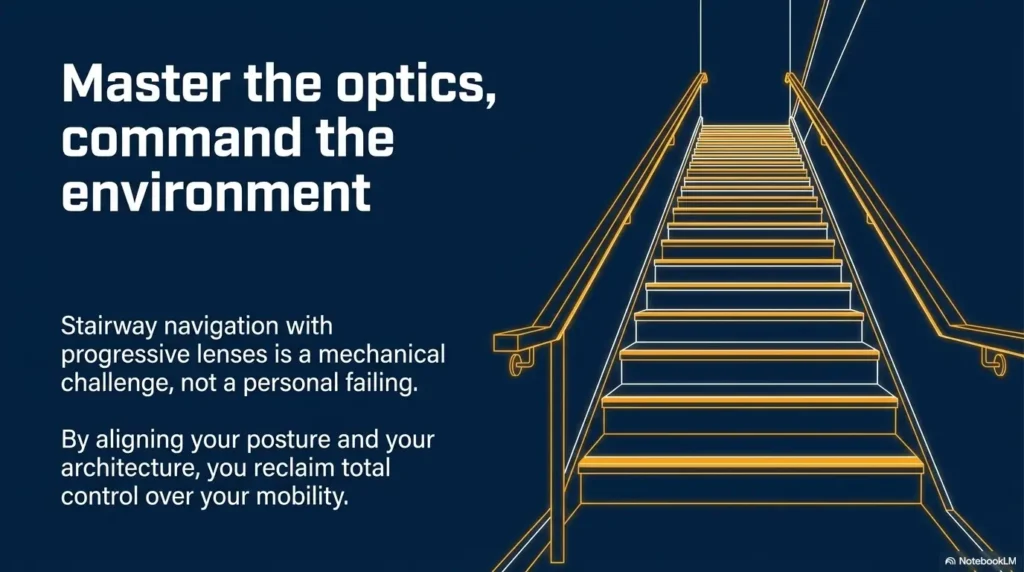
When progressive lenses make stairs feel unsafe, the answer is not shame, bravado, or blind loyalty to new glasses. The answer is a calm safety reset: check the lens fit, change the stair habit, improve contrast and lighting, reduce clutter, and involve an eye doctor or clinician when symptoms point beyond ordinary adaptation.
For the next 15 minutes, do one concrete thing: stand at the top of the stairs with the glasses you actually wear, hold the rail, and write down exactly what looks wrong: blur, glare, shadow, distortion, dizziness, or hesitation. That small note can turn a vague fear into a useful conversation and, just as important, a safer next step.
Last reviewed: 2026-05.