
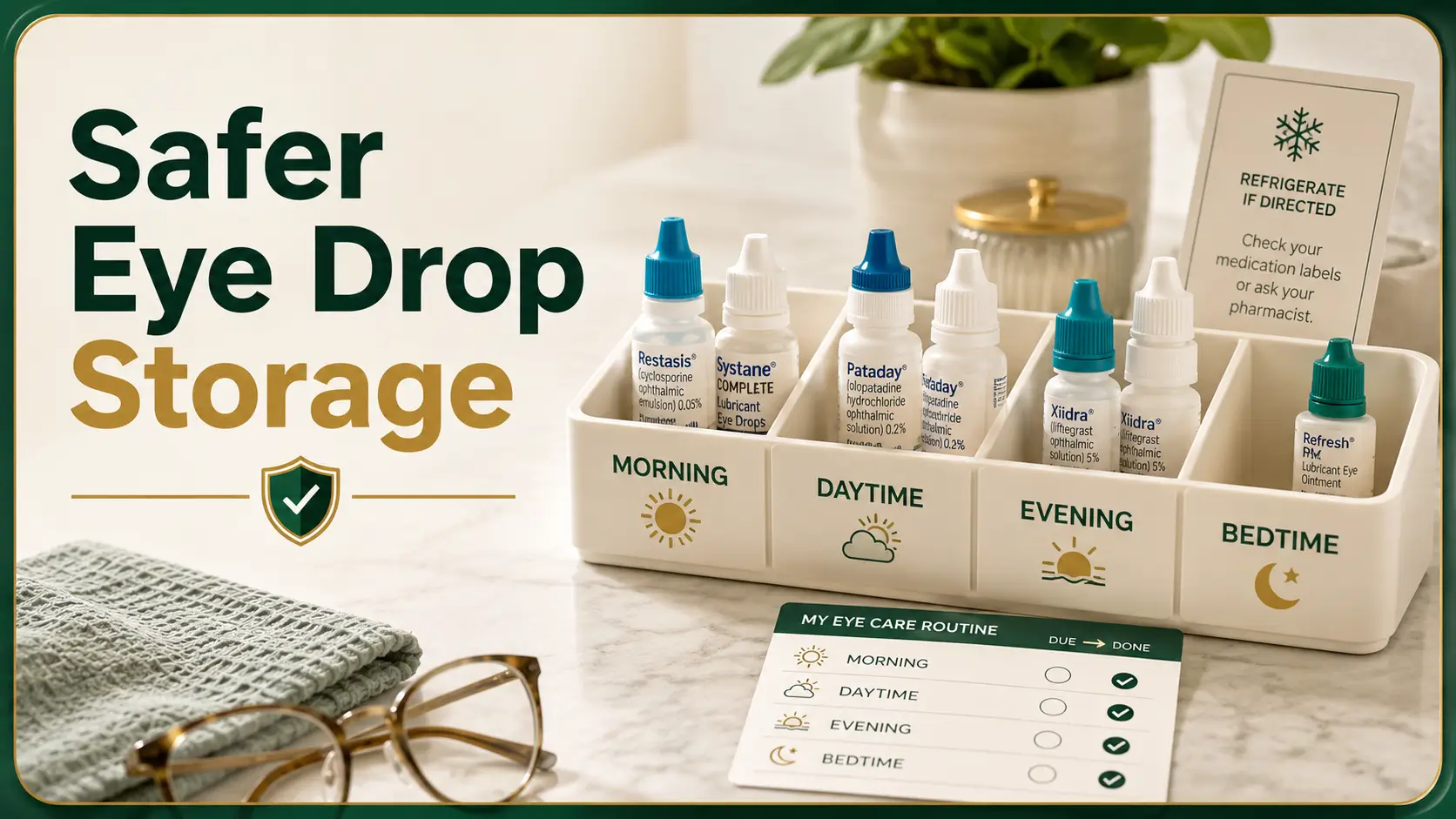
A practical medication-safety guide for older adults and caregivers
Eye Drop Storage Ideas for Seniors
Who Use Multiple Bottles
Five eye drop bottles can occupy less space than a coffee mug and still create a surprisingly complicated routine. Caps look alike. Pharmacy print seems to shrink overnight. One bottle belongs in the refrigerator, another is used only in the right eye, and a third must wait its turn before the next medication goes in.
A good eye drop storage system does more than make a counter look tidy. It helps answer three urgent questions at a glance: Which bottle do I use, when do I use it, and have I already used it? When those answers are visible rather than hidden in memory, daily treatment becomes calmer and medication errors become less likely.
This guide shows how to build a low-clutter, large-print system for glaucoma drops, dry-eye products, allergy medication, and post-surgical prescriptions. It also explains where not to store bottles, how to handle refrigerated drops, and when organization alone is no longer enough.
See the schedule
Separate bottles by time of day and prescribed order.
Prevent mix-ups
Combine large words, symbols, texture, and color.
Support caregivers
Make the setup easy to check, reset, and reproduce.
🧭 The goal is not a perfect-looking organizer. It is a system that still makes sense on a tired Tuesday night.
Snapshot: This guide is for older adults, family caregivers, home health aides, and anyone juggling several eye medications.
You will learn how to create an easy-to-read eye drop station, separate refrigerated medication, track completed doses, reduce contamination risks, and recognize when a pharmacist, clinician, or caregiver should step in.
Table of Contents
Safety First: Storage Rules Come From the Label
Eye drops are medications, even when they arrive in a tiny bottle with friendly-looking colors. Storage conditions, discard dates, refrigeration instructions, and single-use rules can differ from one product to another. The pharmacy label and product instructions should therefore outrank any general organizing tip.
Before buying an organizer or printing labels, gather every current bottle and read the instructions with good lighting. If the print is difficult to see, ask the pharmacy to review it aloud, request large-print directions, or use a trusted helper. The setup should be built around the actual prescription, not around assumptions such as “all eye drops last a month after opening.”
Confirm five details for every bottle
- Medication name and purpose: glaucoma pressure control, inflammation, infection prevention, allergy relief, lubrication, or another use.
- Which eye: right, left, or both.
- How often: once daily, twice daily, every few hours, as needed, or on a tapering schedule.
- Storage: room temperature, refrigeration, protection from light, or another condition stated on the label.
- Discard point: printed expiration, product-specific period after opening, or immediate disposal after a single-use vial is opened.
Treat the bottle tip as a clean zone
The dropper tip should not touch fingers, eyelashes, eyelids, the eye surface, a tissue, a countertop, or the inside of an organizer. Contact can introduce material that does not belong in a sterile eye product.
Wash and dry hands before handling drops. Replace the cap promptly without wiping the tip. If the tip may have touched something, do not quietly return the bottle to its usual slot and hope for the best. Separate it from active medication and call the pharmacy or prescribing office for advice.
Key takeaway
An organizer should never override the prescription label. Its job is to make the label’s instructions easier to follow, not to replace them.
Safety and medical disclaimer
This article provides general organization and medication-safety information. It does not diagnose an eye condition or replace instructions from an ophthalmologist, optometrist, pharmacist, surgeon, or other licensed clinician.
Do not use a product that has changed color, become unexpectedly cloudy, leaked, developed a damaged seal, passed its instructed discard point, or may be contaminated. Seek prompt medical care for severe eye pain, sudden vision loss, new flashes or a curtain-like shadow, injury, marked swelling, intense redness, or symptoms of a serious allergic reaction.
The Real Storage Problem Is Not the Number of Bottles
A crowded countertop is visible. The harder problem is invisible: the amount of thinking required each time a dose is due. A person may need to read tiny print, remember which eye is treated, distinguish two nearly identical bottles, recall whether one was already used, and calculate how long to wait before the next medication.
That is a heavy cognitive load for a task performed several times a day. Add low vision, arthritis, tremor, fatigue, memory changes, or an interrupted routine, and a small medication station begins to feel like airport ground control run from a bathroom shelf.
Why five small bottles can create one large error
Imagine a senior who uses a glaucoma drop every evening, a second glaucoma medicine morning and night, lubricating drops as needed, an allergy drop twice daily, and a temporary post-surgical drop four times a day. Some are used in both eyes. One belongs only in the operated eye. The temporary prescription changes from four doses to two doses next week.
None of those instructions is impossible alone. The risk appears where they overlap. A bottle may be selected correctly but used in the wrong eye. A scheduled drop may be repeated because the person cannot remember completing it. A temporary medication may remain beside current bottles after the prescription has ended.
Look-alike caps and tiny labels are weak identifiers
Cap color can offer a clue, but bottle appearance is not a complete identification system. Manufacturers may use similar container shapes, generics can look different after a refill, and a cap can be replaced incorrectly after several bottles are open.
The problem is similar to organizing similar-looking pills: appearance can support recognition, but it should not carry the whole safety burden. The medication name, purpose, eye, and schedule need their own readable cues.
Memory is not a dose tracker
People often remember unusual events better than repetitive ones. That is why yesterday’s eye appointment may be clear while this morning’s routine dose feels uncertain. The action was familiar, quiet, and nearly identical to the previous hundred doses.
A reliable storage system creates physical evidence. The bottle moves from “due” to “done.” A checkbox is marked. A caregiver initials a chart. The environment holds the memory so the person does not have to reconstruct it later.
Key takeaway
The safest system answers three questions without detective work: which bottle, which time, and whether the dose is already complete.
Build a One-Glance Eye Drop Station
A one-glance station is a fixed, well-lit place where current eye drops are arranged according to the routine. It should reduce reaching, searching, reading, and decision-making. Think of it as a tiny medication workstation rather than a decorative basket.
The station does not need to be expensive. A shallow tray, four labeled cups, a large-print chart, and one “done” section may outperform a complicated organizer with tiny compartments and stiff latches.
Choose one stable, well-lit location
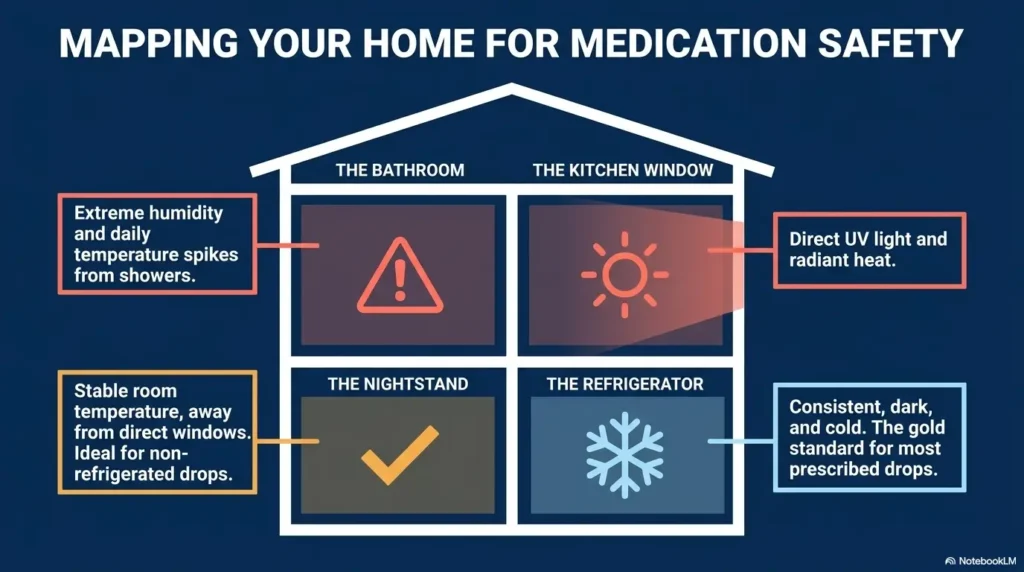
Select a place away from direct sun, heaters, steamy showers, sinks where bottles can be splashed, and areas accessible to children or pets. The surface should be stable and reachable from a seated position when possible.
Lighting matters. A lamp should illuminate labels without producing harsh glare from glossy bottles. Readers who struggle with small print may benefit from the practical strategies in this guide to setting up reading glasses for seniors, especially keeping the correct glasses beside the task rather than in another room.
Create four visible time zones
For many schedules, the simplest arrangement uses four clearly labeled areas:
- Morning
- Daytime
- Evening
- Bedtime
Not every zone must contain a bottle. Empty zones are acceptable. Their purpose is to give the routine a consistent map. Someone who takes only morning and bedtime medication can still use the same framework without reinventing the layout when a temporary prescription is added.
Use a shallow tray that prevents rolling and disappearing
Small cylindrical bottles have an irritating talent for rolling behind lamps, nightstands, and tissue boxes. Choose a tray with a raised edge and a non-slip base. Each bottle should stand upright with enough space for fingers to grasp it without knocking over its neighbors.
A dark bottle may be easier to see against a pale tray, while a white bottle may stand out better against a dark mat. Contrast is often more useful than adding decorative patterns, which can make small objects harder to locate.
Add a “due” side and a “done” side
Divide each time zone into two positions. Bottles begin on the left under a large “DUE” label. After the medication is used, the bottle moves to the right under “DONE.” At the end of the day, the organizer is reset.
This movement should be easy enough for arthritic hands and obvious enough for low vision. Avoid narrow slots that require precise placement. Two broad sections separated by a raised divider, contrasting tape, or a small cup are usually easier.
The Four-Zone Drop Station
1. Morning
Place morning bottles in prescribed order. Move each one from DUE to DONE.
2. Daytime
Use for midday doses, temporary surgical schedules, or supervised medication.
3. Evening
Keep dinner-time or early-evening medication separate from bedtime drops.
4. Bedtime
Use high contrast and a lamp so the final dose is not selected in near-darkness.
Daily rhythm: Read the label → confirm the eye → use the drop → move the bottle → mark the chart → reset once daily.
Color Coding Helps, but Do Not Trust the Cap Alone
Color is fast. The brain can spot a bright yellow band sooner than it can decode six lines of pharmacy text. That makes color useful, but only when it is paired with words, position, or touch.
A color-only system can fail when lighting is poor, vision changes, two shades look alike, or another person helps with the medication. Color should be one layer in a layered identification system.
Use a three-layer identification method
| Layer | Example | Why it helps |
|---|---|---|
| Plain-language words | “GLAUCOMA, BOTH EYES, BEDTIME” | Communicates the actual instruction |
| Color | Dark blue removable band | Supports quick visual recognition |
| Position or texture | Bedtime zone plus one raised dot | Provides a backup when print or color is difficult |
Redundancy is a strength here. A medication may be recognized by its large words, its blue band, and its fixed bedtime location. If one cue becomes unreliable, the other two remain.
Add removable bands without covering required information
Place removable tape or a soft band around an area that does not obscure the medication name, patient name, dosing directions, pharmacy information, expiration date, lot information, barcode, or manufacturer instructions. Do not wrap tape around a cap in a way that interferes with opening or closing.
Labels should not leave sticky residue near the dropper tip. Avoid bulky decorations, dangling tags, and textured materials that collect dust or make the bottle difficult to clean externally.
Choose symbols and textures that cannot be confused
A sun symbol can mean morning, a plate can mean dinner-time, and a moon can mean bedtime. Keep symbols large, simple, and consistent. Do not use several abstract icons that require a legend every time.
For tactile identification, use one clearly positioned raised marker on the outer bottle body or on its assigned organizer slot, provided it does not cover label information. The guide to bump dots versus tactile tape can help caregivers choose a marking method that fits vision and hand-control needs.
Run the substitute-caregiver test
Ask a family member who did not build the system to identify each medication and explain the schedule. If they must guess what a color means, the setup is too dependent on private knowledge.
A good system should remain understandable when the usual caregiver is sick, traveling, or replaced for a weekend. The labels should speak for themselves.
Key takeaway
Color should speed recognition, not replace identification. Pair every color with readable words and a consistent location.
Storage Ideas for Different Routines and Refrigerated Drops
The best organizer depends on where medication is used, how often the person moves through the home, and how much assistance is available. A rigid countertop station may work beautifully for one person and become an obstacle for someone who spends mornings downstairs and evenings upstairs.
Match the organizer to the user, not the catalog photo
| User situation | Useful storage format | Watch for |
|---|---|---|
| Mostly independent with stable vision | Divided tabletop caddy | Tiny compartment labels or lids that are hard to open |
| Moves between rooms | Handled basket with upright dividers | Bottles tipping or rolling during transport |
| Limited counter space | Shallow wall pocket system outside humid areas | Pockets that hide bottle labels or squeeze containers |
| Complex temporary schedule | Caregiver-prepared daily tray plus written chart | Leaving discontinued medication in active zones |
| Frequent appointments or overnight trips | Padded zip pouch with rigid bottle section | Loose bottles, heat exposure, and forgotten cold packs |
A handled basket is useful only if the bottles stay upright and the schedule travels with them. A wall organizer is helpful only if the person can see and reach every pocket. Convenience is not a feature when it quietly creates a new failure point.
Give refrigerated drops their own system
Some eye medications require refrigeration before opening, after opening, or during a specific stage of use. Others should not be refrigerated. Follow the exact product and pharmacy instructions rather than using a blanket rule.
When refrigeration is required, place the bottle in a clean, labeled, lidded container dedicated to medication. Keep it separate from food spills, raw ingredients, and containers that family members may mistake for refreshments. The label should remain visible and dry.
A stable interior shelf may provide a more consistent environment than a refrigerator door that experiences repeated movement and temperature changes. However, the product instructions and pharmacist’s advice remain decisive.
Connect the refrigerator bottle to the main station
A refrigerated bottle can be forgotten because it is physically separated from the other medication. Place a large reminder card in its assigned time zone: “REFRIGERATOR DROP FIRST,” followed by the medication name and eye.
After the dose, return the bottle promptly if required. Move the reminder card from DUE to DONE, just as you would move a room-temperature bottle.
Prepare a travel version before it is needed
A travel pouch should protect bottles from crushing, lint, accidental opening, and direct contact with melting ice. Keep medication in its original labeled container. Add a printed medication list, dosing schedule, pharmacy number, and clinician contact information.
For temperature-sensitive medication, ask the pharmacist exactly how it should be transported, what temperature range is acceptable, and how long it may remain outside refrigeration. Do not place a bottle directly against ice or a frozen pack unless product-specific instructions say that is safe.
Make Labels, Bottle Order, and Dosing Order Work Together
Labels should help the reader act, not merely identify the product. The most useful large-print label states the medication’s purpose, the correct eye, the dose time, and its place in the sequence.
Keep the original pharmacy label intact. Supplemental labels should add clarity without hiding required information. Ask the pharmacy whether large-print labels, duplicate instruction sheets, accessible packaging, or easier-to-handle containers are available.
Put action information in large type
- Purpose: “GLAUCOMA” or “AFTER SURGERY”
- Eye: “RIGHT,” “LEFT,” or “BOTH”
- Time: “MORNING” or “BEDTIME”
- Order: “1 OF 3,” “2 OF 3,” or “LAST”
- Opened date: written in a clearly designated area
- Special note: “REFRIGERATE” or “SHAKE,” only when confirmed by instructions
Use plain words rather than medical abbreviations. “Both eyes” is easier for many households than “OU,” especially when a substitute caregiver is involved. More guidance is available in this practical overview of large-print prescription labels.
Arrange bottles from first to last
Alphabetical order is neat but rarely matches the task. Place bottles in the order they are prescribed, moving left to right. If a waiting period is required between medications, add a large timer card between them.
For example, a morning zone might contain:
- Blue-labeled glaucoma bottle marked “1 OF 2.”
- A card marked “WAIT AS DIRECTED.”
- Yellow-labeled second medication marked “2 OF 2.”
- A “DONE” cup at the far right.
Do not invent a universal waiting interval. Ask the prescriber or pharmacist how different products should be spaced, especially when ointments, gels, contact lenses, or post-operative medications are involved.
Record the opened-on date without guessing the discard date
Writing the opening date provides useful information, but it does not automatically tell you when the product must be discarded. Some multidose products may be usable according to the printed expiration and product instructions, while other products have specific after-opening limits. Single-dose containers may require immediate disposal after use even when liquid remains.
Use two separate fields when needed: “OPENED” and “DISCARD.” Have the pharmacist help fill in the second field if the directions are unclear.
Use a chart that records completion, not intention
A schedule should be marked only after a dose is completed. Avoid checking a box in advance because the person intends to take the drop in a few minutes. Interruptions happen, and an early checkmark can create false reassurance.
| Time | Medication | Eye | Dose completed | Initials |
|---|---|---|---|---|
| 8:00 a.m. | Medication A | Both | □ | _____ |
| 8:10 a.m. | Medication B | Right | □ | _____ |
| 2:00 p.m. | Medication C | Right | □ | _____ |
| 9:00 p.m. | Medication A | Both | □ | _____ |
A fuller printable framework can be adapted from this low-vision medication tracker. Keep the completed sheets long enough to help answer questions during appointments, but do not let old charts remain beside the active one.
Key takeaway
Move the bottle, then mark the chart. A physical “done” signal is more dependable than asking memory to replay a repetitive task.
Short Story: The Two Blue Caps
Margaret had used her evening glaucoma drops for years. When the pharmacy changed one generic manufacturer, the new bottle arrived with a shape and cap that looked remarkably similar to her morning medication.
One evening, her daughter noticed both bottles sitting beside the lamp. Margaret could not confidently say which one she had used. No emergency occurred, but the uncertainty frightened them more than a cluttered counter ever had.
The next day, they created two wide tray sections. The morning bottle received a sun label and one tactile dot. The evening bottle received a moon label and two dots. Each slot also displayed the medication name, eye, and dose time in large print.
The lesson was modest but durable: the bottles did not need to look dramatically different. The system needed to give the same answer through several different clues.
Common Eye Drop Storage Mistakes That Undermine Safety
Most storage mistakes begin with a reasonable intention: save space, make a bottle easier to identify, avoid waste, or keep medication close at hand. The trouble is that convenience can remove the very information and protection that make the product safe to use.
Do not pour drops into another bottle
Transferring medication destroys reliable identification and may introduce contamination. The substitute bottle may contain residue, dispense a different drop size, fail to protect the product from light, or be mistaken for something else.
Keep each medication in its original container. If the bottle is difficult to squeeze or hold, ask the pharmacist or eye-care team about dispensing aids rather than improvising a new container.
Do not keep expired, discontinued, and active bottles together
An old bottle beside a current one remains available for accidental use. Create a separate “pharmacy review” bag for medication that is discontinued, expired, damaged, recalled, or no longer clearly identified.
Do not save leftover prescription drops for a future eye problem unless a clinician specifically instructs you to do so. Similar symptoms can have different causes, and an old treatment may be unsuitable or unsafe.
Avoid convenient-looking storage traps
| Location | Why it can fail | Better approach |
|---|---|---|
| Bathroom cabinet | Humidity, temperature changes, low lighting, and rushed routines | Use a dry station outside the steamy area when permitted by instructions |
| Sunny windowsill | Heat and direct light exposure | Choose a shaded, temperature-appropriate location |
| Hot or cold vehicle | Extreme temperatures may occur quickly | Carry medication with you in suitable protective storage |
| Loose purse or pocket | Lint, pressure, lost caps, and bottle mix-ups | Use a dedicated rigid or padded pouch |
| Beside ear or nasal drops | Wrong-product administration | Store products in separate, clearly marked stations |
| Kitchen refrigerator shelf without a container | Spills, mistaken identity, and poor visibility | Use a dedicated labeled medication box |
Do not open several bottles in advance
Opening multiple backups to “save time” can make discard tracking more difficult and increase the number of bottles exposed to handling. Keep unopened supplies separate from the active station and follow the storage instructions for unopened medication.
When the active bottle is nearly empty, place a refill reminder in the organizer. Do not open the replacement until it is needed unless the pharmacist or clinician gives another instruction.
Show me the nerdy details
Eye drop containers are part of the medication-delivery system. Bottle materials, tip design, cap closure, preservatives, single-dose packaging, and storage conditions are selected for a particular product. Changing the container or using it outside labeled conditions can remove safeguards that are easy to overlook.
A multidose bottle may contain a preservative, use a specialized filtration system, or follow another product-specific design. A preservative-free product may come in single-dose vials or a specialized multidose container. Those categories should not be treated as interchangeable.
This is why a universal “discard every bottle after 28 days” rule can be misleading. The correct use period depends on the product label, packaging, expiration date, and professional instructions.
Key takeaway
Never trade away the original container, pharmacy label, or product instructions for the sake of a tidier shelf.
Who Can Use This System and Who Needs More Support?
A well-designed station can support independence, but it cannot solve every medication-management difficulty. The right level of assistance depends on vision, memory, hand control, judgment, and the complexity of the prescription.
A one-glance station may be a good fit when
- The person can identify bottles using large words, symbols, position, or touch.
- The schedule remains reasonably stable from day to day.
- The person can confirm which eye receives each medication.
- The bottle can be opened, aimed, squeezed, and recapped safely.
- A completed dose can be recorded reliably.
- The person knows when to stop and ask for help.
Independence does not require doing everything alone. A family member may refill reminder cards weekly, photograph the station after changes, or verify discard dates while the senior continues administering medication.
The setup may not be enough when
- Doses are repeatedly missed, duplicated, or used in the wrong eye.
- The person cannot distinguish active medication from old bottles.
- New memory problems interfere with following a written chart.
- Severe vision loss makes labels and bottle placement unreliable.
- Tremor, weakness, arthritis, or poor aim causes frequent tip contact.
- The schedule changes often and the person cannot follow the updates.
- Automated reminders sound, but the correct bottle still cannot be selected.
These signs are not a moral failure or proof that someone has “lost independence.” They indicate that the task and the current support system no longer fit. Changing the support is a safety adjustment, much like adding a handrail when stairs become difficult.
Choose the least complicated support that works
| Need | Possible support |
|---|---|
| Tiny print | Large-print pharmacy labels, magnification, improved task lighting, or read-aloud technology |
| Difficulty squeezing | Pharmacist-approved bottle aid or administration device |
| Uncertain technique | Demonstration by a pharmacist, nurse, or eye-care professional |
| Complex timing | Caregiver-prepared daily station and completion chart |
| Memory impairment | Direct supervision or administration by an appropriate caregiver |
| Changing post-surgical schedule | Updated chart reviewed at every instruction change |
Know which professional can solve which problem
A pharmacist can clarify storage, refills, expiration, product appearance, bottle aids, and contamination concerns. The prescribing clinician can simplify a regimen when medically appropriate, confirm spacing, and address missed or extra doses.
An occupational therapist may help adapt lighting, contrast, reach, hand position, and the physical setup. This list of questions to ask a low-vision occupational therapist can help a family prepare for that conversation.
Five-minute support check
- Ask the person to identify each bottle without coaching.
- Ask which eye receives each medication.
- Ask how they know whether today’s dose is complete.
- Watch one administration without taking over.
- Note any guessing, tip contact, dropped bottles, or uncertainty.
One uncertain answer may call for a label change. Repeated uncertainty may call for direct assistance.
When to Seek Help or Stop Using a Bottle
Organization should make medication safer, but it should never encourage someone to continue using a questionable bottle. When something seems wrong, separate the bottle from the active station and obtain professional guidance.
Call the pharmacy when instructions are unclear
Contact the pharmacy when the label and package instructions appear to conflict, the refill looks different, a discard date is uncertain, a bottle was left outside its required storage conditions, or the cap or seal is damaged.
A written call script can help an older adult describe the problem efficiently. The low-vision pharmacy help script offers a useful structure for asking about labels, medication identity, and accessible instructions.
Contact the prescriber after a wrong, missed, or extra dose
Do not automatically double the next dose or skip medication based on a general rule. The appropriate response depends on the product, condition, timing, amount, and symptoms.
When calling, have the bottle available and report the medication name, strength, eye, prescribed schedule, what happened, when it happened, and any symptoms. If the person may have used ear drops, nasal drops, glue, chemicals, or another non-ophthalmic product in the eye, seek urgent professional guidance.
Set aside a bottle that may be contaminated or damaged
- The tip touched the eye, lashes, fingers, counter, tissue, or another surface.
- The liquid looks different from its usual appearance.
- The bottle leaked or the cap was missing.
- The container was crushed, punctured, or exposed to an extreme temperature.
- The label no longer identifies the medication clearly.
- The product is subject to a recall or safety warning.
Keep the questionable bottle away from current medication while seeking advice. Do not place it in the DUE section, where habit may carry it back into use.
Seek prompt care for serious symptoms
Severe pain, sudden or major vision change, significant swelling, increasing redness, pus-like discharge, chemical exposure, injury, new neurological symptoms, or signs of a severe allergic reaction require prompt medical evaluation. Call emergency services when symptoms are severe or rapidly worsening.
Key takeaway
When a bottle’s identity, cleanliness, storage history, or appearance is uncertain, move it out of the active station and ask before using it again.
FAQ
Should opened eye drops be kept in the refrigerator?
Only when the product label, package instructions, pharmacist, or prescribing clinician says refrigeration is required or permitted. Some products require refrigeration during a particular stage, while others are stored at room temperature. Do not refrigerate all eye drops by default.
Can different eye drop bottles be stored in the same organizer?
Yes, when their individual storage requirements allow it and each bottle remains clearly identifiable in its original container. Separate bottles by time, eye, purpose, and order. Refrigerated products should remain in their required environment with a reminder card at the main station.
How can seniors tell similar-looking eye drop bottles apart?
Use at least three cues: large-print words, a consistent color or symbol, and a fixed position or tactile marker. Do not rely only on cap color, bottle shape, or memory.
Is it safe to put large-print stickers on prescription eye drops?
A supplemental sticker may help when it does not cover the pharmacy label, medication name, instructions, expiration, lot information, warnings, or other required details. Keep stickers away from the dropper tip and closure. Ask the pharmacist to review the placement when uncertain.
How long are eye drops good for after opening?
There is no single period that applies to every product. Follow the printed expiration, product-specific after-opening instructions, single-dose disposal directions, and advice from the pharmacy or prescriber.
Can eye drops be stored in a bathroom medicine cabinet?
A bathroom may expose medication to humidity, temperature changes, glare, and rushed handling. Use a dry, stable, well-lit location that complies with the product instructions. Keep all medication secured from children and pets.
What should a caregiver do after an accidental extra dose?
Check the medication name, strength, eye, amount, and time, then contact the pharmacist, prescriber, or appropriate urgent medical service for product-specific advice. Do not improvise by changing later doses unless instructed.
How should refrigerated eye drops be transported outside the home?
Ask the pharmacist for the permitted temperature range and travel duration. Use a protective medication container and an appropriate insulated carrier when advised. Do not place the bottle directly against ice unless the product instructions specifically permit it.
Can eye ointment be stored with eye drop bottles?
It may be stored nearby when its storage instructions allow, but keep it in a clearly marked slot and confirm the prescribed order. Ointments and gels may affect how other products are used, so ask the clinician or pharmacist about sequencing.
Build a Four-Zone Drop Station in 15 Minutes
The finished system does not need matching containers, designer labels, or a pharmacy-sized cabinet. It needs a stable location, readable instructions, clear separation, and a reliable way to show that a dose is complete.
Set a timer for 15 minutes and complete the following first version. Do not reorganize every medication in the house. Work only with the eye drops that are currently prescribed or actively used.
The 15-minute setup
- Gather current bottles. Bring together every prescription drop, over-the-counter eye product, ointment, and unopened refill.
- Separate uncertain items. Place expired, discontinued, damaged, unidentified, or questionable bottles in a pharmacy-review bag.
- Confirm instructions. Check the medication name, eye, dose time, storage condition, and discard directions.
- Create four zones. Label broad areas MORNING, DAYTIME, EVENING, and BEDTIME.
- Arrange by order. Place bottles from first to last within each zone.
- Add DUE and DONE. Provide a visible place to move each bottle after use.
- Write a large-print chart. Include medication, eye, time, and a completion box.
- Add refrigerator reminders. Put reminder cards in the correct time zones for cold-stored medication.
- Test the system. Ask the user or substitute caregiver to explain it without coaching.
- Photograph the finished station. The photo becomes a reset guide if bottles are moved or another caregiver takes over.
Give the station a weekly reset
- Remove discontinued medication immediately.
- Check supply levels and refill timing.
- Review opened and discard dates.
- Replace smudged or loose supplemental labels.
- Confirm that the schedule has not changed.
- Wipe the organizer externally without exposing bottle tips or damaging labels.
- Compare the setup with the reference photograph.
After surgery or a medication change, perform the reset whenever the schedule changes, not merely at the end of the week. Cross out obsolete instructions and remove the old chart so two schedules cannot compete for attention.
Use one final test: can the station explain itself?
Stand a few feet away and look at the setup. The time zones should be obvious. Each bottle should have a readable identity, a fixed place, and a clear next action. Refrigerated medication should have a visible reminder. Completed doses should leave evidence.
Then hand the routine to someone who did not design it. If that person can identify the morning bottle, find the refrigerated reminder, explain which eye is treated, and show how a completed dose is recorded, the system is doing its job.
The quiet promise of a good eye drop station is not perfect memory. It is something kinder and more practical: fewer decisions, fewer guesses, and a routine that remains readable even when the day has become crowded.
Your next step
Gather the active bottles, make four paper labels, and create one DUE-to-DONE movement today. A simple working system is safer than an elaborate organizer still waiting in an online shopping cart.
Last reviewed: 2026-06