

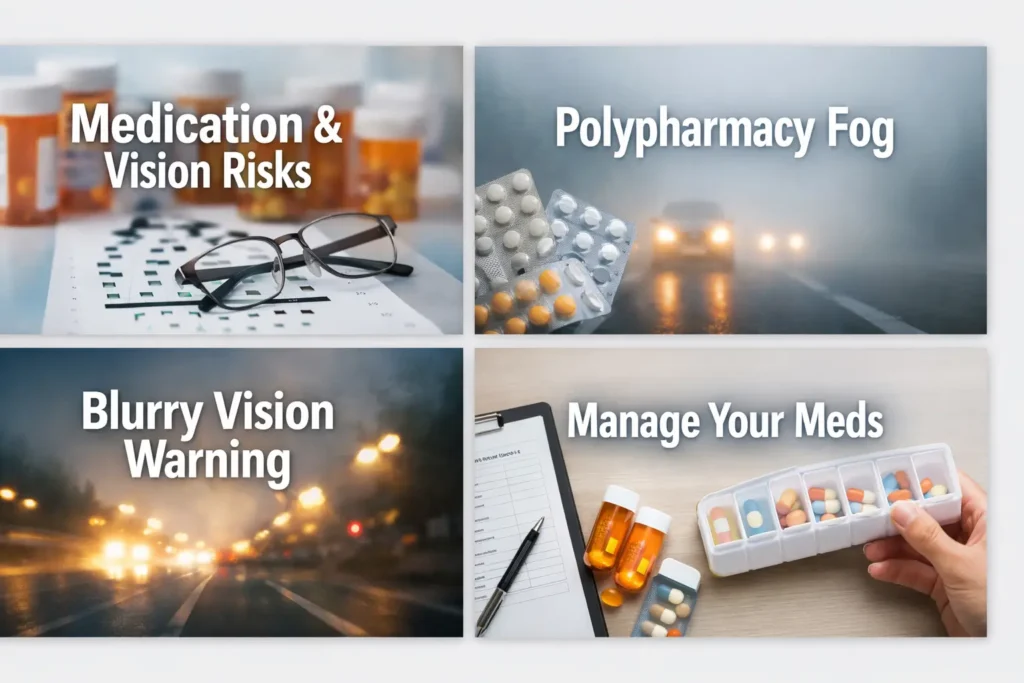
Navigate the Fog: Polypharmacy & Vision Health
Polypharmacy and vision changes rarely crash into your life all at once. They seep in, one “small” symptom at a time, until night driving feels tense, stairs feel less forgiving, and your screen seems to fight back by 8 p.m.
This is where most people get stuck: multiple prescriptions, a few OTC add-ons, a supplement or two, and no single map connecting blurred vision, glare, dry eye, or dizziness to the timing of each dose. The result is not just discomfort, it is decision fog.
Keep guessing, and you risk avoidable falls, unsafe driving moments, and appointments that end with “let’s monitor” but no clear plan.
This guide helps you walk into a medication review prepared like a pro: one complete med snapshot, a symptom timeline your clinician can use fast, and the exact questions that surface interaction risks and safe deprescribing options. It is built around real clinical workflow, not internet biohacking.
- ✓ Clearer signal, less chaos.
- ✓ Safer day-to-day function.
- ✓ A better visit in less time.
- ✓ A 14-day actionable plan.
Table of Contents
Start Here First: Why Polypharmacy and Vision Can Be a Hidden Risk
What “polypharmacy” usually means in real US clinical conversations
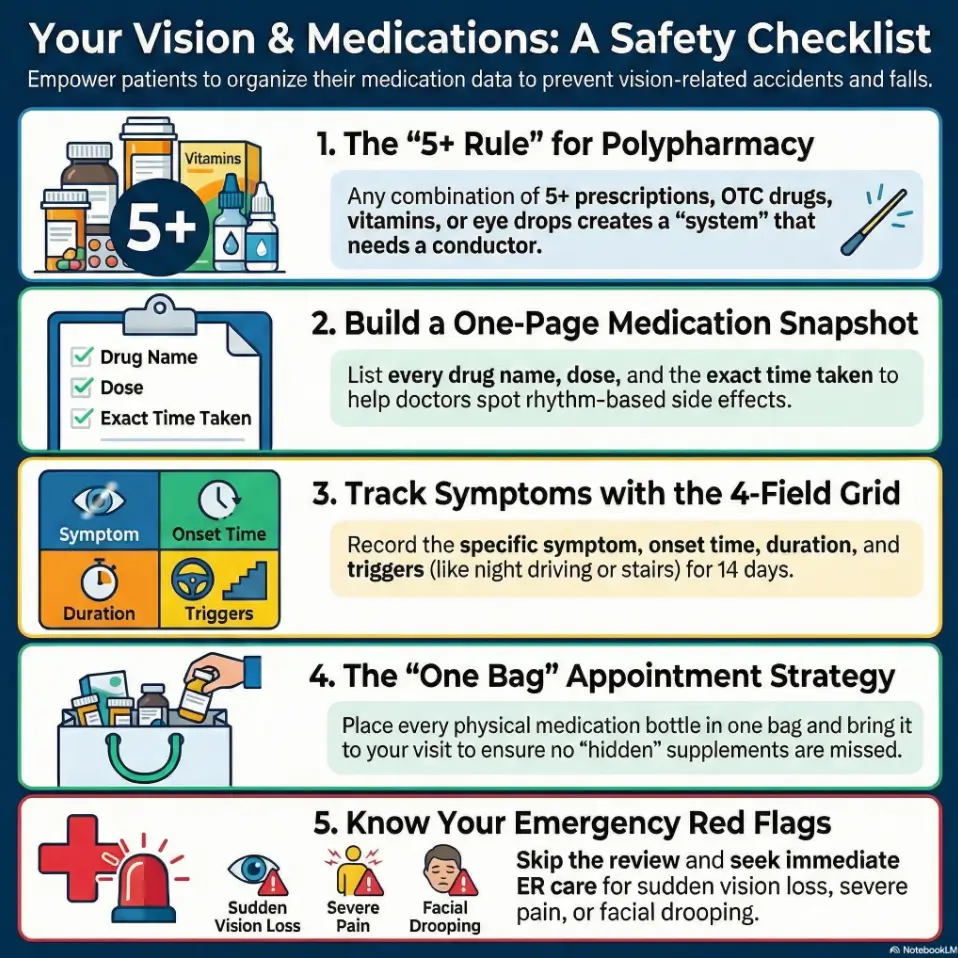
In everyday practice, polypharmacy usually means taking multiple medications at once, often five or more. That count includes prescription drugs, over-the-counter items, eye drops, and supplements. It does not automatically mean “bad care.” Sometimes it reflects complex health needs. The risk appears when the full stack is not reviewed as one system.
I once sat with a caregiver who had three lists: one from primary care, one from cardiology, one on sticky notes near the fridge. None were wrong, but none were complete. The issue was not one dangerous pill. It was the orchestra playing without a conductor.
Vision changes people often dismiss too early (and regret later)
People commonly shrug off dry eyes, intermittent blur, glare at night, “foggy focus,” and brief dizzy spells. But medication side effects can show up as exactly those subtle, annoying symptoms. The FDA’s consumer guidance on medicines and driving highlights blurred vision, dizziness, and reduced focus as safety-relevant effects, especially around tasks like driving or operating equipment. That is a practical reminder that “mild” symptoms can still be high impact. If you are unsure whether symptoms may be part of a broader pattern, this primer on when “just getting older” might actually signal a serious eye issue is a useful cross-check.
Open loop: Could your “normal aging eyes” actually be medication-related?
Sometimes yes. Sometimes no. That is the point. You do not need to self-diagnose the cause tonight. You need a cleaner process so your clinician can decide faster. We will build that process below with one page, four symptom fields, and seven high-value questions.
- Polypharmacy is common, especially with chronic conditions.
- Subtle symptoms can still increase driving and fall risk.
- A structured review beats random troubleshooting.
Apply in 60 seconds: Start a single “master list” note on your phone titled “Medication Review for Vision Symptoms.”
Before the Appointment: Build a One-Page Medication Snapshot
What to list: prescriptions, OTC drugs, eye drops, vitamins, herbals, PRNs
Your doctor can only review what they can see. Build one page with:
- Medication name (brand + generic if known)
- Dose and schedule
- Why you take it
- PRN use pattern (“as needed” frequency)
- OTC items (sleep aids, cold medicines, pain relievers)
- Supplements and herbals
- All eye products, including artificial tears and redness drops
Yes, it feels tedious. So does searching for your phone with your phone flashlight on. Still worth doing.
Add timing details that change interpretation (morning vs bedtime dosing)
Timing often explains symptom rhythm. Example: blur after evening sedating meds is a different problem than morning blur before the first dose. Add a “time taken” column. If a drug is taken twice daily, write the exact windows you usually follow. Your clinician may adjust timing before changing medications, which can reduce risk without destabilizing treatment.
Include recent starts/stops and dose changes from the last 90 days
A 90-day lens is useful because many symptom patterns appear after a start, a dose increase, or a combination change. If you cannot remember exact dates, estimate by anchor events: “after Thanksgiving,” “two weeks before my trip,” “when school started.” Approximate timestamps are still clinically useful.
Pattern interrupt: Let’s be honest, memory is not a medication system
Even very organized people miss details under stress. I have seen engineers miss a nightly OTC sleep aid because “it is not a prescription.” That tiny omission can completely change a risk calculation. If this sounds familiar, a focused guide on low-vision medication management routines can help you build a safer daily system.
Money Block: Eligibility checklist for a high-value medication review
- ☐ You take 5+ total products (Rx + OTC + supplements + eye drops).
- ☐ You had any dose/start/stop changes in the last 90 days.
- ☐ You noticed blur, glare, dizziness, dry eye, or focus changes.
- ☐ Symptoms affect driving, stairs, work screens, or reading.
- ☐ Your med list exists in more than one place and does not match.
Neutral action: If you checked 2 or more boxes, request a dedicated medication review visit rather than squeezing this into a routine follow-up.
Show me the nerdy details
Clinicians triage faster when medication data has fields they can parse quickly: name, dose, frequency, indication, start/change date, and symptom linkage. This structure reduces recall bias and supports safer sequencing of changes.

Symptom Timeline That Helps Doctors Decide Faster
Track 4 fields: symptom, onset, duration, trigger
Create a tiny grid. Keep it simple enough to use daily:
- Symptom: blur, dry eye, halos, double vision, dizziness
- Onset: when it starts (time + relation to dose)
- Duration: minutes, hours, persistent
- Trigger: night driving, stairs, screen work, dehydration, missed meal
Two weeks of entries beats two months of vague memory.
Separate constant blur from episodic blur, glare, halos, diplopia, eye pain
“Vision is weird” is honest but not actionable. Pattern language matters:
- Constant blur might suggest ongoing surface or refractive issues, medication effect, or metabolic factors.
- Episodic blur linked to dose timing can point toward side-effect windows.
- Halos/glare at night can be safety-critical for driving. You can pair this section with practical context from night driving after 70 and night driving safety with macular degeneration.
- Double vision or eye pain needs urgent discrimination.
Mark safety-impact moments: driving, stairs, screen work, night vision
Clinicians make stronger decisions when symptoms are tied to function, not just sensation. Write impact statements like:
- “Missed one highway exit due to glare and delayed focus.”
- “Grabbed handrail twice this week from sudden wooziness.”
- “Could not read text at normal brightness for 40 minutes after evening dose.”
Open loop: The one timestamp that can change your whole care plan
The most valuable timestamp is often first symptom after a medication change. That single data point can shift the plan from “more testing first” to “careful medication sequencing first,” or vice versa.
Infographic: 5-Step Medication Review Workflow for Vision Symptoms
All Rx, OTC, supplements, eye drops
Dose timing + 90-day changes
Symptom, onset, duration, trigger
Urgent red flags vs scheduled review
14-day monitor + escalation rules
Interaction Red Flags: Which Combinations Deserve Extra Scrutiny
Sedating stacks that affect focus, reaction time, and visual processing
Several “small” sedating effects can stack into one large safety issue. A sleep aid plus an anxiety medication plus an antihistamine can leave morning focus lagging and visual tracking sluggish. People often notice this first while merging, parking at night, or reading tiny labels under bright lights.
Anticholinergic burden and dry-eye/blur complaints
Medications with anticholinergic properties can worsen dry eye and blurry vision in some patients, especially when multiple such agents are combined. This is not a diagnosis by itself, but it is a common review target in older adults and people with complicated regimens. If dry-eye symptoms are prominent, see also medication-related dry eye patterns and practical relief steps for dry eye with blurry vision after medication changes.
Blood pressure, glucose, and dehydration effects on visual symptoms
Vision complaints are sometimes downstream signals. Blood pressure swings, blood glucose variability, and dehydration can all alter visual comfort or clarity. If your symptoms cluster around missed meals, hot days, or diuretic timing, that pattern matters. You may also find it useful to review blood pressure medication-related dizziness and blurry vision for conversation prompts before your appointment.
Why “new med + old supplement” is a common blind spot
Supplements are where many otherwise careful plans go off-script. “Natural” does not guarantee neutral. I remember a patient who brought every bottle except one powder she considered “just wellness.” That product changed the interaction picture more than anything else on the table.
Money Block: Decision card
When A vs B for next clinical step
- A: Symptoms are mild, stable, and non-urgent → Start with PCP or prescribing clinician + pharmacist review.
- B: Symptoms are sudden, severe, or neurologic → Emergency evaluation first, medication optimization second.
Time/cost trade-off: Early structured review may prevent repeated visits, but emergency signs should never wait for a routine appointment.
Neutral action: Pick A or B now using your current symptoms, and write your plan on paper.
Do Not DIY: Mistakes That Increase Vision and Fall Risk
Stopping abruptly after reading side effects online
This is the classic trap. You read a scary thread, stop a medication cold, and now you have two variables: original symptoms plus withdrawal or rebound effects. Clinicians cannot interpret noise. Keep the system stable until you can review safely, unless you are instructed otherwise by your care team or you have emergency symptoms.
Doubling or skipping doses to “test” whether vision improves
Self-experiments feel logical and can be dangerous. They can also mask the true pattern by creating artificial spikes and troughs. It is like trying to tune a piano by kicking it.
Using someone else’s eye drops or leftover prescriptions
Eye products are not interchangeable souvenirs. The FDA repeatedly warns that ophthalmic products have unique safety risks and sterility matters. Borrowed drops can delay diagnosis, worsen irritation, or introduce contamination risk.
Pattern interrupt: Here’s what no one tells you about “natural” supplements
Supplements can change sedation, blood pressure, bleeding risk, and metabolism pathways. If it goes in your body and appears in your routine, it belongs on the list. No exceptions.
- Do not abruptly stop or restart medications on your own.
- Do not test dose changes without clinician guidance.
- Do not borrow eye drops or use old leftover prescriptions.
Apply in 60 seconds: Put a sticky note on your med organizer: “No self-dose changes. Ask first.”
Who This Is For / Not For
This is for: adults on multiple meds, caregivers, and patients with new visual symptoms
If you or someone you care for takes several medications and has new blur, glare, dry eye, dizziness, or focus changes, this framework is made for you. It is especially useful when symptoms are real but hard to describe.
This is not for: emergency symptoms needing immediate care
If there is sudden vision loss, severe eye pain, a curtain-like shadow, new neurologic signs, or dangerous near-falls, skip planning and seek urgent help now. A neat checklist is not the first step in an emergency.
If you’ve had recent medication changes, this framework is especially useful
The biggest gains come when you apply this within days to weeks of regimen changes. Earlier pattern capture means cleaner decisions and fewer back-and-forth visits.
Bring These 7 Questions to Your Medication Review
“Which medications here are most likely contributing to my vision symptoms?”
Ask for the top 1 to 3 suspects, not a vague maybe-list of twenty.
“Are there safer alternatives, lower doses, or timing changes?”
Sometimes timing changes reduce side effects without losing therapeutic benefit.
“Which combinations raise fall or driving risk?”
Use functional language: stairs, showering, commuting, night driving. You can reinforce home prevention planning with a quick read of aging vision fall-prevention strategies at home.
“What can be deprescribed, and how would tapering work safely?”
Ask for sequence: what first, why first, and what to monitor after each step.
“Should I see ophthalmology/optometry now, or after med changes?”
Clarify order of operations. Sometimes concurrent evaluation is best.
“Which symptoms are watch-and-wait vs urgent?”
Get explicit escalation thresholds in plain English.
“Can my pharmacist run a full interaction and anticholinergic review?”
Your pharmacist can be the systems engineer of your regimen.
Money Block: Quote-prep list for a better visit
- Bring all medication bottles in one bag.
- Bring your one-page list and 14-day symptom timeline.
- Bring your top 3 safety concerns in writing.
- Bring one caregiver if memory or communication is a challenge.
Neutral action: Put these four items by the door the night before your appointment.
Common Mistakes During the Visit (and How to Avoid Them)
Bringing an incomplete med list (missing OTC/supplements)
This is the number one preventable mistake. If it is omitted, the interaction review can be falsely reassuring.
Describing symptoms vaguely (“vision weird”) instead of behavior impact
Try this conversion:
- From: “My eyes feel off.”
- To: “For 45 minutes after my evening dose, I struggle with small text and headlights feel starburst-like.”
Leaving without a follow-up interval and monitoring plan
Every medication change should have a feedback loop. Ask: “When should I report back, and what exact changes should I watch for?”
Not confirming who owns which next step (PCP, specialist, pharmacist)
Ambiguous ownership causes dropped tasks. End the visit with role clarity in one sentence each.
Show me the nerdy details
Medication optimization often works best as staged changes rather than all-at-once edits. Sequential changes improve attribution: if symptom X improves after change Y, causality is easier to infer. This method also lowers destabilization risk.
When to Seek Help Now: Vision Symptoms You Shouldn’t Wait On
Sudden vision loss, severe eye pain, flashes/floaters with curtain-like shadow
These are urgent symptoms. The American Academy of Ophthalmology emphasizes that sudden flashes, sudden increase in floaters, and a curtain-like shadow can indicate retinal tear or detachment and need prompt evaluation.
Neurologic warning signs (weakness, facial droop, speech changes, confusion)
Vision symptoms plus new neurologic findings are emergency territory. Do not wait for a routine callback. If this follows a vascular event, this guide on vision loss after stroke can help families prepare better questions.
Severe dizziness/falls or near-miss driving episodes after medication changes
If safety is already compromised, same-day escalation is appropriate. “I nearly fell twice today” is a medical signal, not a personal failure.
What to do in the US: urgent care vs ER vs same-day clinician callback
- ER now: sudden severe or neurologic red flags, major trauma, dangerous acute changes.
- Urgent same-day eye/medical evaluation: concerning new eye symptoms without neurologic signs.
- Same-week medication review: persistent non-emergency symptoms affecting function.
Short Story: The timestamp that changed everything (120–180 words)
A retired bus driver I met through a caregiver support group kept saying, “It’s just my age.” His daughter noticed he started tilting his head at night lights and avoiding evening drives. They had three specialists, five prescriptions, and a weekend sleep aid nobody mentioned because it lived in a kitchen drawer, not the pill organizer. During a medication review, they brought one bag with every bottle and a two-week symptom log.
One detail stood out: blurry focus started about 40 minutes after his nighttime stack. That single timestamp changed the visit. Instead of adding another medication for “eye discomfort,” the team adjusted timing, removed one nonessential sedating agent with a taper plan, and coordinated pharmacy follow-up. Two weeks later, he still needed glasses optimization, but he stopped avoiding stairs and resumed short daytime drives. The win was not magic. It was sequence, clarity, and one honest timeline.
- Emergency signs go to emergency care.
- Non-emergency symptoms still deserve timely review.
- A symptom timeline can prevent unnecessary medication layering.
Apply in 60 seconds: Save this phrase in your phone: “New vision symptoms after medication changes. Need triage guidance now.”
The Follow-Through Plan: 14 Days After Your Review
What to monitor daily after dose or regimen changes
Track once daily, same time, under similar conditions:
- Vision clarity (0–10)
- Dryness/discomfort (0–10)
- Dizziness/balance events
- Driving or stair confidence
- Any new adverse effects
One entry per day is enough. Overtracking creates noise. If you need a ready template, use a printable symptom diary for seniors and keep entries short.
How to document improvement vs adverse effects without overtracking
Use a rule: one number + one sentence. Example: “Clarity 6/10, better before lunch, glare still bad after sunset.” That format is fast and useful.
When to escalate if symptoms persist despite changes
If symptoms remain function-limiting after agreed adjustments, escalate according to the plan you set during the visit. Ask whether to prioritize eye exam, medication sequence revision, or both.
Open loop: Why “slightly better” can still be a clinical warning sign
Slight improvement can mean partial success or partial masking. If safety tasks remain compromised, the plan is not done yet. “Better” is not the same as “safe enough.”
Money Block: Mini calculator
2-minute risk snapshot
Input 1: Number of total products (Rx + OTC + supplements + eye drops).
Input 2: Number of symptom episodes in 7 days affecting driving/stairs/work.
Input 3: Number of medication changes in last 90 days.
Output: If any two inputs are ≥2, prioritize a dedicated review this week. If all three are high, request pharmacist + prescriber joint review.
Neutral action: Calculate your three numbers now and add them to your appointment note.
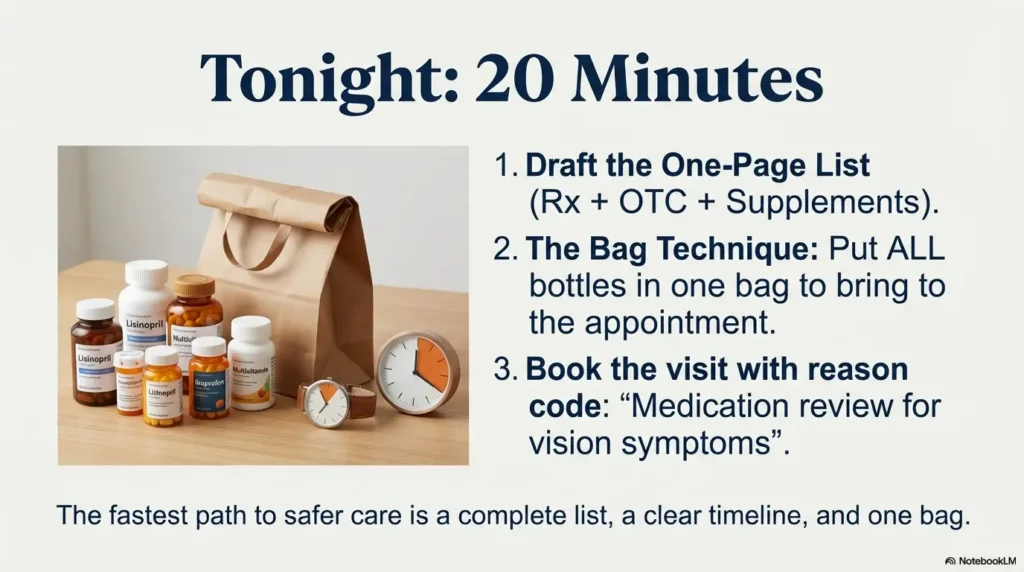
Next Step: Do This in 20 Minutes Tonight
Print or note your full med list, symptom timeline, and top 3 risk questions
Set a 20-minute timer. Do not optimize the template. Just complete it. Completion beats perfection every time.
Put all medication bottles (including OTC/supplements) in one bag for review
When the visit starts, put the bag on the desk. This single move often upgrades the quality of the conversation in the first two minutes.
Book the visit and request “medication review for vision symptoms” in the reason field
Specific reason fields help triage and scheduling. You are more likely to get the right visit length and the right team attention.
- One bag for all products.
- One page for all data.
- One visit goal: safer function, not guesswork.
Apply in 60 seconds: Draft your appointment reason in one line and copy it into the booking form.
Before we close the loop, here is the promise from the beginning: you do not need to become your own pharmacist or ophthalmologist overnight. You need a better conversation architecture. That is what you now have.
Conclusion: If your eyes are sending mixed signals while your medication list keeps growing, the most powerful move is not fear or denial. It is structured preparation. In the next 15 minutes, create your one-page list, write your top three safety questions, and schedule the review. Bring every bottle. Bring your timeline. Ask for role clarity before you leave. That tiny operational shift can prevent falls, reduce avoidable side effects, and restore confidence in daily life.
Last reviewed: 2026-02.
FAQ
Can taking multiple medications cause blurry vision?
Yes, it can. The mechanism differs by medication and combination. Blur may come from direct ocular effects, sedation, blood pressure or glucose shifts, dehydration, or interaction stacking. A structured review helps separate correlation from causation.
Which types of drugs most often affect eyesight or focusing?
Several categories may contribute, including sedating medications, anticholinergic agents, certain blood pressure or glucose-related regimens, and products that worsen dryness. The risk is usually highest when multiple contributors overlap.
Should I stop a medication if my vision changes?
Do not stop medications on your own unless instructed by your clinician, except in emergency scenarios where immediate care is needed. Abrupt changes can create new risks and confuse diagnosis.
What should I bring to a medication review appointment?
Bring all bottles (Rx, OTC, supplements, eye drops), a one-page list with doses/timing/indications, a 14-day symptom timeline, and your top 3 safety questions. This is the highest-yield prep.
Can supplements and over-the-counter drugs worsen medication side effects?
Yes. OTC sleep aids, cold medicines, pain products, and supplements can interact with prescriptions or add to sedation and visual side effects. Always include them in your review. If angle-closure risk is on your chart, review OTC medications to avoid with narrow-angle glaucoma risk before you shop.
How do I ask my doctor about deprescribing safely?
Ask: “What is the safest sequence to reduce nonessential medications, what taper is needed, and what symptoms should trigger escalation?” Sequencing and monitoring are the core of safe deprescribing.
Do I need an eye doctor or primary care first for medication-related vision symptoms?
If symptoms are sudden or severe, urgent eye/emergency evaluation comes first. For non-urgent persistent symptoms, start with prescribing clinician and pharmacist, and coordinate eye care based on triage findings.
How long after a medication change should vision side effects improve?
Timeline varies by medication, dose, baseline eye status, hydration, and metabolic factors. Some effects improve in days, others take longer. Use a daily log and follow the agreed reassessment window.
Is dry eye from medication permanent?
Not always. Some cases improve with regimen adjustments, hydration and environment changes, or eye-surface treatment. Persistent symptoms still deserve eye evaluation rather than guesswork. For common patterns, compare your symptoms with this guide to medication-related dry eye.
What symptoms mean I should go to the ER right away?
Sudden vision loss, severe eye pain, curtain-like shadow, new neurologic signs (weakness, facial droop, speech change, confusion), or dangerous dizziness/falls after medication changes should be treated as urgent emergencies.