

The riskiest part of starting semaglutide isn’t the injection
It’s the quiet 2–6 week window where doses change, glucose shifts, and your eye plan is still “we’ll keep an eye on it.”
If you’re starting Ozempic/Wegovy with diabetic retinopathy, the stress usually isn’t the medication—it’s not knowing whether you need a baseline dilated exam, OCT imaging, or a tighter follow-up during titration, especially if your A1C may drop fast or you’ve been told NPDR/PDR or DME. Keep guessing, and you can lose the one thing that makes eye changes manageable: time.
“Early worsening” (plain English): In some people with existing diabetic retinopathy, a rapid improvement in blood sugar can be linked to short-term retinal changes. It’s not “the drug is destroying your eyes”—it’s why timing and documentation matter.
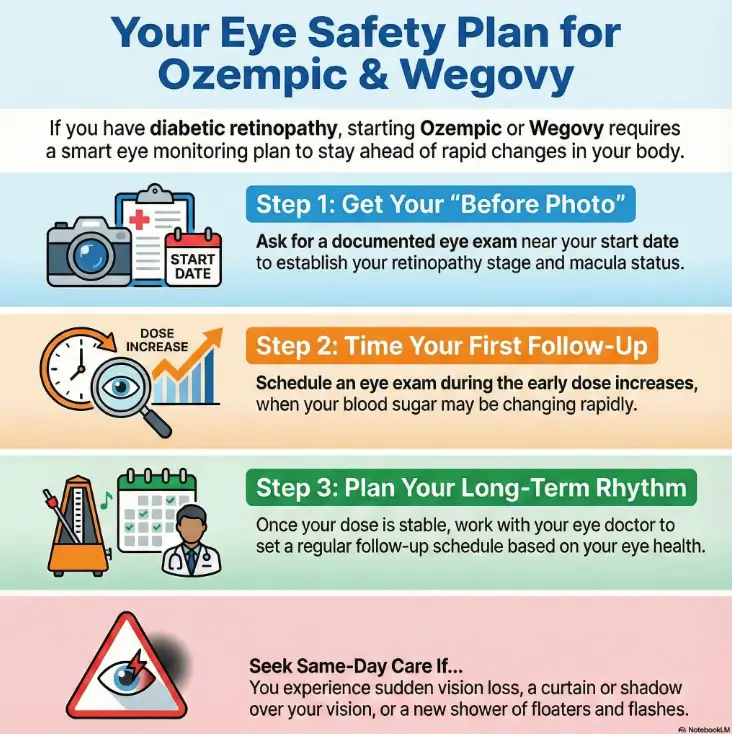
This post helps you turn “call if it gets worse” into a simple, titration-tied monitoring schedule you can ask for—baseline snapshot, an early recheck, and a stable cadence based on severity—plus the exact same-day symptom list. No panic. Just a plan.
- Get a documented baseline (stage + macula status) so changes are measurable.
- Time one follow-up to early dose increases, especially if A1C may drop quickly.
- Know the urgent symptom list so you don’t wait too long.
Apply in 60 seconds: Copy the “portal message” in the Next Step section and send it to both clinics.
Fast Answer
If you have diabetic retinopathy and you’re starting Ozempic/Wegovy, ask for a baseline documented retina “snapshot” (dilated exam + imaging if needed) near your start date, then a timed recheck during early dose increases, with shorter intervals if you have diabetic macular edema (DME) symptoms, moderate/severe retinopathy, or prior injections/laser. Your goal isn’t “more appointments”—it’s no-surprises monitoring tied to titration and A1C speed. If you have sudden vision loss, new floaters/flashes, a curtain/shadow, or severe eye pain, seek urgent eye care.
Table of Contents
The first 4 weeks: where “surprises” happen
If you’re time-poor, here’s the punchline: the riskiest time to “wing it” is the early titration window. Not because semaglutide is automatically “bad for eyes,” but because your body is changing fast. Glucose can improve quickly in some people, and rapid shifts have long been associated with temporary worsening of diabetic retinopathy in certain contexts. That’s why monitoring needs to be scheduled, not reactive.
A common real-world pattern looks like this: someone starts a GLP-1, feels hopeful, gets busy, then notices blur and tells themselves it’s probably dry eyes or “just my glasses.” Two weeks later, they’re scrambling for an appointment. Not dramatic—just human.
- Week 0–2: baseline data matters more than vibes.
- Week 2–6: early dose steps happen; schedule the follow-up window.
- After stable dosing: you move into a maintenance cadence based on severity.
What “early worsening” means (and what it doesn’t)
“Early worsening” is a clinical phrase that’s often misunderstood. It doesn’t mean “the medication is destroying your vision.” It means that in some people—especially those with existing retinopathy—rapid improvements in blood sugar can be associated with short-term retinal changes. The long game of better glucose control can be protective for eyes, but the short game can be bumpy. This is precisely why you want a plan.
Why “I’ll go if my vision changes” is a risky plan
Because symptoms are a lagging indicator. Retinal bleeding, swelling, or new vessel growth can evolve before you notice obvious changes. And some urgent conditions can begin suddenly. “I’ll wait and see” is fine for a lot of life. Your retina is not one of them.
Pattern interrupt: Let’s be honest—most plans start after the problem
Most people don’t ignore their eyes. They just don’t get a calendar invitation for them. Your goal is to create one now—while you feel okay.
Money Block: Eligibility checklist (Do you need a tighter monitoring plan?)
- Yes if you’ve been told you have NPDR/PDR/DME.
- Yes if you’ve had retina injections or laser.
- Yes if your last A1C was high and you expect a big drop.
- Yes if you have new floaters, wavy lines, or recent unexplained blur.
- No/Unsure doesn’t mean “skip”—it means “confirm your baseline status.”
Neutral next action: If you checked any “Yes,” ask for a baseline snapshot + titration-timed recheck.
Who this is for / not for (self-sort in 30 seconds)
This guide is built for the person who wants the simplest possible monitoring schedule without gambling on their vision. You’re not here to read a pharmacology textbook. You’re here to avoid a preventable “why didn’t anyone tell me?” moment.
This is for you if…
- You have diabetes and you’ve ever been told “retinopathy,” “macular edema,” “NPDR,” or “PDR.”
- You’ve had retina treatment (anti-VEGF injections, PRP laser, or eye surgery related to diabetes).
- You’re starting or increasing semaglutide and expect meaningful glucose improvement.
- You’re caring for a parent who can’t keep track of these details (and you want a script).
This may not fit if…
- You do not have diabetes, have no known retinal disease, and are already on a routine eye-exam schedule—your plan may be simpler.
- You have an unrelated eye condition (like advanced glaucoma) where your ophthalmologist has already set a separate, strict cadence.
If you’re unsure what you have
Ask one direct question at your next eye visit: “Do I have NPDR, PDR, or DME—and what stage?” Then ask them to write it in the after-visit summary. One line. That single line turns future decisions from “maybe” to “clear.”
Ozempic vs Wegovy: same molecule, different context
Ozempic and Wegovy share the same active ingredient (semaglutide), but they’re used in different contexts. Ozempic is typically prescribed for type 2 diabetes. Wegovy is typically prescribed for chronic weight management. That difference matters because your baseline risk profile is different if diabetes is in the mix—and diabetic retinopathy is, by definition, a diabetes-related eye disease.
The non-negotiable: they’re not interchangeable
People swap these names casually online. Your prescriber won’t. Doses, indications, coverage rules, and titration schedules can differ. For eye monitoring, the key is not brand loyalty—it’s titration timing plus retina risk level.
Dose-titration reality check (why weeks matter)
Titration is designed to help your body adjust and to reduce side effects. It also means your physiology is changing in steps. Those steps are your natural “check-in points” for a monitoring plan. Think of it like moving house: you don’t wait until you can’t find your toothbrush to label boxes. You label them before the chaos starts.
Open loop: Does higher dose automatically mean higher eye risk?
Not automatically. The more useful question is: How fast is my glucose improving, and what’s my baseline retina status? The same dose can mean different physiological change in different people. That’s why a calendar plan beats internet certainty.
Money Block: Decision card (When A vs B)
- No known retinopathy
- Stable A1C and stable meds
- No new visual symptoms
Trade-off: fewer visits, but less early certainty.
- Known NPDR/PDR/DME
- Prior injections/laser
- Expected fast glucose improvement
Trade-off: more structure now, fewer emergencies later.
Neutral next action: Choose the tighter plan if you’re unsure—then loosen it with your doctor if appropriate.
Baseline “snapshot”: what to document before dose changes
The baseline visit is not “a quick look.” It’s your before-photo. Without it, every future conversation becomes: “I think it’s worse?” “Maybe?” “Hard to tell?” That uncertainty is expensive—not just financially, but mentally. A good baseline snapshot should answer three practical questions: What stage am I? Is my macula swollen? What should trigger a sooner follow-up?
What to request at baseline
- Retinopathy classification: NPDR vs PDR, and severity if known.
- Macula status: any sign of diabetic macular edema (DME) or “swelling”.
- Documented plan: a written follow-up interval tied to titration steps.
Imaging that makes follow-ups obvious
If your clinician recommends imaging (like OCT or retinal photos), it’s not busywork—it’s how subtle changes become obvious. If your macula is the “reading center,” OCT can show swelling even when you’re still functioning. (If you’ve ever squinted through a menu and blamed the lighting, you know how easy it is to normalize blur.)
Pattern interrupt: Here’s what no one tells you—no baseline = guesswork later
A baseline that isn’t documented clearly doesn’t just hurt your future doctor. It hurts you. Because you’ll carry the anxiety of “What if?” without the relief of “We measured it.”
- Ask for the exact stage terms (NPDR/PDR/DME).
- Ask whether your macula is involved (yes/no matters).
- Ask what “sooner than planned” looks like.
Apply in 60 seconds: Before you leave, say: “Can you put the stage and follow-up interval in my summary?”
Money Block: Quote-prep list (what to gather before you call insurance)
- The diagnosis terms written by the clinic (NPDR/PDR/DME).
- Whether imaging is planned (ask the clinic what tests they expect).
- Your plan type (commercial vs Medicare Advantage vs Original Medicare).
- The clinic’s billing phone number (not the front desk).
- Any referral requirements (common in HMO plans).
Neutral next action: Call once with a short script and ask “What is my copay for retina follow-up and imaging?”
The monitoring schedule template to ask for (steal this script)
This is the heart of the article: a schedule template you can bring to both your prescriber and your eye clinician. In the U.S., these systems often don’t “talk.” Your job (unfair, but real) is to be the translator. The easiest way is to ask for a plan with three parts: baseline, early titration check, and stable cadence.
The 3-part ask (baseline → titration recheck → stable cadence)
- Baseline: “Can we do a baseline dilated exam near my start date?”
- Titration recheck: “When should I recheck during early dose increases?”
- Stable cadence: “Once stable, what interval keeps me safe?”
Risk-tier prompts (what to ask, not what to assume)
- If mild: “Is a routine interval okay, or should we add one early check-in during titration?”
- If moderate/severe or DME: “Should we shorten follow-up during dose changes?”
- If prior treatment: “What symptom or measurement would make you move my visit sooner?”
What to do if you miss a visit
Life happens. The key is not shame; it’s recovery. Use this line: “I’m overdue by about X weeks—do you want me triaged sooner given my retinopathy history and medication change?” It’s specific, calm, and gives staff the words they need to route you appropriately.
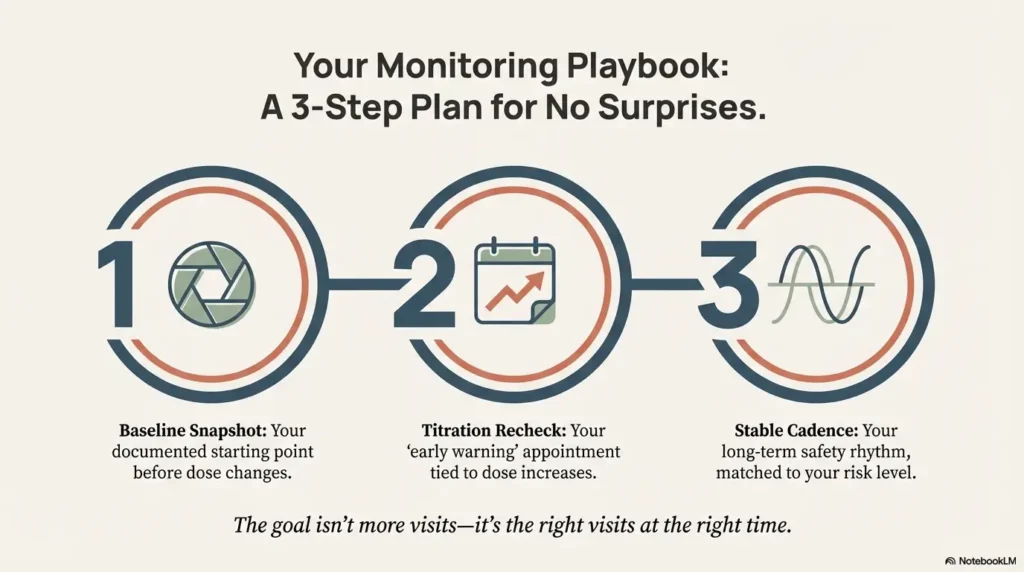
- Baseline = documented starting point.
- Titration recheck = your “early warning” appointment.
- Stable cadence = your long-term safety rhythm.
Apply in 60 seconds: Put the three-part ask in a portal message so it becomes part of your chart.
Risk tiers that change everything
Competitor articles often list “symptoms to watch” and “see your eye doctor regularly.” Helpful, but incomplete. What you need is a risk-tier lens that changes your monitoring questions. Here’s the practical version: stage + macula + prior treatment + expected A1C speed.
If you have mild NPDR
Your plan may be straightforward: a clear baseline, one early titration check if your clinician agrees, then routine follow-ups. The win here is not panic. It’s precision. Mild disease still deserves a real plan, especially during medication changes.
If you have moderate–severe NPDR or PDR history
This is where “annual” can be too slow during the transition. People with more advanced disease, or a history of proliferative changes, often need closer monitoring. The point isn’t to scare you. It’s to prevent a delayed response if something shifts.
If you have DME or prior injections/laser
DME can affect central vision, and prior treatments mean your eye team is already managing risk. Bring them into the semaglutide conversation early. A single line in your chart—“starting GLP-1, please advise follow-up interval”—can prevent months of ambiguity. (If you’ve ever wondered how PRP laser compares with anti-VEGF injections for PDR, this is the exact “retina-level” context your clinic is thinking in.)
Open loop: How fast is “too fast” for A1C drop—for your eyes?
This is where you stop searching for a universal number. Instead, ask your prescriber: “Do you expect my A1C to change quickly, and should that affect my eye follow-up timing?” Then ask your eye clinician the same question from their side. When both answer, your plan becomes personal—not generic.
Money Block: Mini “schedule planner” (conversation starter, not medical advice)
Pick one option in each line, then bring the result as a question to your clinic:
- Retinopathy stage: None/Unknown • Mild NPDR • Moderate/Severe NPDR • PDR history
- Macula status: No known DME • DME present/previous • Not sure
- Change speed: Expect slow change • Expect meaningful A1C improvement • Not sure
Your output line: “Given my baseline risk and medication change, should we schedule a recheck during early titration, and how soon?”
Neutral next action: Use the output line in a portal message to make scheduling easier.
NAION vs retinopathy vs “just blurry”
This is the part the internet makes messy. “Ozempic blindness” headlines mash multiple issues into one scary bucket. But your response depends on which problem you’re dealing with. Three buckets show up repeatedly in conversations about semaglutide and eyes:
- Temporary blur: often related to changing glucose and lens swelling/shape shifts (usually improves as glucose stabilizes).
- Diabetic retinopathy/DME changes: bleeding, swelling, or proliferative changes that need retina-level evaluation.
- Optic nerve events like NAION: sudden vision loss that needs urgent evaluation and a broader medical review.
NAION in plain English
NAION (nonarteritic anterior ischemic optic neuropathy) is an optic nerve problem—essentially, the optic nerve doesn’t get enough blood flow. It can cause sudden vision loss (often painless) and can be permanent. In recent years, it has come up in research and clinical discussions around semaglutide and GLP-1 medications. The important part for you isn’t jargon; it’s urgency: sudden vision loss is not a “wait it out” symptom. If you want a clean, senior-focused explainer to keep the “headline panic” from hijacking your decisions, read semaglutide sudden vision loss in seniors: what’s urgent vs what’s common.
Retinopathy/DME flare signals
New floaters, flashes, a curtain/shadow, or sudden central blur can signal retinal bleeding or traction problems. Wavy lines and “missing spots” can point toward macular involvement. If you have diabetes, treat these as high-priority until proven otherwise.
Temporary blur from glucose shifts
Some blur can happen when glucose is changing and your eye’s lens is adapting. This is the most common “non-drama” explanation—but it’s also the easiest one to mislabel. If blur is new, significant, one-sided, or paired with floaters/flashes/curtain symptoms, you should get evaluated promptly rather than assuming it’s harmless. (And if you’re juggling other meds too, it helps to know which ones can mimic eye scares—see Topamax sudden blurry vision: when to treat it as urgent.)
Show me the nerdy details
Why the confusion? The retina and optic nerve can both be affected by vascular factors, and diabetes itself increases baseline eye risk. Add rapid metabolic changes (glucose, blood pressure shifts, dehydration risk from GI side effects), and you can end up with overlapping symptoms. That’s why symptom-based triage plus a documented baseline is so powerful: you’re not guessing in the dark. (If blood pressure is part of your story, this overview of hypertensive retinopathy and what it can do to the retina can help you connect the dots without spiraling.)
- Sudden vision loss = urgent evaluation.
- Floaters/flashes/curtain = urgent retina-level concern.
- Gradual blur during glucose changes may settle, but still deserves a plan.
Apply in 60 seconds: Screenshot your symptom list and bring it to your appointment.
When to seek help: what “same-day” looks like
This section is intentionally practical. When people delay, it’s rarely because they “don’t care.” It’s because they don’t know the threshold. Or they don’t want to be embarrassed. Or they’re worried about cost. So let’s remove guesswork.
Go same-day / urgent for
- Sudden vision loss (even partial)
- New flashes + a shower of floaters
- A curtain/shadow over vision
- Severe eye pain or pressure with vision change
Call within 24–48 hours for
- New central blur that affects reading or driving
- Wavy lines or distorted text
- One-eye haziness that’s new and persistent
What to say on the phone (triage keywords)
Use words that signal risk without sounding dramatic:
- “Diabetes and retinopathy history”
- “New visual change during dose titration”
- “Sudden onset” (if true)
- “Curtain/shadow” or “new floaters/flashes” (if true)
Coordination protocol: prevent the “someone else is watching” gap
If you’ve ever assumed “the other office has it,” you already know this gap. Your prescriber is focused on glucose, weight, cardiovascular risk, and tolerability. Your eye clinician is focused on retinopathy stage, macular status, and treatment thresholds. Both are correct. But neither automatically owns the shared calendar—unless you make it explicit.
What to ask your prescriber (Ozempic/Wegovy side)
- “Can you note in my chart that I have retinopathy and we’re coordinating monitoring?”
- “If my dose increases early, do you recommend an eye recheck window?”
- “If my A1C improves quickly, should we adjust follow-up timing?”
What to ask your eye doctor (retina/optometry side)
- “What interval do you recommend specifically during titration?”
- “Do you want OCT or photos as part of follow-up?”
- “What symptoms should override the schedule and send me in sooner?”
Open loop: Who “owns” the follow-up if you change doses early?
Ask this directly. It’s a grown-up question, not a rude one. If your prescriber says “eye clinic,” and the eye clinic says “prescriber,” you’ve found the gap—and you can close it with one portal message to both.
- Make titration and retinopathy status visible to both teams.
- Get the follow-up interval documented in the after-visit summary.
- Clarify who triggers rechecks during dose changes.
Apply in 60 seconds: Send one message to both clinics using the same wording.
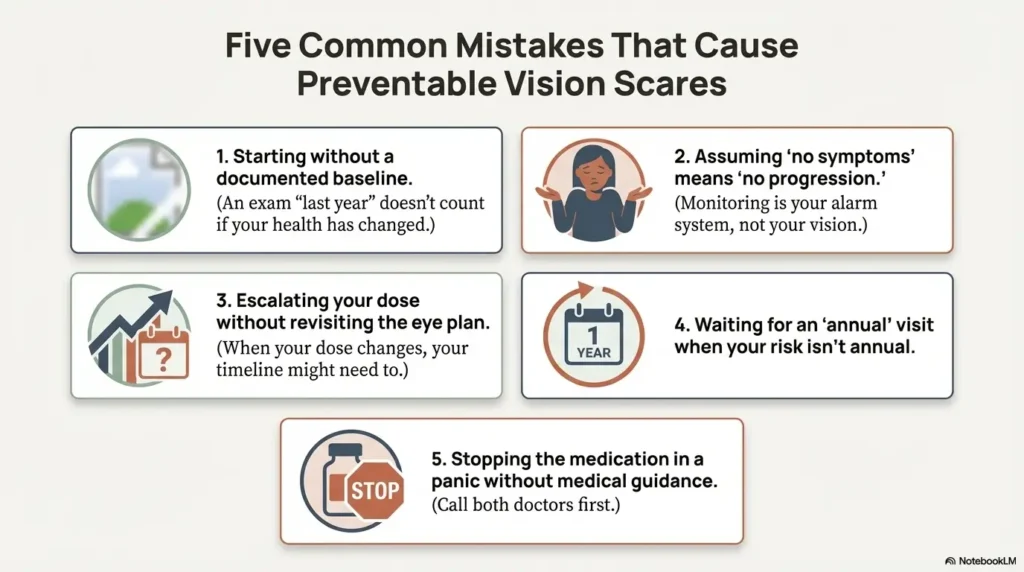
Common mistakes that cause preventable vision scares
This isn’t a scolding section. It’s a “save yourself the hassle” section. Most mistakes happen because someone is busy, optimistic, and trying to keep life moving. (Honestly: the healthiest mindset can sometimes make you a little too trusting of the future.)
Mistake #1: Starting without a documented baseline
“I had an eye exam last year” is not a baseline snapshot for today. Not if your A1C, meds, or symptoms have changed. A baseline needs documented staging and macula status now.
Mistake #2: Assuming “no symptoms” = “no progression”
Retinopathy can progress quietly. Symptoms are not a reliable early alarm. Monitoring is your alarm system.
Mistake #3: Dose escalation without revisiting the eye plan
When a dose changes, your follow-up timing may need to change. Even if the answer is “no, keep the same schedule,” you want that “no” to be intentional.
Mistake #4: Changing two variables at once (when you can avoid it)
If you can, avoid making multiple major medication changes at the exact same time without a clear monitoring plan. It’s not always possible—but when it is, it makes troubleshooting far easier. You don’t want to wonder which change affected what.
Mistake #5: Waiting for “annual” when your risk isn’t annual
Annual screening is appropriate for some people. But “annual” is not a magic charm during a period of rapid metabolic change and known eye disease. Ask for a titration-timed check if your risk tier suggests it. (If you’re rebuilding your baseline schedule, this guide on how often seniors should get dilated eye exams can help you sanity-check what “routine” even means.)
- Find your last eye visit summary (or request it).
- Write down your last A1C and your start date for semaglutide.
- Send the “monitoring schedule” portal message to both clinics.
Access + coverage: when appointments are months out
In a perfect world, you’d get a retina appointment next week. In the real world, you may hear “first available in three months.” If that happens, don’t panic—and don’t do nothing. You need a backup plan that matches your risk and symptoms.
Plan A: retina specialist (best for known PDR/DME or concerning symptoms)
If you have known proliferative disease, macular edema, or new urgent symptoms, push for retina-level triage. Use the phone script from earlier and include your medication change and symptom onset.
Plan B: comprehensive ophthalmology (better than waiting in silence)
If retina is unavailable quickly and you’re symptomatic, a comprehensive ophthalmologist can evaluate urgency, document findings, and help route you faster if needed. It’s not “second best.” It’s a bridge.
Plan C: urgent evaluation for urgent symptoms
Sudden vision loss, a curtain/shadow, or a burst of floaters/flashes should not wait months. You may be directed to urgent eye care or emergency evaluation depending on availability and severity. If you need a simple way to track onset/timing so triage goes faster, use a printable symptom diary for seniors and bring it with you.
Don’t do this: stopping the medication suddenly without medical guidance
It’s tempting to “just stop” if you’re scared. But abrupt changes can create other health risks. If you’re worried, call your prescriber and your eye clinician the same day. Let them decide the safest next step based on your specific situation.
Money Block: “Coverage tier” map (how follow-up intensity tends to shift)
- Tier 1: No retinopathy known → routine exam schedule.
- Tier 2: Mild NPDR → baseline snapshot + consider one early check during titration.
- Tier 3: Moderate NPDR → closer monitoring during change windows.
- Tier 4: Severe NPDR / PDR history → retina-led cadence; avoid delays.
- Tier 5: DME or active treatment → imaging + treatment-driven follow-up schedule.
Neutral next action: Ask your eye clinic which tier you’re in and what that means for timing.
Next step: copy/paste and book it
If you only do one thing after reading this: send the message below. It’s short on purpose. Staff can route short messages. Long messages get parked.
Copy/paste portal message (prescriber + eye clinic)
Message: “I have diabetes and diabetic retinopathy (stage: ___ if known) and I’m starting semaglutide (Ozempic/Wegovy). I’d like a baseline dilated exam (and OCT/retina imaging if indicated) and a follow-up schedule timed to dose titration. What interval do you recommend during dose increases, and what symptoms mean urgent evaluation?”
What to bring to the baseline visit (2 minutes of prep)
- Last A1C and the date it was measured
- Medication list (especially insulin or sulfonylureas if applicable)
- Semaglutide start date + planned dose increase dates (if you have them)
- A 1-sentence symptom summary (even if symptoms are “none”)
A tiny sanity trick (because anxiety loves empty space)
Put the follow-up date on your calendar with a label like: “Eye check during titration”. Not “retina doom appointment.” Words matter. Your nervous system hears them.
FAQ
Do I need a dilated eye exam before starting Ozempic or Wegovy?
If you have diabetes and any known or suspected retinopathy, a baseline exam close to your start date is a smart move. It creates a documented reference point (stage + macula status) so your clinicians can detect meaningful change during titration.
How soon after starting should I schedule a recheck?
The safest approach is to ask for a recheck window that aligns with early dose increases—especially if you have moderate/severe retinopathy, DME, or prior retina treatment. If you’re low-risk, your clinician may keep routine intervals—but you still want that decision to be intentional and documented.
Does semaglutide “cause” diabetic retinopathy to worsen?
Reality is more nuanced. Rapid improvement in glucose control has long been associated with temporary worsening of diabetic retinopathy in some settings. Some prescribing information includes warnings about retinopathy complications in people with a history of diabetic retinopathy and recommends monitoring for progression. Your best move is not fear—it’s a monitoring plan.
What symptoms should make me seek same-day eye care?
Sudden vision loss, a curtain/shadow, a sudden burst of floaters/flashes, or severe eye pain with vision change should be treated as urgent. When in doubt, call your eye clinic and use the triage keywords: diabetes + retinopathy history + new visual change during titration.
Is “Ozempic blindness” the same thing as diabetic retinopathy?
Not necessarily. Online headlines often blur different conditions together. Diabetic retinopathy involves the retina’s blood vessels. NAION involves the optic nerve. Both can be serious, but the symptoms, evaluation, and urgency can differ. If you experience sudden vision loss, treat it as urgent regardless of the label.
Should I stop semaglutide if I notice vision changes?
Don’t make a solo decision in a panic. Call your prescriber and your eye clinician promptly. Sudden changes may require urgent evaluation, and your clinicians can decide whether medication changes are appropriate based on findings and your overall health risk.
What if I can’t get a retina appointment quickly?
Ask for triage using symptom language and your medication change. If you are symptomatic or high-risk, consider interim evaluation with comprehensive ophthalmology while you wait. The goal is not “perfect scheduling.” It’s “no silent deterioration.”
Wrap-up: your monitoring plan in one page
Let’s close the open loop from the beginning: What should you actually ask for? Not “more checks.” Not “perfect certainty.” Just a plan that matches the reality of titration and diabetic eye disease.
Urgent override rule: Sudden vision loss, curtain/shadow, or new floaters/flashes → seek urgent eye care.
If you want a final bit of calm: you don’t have to decide whether the medication is “good” or “bad” for eyes on day one. Your job is simpler. Get your baseline. Tie a follow-up to titration. Know the urgent symptom list. That’s it. That’s the whole operator playbook.
Last reviewed: 2025-12-27.