
When Prescription Labels Are Too Small to Read:
A Critical Safety Question
The tiny print on a prescription bottle can turn an ordinary Tuesday morning into a kitchen-counter puzzle: white cap, orange bottle, six-point font, and a direction line that seems to have been written for ants with perfect eyesight. For seniors, caregivers, and Medicare-age patients, knowing what to ask the pharmacist is not a convenience question—it is a safety question.
Small prescription labels can make it harder to confirm the medicine name, dose, timing, refill date, warning stickers, and side effects. The cost of guessing can be serious: missed doses, double doses, drug interactions, or delayed treatment. The good news is practical and immediate. A pharmacist can often help with larger print, clearer directions, medication lists, accessible labels, refill systems, and safer packaging.
- • Start with the bottle. Then widen the circle.
- • Ask before you leave.
- • Read it back out loud.
Medication safety is not about being perfect. It is about building a system that still works on a tired day, in dim light, with shaky hands, while the kettle is screaming like a tiny steam opera.
The Quick Safety Map: Make the Label Work for the Patient
Best first move: ask the pharmacist to make the label larger and explain the directions in plain English before the medicine goes home.
- Need bigger print? Ask for a large-print label and a readable medication list.
- Need less confusion? Ask what changed, what matters most, and what to do if a dose is missed.
- Need accessibility support? Ask about audio labels, braille, app-based reading tools, or special packaging.
- Need caregiver backup? Ask how a family member can help without guessing or taking over.
Table of Contents
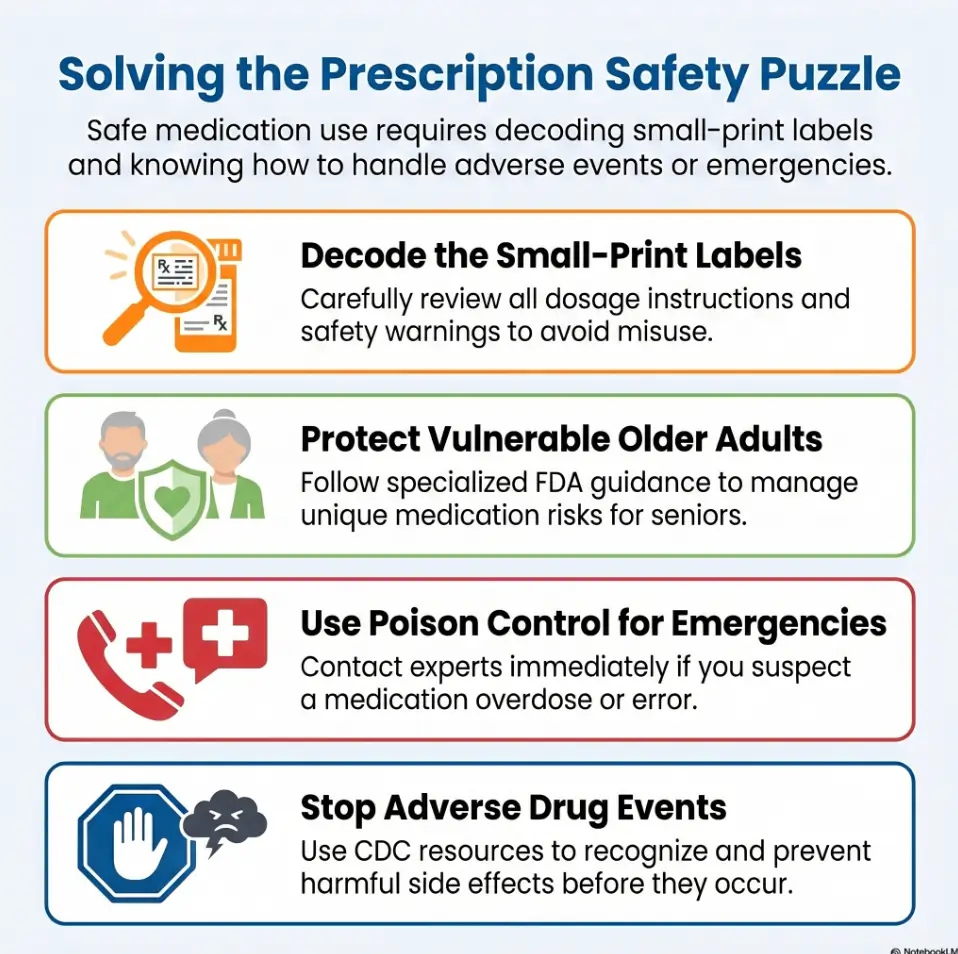
Tiny Labels, Big Risk: Why Small Print Is Not a Small Problem
Prescription labels are small, but the decisions they guide are large. A label may tell someone whether to take a medicine once daily or twice daily, with food or on an empty stomach, in the morning or at bedtime, every day or only when symptoms appear.
That is a lot of responsibility for a sticker the size of a tea biscuit.
The hidden danger is not bad eyesight, it is wrong information at the wrong moment
Many seniors can read well enough in calm conditions. The trouble starts when the setting changes. The kitchen light is dim. The label is glossy. The bottle is curved. The reader is tired. A caregiver is rushing to work. The phone rings. Suddenly, the difference between “take 1 tablet daily” and “take 1 tablet twice daily” becomes less obvious.
Medication safety depends on reliable information at the exact moment a decision is made. If the label is unreadable, the system has already started to wobble.
Why “I’ll remember it” becomes risky when several bottles look alike
Memory works beautifully for songs from 1968 and family recipes that never touched a measuring spoon. It is less dependable when a doctor changes a dose, a pharmacy swaps generic manufacturers, or three orange bottles sit in a row like identical little traffic cones.
Older adults often take more than one prescription, plus over-the-counter medicines, vitamins, eye drops, pain relievers, or supplements. That mix can be perfectly appropriate, but it needs clear labeling and regular review.
For low-vision households, medication safety often overlaps with home organization. A simple low vision medication safety setup can reduce everyday friction before it becomes a real hazard.
The one-second label check that prevents the wrong-pill shuffle
Before taking any medicine, the label check should answer four questions:
- Is this the right person’s medicine?
- Is this the right medicine name and strength?
- Is this the right time and dose?
- Is there a warning that changes how it should be taken?
If one answer is unclear, the next step is not guessing. The next step is asking.
- Small print can hide dose, timing, and warning details.
- Look-alike bottles make memory less dependable.
- One unclear instruction is enough reason to ask the pharmacist.
Apply in 60 seconds: Pick one current bottle and check whether you can read the drug name, dose, and timing without squinting.
Who This Is For, And Who Needs More Help Than a Bigger Label
This guide is for practical medication safety. It is not medical advice, diagnosis, emergency guidance, or a substitute for a pharmacist, prescriber, nurse, poison control center, or emergency care.
Do not stop, double, skip, split, or change medication timing because a label is unclear. Ask a healthcare professional first.
This is for seniors who can manage medicines but struggle with print size
Many older adults are fully capable of handling their medicines once the information is readable. They do not need someone hovering like a nervous lighthouse. They need labels, lists, lighting, and instructions that match real life.
This includes people with cataracts, macular degeneration, glaucoma, diabetic eye disease, dry eye, contrast sensitivity, tremor, arthritis, or ordinary age-related near-vision changes.
If near tasks are getting harder in general, a guide to senior near vision problems can help separate normal reading changes from warning signs that deserve an eye exam.
This is for adult children helping from across town or across the country
Caregivers often hear a parent say, “I’m fine,” while noticing three half-used bottles, a missing refill, and one pill that looks different from last month. The goal is not to stage a family courtroom drama over the kitchen table.
The goal is to create support that preserves independence: readable labels, a current list, simple refill timing, and a clear plan for questions.
Not for emergencies, sudden confusion, or suspected overdose
A bigger label cannot solve sudden confusion, fainting, severe allergic reaction, trouble breathing, chest pain, suspected overdose, or a major change in alertness. Those situations need urgent help.
For suspected poisoning or overdose in the United States, contact Poison Control at 1-800-222-1222 or emergency services if symptoms are severe or life-threatening.
Here’s what no one tells you: label access is part of independence
Independence is not doing everything the hard way. Independence is having the right supports so a person can make safe choices without surrendering control. A large-print label, talking label, or printed medicine list is not a confession of weakness. It is a handrail for the brain.
Money Block: Quick Fit Checklist
Use this guide if most answers are yes:
- Can the person usually take medicine independently?
- Is the main problem reading the bottle, leaflet, or warning sticker?
- Are medicines mostly stable, with only occasional changes?
- Can the person ask questions at the pharmacy or by phone?
- Is there a caregiver, neighbor, or clinician who can help when something changes?
One-line next step: If two or more answers are no, ask the pharmacist or prescriber about a full medication review and added support.
Ask First: “Can You Print This Label Larger?”
The simplest question is often the most powerful: “Can you print this label larger?” Ask before leaving the pharmacy. Once a bottle reaches the medicine cabinet, friction tends to multiply quietly.
Request large-print prescription labels before leaving the pharmacy
Pharmacies vary in what they can provide. Some can enlarge parts of the label. Some may print an additional medication sheet in larger type. Some may offer special accessible formats or work with services that do.
Use plain words at the counter:
- “I cannot read this label safely. Can you make it larger?”
- “Can the drug name, strength, and directions be printed in bigger type?”
- “Can you add large print as a preference on my pharmacy profile?”
That last question matters. One good label is helpful. A saved preference is a little safety machine that keeps working.
Ask whether the pharmacy can enlarge directions, drug name, dose, and timing
Not all label information carries the same risk. Ask the pharmacist to prioritize the most safety-critical items:
- Medicine name
- Strength, such as 5 mg or 20 mg
- Dose, such as one tablet or two capsules
- Timing, such as morning or bedtime
- Important warnings, such as take with food or avoid driving
If space is limited, ask for a large-print companion sheet. The bottle still needs enough information to identify it, but a readable sheet can make the daily routine much safer.
Ask if large print can be saved as a permanent pharmacy preference
A permanent preference can reduce repeated explanations. Ask the pharmacy staff to place a note in the patient profile. Then confirm it at the next refill.
Say: “Can you please add large-print labels or accessible labeling to my profile for all future prescriptions?”
For patients who already use magnification tools, pairing labels with the right reading setup can help. Some people do better with a handheld magnifier, while others need a stand device that does not require steady hands. A comparison of handheld versus stand magnifiers for tremor can help families choose a safer reading method.
Don’t accept “just use a magnifier” as the whole plan
A magnifier may help, but it should not be the only safety layer. Magnifiers get misplaced. Batteries die. Hands shake. Glare attacks from the countertop like a tiny disco ball.
Better plan: larger label, plain-English counseling, printed list, good lighting, and a way to confirm changes after refills.
Show me the nerdy details
Medication labels carry multiple information types at once: identity information, dosing instructions, cautionary warnings, refill data, prescriber information, and pharmacy contact details. The highest-risk reading failures usually happen when small type, poor contrast, curved surfaces, abbreviations, similar bottle shapes, and routine fatigue overlap. A safer system reduces the number of interpretation steps. Instead of asking the patient to decode small text every day, it makes the key information larger, plainer, repeatable, and easier to verify across the bottle, medication list, and pharmacist counseling.
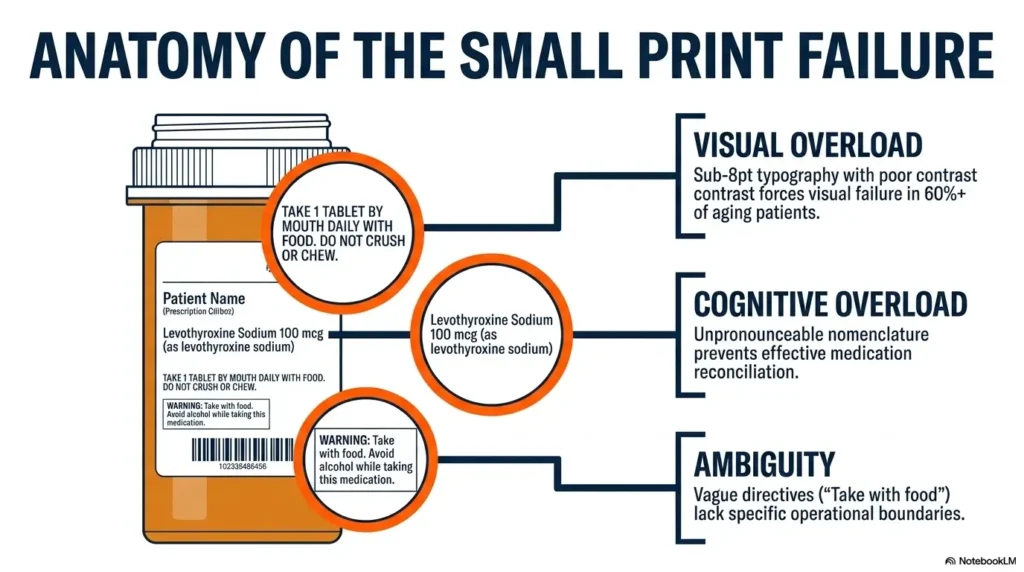
Say It Back: “Can You Explain This in Plain English?”
A larger label helps only if the instruction itself is clear. “Take as directed” is not a direction. It is a shrug wearing a lab coat.
Ask what the medicine is for, not just what it is called
Many medicines have names that sound like distant planets. Ask the pharmacist to connect the name to the purpose.
Try:
- “What is this medicine treating?”
- “Is this replacing something I already take?”
- “Is this a short-term medicine or something I take long term?”
Knowing the purpose helps prevent accidental duplication. For example, a patient may not realize two medicines are both for blood pressure, pain, sleep, allergy symptoms, or stomach acid.
Ask exactly when to take it: morning, noon, evening, bedtime, or with food
Timing language should be practical. Ask the pharmacist to translate instructions into the daily routine.
Instead of accepting “once daily,” ask: “Is morning or bedtime better?”
Instead of “with food,” ask: “Is a cracker enough, or should this be with a meal?”
Instead of “every 12 hours,” ask: “Would 8 a.m. and 8 p.m. work?”
Ask what “as needed” really means for this prescription
“As needed” can be clear to clinicians and fuzzy to everyone else. Ask for boundaries.
- What symptom should trigger a dose?
- How long should the patient wait between doses?
- What is the maximum per day?
- When should the patient stop and call the prescriber?
This is especially important for pain medicine, anxiety medicine, sleep medicine, inhalers, nausea medicine, bowel medicines, and eye drops.
Let’s be honest: “twice daily” can still confuse people
Twice daily may mean breakfast and dinner, morning and bedtime, or about every 12 hours. Those are not always the same. The refrigerator does not care. The bloodstream sometimes does.
Ask the pharmacist to write a sample schedule. Better yet, ask them to mark the schedule on a one-page medication list. A one-page medication list template can make those instructions easier to carry to appointments and pharmacy visits.
Money Block: Plain-English Direction Translator
| Label phrase | Ask the pharmacist | Why it matters |
|---|---|---|
| Once daily | Morning or bedtime? | Builds a routine. |
| Twice daily | Which two times? | Reduces missed or crowded doses. |
| As needed | Needed for what symptom? | Prevents casual overuse. |
| Take with food | Snack or full meal? | May reduce stomach upset or improve use. |
Neutral action line: Choose one confusing phrase and ask the pharmacist to rewrite it as a daily clock time.
Spot the Warning Stickers Before They Become Wallpaper
Warning stickers often sit on the bottle like tiny neon billboards. After a while, people stop seeing them. That is dangerous because the sticker may carry the instruction that changes everything.
Ask which stickers matter most for this specific medicine
Not every warning sticker applies with the same urgency to every patient. Ask the pharmacist to point to the most important one and explain why it matters.
Useful question: “Which warning on this bottle is most important for me?”
That question turns visual clutter into a priority list.
Ask whether alcohol, grapefruit, driving, sun exposure, or dairy matters
Some medicines interact with food, beverages, alcohol, sunlight, driving, or supplements. Others may cause drowsiness, dizziness, stomach upset, or bleeding risk. The right questions are simple:
- “Should I avoid alcohol with this?”
- “Does grapefruit matter?”
- “Can this make me sleepy or dizzy?”
- “Should I avoid dairy, antacids, iron, or calcium near this dose?”
- “Does this increase sun sensitivity?”
Ask what side effects require a call versus urgent care
Every medicine has possible side effects, but not every side effect means panic. Ask the pharmacist to separate ordinary watch items from red flags.
Say: “What side effects should make me call the doctor, and what symptoms mean urgent help?”
This is especially useful when starting a new medicine, changing dose, or combining several medicines that can affect balance, alertness, blood pressure, bleeding, breathing, or blood sugar.
Curiosity gap: the smallest sticker may carry the biggest consequence
A tiny sticker saying “may cause dizziness” can be a fall-prevention clue. A tiny sticker about food can change whether a medicine works well. A tiny sticker about driving can matter more than the main label for that first week.
For seniors with poor contrast sensitivity, glare can make stickers harder to see. Household reading fixes, such as better lamp placement and matte surfaces, can support safer label reading. For broader room changes, bedroom safety for seniors with poor vision offers practical home-safety ideas that also apply to nightstand medicines.
Don’t Mix Bottles: How to Avoid Look-Alike Medication Confusion
Medication confusion is not always caused by small text. Sometimes it is caused by bottles that look like cousins at a family reunion: similar shape, similar label, similar cap, similar everything.
Ask the pharmacist to point out the pill color, shape, imprint, and strength
Before leaving the counter, ask the pharmacist:
- “What color should this pill be?”
- “What shape is it?”
- “What imprint or number is on it?”
- “What strength is this?”
That visual description is not a substitute for the label, but it adds another layer of confirmation. If a pill later looks unfamiliar, pause and ask.
Ask what changed if the pill looks different after a refill
Generic medicines can sometimes look different when a pharmacy uses a different manufacturer. The active ingredient may be the same, but the pill’s size, shape, or color may change.
Never assume. Ask: “My pill looks different. Can you confirm this is the same medicine and strength?”
This is a strong question because it is specific, calm, and fast. No drama. No detective hat. Just verification.
Ask whether generics may look different between manufacturers
If a medication is likely to change appearance, ask the pharmacist to warn you ahead of time. Some patients benefit from a note on the medication list that says, “Pill appearance may vary. Confirm with pharmacy if different.”
For people with low vision, tactile systems can help identify bottles without relying only on print. A guide to pill bottle tactile label placement can help families create a safer touch-based system without covering critical printed information.
Common mistake: pouring new pills into an old bottle
Do not pour new pills into an old bottle unless the pharmacist specifically says it is safe and the label remains accurate. Old bottles may have outdated directions, discontinued doses, or an old prescriber’s instructions.
One of the quietest medication errors begins with “I was just saving space.” The medicine cabinet is not a minimalist design contest. Accuracy wins.
- Ask about color, shape, imprint, and strength.
- Generic manufacturers may change pill appearance.
- Do not combine new pills with an old bottle if directions may differ.
Apply in 60 seconds: Look at one current pill and write its color, shape, and imprint on the medication list.
Build a Safer System: Labels, Lists, Packaging, and Backup Eyes
A readable label is step one. A safer medication system is step two. The best system is simple enough to survive real life: grocery bags, bad lighting, phone calls, refills, doctor changes, and the occasional grandchild asking where the crackers are.
Ask for a printed medication list with names, doses, and timing
Ask the pharmacist for a current medication list. Then compare it with what is actually at home. Include prescriptions, over-the-counter medicines, vitamins, supplements, eye drops, creams, inhalers, and “only sometimes” medicines.
Important fields include:
- Medicine name and strength
- What it is for
- Exact dose and timing
- Prescriber name
- Start date or recent change date
- Major warnings
- Refill timing
A medication list can also support eye-care visits, hospital admissions, urgent care trips, and caregiver handoffs. For people juggling appointments, a doctor appointment note-taking system can help capture dose changes before they vanish into the parking lot air.
Ask whether blister packs, compliance packaging, or synchronized refills are available
Some pharmacies offer packaging that organizes medicines by day and time. Some can synchronize refills so multiple medicines renew on the same schedule. Availability varies by pharmacy, insurance, medication type, and local policy.
Ask:
- “Do you offer blister packs or adherence packaging?”
- “Can my refills be synchronized?”
- “Will packaging work if my doses change often?”
- “What happens if the doctor stops one medicine?”
Packaging can help, but it is not magic. It must be updated when prescriptions change.
Ask how caregivers can help without taking over everything
A caregiver can help by reading labels aloud, checking refill dates, organizing a medication list, calling the pharmacy with permission, or attending a medication review. The key is respect.
Good support sounds like: “Let’s make the label easier to read.”
Poor support sounds like: “You can’t handle this anymore.”
One preserves dignity. The other walks into the room wearing muddy boots.
For family members helping from a distance, simplifying communication tools can reduce stress. A guide to simplifying an older parent’s phone can make pharmacy calls, medication photos, and caregiver check-ins easier.
Ask how to store medicines so the label stays readable
Storage matters. Keep medicines where labels remain dry, clean, and well lit. Avoid steamy bathrooms unless the pharmacist says storage there is fine. Keep active medicines separate from expired, discontinued, or “just in case” bottles.
For low-vision readers, a bedside system may help, especially for morning or bedtime medicines. A low vision bedside organization plan can reduce nightstand clutter and prevent bottle mix-ups.
The Four-Layer Medication Label Safety Stack
1. Readable Label
Large print, clear name, strength, dose, and timing.
2. Plain Directions
Morning, evening, with food, or exact clock times.
3. Current List
One page with all prescriptions, OTCs, and supplements.
4. Backup Check
Pharmacist, caregiver, prescriber, or Poison Control when needed.
Money Block: Packaging Decision Card
Choose larger labels when: medicines change often, the patient wants bottle-by-bottle control, or only a few prescriptions are used.
Ask about blister packs when: there are several daily medicines, timing is confusing, or missed doses are becoming a pattern.
Be cautious with packaging when: doses change frequently, temporary medicines are added, or the patient cannot identify what changed.
Neutral action line: Ask the pharmacist which option fits the current number of medicines and how often doses change.
Accessible Labels: Large Print, Braille, Audio, and Talking Options
The label should adapt to the patient, not the other way around. That sentence sounds obvious until someone is holding a bottle under a lamp, rotating it slowly, hoping the print will surrender.
Ask whether the pharmacy offers large print, braille, talking labels, or app-based audio labels
Accessible prescription information may include larger print, braille, talking labels, audio devices, QR-style systems, app-based reading, or other pharmacy-specific options. Availability differs. Ask directly and early.
Try this script:
“I have trouble reading standard prescription labels. What accessible label options do you offer, such as large print, braille, audio, or talking labels?”
For people who already use phone tools, scanning can help, though it should not replace pharmacist counseling. A practical guide to iPhone Magnifier filters for pill bottles can make small print and contrast easier to manage at home.
Ask whether accessible label services cost extra or require advance notice
Some options may require setup time, a profile note, a specific pharmacy location, or special equipment. Ask:
- “Is there a fee?”
- “How long does it take?”
- “Can this be added to all future prescriptions?”
- “Will it work for refills and new prescriptions?”
Ask if mail-order prescriptions have different accessibility options
Mail-order pharmacies may have different systems from local pharmacies. Ask the plan, pharmacy, or mail-order service whether accessible labels can be requested and how changes are handled.
If a patient uses Medicare drug coverage or a Medicare Advantage plan with drug benefits, the pharmacy network and plan rules may affect where prescriptions are filled. The accessibility conversation still belongs on the table.
Pattern interrupt: the label should adapt to the patient, not the other way around
There is no award for suffering through microscopic print. A safer label respects aging eyes, tremor, memory load, lighting, and urgency.
For a direct script designed for low-vision pharmacy conversations, the low vision pharmacy help script can help patients ask clearly without feeling embarrassed.
Short Story: The Bottle That Finally Spoke
Marion kept her blood pressure pills beside the toaster because morning routines were sacred in her house: coffee, toast, pill, crossword. Then the refill came with a slightly different tablet and a label she could not read without hunting for a magnifier. She guessed for two days, then felt dizzy enough to sit down on the kitchen floor, annoyed at the tiles and herself in equal measure.
Her daughter did not scold. She drove Marion to the pharmacy with all the bottles in a paper bag. The pharmacist printed a clearer medication list, confirmed the changed pill appearance, added a large-print preference, and marked the morning medicines with tactile dots that did not cover the label. Marion still made her own coffee. She still handled her own pills. The difference was that the bottle no longer whispered. It spoke loudly enough to be trusted.
- Ask about large print, braille, audio, and talking labels.
- Request accessibility preferences before the next refill.
- Use technology as support, not as a substitute for pharmacist counseling.
Apply in 60 seconds: Call the pharmacy and ask, “What accessible prescription label options do you offer?”
Common Mistakes Seniors Make When Labels Are Too Small
Most medication mistakes are not wild mistakes. They are ordinary mistakes made by tired humans trying to get through the day. That is why systems matter.
Mistake 1: guessing based on bottle size, color, or location
“The small bottle is the bedtime pill” works until the pharmacy changes the bottle size. “The left bottle is the water pill” works until someone cleans the counter.
Location can support a routine, but it should never replace label reading.
Mistake 2: relying on memory after a dose change
Dose changes are a classic danger zone. A prescriber may say, “Take two tablets now,” or “Cut back to once daily,” but the old bottle may still show the old direction.
Ask the pharmacist whether the printed label reflects the newest instructions. If not, ask what needs to happen before using the medicine.
Mistake 3: ignoring the pharmacy leaflet because it looks too dense
Pharmacy leaflets can look like a legal document married a cereal box. Still, they may contain useful warnings, side effects, and instructions.
Ask for the key points. If reading leaflets is difficult, use a reading strategy or have someone read the important parts aloud. A guide on how to read medicine leaflets with low vision can make those dense pages more manageable.
Mistake 4: keeping expired or discontinued medicines near active ones
Old medicines near current medicines invite mistakes. Ask the pharmacist how to dispose of discontinued or expired medicines safely. Many communities have take-back programs or pharmacy guidance.
Mistake 5: not telling the pharmacist about OTC drugs and supplements
Over-the-counter medicines, vitamins, herbals, and supplements can still interact with prescriptions or affect side effects. Bring the full list. The pharmacist cannot check what they do not know exists.
This is especially important for sleep aids, allergy medicines, pain relievers, stomach medicines, cold medicines, eye drops, and supplements that affect bleeding or sedation.
- Do not identify medicine by bottle location alone.
- Verify every dose change against the current label.
- Tell the pharmacist about OTC drugs and supplements.
Apply in 60 seconds: Move expired or discontinued bottles away from active medicines until you can ask about safe disposal.
The Pharmacist Question Script Seniors Can Use at the Counter
Good questions reduce risk. They also reduce embarrassment because the patient does not need to improvise under fluorescent lights while a line forms behind them.
“Can you make this label easier for me to read?”
This is the anchor question. It covers larger print, clearer placement, accessible formats, and profile preferences.
“What is the most important instruction on this bottle?”
This helps the pharmacist highlight the one thing that must not be missed, such as take with food, avoid certain products, do not crush, or watch for dizziness.
“What should I do if I miss a dose?”
Missed-dose instructions vary. Some medicines can be taken when remembered. Others should be skipped if it is close to the next dose. Some require a call. Never invent the rule.
“Which side effects should make me call someone?”
Ask for a simple split: common side effects to watch, side effects that require a call, and symptoms that require urgent help.
“Does this interact with anything else I take?”
Bring the list. Include prescriptions, OTC medicines, supplements, vitamins, drops, inhalers, patches, creams, and occasional medicines.
“Can you help me organize refills so I do not run out?”
Running out creates its own risks. Ask whether synchronized refills, reminders, auto-refill rules, or caregiver notifications are available and appropriate.
Money Block: Pharmacy Visit Prep List
Bring these before comparing packaging, label, or refill options:
- All current prescription bottles
- OTC medicines, vitamins, and supplements
- Recent hospital discharge papers, if any
- Insurance or Medicare drug plan card
- Preferred daily schedule, such as breakfast and bedtime
- Caregiver contact information, if the patient wants support
Neutral action line: Put everything in one bag and ask for a medication review during a slower pharmacy time.
When to Seek Help: The Red Flags That Need More Than Better Print
Some medication problems need a clearer label. Others need a clinician, Poison Control, or emergency help. Knowing the difference is the adult version of keeping a flashlight by the bed: boring until it matters.
Call the prescriber or pharmacist if doses are repeatedly missed or doubled
One missed dose may be a normal human moment. A pattern needs attention. Repeated missed doses, doubled doses, confusion about timing, or running out early should trigger a call.
Ask for a medication review, simpler timing, packaging support, refill synchronization, or caregiver access if the patient agrees.
Seek urgent help for severe allergic reaction, chest pain, trouble breathing, fainting, or sudden confusion
Severe symptoms need urgent care. This includes trouble breathing, swelling of the face or throat, chest pain, fainting, severe weakness, sudden confusion, severe dizziness, signs of stroke, or a major change in consciousness.
When symptoms are severe or life-threatening, call emergency services.
Contact Poison Control or emergency services for suspected overdose
If a medication overdose is suspected, do not wait for the next business day. In the United States, Poison Control can help guide next steps at 1-800-222-1222. Emergency services are appropriate for severe symptoms or immediate danger.
Ask for a full medication review if there are new falls, dizziness, sleepiness, or confusion
New falls, dizziness, unusual sleepiness, blurry vision, confusion, appetite changes, or worsening balance can have many causes. Medication side effects or interactions may be one part of the puzzle.
Do not assume it is “just aging.” Ask a pharmacist or prescriber to review the full medication list.
For patients managing both vision problems and multiple medicines, polypharmacy and vision problems explains why medication load can make daily safety more complicated.
- Repeated dose mistakes deserve a medication review.
- Severe symptoms need urgent care or emergency services.
- Suspected overdose should involve Poison Control or emergency help.
Apply in 60 seconds: Write Poison Control’s number, 1-800-222-1222, on the medication list.
FAQ
Can seniors ask pharmacies for larger prescription labels?
Yes. Seniors can ask whether larger prescription labels are available and whether that preference can be saved in the pharmacy profile. If the pharmacy cannot change the bottle label itself, ask for a larger-print medication list or accessible format.
What should I do if I cannot read the directions on my medicine bottle?
Do not guess. Call or visit the pharmacy and ask the pharmacist to read and explain the directions. Then ask for a clearer label, larger print, or another accessible option before taking the next uncertain dose.
Are talking prescription labels available in the United States?
Some pharmacies and accessibility services offer talking prescription labels, audio label systems, or app-supported options. Availability varies by pharmacy, location, prescription channel, and setup requirements, so ask directly.
Should I use a pill organizer if labels are too small?
A pill organizer can help some people, but it must be filled from current, accurate instructions. Ask the pharmacist first if medicines change often, if there are “as needed” medicines, or if the patient takes high-risk medicines that require careful timing.
Why does my pill look different after a refill?
A different generic manufacturer may produce a pill with a different color, shape, or imprint. Never assume it is correct. Ask the pharmacist to confirm the medicine, strength, and directions before taking it.
Can a caregiver talk to the pharmacist for an older parent?
Often yes, but privacy rules and pharmacy policies may affect what can be shared. Ask the pharmacy how the older adult can authorize caregiver communication while keeping control over personal health information.
What is the safest question to ask before leaving the pharmacy?
Ask: “Can you show me exactly how and when to take this, and what I should watch for?” That single question invites the pharmacist to cover dose, timing, warnings, side effects, and follow-up steps.
Do Medicare plans cover accessible prescription labels?
Coverage and pharmacy services vary. Ask the pharmacy and drug plan whether accessible labeling, packaging, or mail-order options are available, whether there is a fee, and whether the preference can be added for future refills.
Next Step: Make One Pharmacy Visit Safer Today
The kitchen-counter puzzle from the beginning does not need a heroic solution. It needs one clear next move. A medication label that can be read, understood, and trusted is one of the smallest home safety upgrades with one of the biggest practical effects.
Bring every active medicine, supplement, and OTC product in one bag
Use a paper bag, tote, or box. Bring prescriptions, OTC medicines, vitamins, supplements, eye drops, inhalers, patches, creams, and occasional medicines. If that feels excessive, remember: the pharmacist would rather see the whole orchestra than guess which violin is out of tune.
Ask for one readable medication list before leaving
Ask the pharmacist to help create or update a readable list. Keep one copy at home, one in a wallet or emergency folder, and one with a caregiver if the patient wants that support.
For low-vision households, a low vision medication tracker printable can support daily routines without relying only on tiny bottle print.
Save one pharmacy preference: large print, audio label, or clearer packaging
Do not make this a one-time fix. Ask the pharmacy to save the preference. Confirm it at the next refill and after any change in pharmacy, insurance, prescriber, or mail-order service.
The 15-minute action: call the pharmacy and ask what accessible label options they offer
Use this exact line:
“I have trouble reading standard prescription labels. What options do you offer for large print, clearer directions, audio labels, talking labels, braille, or medication packaging?”
That one call can turn a small-print problem into a safer routine. Not perfect. Not fancy. Just readable enough for real life.
Medication safety often begins with one humble sentence at the counter: “Can you make this easier to read?” Ask it once. Then ask the pharmacy to make it part of the system.
Last reviewed: 2026-05.