
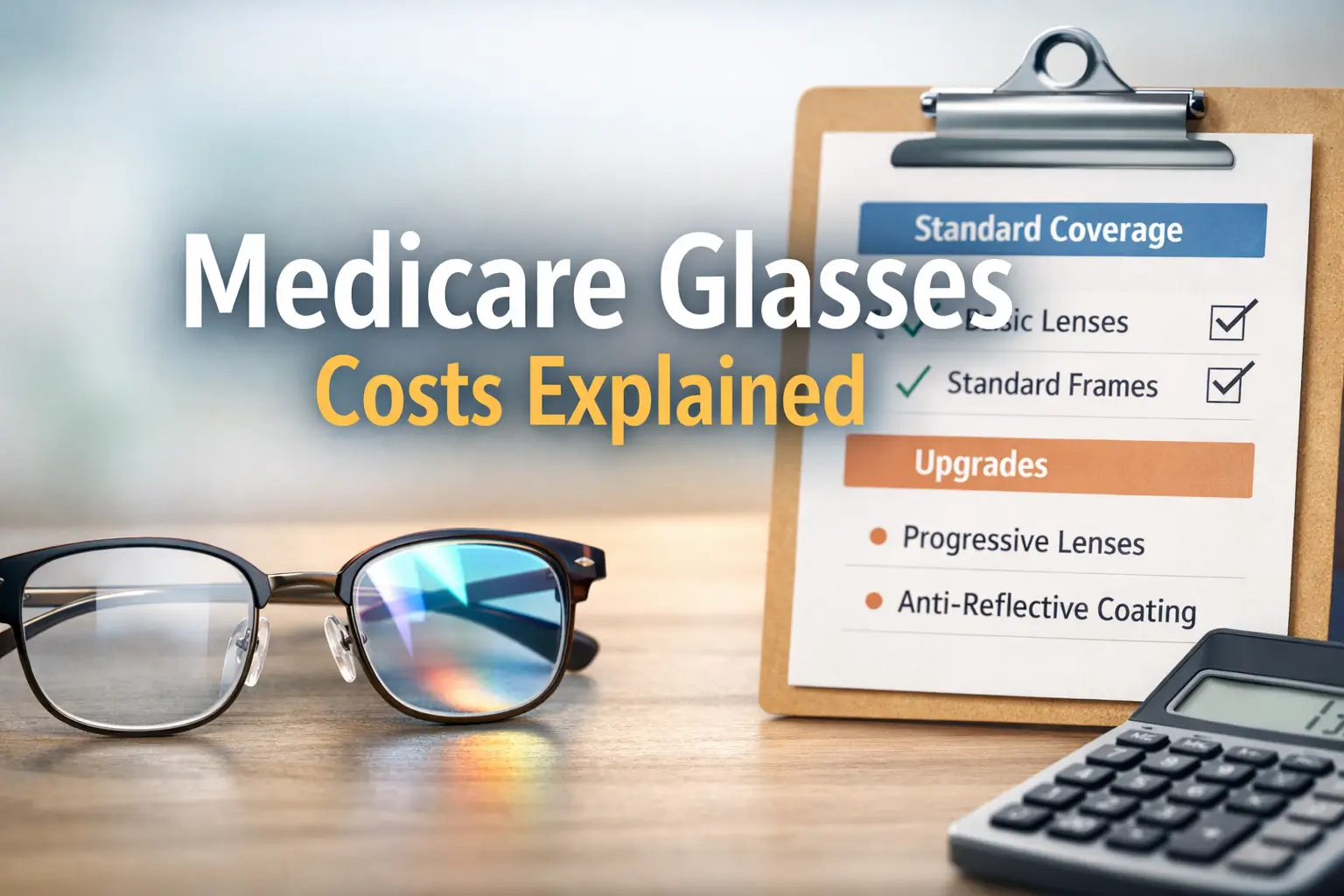

The Hidden Math of Post-Cataract Eyewear
The surprise isn’t the frames—it’s the receipt: a “cataract surgery glasses” benefit on one hand, and a growing stack of “upgrade” line items on the other.
If you’re trying to follow the Medicare cataract surgery glasses rule and still end up with progressives, anti-reflective coating, or a frame you actually like, the confusion usually comes from one thing: the base benefit and the upgrades get blended into one foggy price.
Keep guessing and you risk paying twice—once through Part B cost-sharing, and again through an “upgrade package” that never got separated on paper.
Definition: The Medicare Standard
Medicare Part B generally covers one pair of eyeglasses with standard frames (or one set of contacts) after cataract surgery that implants an intraocular lens—after each surgery. Many people shorthand this as “one pair per eye,” but your out-of-pocket still depends on deductible/coinsurance and how upgrades are itemized. If you want the short version of the rule in one place, see Medicare glasses after cataract surgery (what’s covered and what’s not).
Our Goal: A Clean, Itemized Quote
We use a simple, battle-tested method: two buckets, one itemized estimate.
- ✔ Separate the Medicare-covered portion from upgrades (frames, progressives, coatings)
- ✔ Prevent the “two-eye timing” mistake that triggers a second purchase
- ✔ Coordinate vision insurance discounts without surprise bills (even with Medicare Advantage)
Slow down for 60 seconds.
Get the numbers before the emotions.
Make the counter feel boring—in a good way.
Table of Contents
1) Who this is for / not for
If you’re here because you want the “Medicare cataract glasses” but also want the lenses you actually like (progressives, anti-reflective, photochromic, nicer frames), you’re in the right place. This guide is for people who hate surprise bills and love receipts that make sense.
Who this is for
- Original Medicare (Part B) beneficiaries told “Medicare covers one pair after cataract surgery”
- Caregivers trying to keep a parent from paying twice (or signing a confusing upgrade form)
- Medicare Advantage members who want to understand the baseline benefit and the questions to ask
- Anyone shopping with a vision plan (like VSP, EyeMed, or Davis Vision) and wondering if it helps with upgrades
Who this is not for
- Routine “I just need new glasses” shopping unrelated to cataract surgery
- Clinical lens-choice advice (IOL type, medical decision-making, or what prescription you should choose)
- People who want a loophole for unlimited free frames (I wish; that’s not how it works)
- Yes/No: Did you have cataract surgery with an intraocular lens implant?
- Yes/No: Are you buying the post-surgery corrective eyewear through a supplier who can bill Medicare?
- Yes/No: Are you expecting “standard” coverage but also choosing non-standard upgrades?
Apply in 60 seconds: Call the optical shop and ask, “Are you enrolled and able to bill Medicare for post-cataract corrective lenses?” Then write down the name of the person who answered.
A quick personal note: I’ve watched a family member do the classic mistake—buy gorgeous frames first, ask billing questions later, and then spend the afternoon squinting at a receipt like it’s a riddle from an unfriendly wizard. We’re avoiding that.

2) Medicare rule first: “one pair per eye” in plain English
Medicare Part B usually doesn’t cover routine eyeglasses. Cataract surgery is the exception people hear about—and then misunderstand. If you want a more detailed explainer of the benefit language and the common “standard frames” confusion, start with Medicare cataract surgery glasses coverage (plain-English breakdown).
The one sentence that matters (and what it includes)
After cataract surgery that implants an intraocular lens, Medicare Part B covers one pair of eyeglasses with standard frames or one set of contact lenses. And here’s the part many people miss: it’s after each cataract surgery. In everyday language, that’s the “one pair per eye” idea.
Let’s be honest… “covered” doesn’t always mean $0
“Covered” means Medicare recognizes a benefit and pays its share according to Part B cost-sharing. That can still leave you with a portion of the bill. And if you add upgrades—frames outside “standard,” premium lens designs, coatings—those costs often sit in a separate bucket that Medicare doesn’t treat the same way. (If you want the bigger picture of how Part B tends to behave around cataract care, see cataract surgery and Medicare Part B cost-sharing basics.)
Why people still get billed even when the rule is real
- The supplier isn’t enrolled or won’t bill Medicare for the benefit
- The quote bundles everything into one “package,” so you can’t see what Medicare is paying for
- You bought glasses too early (before your prescription stabilized) and then needed another pair
- A vision plan discount was expected, but the shop can’t coordinate benefits the way you assumed
Tiny story from the trenches: I once heard, “But the receptionist said it’s free.” The receptionist wasn’t lying—she was translating “there is a benefit” into “your out-of-pocket will be zero,” which is a different sentence. The fix is boring and powerful: itemization.
3) Costs decoded: deductible, 20%, and the “upgrade” line item
If you only remember one mental model, make it this: two buckets.
- Bucket A: the Medicare-covered post-cataract eyewear portion (subject to Part B cost-sharing)
- Bucket B: anything labeled upgrade, premium, non-standard, or add-on (often mostly you)
What “Part B cost-sharing” usually means here
In many cases, after you meet your Part B deductible for the year, you pay a percentage (commonly described as 20%) of the Medicare-approved amount for covered items. If you haven’t met your deductible yet, your share can be higher at the beginning of the year. This is why two people can have the same lenses and different out-of-pocket totals.
The upgrade line item is where the bill grows legs and walks off
Upgraded frames and premium lens options can be priced in ways that are hard to compare. Some shops present a single “after cataract surgery package” price. That’s convenient—until you realize convenience is expensive when you’re trying to coordinate Medicare plus a vision benefit. (If you want a focused guide to how “premium” gets priced and bundled, read premium lens upgrades explained (what’s usually an upgrade, and how to compare).)
- Post-cataract corrective lenses benefit
- Standard frames (or contacts)
- Medicare-approved amount applies
Your share: deductible status + coinsurance rules
- Designer or non-standard frames
- Progressives / premium lens designs
- Coatings (AR, photochromic, etc.)
Your share: often most or all of these, unless a vision plan discount applies
Goal: get the quote broken into A and B before you choose frames.
- Input 1: Medicare-approved amount for the covered eyewear portion (ask the shop)
- Input 2: Your remaining Part B deductible for the year (if any)
- Quick math: Out-of-pocket ≈ remaining deductible + (coinsurance % × approved amount)
Apply in 60 seconds: Ask the optician: “What’s the Medicare-approved amount for the covered portion, before upgrades?” Write it on the quote.
A small confession: I used to nod politely when someone said “It’s just a little upgrade.” Then I saw “little” turn into three separate line items—each with its own price, each stacking like pancakes. The cure is not suspicion. It’s clarity.

Fee/Rate snapshot (no surprises, just structure)
| Cost component | What it means | What to ask for |
|---|---|---|
| Part B deductible | Annual amount you may pay before Medicare shares costs (varies by year) | “How much of my deductible is remaining this year?” |
| Coinsurance | Your percentage share of the Medicare-approved amount for covered items | “What is the Medicare-approved amount for the base portion?” |
| Upgrades | Anything beyond standard frames / base coverage | “List each upgrade with its price, separately.” |
4) Timing trap: the “two-eye” schedule that makes people pay twice
Cataract surgery is often done on separate days—one eye, then the other. Clinically, that’s common. Financially, it creates a trap: you may buy glasses after the first eye, then your prescription changes after the second eye, and you buy again. That’s not a moral failing. It’s a timeline problem. If you want a deeper dive into how one-eye vs both-eye planning affects everyday logistics, see cataract surgery one eye or both (timing realities and what to expect).
Why two separate surgery dates change your prescription reality
After the first surgery, you’re living in a “mixed” world: one eye has a new lens and healing underway; the other eye hasn’t been corrected yet. Even if you feel functional, your refraction can shift as healing settles and as the second eye is treated. Many surgeons schedule a follow-up refraction once things stabilize—often weeks, not days.
Here’s what no one tells you (and it’s oddly comforting)
You don’t have to choose between “suffer with blurry vision” and “buy expensive glasses twice.” There’s usually a middle path: temporary solutions for the in-between phase, then a final pair once both eyes are stable.
- Buy now if: you must drive/work safely, the second surgery is far away, and your surgeon says your prescription is stable enough for a temporary pair.
- Wait if: your second-eye surgery is scheduled soon, or you’re already close to stable refraction check timing.
- Hybrid if: you need help now—use a low-cost interim solution, then order the “real” pair after both eyes settle.
Apply in 60 seconds: At your follow-up, ask: “Am I stable enough to order glasses, or should I wait until after the second eye?” Then write the answer on your appointment summary.
A simple “wait vs buy” rule you can bring to your follow-up appointment
Ask your surgeon (or clinic) one clean question: “Is my refraction stable enough to order glasses, or are we expecting meaningful change?” If they expect change, treat your first-pair purchase as a temporary tool, not a forever decision.
A lived-experience moment: I once watched someone order premium progressives after the first eye because they were tired of squinting at texts. Two weeks later, they were squinting at the receipt. The second pair wasn’t optional. The problem wasn’t taste. It was timing.
5) Supplier reality: the Medicare-enrolled requirement
This is the hidden gate that turns “I have a benefit” into “I can actually use it.” Medicare generally expects covered eyewear after cataract surgery to be obtained through a supplier who’s properly enrolled and able to bill Medicare for the item.
The 10-second test (say it exactly like this)
“Hi—quick question. Are you enrolled with Medicare and able to bill Medicare for post-cataract corrective lenses?”
If the answer is “We don’t take Medicare,” you’ve learned something valuable before spending a dollar. If the answer is “Yes,” your next question is the one that saves your sanity:
The receipt you want: line-item estimate (covered vs upgrades vs discounts)
- Line 1: Medicare-covered base eyewear portion (with the Medicare-approved amount, if they can provide it)
- Line 2: Your expected Part B cost-sharing (deductible/coinsurance estimate)
- Line 3+: Each upgrade as a separate line item (frames, lens design, coatings)
- Line last: Any vision plan discount applied (and to which lines it applied)
Show me the nerdy details
Billing gets messy when “base + upgrades” is sold as a single bundle. If the shop can’t separate the covered portion from upgrades, it becomes difficult to coordinate benefits—especially if you’re trying to apply a vision plan discount only to the upgrade lines. The most operator-friendly workflow is: (1) identify the covered item(s), (2) estimate cost-sharing, (3) list upgrades line-by-line, (4) apply any secondary discount to the appropriate lines, and (5) produce a final patient responsibility number you can sign next to.
A small, human detail: this is where caregivers often feel awkward, like they’re “being difficult.” You’re not being difficult. You’re buying a medical-adjacent product with insurance rules. You’re being responsible.
6) Vision insurance + Medicare: when upgrades can get cheaper
This is the part people whisper about like it’s a secret menu: “Can I use my vision insurance for upgrades after Medicare covers the base?” Sometimes, yes—but only when the shop can coordinate it cleanly, and only for the parts your vision plan actually discounts.
The coordination question to ask before you choose frames
“Can you apply my vision plan benefits or discounts to the upgrade portion after Medicare is billed for the base portion—and show it on the quote?”
Notice the shape of that sentence: you’re not asking for magic. You’re asking for a document. If the shop can’t show it on paper, treat “it should work” as a nice story, not a plan.
Why “my friend got it covered” stories are often processing errors
Two people can walk into the same optical shop and walk out with different outcomes because:
- One had already met their Part B deductible; the other hadn’t
- One chose upgrades that the vision plan discounts; the other chose upgrades that don’t qualify
- One shop used an itemized workflow; the other used a bundled package price
- One had a Medicare Advantage plan with network rules; the other had Original Medicare
Three coordination outcomes (best-case / mixed / no-help)
- Best-case: Medicare covers the base benefit; your vision plan discounts part of the upgrades; your final out-of-pocket is meaningfully lower.
- Mixed: Medicare covers the base; your vision plan discounts only certain add-ons (maybe frames but not premium lens designs, or vice versa); you still pay most upgrades.
- No-help: The shop can’t coordinate benefits, or your vision plan doesn’t apply to the chosen upgrades; you pay upgrades fully.
A candid moment: the “mixed” outcome is incredibly common. It’s not failure. It’s just how plan allowances and exclusions work. Your power move is choosing upgrades with eyes open—not discovering exclusions at pickup.
7) Upgrade menu (with money anchors): frames, progressives, coatings
Upgrades aren’t bad. They’re just expensive when you don’t see them coming. Think of this section as your “menu translation,” so you can pick what matters and skip what doesn’t.
Frames: “standard” vs brand-name temptation
“Standard frames” usually means a basic selection that meets the benefit rules. The shop may show you a small rack and then—very gently—walk you toward the wall of designer frames. If you choose a higher-priced frame, the difference is often yours.
- Operator tip: Ask, “Show me the standard frame selection first.” Then decide if you actually dislike them, or if you just needed five minutes to adjust.
- Caregiver tip: If your parent loves a particular frame, get the upgrade price written down before you celebrate.
Lenses: single-vision vs progressive (why opticians bundle)
Progressives can be wonderful—especially if you want distance and near without swapping glasses. But progressives also attract bundling: “premium progressive package” can include multiple add-ons at once. Bundling isn’t evil; it’s just hard to compare.
- Ask this: “What is the price difference between single-vision and progressive as a separate line item?”
- Ask this too: “If I remove one coating, does the price change, or is it bundled?”
Coatings: anti-reflective / photochromic / blue-light (where “small add-on” gets big)
Coatings can improve comfort and clarity, especially in bright conditions. But multiple coatings stacked together can inflate the upgrade portion quickly. The practical approach is to decide which one improves daily life for you, not which one sounds nice in a brochure.
- Ask for each upgrade to be listed separately (no mystery “package” pricing)
- Decide the one upgrade that most improves your day (often AR or lens design)
- If you’re coordinating benefits, confirm which lines your vision plan can discount
Apply in 60 seconds: Say: “Please print the quote with each upgrade itemized. I’m comparing options.”
Personal anecdote, slightly self-deprecating: I once bought “the best” coating because I was tired and it sounded responsible. Then I realized what I actually needed was a lens design that reduced distortion. Fancy doesn’t always equal helpful. Specific does.
8) Recovery behaviors that affect purchases (sunglasses, makeup, stability)
Your shopping decisions don’t happen in a vacuum. They happen while you’re healing, adjusting to brightness, and figuring out when your vision is stable enough to lock in a prescription. If you’re setting up your home and routines for an easier recovery window, you may also like the best home setup after cataract surgery (comfort, safety, and practical gear).
Sunglasses & light sensitivity: the practical reason it matters for timing
After cataract surgery, many people notice light feels sharper, brighter, more “high-definition.” Sunglasses can be comfort equipment. Here’s the money angle: if you’re still in the “everything is bright” phase, you might be tempted to buy photochromic lenses immediately. That might be right for you—but it might also be a “wait until stability” decision.
Makeup timing: plan your errands like a grown-up heist
Many clinics recommend avoiding eye makeup early in recovery to reduce irritation and infection risk. Practically, this changes how you shop: you may not want multiple trips to the optical shop during the most cautious phase. If you can, consolidate: one trip for measurements, one trip for pickup, fewer “just checking” visits.
The day you “feel fine” is often not the day your prescription is final
This is the emotional trap. You feel okay. You want closure. You want the shopping to be done. But refraction stability is a medical timeline, not a motivational quote. If your surgeon says “not stable yet,” believe them. The most stylish glasses in the world won’t help if they’re wrong for your final prescription.
A tiny lived-experience moment: the first time someone close to me said, “Everything looks amazing,” it was day 3. The second time they said it, it was week 4—and that second “amazing” was the one that held. Your eyes deserve that patience.
9) Common mistakes (the expensive kind)
This is the section that saves real money and real frustration. If you only skim one part, skim this.
| Mistake | Why it costs you | Fix |
|---|---|---|
| Assuming “one pair” means “any frames are free” | You accidentally choose upgrades without realizing they’re outside the standard benefit | Ask to see standard frames first; get upgrade prices itemized |
| Buying before refraction is stable | Prescription changes → you buy again | Ask your surgeon if you’re stable enough to order; consider a temporary bridge |
| Using a shop that can’t bill Medicare properly | Benefit becomes theoretical; you pay full retail | Do the 10-second “are you enrolled and able to bill?” test |
| Letting upgrades get bundled | You can’t compare or coordinate benefits line-by-line | Request itemized upgrades and optional add-ons |
| Waiting until pickup day to ask “what’s covered?” | You’re pressured by time, excitement, and sunk cost | Ask for a written estimate before the order is placed |
- Your plan type: Original Medicare or Medicare Advantage (and the plan name)
- Whether you’ve met your Part B deductible this year
- Your vision plan info (if any): carrier and member ID
- A request: “Please itemize base vs upgrades and show any discounts applied.”
Apply in 60 seconds: Put your Medicare card and vision card in the same photo album on your phone for easy access at the shop.
Another lived moment: I’ve watched people sign upgrade forms without reading because the room is bright, their eyes are tired, and the optician is kind but fast. If that’s you, it’s okay. Ask for the quote to take home. Good shops won’t punish you for wanting to think. If you’re untangling a confusing statement or EOB later, how to read a cataract surgery bill (and spot the “what is this charge?” lines) can help you keep your footing.
10) When to seek help (medical + urgent warning signs)
Insurance questions are important, but your eye health outranks any billing problem. If you’re recovering from cataract surgery, clinics and public-health guidance commonly emphasize: don’t wait through severe or worsening symptoms. For a fuller list of what tends to trigger urgent follow-up—especially in older adults—see cataract surgery complications in seniors (warning signs and what to do).
Call your eye doctor right away if you have…
- Sudden vision loss or a major drop in vision
- Severe eye pain that doesn’t improve
- Very red eye, increasing swelling, or worsening discharge
- New flashes, new floaters, or a shadow/curtain sensation
- Eye symptoms can change fast; earlier care is usually simpler care
- Don’t let a shopping plan override a safety signal
- If you’re unsure, call the surgeon’s office and describe symptoms clearly
Apply in 60 seconds: Save your clinic’s after-hours number as a favorite contact on your phone.
I’ve seen people hesitate because they “don’t want to be dramatic.” Your eye does not care about your personality. If you see a curtain-like shadow or sudden flashes, treat it like a real problem, not a vibe.
FAQ
1) Does Medicare really cover glasses after cataract surgery?
Medicare Part B generally doesn’t cover routine glasses, but it commonly recognizes a benefit after cataract surgery with an intraocular lens implant: one pair of eyeglasses with standard frames (or one set of contacts) after each surgery. Your share depends on Part B cost-sharing and whether you choose upgrades. If you want a deeper, example-driven walkthrough, this Medicare glasses-after-cataract-surgery guide breaks it down step by step.
“`2) Is it one pair total or one pair per eye?
The benefit is tied to each covered cataract surgery that implants an intraocular lens. In practical terms, people often call this “one pair per eye.” The important action is to confirm the benefit is being billed correctly and to avoid buying twice due to timing.
3) What does Medicare mean by “standard frames”?
“Standard frames” typically refers to a basic selection that fits within the benefit. If you choose a higher-priced or designer frame, the difference is commonly treated as an upgrade cost. Ask the shop to show you the standard selection first and then price any upgrade separately.
4) Do I still pay 20% for glasses even if they’re “covered”?
Many Part B items involve deductible and coinsurance rules, so “covered” doesn’t always mean “free.” Your out-of-pocket can vary based on whether you’ve met your deductible and what the Medicare-approved amount is for the covered portion. The only reliable way to know is an itemized quote.
5) Does Medicare cover progressive lenses after cataract surgery?
Progressives are frequently treated as an upgrade compared with simpler lens options. Whether any portion is covered or discounted depends on how the supplier itemizes the base benefit versus upgrades and (if applicable) whether a vision plan discount can apply to the upgrade lines.
6) Can I get contacts instead of glasses?
The post-cataract benefit is often described as one pair of eyeglasses with standard frames or one set of contact lenses after each cataract surgery with an intraocular lens implant. If you want contacts, ask the supplier to explain how they bill that option under the benefit and what your out-of-pocket would be.
7) Can I use vision insurance for upgrades after Medicare pays the base?
Sometimes, yes—if the shop can coordinate the workflow and if your vision plan discounts the specific upgrades you chose. The safest approach is to request a written quote that shows the Medicare-covered portion, your cost-sharing estimate, each upgrade line item, and the exact discount applied by the vision plan.
8) What if I have Medicare Advantage—do the rules change?
Medicare Advantage plans generally must cover at least what Original Medicare covers, but the plan can have different cost-sharing, networks, and billing requirements. Use the same strategy: confirm the supplier is in-network (if required), ask for itemization, and get the final expected out-of-pocket in writing before ordering.
9) Do I have to use a Medicare-enrolled supplier?
In many cases, yes—the benefit is intended to be used through suppliers that can bill Medicare appropriately. If a shop can’t bill Medicare for post-cataract corrective lenses, you may end up paying full retail. Ask the 10-second enrollment question before you shop seriously.
10) What if my prescription changes between first eye and second eye surgery?
That’s common, and it’s why timing matters. If you buy premium glasses after the first eye and then your prescription shifts after the second, you may need another pair. Ask your surgeon whether you’re stable enough to order, and consider a temporary bridge strategy if the second surgery is soon.
“`
12) Next step: request an itemized, written quote
If you do one thing today, do this. Not tomorrow. Not “when I’m already there.” Today.
Use this 3-line script (calm voice, no apology)
- “Please split my estimate into the Medicare-covered post-cataract eyewear portion and each upgrade as separate lines.”
- “If you can coordinate my vision plan, please show exactly what lines it discounts.”
- “Can you print or email the quote before I place the order?”
This is the moment you become the hero of your own shopping story. You’re not trying to win an argument. You’re trying to avoid confusion—and confusion is expensive.
Coverage tier map (how your out-of-pocket typically changes)
- Tier 1: Standard frames + basic lenses → mostly governed by Medicare cost-sharing.
- Tier 2: Standard frames + one small add-on (e.g., a single coating) → modest upgrade line item.
- Tier 3: Upgraded frames or progressives → upgrade costs become the main bill.
- Tier 4: Premium progressives + multiple coatings + designer frames → bundling risk is high; itemization matters most.
- Tier 5: Tier 4 plus weak coordination (no discounts applied) → highest chance of surprise at pickup.
Neutral action: Choose your tier on purpose, then ask the shop to confirm it in writing.
Conclusion
Let’s close the loop from the beginning: the surprise bill usually isn’t because Medicare “didn’t cover it.” It’s because the purchase blended two different things into one foggy price—the base benefit and the upgrades you chose—and nobody forced the fog to become numbers.
The trusted-operator approach is simple, even if the shopping trip isn’t: confirm the supplier can bill the benefit, wait for stable refraction when timing matters, and insist on an itemized quote that separates base from upgrades (and shows any vision discounts line-by-line). It’s not confrontational. It’s adult.
Your next step can happen in the next 15 minutes: call the shop, read the 3-line script, and request the quote in writing. Once you have that, the decision becomes calm—and you can choose upgrades because you want them, not because you were rushed into them.
Last reviewed: 2026-01.